Search

band annie's Weblog

I have a parallel blog in French at http://anniebannie.net

Category

israel

Lieberman urges Europe embassies to use ‘allies’ in PR efforts

    New advocacy campaign to begin early next year, will make extensive use of professional advocacy and public relations experts by Israeli embassies in Europe.
    By Barak Ravid 

    The Foreign Minister is planning to initiate a new public relations campaign in a number of European capitals early next year. The campaign, which will make extensive use of professional advocacy and public relations experts by Israeli embassies in Europe, aims to also use as many as a thousand people in each country, who will be willing to volunteer to spread Israel’s message.

    Avigdor Lieberman Foreign Minister Avigdor Lieberman
    Photo by: Emil Salman

    A week ago, the embassies of Israel in London, Berlin, Rome, Madrid, Paris, The Hague, Oslo, and Copenhagen were informed about the basic principles of the new public relations plan.

    “It was decided to give public relations emphasis in the countries you are serving,” Naor Gilon, who heads the Western Europe division at the ministry, wrote the envoys.

    “The Foreign Minister is very interested in this campaign and intends to meet with you on the issue at a meeting of ambassadors,” the message wrote, referring to a meeting that is scheduled to take place next month.

    The Foreign Ministry is putting its money on the gambit too, doubling the public relations budgets of the embassies in the nine capitals in Europe for next year.

    Each ambassador was instructed to prepare, by January 16, a list of at least 1,000 “allies” who will be routinely briefed by the embassy for advocacy and public relations. These “allies” will have to be willing to take action on behalf of Israel, through support demonstrations and rallies, in publishing articles in the press, etc.

    Among the types of persons that will be sought to assist in the campaign will be members of the local Jewish community, activists in Christian organizations, journalists, politicians, intellectuals, academics and activists in student organizations.

    The novelty of this campaign is that it will not rely on the work only of Israeli diplomats and volunteer supporters, but on professional lobbying and public relations companies hired by the embassies.

    The instructions from the Foreign Ministry to the embassies is that the firms not be “advertising firms but companies that will assist the embassy in its work vis-a-vis influential elements.”

    The professional lobbyists and PR agents will be provided with materials from the embassies, and which will be produced by a special team at the Foreign Ministry.

    The Foreign Ministry team will produce three types of materials: political messages, in which Israel’s positions on the peace process, the settlements, etc. will be encapsulated; “branding” messages which will position Israel in specific areas of activity, such as technology, economy, tourism, etc.; and messages about problematic developments in the Middle East which are not directly related to Israel, such as human rights in Iran or Syria, Hezbollah’s take over in Lebanon, etc.

    The ministry has also instructed the ambassadors in those nine capitals to focus their activities on organizing groups of influential persons from those countries to visit Israel.

    The ambassadors were also instructed to hold, at least once a month, a high profile public event.

    The public relations campaign will be evaluated in two surveys that the ambassadors were instructed to carry out during 2011, and reports every three months on the work of the “allies.”

    bandannie totally agrees with this comment at Ha’aretz : “It’s not like we don’t have already enough Israeli propaganda in Europe and a PR campaign can easily backfire especially regards to the public opinion. Just stay quiet, end the occupation and make peace with your neighbors. Then you won’t need any PR… As I see now the real goal is to create “facts on the ground” grab more and more land and try to divert the public opinion with PR. It will not work…”


    source

    Israel Demolishes a Mosque and Other Structures in the West Bank

    © Agence France-Presse/Getty Images
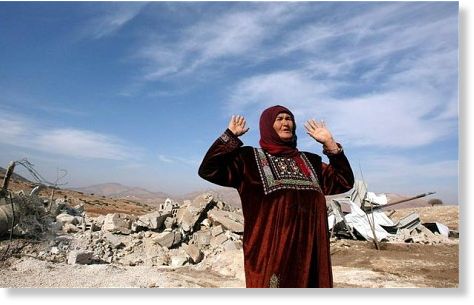
    A Palestinian woman rects near the rubble of a mosque that was destroyed by the Israeli army in the West Bank village of Khirbet Yarza

    Israeli troops demolished a mosque and over 10 other structures in two areas of the occupied West Bank on Thursday, according to Palestinian sources.

    Most of the demolition activity took place in the village of Khirbet Yarza in the northern Jordan Valley, where residents said troops had razed a very old mosque and its much-larger extension, which was built last year.

    They also said troops had levelled “more than 10 buildings used for sheep”.

    The army confirmed knocking down what it described as “eight temporary structures” that had been built inside a military firing zone.

    “The security forces and the Civil Administration destroyed eight temporary structures and the frame of another structure, which were built without the required permits inside a firing zone endangering the lives of the residents,” said COGAT, an Israeli defence ministry unit that acts as a link between the army and the Palestinians.

    At the opposite end of the West Bank, Israeli troops destroyed a building which was home to 18 people in the southern town of Yatta, the residents and municipal officials told AFP.

    Khirbet Yarza is located in Area C of the West Bank, which is under full Israeli control and where all construction and planning issues come under the jurisdiction of the Israeli Civil Administration.

    The Palestinian Authority condemned the demolitions, including that of a new road only opened in September by prime minister Salam Fayyad near Salfit in the northern West Bank.

    “Our efforts to construct a (Palestinian) state come up against the destruction of this state by Israel,” a statement said, pointing out that the building of the new road had been largely financed by international donors.

    Israel controls some 60 per cent of the Palestinian territory, especially areas around Jewish settlements.

    Figures from the Israeli NGO Bimkom show that around 95 per cent of applications for a building permit are rejected, with the Civil Administration only granting around 12 permits a year.

    United Nations figures show that in 2009, Israel destroyed 180 Palestinian structures in Area C, including 56 residential buildings.

    Print this article

    The IPI, a pragmatic “yes” to the API

    bandannie gave you the Ha’aretz article, this is the original from Rabin and Huberman published in Bitter Lemons

    November 24, 2010 Edition 2

    Yuval Rabin and Koby Huberman

    Since 2000, the peace process has been oscillating between stops and starts. Whether Israelis and Palestinians resume talks for another 90 days, and definitely if talks fail, it’s time to face the inevitable conclusion: permanent status agreements are unlikely to be achieved through bilateral negotiations without a regional context, either as a cementing element or as fallback. A new approach is therefore needed to ensure that the process reaches its destination while the impact of the spoilers is gradually minimized. 

    Articles in this edition
    The IPI, a pragmatic “yes” to the API– Yuval Rabin and Koby Huberman
    The best policy alternative for Israel– Alex Mintz and Yosi Ganel
    Why the API was ignored by Israel in 2002– Yossi Alpher
    What peace process? What peace?– As’ad AbuKhalil
    The best possible deal– Saleh Abdel Jawad

    In 2002, the Arab states presented the Arab Peace Initiative as their “end game” vision, introducing a transformational shift toward a comprehensive, regional and “future-based” process rather than a fragmented, bilateral and incremental one. Like many Israelis, we perceived this as a historic event. Still, we do not intend to explain the difficulties Israeli governments have had with the API or why it was not accepted. Instead, we propose that Israel respond with a pragmatic “yes” by presenting its own parallel “end game” vision–as an Israeli Peace Initiative or IPI rather than an attempt to “fix” the API.

    The IPI should articulate Israel’s own long-term vision, to be achieved after successful and gradual implementation of all permanent status agreements. Publishing such an IPI would demonstrate a transformational shift in Israel’s strategy, realizing that only by ending the regional Arab-Israel conflict will Israel achieve its fundamental interests, attain its security goals and eliminate existential threats. Such a vision should also demonstrate that these long-term fundamental interests (such as security, identity and acceptance in the region) are achievable in accordance with the API core concepts, with bridgeable gaps.

    With that in mind, in 2008 we started to draft an IPI proposal, based on three principles: our interpretation of Israel’s genuine strategic interests; our assumption that Israeli leaders will be ready to make “all possible concessions” only when they can show Israelis that this is “in return for the end of all conflicts”; and our determination to adopt existing proposals and solutions already negotiated in the past 19 years since Madrid, without reinventing the wheel.

    The detailed IPI text will be published soon in English, Hebrew and Arabic; it contains four vision chapters, starting with regional end-of-conflict scenarios. The Israeli-Palestinian scenario is a viable Palestinian state based on the 1967 borders and one-on-one land swaps, Jerusalem as the home of two capitals and special arrangements in the holy basin, an agreed solution for the refugees inside the Palestinian state (with symbolic exceptions), mutual recognition of the genuine national identities of the two states as the outcome of negotiations and not as a prerequisite, reiteration of the principles underlying Israel’s 1948 declaration of independence regarding civic equality for its Arab citizens, and long-term security arrangements with international components.

    The Israeli-Syrian end-of-conflict scenario is based on phased withdrawals from the Golan Heights to finally reach the 1967 borders with one-on-one land swaps, coupled with tight security arrangements to curb terrorists and paramilitary organizations. Regarding Lebanon, the scenario articulates mainly security arrangements, as international borders have already been established. The other three IPI components present regional security mechanisms addressing common regional threats, a vision for regional economic development, and parallel evolution toward regional recognition and normal ties.

    As we are just pragmatic businesspeople, we intentionally left many issues for the experts and diplomats, e.g., water, symbolic exceptional solutions for refugees in Israel and the impact of long-term permanent security arrangements on nuclear weapons in the region. For similar reasons, we are not in a position to suggest the exact diplomatic processes that will turn the API and IPI into actionable platforms and a synchronized process. However, in the past 18 months we have shared the evolving IPI text with Arab figures in various forums and were encouraged to hear them welcoming the very fact that Israelis are responding to the API, regardless of the IPI’s precise language. When talking to them and Israeli experts, we presented our idea to form a regional framework agreement as a synthesis between the API and the IPI. In fact, the two initiatives could become “vision deposits” that provide a declaration of principles or alternatively a framework agreement.

    The ideas in the IPI are not what we Israelis have been dreaming and hoping for, as they represent a major shift from our collective ideology. Accordingly, Israeli society will find them difficult to digest. But we believe Israeli society can face up to these challenges and that our democratic system will win, because the IPI captures the mutual sacrifices needed to end all conflicts and to achieve the true strategic interest of the State of Israel: a secure homeland for the Jewish people, enjoying full regional recognition.

    We hope the IPI creates an intensified dialogue and some rethinking both in Israeli circles and the region. More importantly, 15 years after Prime Minister Yitzhak Rabin’s assassination, we hope to see brave regional and international leaders translate the API and IPI visions into practical and synchronized progress.-Published 24/11/2010 © bitterlemons-api.org


    Yuval Rabin is a businessman; Koby Huberman is a strategy development expert, a businessman and a social entrepreneur. They are the coauthors of the IPI.

    source

    Rabin’s son presents his Israeli Peace Initiative

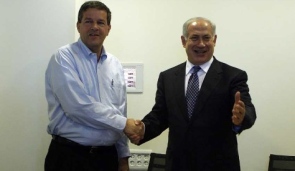
    Yuval Rabin with Prime Minister Benjamin Netanyahu. Photo by: Tomer Appelbaum

    Yuval Rabin and businessman Koby Huberman propose a response to the 2002 Arab Peace Initiative: A Palestinian state based on 1967 borders, with Jerusalem ‘the home of two capitals’.
    By Akiva Eldar Tags: Israel news Yitzhak Rabin

    Yuval Rabin, the son of the late prime minister Yitzhak Rabin, has joined forces with businessman and social activist Koby Huberman in order to advocate for the Israeli Peace Initiative, or IPI, a response to the 2002 Arab Peace Initiative.

    In an article published in the Web site bitterlemons.org, Rabin and Huberman propose that instead of responding to the APA, the Israeli government should say “yes” by presenting a parallel proposal to end the conflict – the IPI.

    The two have spent several months promoting the IPI among political figures, academics, and businessmen in Israel and at the same time tested the reaction of Palestinian and Arab figures to the principles of the initiative in an unofficial manner.

    The detailed IPI proposal will be soon published in English, Hebrew, and Arabic, and the principles outlined are the following:

    1. A viable Palestinian state based on the 1967 borders and one-on-one land swaps
    2. Jerusalem as the home of two capitals and special arrangements in the holy basin
    3. An agreed solution for the refugees inside the Palestinian state (with symbolic exceptions)
    4. Mutual recognition of the genuine national identities of the two states as the outcome of negotiations and not as a prerequisite
    5. Reiteration of the principles underlying Israel’s 1948 declaration of independence regarding civic equality for its Arab citizens
    6. Long-term security arrangements with international components.

    In regards to the Syrian channel, the IPI suggests that the end-of-conflict scenario include “phased withdrawals from the Golan Heights to finally reach the 1967 borders with one-on-one land swaps, coupled with tight security arrangements to curb terrorists and paramilitary organizations.”

    “Regarding Lebanon,” Rabin and Huberman write, “the scenario articulates mainly security arrangements, as international borders have already been established. The other three IPI components present regional security mechanisms addressing common regional threats, a vision for regional economic development, and parallel evolution toward regional recognition and normal ties.”

    Concluding the article, Rabin and Huberman say that they “hope the IPI creates an intensified dialogue and some rethinking both in Israeli circles and the region.”

    “More importantly, 15 years after Prime Minister Yitzhak Rabin’s assassination, we hope to see brave regional and international leaders translate the API and IPI visions into practical and synchronized progress.”

    Before the previous elections, Yuval Rabin met with Prime Minister Benjamin Netanyahu and told him that he didn’t rule out voting for him for prime minister, and also supported Netanyahu’s intentions of establishing a unity government.

    Rabin’s initiative may indicate his disappointment with Netanyahu’s current policies.


    http://www.haaretz.com/news/diplomacy-defense/rabin-s-son-presents-his-israeli-peace-initiative-1.327055

    Anti-Apartheid Wall Campaign & STOP MUJI Campaign in Japan

    Burning Conscience: Israeli Soldiers Speak Out

    Israeli mother Addresses European Parliament

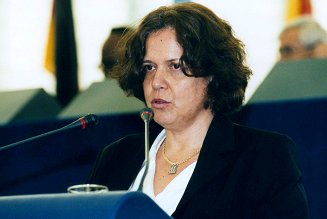
    Nurit Peled-Elhanan

    Dear Friends,

    Dr. Nurit Peled-Elhanan is the mother of Smadar Elhanan, 13 years old when killed by a suicide bomber in Jerusalem in September 1997. Below is Nurit’s speech made on International Women’s Day in Strasbourg earlier this month. Please listen to the words of a bereaved mother, whose daughter fell victim to a vicious, indiscriminating terrorist attack. I wish her words will enter the hearts of all peace seekers in our troubled and divided world.

    For better days,
    Professor Avraham Oz Department of Hebrew and Comparative Literature University of Haifa


    WOMEN
    Nurit Peled-ElhananThank you for inviting me to this today. It is always an honour and a pleasure to be here, among you (at the European Parliament).

    However, I must admit I believe you should have invited a Palestinian woman at my stead, because the women who suffer most from violence in my county are the Palestinian women. And I would like to dedicate my speech to Miriam R’aban and her husband Kamal, from Bet Lahiya in the Gaza strip, whose five small children were killed by Israeli soldiers while picking strawberries at the family`s strawberry field. No one will ever stand trial for this murder.

    When I asked the people who invited me here why didn’t they invite a Palestinian woman, the answer was that it would make the discussion too localized.

    I don’t know what is non-localized violence. Racism and discrimination may be theoretical concepts and universal phenomena but their impact is always local, and real. Pain is local, humiliation, sexual abuse, torture and death, are all very local, and so are the scars.

    It is true, unfortunately, that the local violence inflicted on Palestinian women by the government of Israel and the Israeli army, has expanded around the globe, In fact, state violence and army violence, individual and collective violence, are the lot of Muslim women today, not only in Palestine but wherever the enlightened western world is setting its big imperialistic foot. It is violence which is hardly ever addressed and which is halfheartedly condoned by most people in Europe and in the USA.

    This is because the so-called free world is afraid of the Muslim womb.

    Great France of “la liberte égalite et la fraternite” is scared of little girls with head scarves. Great Jewish Israel is afraid of the Muslim womb which its ministers call a demographic threat.

    Almighty America and Great Britain are infecting their respective citizens with blind fear of the Muslims, who are depicted as vile, primitive and blood-thirsty, apart from their being non-democratic, chauvinistic and mass producers of future terrorists. This in spite of the fact that the people who are destroying the world today are not Muslim. One of them is a devout Christian, one is Anglican and one is a non-devout Jew.

    I have never experienced the suffering Palestinian women undergo every day, every hour, I don’t know the kind of violence that turns a woman’s life into constant hell. This daily physical and mental torture of women who are deprived of their basic human rights and needs of privacy and dignity, women whose homes are broken into at any moment of day and night, who are ordered at a gun-point to strip naked in front of strangers and their own children, whose houses are demolished , who are deprived of their livelihood and of any normal family life. This is not part of my personal ordeal.

    But I am a victim of violence against women insofar as violence against children is actually violence against mothers. Palestinian, Iraqi, Afghan women are my sisters because we are all at the grip of the same unscrupulous criminals who call themselves leaders of the free enlightened world and in the name of this freedom and enlightenment rob us of our children.

    Furthermore, Israeli, American, Italian and British mothers have been for the most part violently blinded and brainwashed to such a degree that they cannot realize their only sisters, their only allies in the world are the Muslim Palestinian, Iraqi or Afghani mothers, whose children are killed by our children or who blow themselves to pieces with our sons and daughters. They are all mind-infected by the same viruses engendered by politicians. And the viruses , though they may have various illustrious names–such as Democracy, Patriotism, God, Homeland–are all the same. They are all part of false and fake ideologies that are meant to enrich the rich and to empower the powerful.

    We are all the victims of mental, psychological and cultural violence that turn us to one homogenic group of bereaved or potentially bereaved mothers. Western mothers who are taught to believe their uterus is a national asset just like they are taught to believe that the Muslim uterus is an international threat. They are educated not to cry out: `I gave him birth, I breast fed him, he is mine, and I will not let him be the one whose life is cheaper than oil, whose future is less worth than a piece of land.`

    All of us are terrorized by mind-infecting education to believe all we can do is either pray for our sons to come back home or be proud of their dead bodies.

    And all of us were brought up to bear all this silently, to contain our fear and frustration, to take Prozac for anxiety, but never hail Mama Courage in public. Never be real Jewish or Italian or Irish mothers.

    I am a victim of state violence. My natural and civil rights as a mother have been violated and are violated because I have to fear the day my son would reach his 18th birthday and be taken away from me to be the game tool of criminals such as Sharon, Bush, Blair and their clan of blood-thirsty, oil-thirsty, land thirsty generals.

    Living in the world I live in, in the state I live in, in the regime I live in, I don’t dare to offer Muslim women any ideas how to change their lives. I don’t want them to take off their scarves, or educate their children differently, and I will not urge them to constitute Democracies in the image of Western democracies that despise them and their kind. I just want to ask them humbly to be my sisters, to express my admiration for their perseverance and for their courage to carry on, to have children and to maintain a dignified family life in spite of the impossible conditions my world in putting them in. I want to tell them we are all bonded by the same pain, we all the victims of the same sort of violence even though they suffer much more, for they are the ones who are mistreated by my government and its army, sponsored by my taxes.

    Islam in itself, like Judaism in itself and Christianity in itself, is not a threat to me or to anyone. American imperialism is, European indifference and co-operation is and Israeli racism and its cruel regime of occupation is. It is racism, educational propaganda and inculcated xenophobia that convince Israeli soldiers to order Palestinian women at gun-point, to strip in front of their children for security reasons, it is the deepest disrespect for the other that allow American soldiers to rape Iraqi women, that give license to Israeli jailers to keep young women in inhuman conditions, without necessary hygienic aids, without electricity in the winter, without clean water or clean mattresses and to separate them from their breast-fed babies and toddlers. To bar their way to hospitals, to block their way to education, to confiscate their lands, to uproot their trees and prevent them from cultivating their fields.

    I cannot completely understand Palestinian women or their suffering. I don’t know how I would have survived such humiliation, such disrespect from the whole world. All I know is that the voice of mothers has been suffocated for too long in this war-stricken planet. Mothers` cry is not heard because mothers are not invited to international forums such as this one. This I know and it is very little. But it is enough for me to remember these women are my sisters, and that they deserve that I should cry for them, and fight for them. And when they lose their children in strawberry fields or on filthy roads by the checkpoints, when their children are shot on their way to school by Israeli children who were educated to believe that love and compassion are race and religion dependent, the only thing I can do is stand by them and their betrayed babies, and ask what Anna Akhmatova–another mother who lived in a regime of violence against women and children–asked:

    Why does that streak o blood, rip the petal of your cheek?

    Source

    Israel’s Crimes 1 Criminal Corporate Complicity- News Analysis [22-Nov-10]

    Reload from PressTVGlobalNews | PressTV.ir

    In this Edition of Press TV’s News Analysis, the focus is on the Russell Tribunal on Palestine. It is heard compelling evidence of corporate complicity in Israeli violations of international law in occupied Palestinian territories, such as US companies, which provide bulldozers that demolish Palestinian homes. Holding no legal authority, it will publish its findings, at a minimum, for public awareness of Israeli crimes.

    BDS Success: Tindersticks Cancel Tel Aviv Shows

    Tuesday, 23 November 2010 12:54 Tindersticks

    E-mail Print PDF

    It is with sadness that Tindersticks announce the cancellation of their forthcoming concerts in Tel Aviv.

    tindersticks

    When agreeing to play our music in Israel we, perhaps naively, believed that the music we make is beyond political considerations.
    Over the past weeks, the pressure exerted on us by people and organisations, some close to us, has shown us that this is not the case. It is difficult to defy a rapidly growing movement with whose aims we agree, even if we are not wholly convinced by their methods.
    The songs we looked forward to playing and singing have already been tainted and their enjoyment stifled, if not completely drowned out by the political furore.
    We sincerely look forward to a time when we, and others, can make our music for the people in the Middle East for the pure joy of the music itself.


    Blog at WordPress.com.

    Up ↑