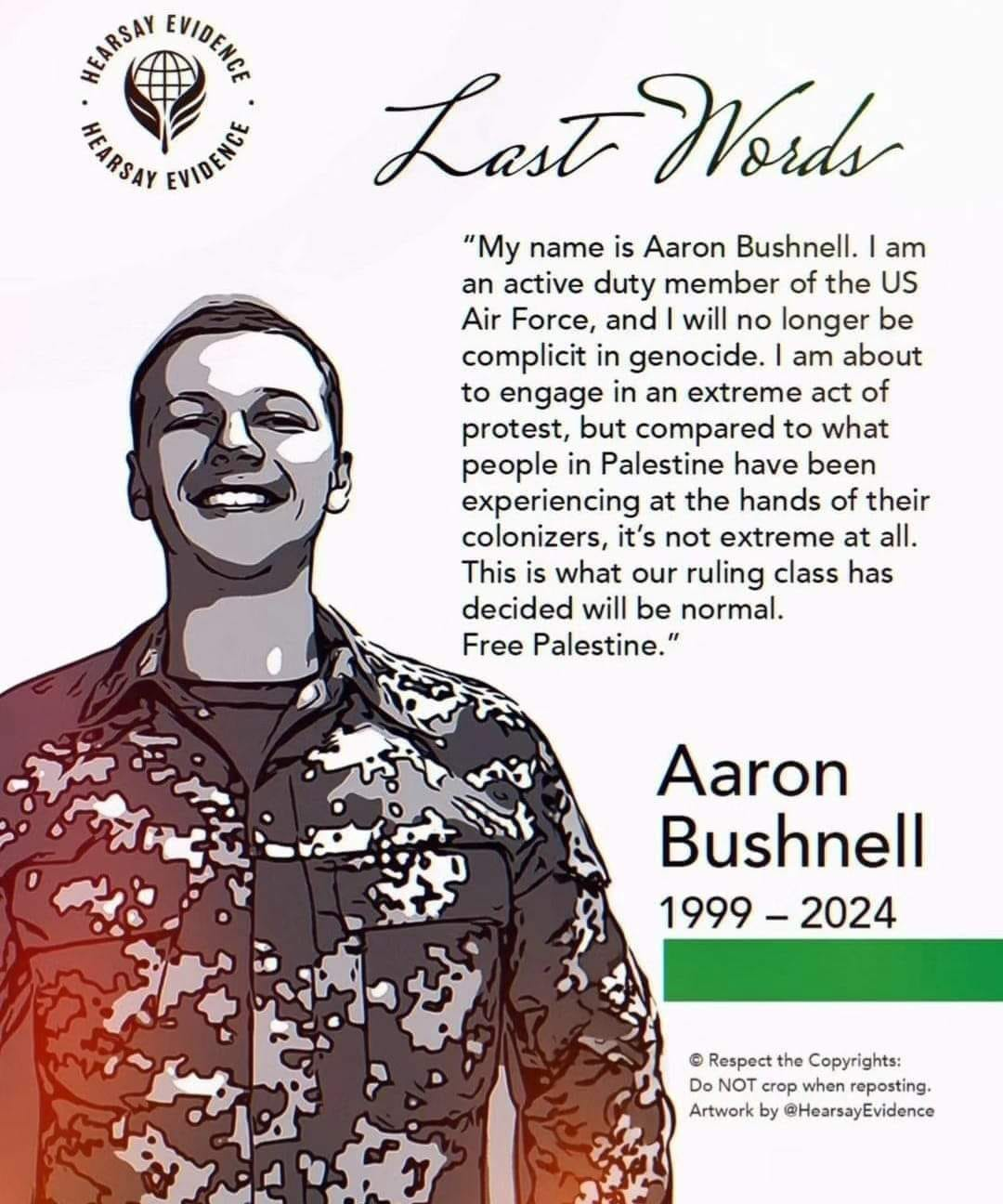
He was not mentally ill. He did not escape from some mental institute. He was on active duty in your army. He did not commit suicide. He committed an act of resistance. You do not recognise this because YOU are mentally retarded by propaganda. Rest in power #AaronBushnelpic.twitter.com/pPz3st7RoV
Israeli Prime Minister Benjamin Netanyahu, in Jerusalem, earlier this month.Credit: Ronen Zvulun / ReutersGideon LevyGet email notification for articles from Gideon LevyFollow
Feb 25, 2024 4:30 am IST
Once again it has been proved that there is no real substitute, no genuine alternative and no true opposition to Benjamin Netanyahu.
The behavior by the centrist parties throughout the war, including the results of two important votes in the Knesset last week, clearly prove that on the state’s fundamental issues which define Israel’s character – the occupation, the war, and incredibly, democracy – there are no significant differences among the right, the center and the Zionist left. On these issues we are a state with one voice, one outlook, one opinion: Together we will win.
These things are particularly astonishing in light of the raucous political struggle now raging between the camps. Everyone speaks of a division, a rift, a chasm, when in fact no real differences of opinion exist.
One could think that Israel during war would be a different country were Benny Gantz, Gadi Eisenkot or Yair Lapid to lead it. Absolutely not. Their personal conduct would surely be more upright and humble, but the results would be remarkably similar. Here is the evidence.
In a result that would not shame a Belarusian election – 99-9 – the Knesset supported a government resolution opposing “unilateral” recognition of a Palestinian state. Tempers flared, and hands were raised in overwhelming support of Israeli rejectionism.
The state, whose occupation and settlement policy is the mother of unilateralism, scoffs at the entire world and unites unanimously against a unilateral measure that is ostensibly accepted by half its lawmakers. What a disgrace, albeit not a surprise.
No less predictable was the near-unanimity in the vote to oust MK Ofer Cassif. It doesn’t have to do with the Palestinians and the territories, but rather, with democracy, the issue that has stirred the country above all others over the past year.
Israel was divided between democracy’s guardians and its destroyers, and in the first test of democracy, it united nearly entirely behind an anti-democratic measure of unparalleled danger. Most of those who fought against the government coup, almost all of those shrieking for democracy, either raised their hand in favor of removing a lawmaker for his opinions and his worldview or fled from the vote in cowardice.
The coup has already won, and this time not only with the votes of the right but also with the votes of Yesh Atid, the National Unity Party and even the Labor Party. The wretched fleeing from the vote by Benny Gantz, Gadi Eisenkot, Yair Lapid, Merav Michaeli and their colleagues was a badge of shame for ones purporting to fight for democracy.
They should have voted no, loud and clear. After all, they know that had the measure succeeded – it was defeated by four votes – it would lead to the removal of all of the Arab lawmakers. And yet they ran away. Another shame, another disgrace for which there is no pardon.
Finally, the behavior in the war: The left and the center supported all of Israel’s wars, the just war and the criminal wars, in the beginning. But in the past they soon came to their senses, and there was opposition to every previous war.
Israel’s most brutal and most futile war does not have a single voice of opposition in the Knesset, not even after more than four months and almost 30,000 Palestinian deaths, besides the Arab MKs.
Parts of those not on the right support the war from within the government, and another part supports it from the outside, and everyone in the choir sings the same song, conducted by the right. The whole world is calling for an end to the war, and in the Knesset there is not a single Zionist MK who will do so. Democracy? Opposition? Alternative? Not here, not now.
Only the loathing for Netanyahu reminds us that there still remains a coalition and an opposition, but this loathing is mainly personal. He is a liar, he is a hedonist, he is corrupt and thinks only of himself. He forsook the hostages, he sold his soul to the Kahnist right and legitimized it, and perhaps he was always there. All of this is very true and infuriating. But it is not a proposal for an alternative.
It turns out that there is none; together we will win, any moment now.
Most agreements to resolve ethno-national conflicts don’t survive the test of time. A study of those that have succeeded reveals the secret: They sprang from prisons. Israel needs to take this under consideration for the ‘day after’ the war in Gaza
Marwan Barghouti mural in Gaza. He played a key role in drafting the 2006 “prisoners document,” which brought Fatah and Hamas to enter into talks.Credit: Majdi Fathi / ReutersAvraham SelaTomer Schorr-Liebfeld
Jan 25, 2024
The discussion about the “day after” the war in the Gaza Strip necessitates a reexamination of the question of the security prisoners being held by Israel. Not only in the context of an exchange deal in which, it is to be hoped, the Israeli hostages in Hamas captivity will be released in exchange for, among other things, the prisoners incarcerated in Israel; but also in a context that is barely discussed: the role that the Palestinian prisoners can play in shaping the political situation and even in promoting a long-term Israeli-Palestinian settlement.
This has become relevant for two reasons. The first is the political vision set forth by U.S. President Joe Biden in a column this past November in The Washington Post, in which he posited as a strategic aim the establishment of a Palestinian state alongside Israel. According to Biden, it would be governed by a “revitalized” Palestinian Authority, namely one vested with greater political legitimacy and more effective capacity for functioning than the existing PA. That authority would be responsible for governing the Gaza Strip after the vanquishing of Hamas.
The second reason is the urgent need to bring about an efficient system of governance in the Gaza Strip, whose cardinal task will be to rehabilitate and rebuild the administrative and physical infrastructures, which have been utterly devastated. In both of these contexts, Palestinian prisoners can play a role both symbolic and practical.
Already now, before the war has ended, the incomprehensible number of more than 25,000 people have been killed in Gaza; towns, villages, residential neighborhoods and refugee camps have been reduced to rubble; and a humanitarian disaster has been inflicted on the Strip’s two million inhabitants. Even if the international community comes up with the necessary funds, an efficient apparatus will be needed to channel the money into the construction of physical infrastructures and establishment of civilian services, to enforce law and order, and prevent a renewed deterioration into violence, both internally and against Israel.
Rehabilitating the Gaza Strip will be a years-long project, taking place under chaotic social and political conditions. Reason thus leads to the conclusion that no Palestinian government will be able to fulfill its task in the Gaza Strip without the integration of Hamas in a political format. Releasing prisoners in exchange for hostages can be expected to boost Hamas’ prestige in the short term, but it’s likely that in the long run, the mortal blow dealt to its military capabilities and to its leadership in the Strip will weaken the movement and bring about its readiness to take part as a faction within the framework of the PLO, and in partnership with the Fatah-based Palestine Liberation Organization. Indications to that effect on the part of Hamas’ political leadership are already discernible.
Prime Minister Benjamin Netanyahu’s vigorous opposition to Biden’s blueprint is a direct continuation of the policy of separating between the West Bank and the Gaza Strip, which Netanyahu has cultivated since 2009, with the aim of averting the establishment of a Palestinian state. That opposition explains the preference of the security establishment today for a “government of hamulas” (clans) over a central Palestinian authority. This is an untenable conception of governance from every point of view, and one that disregards the rupture of Gaza’s social-political structures wrought by the war.
It’s hardly possible to ignore the weaknesses of the PA and of Mahmoud Abbas, who has headed it since 2005, or to gainsay the need for a reform of the PA’s structure and its personal makeup. However, the PA is the only Palestinian-national framework that can possibly serve as a post-war government in the Gaza Strip. This is not only the view of the West but also of the Arab states, especially those that are likely to donate funds for the Strip’s reconstruction.
One of the most intractable barriers in processes of conflict resolution, as in international humanitarian involvement, is the absence of a central authority that enjoys legitimacy and is vested with enforcement capability. In this context, the release of security prisoners who have committed to abstaining from a return to violence, can bestow political legitimacy domestically on the Palestinian government and bolster its administrative abilities. This, by virtue of their activity on behalf of the national cause, the organizational experience they have gleaned and the broad public support they enjoy among the Palestinian public overall.
Most of the Fatah prisoners who were released before and after the Oslo Accords – among them Marwan Barghouti, Jibril Rajoub, Hisham Abdel Razek, Sufyan Abu Zaydeh and Qadura Fares – unreservedly supported the accords and the principle of establishment of a Palestinian state alongside Israel. They also assumed senior positions in the PA government. Barghouti, who in 2002 was sentenced by Israel to five life terms plus 40 years in prison, is today the only senior Fatah prisoner who has for years enjoyed the broadest support of the Palestinian public. It’s not by chance that he tops the list of the prisoners whose release Hamas is demanding now, perhaps in the hope that he will treat the organization well if and when a reshuffled PA returns to power in the Gaza Strip.
Calls for Barghouti’s release are voiced from time to time, and recently more insistently, by left-wingers in Israel, who believe that, like Nelson Mandela in his country, he can lead the Palestinians to a political settlement with Israel. From personal acquaintance with Barghouti in the 1990s (of co-author Sela), it can be surmised that he will be willing to advance a solution in this spirit, but only on condition that the Israeli government is ready to promote such an agreement. Without that readiness on Israel’s part, his release would only serve to further intensify the conflict with the Palestinians.
The idea that the security prisoners being held by Israel can play a key role in forming an effective PA, and more specifically in promoting a political settlement based on President Biden’s principles, is based on a comparative study we conducted on the role of political-security prisoners in the resolution of protracted ethno-national conflicts. Our paper on that study, which was published last November in the International Studies Quarterly, the flagship of the International Studies Association, examined this subject in the context of three different conflicts: Northern Ireland, South Africa and the Israeli-Palestinian conflict.
The PA is the only Palestinian-national framework that can possibly serve as a post-war government in the Gaza Strip. This is not only the view of the West but also of the Arab states, especially those that are likely to donate funds for the Strip’s reconstruction.
The study points to the disparity between the effective absence of Palestinian prisoners from the Oslo process, and the key role played by prisoners from Northern Ireland and South Africa in resolving those conflicts. In both cases, the prisoners worked to lay the groundwork for negotiations, the ratification of the agreement that emerged, and then its implementation. As such, the agreements reached in Northern Ireland and South Africa differed from most of the accords attained in ethno-national conflicts in the first two decades post-Cold War, which, like the Oslo Accords, reverted to hostilities within a few years of being signed.
Political-security prisoners are not a cause but a consequence of the long conflicts under consideration, but their incarceration generates powerful feelings in their communities, and can potentially shape the future of the conflict in the direction of a settlement or an escalation. The emotional intensity of this subject is reflected in Hamas’ recurring attempts, including in the October 7 attack, to abduct Israeli soldiers and civilians who can then be exchanged for Palestinian prisoners held by Israel. Hence, an intelligent use of the symbolic capital embodied in the prisoner population might contribute much to resolving the conflict, as attested to by the processes undergone in both Northern Ireland and South Africa in this context.
The prisoners of a national struggle are perceived by their public as patriots, and identified with devotion and sacrifice for the sake of the commonality. The story of the longtime prisoners in Israel, like in Northern Ireland and South Africa, paints a similar picture of the prison as a “hothouse of ideas.” It is here that a national consciousness can develop by way of deep and free debate, which includes calling into question basic assumptions and sacrosanct perceptions regarding the national vision and the strategy for realizing it.
In both those countries, the long years of living together in close quarters in prison created a distinct community that expanded voluntarily and informally; together with inmates who had served their terms and were released, these prisoners became, over the years, a key power center in their movements’ decision-making processes. In many cases, the prisoners shaped the agenda of the resistance movement on the outside by staging hunger strikes, which then engendered manifestations of revolt and violence outside the prison. Through the social connections that were forged in the prisons, the prisoners succeeded in promoting their interpretation of reality and in transforming the hegemonic discourse of armed struggle into one of negotiations instead.
The Irish Republican Army inmates in Northern Ireland, for example, laid the groundwork for the political process of the 1980s and early 1990s, initially parallel to the use of violence and later by development of a strategy of nonviolent struggle. Subsequently, they effectively gave up the dream of a united Ireland, postponing it to an indefinite time in the future. At the same time, the Protestant leadership was compelled to accept the true and full sharing of power with the Catholics. During the period between the signing of the agreement in Northern Ireland in April 1998 and its ratification a few weeks later by way of referendums held in the two rival communities, the prisoners carried considerable weight in forming a Catholic consensus around the agreement. Furthermore, in the two fraught years that followed the referendums, they played a central role in curbing the “spoilers” who advocated continued violence, and in preventing backsliding of the communities into the cycle of blood.
The first lesson one can take from Northern Ireland and South Africa is the essential importance of prisoners’ participation in legitimizing various aspects of resolution of the conflict, which by its nature entails bitter concessions, perceived as taboo, on certain issues.
In South Africa, Mandela, and through him the other prisoners and the leadership of the African National Congress, came to terms with giving up the ANC’s aspiration to see the country’s resources redistributed, after being apprised of the apprehensions that guided the behavior of the other side. Similarly, in the Israeli-Palestinian conflict, it was the prisoners who were released in the “Jibril deal,” in 1985, who instigated the first intifada and led the PLO leadership, in 1988, to declare an independent Palestinian state on the basis of the United Nations partition resolution of 1947, thereby effectively abandoning the idea of liberating all of Palestine.
In some cases, the prisoners dictated political decisions to their movements. A case in point is the “prisoners’ document” of 2006, which was signed by the jailed leaders of Fatah, Hamas and other organizations in an attempt to end the rift between the PLO-Fatah leadership and Hamas. The document, in whose drafting Marwan Barghouti played a key role, compelled the two rival factions to enter into talks on cooperation on the basis of a platform that accepted the two-states principle. The result was a strategic accord between the factions and the signing of the Mecca Agreement of 2007, even though four months later that concord was voided when Hamas took over the Gaza Strip by force.
The importance of security-political prisoners in efforts to resolve protracted intra-state conflicts stems in large measure from the scope of their sector, which is a consequence of decades of bloody conflict between the state and the group rebelling in society. Thus, in decades of Israeli occupation in the territories, about a million Palestinians have passed through Israeli detention facilities, constituting about 20 percent of the population. In other words, almost every Palestinian family has experienced the incarceration of a family member, neighbor or close acquaintance, so much so that arrest became a formative experience of the whole of Palestinian society. In Northern Ireland and South Africa, the prisoners constituted a smaller though still substantial percentage of the populations.
* * *
The first lesson one can take from the resolution of the conflicts in Northern Ireland and South Africa is the essential importance of prisoners’ participation in legitimizing various aspects of resolution of the conflict, which by its nature entails bitter concessions, perceived as taboo, on certain issues. In Israel, by contrast, the prisoners were not taken into account in any way ahead of the signing of the Oslo Accords. Even afterward, the government consistently objected to the release of prisoners “with blood on their hands,” an approach that weakened the support of the community of prisoners for the entire process.
The second lesson concerns the need for a prior stage in which confidential “feelers” were sent out to prisoner-leaders while they were still incarcerated, even before the start of real negotiations between the sides. These contacts, which in some cases were drawn-out and crisis-ridden, enabled the sides to exhaust fully the negotiating possibilities and to formulate a possible framework for an agreement, even before anything was committed to paper. Whereas in Northern Ireland and South Africa, talks were conducted between government representatives and the prisoners’ leaders for many years before agreements were made, the Oslo Accords were concluded within a short period of just months, and without the leaders of the two sides having had time to examine thoroughly the mutual concessions that they would be required to make even to implement the limited agreement they signed.
The Oslo Accords did in fact represent a vague and not clearly defined blueprint for the strategic goal of the process. Postponing negotiations and decisions on the conflict’s core issues (Jerusalem, refugees, borders, Jewish settlements) to the stage of the final-status negotiations, reflected the fact that there were deep and substantive differences on these issues, which would surface afterward and cause the collapse of the process. Above all, the splitting of the process into two stages exposed it to fierce opposition from both sides. The Palestinian prisoners released after the signing of the Oslo Accords, many of whose comrades remained incarcerated in Israel, were unwilling to grant legitimacy to the process, the more so as it was effectively suspended in the period of the first Netanyahu government (1996-1999).
With the wisdom of hindsight, it’s possible to surmise that a meaningful dialogue with the Palestinian prisoners, who from the outset were exposed to the internal Israeli discourse and enjoyed public influence back home, would have enabled the two sides to get to know each other better, helped them understand the limits of the possible on the other side, and might even have led to a more coherent blueprint for a solution.
The third lesson lies in the importance of reaching agreement on a general amnesty for prisoners who support the accord that is hammered out, and who commit to desisting absolutely from the use of violence. In Northern Ireland and South Africa, a mechanism was worked out for the release of prisoners on just such terms. This helped reduce to a large extent the use of violence by the accord’s opponents, by granting them the possibility of inclusion in the amnesty in return for renouncing violence. As such, the prospect of the prisoners being freed acted as an incentive for all the organizations to join the cease-fire in the most critical period of the agreement’s implementation, when most protracted conflicts slide back into violence.
* * *
Beyond formulation of a political blueprint for the postwar period being a clear American demand, it is also a supreme Israeli interest from both the security and political viewpoints. It is essential for Israel that an effective Palestinian governing institution be established in Gaza in place of Hamas. Moreover, the rehabilitation of life in the Gaza Strip following the physical destruction and the humanitarian crisis caused by the war, is a vital element in creation of a secure border with Israel. In both matters, the international community will play a decisive role, which will in turn obligate the government of Israel to make tough political concessions.
Launching a direct dialogue with the prisoners obligates a conceptual shift by decision makers and other public leaders in Israel – most of whom view the prisoners as terrorist murderers who must serve out their punishments in full.
Israel has the possibility of correcting its approach to the issue of the prisoners, if it wishes to turn over a new leaf in the conflict with the Palestinians. Indeed, the veteran inmates from Fatah are not lovers of Zion, and their support for a settlement on the basis of “two states for two peoples” reflects an acquiescence to the limits of power and an acceptance of reality. Many of them have been incarcerated for decades in Israeli prisons and are fluent in Hebrew and knowledgeable about the history of the State of Israel and about its social and political situation. At the same time, no one need expect that they will make concessions on substantive questions relating to core issues, such as have been put forward by the PLO in the years since the Oslo Accords.
Launching a direct dialogue with the prisoners obligates a conceptual shift by decision makers and other public leaders in Israel – most of whom view the prisoners as terrorist murderers who must serve out their punishments in full. It is self-evident that a necessary condition for holding a dialogue of this kind is readiness by Israel to renew the negotiations on a two-state basis, which according to Biden is “the only way to ensure the long-term security of both the Israeli and Palestinian people” and which is now “more imperative than ever.” In this context we should bear in mind Yitzhak Rabin’s assertion that, “The road to reconciliation leads through the prisons.”
If and when the government of Israel is ready to discuss sincerely the two-state blueprint with the Palestinians, it will do well to adopt the models of Northern Ireland and South Africa on this issue, and begin a dialogue with Barghouti and perhaps with members of other Palestinian organizations while they are still in prison. Doing so will help prepare the ground for their participation in rebuilding the Palestinian Authority, in a way that will gain it broad public support and enable it to function as an effective governmental body. As such, the freeing of the prisoners will be an integral element of a future settlement and make the prisoners practical partners in its acceptance and implementation.
The war to eradicate Hamas rule in the Gaza Strip has restored to the top of the regional and international agenda the “unfinished business” of a resolution to the Israeli-Palestinian conflict. What began with the signing of the Declaration of Principles between the Rabin government and the PLO in September 1993 never even achieved its minimal goals: full autonomy for the Palestinians in most of the West Bank and the Gaza Strip. Even if the renewal of the negotiations with the Palestinians on the two-state blueprint is anathema to the majority of the Israeli public today, the crisis into which Israel was plunged on October 7 emphasizes the necessity of fully exhausting that process.
Tomer Schorr-Liebfeld’s doctoral dissertation, submitted to the Hebrew University of Jerusalem in 2021, is about political prisoners in conflict-resolution processes. Avraham Sela is emeritus professor in the Department of International Relations and a senior research fellow in the Truman Research Institute for the Advancement of Peace, both at the Hebrew University.
American former ‘lone soldiers’ who served in the occupied territories return to the U.S. to talk about what they were sent to do. Testimonies start at 9 “
A searing interview with Avichai Sharon and Noam Chayut, both veterans of the Israeli Defense Forces and members of Breaking the Silence. Sharon and Chayut served during the second intifada, an on-going bloodbath that has claimed the lives of over three thousand Palestinians and nine-hundred-fifty Israelis. After thorough introspection, these young men have chosen to speak out about their experiences as self-described “brutal occupiers of a disputed land.” Producer: Sat Gwin
For more than a century, Zionists have understood that the Zionist project involved doing some unpleasant things, and it was best to keep quiet about those things.
Theodor Herzl realized this as early as 1891. He confided in his diary that “we must expropriate gently the private property on the estates assigned to us” and “we shall try to spirit the penniless population across the border,” adding that “the process of expropriation and the removal of the poor must be carried out discreetly.” [Emphasis added].
The State of Israel has broken the unspoken rule. Israeli soldiers have been publishing videos of themselves blowing up dozens of residential neighborhoods in Gaza. Jewish Israeli leaders have been publicly declaring their intention to ethnically cleanse Gaza while Jewish Israeli journalists have been calling on the military to flatten the entire Strip. Prime Minister of Israel Benjamin Netanyahu himself likened Israel’s enemy to Amalek twice, Amalek being the people the Biblical Israelites were instructed to commit a genocide against.
Of course, not all pro-war Israelis have forgotten the rule. The Israeli judge appointed to the ICJ by Israel, Aharon Barak, voted in support of South Africa’s claim about incitement to genocide. For Barak, the problem was not what Israel was doing, the problem was what Israeli leaders were saying. They were violating the unspoken rule about Zionism. When removing Palestinians from their homes, and making it impossible for them to return, best to do it discreetly.
The Zionist leader Jacob Thon (1880-1950), who worked at the Palestine Land Development Co. buying up land from Arabs in the 1910s, believed that “of course” transferring the Arabs to Transjordan was desirable. But, Thon warned, if the Zionists talked about transfer openly their chances of accomplishing it would diminish. Any steps to “transfer” Arabs would have to be taken “privately.”
During the 1920s, Israel Zangwill (1864-1926) frequently wrote and spoke openly of the removal of the Palestinian Arab population of Palestine. In his view, that was necessary to establish a Jewish democratic state, and so Palestinian Arabs often cited Zangwill’s writings as evidence of Zionism’s nefarious aims. Zionist leaders learned an important lesson from Zangwill’s frankness: “under no circumstances should they talk as though the Zionist program required the expulsion of the Arabs, because this would cause the Jews to lose the world’s sympathy,” in Tom Segev’s words.
Golda Meir also understood the importance of doing things quietly. By 1971, Israeli ministers were going on media roadshows in their newly established settlements in the Israeli-occupied West Bank. The Geneva Conventions of 1948 prohibit states from transferring their civilian population onto land occupied in war, something obvious to Meir but apparently not her ministers. “Before we move forward with our discussion,” Meir said at the outset of a 1971 cabinet meeting, “there’s something I’d like to ask. It was our habit that for anything that has to do with settlements, outposts, land expropriations and so on, we simply do and do not talk [about it].”
Until recently, the Israeli government appreciated the importance of doing the expulsions and the expropriations quietly. For more than a decade, Israeli archivists have been scouring the Israeli archives on a hunt for documents related to the expulsion of Palestinians from their homes. Hundreds of documents have been concealed in “a systematic effort to hide evidence of the Nakba,” or Israel’s ethnic cleansing of the Palestinians in 1948.
Israelis have generally understood that, whenever the matter pertains to removing Palestinians from their homes, or settling Jews in those homes, the actions must be done quietly to avoid attention. That’s why, in November 2020, Israel chose US Presidential election day to carry out its largest forced displacement in over four years, making 73 Palestinians in Khirbet Humsa homeless. That’s also why Israeli Jewish settlers usually take over Palestinian homes in the middle of the night (1, 2, 3, 4, 5, 6). Incidentally, that’s also why Israel bombs Gaza at night. That’s also why Israel does not allow foreign journalists to enter Gaza and why journalists native to Gaza are so often targeted. They are giving a voice to what Israel doesn’t want you to hear, and they are shining a light on what Israel doesn’t want you to see.
Perhaps Zionism should embrace a new slogan. Do Zionism quietly, discreetly, under the cover of darkness.
If committed activists needed an additional reason for why what they are doing is essential and just, then the ICJ’s ruling is a chilling reminder of what is at stake here.
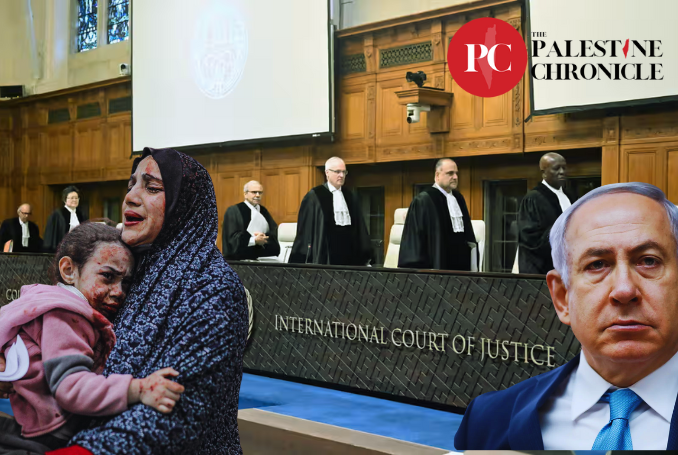
The moral and brave approach by South Africa to the International Court of Justice (ICJ), hoping for a ruling that would bring an end to the genocide of the Palestinians in Gaza, was not matched by the court on Friday, January 26, 2024.
I am not underestimating the significance of the court’s ruling. True, the court confirmed the right of South Africa to approach the ICJ and substantiated the facts it presented, including the assumption that Israel’s actions could be defined as genocide under the terms of the genocide convention.
In the long run, the language and the definitions used by the ICJ in its first ruling will constitute a huge symbolic victory on the way to Palestine’s liberation.
But this is not why South Africa approached the ICJ. South Africa wanted the court to stop the genocide. And therefore, from an operative point of view, the ICJ missed an opportunity to stop the genocide, mainly because it still treated Israel as a democracy and not a rogue state.
Palestinians, and whoever supports any struggle against crimes committed by countries of the global north, ceased a long time ago to be impressed by symbolic actions. Actions against rogue states only are meaningful if they have an operative side to them.
The operative actions suggested by the ICJ are basically a demand from Israel to submit, in one month’s time, a report on measures taken to prevent genocide in Gaza.
No wonder, the Israeli government has already hinted that such an assignment would not be high on its agenda and, most importantly, would not have any impact on its policies on the ground.
Even if the ICJ would have demanded, as it should have, a ceasefire, it would have taken quite a while to implement it, given the Israeli intransigence. But the message to Israel would have been clear – and effective.
License to Commit Genocide
The important thing to remember in any engagement with Israel is that what matters is not how the message is intended but how it is understood by Israeli policymakers.
The Western solidarity with Israel, shown on October 7, 2023, was understood by its policymakers as a free license to commit genocide in Gaza. Similarly, opting for a report instead of action is understood in Israel as a slight slap on the hand, which gives Israel at least another 30 days to continue its genocidal policies.
If this is the case, what would be left of Gaza in a month? What would be the magnitude of the genocide in a month’s time, if not only the West but also the ICJ, refuses to call for an immediate ceasefire? I am afraid that there is no need to answer these terrible questions.
More importantly, the crime has already been committed, it is not as if there is still time to stop it. Therefore, unless the ICJ believes that Israel’s actions be reversed and rectified, it sends a very confused message. It seems to hint that, although the actions may be a crime, if the carnage is limited, then this would be welcomed by the ICJ.
History of Failure in Palestine
The ICJ seemed to lack courage when it refrained from demanding what many countries in the global south and a huge number of people in the global civil society were asking for in the last three months.
If this whole process ends with the usual conclusion that international law has no power to stop the destruction of Palestine and the Palestinians, this will have even a greater impact on the question of Palestine.
In fact, this awareness could severely undermine the confidence, which is already very low, of the global south in the universality of intentional law.
Ever since its final institutionalization after the Second World War, the international law failed to deal properly with colonialism as a crime and was never able to challenge settler colonial projects like Israel.
It also became clear that imperialist policies pursued by the US and Britain, in clear violation of international law, are totally exempt from international law’s jurisdiction. Hence, the US was able to invade Iraq with a stark violation of international law and Britain now plans to send, without fear of reprisal, asylum seekers to Rwanda.
In the case of Palestine, throughout 75 years of the ongoing Nakba, international law – through its official and informal representatives, practitioners and delegations – was completely ineffective. It did not stop the killing of one single Palestinian; it did not lead to the release of one single Palestinian political prisoner, nor did it prevent the ethnic cleansing of Palestine. Indeed, the list of its failures is too long to be detailed here.
But There is Hope
There is a new, important lesson that should shape our activity and inform our hopes for the future.
We already learned that there is no hope for change within Israeli society, a lesson that was ignored by those involved in the so-called peace process.
The failure to understand the DNA of the Zionist society allowed Israel, since its inception, to kill Palestinians incrementally and massively either directly, by shooting them, or indirectly, by denying them basic human conditions for living.
This process, led by the US, was based on the formula that only after “peace” is restored, Israel would be obliged to change its ruthless policies on the ground.
This false paradigm has totally collapsed, even if the Biden Administration attempts, these days, to resurrect it, along with the few Palestinians who, for some reason, still put their faith in the two-state solution.
And now comes the new, important lesson: not only can we not hope for a change within Israel, we cannot rely on international law to protect the Palestinians from genocide.
This, however, does not mean that there is no hope in the future for liberation and decolonization. The Zionist project is in the process of imploding from within.
Israel’s Jewish society is disintegrating, its economy is failing, and its international image is deteriorating.
The Israeli army did not function in October and the government is in tatters and unable to provide basic services to its citizens. Under these circumstances, only wars and cynical Western interests will keep this project alive, but for how long?
And yet, such a process of implosion in history can be long, brutal and violent as it transpires in front of our eyes these days.
And we are not just onlookers. The activists among us understand that we have to double and triple what we already know has to be done.
We continue, outside of Palestine, to try and move the ‘B’ and ‘D’, in Boycott and Divestment, to ‘S’, as in Sanction.
This effort can be intensified by pushing in two directions. On one hand, we should exert more pressure on the governments of the global south to be more active, particularly in the Arab and Muslim worlds. On the other hand, we should find better ways to increase the electoral pressure on our representatives in the global north.
There is no need to tell the Palestinian Resistance what to do to defend itself and its people. There is no need to tell the liberation movement how to strategize for the future. Wherever they are, Palestinians who are involved in the struggle will continue to persevere and be resilient. What they truly need is for any external effort to be more effective, realistic and bold.
One can not but admire what the solidarity movement with Palestine has already achieved, especially in the last three months.
However, if its loyal and committed activists needed an additional reason for why what they are doing is essential and just, then the ICJ’s ruling is a chilling reminder of what is at stake here.
If there is hope to stop the genocide all over historical Palestine, it lies in the ability of the global civil society to take the lead. Because it is far too obvious that governments and international bodies are unwilling or unable to do so.
– Ilan Pappé is a professor at the University of Exeter. He was formerly a senior lecturer in political science at the University of Haifa. He is the author of The Ethnic Cleansing of Palestine, The Modern Middle East, A History of Modern Palestine: One Land, Two Peoples, and Ten Myths about Israel. He is the co-editor, with Ramzy Baroud of ‘Our Vision for Liberation.’ Pappé is described as one of Israel’s ‘New Historians’ who, since the release of pertinent British and Israeli government documents in the early 1980s, have been rewriting the history of Israel’s creation in 1948. He contributed this article to The Palestine Chronicle.
https://www.youtube.com/embed/wJcZ4YBUZpY?feature=oembed&The fallout has been growing from the so-called investigation by The New York Times into alleged mass rapes of Israeli women by Hamas fighters on 7 October – as I discuss with my colleague Nora Barrows-Friedman in the video above.
As The Electronic Intifada has reported, Israel’s sensational claims are not backed by any substantial evidence.
Rather, the lurid allegations of sexual violence appear calculated to demonize Palestinians and justify or distract from Israel’s genocide in Gaza.
Yet mainstream media and politicians continue to disseminate this atrocity propaganda without regard for the obvious holes in the Israeli narrative.
The Times article, published in late December, gave added credence to these claims, especially since its lead writer was Jeffrey Gettleman, a Pulitzer Prize-winning reporter.
But as we demonstrated, it is a journalistic fraud.
Members of the family of Gal Abdush, the deceased woman portrayed by Gettleman as a victim of the alleged “broad pattern” of sexual violence have repudiated the article and accused the Times of misleading and manipulating them. They say there is no evidence that Abdush was raped.
Gettleman also relied extensively for “evidence” on ZAKA, an extremist Jewish group that collects bodies and body parts for burial, and whose leaders have fabricated numerous accounts of atrocities from 7 October.
A recent investigation by Israel’s Haaretz newspaper accuses ZAKA of using bodies of people killed on 7 October as props for fundraising and that as part of its effort “to get media exposure, ZAKA spread accounts of atrocities that never happened, released sensitive and graphic photos, and acted unprofessionally on the ground.”
Now some of Gettleman’s colleagues at the Times are also raising questions, wary of being caught in yet another of the newspaper of record’s notorious journalistic scandals.
On 28 January, The Intercept revealed that the Times pulled a high-profile episode of its podcast The Daily that was based on Gettleman’s mass rapes article.
The decision not to air the episode was taken “amid a furious internal debate about the strength of the paper’s original reporting on the subject,” according to The Intercept.
The episode was supposed to go out on 9 January but as criticism of Gettleman’s reporting grew internally and externally, The Daily shelved the original script and put the episode on hold.
A new script was drafted, one that according to The Intercept, “allowed for uncertainty, and asked open-ended questions that were absent from the original article.”
But even that new script “remains the subject of significant controversy” within the Times newsroom and has yet to air. Some New York Times staffers fear “another Caliphate-level journalistic debacle,” The Intercept reports.
That’s a reference to the 2018 multipart podcast Caliphate, which the Timeshad to retract after it turned out that the main character – a Canadian Muslim claiming to have been a former ISIS fighter in Syria – had fabricated his entire story.
But rather than learning the lessons from this – or its false reporting on Iraqi “weapons of mass destruction” that helped pave the way for the 2003 US-led war of aggression against Iraq – the Times leadership appears to be doubling down.
“There seems to be no self-awareness at the top,” one Times staffer told The Intercept.
The newspaper’s editors allowed Gettleman to publish a follow-up article on 29 January, in an attempt to patch up his original story.
As I explain in the video above – a segment from The Electronic Intifada’s livestream of 31 January – Gettleman fails to address the criticisms of his story.
Instead he spins, distorts and provides new claims that lack any credibility – anything but take responsibility for his egregious malpractice and spreading of atrocity propaganda.
In 2011, Hillary Clinton’s State Department disseminated false claims that Libyan forces had been given the drug Viagra so that they could carry out mass rapes as a weapon for war.
These fabrications were part of the Obama administration’s push to justify the US military intervention that overthrew the country’s leader Muammar Gaddafi and, among other things, turned Libya into a haven for human trafficking, including torture and sexual violence.
This week’s event at Columbia University – where Clinton now teaches – is set to be another forum for her to spread atrocity propaganda to justify war, this time on behalf of Israel.
Additional resources on Israel’s “mass rapes” propaganda



 band annie's Weblog