Search

band annie's Weblog

I have a parallel blog in French at http://anniebannie.net

Category

israel

Israeli students to get $2,000 to spread state propaganda on Facebook

Submitted by Ali Abunimah on Wed, 01/04/2012 – 17:53>

The National Union of Israeli Students (NUIS) has become a full-time partner in the Israeli government’s efforts to spread its propaganda online and on college campuses around the world.

NUIS has launched a program to pay Israeli university students $2,000 to spread pro-Israel propaganda online for 5 hours per week from the “comfort of home.”

The union is also partnering with Israel’s Jewish Agency to send Israeli students as missionaries to spread propaganda in other countries, for which they will also receive a stipend.

This active recruitment of Israeli students is part of Israel’s orchestrated effort to suppress the Palestinian solidarity movement under the guise of combating “delegitimization” of Israel and anti-Semitism.

The involvement of the official Israeli student union as well as Haifa University, Tel Aviv University, Ben-Gurion University and Sapir College in these state propaganda programs will likely bolster Palestinian calls for the international boycott of Israeli academic institutions.

Suite

Arendt: Born in conflict, Israel will degenerate into Sparta, and American Jews will need to back away

by Philip Weiss on January 1, 2012 38

Hannah Arendt
Hannah Arendt

For the new year, here are some prophetic excerpts from two essays of Hannah Arendt’s, collected in The Jewish Writings (2007). Please note her predictions of the Nakba, of unending conflict, of Zionist dependence on the American Jewish community, of ultimate conflict with that American Jewish community, and the contribution of political Zionism to world anti-semitism. Just what Howard Gutman said recently. For which he was denounced by– Zionists.

Zionism Reconsidered, 1944:

Nationalism is bad enough when it trusts in nothing but the rude force of the nation. A nationalism that necessarily and admittedly depends upon the force of a foreign nation is certainly worse. This is the threatened state of Jewish nationalism and of the proposed Jewish state, surrounded inevitably by Arab states and Arab people. Even a Jewish majority in Palestine–nay even a transfer of all Palestine’s Arabs, which is openly demanded by the revisionists–would not substantially change a situation in which Jews must either ask protection from an outside power against their neighbors or come to a working agreement with their neighbors…

[T]he Zionists, if they continue to ignore the Mediterranean people and watch out only for the big faraway powers, will appear only as their tools, the agents of foreign and hostile interests. Jews who know their own history should be aware that such a state of affairs will inevitably lead to a new wave of Jew-hatred; the antisemitism of tomorrow will assert that Jews not only profiteered from the presence of foreign big powers in that region but had actually plotted it and hence are guilty of the consequences…

[T]he sole new piece of historical philosophy which the Zionists contributed out of their own new experiences [was] “A nation is a group of people…  held together by a common enemy” (Herzl)–an absurd doctrine…

To such [political] independence, it was believed, the Jewish nation could arrive under the protecting wings of any great power strong enough to shelter its growth…. the Zionists ended by making the Jewish national emancipation entirely dependent upon the material intersts of another nation.

The actual result was a return of the new movement to the traditional methods of shtadlonus [court Jews], which the Zionists once had so bitterly despised and violently denounced. Now Zionists too knew no better place politically than the lobbies of the powerful, and no sounder basis for agreements than their good services as agents of foreign interests…

[O]nly folly could dictate a policy which trusts a distant imperial power for protection, while alienating the goodwill of neighbors. What then, one is prompted to ask, will be the future policy of Zionism with respect to big powers, and what program will Zionists have to offer for a solution of the Arab-Jewish conflict?…

If a Jewish commonwealth is obtained in the near future–with or without partition–it will be due to the political influence of American Jews…. But if the Jewish commonwealth is proclaimed against the will of the Arabs and without the support of the Mediterranean peoples, not only financial help but political support will be necessary for a long time to come. And that may turn out to be very troublesome indeed for Jews in this country [the U.S.], who after all have no power to direct the political destinies of the Near East. It may eventually be far more of a responsibility than today they imagine or tomorrow can make good.

To Save the Jewish Homeland, 1948 [on the occasion of war in Palestine]

And even if the Jews were to win the war, its end would find the unique possibilities and the unique achievements of Zionism in Palestine destroyed. The land that would come into being would be something quite other than the dream of world Jewry, Zionist and non-Zionist. The ‘victorious’ Jews would live surrounded by an entirely hostile Arab population, secluded into ever-threatened borders, absorbed with physical self-defense to a degree that would submerge all other interests and acitvities. The growth of a Jewish culture would cease to be the concern of the whole people; social experiments would have to be discarded as impractical luxuries; political thought would center around military strategy…. And all this would be the fate of a nation that — no matter how many immigrants it could still absorb and how far it extended its boundaries (the whole of Palestine and Transjordan is the insane Revisionist demand)–would still remain a very small people greatly outnumbered by hostile neighbors.

Under such circumstances… the Palestinian Jews would degenerate into one of those small warrior tribes about whose possibilities and importance history has amply informed us since the days of Sparta. Their relations with world Jewry would become problematical, since their defense interests might clash at any moment with those of other countries where large number of Jews lived. Palestine Jewry would eventually separate itself from the larger body of world Jewry and in its isolation develop into an entirely new people. Thus it becomes plain that at this moment and under present circumstances a Jewish state can only be erected at the price of the Jewish homeland…

One grim addendum. In the heyday of the special relationship between the US and Israel, American Jewry felt itself to be one with the Israeli people. We Are One! declared Melvin Urofsky’s book of 1978. That unity is today being dissolved. The haredi-secular conflict in Israel that is getting so much attention here is one means of that dissolution. And the aim, unconsciously, may be a desire by American Jews to distance themselves from Israeli Jews so that when the Arab Spring at last brings a democratic movement to Israel and Palestine, and bloody conflict ensues, and the Israeli gov’t is cast as the bad guys, American Jews are emotionally prepared to regard the bloodshed as inevitable and not their problem.

About Philip Weiss

Philip Weiss is Founder and Co-Editor of Mondoweiss.net.

Israel Zochrot : Testimony of Amnon Neumann

[youtube http://youtu.be/KS4OXOom_vk?]

Israel ‘will launch significant Gaza offensive sooner or later’

Israel Defence Forces chief of staff speaks on third anniversary of start of a major three-week Gaza assault

Harriet Sherwood in Jerusalem · guardian.co.uk

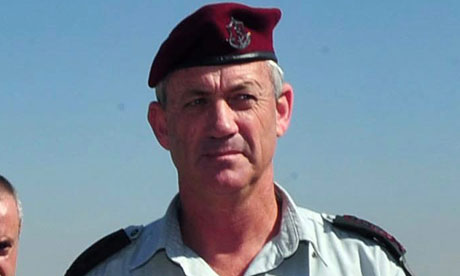
Benny Gantz said there would be 'no escape from conducting a significant operation'. Photograph: Ariel Hermoni/EPABenny Gantz said there would be ‘no escape from conducting a significant operation’. Photograph: Ariel Hermoni/EPA


A new Israeli military offensive against Gaza will be launched “sooner or later” and will be “swift and painful”, Israel’s most senior military officer has warned.

Benny Gantz, the chief of staff of the Israel Defence Forces, was speaking on the third anniversary of the start of a major three-week assault on Gaza during which around 1,400 Palestinians and 13 Israelis were killed.

That offensive was “an excellent operation that achieved deterrence for Israel vis-a-vis Hamas”, Gantz told Army Radio on Tuesday. He added there were signs that the deterrent effect was wearing thin.

“Sooner or later, there will be no escape from conducting a significant operation,” he said. “The IDF knows how to operate in a determined, decisive and offensive manner against terrorists in the Gaza Strip.”

Within hours of Gantz’s comments, the Israeli military launched two airstrikes on targets in Gaza, killing one person and injuring around 10, according to local reports.

A spokesman for the IDF said direct hits on two “terrorist squads with global jihad associations” had been confirmed. According to security officials quoted by Israel Radio, one of the targets was a cell en route to Sinai with the intention of launching an attack on Israel from Egypt.

Since the end of the Gaza war in January 2009, Hamas has attempted to enforce a ceasefire among militant groups, although sporadic rocket fire has continued. Israel holds Hamas, as the de facto government, responsible for all rocket fire emanating from Gaza.

There have been suggestions in recent weeks that Hamas is ready to distance itself further from attacks on Israel as part of its reconciliation process with its rival faction Fatah.

“They have accepted popular [non-violent] resistance,” senior Fatah official Mohammed Shtayyer said, adding that Hamas would stop “these fireworks” being launched.

However, Hamas officials have also said they reserve the right to self-defence and the prime minister, Ismail Haniyeh, pledged to continue “resistance” at a public rally this month.

Gantz’s comments were meant “to keep [Hamas] on their toes”, according to the Israeli analyst Yossi Alpher, who said: “He’s letting us know that another operation is possible and it would be successful.”

Alpher identified two constraining factors – moves towards Fatah-Hamas reconciliation “which may change the political nature of the Gaza regime”, and Egypt. “In the past, we could assume that if we launched an operation in Gaza, [former president Hosni] Mubarak would be largely sympathetic. That’s not necessarily the case now,” he said.

Hamas’s message was not unequivocal or comprehensive, he said, adding: “The question is, are we witnessing an evolutionary process in which Hamas follows the lead of Islamists in Egypt and Tunisia away from violence and into politics? My sense is we are, but it’s a slow process.”

Shlomo Brom, of the Institute for National Strategic Studies, said a new offensive on Gaza could be pre-empted by political developments, including the opening of a covert dialogue between Israel and Hamas.

“The developments of Hamas’s position taking into account the effects of the Arab spring could open different possibilities,” he said.

Source

Confronting intimidation, working for justice in Palestine

27 December 2011

Demonstration in commemoration of the killing of Mustafa Tamimi, Nabi Salih, West Bank (16 December 2011).

If we had a wish list for 2012 as Palestinians and friends of Palestine, one of the top items ought to be our hope that we can translate the dramatic shift in recent years in world public opinion into political action against Israeli policies on the ground.

We know why this has not yet materialized: the political, intellectual and cultural elites of the West cower whenever they even contemplate acting according to their own consciences as well as the wishes of their societies.

This last year was particularly illuminating for me in that respect. I encountered that timidity at every station in the many trips I took for the cause I believe in. And these personal experiences were accentuated by the more general examples of how governments and institutions caved in under intimidation from Israel and pro-Zionist Jewish organizations.

A catalogue of complicity

Of course there were US President Barack Obama’s pandering appearances in front of AIPAC, the Israeli lobby, and his administration’s continued silence and inaction in face of Israel’s colonization of the West Bank, siege and killings in Gaza, ethnic cleansing of the Bedouins in the Naqab and new legislation discriminating against Palestinians in Israel.

The complicity continued with the shameful retreat of Judge Richard Goldstone from his rather tame report on the Gaza massacre — which began three years ago today. And then there was the decision of European governments, especially Greece, to disallow campaigns of human aid and solidarity from reaching Gaza by sea.

On the margins of all of this were prosecutions in France against activists calling for boycott, divestment and sanctions (BDS) and a few u-turns by some groups and non-governmental organizations (NGOs) in Europe caving in under pressure and retracting an earlier decision to cede connections with Israel.

Learning firsthand how pro-Israel intimidation works

In recent years, I have learned firsthand how intimidation of this kind works. In November 2009 the mayor of Munich was scared to death by a Zionist lobby group and cancelled my lecture there. More recently, the Austrian foreign ministry withdrew its funding for an event in which I participated, and finally it was my own university, the University of Exeter, once a haven of security in my eyes, becoming frigid when a bunch of Zionist hooligans claimed I was a fabricator and a self-hating Jew.

Every year since I moved there, Zionist organizations in the UK and the US have asked the university to investigate my work and were brushed aside. This year a similar appeal was taken, momentarily one should say, seriously. One hopes this was just a temporary lapse; but you never know with an academic institution (bravery is not one of their hallmarks).

Standing up to pressure

But there were examples of courage — local and global — as well: the student union of the University of Surrey under heavy pressure to cancel my talk did not give in and allowed the event to take place.

The Episcopal Bishops Committee on Israel/Palestine in Seattle faced the wrath of many of the city’s synagogues and the Israeli Consul General in San Francisco, Akiva Tor, for arranging an event with me in September 2011 in Seattle’s Town Hall, but bravely brushed aside this campaign of intimidation. The usual charges of “anti-Semitism” did not work there — they never do where people refuse to be intimidated.

The outgoing year was also the one in which Turkey imposed military and diplomatic sanctions on Israel in response to the latter’s refusal to take responsibility for the attack on the Mavi Marmara. Turkey’s action was in marked contrast to the European and international habit of sufficing with toothless statements at best, and never imposing a real price on Israel for its actions.

Do not cave in to intimidation

I do not wish to underestimate the task ahead of us. Only recently did we learn how much money is channeled to this machinery of intimidation whose sole purpose is to silence criticism on Israel. Last year, the Jewish Federations of North America and the Jewish Council for Public Affairs — leading pro-Israel lobby groups — allocated $6 million to be spent over three years to fight BDS campaigns and smear the Palestine solidarity movement. This is not the only such initiative under way.

But are these forces as powerful as they seem to be in the eyes of very respectable institutions such as universities, community centers, churches, media outlets and, of course, politicians?

What you learn is that once you cower, you become prey to continued and relentless bashing until you sing the Israeli national anthem. If once you do not cave in, you discover that as time goes by, the ability of Zionist lobbies of intimidation around the world to affect you gradually diminishes.

Reducing the influence of the United States

Undoubtedly the centers of power that fuel this culture of intimidation lie to a great extent in the United States, which brings me to the second item on my 2012 wish list: an end to the American dominance in the affairs of Israelis and Palestinians. I know this influence cannot be easily curbed.

But the issue of timidity and intimidation belong to an American sphere of activity where things can, and should be, different. There will be no peace process or even Pax Americana in Palestine if the Palestinians, under whatever leadership, would agree to allow Washington to play such a central role. It is not as if US policy-makers can threaten the Palestinians that without their involvement there will be no peace process.

In fact history has proved that there was no peace process — in the sense of a genuine movement toward the restoration of Palestinian rights — precisely because of American involvement. Outside mediation may be necessary for the cause of reconciliation in Palestine. But does it have to be American?

If elite politics are needed — along with other forces and movements — to facilitate a change on the ground, such a role should come from other places in the world and not just from the United States.

One would hope that the recent rapprochement between Hamas and Fatah — and the new attempt to base the issue of Palestinian representation on a wider and more just basis — will lead to a clear Palestinian position that would expose the fallacy that peace can only be achieved with the Americans as its brokers.

Dwarfing the US role will disarm American Zionist bodies and those who emulate them in Europe and Israel of their power of intimidation.

Letting the other America play a role

This will also enable the other America, that of the civil society, the Occupy Wall Street movement, the progressive campuses, the courageous churches, African-Americans marginalized by mainstream politics, Native Americans and millions of other decent Americans who never fell captive to elite propaganda about Israel and Palestine, to take a far more central role in “American involvement” in Palestine.

That would benefit America as much as it will benefit justice and peace in Palestine. But this long road to redeeming all of us who want to see justice begins by asking academics, journalists and politicians in the West to show a modicum of steadfastness and courage in the face of those who want to intimidate us. Their bark is far fiercer than their bite.

The author of numerous books, Ilan Pappe is Professor of History and Director of the European Centre for Palestine Studies at the University of Exeter.

Pro-Israel Rally For Attacking Gaza, NYC, 1-11-09

[youtube http://youtu.be/FABqq_jjRRo?]

Gaza, never forget! Video by Max Blumenthal and Dan Luban. Full story here: http://www.alternet.org/story/119372

Bus to Jerusalem stopped after woman refuses to move to back

Saturday, December 17 2011|Ami Kaufman

All Tanya Rosenblit wanted to do was get on a bus to Jerusalem. She didn’t have any plans to turn into the Israeli Rosa Parks, when a group of ultra-Orthodox Jews demanded she move to the back of the bus

Tanya Rosenblit

It was supposed to be just another regular Friday morning for Tanya Rosenblit. Tanya had to get from her hometown Ashdod to Jerusalem for a meeting there. On the way, Rosenblit experienced one of the most intimidating stories of religious coercion I’ve seen lately: She was told by a Haredi man to get to the back of the bus, or nobody was going to go anywhere.

And what do you think Rosenblit did? That’s right – she stayed put. And she took pictures of the whole ordeal and later wrote about it on Facebook. Here’s her story, which I publish a part of with her permission:

A bus ride to Jerusalem taking the wrong turn…

I lived in Israel all my life. I was brought up in a free country and I was taught the value of freedom as a basic right that could never be undermined by anyone. All my life, during my teens, my military service, my university years and then after I always felt as equal among my peers. I was always proud to be a woman and never felt deprived or weakened by men, until today.I had an appointment in an Orthodox Jewish neighborhood in Jerusalem and looked for easy transportation on a Friday morning. After checking the official Egged site, which is the leading bus company in Israel, I decided to take line 451 from Ashdod (my hometown) to Jerusalem. I chose this line because it stopped a mere five minute walk from my scheduled appointment.The driver looked at the station where I was standing and didn’t stop. I had to signal him by raising my hand for him to stop. When I entered the bus he looked surprised. He explained that the only ones who go on the bus are Orthodox Jews. I sat behind him in the first row and asked for him to tell me when we get to my station.At the next stop, Orthodox Jews started mounting the bus. At first, they just stared at me, but said nothing and moved on to sit somewhere in the bus behind us. Only one passenger decided that he preferred standing on the stairs near the driver, although there was plenty of space. I didn’t mind that, and focused on the music in my ears. But then, another one entered the bus, but instead of entering, he prevented the driver from closing the door. He looked at me with despise, and when I took off the earphones, I heard him call me “Shikse”, which means “whore” in Yiddish. He demanded I sit in the back of the bus, because Jewish men couldn’t sit behind women (!!!). I refused.

The driver tried to talk to him, explained that he was late, but the “penguin” wouldn’t budge. Another passenger, also religious and orthodox asked the driver to be refunded because he was gonna miss his meeting. He also said that he didn’t mind what was going on, he just wanted to get to where he was going and that the fact that they decided to stop the bus is a good reason for the driver to give him his money back. For company policy, he didn’t, but that’s a different story.

The driver understood he was not going to move anytime soon, so he called the police. Until that moment, no one tried to talk to me. The only comment I heard was from the initiator of this whole mess ordering me to sit in the back of the bus as a sign of respect. In the meantime, a crowd started forming outside the bus, as a result of his cries. I was starting to get scared, to tell you the truth. There were like 20 of them, all wearing black. Most of them were just curious, but they were definitely on his side.

After a while, the police came. It was one officer who first talked to the driver. The driver explained to him that he didn’t tell me anything and that they wouldn’t budge. Then, the officer had a long conversation with the person who started this whole mess. It seemed quite friendly, and in the end, the policeman came to me and asked me if I was willing to respect them and sit in the back of the bus. I answered that I respected them enough by wearing modest cloths, because I knew I was going to an Orthodox neighborhood, but I wouldn’t be humiliated by those who can’t even respect their own mothers and wives.

The officer stepped down and so did the leader of the little protest that was going on. He stayed in Ashdod, while the rest of the Orthodox Jews, including those who got on the bus later on boarded the bus and quietly went to sit behind me. The person who chose to stand on the stairs at the beginning remained on the stairs sitting and praying throughout the entire bus ride, because he wouldn’t sit behind a woman!!!

The entire delay took about half an hour, but we managed to arrive on time. In the neighborhood, I met some very pleasant people who were very happy and eager to help me when I asked for directions, men and women, Orthodox and religious. When I later decided to take a walk around the Mahane Yehuda Market in Jerusalem, I was again treated as an equal, as a secular woman, with the utmost respect and sympathy, by men and women of all streams.

The reason I am posting this story is not to declare the Orthodox Jews as pure evil and the oppressors of human rights and liberties. I want to point out that this is a social and educational problem. There are a lot of lovely things about religion, but forcing people to choose religion is wrong. It is wrong to use religion as an excuse to eliminate people’s basic rights: the right for freedom and the right for dignity.

Waiting for Rosenblit to move to the back, preventing driver from moving (photo: Tanya Rosenblit)
A crowd gathers outside (Photo: Tanya Rosenblit)
He won’t sit behind a woman (photo: Tanya Rosenblit)
Policeman speaks to “head” of protest (photo: Tanya Rosenblit)
Most passengers just didn’t care (photo :Tanya Rosenblit)
Tanya’s story filled me with mixed emotions. First and foremost, I am in awe of her bravery. I don’t think there was any danger of violence, but to stand up to that kind of intimidation shows an inner strength of a very special kind.

And, of course, it filled me with anger. That the policeman actually asked her to move. And that this is what Israel is turning in to. It’s a slow process. But it’s steady.

Tanya wishes to make sure that her cry is not against the ultra-Orthodox as a whole and does not wish to turn this into a religious war of any kind. As she told me today: “The extremists are the problem. In Israel 2011 we are waging a battle for individual rights. We should fight for freedom and tolerance for all.”

I agree with Tanya that these are extremists. But I also believe their numbers are on the rise, and that the current political system has shown no interest whatsoever in changing the tide.

P.S. I just have to add that as much as I don’t like the word “shikse”, I don’t particularly approve of the term “penguin” as well. I can only presume it was written when emotions ran high.

Rudd seeks action on torture allegations involving Palestinian children

by John Lyons

The Australian

17 December 2011

AUSTRALIA will raise concerns with Israel about its juvenile military court system, which has been accused of jailing and torturing Palestinian children as young as 12.

Following a report in The Weekend Australian Magazine three weeks ago, Foreign Minister Kevin Rudd has instructed Australian diplomats to visit the juvenile military court.

The diplomats have been told to report to Mr Rudd on the conditions they find at the Ofer military prison, near Jerusalem.

According to a statement from Mr Rudd’s office, he has also instructed Australian officials to initiate a meeting with Israeli authorities to raise concerns about the system under which Palestinian children are tried.

Sixty of Israel’s leading psychologists, academics and child experts have written to Israeli Prime Minister Benjamin Netanyahu saying that “offensive arrests and investigations that ignore the law do not serve to maintain public order and safety”.

The Weekend Australian Magazine reported that allegations included : a boy kept in solitary confinement for 65 days ; other boys in solitary confinement with the lights on 24 hours a day ; a seven-year-old boy in Jerusalem taken for interrogation who says he was hit during questioning ; three children being given electric shocks by hand-held devices to force them to confess ; dog’s food being put on the head and near the genitals of a blindfolded boy and a dog being brought in to eat it while his interrogators laughed.

The magazine reported that, since January, 2007, Defence of Children International has collected and translated into English 385 sworn affidavits from Palestinian children held in Israeli detention who claim to have suffered serious abuse : electric shocks, beatings, threats of rape, being stripped naked, solitary confinement, threats that their families’ work permits will be revoked and “position abuse” – which involves a child being placed in a chair with their feet shackled and hands tied behind their back, sometimes for hours.

A 10-year-old boy testified : “A soldier pointed his rifle at me. The rifle barrel was a few centimetres from my face. I was so terrified that I started to shiver. He made fun of me and said, ’Shivering ? Tell me where the pistol is before I shoot you’.”

A 15-year-old boy testified that he was tied to a metal pipe and beaten by a soldier and that an interrogator placed a device against his body and gave him an electric shock, saying : “If you don’t confess I’ll keep shocking you.” He said the interrogator gave him another electric shock, at which point he could no longer feel his arms or legs, felt pain in his head and confessed.

Gerard Horton, an Australian lawyer dealing with many of the cases in his role at DCI, said one Israeli interrogator working in the settlement, Gush Etzion, “specialises in threatening children with rape” to get confessions.

One woman involved in the YMCA’s rehabilitation program for children who have been under Israeli detention, Fadia Saleh, told The Australian as part of its investigation : “Last week, one boy described to me how dogs were present in the army jeep. In those jeeps, you have chairs on each side and an empty space in the middle – the children are put there, on the floor. Sometimes soldiers step on them.

“Every time the child moved, one of the dogs would bite him. When he arrived at the interrogation centre, his arm was bleeding. It was a short trip but he felt like (it was) a year.”

The Weekend Australian Magazine reported that, while diplomatic and parliamentary missions from many countries had visited the juvenile court, Australian diplomats had appeared to show no obvious interest in the court.

Mr Horton said Australia had been “conspicuously silent” about possible human rights abuses against Palestinian children.

He told the magazine : “It is disappointing that, of all the diplomatic missions in the region, Australia has been conspicuously silent on the issue of the military courts.”

Australia’s Ambassador to Israel, Andrea Faulkner, was told of the treatment of children more than a year ago.

Although informed of the issue, neither Ms Faulkner nor any other Australian representative has visited the court.

The Weekend Australian Magazine was given rare access for the media to the court – it was allowed to visit on three separate occasions over the last year, with the Israeli Defence Forces, as part of this investigation.

This week, an Australian official has begun meetings on the issue in preparation for a visit to the juvenile court by Australian diplomats.

Most of the children before the military court are charged with stone-throwing and sentenced to prison terms ranging from two weeks to 10 months.

The Israeli Defence Forces reported at least 2766 incidents of rock-throwing against them or passing cars this year.

Israeli police say a crash in September in which a man and his infant son were killed may have been caused by a rock hitting their car.

Authorities in Israel did not want to discuss individual cases of children but the country’s international spokesman Yigal Palmor said there were “many things” that needed to improve and that Israel was working with human rights groups and making “slow reform and improvement”.

The treatment of Palestinian children in the West Bank, which is under Israeli military occupation, is in contrast to the treatment of children in Israel.

In Israel, a child cannot be sent to jail until the age of 14, while Palestinian children are being jailed from the age of 12 ; in Israel a child cannot be interrogated without a parent present ; in Israel a child cannot be interrogated at night, while most of the Palestinian children being taken from their homes are detained between midnight and 5am ; in Israel the maximum period of detention without access to a lawyer is 48 hours, while in the West Bank it is 90 days.

In recent times, the military court has been visited by diplomats or parliamentary delegations from the UK, the US, the European Union, the Netherlands, France, Spain, Belgium, Germany, Ireland, Norway, Cyprus and the United Nations.

Mr Horton says that before most cases are taken up, DCI requires a sworn affidavit.

He told the magazine of the common treatment for many children : “Once bound and blindfolded, the child will be led to a waiting military vehicle and in about one-third of cases will be thrown on the metal floor for transfer to an interrogation centre.

“Sometimes the children are kept on the floor face down with the soldiers putting their boots on the back of their necks, and the children are handcuffed, sometimes with plastic handcuffs, which cut into their wrists. Many children arrive at the interrogation centres bruised and battered, sleep-deprived and scared.”

Mr Horton said the whole point of this treatment was to get the children to confess as quickly as possible.

In one case, even though a child insisted that a confession he had signed was not true, as he had signed it only after pressure, he was convicted on the basis of the confession.

A spokeswoman for Mr Rudd said that, during Israel’s last appearance before the UN Universal Periodic Review Working Group, Australia questioned Israel about reported mistreatment of detainees.

She said the government universally opposes the detention of minors.

“The Australian government’s long held view is that all children, regardless of ethnicity, religion, gender or other differences, should enjoy the same legal and human rights protections,” she said.

17 décembre 2011 – The Australian – available to subscribers only

The Jews Go To War (With Themselves)

by Lawrence Davidson on December 17, 2011

Part I

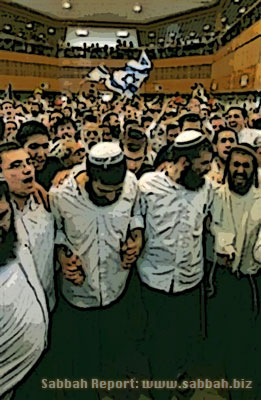
On 12 December 2011 hundreds of Israeli settler fanatics besieged a West Bank IDF army base. They destroyed equipment, set fires, and even stoned the base soldiers. This was the second such attack in a month. The cause? Anger over the army’s dismantlement of a small number of isolated, unauthorized settler outposts. The Chief of the Central Command of the Israel “Defense” Forces, Major General Avi Misrahi, is quoted as saying “I have not seen such hatred of Jews towards soldiers during my 30 years of service.” He must not have been looking.

fanatic jewish settlersThis an exceptional event. The subsequent indignation over the attack expressed by Prime Minister Netanyahu (“red lines have been crossed”) was, as Alex Fishman writing in Yedioth Ahronoth put it, staged hypocrisy. The Prime Minister is certainly aware that for some time there has been on-going skirmishing between the settlers and government security forces. Right wing settlers regularly throw rocks and fire bombs at police and army vehicles and “physical altercations” between settlers and Israeli police and soldiers are “almost routine.” This is so despite the fact that the government, both Prime Minister and Knesset, “either tacitly or openly” support the settlers. Then why the hatred and why the attacks?

At this stage the battle is over strategy. The Israeli government wants to gobble up all of Palestine in an orderly step by step fashion. In part, this is to avoid too much international criticism at any particular stage of the process. On the other hand, the settlers don’t give a damn about international opinion – no more than does al-Qaeda, to which they have an unsavory resemblance. Led “by fundamentalist religious leaders who do not recognize the state of Israel and its laws,” they are driven by religious fanaticism and have no respect for governments or their agents. It is their ideological conviction that all of Palestine (including, by the way, Jordan) must be Jewish as soon as possible. The authorities sometime get in the way of this goal and that has led the settlers to, as Fishman puts it, “terrorize not only the Palestinian population but also the police and the army.”

Prime Minister Netanyahu, belatedly noticing an erosion of government authority, has begun to set rules against settler violence when it is directed toward the IDF and police (but not toward the Palestinians). The New York Times reports that from now on such “radical Israelis” attacking soldiers or policemen will be treated just like “Palestinian militants.” That is they will be “detained for long periods without charge and tried in military courts.”

Alas, this new toughness won’t work. For years Israeli governments have looked the other way as thousands of armed religious fanatics organized themselves and got stronger and more self-assured. Now, as Adam Keller of Gush Shalom tells us, “the Golem has turned on its creator.” These are the people who assassinated Yitzhak Rabin. What makes Netanyahu believe that Israel’s present army, police and courts which, reminiscent of the Weimar Republic, regularly show sympathy and leniency toward these criminals, are going to change their attitude on his orders? When a military reporter asked a brigade commander if he was prepared to act toward settler hostility in the same manner as he would Palestinian hostility, he answered “you would not expect me to open fire on a Jew…I am certain you didn’t mean that.”

The reporter would have gotten a very different answer if she had asked the fanatic settlers about how far they were willing to go. Anshel Pfeffer writing in the Israeli newspaper Haaretz notes that “the only red line that has yet to be crossed is a scenario in which an Israeli citizen [belonging to] the extreme settler right would open fire on IDF soldiers. There are those in Israel’s security forces who fear that day is not so distant.”

Netanyahu’s apparent change of heart comes too late. What we have here is incipient civil war. Any really serious effort to stop these fanatics will result in their turning their weapons on those who represent the government. What you sow is what you reap.

Parts II  and III here

Blog at WordPress.com.

Up ↑