Search

band annie's Weblog

I have a parallel blog in French at http://anniebannie.net

Category

israel

Welcome to Israel 2012

April 13th, 2012 § 1 Comment

Welcome to Palestine 2012 is already a huge success. Israel has already set up a welcoming committee, the only way a military regime meeting opposition knows how: As in last year’s Fly-in, hundreds of border patrol personnel and police officers will await the delegation. Detention facilities are already ready for 1500 children, women and men, expected to arrive in Ben Gurion Airport. But why tell when I can show? Here’s your typical, run of the mill article on Channel 1:

[youtube http://youtu.be/cvZPb81aELM?]

The State of Shooting Itself in the Foot

The segment is a goldmine for examining the Israeli state of paranoia. As a translator, I often get the chance to rethink my mother tongue. While I find the irony of the use of the terms “Safe Space”, “community”, “big brother” and “equip with flowers” hilarious, I want to specifically talk about the changing attitude of the Israeli media towards Hasbara.

I began writing about Israeli media since the Gaza Massacre of the winter of 2008. I admit I hadn’t Fisked an article in over a year, I guess I got bored. Translating this segment, however, it occurred to me that the change in Hasbara strategy, which can be traced back to “Brand Israel”, concocted around the second intifada, has become a sort of “common knowledge”, which journalists don’t even think about, as they construct their sentences.

So while we have the yey ole’ tactics of outright lying in the first lines of the segment, as exemplified by the hysteria mongering “violent clashes”, something very interesting happens with the rest of it. The “security” apparatus of Israel declares a “Hasbara war” via Channel 1 (a.k.a. “The Broadcasting Authority”). Gone are the days of the “victim narrative”. You see, for the Israeli Police maintaining “order” is “small potatoes”, the real threat is in counter-propaganda.

How do you counter propaganda of the oppressed and their supporters? Well duh! You put a brigade of undercover police in the airport, seize all tourists, cut their connection to the outside world, and after welcoming them with a search and interrogation, arrest the “suspicious” culprits, who would have “admitted” to their “crime” willingly at the appropriate already existing checkpoint, and “equip” the “innocent tourists” with an apology and flowers. Oh yeah, don’t forget to upload photos to Netanyahu’s Facebook page and tweet it on the IDFinfodesk twitter account. This will undoubtedly entice scores of tourists from enlightened Europe to come on down to the OnlyDemocracyInTheMiddleEast™. Welcome to Israel!

Fair and Balanced Hasbara

I actually don’t think that Channel 1 was attempting to be fair and balanced, It’s just that we at Welcome to Palestine were very forthcoming with the Information. Our contacts were sent to all the media outlets in Israel; Palestinian, international and Israeli, so they could get the story straight. Interestingly, after doing their lazy, routine work of pseudo journalism, interviewing the Hasbara Ministry, the police and immigration, and making sure all ministry talking points have been expressed,  they decided to speak with the Palestinian organizers. And though the final minutes are dedicated to the Palestinian faces behind Welcome to Palestine, to their community projects, and to the earnestness of their intentions, somehow Palestinians in Israeli mainstream media are always “claiming”, while the occupying Israeli military regime is speaking straight out of the mouth of the media, as it “knows” what’s happening and “estimating” facts on the ground.

There must be a confidence within the government and media, that it’s OK to show the “other side”, because the Israeli public doesn’t hear Amira Musallam when she says “we don’t want to lie”, all they see is the enemy. But just in case, the concluding sentence is the diminutive “Another act of protestation against Israel that’s mostly granted and will garner a passing media impact.” A rather calming message, already stating the victory of Israel in the “Hasbara war”, which contradicts the massive “security” hysteria, which is actually “small potatoes”.

Another thing to be learned from this segment is that in Israel there’s no real distinction between the state and the media. All of the state’s oppressive procedures and whitewashing tactics are being announced to the Israeli public, but rather than in a critical manner, they are framed as protection from a threat to public safety.

Being one out of 7 Israeli activists who have been summoned for by the Shabak over Welcome to Palestine, I agree with one thing the segment has to say: All involved know that Israel’s “security” apparatus knows exactly who’s coming in, and that they are, in fact, families, with children and elderly. Moreover, they know perfectly well that neither the delegation, or the welcoming committees of dissident Israeli citizens have any plans of holding a demonstration inside the airport. Knowing this, one must ask the question, why the state is reacting as if any of us are dangerous, and why it encourages the media to portray the delegation as a “security threat”?

Israel is hellbent on showing the world how far it’s willing to go in order to violate the freedom of movement, thought and political assembly. The state’s inability to allow action which it deems legal, exposes its true fears, and as such, it’s true agenda. Indeed, what could be scarier than someone wishing to go to a place called Palestine.

source

Peace, Propaganda and the Promised Land

This video was included in the previous post from Mondoweis but it is so important that I post it separately

click on image

 U.S. Media & the Israeli-Palestinian Conflict How Israel manipulates and distorts American public perceptions Through the voices of scholars, media critics, peace activists, religious figures, and Middle East experts, Peace, Propaganda & the Promised Land carefully analyzes and explains how–through the use of language, framing and context–the Israeli occupation of the West Bank and Gaza remains hidden in the news media, and Israeli colonization of the occupied terrorities appears to be a defensive move rather than an offensive one. keywords: Palestine Israel Zionist Jew Islam Jewish Idi Amin Noam Chomsky Media Bias Big Brother Rupert Murdoch FOX News Sky News George Orwell Police State Military Occupation Iran Lebanon Terrorstorm Alex Jones manipulation media movements revolution alternative media Video available for sale here : http://www.mediaed.org/videos/MediaRaceAndRepresentation/PeacePropaganda Watch current Israel/Palestine news: http://newstree.org/search.jsp?query=Israel%20palestine%20video:1&hp=10&sort=ndateinmin&reverse=true&vx=1«

GERMANS ARE BEHIND GÜNTER GRASS

MONDAY, APRIL 9, 2012 AT 9:03AM GILAD ATZMON

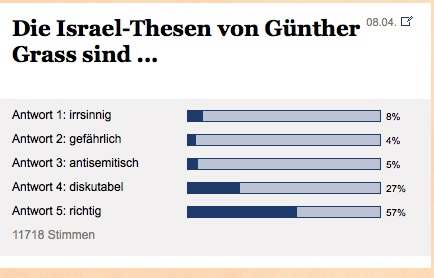
 Israel doesn’t approve Grass’s recent poetic intervention. Yet, according to the German Financial Times, Grass views are highly accepted amongst Germans.

http://www.ftd.de/

Günter Grass´ take on Israel is..

1.ludicrous———————8%

2.dangerous—————- 4 %

3.antisemitic—————– 5 %

4.discussable—————-27%

5.correct———————55%

Seemingly the Germans have drawn the necessary lesson from the big war. They oppose war, expansionism and militancy. But what about the Israelis, will they ever learn?

source

Israelis can be angry with Gunter Grass, but they must listen to him

After we denounce the exaggeration, after we shake off the unjustified part of the charge, we must listen to the condemnation of these great people.

By Gideon Levy 

The harsh, and in some parts infuriating, poem by Gunter Grass of course immediately sparked a wave of vilifications against it and mainly against its author. Grass indeed went a few steps too far (and too mendaciously ) – Israel will not destroy the Iranian people – and for that he will be punished, in his own country and in Israel. But in precisely the same way the poem’s nine stanzas lost a sense of proportion in terms of their judgment of Israel, so too the angry responses to it suffer from exaggeration. Tom Segev wrote in Haaretz: “Unless Prime Minister Benjamin Netanyahu or Iranian President Mahmoud Ahmadinejad recently confided in him, his opinion is vacuous.” (“More pathetic than anti-Semitic,” April 5 ). Prime Minister Benjamin Netanyahu mentioned Grass’ Nazi past, and Israeli embassies in Germany went so far as to state, ridiculously, that the poem signified “anti-Semitism in the best European tradition of blood libels before Passover.”

It is doubtful that Grass intended his poem to be published on the eve of Passover. It contains no blood libel. In fact, it is the branding of it as anti-Semitic that is a matter of tradition – all criticism of Israel is immediately thus labeled. Grass’ Nazi past, his joining the Waffen SS as a youth, does not warrant shutting him up some 70 years later, and his opinion is far from vacuous. According to Segev, anyone who is not a nuclear scientist, an Israeli prime minister or an Iranian president must keep silent on the stormiest issue in Israel and the world today. That is a flawed approach.

Grass’ “What Must Be Said” does contain things that must be said. It can and should be said that Israel’s policy is endangering world peace. His position against Israeli nuclear power is also legitimate. He can also oppose supplying submarines to Israel without his past immediately being pulled out as a counterclaim. But Grass exaggerated, unnecessarily and in a way that damaged his own position. Perhaps it is his advanced age and his ambition to attract a last round of attention, and perhaps the words came forth all at once like a cascade, after decades during which it was almost impossible to criticize Israel in Germany.

That’s the way it is when all criticism of Israel is considered illegitimate and improper and is stopped up inside for years. In the end it erupts in an extreme form. Grass’ poem was published only a few weeks after another prominent German, the chairman of the Social Democratic Party, Sigmar Gabriel, wrote that there is an apartheid regime in Hebron. He also aroused angry responses. Therefore it is better to listen to the statements and, especially, finally, to lift the prohibition against criticizing Israel in Germany.

Israel has many friends in Germany, more than in most European countries. Some of them support us blindly, some have justified guilt feelings and some are true, critical friends of Israel. There are, of course, anti-Semites in Germany and the demand that Germany never forget is also justified. But a situation in which any German who dares criticize Israel is instantly accused of anti-Semitism is intolerable.

Some years ago, after a critical article of mine was published in the German daily Die Welt, one of its editors told me: “No journalist of ours could write an article like that.” I was never again invited to write for that paper. For years, any journalist who joined the huge German media outlet Axel Springer had to sign a pledge never to write anything that casts aspersions on Israel’s right to exist. That is an unhealthy situation that ended with an eruption of exaggerated criticism like Grass’.

Grass is not alone. No less of a major figure, the great author Jose de Sousa Saramago opened the floodgates in his later years when, after a visit to the occupied territories, he compared what was going on there to Auschwitz. Like Grass, Saramago went too far, but his remarks about the Israelis should have been heeded: “Living under the shadow of the Holocaust and expecting forgiveness for everything they will do in the name of their suffering seems coarse. They have learned nothing from the suffering of their parents and their grandparents.”

After we denounce the exaggeration, after we shake off the unjustified part of the charge, we must listen to these great people. They are not anti-Semites, they are expressing the opinion of many people. Instead of accusing them we should consider what we did that led them to express it..

source

With ‘last ink,’ Gunter Grass breaks silence on Israeli nuclear program threatening world peace

by on April 5, 2012 104

Gunter Grass Gunter Grass, by Marcus Brandt in the Guardian

The Gunter Grass poem was published in Germany. Our translation is by Norbert Jost. It is already stirring big controversy. Guardian headline: “Nobel Prize-winning author Günter Grass uses poem to say a nuclear-armed Israel is a threat to world peace.” Tom Segev says Grass is “pathetic” and is guilty about his Nazi past.

Why am i silent, conceal already too long a time, What is apparent and has been simulated in exercises, at the end of which we the survivors may at best be footnotes. It is the alleged entitlement for a first strike, which could extinguish the Iranian people, – subjugated by a big mouth and directed to organized jubilations- because one assumes the making of a nuclear bomb. Alas, why do i restrain myself to name the name of the other country, where since years – although kept secret – a growing nuclear potential (is) available, albeit beyond control, because inaccessible for any examination? The general silence of this fact, which my silence has subordinated itself to, i feel to be a burdensome lie and as coercion, which promises punishment, soon as it is not complied with; the verdict “antisemitism” is ready at hand. However, now, that my country, which is confronted with its very own crimes which are unique without comparison, again and again and made to answer for, is about to deliver, routinely and businesslike, even though with a nimble tongue declared as reparation, is to supply Israel another submarine, the speciality of which is to deliver all-destructive warheads to where the existence of a single nuclear bomb is unproven, only “proven” by the strength of fear, I say, what must be said. But why did i remain silent so far? Because I was of the opinion, that where i am from, which is stained with a never removable stain, forbids me, to dare confronting Israel, the country I am attached to and want to remain so, with this fact as an outright spoken truth. Why do I speak now only, aged and with the last ink: The nuclear power Israel endangers the world’s peace, ever so delicate anyhow ? Because it must be said, what already tomorrow could be too late; also because we – as Germans burdened enough – could become suppliers of a crime, which can be foreseen, and why our complicity could not be made undone by any of the usual evasions. And admitted: i do not remain silent anymore, because i am weary of the hypocrisy of the West; moreover, it is hoped, may many free themselves of the bondage of silence, demand from the originators of the discernible danger the renunciation of all violence and simultaneously insist, that an unhindered and permanent control of Israeli nuclear potential and of Iranian nuclear facilities through an international entity will be permitted by the governments of both countries. Only this way, everybody, Israelis and Palestinians, even more, all human beings, who live as enemies next to each other in this region, occupied by madness, can be helped – ultimately us, too.

About Philip Weiss

Philip Weiss is Founder and Co-Editor of Mondoweiss.net.

Israeli Soldiers Violently Evict Palestinians from Hebron House

Just like the Syrian Army ….

Afghan My Lai — Robert Bales was not alone

March 31st, 2012 § 3 Comments

That is according to Afghan child witnesses interviewed by Yalda Hakim for Australia’s SBS Dateline. (h/t Shaheen)

[youtube http://youtu.be/gnueG4I7Q9g?]
Hakim, who was born in Afghanistan and immigrated to Australia as a child, is the first international journalist to interview the surviving witnesses. She said American investigators tried to prevent her from interviewing the children, saying her questions could traumatize them. She said she appealed to village leaders, who arranged for her to interview the witnesses.

Noorbinak, 8, told Hakim that the shooter first shot her father’s dog. Then, Noorbinak said in the video, he shot her father in the foot and dragged her mother by the hair. When her father started screaming, he shot her father, the child says. Then he turned the gun on Noorbinak and shot her in the leg.

“One man entered the room and the others were standing in the yard, holding lights,” Noorbinak said in the video.

A brother of one victim told Hakim that his brother’s children mentioned more than one soldier wearing a headlamp. They also had lights at the end of their guns, he said.

“They don’t know whether there were 15 or 20, however many there were,” he said in the video. […]

Gen. Karimi, assigned by Afghan President Hamid Karzai to investigate the murders, told Hakim that he, too, wonders whether Bales acted alone and how he could left the base without notice.

“Village elders said several soldiers took part and that there is boot prints in the area,” Karimi told Hakim. He said villagers told him that they saw three or four individuals kneeling and that helicopters were overhead during the rampage.

“To search for him?” Karimi said he asked them.

“No,” he said they told him. “They were there from the very beginning.”

Source

Supporting the Syrian People Fighting for Their Freedom—A Response to Widespread Objections

We, the Tarabut-Hithabrut movement, support unequivocally the Syrian people in their struggle for their liberty and their rights.

There are those who say that the situation in Syrian and the wider regional reality is complex, and they are right. However, we want to directly address the various objections raised against taking a position in favor of the democratic uprising of the Syrian people:

 There are those who say that the Syrian regime is anti-imperialist and comprises the last barrier to Western domination in our region.

The Baath Party in Syria is a corrupt regime of a small group of super-wealthy and powerful people who control enormous amounts of capital, which was stolen directly out of the pockets of the Syrian people. This ruling junta is not motivated by anti-imperialist ideals and can serve neither as a model for these ideas or as a defender of socialism. Although this regime is in a confrontation with Israel and the United States, a series of event such as the Gulf War show that the regime’s positions on international affairs are not consistent or principled but opportunistic. In addition, the Cold War is long over and the regime has since become friendly to Putin’s Russia, which is, as should be emphasized, a capitalist, authoritarian government with its own imperialist ambitions in addition to being a regime supported by the new empire, China, which is equally devoid of scruples or constraints.

 Protesters against the regime are peons in an imperialist plot

The uprising in Syria started in Dar’a when a group of parents who protested when the security forces jailed and tortured their children, who dared to write “the People Demand to Depose Bashar” on their school building’s wall. Insults and humiliations directed toward the children’s parents and local leaders triggered the mass protests. The protests that spread throughout the country were inspired by the successful democratic uprisings in Tunisia and Egypt. We cannot forget this.

There are also foreign forces that are trying to take advantage of the situation and ride the wave of Syrian protesters, but this does not turn the protesters themselves into peons or agents of imperialism. The source of the protest is in the Syrian situation itself. Syria has no official statistics and no trustworthy data, but Syrians are well aware that even before the protests the unemployment rate was incredibly high and since then it has only worsened. Many people could only make a livelihood by joining the oppression and investigation apparatus of the regime or by supplementing their income by collaborating with them. Most of the population can only survive their day-to-day lives through bribery, where they must receive and take bribes in order to live and get a hold of basic good and services. Syrian voices demanding fundamental change have grown steadily louder and the masses started to shake free from the fear. The Syrian people are the source of the present protest and any consideration of this issue must begin with them, their rights, their suffering and their legitimate demands.

 The Syrian regime defends the Palestinian resistance

The Syrian regime has a special security force whose purpose is to monitor and oppress the political activism of the Palestinian refugees who live there. The regime does not allow any political organizing that does not conform to the regime. Regime dissidents are disappeared and murdered. Syria has 19 different security forces who have one goal: to eliminate any threat to the Syrian regime. From a historical point of view, the Asad family’s support of Palestinian organizations always came with preconditions. The Syrian Army massacred Palestinians several times during its wars in Lebanon (Tel AlZaatar, Tripoli) and of course, the regime acted again and again to divide the Palestinian national movement (their support for Abu Musa in Lebanon and their encouragement of the war between Hamas and Fatah are only two of the most obvious cases) and by doing this they blocked the Palestinian national movement’s ability to make decisions independently.

 The social protest is primarily a struggle between ethnic groups. The regime defends ethnic minorities and especially the Alawi group, which might suffer from a Sunni takeover.

There are inter-ethnic tensions in Syria, which sometimes result in hate crimes and revenge attacks. But the current regime is not an Alawi regime. The security force known as “AlShabiha” (literally “ghosts,” thugs that drive Mercedes cars that the regime pays for) is a security force established by the Baath party whose goal is to suppress resistance and political activity among the Alawis. Because Asad finds it complicated to use the standing army and the official security forces against his own community, he established an additional security force which is above the law. Many Alawi opposition leaders have been murdered by the regime and its agents, and many Alawis are in the opposition’s ranks today. “AlShabiha” have been trying to exacerbate inter-ethnic tensions in recent months, and this is also the purpose of the recent attacks in Christian neighborhoods, whose perpetrators are not known. This has no connection to the protests against the regime, in which members of all ethnic groups took part.

 A large part of the Syrian people supports the regime, as many as oppose it if not more.

In a dictatorial regime, there isn’t much meaning to citizens protesting in favor of the regime. Decades of dictatorial rule break social structure down and prevent the emergence of local leadership. Every citizen who shows signs of leadership is in danger of being eliminated by the government. Other citizens know this and live in fear. The same TV networks that broadcast the “support protests” also broadcast citizens kissing Bashar AlAsad’s photograph and declaring that “There is No God but Bashar” while soldiers are stepping on their backs and pointing a gun to their head. If we examine our own history, we will remember that, before the First Palestinian Intifada, Israeli TV would film Palestinian merchants and passers by in the West Bank answer “yes” to a question by an Israeli journalist about whether they are happy, and a determined “no” when they were asked if there were any political problems. To see these expressions of support as something authentic is to be blind to the deep fear and oppression in Syrian society in light of these forced expressions of support by frightened citizens.

It s important to emphasize how paralyzed the political system is, even though it is dependent on the regime: until now, after a whole year of protests, there was not a single published statement of support for the regime by any local branch of the Baath party or the artificial parties affiliated with it under the “National Progressive Front.”

 Opposition to the Asad regime is armed and therefore not popular and not legitimate

Among the protesters there are those that use weapons. However, the strongest and clearest voice that emerges from the protests in Syria from their very beginnings is one that speaks of nonviolent revolution and resistance. There are testimonies of armed groups of rebels that also commit war crimes and murder citizens—we condemn these crimes to the same degree that we condemn the regime’s crimes. Behind these crimes there may be different interests, but their background is a decades-long oppression that has prevented the establishment of a democratic political culture.

Concerning the question of the legitimacy of the armed resistance movement: let us not forget that Syria, like the countries that support it, arms and supports other armed organizations in other countries. Those who oppose the Syrian resistance because it is armed and support other armed resistance movements unconditionally are operating under a double standard.

It is not our purpose in this article to pass moral or ideological judgment as to whether the use of violence in order to rebel against an even more violent regime is justified or not, but history has proven to us numerous times that the weapons of the resistance have eventually been turned onto citizens, whether after the victory or on the way to it.

 What about international intervention?

Today, after months of widespread protest and economic crisis, the current regime is being held alive today only through the generous assistance of other states such as China, Russia and Iran. This is also a form of international intervention in the matters of the Syrian people.

We oppose international military intervention. Every place where such intervention took place, the consequences have been dire. The powers that intervene militarily do not do this out of their dedication to the good of the world’s freedom-seeking people, but rather out of economic and strategic interest. There are numerous examples in both space and time: Iraq and Libya. Nothing good comes to the world’s people from imperial military intervention, and there has never been a “Robin Hood” armed with combat jets that will faithfully prevent massacres without massacring and plundering himself. This has been true especially for the US and NATO, but not only them. Obviously, Turkish intervention would also not be for the Syrian people but rather for the suppression of the Kurds and the interests of the Turkish establishment. Different competing local organizations can invite foreign imperialist intervention—that’s the way that it’s always been. Every foreign military intervention is always under the cover of a local organization that invites them.

The question is not who is more cruel in bombing civilians—the Western powers or the local dictators. From a humanitarian point of view, all bombings are equal. But from the point of view of the long-term consequences of military intervention, the consequences of the initiation by local and foreign powers of pseudo-legitimate military activity in the region are totally different. It is a terrible blow to a people fighting for their freedom. Since at least the 19th century, Western powers have been invading different countries to save the poor indigenous peoples from themselves. The argument about the cruel locals who slaughter each other is not new. This is how it was done in Africa, in Asia and even Israel tried it. We cannot fall into the trap of foreign military intervention in the name of the humanitarian ideals of an enlightened elite.

 What will happen when the regime falls? A worse regime will rise in its place.

It is not for us to decide in the place of the Syrian people. The masses have flooded the streets and they are demanding the end of the current regime. There is no way of knowing what happens the day after the regime’s fall. It is very likely that there will be additional, painful struggles.

We too are concerned by a potential rise of an Islamic, intolerant regime or a puppet regime ruled by the US, or perhaps a regime that will continue the current state of affairs under a different cover. There is a big chance that this is exactly what will happen. However, it is the Syrian people’s prerogative to create the alternative and to judge its merit.

Many revolutions erupted to promote certain ideas, but after the revolution, a regime totally opposed to the revolution’s ideas arose. For example, the Algerian revolution ended with the establishment of an oppressive and dictatorial regime, and the revolution in Iran, which promoted freedom for Iranians, ended up being an oppressive and murderous regime. The final result does not undermine the justice of the struggle against colonial France in Algeria or the Shah’s rule in Iran.

In Syria, more than 10,000 citizens have already been murdered by the regime. This fact on its own is enough to call for this regime’s immediate end. Even if certain aspects of the current regime are better than some possible alternatives, that doesn’t mean that this regime has any legitimacy to continue to exist.

Of course, we prefer that a civilian, democratic, non-ethnic regime will be formed in Syria, one that respects the lives of its citizens and their social rights—a regime that expresses the will of the people, an independent regime free of external influence of the US, China, Russia, Turkey, Iran or others, which would express the Syrian people’s goal to free the Golan Heights from Israeli occupation and which will be friendly to the peoples of the region. But as we have said, this is the Syrian people’s decision, and only they have the authority to decide which regime and what government to have.

We are sure that a people that has bravely opposed a murderous regime will never again accept oppression and dictatorship from any new regime that arises. The Syrian people have begun a path to freedom from which there is no going back, and they will continue to struggle until they achieve their demands.

++++++
Rare peek at nightly raids of West Bank village (Nabi Saleh) w/English subs

[youtube http://youtu.be/vS8Kni8LJZQ?]

This is footage of Israeli soldiers raiding homes in the West Bank village of Nabi Saleh on the night of March 20th, 2012. This video captures a raid on the home of imprisoned Palestinian nonviolent leader Bassem Tamimi. His wife, children, and likely his mother, can be seen in the video reacting in horror to the ransacking of their home, albeit it rather common across the West Bank and in Nabi Saleh itself.

The video was originally posted by Bilal Tamimi and is available here: http://www.youtube.com/watch?v=AU-8d9osFfM

This version is essentially unchanged but with English subtitles translating both the Hebrew and Arabic spoken.

Blog at WordPress.com.

Up ↑