vieuw here : https://youtu.be/pNoAjW1lRWI?si=5DR1fBgWnHhf4Fp2
 Qunfuz Robin Yassin-Kassab leave a comment The most repulsive thing I saw yesterday was a Zionist justifying the genocide of Palestinians by reference to the genocide of Syrians. Three points. One: One genocide doesn’t make another OK. Obviously. Two: Israel was a major reason why the US stopped serious weapons reaching the Free Army. Other than a few rhetorical comments, the US worked with Iran (doing a deal) and Russia (welcoming it into Syria to ‘solve the chemical weapons problem’, which of course it didn’t) to save Assad. This, according to what American officials told Syrians lobbying for weapons, was because Israel was worried about ‘instability’, especially about Syrians having anti-aircraft missiles and heavy weapons. So hundreds of thousands of Syrians were murdered, millions expelled, and the country utterly destroyed, for the sake of the apartheid state’s ‘stability’. Three: Israel is doing exactly the same to Gaza as what Assad/Iran/Russia did to Homs, Aleppo, the Ghouta, etc: it is destroying the civilian infrastructure, imposing starvation sieges, hitting schools, hospitals, residential blocks, bakeries. Its aim is the same – to remove or annihilate the civilian population. Its genocidal rhetoric is the same, but it seems to be far more deeply spread amongst Israeli Jews than it is amongst Assad’s ‘loyal’ Alawi community. The difference in method is that Israel does the killing faster and more efficiently, with more advanced western (American and German) weapons. So Israel does the same as Assad/Iran/Russia, only faster, and Israel contributed to the disaster in Syria anyway, and you can’t justify your fascist genocide in the south of bilad ash-sham by pointing to the fascist genocide in the north. You are all fascists, and the people of the region in their overwhelming majority despise you both. There will be no peace until both of your ideologies and murderous power systems are dismantled. It is because the Assad regime (murderer of tens of thousands of Palestinians, which kept the border with the occupied Golan quiet for decades and silenced all Syrian political organisation) and Israel have so much in common that they have protected each other over the decades. The Zionist line on this is : ‘look how Assad committed a real genocide, whereas Israel does its best to protect civilians.’ These people are worse than liars. They are propagandising to cover a clear genocide, whose sole aim is to destroy civilians. It’s ‘look at the savages doing genocide, whereas we are civilised people doing gentle, civilised police work.’ But you, if you are Zionists, are perpetrating genocide, murdering the children first, in order to defend an apartheid state built on land stolen from another people. (Meanwhile, there are also ‘leftists’ and supposed ‘anti-Zionists’ who say, against all evidence, that Assad/Iran/Russia are anti-imperialists working to stop Israel. Such people are ignorant at very best, fascists laughing at the slaughter of Arabs and Muslims at worst. Don’t trust them.) Maybe it was German Zionists who invented the ‘look at the Syrian genocide’ tactic, because their usual argument is ‘because of our genocide of Jews, we should also commit genocide against Palestinians’. They are used to justifying one genocide by referring to another. (And this is their genocide, their weapons, their arrests of protesting Jews and Muslims, their visa bans, their racist hysteria against Arab immigrants. This genocide is being perpetrated by the US and Germany as well as Israeli Jews, and the UK, France, Canada, and many others are complicit. This is the worst thing the west has done in half a century, and it changes everything.) Source : Genocide justifying itself by genocide |
Gideon Levy and Alex Levac Haaretz
Apr 28, 2024
Amer Abu Halil, a West Bank resident who was active in Hamas and was jailed without trial, recalls the wartime routine he endured in Israel’s Ketziot PrisonShare in TwitterShare in WhatsAppGift this article

Amer Abu Halil, who was recently released from Ketziot Prison, demonstrating how he was forced to walk, with hands bound behind his back.Credit: Alex Levac Gideon LevyAlex Levac
Apr 28, 2024
There is no resemblance between the young man who sat with us this week for hours in his backyard, and the video of his release from prison last week. In the clip, the same young man – bearded, unkempt, pale and gaunt – is seen as barely able to walk; now he’s well groomed and sports a crimson jacket with a checkered handkerchief tucked into its pocket. For 192 days, he was forced to remain in the same clothes in prison – maybe that accounts for his extreme elegance now.
Nor is there any resemblance between what he relates in a never-ending cascade of words that’s hard to staunch – more and more shocking accounts, one after the other, backed up by dates, physical exemplifications and names – and what we knew until now about what’s been happening in Israeli detention facilities since the start of the war. Since his release, on Monday of last week, he hasn’t slept at night for fear of being arrested again. And seeing a dog in the street terrifies him.
The testimony of Amer Abu Halil, from the town of Dura, near Hebron, who was active in Hamas, about what is going on in Ketziot Prison in the Negev, is even more shocking than the grim account reported in this column a month ago, of another prisoner, Munther Amira, aged 53, who was incarcerated in Ofer Prison. Amira likened his prison to Guantanamo, Abu Halil calls his prison Abu Ghraib, evoking the notorious facility in Saddam Hussein’s Iraq, and later used by the Allies following Saddam’s overthrow.
Among candidates for U.S. sanctions, Israel’s Prison Service should be next on the list. This is apparently the realm where all the sadistic instincts of the minister of national security, Itamar Ben-Gvir, find their outlet.
We were accompanied on the visit to Abu Halil’s home in Dura this week by two field researchers of B’Tselem, the Israeli human rights organization: Manal al-Ja’bari and Basel al-Adrah. Abu Halil, who’s 30, is married to 27-year-old Bushra and is the father of 8-month-old Tawfiq, who was born while his father was in prison. Abu Halil met him for the first time last week, though it’s still emotionally difficult for him to hold the infant in his arms.

Abu Halil is a graduate in communications from Al-Quds University in Abu Dis, adjacent to Jerusalem, where he was active in the school’s Hamas branch, and he is a former spokesperson for the Palestinian cellular communications company Jawwal.
Since his first arrest, in 2019, he’s spent a cumulative period of 47 months in Israeli imprisonment, much of it in “administrative detention” – in which the detainee is not brought to trial. The Palestinian Authority also wanted to take him into custody at one time, but he didn’t report for the interrogation. Like some of his brothers, Amer is active in Hamas but he’s not a “senior figure in Hamas,” he says in his few prison-Hebrew words.
- Testimony from Israel’s answer to Guantanamo
- Abusing Palestinian detainees is not the way for Israel to fight Hamas
The brothers: Umar, 35, lives in Qatar; Imru, 27, who is suffering from cancer, is incarcerated in Ofer Prison for his activity in Hamas and has spent seven years imprisoned in Israel and 16 months in a Palestinian facility; 23-year-old Amar is sitting with us in a white robe and a kaffiyeh – the imam of the mosque in Dura, he hopes soon to hold the same position in a mosque in North Carolina, which he would like to immigrate to. Not since 2013 have all the brothers – Amer, Amar, Imru and Umar – sat together for a holiday meal. Someone was always in custody.
On one occasion, Amer Abu Halil was summoned to an interrogation by the Shin Bet security service, through a call to his father: “Why haven’t you been praying in the mosque lately?” the Shin Bet agent asked him. “Your quiet is suspicious.” “When I’m quiet you suspect me, and when I’m not quiet – the same,” he told his interrogator. That’s how they “sat on” him, as the term goes.
He was in and out of interrogation rooms up until December 4, 2022, when his home was raided in the dead of the night, he was again arrested, and again he was sent into administrative detention with no trial. This time it was for four months, which was extended twice, each time for an additional four months. Abu Halil was slated to be released in November 2023. But then the war broke out and the prison underwent a radical change. The terms of all the Hamas prisoners who were scheduled for release – Abu Halil among them – were extended automatically and sweepingly.
In his latest term, he worked as a cook in the prison’s Hamas wing. On the Thursday before the war broke out, he thought of preparing falafel for the wing’s 60 inmates, but then decided to postpone the falafel until Saturday. On Friday he delivered the sermon in the afternoon prayers and talked about hope. On Saturday he awoke at 6 A.M. to prepare the falafel. Inmates there were no longer allowed to prepare their own food or deliver sermons. Not long afterward, Channel 13 broadcast images of Hamas pickup trucks driving through Sderot, and a barrage of rockets fired from Gaza fell in the area of the prison, which is north of Jerusalem, in the West Bank. “Allahu akbar” – “God is greatest” – the prisoners said accordingly, as a blessing. They hid under their beds from the rockets; for a moment they thought Israel had been conquered.
Around midday, the prison guards arrived and impounded all the televisions and radios and the cell phones that had been smuggled in. The next morning they didn’t open the cell doors. The shackling, beating and abuse began on October 9. On October 15, large forces entered the prison and confiscated all personal items in the cells, including watches and even the ring Abu Halil wore that had belonged to his late father. That marked the start of 192 days during which he was unable to change clothes. His cell, which was meant to hold five inmates, now held 20, afterward 15 and more recently 10. Most of them slept on the floor.
On October 26, large forces of the Prison Service’s Keter unit, a tactical intervention unit, accompanied by dogs, one of them unleashed, stormed into the prison. The wardens and the dogs went on a rampage, attacking the inmates whose screams left the whole prison in a state of terror, Abu Halil recalls. The walls were soon covered with inmates’ blood. “You are Hamas, you are ISIS, you raped, murdered, abducted and now your time has come,” said one warden to the prisoners. The blows that followed were brutal, the inmates were shackled.

The beatings became a daily affair. Occasionally the guards demanded of prisoners that they kiss an Israeli flag and declaim, “Am Yisrael Chai!” – “The People of Israel live.” They were also ordered to curse the prophet Mohammed. The usual call to prayer in the cells was prohibited. The prisoners were afraid to utter any word starting with the sound “h” lest the guards suspect they had said “Hamas.”
On October 29, the supply of running water to the cells was halted, except between 2 P.M. and 3:30 P.M. And each cell was permitted only one bottle for storing water for an entire day. That was to be shared by 10 inmates, including for use in the toilet inside cell. The doors of the toilet were ripped off by the guards; the inmates covered themselves with a blanket when they relieved themselves. To avoid a stench in the cell, they tried to contain themselves until water was available. During the hour and a half when there was running water, the prisoners allocated five minutes in the toilet to each cellmate. With no cleaning supplies, they cleaned the toilet and the floor with the bit of shampoo they were given, using their bare hands. There was no electricity at all. Lunch consisted of a small cup of yogurt, two small, half-cooked sausages and seven slices of bread. In the evening they received a small bowl of rice. Sometimes the guards delivered the food by throwing it on the floor it.
On October 29, the inmates of Abu Halil’s cell requested a squeegee to wash the floor. The response to that was to send the terrifying Keter unit into their cell. “Now you will be like dogs,” the guards ordered. The prisoners’ hands were cuffed behind their back. Even before they were shackled, they were ordered to move only with their upper body bent over. They were led to the kitchen, where they were stripped and forced to lie one on top of the other, a pile of 10 naked prisoners. Abu Halil was the last. There, they were beaten with clubs and spat on.
A guard then started to stuff carrots into the anus of Abu Halil and other prisoners. Sitting at home now, reciting his story, Abu Halil lowers his gaze and the flow of words slows down. He’s embarrassed to talk about this. Afterward, he continues, dogs hunched over them and attacked them. They were then allowed to put on their underwear before being led back to their cell, where they found their clothes thrown into a heap.
The loudspeaker in the room wasn’t silent for a second, with curses of Hamas leader Yahya Sinwar or a sound check in the middle of the night to the tune of “Get up, you pigs!” to deprive the prisoners of sleep. The Druze guards cursed and abused in Arabic. They underwent checks with a metal detector while naked, and the device was also used to deliver blows to their testicles. During a security check on November 2 they were made to chant “Am Yisrael am hazak” (“The people of Israel is a strong people”), a variation on a theme. Dogs urinated on their thin mattresses, leaving an awful smell. One prisoner, Othman Assi from Salfit, in the central West Bank, pleaded for more gentle treatment: “I am disabled.”The guards told him, “Here no one is disabled,” but agreed to remove his handcuffs.
Yet the worst was still to come.
November 5. It was a Sunday afternoon, he recalls. The administration decided to move the Hamas prisoners from Block 5 to Block 6. The inmates of cells 10, 11 and 12 were ordered to come out with hands bound behind their back and the usual hunched-over walk. Five guards, whose names Abu Halil provides, took them to the kitchen. Again they were stripped. This time they were kicked in the testicles. The guards would lunge at them and kick, lunge and kick, again and again. Nonstop brutality for 25 minutes. “We are Bruce Lee,” the guards proclaimed. They shook them and shoved them around like balls from one corner of the room to the other, then moved them to their new cells in Block 6.
Guards claimed that they had heard Abu Halil saying a prayer on behalf of Gaza. In the evening the Keter unit entered his cell and began beating everyone, including 51-year-old Ibrahim al-Zir from Bethlehem, who is still in prison. One of his eyes was almost torn out from the blows. The prisoners were then forced to lie on the floor as the guards stepped on them. Abu Halil lost consciousness. Two days later came another round of blows and he passed out again. “This is your second Nakba,” the guards said, referring to the catastrophe experienced by Palestinians at the time of Israel’s founding. One of the guards struck Abu Halil on the head with a helmet.

Between November 15 and 18 they were beaten three times a day. On November 18, the guards asked which of them was Hamas, and no one replied. The blows weren’t long in coming. Afterward they were asked, “Who here is Bassam?” Again, no one replied, because none of them was named Bassam – and again the Keter unit was called in. They came that evening. Abu Halil says that this time he passed out before being beaten, from sheer fright.
Around this time, Tair Abu Asab, a 38-year-old prisoner died in Ketziot Prison. It’s suspected that he was beaten to death by guards for refusing to bow his head as ordered. Nineteen guards were detained for questioning on suspicion of having attacked Abu Asab. They were all released without any charges.
In reply to a request for comment, a Prison Service spokesperson sent Haaretz the following statement this week:
“The Prison Authority is one of [Israel’s] security organizations, and it operates in accordance with the law, under the strict supervision of many oversight authorities. All prisoners are held in accord with the law and with strict protection of their basic rights and under the supervision of a professional and trained corrections staff.
“We are not familiar with the claims described [in your article], and to the best of our knowledge, they are not correct. Nonetheless, every prisoner and detainee has the right to complain via the accepted channels, and their claims will be examined. The organization operates according to a clear policy of zero tolerance of any action that violates the values of the Prison Service.
“With regard to the death of the prisoner, you should be in touch with the unit for the investigation of prison officers.”
JUAN COLE 03/31/2024
Ann Arbor (Informed Comment) – US Representative Tim Walberg (R-MI), a former pastor, called this week for a genocide, the Final Solution of the Palestinian Problem..
Michigan’s 5th congressional district stretches across the far bottom of the state, encompassing cities such as Albion and Jackson and abutting Ohio and Indiana. I don’t have any reason to think that the district is full of merciless psychopaths and mass murderers. Jackson has a famous ice cream shop, The Parlour, where the portions are to say the least generous, and which is pleasant to visit on a hot summer day. The district has a population of 768,000 and a median household income of $64,000 (for the US as a whole it is $74,580). It is about 85% white, with Hispanics, African Americans and mixed-race persons making up most of the other 15%. It has voted for a Democratic president in every election in this century and even favored Hilary Clinton over Trump. That Walberg represents this district demonstrates the axiom that Americans buy peanut butter more intelligently than they vote.
That is, the district is represented in Congress by a cruel would-be mass murderer. His soul lacks any hint of the milk of human kindness. Walberg, a fundamentalist former Christian pastor, once ran the homophobic, far right Moody Bible Institute in Chicago while supposedly representing a Michigan district, Walberg is against everything— a woman’s right to choose, the Affordable Care Act, gay marriage, and any attempt to counter the climate crisis. He went to Uganda to voice support for that country’s Anti-Homosexuality Act, which prescribes executions for gay people.
So genocidal tendencies were already apparent. Some 14 million American adults identify as LGBT in polling and apparently Rep. Walberg would happily see them all murdered. It should be remembered that some 90,000 gay men were rounded up in Nazi Germany, with as many as 15,000 sent to death camps, where perhaps 60% were killed. The only difference between Walberg and Heinrich Himmler, who created the Reich Central Office for Combating Homosexuality and Abortion, is that Walberg hasn’t yet found a way to implement his sadistic dreams.
At a meeting in Dundee with constituents on March 25, Walberg said that President Biden had spoken of our need to get aid into Gaza. He said, “I don’t think we should. I don’t think any of our aid that goes to Israel, to support our greatest ally, arguably maybe in the world, to the feet of Hamas, and Iran, and Russia. Probably North Korea is in there and China, too — with them, helping Hamas. We shouldn’t be spending a dime on humanitarian aid. It should be like Nagasaki and Hiroshima. Get it over quick.”
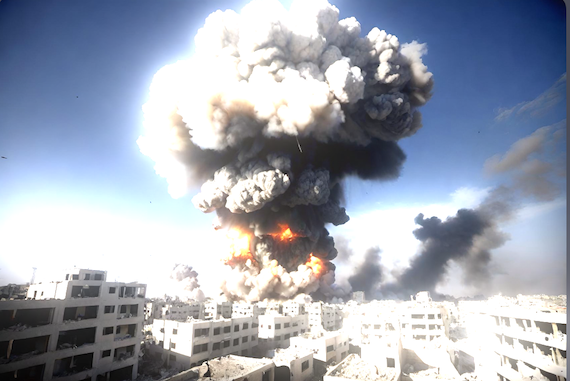
“Nuking Gaza,” by Juan Cole, Digital, Dream / Dreamland v. 3 / IbisPaint, 2024.
Unfortunately for Walberg, who likely talks like this all the time with his inner circle of fellow sociopaths, his remarks were recorded.
It is worth noting the bizarre conspiracy theory that any US aid money sent to Gaza would somehow benefit Russia, China and North Korea or that those three countries back Hamas. I might once have called such paranoid fever dreams abnormal, but I see them and their like normalized all around me these days.
The 2.2 million Gaza noncombatants cannot be blamed for the actions of a small Hamas guerrilla group. These civilians are in imminent danger of mass starvation and some are already dying of hunger. Half of them are children. Most of the rest are women and noncombatant men. Some 70% of them are in Gaza because Zionist gangs chased them out of their homes in 1948 in what became southern Israel, and made them stateless refugees. Now they are being killed on a scale unseen in any conflict in this century.
And, again, mass starvation was a key Nazi technique of war.
the News

Palestinian woman reacts as she cradles a wounded boy after Israeli bombardment in central Gaza City, last week. Credit: AFP
Mar 28, 2024 11:58 pm IST
UN Special Rapporteur on the occupied Palestinian territories, Francesca Albanese, released a report this week claiming that the nature and scope of attacks by Israeli Defense Forces in the Gaza Strip, as well as the ruinous living conditions created there by Israel, “can only be interpreted as constituting prima facie evidence of an intention to systematically destroy the Palestinians as a group.”
One Israeli told me he believes there is no need for such explosive terminology, while another asked whether there was any proof of these claims.
A woman who, until October 7 was affiliated with the left wing and has since sobered up, or awakened, had somehow seen – from beyond the Israeli iron curtain – a photograph of a Gazan child who was all skin and bones. She told me: “If these images are true, we must see them.”
- Israel’s war on Hamas must not turn into a second Palestinian Nakba
- Gaza’s strawberry harvest, once a symbol of abundance, is another victim of the war
- The nine-year-old Palestinian girl bringing Gazans’ struggles to social media amid war
So Israelis may wonder, raise questions, doubt, downplay or revoke Palestinians and their tragedy, even when it is clear as day, published in a United Nations report, or broadcast live on a non-Israeli news channel. I recalled how back after October 7, Palestinians and others were forbidden from asking questions, from questioning “facts” or from asking for proof.
It is well known that claims by the Israeli side are viewed as gospel, and that whoever rejects them is an antisemitic supporter of Hamas. But when it happens on the Palestinian side, all claims are an exaggeration, a conspiracy, fake-news, and Israelis can and are even obligated to ask about their authenticity.
It is interesting just how important is it to ask whether the photographs are real, or whether these claims are supported by any shred of proof, when there is an abundance of evidence of children dying of malnutrition in Gaza.

This doubt that is cast on every Palestinian image, or video, or report, is part of the Israeli iron curtain, with the underlying assumption that all Palestinians are liars.
It is gaslighting of tremendous proportions that Israelis are inflicting upon themselves and on Palestinians, in order to go on ignoring the genocide the entire world has been continually warning about. Israelis refuse to see or listen, and are still convinced that everything is all right.
Israelis are addicted to the iron curtain, and this practice of denying reality is deeply embedded into the Israeli DNA. It is an integral part of the knotted problems Israelis bring upon themselves through their arrogance and boastfulness.
This denial of reality is present at almost every aspect. Are most Israelis aware, for example, that at the core of the current negotiations between Israel and Hamas, or rather at the core of lack of progress in these negotiations, lies the refugee problem? Israel does not want to allow evacuated Palestinians to return to the northern area of the Gaza Strip.

Are Israelis asking themselves what the purpose of permanently uprooting them from the north is and of leaving the area under Israel’s control? That perhaps Israel wants an ethnic cleansing of the Gaza Strip, to be accompanied by establishing settlements just like in the West Bank, which would lead to the same inescapable state of constant warfare and the destruction of relationships with Palestinians everywhere?
From beyond the Israeli iron curtain, reality seems to most Israelis to be essentially good. However, the more they go on looking from behind that iron curtain, so will their distance from reality continue growing, until the inevitable fall into the gaping chasm. Will they still be able to break that curtain?
| March 22, 2024 | Read Online |
 Zachary Foster Zachary Foster |
 Meet the Palestinian Hostages Taken by Israel, Known as “Administrative Detainees”Meet Omar al-Khatib, a research partner at The Institute of Development Studies, affiliated with the University of Sussex in Brighton, UK. Meet the Palestinian Hostages Taken by Israel, Known as “Administrative Detainees”Meet Omar al-Khatib, a research partner at The Institute of Development Studies, affiliated with the University of Sussex in Brighton, UK. Omar al-Khatib, a Palestinian hostage abducted by Israel (source)On 1 March 2024, Omar was taken hostage by Israel. He was not charged with anything. He was not told why he was taken to prison, nor why his imprisonment could be renewed forever.Omar’s colleagues described him as empathic, passionate and brilliant. Omar was robbed of his freedom and will likely be subjected to untold abuses such as harassment, assault, solitary confinement, torture, sexual abuse or possibly worse: at least 7 Palestinian prisoners have mysteriously “died” in Israel’s custody since Oct. 7th. So why was Omar taken hostage? In all likelihood, he will be leveraged as a bargaining chip in hostage negotiations with Hamas. In other words, he was taken for the same reason that Hamas took Israeli civilians hostage on Oct. 7th, as leverage in a prisoner swap. But there is at least one key difference between Israel’s actions and Hamas’s actions: Hamas took a few hundred civilians hostage on Oct. 7th, while Israel has taken 3,558 civilians hostage, and continues to take more hostages every day.In fact, the 3,558 Palestinians taken hostage includes only those known as “administrative detainees,” the term Israel uses to whitewash its policy of hostage taking. [This figure does not include an additional 5,519 Palestinian prisoners, classified as “Security Prisoners”, “Security Detainees” or “Unlawful Combatants”] The phrase “administrative detainee” typifies the sanitizing language that has become a hallmark of Western media coverage of Israel’s genocidal war on the people of Gaza. Palestinians aren’t killed, but they do seem to die a lot; they aren’t attacked, although there are a lot of explosions, and they definitely aren’t hostages, they are administrative detainees.Meet Diala Ayesh, a Palestinian human rights lawyer. On Jan. 17th, Israel took Diala hostage.  Diala Ayesh, a Palestinian hostage abducted by Israel (source)Much like Omar, Diala was not charged with anything nor told why she was taken to prison, nor explained why she could be imprisoned forever without ever getting an answer about what she did wrong.“Whenever I cry at night in bed…I try to remember how extremely strong she is,” her 26-year-old sister, Aseel, told Al Jazeera. Diala’s abduction appears to have been designed to maximize the number of Palestinian lives destroyed via “administrative detention.” That’s because Diala was herself a lawyer defending the rights of other Palestinians abducted by Israel. In fact, she not only defended Palestinian abductees, she was training other lawyers in how to defend Palestinian administrative detainees in Israel’s military courts. For Israel, if there are fewer lawyers to defend the Palestinian hostages, and fewer lawyers to train other lawyers to defend the Palestinian hostages, there will be fewer impediments to taking more Palestinians hostage.Israel’s policy of abducting Palestinians, unsurprisingly, goes back many decades: 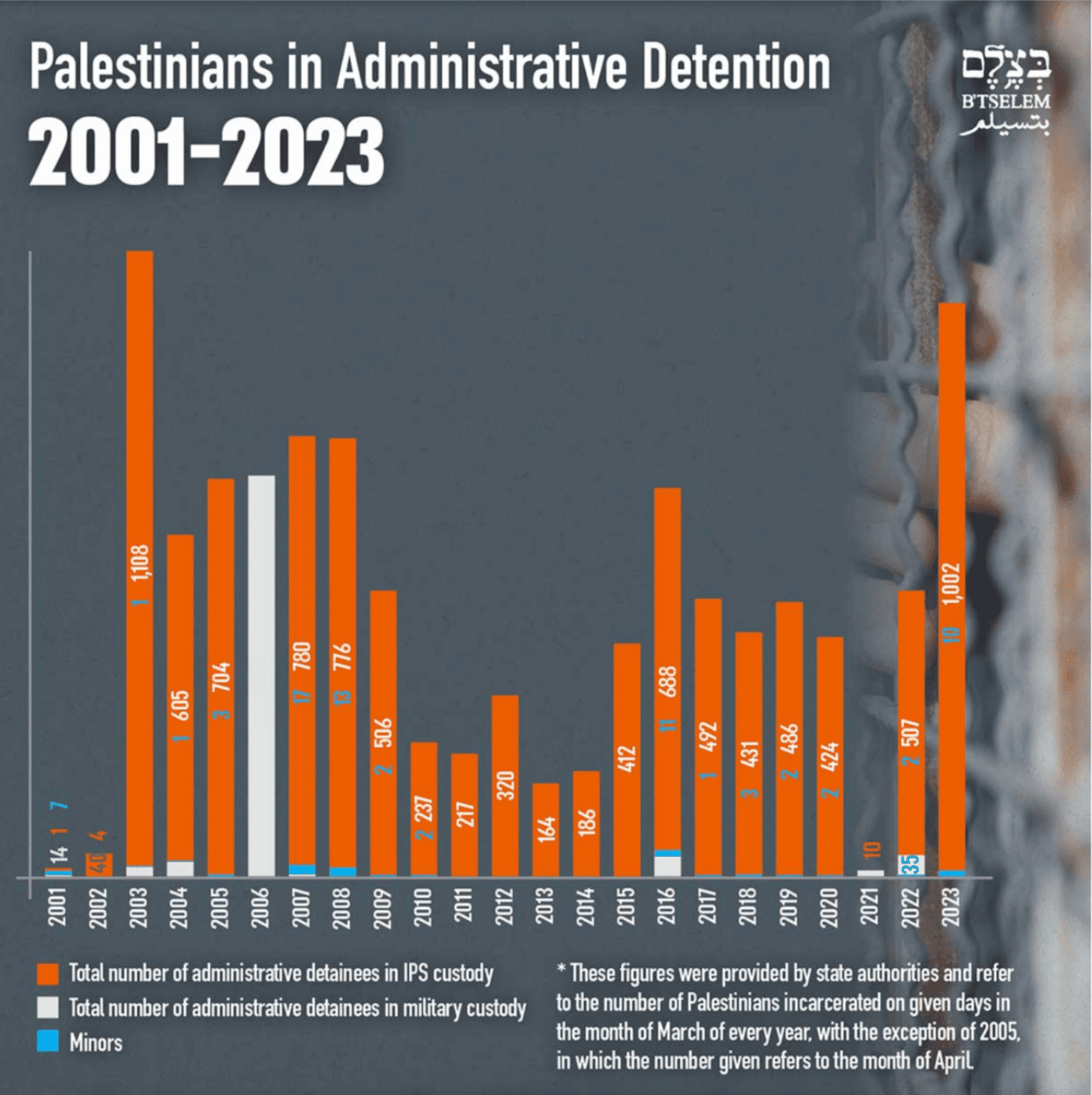 Source: B’tselem Today, Israel is currently holding 3X more Palestinian hostages than at any point in the past two decades, a policy that relies on a simple principle. If you are an Israeli living in the Occupied Palestinian Territories, you are entitled to due process, but if you are a Palestinian living in the Occupied Palestinian Territories, you are not entitled to due process.No surprise that this what-the-fuck policy has triggered the most visceral and self-sacrificial form of resistance: hunger strikes.For decades, Palestinians denied basic due process have been at the forefront of the hunger protests. In May 2023, Khader Adnan died in his prison cell after he went on a hunger strike protesting his imprisonment. Adnan had been arrested at least 12 times in the past and spent around eight years in prison, mostly in “administrative detention.” This was the fifth and final time he was to go on a hunger strike.In Dec. 2021, Israel abducted Khalil Awawdeh, a Palestinian father of four who went on a six-month hunger strike in 2022 until Israel agreed to release him–pressing no further charges against him.It’s time to regard Israel’s policy of hostage taking for what it is, hostage taking. |
Violent abuse, humiliation, appalling overcrowding, cold and barren cells, shackles for days on end. A Palestinian who spent three months in Israeli administrative detention amid the Gaza war describes his experience at Ofer Prison

Amira, at home in the Aida camp this week, after release from Ofer Prison. “I was in Ofer before, but it was never like this.”Credit: Alex Levac Gideon LevyAlex Levac
Mar 23, 2024 5:31 am IST
Munther Amira has been released from “Guantanamo.” He’d already been arrested a few times in the past, but what he experienced during incarceration in an Israeli prison during the Gaza war is unlike anything he has ever gone through. A friend who spent 10 years in an Israeli prison told him that the impact of his own incarceration during the past three months was the equivalent of 10 years in jail during more normal times.
The detailed testimony we heard this week from Amira in his home in the Aida refugee camp, in Bethlehem, was shocking. He expressed his ordeal with his body, kneeling on the floor repeatedly, describing things in minute detail, without any feeling, until the words became unbearable. It was impossible to go on listening to the harrowing descriptions.
But it seemed as though he had been waiting for the opportunity to relate what he endured in an Israeli prison over the past several months. The descriptions poured from him in an unbroken flow – horror heaped on horror, humiliation after humiliation – as he described the hell he had been put through, in fluent English interspersed with Hebrew prison terminology. Over three months, he had lost 33 kilos (73 pounds).
There are two large pictures in his living room. One is of his friend Nasser Abu Srour, who has been imprisoned for 32 years for murdering a Shin Bet security service agent; the other is of him on the day of his release, exactly two weeks ago. This week Amira appeared to be physically and mentally resilient, looking like a different person than he did on the day he left prison.

Amira is 53, married and a father of five; he was born in this refugee camp, whose population includes descendants of the residents of 27 destroyed Palestinian villages. He designed the large key of return that hangs from the camp’s entry gate and bears the inscription, “Not for sale.” Amira is a political activist who believes in a nonviolent struggle, a principle he still holds even after the enormous number of deaths in Gaza in the war, he emphasizes. He is a member of Fatah who works in the Palestinian Authority’s Office for Settlements and the Fence, and a graduate of the social sciences faculty of Bethlehem University.
December 18, 2023, 1 A.M. Loud noises. Amira looks out the window and sees Israeli soldiers hitting his younger brother Karim, who is 40. The troops drag Karim up to the second floor, to Amira’s apartment, and throw him down in the middle of the living room. Amira says his brother fainted. Karim is the administrative director of the cardiac department in Al-Jumaya al-Arabiya Hospital in Bethlehem, and he’s not accustomed to this sort of violence.
- Israel Police are holding Palestinian prisoners in makeshift cage-like cells
- Autopsies of Palestinians who died in Israeli prisons indicate medical neglect, bruising
- The mass killing in Gaza will poison Israeli souls forever
The room was packed with soldiers, dozens perhaps. Amira’s daughter, Yomana, was standing behind him. The officer said, “Take her,” and Amira’s heart skipped a beat. Had they come to arrest his 18-year-old student daughter? What was her transgression? The soldiers then bound his 13-year-old son Mohammed and his son Ghassan, who’s 22. Mohammed was wearing a T-shirt emblazoned with a map of the whole of Palestine – soldiers tore it off him.
Amira didn’t understand what was happening. The soldiers took his picture and sent it to wherever they sent it. “It’s him,” he heard them say afterward. He was bound and taken to a military base, where he was thrown onto the floor and kicked by soldiers, he relates. About an hour later, he was taken back home. He was blindfolded, but in the dark he heard Yomana shouting “I love you.” That fleeting, sweet moment would accompany him during the next three months in prison. He replied, “I love you, and don’t be afraid.” For that he was punished, but at least he felt calmer, knowing that Yomana had not been arrested.

He was again taken away and thrown into a military vehicle, where he was stepped on kicked by soldiers incessantly. He’s the age of the fathers of many of those same soldiers. He was then placed in the trunk of the car, and they started to move. After about half an hour, they reached a military base, where he was left outside on a cold winter night. The soldiers spoke among themselves about Gaza. One of them said to him, “Today we will fulfill your dream. You wanted to be a shahid [religious martyr]? We will send you to Gaza.” Amira shuddered, and answered, “I want to live, not die.” He was afraid that the troops would do what they threatened and already imagined his death in Gaza.
Morning came and he found himself in the Etzion detention center. “Now the show begins,” the soldiers said. Amira was taken into an office, where the handcuffs, which were already leaving blue bruises on his wrists, were removed, and he was ordered to strip. When he got to his underpants, he refused to continue. The soldiers kicked him and he fell to the ground. “Suddenly I understood what rape is, what sexual harassment is. They wanted to strip me and take my picture.” He stood naked, the soldiers told him to spread his legs, he felt humiliated as never before in his life. He was afraid that they would post the videos they took. Finally he was taken to a cell.
Supper consisted of a small plate of cream cheese and a slice of bread. But it was the next day’s lunch that truly flabbergasted Amira. Soldiers placed four trays in the four corners of the room, and eight detainees were ordered to kneel and eat off the trays with their hands. The image that came to mind was street cats, he recalls. The food consisted of unrecognizable and inedible mush. He says it was a mixture of leftovers from the soldiers’ meals. He asked what the white part was and was told that it was from an egg. He’s ready to swear that it was not an egg. Amira didn’t touch the food.
The next day he was moved to Ofer Prison, near Ramallah, where he was questioned about a few posts that the interrogators claimed he had uploaded and which he denied. “There is nothing in my Facebook [feed] that supports violence,” he says. The posts included identification with the fate of the residents of Gaza. “‘Mabruk [congratulations],’ the interrogator said. ‘You’re going to administrative detention'” – incarceration without a trial.

That was Amira’s lot for the next three months. He was sentenced to four months in prison, on the basis of no evidence, let alone a trial. “I was in Ofer before, but it was never like this.” The combination of a war during which Palestinians everywhere can be subjected to abuse, and the fact that the Israel Prison Service is under the purview of Itamar Ben-Gvir, the national security minister, is leaving its mark. Amira decided not to resist anything, in order to survive.
He received a brown prison service uniform, with no underwear and with no connection to his size. Later, he exchanged clothes with another inmate. He had a mattress 5 centimeters (about 2 inches) thick and a wool blanket; he slept with 12 other detainees in a cell designed for five. “That is contrary to a High Court of Justice decision,” he notes. Eight inmates slept on the floor; because of his age he was given the use of a bed.
Amira discovered that he was in Wing 24 of the prison, which is earmarked for problematic detainees. “And I thought I was a good person,” he says with a smile. New prisoners who arrived from Gaza were held in the adjacent wing. He thinks some of them were from Hamas’ Nukhba unit. He will not soon forget their shouts. “People are screaming, people are barking, people are crying, locked up 24 hours a day, blindfolded, and the guards beat them nonstop.”
Not that things were easy in his wing. Five times during the three months, prison service special ops officers employing acute violence raided their cell, each time on a different pretext. The cell didn’t look the way an Ofer cell used to appear: It was completely bare. The television, the electric kettle, the burner, the radio, the books, the pen and paper, the chess, the backgammon – nothing remained, and of course there was no canteen. I came to terms with it, Amira says. This is the price of resistance to the occupation and the war in Gaza.
They assembled a backgammon board using a bread carton, and drew the markings for the game with a solution made from one prisoner’s crushed-up anti-anxiety tablets and water. The pieces were made from eggshells. Then one night, the patrol confiscated the improvised game. Punishment came swiftly. At 6 A.M., the special ops force Keter Ofer showed up with two dogs, and assaulted the inmates. Then they took them to the showers and washed them down in their clothes. The next morning they took away the blankets and mattresses, keeping them until 10 P.M. The cold was brutal.
No coffee, no cigarettes. It was a nightmare for smokers. Sometimes the prisoners would walk by and smoke into the cell to exacerbate their suffering. The aroma of the guards’ coffee also drove the inmates crazy. Two small dishes of jam for 13 prisoners, who fought just to get a taste.

“I counted the seconds,” Amira says, but time seemed to stand still in prison. For the first time he saw an inmate who tried to kill himself by throwing himself from the second floor onto the fence outside. Lately there have been more attempts at suicide in the prison, he says, which goes completely against the ethos of Palestinians who have decided to struggle against the occupation. The inmate who jumped was bleeding, his fellow inmates tried to call for a paramedic. But in Ofer you’re not allowed to call for anyone – so again they were punished. The Keter Ofer squad reappeared and this time made them all lie on the floor and beat them with truncheons. They hit Amira in the testicles, too. That too is sexual assault, in his view. “I said to myself: I am going to die. I have a blood pressure problem, and my heart was pounding. Some of us were bleeding from the nose.”
The eggs that were served were not cooked. A few days later, he decided he would eat everything, in order to survive. On one occasion, when they were taken to “waiting” cells (solitary cells for those about to be transferred), and he was handcuffed for an entire day and night. He had to relieve himself in his pants because he wasn’t able to lower them. “And everything has to do with October 7. Everything I asked for, they said ‘October 7.’ When we asked for the eggs to be cooked, they said: ‘October 7.’ It’s Guantanamo, I tell you.”
The Israel Prison Service spokesperson stated this week in response to an inquiry from Haaretz: “We are not aware of the allegations that are described, and as far as we know they are incorrect. If a proper complaint is submitted, it will be examined by the appropriate persons.”
The IDF Spokesperson’s Unit told Haaretz: “The suspect was arrested on December 18, 2023, on suspicion of incitement and activity in a hostile organization. During a hearing in the military court on the military prosecutor’s request to extend his confinement, the suspect raised claims regarding his treatment by the soldiers during his imprisonment. The claims are being clarified.”
Amira was released after three months, a month ahead of schedule. No one told him anything, he was just given clothing supplied by the Red Cross and thought he was being freed as part of a deal (that didn’t happen). He told us in his home this week: “Mahmoud Darwish wrote that the prisoners are the source of hope of the Palestinian people. That is no longer true. It’s the first time that detainees are trying to commit suicide. The first time I felt that the door of the cell is the door of a grave. An Israeli prison is now a graveyard for the living.”
 band annie's Weblog