Search

band annie's Weblog

I have a parallel blog in French at http://anniebannie.net

Category

israel

A Pillar Built on Sand

November 16, 2012

The great John Mearsheimer has a brilliant piece on the LRB Blog. It is the most comprehensive historical and political analysis of recent developments in Gaza. Two passages in particular bear highlighting. The first one is about Israel’s long-standing strategy:

John Mearsheimer

Israel’s leaders have a two-prong strategy for dealing with their Palestinian problem. First, they rely on the United States to provide diplomatic cover, especially in the United Nations. The key to keeping Washington on board is the Israel lobby, which pressures American leaders to side with Israel against the Palestinians and do hardly anything to stop the colonisation of the Occupied Territories.

The second prong is Ze’ev Jabotinsky’s concept of the ‘Iron Wall’: an approach that in essence calls for beating the Palestinians into submission. Jabotinsky understood that the Palestinians would resist the Zionists’ efforts to colonise their land and subjugate them in the process. Nonetheless, he maintained that the Zionists, and eventually Israel, could punish the Palestinians so severely that they would recognise that further resistance was futile.

Israel has employed this strategy since its founding in 1948, and both Cast Lead and Pillar of Defence are examples of it at work. In other words, Israel’s aim in bombing Gaza is not to topple Hamas or eliminate its rockets, both of which are unrealisable goals. Instead, the ongoing attacks in Gaza are part of a long-term strategy to coerce the Palestinians into giving up their pursuit of self-determination and submitting to Israeli rule in an apartheid state.

The second passage is about the timing of this particular assault:

The timing of the present operation is easy to explain. For starters, President Obama has just won a second term despite Netanyahu’s transparent attempt to help Mitt Romney win the election. The prime minister’s mistake is likely to have hurt his personal relations with the president and might even threaten America’s ‘special relationship’ with Israel. A war in Gaza, however, is a good antidote for that problem, because Obama, who faces daunting economic and political challenges in the months ahead, has little choice but to back Israel to the hilt and blame the Palestinians.

The Israeli prime minter faces an election of his own in January and asMitchell Plitnick writes, ‘Netanyahu’s gambit of forming a joint ticket with the fascist Yisrael Beiteinu party has not yielded anything close to the polling results he had hoped for.’ A war over Gaza not only allows Netanyahu to show how tough he is when Israel’s security is at stake, but it is also likely to have a ‘rally round the flag’ effect, improving his chances of being re-elected.

source

Gaza : Hypocrisy, As Usual

Qunfuz

Robin Yassin-Kassab

Omar al-Masharawi, son of a BBC cameraman in Gaza, murdered by Zionist bombs.

Israel has launched yet another attack against the Gaza Strip, striking the densely-populated and besieged territory from the air and the sea, and as usual the United States, Canada and Britain have lined up in support of Zionist terrorism.

Speaking from a system poisoned by the Israel lobby, State Department spokesman Mark Toner says: “There is no justification for the violence that Hamas and other terrorist organizations are employing against the people of Israel. We call on those responsible to stop these cowardly acts immediately. We support Israel’s right to defend itself.” Confusing Zionist settlers for ‘the Jewish people’, confusing perpetrator with victim, and then parroting outmoded ‘war on terror’ propaganda, Canadian foreign minister John Baird vomits the following: “Far too often, the Jewish people find themselves on the front lines in the struggle against terrorism, the great struggle of our generation.” Then Britain’s foreign minister William Hague makes the following immoral and illogical comment: “I utterly condemn rocket attacks from Gaza into southern Israel by Hamas and other armed groups. This creates an intolerable situation for Israeli civilians in southern Israel, who have the right to live without fear of attack from Gaza.”

Two things must be said. First, this round of escalation, like the 2008/2009 slaughter, was started by Israel. It is totally mendacious to pretend otherwise. The Hamas government in Gaza refrained from stopping other groups from firing missiles as a result of Israel’s murder of a disabled man and of a twelve-year-old boy in Gaza. Here is a timeline of events. Second, the settlers of southern Israel do not have the right to live without fear of attack while the original inhabitants of ‘southern Israel’ are herded into refugee camps. Eighty percent of people in Gaza are descendants of refugees ethnically cleansed from their villages and towns by Zionist militias in 1947 and 1948.

No Western approach to the Middle East will be coherent or helpful so long as the West remains attached to apartheid Israel. America has granted some millions of dollars to support Syrian refugees and to provide a few revolutionary activists with satellite phones, but Obama refuses to recognise the Syrian National Coalition as representative of the Syrian people, and has made it clear that the US won’t be supplying weaponry to the Free Syrian Army. Indeed, the Obama administration has been preventing Qatar and Saudi Arabia from providing effective weaponry to the resistance. Fear of Islamism translates here into fear of anti-Zionism. No weapons can be supplied which might one day be turned against the occupiers of the Golan Heights and the tormentors of the Palestinians.

Oil and geostrategy also ensure that Western policy on the Middle East will continue to lack credibility. After visiting Syrian refugee camps in Jordan David Cameron seemed to incline to arming the Syrian resistance, but he arrived in Jordan after a tour of the Gulf in which he’d offered to arm several tyrannies, including the Bahraini tyranny which is killing, imprisoning and torturing its democratic opposition. Bahrain hosts the US Fifth Fleet.

States and politicians are beholden to interests and lobbies. There is less excuse for individual activists and ‘anti-imperialists’ who are partial to one group’s freedom but make excuses for denying that of another. Many support the Bahraini revolution but not the Syrian, or vice versa, for sectarian reasons or out of blanket thinking (of course, sectarianism is a form of blanket thinking). And many of those who are quite correctly calling for demonstrations today against Zionist terror have not stirred in the last two years as forty thousand Syrians have been slaughtered, except perhaps to explain that the victims are enacting a dastardly plot against a resistance regime. A recent Facebook status from Sharif Nashashibi serves as an excellent rejoinder: “Sadly, there are people who condemn the slaughter of Palestinians but defend the slaughter of Syrians, and vice versa. As a Palestinian and a Syrian, I totally reject these hypocrites’ so-called support. The suffering of Palestine is the suffering of Syria, and vice versa. We are one and the same.”

This is absolutely correct. The slaughter of the people of bilad ash-Sham is as much of an abomination in Syria as it is in Palestine. American support for the frenzied Zionist bombing of Gaza is no more or less disgusting than Russian (and Iranian) support for Asadist barbarism. Furthermore, both Palestinians and Syrians have the right to self-defence. This is why I support providing anti-aircraft weaponry to both the Syrian and the Palestinian resistance.

Many analysts believe the timing of Israel’s attack has been determined by upcoming elections. Netanyahu needs to look tough for his rabid public, so he brings more trauma and death to Gaza. It is grotequely easy for Zionists to act out their impulses on the Palestinians, just as they used to find south Lebanon easy. In this revolutionary age, is no Arab power going to make the slaughter more expensive?

Saad el-Katatny of Egypt’s Muslim Brotherhood says, “The brutal aggression on Gaza proves that Israel has not yet learned that Egypt has changed.” So far, President Morsi has recalled the Egyptian ambassador from Tel Aviv, called a UN Security Council meeting, and opened the Rafah border for medical evacuations. This is far more than Mubarak would have done, but it’s still not nearly enough. The Qatari foreign minister says, “This filthy crime must not pass without a punishment.” Again, words are not enough. (By the by, I wonder if infantile leftists will decide that Palestinian resistance is a foreign plot now that the Qatari emir has visited Gaza and funded some projects there?)

While pointless adventurism would be criminally stupid at this moment of general Arab crisis, the new leaders of revolutionary Egypt, Tunisia and Libya, and old leaders seeking to adapt to the revolutionary wave, should remember that national dignity as expressed through a pro-Arab and anti-imperialist foreign policy is one of the key demands of Arab revolutionaries. This is a test for the Egyptian Muslim Brotherhood in particular. The Palestinians must not be left alone indefinitely.

source

Two new resources: Timeline of Israeli escalation in Gaza and Israel’s history of breaking ceasefires

by on November 14, 2012 7

The Institute for Middle East Understanding has released two useful resources on the current Israeli attack on Gaza. The first presents a timeline of events and the second outlines Israel’s history of breaking ceasefires.

TIMELINE: ISRAEL’S LATEST ESCALATION IN GAZA

THURSDAY, NOVEMBER 8

Following a two-week lull in violence, Israeli soldiers invade Gaza. In the resulting exchange of gunfire with Palestinian fighters, a 12-year-old boy is killed by an Israeli bullet while he plays soccer.

Shortly afterwards, Palestinian fighters blow up a tunnel along the Gaza-Israel frontier, injuring one Israeli soldier.

SATURDAY, NOVEMBER 10

An anti-tank missile fired by Palestinian fighters wounds four Israeli soldiers driving in a jeep along the Israel-Gaza boundary.

An Israeli artillery shell lands in a soccer field in Gaza killing two children, aged 16 and 17. Later, an Israeli tank fires a shell at a tent where mourners are gathered for a funeral, killing two more civilians, and wounding more than two dozen others.

SUNDAY, NOVEMBER 11

One Palestinian civilian is killed and dozens more wounded in Israeli attacks. Four Israeli civilians are also injured as a result of projectiles launched from Gaza, according to the Israeli government.

During an Israeli government cabinet meeting, Transportation Minister Yisrael Katz urges the government to “cut off the head of the snake… take out the leadership of Hamas in Gaza.” He also calls for a cutting off of water, food, electricity, and fuel shipments to Gaza’s 1.7 million people.

MONDAY, NOVEMBER 12

Palestinian militant factions agree to a truce if Israel ends its attacks.

WEDNESDAY, NOVEMBER 14

Israel breaks two days of calm by assassinating Ahmed Jabari, the head of Hamas’ military wing. According to reports, at least eight other Palestinians are killed in Israeli attacks, including at least two children. Palestinian militant groups vow to respond.

FACT SHEET – Self-Defense or Provocation?: Israel’s History of Breaking Ceasefires

Since Israel’s creation in 1948, Israeli political and military leaders have demonstrated a pattern of repeatedly violating ceasefires with their enemies in order to gain military advantage, for territorial aggrandizement, or to provoke their opponents into carrying out acts of violence that Israel can then exploit politically and/or use to justify military operations already planned.

The following fact sheet provides a brief overview of some of the most high profile and consequential ceasefire violations committed by the Israeli military over the past six decades.

2012 – On November 14, two days after Palestinian factions in Gaza agree to a truce following several days of violence, Israel assassinates the leader of Hamas’ military wing, Ahmed Jabari, threatening to escalate the violence once again after a week in which at least six Palestinian civilians are killed and dozens more wounded in Israeli attacks.

2012 – On March 9, Israel violates an Egyptian-brokered ceasefire and assassinates the head of the Gaza-based Popular Resistance Committees, sparking another round of violence in which at least two-dozen Palestinians are killed, including at least four civilians, and scores more wounded. As usual, Israel claims it is acting in self-defense, against an imminent attack being planned by the PRC, while providing no evidence to substantiate the allegation.

Following the assassination, Israeli journalist Zvi Bar’el writes in Haaretz newspaper:

‘It is hard to understand what basis there is for the assertion that Israel is not striving to escalate the situation. One could assume that an armed response by the Popular Resistance Committees or Islamic Jihad to Israel’s targeted assassination was taken into account. But did anyone weigh the possibility that the violent reaction could lead to a greater number of Israeli casualties than any terrorist attack that Zuhair al-Qaisi, the secretary-general of the Popular Resistance Committees, could have carried out?

‘In the absence of a clear answer to that question, one may assume that those who decided to assassinate al-Qaisi once again relied on the “measured response” strategy, in which an Israeli strike draws a reaction, which draws an Israeli counter-reaction.’

Just over two months prior, on the third anniversary of Operation Cast Lead, Israeli army Chief of Staff Lt. Gen. Benny Gantz tells Israel’s Army Radio that Israel will need to attack Gaza again soon to restore its power of “deterrence,” and that the assault must be “swift and painful,” concluding, “We will act when the conditions are right.”

2011 – On October 29, Israel breaks a truce that has maintained calm for two months, killing five Islamic Jihad members in Gaza, including a senior commander. The following day, Egypt brokers another truce that Israel proceeds to immediately violate, killing another four IJ members. In the violence, a total of nine Palestinians and one Israeli are killed.

2008 – In November, Israel violates a ceasefire with Hamas and other Gaza-based militant groups that has been in place since June, launching an operation that kills six Hamas members. Militant groups respond by launching rockets into southern Israel, which Israel shortly thereafter uses to justify Operation Cast Lead, its devastating military assault on Gaza beginning on December 27. Over the next three weeks, the Israeli military kills approximately 1400 Palestinians, most of them civilians, including more than 300 children. A UN Human Rights Council Fact Finding Mission led by South African jurist Richard Goldstone subsequently concludes that both Israel and Hamas committed war crimes and crimes against humanity during the fighting, a judgment shared by human rights organizations such as Amnesty International and Human Rights Watch.

2002 – On July 23, hours before a widely reported ceasefire declared by Hamas and other Palestinian groups is scheduled to come into effect, Israel bombs an apartment building in the middle of the night in the densely populated Gaza Strip in order to assassinate Hamas leader Salah Shehada. Fourteen civilians, including nine children, are also killed in the attack, and 50 others wounded, leading to a scuttling of the ceasefire and a continuation of violence.

2002 – On January 14, Israel assassinates Raed Karmi, a militant leader in the Fatah party, following a ceasefire agreed to by all Palestinian militant groups the previous month, leading to its cancellation. Later in January, the first suicide bombing by the Fatah linked Al-Aqsa Martyr’s Brigade takes place.

2001 – On November 23, Israel assassinates senior Hamas militant Mahmoud Abu Hanoud. At the time, Hamas was adhering to an agreement made with PLO head Yasser Arafat not to attack targets inside of Israel. Following the killing, respected Israeli military correspondent of the right-leaning Yediot Ahronot newspaper, Alex Fishman, writes in a front-page story: “We again find ourselves preparing with dread for a new mass terrorist attack within the Green Line [Israel’s pre-1967 border]… Whoever gave a green light to this act of liquidation knew full well that he is thereby shattering in one blow the gentleman’s agreement between Hamas and the Palestinian Authority; under that agreement, Hamas was to avoid in the near future suicide bombings inside the Green Line…” A week later, Hamas responds with bombings in Jerusalem and Haifa.

2001 – On July 25, as Israeli and Palestinian Authority security officials meet to shore up a six-week-old ceasefire, Israel assassinates a senior Hamas member in Nablus. Nine days later, Hamas responds with a suicide bombing in a Jerusalem pizzeria.

1988 – In April, Israel assassinates senior PLO leader Khalil al-Wazir in Tunisia, even as the Reagan administration is trying to organize an international conference to broker peace between Israelis and Palestinians. The US State Department condemns the murder as an “act of political assassination.” In ensuing protests in the occupied territories, a further seven Palestinians are gunned down by Israeli forces.

1982 – Following Israel’s invasion of Lebanon in June, and after PLO fighters depart Beirut under the terms of a US-brokered ceasefire, Israel violates the terms of the agreement and moves its armed forces into the western part of the city, where the Palestinian refugee camps of Sabra and Shatila are located. Shortly thereafter, Israeli soldiers surround the camps and send in their local Christian Phalangist allies – even though the long and bloody history between Palestinians and Phalangists in Lebanon is well known to the Israelis, and despite the fact that the Phalangists’ leader, Bashir Gemayel, has just been assassinated and Palestinians are rumored (incorrectly) to be responsible. Over the next three days, between 800 and 3500 Palestinian refugees, mostly women and children left behind by the PLO fighters, are butchered by the Phalangists as Israeli soldiers look on. In the wake of the massacre, an Israeli commission of inquiry, the Kahan Commission, deems that Israeli Defense Minister (and future Prime Minister) Ariel Sharon bears “personal responsibility” for the slaughter.

1981-2 – Under Defense Minister Ariel Sharon, Israel repeatedly violates a nine-month-old UN-brokered ceasefire with the PLO in Lebanon in an effort to provoke a response that will justify a large-scale invasion of the country that Sharon has been long planning. When PLO restraint fails to provide Sharon with an adequate pretext, he uses the attempted assassination of Israel’s ambassador to England to justify a massive invasion aimed at destroying the PLO – despite the fact that Israeli intelligence officials believe the PLO has nothing to do with the assassination attempt. In the ensuing invasion, more than 17,000 Lebanese are killed.

1973 – Following a ceasefire agreement arranged by the US and the Soviet Union to end the Yom Kippur War, Israel violates the agreement with a “green light” from US Secretary of State Henry Kissinger. According to declassified US documents, Kissinger tells the Israelis they can take a “slightly longer” time to adhere to the truce. As a result, Israel launches an attack and surrounds the Egyptian Third Army, causing a major diplomatic crisis between the US and Soviets that pushes the two superpowers to the brink of nuclear war, with the Soviets threatening to intervene to save their Egyptian allies and the US issuing a Defcon III nuclear alert.

1967 – Israel violates the 1949 Armistice Agreement, launching a surprise attack against Egypt and Syria. Despite claims Israel is acting in self-defense against an impending attack from Egypt, Israeli leaders are well aware that Egypt poses no serious threat. Yitzhak Rabin, Chief of the General Staff of the Israeli army during the war, says in a 1968 interview that “I do not believe that Nasser wanted war. The two divisions he sent into Sinai on May 14 would not have been enough to unleash an offensive against Israel. He knew it and we knew it.” And former Prime Minister Menachem Begin later admits that “Egyptian army concentrations in the Sinai approaches did not prove that Nasser was really about to attack us. We must be honest with ourselves. We decided to attack him.”

1956 – Colluding with Britain and France, Israel violates the 1949 Armistice Agreement by invading Egypt and occupying the Sinai Peninsula. Israel only agrees to withdraw following pressure from US President Dwight Eisenhower.

1949 – Immediately after the UN-brokered Armistice Agreement between Israel and its neighbors goes into effect, the armed forces of the newly-created Israeli state begin violating the truce with encroachments into designated demilitarized zones and military attacks that claim numerous civilian casualties.

About Adam Horowitz

Adam Horowitz is Co-Editor of Mondoweiss.net.

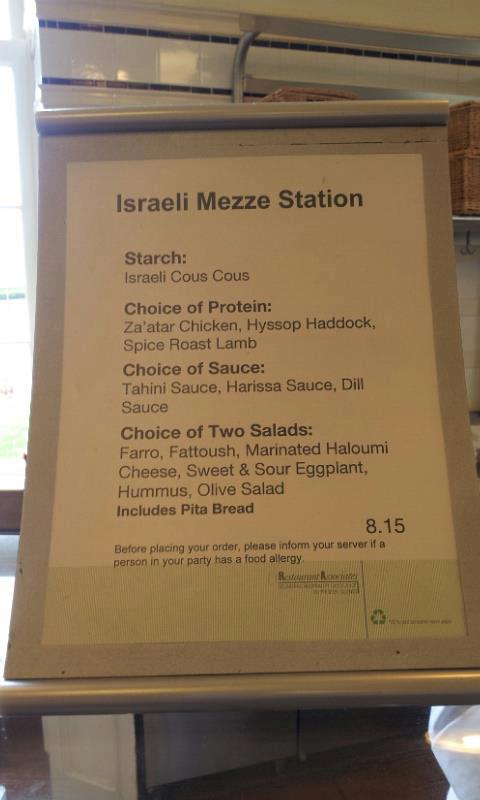
From the cafeteria of the Harvard Business School

Sara El-Yafi from her fb page

Alright Harvard Business School, let’s have a word or two.

I understand that you like to “change” things in your dining room every once in a while to tickle the palate of the HBS kids who have a tendency to grow blasé rather quickly of your stationary Italian, Asian, & Micronesian stations, so you feel the need to spice it up with an occasional exotic nationality… but this, THIS, is where we draw the line. Israeli food station? Hold your breath.

Let’s see:
1. Harissa (ه

ريسة) is a Tunisian and Libyan hot chili sauce whose main ingredient is piri piri. Piri piri grows in the wild in Africa. –> Since Israel is not in Africa, Harissa is not Israeli.

2. Couscous (كسكس) is a Maghrebian dish, a staple food throughout Algeria, Morocco, Tunisia, and Libya. Not Israeli. As for “Israeli couscous”, the real name is “Maftoul” (مفتول), which is a Palestinian dish of Couscous.

3. Fattūsh (فتوش) is a word made of Arabic fatt “crush” and the suffix of Turkic origin -ūsh. Coining words this way was common in Syrian Arabic as well as in other dialects of Arabic. –> Unless Israel’s main language is Arabic, this too is NOT Israeli.

4. Halloumi (χαλούμι) is a Cypriot semi-hard, unripened brined cheese made from a mixture of goats’ and sheep milk. It’s not even ARABIC. So seriously, your “fuck-you” is not even centered around Arabs, it’s going west. –> Until Cyprus becomes another conquered Israeli territory, Halloumi is considered NOT Israeli.

5. Hummus (حُمُّص): Let’s get to the bottom of this once and for all. Hummus is an Arabic word meaning “chickpeas.” Ok? It is an Arabic word. As far as “Israelis” are concerned, they don’t speak Arabic. So unless you change your primary language, you have no argument here. The earliest documented recipe for something similar to modern hummus dates to 13th Century (CE) Egypt. –> Since Israel was created in 1948, Israel is NOT 13th CENTURY EGYPT! And Hummus is therefore NOT ISRAELI.

6. Tahini (طحينه): ONE: Tahini is a loanword from Arabic: طحينة, or more accurately ṭaḥīnīa طحينية, and is derived from the root ط ح ن Ṭ-Ḥ-N which as a verb طحن ṭaḥan which means “to grind.” TWO: You can only make Hummus with Tahini, since it is the second main ingredient. –> As per the argument of Hummus, we conclude that Tahini is NOT Israeli.

7. Zaatar (زَعْتَر): Alright. Zaatar is THYME. It is a Middle-Eastern plant. It grows in Palestine and other land areas. Since Israel is modern-day Palestine, then I can see why you would like to make that plant Israeli. And you might be able to get away with it. But get this: Zaatar is an Arabic word. So, to make your argument more solid, why don’t you use a Hebrew word for it? Like “שקר”, which is hebrew for LIE.

8. Mezze (in the title): This word (which refers to a selection of small dishes) comes from the Turkish meze ‘taste, flavour, snack, relish’, borrowed from Persian مزه (maze ‘taste, snack’ < mazīdan ‘to taste’) and/or the Greek version mezés (μεζές). SO TURKISH, PERSIAN and GREEK –> NOT ISRAELI.

9. “Sweet & Sour”: This draws the f*ckin limit. Now this sure isn’t Arabic, but I would like to see Chinatown respond to this.

Dear HBS, that “Israeli Mezze Station” is the ultimate multicultural, multireligious fuck-you in the face of ALL Arabs at once from North Africa to the Levant… (while engaging a small spit on the Cypriots)… NINE counts.

If you insist on giving no honor to the Arabs (many of whom are Harvard students/alumni- “hi!”), and/or if you insist on never ever speaking of Arabs in culinary worth (since we’re only ever referred to as warmongers and terrorists), at least have the decency of calling it MEDITERRANEAN MEZZE STATION.

Israel already has a hard time keeping face in the Arab world for the way it has “appropriated” its lands since 1948, don’t make it worse for them by having them appropriate other peoples’ foods as well.

“Before placing your order, please inform your server if a person in your party is an Islamic fundamentalist and/or has ties to the Chinese government. We will rectify the nationality of your dish accordingly.
Sincerely, HBS”

Onwards.

(Picture taken by my dear friend/Harvard classmate “Mohamed El Dahshan” two days ago in the Harvard Business School Dining Room)

When an Israeli soccer game looks like a Klan rally

By

|Published November 2, 2012

It’s hard to say which is worse – the behavior of racist fans, or the tacit approval they get from Israeli sports officials and media.

I like to think that if you discount for the century of fighting with Arabs, Israel is still plenty racist, but no more than most societies. I remind myself that even the absolute worst display of Israeli racism – the chanting of monkey noises (“hoo-hoo-hoo!! hoo-hoo-hoo!!”) and the throwing of bananas at black players during soccer games – has been going on in Europe, too, and probably elsewhere. But what happened this week to Nigerian-born Israeli player Toto Tamuz shows a level of callousness to blatant, raw racism that I wonder how many countries could match.

On Monday, Tamuz scored the go-ahead goal against Beitar Jerusalem in the capital’s Teddy Stadium, and right afterward looked out at the crowd and put his index finger up to his lips to shush them. Immediately the referee penalized him for unsportsmanlike conduct: “provoking the crowd.” Since this was Tamuz’s second penalty of the game, he was automatically disqualified. His team, Hapoel Tel Aviv, went on to lose, 3-2.

It was only after a day of sports reporters and commentators praising the Beitar crowd for firing up the atmosphere with their mad-dog spirit that it became known why Tamuz tried to shush the crowd in the first place. He told Yediot Aharonot:

I’ve never seen such racism in my whole life. … [two other black Hapoel players] and I were the last ones on the field. When we came out of the tunnel they started throwing bananas at us. We heard curses and racist chants. … [During the game] I heard their regular song, ‘Give Toto a banana,’ and a lot of other things I’m embarrassed to mention.

Another black Hapoel player, Eric Djemba Djemba from Cameroon, told the newspaper:

When they call you ‘kushi’ [‘nigger’] … and throw bananas at you, it’s not exactly pleasant. I like this country and I’m happy to be here, but this is impossible. I didn’t know things like this happened in Israel.

From the media coverage I saw (which was not by any means comprehensive), these remarks were treated as “their side of the story,” but the “objective” story was mainly about a hugely exciting soccer game in which there probably was a bad call by the ref, along the lines of:  you shouldn’t throw a player out of the game for “shushing” the crowd, but then those are the breaks …

What’s shocking about all this is that everyone in Israel knows that what Tamuz and Djemba Djemba described is what happens at any given game in which black players are on the field, especially if they score a goal. I witnessed it myself at a game in Tel Aviv’s Bloomfield Stadium in 2006, one of the very few Israeli soccer games I’ve been to. When an opposing black player would get the ball, a few Maccabi Tel Aviv fans several rows up from me would start chanting the monkey noises. (Neither I nor anyone else in the stands said a word to them. I was there with my two young sons, and I was afraid to confront them for fear of having to fight them all, which I imagine was in the minds of many other fans.) Later, when one of the black players on the visiting team scored a goal, the section reserved for several hundred hardcore Maccabi fans erupted with loud, furious, sustained chants of “hoo-hoo-hoo!! hoo-hoo-hoo!!

This sort of thing has been going on at Israeli soccer games ever since the first black players arrived from overseas almost 20 years ago. The racist chanting against opposing Arab players has been going on ever since Arabs came into the league. Everybody knows this – and everybody knows that the worst, most psychotically racist fans in the country are those of Beitar Jerusalem, and that the atmosphere in Teddy Stadium when there are Arab or black opponents on the field is something out of a Klan rally. (I’ve sat in the stands with Beitar fans; they sing “I hate all the Arabs” with as much ease and familiarity as they sing Happy Birthday to You.)

Anybody who knows anything about Israeli soccer knows that Tamuz, who used to play for Beitar Jerusalem, was telling the truth – that he was trying to silence the racial mass hysteria going on in the stands. The same exact thing happened to him about two years ago in a game against Beitar – the monkey noises, the singing of “Give Toto a banana” – only that time the Israel Football Association had the decency to penalize Beitar, even rather severely, in soccer terms. But that was the exception; the rule is to accept what’s going on, to pretend it’s not happening, and the rule was in force this week.

The story wasn’t the Beitar crowd, but rather Tamuz. When the referee made him the villain and kicked him out of the game for his shushing gesture, the question in the media was whether the referee had been too harsh, not whether such a thing could have really happened, not whether we were all living in some Stephen King story.

And it didn’t end there. When the referee threw Tamuz out, the 24-year-old made some parting remarks. Tamuz says he told the ref that the crowd was the guilty one, not him. The ref says Tamuz called him “a shame and disgrace.” For that, Tamuz had to go before an Israel Football Association judge, attorney Yisrael Shimoni, who banned him from Hapoel’s next two games and put him on probation for two more.  ”There is no connection between, on the one hand, the atmosphere in the stands and whether racist expressions were made or not, and, on the other hand, the insulting remarks to the referee,” said the judge.

Beitar Jerusalem, the pride of the Israeli right, the only team in the league that has an unwritten but ironclad ban on hiring Arab players, said the claims by Tamuz and Djemba Djemba were an “orchestrated campaign of lies.”

Hapoel Tel Aviv, the pride of the Israeli left, the only predominantly Jewish team in the league to have an Israeli Arab captain, provided the only note of decency and honor in this episode. It announced: “The team will give full backing to its players who fall victim to racist attacks from rival fans. The next time the team’s players are victimized by racist, demeaning behavior from the fans of any team – all of [Hapoel’s] players and officials will leave the field immediately.”

source

Israelis vs. Africans (Goldstein Dawn)

[youtube http://youtu.be/XGzBwLd0OfY?]

October 28, 2012 Tel Aviv, Israel protest demanding the expulsion of all non-Jewish African asylum-seekers

Goldstein dawn, may be a  reference to the xenophobic fascist Greek political party Golden Dawn

On Facebook, IDF illustrates Palestinian violence – with photo from Bahrain

An infographic purportedly depicting Palestinian attacks in the West Bank makes its case with a photo shot during a Bahrain protest. This would not be the first time the army posted misleading photographs to Facebook to serve its PR machine.

By Mati Milstein

On October 17, the Israeli military posted the above infographic on its Facebook page. The image includes a photograph of a young masked man holding a firebomb and featuring statistics regarding the number of firebomb attacks against Israelis in the West Bank since the start of 2012. The Israeli military urges Facebook users to share the image “because the mainstream media will not.”

In fact, the mainstream media did share this photo extensively – in its coverage of protests in Bahrain.

This powerful image has nothing to do with Judea, Samaria, Palestinians or Israelis. It was shot by Reuters photographer Hamad I Mohammed during protests in the Bahraini village of Salmabad last April.

The Israeli military’s decision to use foreign photos to illustrate attacks in the West Bank as part of its propaganda efforts (without indicating that the image is only an illustration) may raise some interesting questions about its own ethical perception and standards.

This is not the first time the army has faced this particular criticism. In June, the army marked gay pride month by posting a photograph of two male Israeli soldiers holding hands. It was later revealed that the two soldiers are not a couple and only one of them is gay.

The use of a photo unrelated to the incident it purports to be illustrating was also more striking given the recent Israeli reaction to another alleged misuse of photographs.

Last March, Israeli military and political figures demanded the United Nation’s OCHA office in Jerusalem fire a staff member after she tweeted a photograph of a fatally wounded girl, whom she indicated had just been killed by Israeli fire in Gaza.

Pro-Israel activists and government officials maintained that the photograph had been published by Reuters in 2006 and a veritable campaign was launched besmirching the OCHA employee. Beyond the hypocrisy inherent in doing something that you had only just condemned others for doing, we should remember a key distinction between the two incidents: While the OCHA employee published the concerned photograph on her private Twitter account, as a private citizen, the Israel Defense Force is an official body and its Facebook page is an official government channel.

There are two options here: 1) The Israeli military did not know the source of the Bahraini image and did not bother to investigate before choosing to use the image (an “investigation” that took me only five minutes); 2) The military was aware of the photograph’s origin and chose to use it anyway in a misleading manner.

The IDF Spokespersons’ new media section has been contacted for comment. This post will be updated should a response be received.

source

IDF “The goal is to instill fear”

[youtube http://youtu.be/XkequD_giB8?]

A soldier learns that creative punishments are best, so that Palestinians never know what to expect or what the consequences of their actions will be.
This video on our website:
http://www.breakingthesilence.org.il/testimonies/videos/29690
For more Breaking the Silence videos:
http://www.breakingthesilence.org.il/testimonies/videos

No More Israel in 10 Years

By on 10/22/2012

Maybe Kissinger is right. Privately and secretly perhaps the dog is beginning to bark.

No More Israel in 10 Years

On September 17, the New York Post quoted saying:

“In 10 years, there will be no more . I repeat: In 10 years, there will be no more .”

He didn’t mean Israel will self-destruct or collapse. His view mirrors the combined assessment of 16 US intelligence agencies. Months earlier, its report headlined “Preparing For A Post Israel Middle East.” It wasn’t released publicly so no link.

It concluded that Washington’s national interest is at odds with Israel. The so-called special relationship is counterproductive. What benefits Israel geopolitically often harms America.

full article here

Blog at WordPress.com.

Up ↑