In a bloody career that spanned decades, he destroyed entire cities and presided over the killing of countless civilians.
Max Blumenthal
January 11, 2014
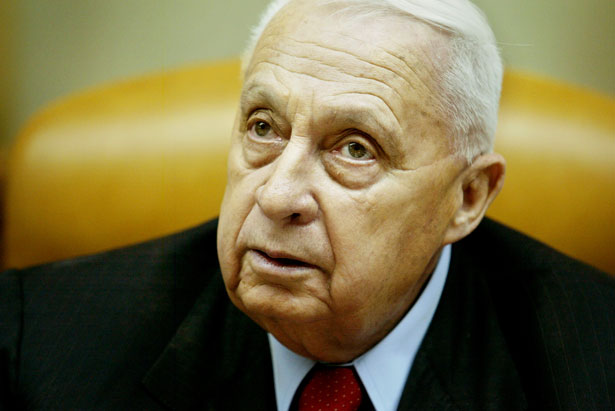
A central player in Israeli affairs since the state’s inception, Ariel Sharon molded history according to his own stark vision. He won consent for his plans through ruthlessness and guile, and resorted to force when he could not find any. An accused war criminal who presided over the killing of thousands of civilians, his foes referred to him as “The Bulldozer.” To those who revered him as a strong-armed protector and patron saint of the settlements, he was “The King of Israel.” In a life acted out in three parts, Sharon destroyed entire cities, wasted countless lives and sabotaged careers to shape the reality on the ground.
The first act of Sharon’s career began after the 1948 war that established Israel at the expense of 750,000 Palestinians who were driven away in a campaign of mass expulsion. Badly wounded in the battle of Latrun, where the Israeli army suffered a bitter defeat at the hands of the Royal Jordanian Army, Sharon momentarily retired from army life. He looked back in anger at the failure to take Latrun, a strategic swath of land containing three Palestinian towns seemingly obstructing the new Jewish state’s demographic continuity. Spineless politicians and feckless commanders had tied the hands of Israel’s troops, he claimed, leaving the Jewish state exposed from within. Sharon yearned to finish 1948—to complete the expulsion project he viewed as deficient.
In 1953, Sharon was plucked out of retirement by Prime Minister David Ben Gurion and appointed the head of a secret commando unit tasked with carrying out brutal acts of reprisal and sabotage. Following a lethal Palestinian assault on an Israeli kibbutz, Sharon led his men into the West Bank town of Qibya with orders from Ben Gurion’s Central Command to “carry out destruction and cause maximum damage.” By the time they were done, sixty-nine civilians—mostly Palestinian women and children—lay dead.
In the years after that scandal, Sharon carried out bloody raids on Egyptian and Syrian territory that inflamed relations with Israel’s neighbors and led them to seek urgent military assistance from the Soviet Union. In the 1956 Sinai Campaign, Sharon was accused by one of his commanders, Arye Biro, of overseeing the massacre of forty-nine Egyptian quarry workers who had been taken prisoner and had no role in the fighting (official censorship kept the details from the public for decades). In the 1967 Six Day War, Sharon ran up the body count on encircled Egyptian tank units, converting unprecedented kill ratios into national fame. With the Gaza Strip now under Israeli control, Sharon orchestrated the razing of Palestinian citrus orchards to make way for Jewish colonization.
During the 1973 war, Sharon waged his own parallel war for personal glory. Determined to be the first Israeli commander to cross the Suez Canal, he sent his soldiers rushing into the teeth of the Egyptian army without sufficient artillery or air support. Scores of his men died in the blind thrust while entire brigades were left exposed. But Sharon salvaged his quest for fame when his tank brigades encircled the Egyptian Third Army. After the battle, photos of the general standing proudly in the Egyptian desert, bandaged from a superficial wound and surrounded by soldiers hailing him as “The King of Israel,” circulated in the Israeli and international media. The high-flying political career he had sought was now guaranteed. In short order, Sharon helped found the Likud Party, opening the second act of his storied career.
Though set on a rightward political trajectory, Sharon owed his fortunes to the icons of Labor Zionism. His original patron, Ben Gurion, and the younger warrior-politician Moshe Dayan, constantly shuffled him up the ranks of the military hierarchy, despite a clear pattern of scandalously insubordinate behavior. His first cabinet-level post was an abbreviated stint in the 1970s government of Yitzhak Rabin, the quintessential Laborite, who imagined Sharon leading a reorganization of the army following the disaster of the 1973 war. But it was in the Likud-led 1977 coalition of Menachem Begin that Sharon was finally able to translate his influence into history-altering policies.
Appointed minister of agriculture, Sharon exploited his seemingly insignificant position to bring the messianic project of Greater Israel to fruition. With unbridled vigor, he expanded the settlement enterprise across the West Bank, boasting that he personally established sixty-four settlements during his first four years in government. He revealed his strategy in a private chat with Winston Churchill’s grandson: “We’ll make a pastrami sandwich out of them. We’ll insert a strip of Jewish settlements in between the Palestinians, and then another strip of Jewish settlements right across the West Bank, so that in twenty-five years’ time, neither the United Nations nor the United States, nobody, will be able to tear it apart.”
Having established himself as the visionary behind the settlements, Sharon set his sights on the Ministry of Defense, actively intimidating Begin to fulfill his ambition. When Begin finally capitulated before Sharon’s bullying, he declared only half-jokingly that Sharon might have staged a military coup if he hadn’t been offered his desired sinecure.
Sharon entered the Defense Ministry consumed with dreams of an Israeli-friendly Christian puppet government in Beirut—the bulwark of a regional Israeli empire. Clamoring for an invasion of Lebanon, Sharon withheld his true intentions from everyone except perhaps Begin, claiming he merely aimed to drive the PLO out of southern Lebanon, where it had staged periodic raids on Israeli territory. When Begin green-lighted Operation Peace for Galilee in June 1982, Sharon sent Israeli tanks rumbling towards Beirut without the approval of the rest of the cabinet, whom Sharon had deliberately deceived. Many of them were outraged, but it was too late to turn back.
Against fierce Palestinian resistance, one of the Middle East’s most vital and cosmopolitan cities was laid to ruin. Sharon’s forces flattened West Beirut with indiscriminate shelling, leaving streets strewn with unburied corpses. With each passing day, disease and famine spread at epidemic levels. In August, the day after the Israeli cabinet accepted US special envoy Philip Habib’s proposal for the evacuation of the PLO, Sharon’s forces bombarded Beirut for seven hours straight, leaving 300 dead, most of them civilians. The Israeli sociologist Baruch Kimmerling wrote that the raid “resembled the attack on Dresden by the Allies toward the end of World War II.” Sharon even requested an additional paratrooper brigade to obliterate the PLO forces besieged in the city, earning a rare rebuke from Begin, who worried that his defense minister would completely destroy Habib’s efforts to resolve the crisis.
PLO forces withdrew from Lebanon, according to Habib’s guidelines, but the worst was yet to come. Sharon had stymied a proposal for the introduction of multinational peacekeepers capable of preventing reprisals against the defenseless Palestinian refugees who had been left behind. Thus the stage was set for the most heinous massacre of the war. Following the assassination of Bashir Gemayel, the Christian warlord who was supposed to serve as Sharon’s handpicked puppet president, Israeli forces helped usher Christian Phalangist militias into the Palestinian camps of Sabra and Shatila, then surrounded by the Israeli military, providing them with intelligence and operational support. Sharon and many of his officers were well aware of the Phalangists’ intention to murder as many women and children as they could. After days of slaughter, as many as 2,000 civilians were dead, with countless others raped and brutalized.
In February 1983, Israel’s Kahan Commission found Sharon “indirectly responsible” for the massacre, urging his dismissal as defense minister. With the Israeli body count was piling up in Lebanon, city squares in Tel Aviv and Jerusalem were thronged with outraged mothers and a growing movement of service refuseniks. The antiwar demonstrations shook the confidence of the army’s high command. At the prime minister’s office, Sharon berated Begin and his ministers, warning them, “If we adopt this [Kahan] report, all our ill-wishers and naysayers will that what happened in the camp was genocide.” Calling the findings “a mark of Cain on all of us for generations,” Sharon adamantly refused to step down.
During the meeting, a right-wing Jewish terrorist lobbed a live grenade into a crowd of antiwar protesters right outside the prime minister’s office, killing the teacher and antiwar activist Emil Grunzweig. The incident was Sharon’s coup de grâce, prompting his resignation. Though he remained in government as a minister without portfolio, his dreams of serving as prime minister appeared to be dashed.
Sharon’s fear of prosecution did not end with his resignation. In July 2001, a Belgian court opened an inquiry into the Sabra and Shatila massacre when a group of survivors filed a complaint under the country’s “universal jurisdiction” guidelines. Elie Hobeika, the Phalangist commander directly responsible for the killings, was assassinated months later, after informing Belgian politicians that he would testify against Sharon. “Israel doesn’t want witnesses against it in this historic case in Belgium which will certainly convict Ariel Sharon,” the Lebanese Minister of Displaced People Marwan Hamadeh remarked at the time, echoing widespread speculation about Sharon’s involvement. In September 2003, with Belgian relations with Israel at an all-time low, the Belgian court threw out the case, citing Sharon’s diplomatic immunity.
By this time, Sharon had resuscitated his political career in dramatic fashion. On September 28, 2000, following the collapse of peace negotiations between Israel and the Palestinian Authority at Camp David that summer, Sharon toured the Haram al-Sharif in Jerusalem, site of the Al Aqsa Mosque and the Dome of the Rock, accompanied by 1,000 armed police and security agents. It was a provocative stunt, staged to inflame rising tensions in the occupied territories. As expected, the appearance sparked widespread Palestinian rioting the next day, which was met with a draconian Israeli crackdown—Israeli forces fired 1.3 million bullets at mostly unarmed demonstrators in October 2000 alone—fueling what became known as the Al Aqsa Intifada. The following year Sharon was elected prime minister and Palestinian suicide bombings were battering the cafes and nightclubs of Tel Aviv and West Jerusalem. Channeling the mood of Israel’s “peace camp,” which had called for Sharon’s ouster during the invasion of Lebanon, the liberal newspaper Haaretz demanded “a war about the morning’s coffee and croissant.”
The beleaguered peace camp was shocked at the intifada, but also cynically misled by Sharon’s predecessor as prime minister, Ehud Barak, who declared after the collapse of the Camp David negotiations that there was “no Palestinian partner” for peace. Sapped of confidence, they became quiescent while the mainstream united behind Sharon, their vengeful protector. With a free hand to deploy tanks and combat jets against Palestinian population centers, Sharon oversaw a campaign of carefully calculated brutality, culminating, in 2002, in the comprehensive demolition of the Jenin refugee camp. Baruch Kimmerling termed Sharon’s strategy “politicide,” a “gradual but systematic attempt to cause [Palestine’s] annihilation as an independent political and social entity.” As in the beginning, Sharon’s unspoken goal was to finish the war of 1948.
While Israeli bulldozers trundled across Gaza and the West Bank, Sharon announced his intention to “make separation across the land.” Though initially resistant to the idea, he resolved to fulfill a plan first introduced in the 1990’s under Yitzhak Rabin: the construction of a vast wall that would drive a nail into the coffin of the Palestinian national movement. Cutting into the West Bank and Jordan Valley, the wall would effectively annex 80 percent of settlements into Israel proper, consolidating the country’s Jewish demographic majority while relegating Palestinians to a permanent regime of ghettoized exclusion.
Next, Sharon planned to pull Israeli settlers from the Gaza Strip, setting the stage for a high-tech siege of that occupied coastal territory. Unlike in the past, Sharon sold his plans to the public with carefully calibrated, subtle rhetorical touches. Stunned by a new movement of mass refusal—a group of former and active Israeli air force pilots had issued a letter declaring their refusal to participate in operations in occupied territory—and by the furious opposition of the settlement movement to his plan, Sharon uncharacteristically proclaimed that the occupation was a “bad thing for Israel.” Next, he bolted from Likud, cobbling together a random assortment of politicians including his former aide, the telegenic, PR-friendly Tzipi Livni, to drive the separation plan forward under the banner of Kadima.
Sharon’s maneuvers earned him the political space he needed to fulfill his goals. Haaretz, the voice of Israeli liberalism, supported the vast separation wall as a “revolutionary” step towards two states. Endorsing the withdrawal of settlers from Gaza, The New York Times editorial board declared that Sharon “should be cheered.” Back in Tel Aviv, the anti-settlement group Peace Now and the Labor Party organized a mass demonstration in support of the Gaza disengagement plan. Winning liberals to his side was Sharon’s final political coup, and probably his most consequential.
The true goal of Sharon’s separation regime was never to end the occupation but to reinforce it under new parameters that would prevent the collapse of Israel’s international image. A top aide to Sharon, Dov Weissglass, revealed the real logic behind Sharon’s plans: “The disengagement [from Gaza] is actually formaldehyde. It supplies the amount of formaldehyde that is necessary so there will not be a political process with the Palestinians.” Another close adviser, Arnon Sofer, was even more frank:
…when 2.5 million people live in a closed-off Gaza, it’s going to be a human catastrophe. Those people will become even bigger animals than they are today, with the aid of an insane fundamentalist Islam. The pressure at the border will be awful. It’s going to be a terrible war. So, if we want to remain alive, we will have to kill and kill and kill. All day, every day.
Eight years after Sharon slipped into a coma, the real implications of separation stand exposed. Gaza suffers under a joint Israeli-Egyptian siege, while Israel shrugs off any responsibility for its inhabitants. Though Israel controls the entrances, exits, airspace and coast of Gaza, and effectively regulates the caloric intake of each resident of the coastal territory, the occupation is over as far as its government is concerned. Israeli settlements are firmly entrenched in the West Bank and encircle East Jerusalem, reducing Palestinian areas to the “pastrami sandwich” of non-contiguous bantustans that Sharon had originally envisioned. With the peace process effectively embalmed in political “formaldehyde,” right-wing elements have achieved unfettered dominance over the Jewish state’s key institutions. Typical of the new generation of Israeli rightists is Sharon’s corruption-stained son, Gilad, who has called Palestinian society a “predator,” an “animal” and “stabbers of babies.”
Now that Sharon’s unilateral vision appears to have been consolidated, Israel’s government must perpetually manage an occupation it has no intention of ending. It has no clear strategy to achieve international legitimacy and no endgame. Its direct line to Washington has become a life-support system for the status quo. Like Sharon, who spent his last years in a comatose state without any hope of regaining consciousness, Israel is only buying time.
Max Blumenthal
January 11, 2014
from Ilan Pappe
Yossef Vashitz was a senior advisor of Arab affairs to Mapam, whose major military force, the Palmach, were the commando units of the Zionist military effort in 1948. His private collection include this half page – undated – translated here, which just give a short list of atrocities committed in 1948 (mostly in October to November that year during operation Hiram) in the upper Galilee. Here it is: Safsaf –caught 52 men, tied them one to the other, dug a hole and shot them. While they were sill alive, women came and pleaded for their lives. Found 6 bodies of old men, all and all 61 bodies.
Yossef Vashitz was a senior advisor of Arab affairs to Mapam, whose major military force, the Palmach, were the commando units of the Zionist military effort in 1948. His private collection include this half page – undated – translated here, which just give a short list of atrocities committed in 1948 (mostly in October to November that year during operation Hiram) in the upper Galilee. Here it is: Safsaf –caught 52 men, tied them one to the other, dug a hole and shot them. While they were sill alive, women came and pleaded for their lives. Found 6 bodies of old men, all and all 61 bodies.
Three rape cases. One by a Mizrachi Jew from Jaffa of a 14 years old girl. 4 men shot and killed. From The one they cut by knife his fingers to take his ring. Jish – 400 inhabitants. A women embracing a child – both dead. 4 women and 11 soldiers dead. The Logistic Unit. They wipe everything. The Kibbutzim rob everything. Kefar Giladi [robbed] five flower lorries.
Ein Zitun, the logistic went wild…tore women earlobes to take the ear rings. In Birim – the same sight and one dead man for no reason. Sasa. Murders; especially of old men.
Ilabun – 1000 people, the army received surrender, slaughtered [animals], food, and then the expulsion from the village began by shooting. Thirty people died. The order was to expel the villages. Rumours of it across the border. Saliha – ninety two, men, old men women and children [died] when a house was blown on them. Mashhat – the village wanted to surrender already in the days of Qawqji, he revenged, now we.
![Photo : Historical quote of the day</p><br />
<p>Yossef Vashitz was a senior advisor of Arab affairs to Mapam, whose major military force, the Palmach, were the commando units of the Zionist military effort in 1948. His private collection include this half page – undated - translated here, which just give a short list of atrocities committed in 1948 (mostly in October to November that year during operation Hiram) in the upper Galilee.</p><br />
<p>Here it is:<br /><br />
Safsaf –caught 52 men, tied them one to the other, dug a hole and shot them. While they were sill alive, women came and pleaded for their lives. Found 6 bodies of old men, all and all 61 bodies. Three rape cases. One by a Mizrachi Jew from Jaffa of a 14 years old girl. 4 men shot and killed. From The one they cut by knife his fingers to take his ring.<br /><br />
Jish – 400 inhabitants. A women embracing a child - both dead. 4 women and 11 soldiers dead.<br /><br />
The Logistic Unit.<br /><br />
They wipe everything. The Kibbutzim rob everything. Kefar Giladi [robbed] five flower lorries.</p><br />
<p>Ein Zitun, the logistic went wild…tore women earlobes to take the ear rings. In Birim – the same sight and one dead man for no reason.<br /><br />
Sasa. Murders; especially of old men.<br /><br />
Ilabun – 1000 people, the army received surrender, slaughtered [animals], food, and then the expulsion from the village began by shooting. Thirty people died. The order was to expel the villages. Rumours of it across the border.<br /><br />
Saliha – ninety two, men, old men women and children [died] when a house was blown on them.<br /><br />
Mashhat – the village wanted to surrender already in the days of Qawqji, he revenged, now we.](https://scontent-a-lhr.xx.fbcdn.net/hphotos-frc3/p480x480/1505275_752581984771335_929224715_n.jpg)
By Miko Peled

Ariel Sharon, visit to the Temple Mount, October, 2000
I never understood how people could rejoice at the news of a person’s death. I happened to be in the UK when Margaret Thatcher died so I witnessed the celebrations. The expressions of joy as the news of the Iron Lady’s death spread around the country shocked me at first, as people were actually throwing parties to celebrate her death. As I visited different parts of the country, particularly Wales and Ireland, it occurred to me that when Ariel Sharon dies we may see similar outbursts of joy taking place.
Sharon has been in a coma since January 2006 when he suffered several brain hemorrhages that left him in a vegetative state. But now there is news that his kidneys are failing and concerns are expressed in Israel that there is a chance he will die soon.
One can imagine the long eulogies we will have to endure once he is laid to rest: “A hero,” “a great leader,” “a military genius,” all of this will be said and more. The press will recount every military achievement, ever battle he won, every enemy, both military and political that he defeated. His resolve as Israel’s leader will be heralded, and, we will be told, he will be remembered for giving his all to his country.
In my book, The General’s Son, Journey of an Israeli in Palestine, I mention Sharon several times, in his capacity as a military man who was cruel, brilliant and reckless, then as defense minister and finally as prime minister. But it is important to set the record straight about this man before the nauseating outpour of condolences, replete with hypocrisy and lies, that are sure to follow his death.
Ariel Sharon was an ambitious man. He was brutal, greedy, uncompromising and dishonest. He possessed an insatiable appetite for power, glory and fortune. His tendencies as a cold-blooded, merciless killer were evident from early on in his career when he commanded the Israeli army’s Unit 101 in the 1950’s. Unit 101 was an infamous commando brigade with special license to kill and terrorize Palestinians. It operated mostly in Gaza, but also in other parts of the country and beyond. Unit 101 was so brutal in its practices, and claimed so many innocent lives, that even by Israeli standards it was thought to have gone too far and the unit was eventually disbanded.
Sharon went on to be promoted to other commands in the Israeli army earning a name for himself as a promising commander and all were expecting that he would one day be the Israeli army’s top commander, or Chief of Staff. But this was one job he never got, he did better. Sharon entered politics and was nominated to be Defense Minister under Prime Minister Menachem Begin. In that capacity he lead Israel’s catastrophic invasion of Lebanon in 1982.
This invasion left countless Lebanese and Palestinians dead, wounded and displaced. Sharon was also behind the massacres that took place in September of that year in the Sabra and Shatila refugee camps near Beirut, and here once again, even by Israeli standards Sharon had gone too far and was removed from office.
Though Sharon was reprimanded for his role in the Sabra and Shatila massacre, and was prevented from serving as defense minister, his political career continued nevertheless and his sphere of influence grew. As minster of Housing and Development he contributed more than any other to the racist, anti Palestinian policies and the corruption within the ministry. It is claimed that during his tenure the ministry’s budget was without limits, exceeding Israel’s entire defense budget. He used his full weight to achieve the colonization and displacement Palestinians from what used to be the West Bank.
Surely the most absurd thing ever said about Sharon, is that he was a man of peace. That he “left” Gaza and that he “gave” Gaza back to the Palestinians. That he did it for peace and in return all Israel received were rockets fired from Gaza. The Israeli disengagement from Gaza was a cynical, unilateral move. It allowed Sharon to get the Israeli settlers in Gaza out of his way, close Gaza like a prison and score a few political points with the US administration. It was a cruel move that allowed him to further suffocate the people of Gaza, people that he was determined to destroy from early on in his violent career. But the proud Palestinians would not surrender and served as a constant reminder of the blood with which his hands are stained.
One could go on and on about Sharon and his crimes. As he lay dying, perhaps within days or minutes of his final breath, we must all remember his victims, the countless dead, wounded and displaced and remind the world that this man was not a hero but a criminal.
As I write these words Ariel Sharon is still alive, if one can call it that, and in many ways the state in which he lives now could be the hell he so richly deserves.
By LAHAV HARKOV
12/09/2013 19:27
Knesset Speaker to head Israeli delegation at memorial as PM, Peres can’t attend for financial, security reasons.
The US sent its president and three former presidents to Tuesday’s memorial service for anti-apartheid hero and former South African president Nelson Mandela. The UK and France sent its prime ministers, as did another nearly 90 countries. Oprah Winfrey and the Dalai Lama were set to attend. Israel, however, came close to sending no one, in a near diplomatic fiasco that started Sunday and developed throughout Monday.
In the end, Knesset Speaker Yuli Edelstein flew Monday night to the memorial service, along with the first female Ethiopian MK Pnina Tamnu-Shata (Yesh Atid), as well as MKs Dov Lipman (Yesh Atid), Nitzan Horowitz (Meretz), Gila Gamliel (Likud Beytenu) and Hilik Bar (Labor).
4 dec 2013
In his new book, GOLIATH: Life and Loathing in Greater Israel, award-winning journalist and New York Times bestselling author Max Blumenthal takes readers on an eye-opening journey through the badlands and high roads of Israel-Palestine. Based on four years of research and on-the-ground reporting, the book is an unflinching, unprecedented work of journalism which depicts a startling portrait of Israeli society under siege from increasingly authoritarian politics.
GOLIATH illuminates the momentous political and social transitions occurring in greater Israel, with a particular focus on the effects of these changes on the people themselves — both Jews and Palestinians. Blumenthal charts the progression of Israel’s current crisis through the 2012 Israeli national elections, and against the historical backdrop of the cataclysmic events of 1948 that haunt the Holy Land to this day.
The New America Foundation hosted a discussion about his book and what his findings mean for the potential of peace in one of the world’s most contested regions.
Join the conversation online using #GOLIATH and following @NatSecNAF on Twitter.
Participants
Max Blumenthal
Author, GOLIATH: Life and Loathing in Greater Israel
Written by Michel (Mikado) Warschawski, Alternative Information Center (AIC)

With agreement between Iran and the West, Israel is afraid of losing its historical role in the area/Photo: State Department
Western governments are fed up with the Israeli angry reactions to the agreement between them and the Iranian government. “It is done, and there is no way back”: this is the message they are conveying to the Israeli government, adding that the best for Israel would have been to participate in the international efforts for a final agreement on the nuclear capacities of Iran. According to Haaretz (November 26), Benjamin Netanyahu tried for thirty minutes to convince Barack Obama that he has been fooled by the Iranians. The Iranians’ sole objective, according to Netanyahu, was to gain time in order to develop their military nuclear capacities, in order to be able to destroy not only Israel but the Western civilization as a whole.
What is behind Israel’s anti-Iranian obsession? What makes Netanyahu declare that the US intelligence agencies are not doing their job properly, and that the Israeli Mossad has better information concerning the real Iranian plans? What pushes him to create tensions with the only true strategic ally Israel still has?
The beginning of rapprochement between the West and Iran is not worrying only the Jewish state. Saudi Arabia, too, is extremely worried and, as a result, is strengthening its ties with Tel Aviv. The motivations, however, of Riad and Tel Aviv are not the same. While the Saudis are complaining about the fact that they may lose their place as America’s number one ally in the Golf region and are concerned by the strengthening of the so-call Shia axis at the expense of the Sunni one, Israeli leaders are worried by the eventual disappearance of a global enemy in the region.
Israeli militarism has always justified its wars and heavy armaments by the existence of a global enemy of Western civilization/the free world/democratic countries, and its role as an active defender of the West against whoever was threatening it, whether it is communism, Arab nationalism or Islam. Since the fall of the Shah – a historical ally of Israel – Iran has become the global enemy and “Teheran Delenda Est,” the war slogan of Israeli neo-conservative governments. Losing this global enemy may puts into question the role of Israel in the area and the reason for the massive military as well as diplomatic support delivered by Washington.
“If needed, we will attack the Iranians alone” said Netanyahu. As many Israeli commentators wrote in the past weeks, such arrogant statements are empty words and pathetic threats. However, the harsh words used against the White House by Netanyahu and his team express the great worry of the Israeli leadership from the strategic changes in the Middle East. They may well provoke a military adventure, in Lebanon or Syria, in order to try to stop what seems to be a new spring in the Middle East.
 band annie's Weblog