Search

band annie's Weblog

I have a parallel blog in French at http://anniebannie.net

Category

Israeli dissidents

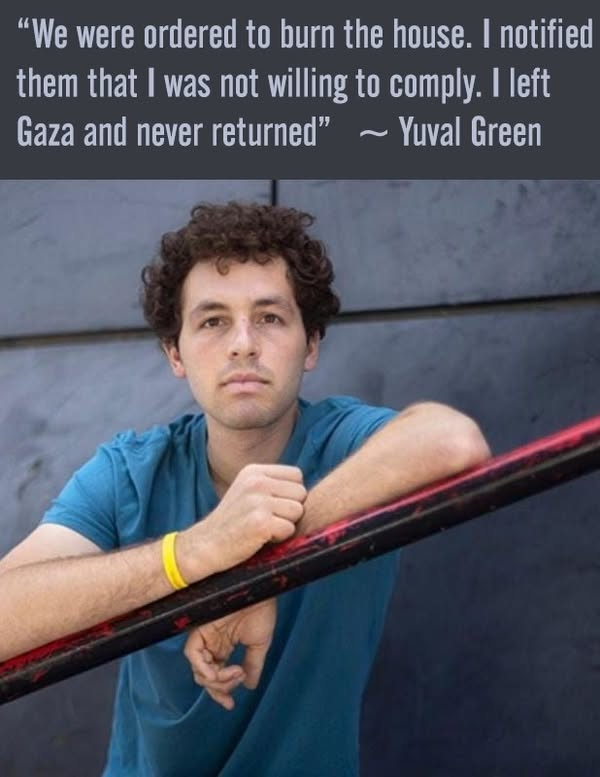
We were ordered to burn the house

This is an OpEd written by Jewish Israeli youth Yuval Green, age 26.

It was published in hebrew in Haaretz, on March 21 2025.

From FB Dave Meslin

_________________________________________________________

We were ordered to burn the house; I notified them that I was not willing to comply. I left Gaza and never returned

Yuval Green, Haaretz, March 21 2025

Like many Israelis, I enlisted in the military out of a sense of loyalty to the state and a willingness to sacrifice. After a challenging combat service, I continued to serve as a reserve soldier. On October 7th, I was called, along with my comrades, to defend the borders of the country. That very evening, I arrived at the supply warehouses of my reserve unit. There, we received old and faulty equipment and witnessed how the military, on which we relied, failed to prepare for an extreme scenario.

In the following days, we entered the affected settlements around the Gaza Strip. I saw the deserted paths of Gaza villages, corpses lying in them, cars riddled with bullets, destroyed homes.

After the first days of the war, my unit entered a period of waiting and training. During that time, doubts began to take root in me. I believed that Israel’s primary commitment should be toward the hostages, who had been taken cruelly from their homes due to the security failure. I thought that there was no military solution to the hostage problem.

It was clear to me that military action in Gaza was endangering the lives of the hostages. At the same time, I assumed that Hamas would be willing to sign a deal — after all, they kidnapped the people to free prisoners in Israel. Moreover, after the terrible disaster we experienced on October 7th, I thought that the last thing we needed was more fallen soldiers.

Beyond the consequences of the war for us, Israelis, I watched in pain what was happening in Gaza. Already in the early days of the war, there were thousands of casualties, thousands of destroyed homes, displaced persons, suffering, and pain.

Despite my doubts, I chose to enter Gaza with my comrades. I did this because, as a platoon medic, I felt a strong sense of commitment to them. Furthermore, at that time, I still struggled to know what the right thing was — maybe I am wrong? Maybe the way to bring back the hostages does go through military action?

A few days after we entered Gaza, in early December 2023, I heard a news report on the radio stating that Israel was refusing to end the war in order to bring back the hostages. This news devastated me. My motivation for service was shaken even more. Still, my sense of duty as a medic kept me in Gaza.

A few weeks later, 50 days after entering Gaza, we received an order from our company commander: after we leave the house we are staying in, we must burn it. The order left me in shock. I asked the commander why we were burning the house. His first response — which, in my eyes, exemplifies the indifference to Palestinian lives — I will never forget: “We are burning the house because we don’t have a D9 bulldozer available.” After I insisted on understanding, he added: “We burn every house we leave.” My requests to reconsider the act went unanswered, and that evening, around four buildings were burned in Khan Yunis. I witnessed those fires, the black smoke. How many families lost their homes that evening?

I informed my commander that I was not willing to cooperate with this action, and I was leaving the fighting. I set a clear moral boundary in the face of immoral actions. I left Gaza in the first supply vehicle and never returned, five days before my unit withdrew from the fighting.

The commentators in the studios engage in debates about “total victory” or the “collapse of Hamas.” I don’t know the military situation of Hamas, but I know one thing — it doesn’t matter at all. The reasons that led to the rise of Hamas in Gaza are the same reasons that led to the rise of the fedayeen in the 1950s and the rise of the PLO in the 1960s. Without a political settlement, when the Palestinians are under our control, they will always rise against us, carry out attacks, and fight. Even if Hamas is eradicated, another movement will rise in its place.

This war, despite being sold to us as a change in the reality of the Middle East, in fact entrenches exactly the same reality. Another waste of blood, more killing, leading to more violent opposition, which leads to more killing.

The war in Gaza continues primarily because of a rotten and corrupt political culture, where cynical and unworthy politicians are dragged into a messianic struggle led by religious fanatics, who view settling the land as a higher value than human life.

I believe that Israeli culture, which blindly elevates military service above any other human value, is what allows extremists to lead us down this path. I see many people around me who recognize reality as I see it. They understand that the military pressure is killing the hostages, understand that the war is killing soldiers, understand that we are fighting mainly due to pressure from extreme elements. But they continue to show up for service. They don’t connect their military service with the continuation of the war.

We are often accused, those of us who refuse to participate in the war, of harming the army and thereby endangering the security of the state. However, I believe that in a country walking the path of fascism, where ending the war is seen as a “painful concession” in negotiations, there will never be enough soldiers. Even if we recruit all the yeshiva students, send all the youth to the front, and even mobilize the Arab population, there will always be more land to conquer in Syria, another enclave in the West Bank to seize.

In my opinion, strengthening the security of the state lies in a firm opposition to the war that endangers our soldiers, harms our economy, kills many Palestinians, and thus sows deep seeds of hatred — and of course, abandons our brothers and sisters in captivity.

My comrades and I in the organization “Soldiers for Hostages” declared that we will not be willing to continue cooperating with the abandonment of the hostages. If the government does not change course, we will not continue to serve. In such an extreme political climate, our role has become more important than ever. In recent months, since the publication of our letter in an article by Liza Rozovsky (“Haaretz”, 9.10.2024), we have received significant responses that indicate how much our movement is troubling the leadership. This, despite the fact that at the time of publication, we were only 130 soldiers. The Prime Minister addressed our group in a cabinet meeting and said about us: “They’ve lost their national compass.” In addition, each signatory of the letter received a personal phone call from their battalion or brigade commander, demanding they remove their signature.

It is important to clarify that we, the signatories of the letter, now more than 200 soldiers, are neither deserters nor evaders. Among us are fighters and officers who fought in Gaza and Lebanon. We choose this path not out of a desire to evade our duties and not because of the burden of reserve duty, but precisely because of our deep commitment to the state.

Just as we were willing to risk ourselves, strive, and fight in battle, today we believe we must give of ourselves to stand up to social pressure. We do this because we think it’s time to draw a red line for the war.

Avigail Abarbanel’s Fully Human Essay

Source https://avigail.substack.com/p/identity-and-shared-humanity

Positive’ and ‘negative’ exceptionalism

Readers’ comments and the discussions that unfold beneath my articles often inspire my thinking and writing. These exchanges reveal what preoccupies people’s minds as they struggle, both emotionally and intellectually, to process Israel’s genocide of the Palestinian people and their own relationship to these events. A recurring theme emerging from these discussions is the complex question of identity—specifically, how Israel invokes its self-designation as a ‘Jewish state’ to claim exceptional status in human history. The following essay is built around some of those discussions.

Thanks for reading Avigail Abarbanel’s Fully Human Essays! Subscribe for free to receive new posts and support my work.


‘Positive’ and ‘negative’ exceptionalism

Israel is gradually exterminating the Palestinian people in full view of the world. Most of the West’s leaders and the corporate media maintain shameless and unrepentant support for Israel. They repeat the fraudulent justifications Israel offers for what it does, namely that Israel is reluctantly engaged in a ‘war against terror’, and that everything Israel is doing, including (but not limited to) destroying hospitals, directly targeting medical staff, and murdering children and babies, is necessary for Israel’s security. Most media outlets continue to perpetuate the fallacy that there is symmetry between Israel—a settler-coloniser society—and its victims—the Palestinian people.

The phrase ‘settler-colonialism’ is never mentioned. Infuriatingly, our politicians and the media continue to peddle the image Israel has sold the rest of the world for decades, that it is an ‘enlightened’ and ‘normal Western democracy’, a nice and benevolent country that desires nothing other than to live in peace. This, along with the ongoing supply of arms, munition, spare parts, and other destructive military and surveillance technology enables Israel to proceed, uninterrupted, with its genocidal settler-colonial plan.

Israel’s Zionist settler-colonialism’s aims are:

  • To eliminate all the Palestinian people from all of historic Palestine,
  • Destroy all evidence of their culture, history and existence,
  • Take over all the land and natural resources from the river to the sea, and now also to the north (parts of Lebanon and Syria), and
  • Replace all of historic Palestine’s non-Jewish inhabitants with what Israel calls Jews.

You do not have to be an expert in International Law to recognise that Israel’s actions qualify as genocide.

It is clear for anyone to see that Israel enjoys extraordinary exceptionalism that enables it to not only get away with genocide, but also receive seemingly unlimited military and diplomatic cover. (Whether this will finally change remains to be seen). However, the exceptionalism that others see Israel enjoying bears little resemblance to Jewish Israelis’ understanding of their own situation.

Inside Israeli society, Israel’s exceptionalism is perceived differently. Jewish-Israeli society focuses only on criticism of, and objections to what Israel does. Israeli Jews perceive any criticism of Israel’s policies and behaviour as stemming solely from antisemitism, treating it as completely detached from, and unrelated to Israel’s actual conduct. The strong belief within Israeli society that everyone hates Jews serves as justification for their view that Israel is treated differently to other countries. Israeli society and its politicians, as well as supporters of Israel around the world, frequently compare what Israel is doing with other examples of human rights violations and genocide. They ask, ‘Why are you criticising us? Why do you single us out when others are doing bad things too?’

I thought exactly this way when I still lived in Israel. The Israeli media routinely downplay the support Israel receives and emphasise statements that are seen as hostile or critical of Israel. When I was in Israel, I believed everyone hated us. It is hard to explain to outsiders how obsessive we were about scouring every story about some celebrity overseas to see whether they liked us or not. If they did not absolutely admire us, or were even the least bit critical, we dismissed them as antisemites. (In Israel there is no distinction between society and the individual — ‘us’ means ‘Israel’). People’s views about Israel were the only measure by which we evaluated their worth. It did not matter what character or achievements people had. All we cared about was what they thought of us. I was frightened when I moved to Australia, because I genuinely believed everyone there would hate me. I still remember how shocked I was to discover that reality was exactly the opposite of what I was taught.

This selective understanding of exceptionalism—seeing only criticism whilst remaining wilfully blind to the unprecedented level of support Israel enjoys—reveals a deeper pattern. Israeli Jews have no real concept of how much money and how much support Israel is getting, as this would contradict their deeply held belief that they are uniquely victimised. This cognitive dissonance enables the population to be perpetrators while maintaining their self-image of victimhood. In other words, Israel’s perception of exceptionalism is ‘negative’. They believe they are singled out for unfair treatment, because of antisemitism, which is also seen as a unique and ‘exceptional’ form of racism.

About identity and ’specialness’ — Sharing a few comments and replies

In my previous article I wrote about my own relationship with the definition of Jewishness imposed on me by Israel, and referred to Rabbi Yaakov Shapiro’s interview with Katie Halper. In the interview Rabbi Shapiro argued that Jews do not need to emphasise Jewishness when they stand up for the Palestinian people because this just lends support to Israel’s false claim to be the state of all Jews, and to speak for all Jews. Katie Halper kindly commented on my article, and I share some of our exchange below.

Katie HalperThanks for the shout out. I identify as Jewish for several reasons but what I find undeniable is that it is politically wise to identify as a pro Palestine Jew because it dispels the notion that being Zionist and being Jewish is one in the same and it helps dispel the notion that antizionism is antisemitism.

My reply: Thanks for taking an interest in my essay and for commenting. Here is a previous reply I made to someone with respect to this essay: … I see both sides. I agree with the Rabbi’s point, but also with those who choose to call themselves Jews and do not accept Israel’s definition of a ‘good Jew’ (that’s a real thing in Israeli culture). I wanted to mention my own choice, which is to not call myself a Jew because I have no idea what makes me a Jew except Israel’s nonsense ‘race science’. I am only making a choice for myself, while seeing that others have a pov of their own.

Katie Halper: If, for argument’s sake, a majority of Palestinians thought it was helpful for people to identify as anti Zionist Jews would you still advise against it?

My reply: There are many opinions among Palestinians I know. Most don’t care about my background at all, only that I am another human standing shoulder to shoulder with them. The article [my previous essay, on which Katie is commenting] is entitled ‘our shared humanity’ for a reason. I believe the majority of Palestinians do not see what Israel is doing as a ‘Jewish thing’, and have no qualms with Jewish religion, only with Zionism’s genocidal setter-colonialism.

I find it offensive that Israel defines my ‘identity’ and ‘affiliation’ for me, seemingly leaving me with no choice. I did not grow up on any of the ‘Jewish values’ that you and other good people in the US say you have grown up on. I believe you, and I envy you to some extent, but that was not my experience at all.

Israeli society, its philosophy of life, and its institutions are there to justify genocide. This includes the interpretation of Jewish religion they teach even in the secular school system.

I have always been puzzled by how anyone who calls themselves Jewish does not, at least, critique the morality behind Joshua leading a comprehensive genocide in Canaan1, supposedly at god’s instructions. I never understood how anyone can celebrate the Passover Seder and not consider how wrong it is to rejoice in the killing of all the eldest sons of Egypt on the eve of the Exodus.

Of course, none of it is actual history but these are identity myths that go right to the heart of Jewish ‘identity’. As a human being I can’t possibly identify with this, and if to be Jewish means I have to accept such stories/myths uncritically, then I choose to not be Jewish (and it is a choice, unless you believe in ‘race science’).

I don’t know (I really don’t know) what goes on in non-orthodox synagogues in the West, and how they reconcile these stories with enlightened ‘Jewish values’. Israel revels in these stories, which are taught uncritically right from kindergarten and in families even earlier. There is never any moral questioning of any of this.

It is all taught as identity stories even in the secular school system, which I attended. No one questions the morality of it, because the moment they do, the entire quasi-religious justification for Zionism, the Nakba and the continued genocide in Palestine falls apart.

In light of my upbringing in Israel and my education there, I am justifiably suspicious of Jewish identity, as it is understood by non-religious Western Jews. As I said, I don’t know anything about what is taught in non-orthodox Synagogues, and whether these identity stories are questioned and critiqued on moral grounds. If they are not, then you can see the inherent contradiction between them and universal human values.

I think everyone needs to make their own choice, katie … I am making mine. I am not decreeing anything for anyone else. My position is just that, my position, and there is always a diversity of views in any group and in any contexts, as you obviously well know. I also do not know everything as I said above.

My own personal moral sense does not align with any version of Jewishness that I grew up with in Israel. One of the disadvantages of Western Jews, I think (and I could be wrong), is that they really don’t know, or understand Israel at all. The only ones who do are the ones who join the ranks of the ‘settlers’. “

Until you live there you can’t know Israel and this is deliberate. Israel has always presented a very carefully crafted image of itself to the world, including to Western Jewish communities. Its citizens (including the 20% Palestinian citizens who are now in great danger) know the real Israel. Thank you for reading and commenting.

On another thread I had this exchange with reader Irfan A Khan

Irfan A Kahn: Indoctrination based on religious and racial exceptionalism can create a deep sense of entitlement in the minds of any population and that feeling of entitlement can be exploited easily toward mistreatment of ‘the other’. The extent of mistreatment of ‘the other’ can be exacerbated into settler colonialism, ethnic cleansing and genocide with a small nudge in the right direction.

This phenomenon is not true for Jews of Israel only. Muslims, Christians, Buddhists, Hindus and even small tribes in the mountains have this trait in common. In Bangladesh, ~90% Muslims majority population is protesting and crying for the plight of Palestinians, but are doing the exact same thing to the indigenous tribes in the hill tracts of Chittagong for more than 50 years. No empathy. Interestingly, one of the victims of this abuse – the Chakma tribe tends to do the exact same thing to the smaller tribes when they get the opportunity.

Then you look at the ethnic cleansing and genocide in Kashmir by the Hindus, in Myanmar by Buddhist monks, in Iraq and Syria by the Turks, In China by communists, in Yemen by Saudi Arabia and see the pattern. I am sorry if I have missed any other genocide and ethnic cleansing going on at the moment.

One thing I know for sure, it is not really about religion or race.

My reply: Of course. One of the main points I always emphasise is that despite Israel’s sense of ‘specialness’, there is nothing special about it or what it is doing. Israel is just a case study in world history. It is among the most noxious ones, but it is by no means original. Israel needs to be called out for what it is: One of the worst examples of humanity, but still one of many in human history, as far back as we remember our history.

Very clearly it is not about religion and race, but both are used to justify a particular psychological mindset based on deep fear and survivalism. Very human. Having said that Israel is making it about race and to some extent religion as well, and it is important that people do not get trapped in the Israeli mindset, and maintain the position you (and I) hold, that what Israel is doing is a fundamentally a human problem. The Palestinians are human and their persecutors, Israel and its society are also human. That is why what Israel is doing is a crime against humanity, not some ‘special case’ that requires ‘special consideration’.

Does religion justify genocide?

Discussions in the comments section keep going back to Judaism and Jewish identity and their relationship to what Israel is doing. In South Africa, Christian interpretations were wielded to justify apartheid. To those who called themselves ‘Christian’ supporters of apartheid, the fundamental command to ‘love one another‘ conveniently excluded black people. Today, we see the Taliban use their interpretation of Islamic teachings to enforce what stands as one of modern history’s most severe examples of formal oppression of women. Meanwhile, in parts of Asia, Buddhist monks—followers of one of the world’s most explicitly non-violent religions—preach hatred against Muslims and participate in their murder. One can only imagine what the Buddha’s response would be to such a perversion of his teachings.

In a 2010 interview with Amina Chaudary, Archbishop Desmond Tutu said:

It is people. … some people are able to use Bible as a means of opposing injustice, whereas others are able to find justification. You can find justification for slavery in the Bible. Some say this is what the Bible says and that closes the argument. You will find that the Bible, if you want it to, will justify many things. St. Paul had a very male chauvinistic view of women. He would say things like women must not talk in church, must cover their heads, they mustn’t talk and must remember that it was a woman who first tempted and this whole mess started because women messed us up. So you can read it in such a way that it justifies polygamy. Most of the leading figures of the Old Testament were polygamists. Abraham had several wives and concubines. If they wanted, they could say this was approved in the Bible.

People will use anything. Look, when you think of the KKK, they actually have as their emblem a fiery cross. And they don’t see any contradiction between the cross, an instrument of suffering that procured our reconciliation with God, and its use as a symbol for nefarious attacks on black people. But they believe that they are being obedient to God because they can read things that they see. People in apartheid South Africa can tell you that God cursed black people when they cursed Him. And so the hermetic people were condemned to be drawers of water and of wood.

There are no monolithic religions or philosophies. Everything splits into countless interpretations as humans mould these belief systems to their needs. We, humans, possess an extraordinary talent for manipulating any system of belief to validate our pre-existing convictions, and we seem to harbour a deep psychological need for such validation. Even the most morally compromised individuals must possess a conscience somewhere in the depths of their being—a quiet voice that unsettles their certainties. Religious justifications and rationalisations have proven particularly effective at silencing this inner voice, especially because they can invoke divine authority.

Self-deception comes at a psychological cost, usually manifesting in chronic anxiety. But for many people, perceived survival takes precedence over everything, including their own wellbeing. They would rather endure a life riddled with anxiety, than confront their own inner contradictions. When Israeli Jews believe that they are facing mortal danger from Palestinians, they will find something in Jewish religion to justify genocide. But are such justifications truly there? As Desmond Tutu points out, the Bible says many things.

Our fundamental psychology, which predates all religions and philosophical systems, underlies every belief we hold and every action we take. People will extract whatever meaning serves their purposes from any text. Zionists reading my essays immediately perceive the words of a traitor. What others might consider basic human decency, they can only interpret as betrayal of the group. Their psychology predisposes them to elevate group loyalty above all other values, including truth and justice. Meanwhile, some anti-Zionist readers scan the same text and somehow see pro-Israeli sentiment. When I ask either group to read my actual words more carefully, they respond with hostility. I have had to ban some Zionists and anti-Zionists from this Substack page, because they are unable to engage with what I say and end up attacking me as a person.

This selective perception is not accidental. Our more primitive limbic psychology predisposes us to see what we want to see, filtering out information that contradicts our pre-held beliefs. We are all at risk of that. Only through conscious integration can we hope to transcend these limitations. (See my short book Therapy Without A Therapist). A psychology dominated by fear and survivalism inevitably breeds tribalism, cultism, or racism. It also produces the ‘me first’ mentality we witness in our new ‘religion’ of economic neoliberalism, where indifference to others’ suffering is repackaged as rational self-interest.

Our identity is not given to us, we need to choose it

In my family therapy education, I studied Murray Bowen’s body of theory with a special focus on his theory of ‘self-differentiation’2. Bowen defined ‘differentiation’ as ‘the amount of self you have in you’. Differentiation is another word for maturity or growth, or in Interpersonal Neurobiology (IPNB) terms, integration. My teachers were adamant that if psychotherapists do not commit to their own process of ‘differentiation’, they have no business seeing clients.

Bowen understood differentiation as the process of crafting one’s own identity within the web of relationships that shape us. He recognised that as human beings develop, they inevitably synthesise their unique identity from a complex tapestry of influences: their family of origin, its beliefs and patterns, their societal context, and the historical forces that shaped their family, their people, and humanity. Bowen urged individuals to trace their family history as far back as records would permit. While we cannot draw straight lines of causation from past to present, we can develop a profound understanding of the rich context that shaped us.

I cannot recall if it was Bowen’s own metaphor, or one my teachers devised, but we can understand differentiation through the image of sorting through a personal inheritance chest. Picture a chest filled with everything you have inherited from your family and ancestors: beliefs, patterns, traditions, values, behaviours, ways of relating to others, and of seeing yourself and the world around you. As you open this chest and examine each item within, you must decide what to keep and what to discard. If your goal in life is to grow and develop to your potential, you would keep the elements that nurture your authentic development, and discard everything else. If your main goal is to survive, you would keep the elements the support your survival, and get rid of the rest. This mental exercise demands both a clear-sighted perspective and honesty with ourselves. It makes us think about what we want from our life and what is important to us. We do not simply accept all of our inheritance and live with it. By differentiating, we choose our own identity.

The most significant limitation in Bowen’s theory lies in his tendency to ignore or overlook the role of emotions. Bowen saw differentiation as primarily an intellectual journey. He underestimated, I believe, the role of uncomfortable emotions, especially fear. Difficult emotions often drive people’s resistance to differentiating from their family or group. Bowen could not imagine any reason why anyone would not want to grow towards their potential. But it is usually uncomfortable emotions that people cannot face or handle that hold them back from differentiating, and growing towards their innate potential. Emotions such as fear, guilt, loyalty, often keep people tied to an inherited identity, or a group sometimes at a great personal cost. I had to differentiate from my family of origin to be well psychologically, and from Israeli society and the identity it gave me in order to become a decent human being.

Bowen did acknowledge the fundamental tension between ‘separateness’ and ‘togetherness’ that all humans experience. We harbour both a deep need to be our unique selves, and an equally powerful, survival-driven need to belong. I have always interpreted ‘togetherness’ not merely as belonging, but as sameness. In other words, we experience tension between the need to be ourselves, and the need to be like others, to conform. This tension emerges at the very start of life in response to our environment.

Growth and differentiation are easier within mature, confident groups that are not driven by fear. Such groups value difference and diversity, and actively encourage and support their members to develop their authentic selves. For example, mature parents and grandparents consciously help children develop their own unique self, and do not demand that they think, feel, behave, eat, or dress like others in the family. Unfortunately, mature groups remain the minority. At its present level of development humanity is dominated by immature groups that make conformity the price of belonging. The more primitive the group, the more intensely it demands our conformity, and the more likely it is to interpret the individual need to differentiate as betrayal.

When people actively engage with their process of self-differentiation, their moral compass increasingly points away from group loyalty. Their ethical choices emerge from a deeper understanding of a human connection that transcends tribal boundaries. This understanding is fundamentally embodied—it starts with our shared physical experience of being human.

I have a human body, a brain, sensations, and emotions. It requires little imagination to connect with what it feels like to be wet, cold and hungry. I can viscerally relate to the terror of human beings like me who are bombed out of their homes, losing all their familiar surroundings, cherished possessions, and routines. Fear lives in every human body. I know its taste, and can imagine the primal dread of hearing approaching jets, drones and bombs. I can comprehend the psychological devastation of witnessing, or experiencing abuse by barbaric Israeli soldiers. I understand what loss feels like, and the bewildering pain of not understanding why it’s happening, or why the world stands by and does nothing to stop it.

Our shared humanity provides all the moral guidance we need. It is the most trustworthy anchor, more reliable than any religion, philosophy, or group identity, no mater how benign. The deep, embodied recognition of our shared humanity does not require us to abandon our diversity, customs, beliefs, traditions, or any labels we choose for ourselves. These can enrich our lives and communities. But our fundamental guiding principle must be our recognition of our shared human experience. I support the Palestinian people for no other reason than the simple and profound truth that we are all human beings, and this does not require any explanation or justification of any kind. It is a self-evident truth.


A comment on paid subscriptions

Substack encourages writers to apply paid subscriptions. They take a small cut to enable them to provide this, otherwise free-to-use platform. A few readers have pledged money for monthly or yearly subscriptions, to which I am grateful. I enjoy, and feel privileged to write and publish on this platform. But I am holding back on monetising my Substack channel, because I do not want to turn my writing into an obligation.

Below you will see a ‘buy me a coffee’ button. If you haven’t seen it before, it is a way of offering a donation to freelance writers, and others who provide similar services that are not paid work. Payments are processed securely on the ‘Buy Me A Coffee’ site, using Stripe, and I believe people can keep donations anonymous if they wish. This is entirely voluntary. Everyone is welcome to read my work free of charge.

Thank you so much for reading my work!

Buy me a coffee 🙏🏼

1

The story of Joshua’s colonisation of Canaan is told in the Biblical book of Joshua. (https://en.wikipedia.org/wiki/Book_of_Joshua)

2

See also my paper Differentiating from Israel. You should be able to access it via this link, but if you encounter any problems, give me a shout. See also my adaption of Bowen’s scale of differentiation, available to download from my work website.
Ilan Pappé on YouTube

Attack on Rafah

Decolonizing Israel
New history
Zion : An investigation

ICJ Ruling is Not Good Enough, and This is the Way Forward – ILAN PAPPE

January 29, 2024 ArticlesCommentary
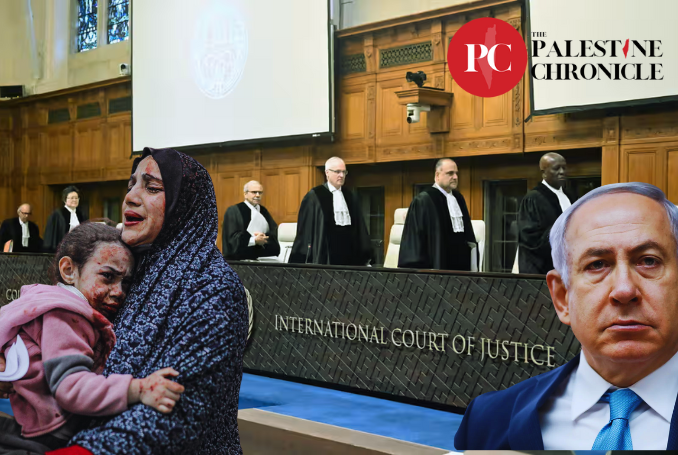
Ilan Pappe” ‘The ICJ missed an opportunity to stop the genocide in Gaza.’ (Image: Palestine Chronicle)

By Ilan Pappe – The Palestine Chronicle  

If committed activists needed an additional reason for why what they are doing is essential and just, then the ICJ’s ruling is a chilling reminder of what is at stake here. 

The moral and brave approach by South Africa to the International Court of Justice (ICJ), hoping for a ruling that would bring an end to the genocide of the Palestinians in Gaza, was not matched by the court on Friday, January 26, 2024. 

I am not underestimating the significance of the court’s ruling. True, the court confirmed the right of South Africa to approach the ICJ and substantiated the facts it presented, including the assumption that Israel’s actions could be defined as genocide under the terms of the genocide convention.  

In the long run, the language and the definitions used by the ICJ in its first ruling will constitute a huge symbolic victory on the way to Palestine’s liberation. 

But this is not why South Africa approached the ICJ. South Africa wanted the court to stop the genocide. And therefore, from an operative point of view, the ICJ missed an opportunity to stop the genocide, mainly because it still treated Israel as a democracy and not a rogue state. 

Palestinians, and whoever supports any struggle against crimes committed by countries of the global north, ceased a long time ago to be impressed by symbolic actions. Actions against rogue states only are meaningful if they have an operative side to them.

The operative actions suggested by the ICJ are basically a demand from Israel to submit, in one month’s time, a report on measures taken to prevent genocide in Gaza. 

No wonder, the Israeli government has already hinted that such an assignment would not be high on its agenda and, most importantly, would not have any impact on its policies on the ground. 

Even if the ICJ would have demanded, as it should have, a ceasefire, it would have taken quite a while to implement it, given the Israeli intransigence. But the message to Israel would have been clear – and effective. 

License to Commit Genocide

The important thing to remember in any engagement with Israel is that what matters is not how the message is intended but how it is understood by Israeli policymakers. 

The Western solidarity with Israel, shown on October 7, 2023, was understood by its policymakers as a free license to commit genocide in Gaza. Similarly, opting for a report instead of action is understood in Israel as a slight slap on the hand, which gives Israel at least another 30 days to continue its genocidal policies.

If this is the case, what would be left of Gaza in a month? What would be the magnitude of the genocide in a month’s time, if not only the West but also the ICJ, refuses to call for an immediate ceasefire? I am afraid that there is no need to answer these terrible questions. 

More importantly, the crime has already been committed, it is not as if there is still time to stop it. Therefore, unless the ICJ believes that Israel’s actions be reversed and rectified, it sends a very confused message. It seems to hint that, although the actions may be a crime, if the carnage is limited, then this would be welcomed by the ICJ.

History of Failure in Palestine 

The ICJ seemed to lack courage when it refrained from demanding what many countries in the global south and a huge number of people in the global civil society were asking for in the last three months.

If this whole process ends with the usual conclusion that international law has no power to stop the destruction of Palestine and the Palestinians, this will have even a greater impact on the question of Palestine. 

In fact, this awareness could severely undermine the confidence, which is already very low, of the global south in the universality of intentional law.  

Ever since its final institutionalization after the Second World War, the international law failed to deal properly with colonialism as a crime and was never able to challenge settler colonial projects like Israel. 

It also became clear that imperialist policies pursued by the US and Britain, in clear violation of international law, are totally exempt from international law’s jurisdiction. Hence, the US was able to invade Iraq with a stark violation of international law and Britain now plans to send, without fear of reprisal, asylum seekers to Rwanda. 

In the case of Palestine, throughout 75 years of the ongoing Nakba, international law – through its official and informal representatives, practitioners and delegations – was completely ineffective. It did not stop the killing of one single Palestinian; it did not lead to the release of one single Palestinian political prisoner, nor did it prevent the ethnic cleansing of Palestine. Indeed, the list of its failures is too long to be detailed here. 

But There is Hope 

There is a new, important lesson that should shape our activity and inform our hopes for the future. 

We already learned that there is no hope for change within Israeli society, a lesson that was ignored by those involved in the so-called peace process. 

The failure to understand the DNA of the Zionist society allowed Israel, since its inception, to kill Palestinians incrementally and massively either directly, by shooting them, or indirectly, by denying them basic human conditions for living.  

This process, led by the US, was based on the formula that only after “peace” is restored, Israel would be obliged to change its ruthless policies on the ground. 

This false paradigm has totally collapsed, even if the Biden Administration attempts, these days, to resurrect it, along with the few Palestinians who, for some reason, still put their faith in the two-state solution.

And now comes the new, important lesson: not only can we not hope for a change within Israel, we cannot rely on international law to protect the Palestinians from genocide. 

This, however, does not mean that there is no hope in the future for liberation and decolonization. The Zionist project is in the process of imploding from within. 

Israel’s Jewish society is disintegrating, its economy is failing, and its international image is deteriorating. 

The Israeli army did not function in October and the government is in tatters and unable to provide basic services to its citizens. Under these circumstances, only wars and cynical Western interests will keep this project alive, but for how long? 

And yet, such a process of implosion in history can be long, brutal and violent as it transpires in front of our eyes these days.

And we are not just onlookers. The activists among us understand that we have to double and triple what we already know has to be done. 

We continue, outside of Palestine, to try and move the ‘B’ and ‘D’, in Boycott and Divestment, to ‘S’, as in Sanction.

This effort can be intensified by pushing in two directions. On one hand, we should exert more pressure on the governments of the global south to be more active, particularly in the Arab and Muslim worlds. On the other hand, we should find better ways to increase the electoral pressure on our representatives in the global north. 

There is no need to tell the Palestinian Resistance what to do to defend itself and its people. There is no need to tell the liberation movement how to strategize for the future. Wherever they are, Palestinians who are involved in the struggle will continue to persevere and be resilient. What they truly need is for any external effort to be more effective, realistic and bold. 

One can not but admire what the solidarity movement with Palestine has already achieved, especially in the last three months. 

However, if its loyal and committed activists needed an additional reason for why what they are doing is essential and just, then the ICJ’s ruling is a chilling reminder of what is at stake here.  

If there is hope to stop the genocide all over historical Palestine, it lies in the ability of the global civil society to take the lead. Because it is far too obvious that governments and international bodies are unwilling or unable to do so.

– Ilan Pappé is a professor at the University of Exeter. He was formerly a senior lecturer in political science at the University of Haifa. He is the author of The Ethnic Cleansing of Palestine, The Modern Middle East, A History of Modern Palestine: One Land, Two Peoples, and Ten Myths about Israel. He is the co-editor, with Ramzy Baroud of ‘Our Vision for Liberation.’ Pappé is described as one of Israel’s ‘New Historians’ who, since the release of pertinent British and Israeli government documents in the early 1980s, have been rewriting the history of Israel’s creation in 1948. He contributed this article to The Palestine Chronicle.

The 1967 Obsession, Trump and Trivia By Miko Peled

Israeli Generals Dayan, Narkis and Bar-Lev at the Western Wall

Israeli Generals Dayan, Narkis and Bar-Lev at the Western Wall

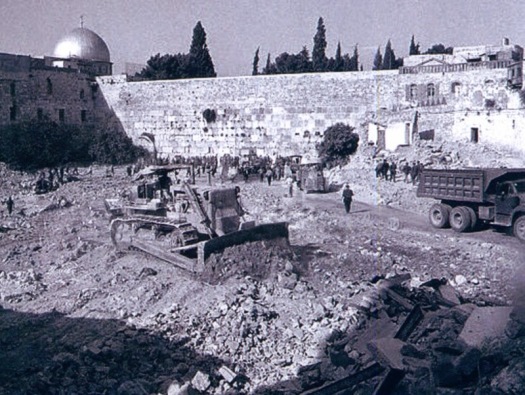
I arrived in Jerusalem last night and as always during the weeks between mid-May and mid-June the media is full of romanticized memories. Within these weeks are the two most siginicfant dates in modern Palestinian history: May 1948 when Palestine was conquered and renamed Israel, and June, 1967 when the Israeli army completed the conquest of Palestine by taking East Jerusalem, the West Bank and the Gaza Strip. For Palestinians these dates bring back bitter memories, but for Israelis the memories are sweet – those were the days when we were young and brave and innocent.  Vintage photos of soldiers at the newly conquered Western Wall, generals announcing “the Temple Mount is in our hands,” and teary-eyed old Jews praying with devotion are everywhere. The horrors that make up the Palestinian memories, the piles of dead bodies, civilians panicking as they are forcibly exiled, children lost in the mayhem and ancient villages and communities bulldozed only to be rebuilt for Jews are rarely shown or discussed.

Palestinian refugees fleeing to Jordan across the wrecked Alenbi Bridge

Destruction of the 700 year old Mughrabi neighborhood was done immediately following the Israeli conquest of East Jerusalem to create the Western Wall plaza.

To add to all that, Donald Trump is expected to arrive in Jerusalem and this gives the press and the official state PR machine an even greater opportunity to deal with the two things they love best: smoke screens and trivia.  Gaza? never even heard of it! Fifteen hundred innocent political prisoners on a hunger strike for over a month? Nobody cares! But check this out: apparently Trump will fly directly from Saudi Arabia to Tel-Aviv and this is the first direct flight between the two countries; the King David Hotel in Jerusalem is preparing for Trump’s visit and a drone was spotted in the hotel parking lot! And the ongoing burning question, will the great deal maker be able to close the Israeli-Palestinian peace Deal?  All smoke screens and trivia which are the staples of tabloids – a category into which most Israeli media outlets fit perfectly – though in their defense one must admit that there is no point in dealing with substance because Trump’s visit will offer none.

Here are a few items that are sure not to be on Trump’s agenda: Two million people in Gaza have no access to clean water, proper nutrition or medicine.  They have been victims of devastating attacks for seven decades and before they can recover from one assault there is another one pending.  The Israeli water authority allocates only 3% of the water to Palestinians even though they make up more than 50% of the overall population. More than 55% of Palestinians with Israeli citizenship live below the poverty line, and even though they rate one of the highest in the world in literacy, there is massive unemployment among Palestinians. Palestinians in the West Bank live under a brutal military regime governed by Israeli commanders who impose inhumane laws and prevent people from enjoying the basic most human rights. Seven thousand political prisoners sit in Israeli jails in violation of international law, over fifteen hundred of them on a hunger strike for over a month.

Trump may also visit Ramallah, and there too these topics are not likely to come up. Though there are attempts to prop the legitimacy of the Palestinian Authority, it is on life support and barely surviving. Municipal elections to West Bank cities were a failure – marked by boycotts of major political parties and a lack of voter interest. Mahmoud Abbas, the so-called president of the Palestinian Authority is old and tired and can no longer mask his disinterest in the fate of his people.  Hamas has made some changes to its charter and the newly elected head of Hamas’ political bureau is the Gaza resident, Gaza born Ismail Haniya, who is also the democratically elected Prime Minister of the now defunct Palestinian Authority.  The Authority has no real authority and neither party is relevant anymore.

The question of moving the US embassy to Jerusalem is also dead at this point although for political reasons Netanyahu will pretend it is a priority.  Both Trump and Netanyahu know that Jerusalem is a red line that even two reckless politicians such as them will not dare cross. Trump will not risk a multi billion dollar weapons deal with Saudi Arabia, and Netanyahu won’t risk an uprising for a symbolic gesture for which no country in the world can give its support.  The international community has never recognized Jerusalem as part of Israel, and international recognition of Israel’s jurisdiction is out of the question. So while Israeli politicians may try to create headlines over this topic, it is nothing but a smoke screen.

The terror under which Palestinians live – be it in their own country or in refugee camps  around it, is part of the daily bread of Palestinian existence. The causes for this existence, the wars of 1948 and 1967 are commemorated each year during the weeks between mid-May and mid-June.  The horror of the Palestinian reality is magnified when compared to the dishonest, romanticized narrative presented by Jews during that time: An Israel that is eternally young and brave and facing constant danger, yet winning and succeeding. Judging by Trump’s entourage, which includes David Friedman the new US ambassador to Israel and Jared Kushner, the famous Jewish son in law, Israel’s narrative of lies will dominate the agenda, while trivia and smoke screens will dominate the news.


Miko Peled : few days in Palestine

img_8471_d6502

It’s only been a few days since I arrived in Palestine so not much has happened. Well, relatively speaking not much. I was traveling to Nabi Saleh to see my friend Bassem Tamimi. Since I didn’t have a car I had to travel by bus through Qalandia checkpoint to Ramallah then by service cab to the village and back – and on the way back, the girl soldier put down her phone long enough to examine my ID, realize I was Israeli and detain me. Then the next day, I went to the epic “Combat BDS” conference also known as, or rather should be known as “Crazy & Loony Bros. How Do We Kill BDS Circus” in Jerusalem. It was an unforgettable experience. And now, as I sit and write this, a soldier is being tried for murder because he shot a Palestinian who was already dead. So its not the soldier that shot and murdered the young Palestinian that’s on trial, it’s the soldier that shot him for fun after he lay dead, or nearly dead on the ground, ignored by several Israeli ambulances that were driving around him – that’s the soldier that’s being tried. But, as I said, it’s only been a few days.

I grew up here and when I come here I live in the home and in the room where I grew up. Very little has changed in Motza Elite, a quiet and disorganized little place where for the most part houses are surrounded by trees and vegetation. Sure, the trees are taller, their trunks thicker, but it is still a quiet, beautiful little place with no soldiers, police or border guards and of course, no Arabs. It is the perfect white, Jewish, privileged community and it is the perfect place to get away from it all, or as most people who live here do, ignore any of it exists. “It” is the rest of Palestine.

*

I will start with what seems to me the most bizarre thing going on at this moment. Two young Palestinians, who attacked fully armed soldiers using knives, were killed. Ambulances are on the scene taking care of the soldiers who were slightly wounded and they drive around the bodies of the young Palestinians. Suddenly a shot is heard. A soldier who was not on the scene originally decides to shoot one of the Palestinians lying on the ground, motionless, in the head. He claims he saw some movement and was concerned the victim on the ground might detonate a bomb. Now for some reason this soldier is charged with murder.

*

It’s a good idea from time to time to travel around the country as Palestinians do. Use buses, service cabs and go through checkpoints. It’s inconvenient, takes a lot of time and is totally unpredictable. So that’s what we did. Fadwa, my better half and I took a bus to East Jerusalem then another bus to Ramallah where we met Bassem Tamimi. We had coffee at “Stars and Bucks Café” and then the three of us took a service cab to Nabi Saleh. Bassem was supposed to be in the US now on a speaking tour. This would have been his third tour since receiving his visa to the US. But suddenly, with no real explanation and no apparent reason he got notice that his visa has been revoked. So American audiences were denied the chance to hear him and he remains here in Palestine trying to help the nearly twenty youth from Nabi Saleh, who are in prison, including his son Wa’ed.

We arrived in Nabi Saleh, spent the afternoon there and then returned to Jerusalem. We took a service cab to Ramallah, a cab to the checkpoint, tried to find our way through the maze that makes up the checkpoint, and thankfully the Palestinian vendors outside pointed us in the right direction. The soldier behind the window rarely takes the trouble to lift their eyes when the ID is presented. So, I press my ID against the window expecting to be waved through when something caught her eye long enough for her to see that mine was an Israeli ID. With nothing better to do she decided to look into this strange phenomenon, an Israeli coming through a Palestinian checkpoint. Thinking I was probably some kind of “human rights” agitator or something she called me from inside, “Are you with human rights?”

MORE…
“ISRAEL IS FIGHTING FOR YOU”: EXPOSING THE FALSEHOODS IN THE RECENT AND RENEWED ZIONIST PROPAGANDA TECHNIQUE AGAINST THE PALESTINIAN STRUGGLE FOR JUSTICE
G4S CONCEDES TO BDS PRESSURE; SET TO LEAVE ISRAEL
WITCH-HUNTING FOR ISRAEL
MORE ON ISRAEL’S COMBATING BDS
“No.”

“Are you with B’Tselem”

“No.”

“Don’t you know Jews are not allowed to cross here?

“No.”

“What were you doing in Ramallah?”

“We bought strawberries, and had coffee.”

Fadwa is not the problem because she is not Jewish. I am the problem. Still they ask her the same questions and we are “invited” in to a waiting room and sit down.

We sit and wait. The room is maybe three feet by three feet and its freezing cold. We start looking at the graffiti in Arabic that is engraved into the walls. Ten minutes go by and nothing happens.

“What are we waiting for?”

“The police are on their way?’

“What for”

“To question you?”

“Why?”

“There is an order from the colonel or general that prohibits Jews from crossing here.”

She should read my book, The General’s Son, Journey of an Israeli in Palestine, there is a chapter called, The Commanding General’s Order.

“OK, we wont do it again.”

“The police will be here any minute.”

We wait ten more minutes and the same conversation takes place, then again and again about every ten minutes. Finally, she hands me my ID and says, “You can go now.” No explanation, no nothing.

*

It was a cold, rainy day as thousands entered the convention center in Jerusalem. Fresh coffee, sandwiches and pastries were free, security was tight and I tried to make myself as un-noticeable as possible. “Just blend in,” I thought to myself when I heard someone say, “look that’s Miko Peled.” Crap! Not the place I want to be recognized. Every kind of Israeli crazy was there. I look over, and it’s Anthony Lowenstein, the Auzzie journalist and Dan Cohen, an American journalist. Both are crazy Jews like me who came to see this circus. We sat down and then it started. The world’s most self-absorbed, self-righteous and criminally insane society was putting on a show, with its best actors playing lead roles. This was the “How To Combat BDS” conference, put on by Israel’s largest newspaper, Yediot Aharonot.

Israeli President Reuven Rivlin was up first. Israel could hardly have selected a better-suited man for the job of representing the state and the people of Israel. Rivlin is a white, European colonizer, constantly patting Israel and himself on the back for being a liberal democratic melting pot. “BDS foundation is de-legitimization of Israel without connection to what Israel does” President Rivlin said and he added that “the world is in awe of Israeli exceptionalism.” He ended his remarks by saying that he sleeps better than ever knowing the Israeli army is the most moral army on earth. Talk about “opium to the masses.”

Anthony Lowenstein wrote a piece about the conference everyone should read, but here is quick review of some of my favorite highlights: Gilad Erdan minister of public security, strategic affairs and Hasbarah (all that is one ministerial office) who has been designated as lead role in the fight against BDS said that it’s all about legitimacy. Indeed this is about legitimacy. Everything Israel does is about claiming it has legitimacy when clearly, being a settler-colonialist project that established a racist system in Palestine, it hasn’t got any legitimacy at all. Erdan went on to say that BDS activists would soon begin to pay for de-legitimization of Israel. He didn’t specify how they would pay, but one can be sure that all dedicated BDS activists expect that the struggle to free Palestine will be a tough one and will readily confront obstacles to achieve this goal.

Then Jewish Billionaire Ron Lauder came up to speak. He said that since anti-Semitic campus groups such as Students for Justice in Palestine and the Muslim Students Association are so well funded, poor Jewish students can’t complete and have no tools to defend themselves. You had to wonder if he is lying or just totally clueless. His remedy is that he will provide the funds for Pro Israeli groups on campus so that the Zionist voice is heard. As president of the World Jewish Congress he works closely with Jewish leaders around the world to push for anti-BDS legislation. Interestingly enough, he was the first one to mention Omar Barghouti, who heads the BDS movement, “why does he want to destroy Israel?” Lauder asked. If they had any sense they would have invited him to explain.

The EU ambassador to Israel was on a panel with some of the worst racist figures in Israel, including Danny Dayan. Dayan who was rejected by the government of Brazil to be Israel’s ambassador was now nominated to be Israel’s Consul General in NY. The EU ambassador said that West Bank settlement products are welcome in the EU, and that the labeling of settlement products is done merely for information purposes. More opium! Dore Good, general director of the Israeli foreign ministry said that we must expose the fact that the Islamic jihad and the Muslim Brotherhood established BDS. He repeated this several times even though it is completely untrue, practicing what was once said about a lie, that if it is repeated enough times, it becomes truth. Well, I doubt that in this case it will work. The day ended shortly after that and the three exhausted Jewish infiltrators drove away to bask in the warmth of Arab East Jerusalem. Who knows what the next few days may bring.

On Contact: The BDS Movement with Miko Peled

Shimon Peres from the perspective of his victims

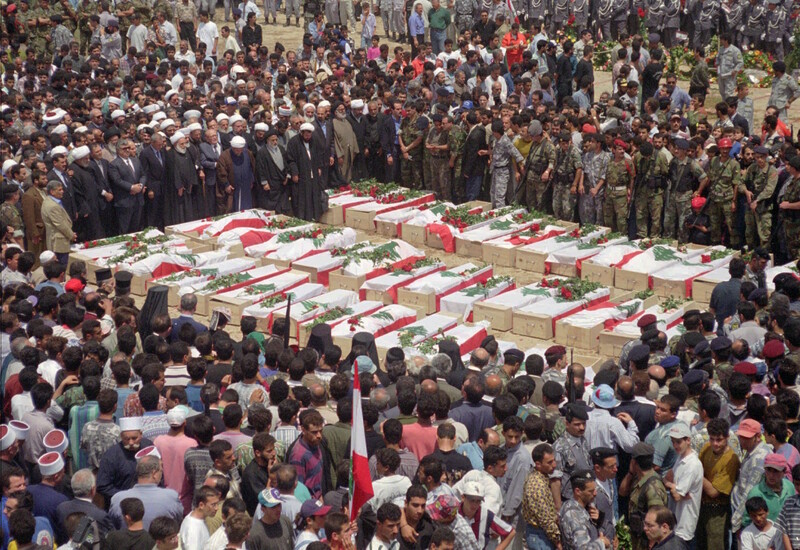
Officials and mourners surround coffins covered with Lebanese flags during a mass funeral in the southern Lebanese town of Tyre, 30 April 1996. The victims were killed in an Israeli artillery attack on a UN base in Qana, in southern Lebanon, on 18 April as part of an operation ordered by then Israeli Prime Minister Shimon Peres. Ahmed Azakir AP Photo

The obituaries for Shimon Peres have already appeared, no doubt prepared in advance as the news of his hospitalization reached the media.

The verdict on his life is very clear and was already pronounced by US President Barack Obama: Peres was a man who changed the course of human history in his relentless search for peace in the Middle East.

My guess is that very few of the obituaries will examine Peres’ life and activities from the perspective of the victims of Zionism and Israel.

He occupied many positions in politics that had immense impact on the Palestinians wherever they are. He was director general of the Israeli defense ministry, minister of defense, minister for development of the Galilee and the Negev (Naqab), prime minister and president.

In all these roles, the decisions he took and the policies he pursued contributed to the destruction of the Palestinian people and did nothing to advance the cause of peace and reconciliation between Palestinians and Israelis.

Born Szymon Perski in 1923, in a town that was then part of Poland, Peres immigrated to Palestine in 1934. As a teenager in an agricultural school, he became active in politics within the Labor Zionist movement that led Zionism and later the young State of Israel.

As a leading figure in the movement’s youth cadres, Peres attracted the attention of the high command of the Jewish paramilitary force in British-ruled Palestine, the Haganah.

Nuclear bomb

In 1947, Peres was fully recruited to the organization and sent abroad by its leader David Ben-Gurion to purchase arms which were later used in the 1948 Nakba, the ethnic cleansing of Palestinians, and against the Arab contingents that entered Palestine that year.

After a few years abroad, mainly in the United States, where he was busy purchasing arms and building the infrastructure for the Israeli military industry, he returned to become director general of the defense ministry.

Peres was active in forging Israel’s collusion with the UK and France to invade Egypt in 1956, for which Israel was rewarded by France with the needed capacity to build nuclear weapons.

Indeed it was Peres himself who largely oversaw Israel’s clandestine nuclear weapons program.

No less important was the zeal Peres showed under Ben-Gurion’s guidance and inspiration to Judaize the Galilee. Despite the 1948 ethnic cleansing, that part of Israel was still very much Palestinian countryside and landscape.

Peres was behind the idea of confiscating Palestinian land for the purpose of building exclusive Jewish towns such as Karmiel and Upper Nazareth and basing the military in the region so as to disrupt territorial contiguity between Palestinian villages and towns.

This ruination of the Palestinian countryside led to the disappearance of the traditional Palestinian villages and the transformation of the farmers into an underemployed and deprived urban working class. This dismal reality is still with us today.

Settlers’ champion

Peres disappeared for a while from the political scene when his master Ben-Gurion, Israel’s founding prime minister, was pushed aside in 1963 by a new generation of leaders.

He came back after the 1967 War and the first portfolio he held was as minister responsible for the occupied territories. In this role, he legitimized, quite often retroactively, the settlement drive in the West Bank and Gaza Strip.

As so many of us realize today, by the time the pro-settlement Likud party came to power in 1977, the Jewish settlement infrastructure, in particular in the West Bank, had already rendered a two-state solution an impossible vision.

In 1974, Peres’ political career became intimately connected to that of his nemesis, Yitzhak Rabin. The two politicians who could not stand each other, had to work in tandem for the sake of political survival.

However, on Israel’s strategy toward the Palestinians, they shared the Zionist settler-colonial perspective, coveting as much of Palestine’s land as possible with as few Palestinians on it as possible.

They worked well together in quelling brutally the Palestinian uprising that began in 1987.

Peres’ first role in this difficult partnership was as defense minister in the 1974 Rabin government. The first real crisis Peres faced was a major expansion of the messianic settler movement Gush Emunim’s colonization effort in and around the West Bank city of Nablus.

Rabin opposed the new settlements, but Peres stood with the settlers and those colonies that now strangulate Nablus are there thanks to his efforts.

In 1976, Peres led government policy on the occupied territories, convinced that a deal could be struck with Jordan, by which the West Bank would be within Jordanian jurisdiction but under effective Israeli rule.

He initiated municipal elections in the West Bank but to his great surprise and disappointment, the candidates identified with the Palestine Liberation Organization were elected and not the ones loyal to Jordan’s Hashemite monarchy.

But Peres remained faithful to what he named the “Jordanian option” as an opposition leader after 1977 and when he returned to power in coalition with the Likud in 1984-1988. He pushed forward the negotiations on the basis of this concept until King Hussein’s decision to cede any political connection between Jordan and the West Bank in 1988.

Israel’s international face

The 1990s exposed to the world to a more mature and coherent Peres. He was Israel’s international face, whether in government or outside it. He played this role even after the Likud ascended as the main political force in the land.

In power, in Rabin’s government in the early 1990s, as prime minister after Rabin’s 1995 assassination, and then as a minister in the cabinet of Ehud Barak from 1999 to 2001, Peres pushed a new concept for what he called “peace.”

Instead of sharing rule in the West Bank and Gaza Strip with Jordan or Egypt, he now wished to do it with the Palestine Liberation Organization. The idea was accepted by PLO leader Yasser Arafat, who may have hoped to build on this a new project for the liberation of Palestine.

As enshrined in the 1993 Oslo accords, this concept was enthusiastically endorsed by Israel’s international allies.

Peres was the leading ambassador of this peace process charade that provided an international umbrella for Israel to establish facts on the ground that would create a greater apartheid Israel with small Palestinian bantustans scattered within it.

The fact that he won a Nobel Peace Prize for a process that advanced the ruination of Palestine and its people is yet another testimony to world governments’ misunderstanding, cynicism and apathy toward their suffering.

We are fortunate to live in an era in which international civil society has exposed this charade and offers, through the boycott, divestment and sanctions movement and the growing support for the one-state solution, a more hopeful and genuine path forward.

Qana

As prime minister, Peres had one additional “contribution” to make to the history of Palestinian and Lebanese suffering.

In response to the endless skirmishes between Hizballah and the Israeli army in southern Lebanon, where Hizballah and other groups resisted the Israeli occupation that began in 1982 until they drove it out in 2000, Peres ordered the bombing of the whole area in April 1996.

During what Israel dubbed Operation Grapes of Wrath, Israeli shelling killed more than 100 people – civilians fleeing bombardment and UN peacekeepers from Fiji – near the village of Qana.

Despite a United Nations investigation that found Israel’s explanation that the shelling had been an accident to be “unlikely,” the massacre did nothing to dent Peres’ international reputation as a “peacemaker.”

In this century, Peres was more a symbolic figurehead than an active politician. He founded the Peres Center for Peace, built on confiscated Palestinian refugee property in Jaffa, which continues to sell the idea of a Palestinian “state” with little land, real independence or sovereignty as the best possible solution.

That will never work, but if the world continues to be committed to this Peres legacy, there will be no end to the suffering of the Palestinians.

Shimon Peres symbolized the beautification of Zionism, but the facts on the ground lay bare his role in perpetrating so much suffering and conflict. Knowing the truth, at least, helps us understand how to move forward and undo so much of the injustice Peres helped create.

The author of numerous books, Ilan Pappe is professor of history and director of the European Centre for Palestine Studies at the University of Exeter.

Interview with Shir Hever


You went to Berlin to the Free University. Why?

I actually live in Heidelberg, although I’m writing my PhD at the Free University of Berlin. I followed my partner who found a job in Germany. The very large emigration from Israel of young and educated people has meant that much of my family and friends have already left Israel, and Berlin is actually a favorite destination, where I meet many of my old friends from Jerusalem and Tel-Aviv.

What motivated you to research Israel’s military sector and to support BDS? Did your upbringing and family background have a role in this, or was it something you came to later in life?
I did grow up in a leftist and critical family, and was taught to ask questions from a young age. I went to a very militaristic school, so I was taught a Zionist perspective as well, but I didn’t want to take part in the occupation directly as a soldier. In order to try to be a non-combat soldier, I volunteered for a year of social service in the town of Sderot, and there I had time to think about politics, to hear from my friends who were drafted into the army, and to see aspects of Israeli society that I never knew existed. I decided not to do any military service. By pretending to be crazy I easily received an exemption, like thousands do every year.
Only in university, however, did I become aware of the Palestinian side of the story, when Palestinians were invited by a political group called “The Campus Will Not Stay Silent” to speak about their experiences during the Second Intifada. I started to become politically active and joined the Alternative Information Center, a joint Palestinian-Israeli organization.
Supporting BDS came naturally as I was part of the group of activists who were considering various strategies of combating the occupation. As an economist, I felt that BDS can have a very strong impact on the Israeli economy and society and was something that empowers Palestinians to use non-violent resistance.
Choosing my research topics was done in an activist environment, and I would usually write reports and studies on matters upon requests from activists. After writing my book on the political economy of Israel’s occupation, I realized that the Israeli military industry and Israeli arms exports are very important to complete the picture, to explain how Israel’s occupation fits into global interests, and so I chose this as a topic for my PhD.

It is said that the Israeli population is becoming more mentally and psychologically isolated from the rest of the world. Is that also your experience?
Absolutely not. Israelis strongly depend on a feeling of being part of the “west,” and part of Europe (even though Israel is not in Europe). The fascination of Israelis with the European Football Cup, with the Eurovision etc. is one aspect of this, but also the desire to travel in the world, to consume western culture, etc. I admit that when BDS started, I did not imagine that its most powerful impact would be precisely in the sphere of culture. Whenever a famous artist cancels a performance in Israel, the reactions are very powerful, because Israelis don’t want to feel isolated. The fact that Israelis are willing to pay double the prices for tickets to performances of artists who choose to violate BDS and perform in Israel is a testimony to that fact. Actually, this is the reason for BDS being a successful tactic; it targets a sensitive nerve of Israel’s culture, the need to be included.

Listening to Netanyahu and Lieberman, we get the impression here that the division between Jews and Palestinians in Israel itself is increasingly growing. Is that true?
On the political level, yes of course. The Israeli government is not ashamed to call for separation, and to demonize Palestinians as a group. On the local and personal level, there are also many cases of Palestinians and Jews working together, becoming friends, creating families together. Separation is never 100% successful. It is true that many Israeli Jews have little contact with Palestinians and know very little about them. Very few Israeli Jews bother to learn Arabic. But Palestinian Israelis, on the other hand, have frequent contact with Israeli Jews, speak good Hebrew and have a very good understanding of Jewish culture and politics.

How can you explain that an Israeli general has compared the situation in his country with Germany of the 1930s?
Major-General Yair Golan is well-known for being very direct and not too careful with what he says. In a lecture he gave in 2007 he admitted that the Wall of Separation’s main purpose is to separate populations, and security only comes as a second priority.
Currently Israel is witnessing a fierce struggle between two competing elite groups. The old military elite in Israel (to which Golan belongs) is in a state of crisis, losing much of its influence over the government and the business sector.
The military elite is not leftist, progressive or opposed to the occupation, but it believes in creating an “intelligent” occupation, a careful and planned use of force in order to keep the Palestinians under control. They are afraid of the populism of the Israeli government and how it encourages unbounded brutality of Israeli soldiers against Palestinians. Golan hinted that such populism and brutality are not signs of strength of Israel, but actually signs of weakness.
His statement was severely criticized, and gave the government the opportunity to make more populist statements. Minister of Defense Ya’alon (also a member of Israel’s military elite, and former commander of the army) was forced to resign and was replaced by Lieberman, who is not a member of the military elite.

Does militarism and war (also) serve to cover the tensions within Israeli Jewish society?
I wouldn’t say militarism and war, but rather an obsession with security. Israel hasn’t fought a real conventional war since 1973, instead it is constantly engaged in asymmetrical conflicts in civilian areas, where Israeli soldiers use heavy armaments in civilian areas. But the constant fear of retaliation, the threat of real and imagined terrorism, are exploited very cynically by the Israeli government to distract from the burning social issues in Israel.
A good example of this is the 2011 attack on an Israeli bus in the midst of large social protests in Israel. Netanyahu quickly announced that the attackers came from Gaza, and ordered a bombing against Gaza, killing five Palestinians. Even though the attackers did not come from Gaza, Palestinians chose not to react to the Israeli killing of innocent Palestinians, because such retaliation would serve the desire of Netanyahu to suppress the social protests. I think that we can learn from this example how well Palestinians understand Israeli society. Interestingly, the social protests ended eventually with very little effect, and the security issue continues to dominate Israeli political discourse.

If we look at the big military companies such as the Israeli Aerospace Industries (IAI) and Elbit, do they account for a large share of the Israeli economy?
The arms sector is a large section of Israel’s industrial sector, and the two biggest arms companies are the government-owned IAI, and the private Elbit Systems. There are conflicting numbers from various sources, and I estimate that 11% of Israel’s total exports are security and military exports, to which these two companies contribute more than half. Of course this is very significant for the Israeli economy, and no other country in the world has arms as such a high proportion of its total exports (not even the U.S, the world’s largest arms exporter). Nevertheless, one must remember that the majority of Israel’s exports, and industrial companies and workforce are civilian.

How is the Netherlands (and the EU) most complicit in supporting the Israeli military industrial complex? Through its subsidies and financing, its scientific research, its global production facilities, its purchases of Israeli military products and services, or its provision of tax havens for the companies’ profits?

All of the above, but the complicity is not just in helping to fund the Israeli arms industry, but also by legitimizing it. When Dutch and European politicians promote security cooperation projects with Israel, they are fully aware that the Israeli arms industry is based on the Israeli military experience in the Occupied Palestinian Territory, technologies developed in the course of repression of Palestinian resistance and control over a large population denied its basic rights. Therefore, all these ties between European and Israeli arms companies send a message that Europe accepts Israel’s occupation and even seeks to learn from it. This was said by General Yoav Galant (currently Israel’s minister of housing), that “foreign governments are hypocritical. On the one hand they criticize our actions, but then they come to us to learn how we do it.”

BDS campaigns in Europe have the potential to be a powerful force given that the EU traditionally has been one of Israel’s largest markets. Is this where you think BDS efforts can be most effective – or rather in the US or elsewhere?
In the end, the most effective BDS campaigns are not necessarily the ones that have the biggest monetary effect, but those that get the attention of the Israeli public. U.S-based BDS was very effective in making Israelis feel that “even our closest ally is changing its opinion on us,” but so did BDS actions in Germany. Europe remains Israel’s largest target both for exports and for imports, but BDS doesn’t seek to change that. BDS is not a tool to harm the Israeli economy, but to achieve political change through pressure.
The Netherlands play a very important role because of the importance of the Rotterdam port to Israel’s exports to Europe, especially of agricultural produce, which is of great symbolic significance. If the Netherlands will impose more strict controls over that import, it has a direct impact on the Israeli illegal colonies in the Jordan Valley, which is the most fertile land in all of Palestine.

Is BDS a bigger threat for the economy of Israel or for its image?
BDS does not seek to harm the Israeli economy, but to convince Israelis that it is unsustainable to violate international law. I don’t believe that the Israeli government will continue with its policies of apartheid and occupation long enough for BDS to cause a long-term damage to the Israeli exports. When Israeli companies will start moving to other countries to avoid BDS, the Israeli government will either collapse, or change its policies. The majority of the Israeli public today (unlike the situation in the 1970s and 1980s) is no longer willing to make great sacrifices for the sake of Zionism.
The Israeli image, however, is already strongly affected by BDS. The strength of BDS is that it is a movement based on research and information, and that through BDS, activists are able to educate the public about the situation in Palestine, and disseminate materials. The image of Israel in the world is changing as a result, and this is something that has no less of an effect on Israeli decision makers than the economic impact.

What could be important focus points for organizations such as docP and Stop de Wapenhandel (Stop the Arms Trade)?
In my experience, it is a very bad idea for someone from Israel/Palestine to tell organizations what their focus should be. Surely you know better than me who is your audience, what kind of message will be more effective to reach them and what they can do and organize locally. Palestine solidarity groups work in a wide variety of contexts – from student groups to church groups, from labor unions to social justice and environmental movements. My only recommendation would be to choose projects that can have an impact inside Israel, projects that involve major and well-known Israeli companies, politicians, etc. And that each such project should be accompanied by research. Activists can only be successful if they have a lot of information that they can disseminate as part of their activity. It is never enough to say “let’s boycott this company because it is Israeli.” You must explain why.

Shir Hever

DocP |  source


Blog at WordPress.com.

Up ↑