Shir Hever is an economic researcher in the Alternative Information Center, a Palestinian-Israeli organization active in Jerusalem and Beit-Sahour. Researching the economic aspect of the Israeli occupation of the Palestinian territories, some of his research topics include international aid to the Palestinians and Israel, the effects of the Israeli occupation of the Palestinian territories on the Israeli economy, and the boycott, divestment and sanctions campaigns against Israel. He is a frequent speaker on the topic of the economy of the Israeli occupation.
Backlash over threat to outlaw supporters of boycott movement aimed at ending the continued occupation of the West Bank
Rachel Shabi in Jerusalem and Peter Beaumont
The Observer, Sunday 11 July 2010

An academic backlash has erupted in Israel over proposed new laws, backed by the government of Binyamin Netanyahu, to criminalise a handful of Israeli professors who openly support a campaign against the continuing occupation of the West Bank.
The Boycott, Divestment and Sanctions (BDS) campaign against Israel has gained rapid international support since Israeli troops stormed a Gaza-bound flotilla of aid ships in May, killing nine activists. Israeli attention has focused on the small number of activists, particularly in the country’s universities, who have openly supported an academic boycott of Israeli institutions.
A protest petition has been signed by 500 academics, including two former education ministers, following recent comments by Israel’s education minister, Gideon Saar, that the government intends to take action against the boycott’s supporters. A proposed bill introduced into the Israeli parliament – the Knesset – would outlaw boycotts and penalise their supporters. Individuals who initiated, encouraged or provided support or information for any boycott or divestment action would be made to pay damages to the companies affected. Foreign nationals involved in boycott activity would be banned from entering Israel for 10 years, and any “foreign state entity” engaged in such activity would be liable to pay damages.
Saar last week described the petition as hysterical and an attempt to silence contrary opinions. While the vast majority of the signatories do not support an academic boycott of Israel, they have joined forces over what they regard as the latest assault on freedom of expression in Israel. The petition states: “We have different and varied opinions about solving the difficult problems facing Israel, but there is one thing we are agreed on – freedom of expression and academic freedom are the very lifeblood of the academic system.”
Daniel Gutwein, a history professor at Haifa University who is one of the signatories, described the minister’s intervention as an attempt “to make Israeli academia docile, frightened and silent”.
Although the BDS campaign – in various forms – has been running for over half a decade, it has become an increasingly fraught issue inside Israel in the past year since a small number of academics publicly declared support for a boycott, including Neve Gordon, author of Israel’s Occupation and a former paratrooper who was badly injured while serving with the Israeli Defence Force.
Speaking to the Observer last week, Gordon said that many Israelis saw support for the BDS as “crossing a red line”. Adding that he had received recent death threats, he said: “I am worried about what is happening to the space for debate in Israel. I find that there is a proto-fascist mindset developing. One of the slogans you hear a lot now is no citizenship without loyalty. It is an inversion of the republican idea that the state should be loyal to the citizen.”
Israeli campaigners believe the Gaza flotilla incident represents a tipping point in raising support for boycotts. Musicians including Elvis Costello, Gil Scott Heron and the Pixies have cancelled shows in Israel. Hollywood actors also snubbed Jerusalem’s international film festival and internationally acclaimed writers have supported the BDS movement, which is gaining support in dozens of countries.
“It’s a different world to what it was even a month ago,” says Kobi Snitz, member of an Israeli BDS group. “Suddenly, all sorts of people are supporting it – people that you wouldn’t expect.”
What is most interesting, however, has been the impact in Israel itself. Israeli journalist and blogger Noam Sheizaf wrote recently that such actions are now forcing Israelis “to think about the political issues and about their consequences… For a country in a constant state of denial regarding the occupation, this is no small thing.” Sheizaf does not promote the boycott, but says: “I will gladly return concert tickets if that is the price for making Israelis understand that the occupation cannot go on.”
Adi Oz, culture editor on the Tel Aviv weekly Ha’ir, appeared on Israeli national radio explaining her support for recent boycott activity. “When the Pixies cancelled their concert here I was disappointed,” she says. “But I was not critical of the Pixies, I was critical of our government, because they are responsible for Israel’s isolation.” She adds that, post-flotilla, the cultural boycott is “something that everyone has a stand on – and some people are realising that they are in favour of it, without having thought about it before.” There has also been a spate of boycott-related discussion in the financial press. The daily business newspaper Calcalist ran an uncritical profile of the Israeli campaigners behind Who Profits, an online database of Israeli and international companies involved in the occupation of the West Bank.
The project’s co-ordinator, Dalit Baum, of the Coalition of Women for Peace, says: “Every day there is an article about this issue in the Israeli media, which creates a discussion about the economy of the occupation and raises the fact that there’s a problem.”
By JONNY PAUL, JERUSALEM POST CORRESPONDENT
07/01/2010 04:21
Methodist Church rejects products from the West Bank.
LONDON – The Methodist Church of Britain voted on Wednesday to boycott Israeli-produced goods and services from the West Bank because of Israel’s “illegal occupation of Palestinian lands.”
“A majority of governments recognize the Israeli occupation of Palestinian territories as illegitimate under international law,” the church body said at its annual conference in Portsmouth.
The church body will now encourage Methodists across the UK to follow suit.
The motion stated that the boycott of goods “from illegal Israeli settlements” was in response to a call by the World Council of Churches – which advocates divestment from Israel – and by Palestinian civil society and “a growing number of Jewish organizations in Israel and worldwide.”
“The Methodist Conference notes the call of the World Council of Churches in 2009 for an international boycott of settlement produce and services and the support given for such a boycott by Christian leaders in Palestine in the Kairos document, Palestinian civil society and a growing number of Jewish organizations both inside Israel and worldwide and calls on the Methodist people to support and engage with this boycott of Israeli goods emanating from illegal settlements,” the church said.
Last year, the Methodist Church set up a working group to “work for an end to the Occupation, an end to the blockade of Gaza, adherence to international law by all sides and a just peace for all in the region.”
The resulting 54-page report produced by the church body, titled “Justice for Palestine and Israel,” met with a fierce condemnation by the Board of Deputies of British Jews, the Council of Christians and Jews and British Chief Rabbi Jonathan Sacks.
In a statement released after Wednesday’s vote, the church body said the decision, which carried unanimously, had the goal of ending “the existing injustice.”
“This decision has not been taken lightly, but after months of research, careful consideration and finally, today’s debate at the conference,” said Christine Elliott, secretary for external relationships. “The goal of the boycott is to put an end to the existing injustice. It reflects the challenge that settlements present to a lasting peace in the region.”
Jewish community leadership organizations reacted with dismay. In a joint statement, the Board of Deputies of British Jews and the Jewish Leadership Council said it was, “This is a very sad day, both for Jewish-Methodist relations and for everyone who wants to see positive engagement with the complex issues of Israeli-Palestinian relations. The Methodist Conference has swallowed hook, line and sinker a report full of basic historical inaccuracies, deliberate misrepresentations and distortions of Jewish theology and Israeli policy.
“The deeply flawed report is symptomatic of a biased process: The working group which wrote the report had already formed its conclusions at the outset. External readers were brought in to give the process a veneer of impartiality, but their criticisms were rejected. The report’s authors have abused the trust of ordinary members of the Methodist Church, who assumed that they were reading and voting on an impartial and comprehensive paper, and they have abused the goodwill of the Jewish community, which tried to engage with this issue, only to find that our efforts were treated as an unwelcome distraction,” the statement said.
David Gifford, the chief executive of the Council of Christians and Jews, said he was disappointed that the Israeli narrative was not heard during the debate.
“I was very disappointed at the emotive nature of the debate which again did not hear fairly also the pain and cry of the Israeli,” Gifford said. “It was right to hear the pain of the Palestinian but in the end the vote of the Methodist Conference was to boycott goods and services that originate from the West Bank. We shall have to see how this will affect future relationships of the Methodist Church with other churches, the CCJ [Council of Christians and Jews] and with the British Jewish community.”
The Board of Deputies said the conference should “hang its head in shame.”
“This outcome is extremely serious and damaging, as we and others have explained repeatedly over recent weeks. Israel is at the root of the identity of Jews and of Judaism, and as an expression of Jewish spiritual, national and emotional aspirations. Zionism cannot simply be ruled as illegitimate in the way that the conference has purported to do. This smacks of breathtaking insensitivity, as crass as it is misinformed. That this position should now form the basis of Methodist Church policy should cause the conference to hang its head in shame, just as surely as it will cause the enemies of peace and reconciliation to cheer from the sidelines.”
Anti-Zionist and anti-Israel activists who support a blanket boycott of Israel were the main sources of the document. They included Israeli-born academics Ilan Pappe and Avi Shlaim; Jeff Halper from the Israeli Committee against House Demolitions; Anglican vicar Stephen Sizer; and Beirut-based journalist Robert Fisk.
BIG BOYCOTT ACTIONS AT MORRISONS and SAINSBURY
SUPERMARKETS
BIG BOYCOTT PHONE IN
BIG BOYCOTT WRITE IN
BIG BOYCOTT BADGE PLEDGE
People of conscience all over the world want nothing to do with the Apartheid State of Israel. We don’t want Israeli goods in our supermarkets.
Week of action: July 9 – 17th 2010.
Demand an end to the sale of Israeli produce in our supermarkets.
The BIG Boycott Phone in: Friday July 9th 2010.
On July 9th – join the BIG boycott phone in: Use your voice – complain; ask questions.
Phone Morrisons; 0845 611 6111 (Lines open 730 a.m. – 6.30 p.m).
Phone Sainsbury 0800 636 262 (lines open 8 a.m. – 7 p.m.)
Ask why and demand answers:
Why is your supermarket sourcing produce from a country that repeatedly violates international law?
Why is your supermarket sourcing produce from companies that operate on land where Palestinians cannot live or work? (the Jordan Valley)
Why are you sourcing produce from companies that operate in illegal settlements and which benefit from an Apartheid system inside Israel?
Why are you sourcing produce from companies which are all benefitting from the illegal theft of Palestinian water and the theft of Palestinian land?
The BIG Boycott Write in: July 9th 2010
Write to Morrisons Head Office or to your local store manager.
To e mail: http://www.morrisons.co.uk/Store-finder/About-customer-services/Contact-Us1/
Or write to: Morrisons head Office: Hilmore House, Gain lane, Bradford, BD3 7DL.
Write to Sainsbury Head Office: J. Sainsbury plc, Holborn Place, 33 Holborn, Londond EC1 N2HT. Head Office Phone no: 0207 6956000.
Challenge them on the fact that they are trading with Israeli companies. Call for an end to business with Israeli companies which are profiting from Israeli occupation and Israel’s apartheid policies. The Israeli export companies known to be supplying British supermarkets, including Carmel Agrexco, Arava and Mehadrin Tnuport Export (MTEX) are all profiting from Israel’s violations of international law.
The BIG Boycott Badge Pledge: July 9th 2010
Make a pledge to wear your Boycott Israeli Goods badge, or any Boycott Israel badge.
Wear your Boycott Israeli Goods badge and keep on wearing it! Israel has been in the news so much that people are noticing badges and now is the time to tell people about the boycott, in whatever way we can. Wear badges; give out badges on the street; call on all your supporters to wear badges.
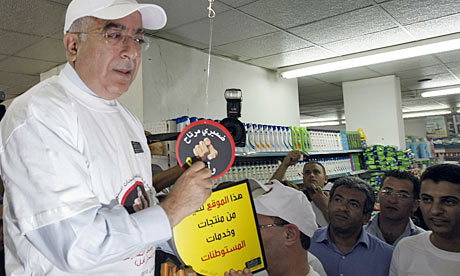
Campaign to clear supermarket shelves of West Bank settlement wares forces Israeli factories to cut production
Israeli factories based in settlements on the West Bank have been forced to cut back production as a growing Palestinian boycott movement begins to take effect.
The boycott, endorsed by the Palestinian president, Mahmoud Abbas, was given further momentum this week when a campaign to clear supermarket shelves of produce originating in settlements was rolled out in Ramallah.
“The objective is to ensure the Palestinian market is free of Israeli settlement produce by the end of this year,” the Palestinian prime minister, Salam Fayyad, said at the launch of the Store to Store campaign at the Alameen supermarket.
A team of volunteers will inspect 66,000 stores across the West Bank in the coming weeks, awarding certificates and window stickers to those free of settlement produce.
After a period of grace, shopkeepers retaining such produce in their stores could be liable to a fine of more than £9,000 or up to five years in prison under a law already passed but not yet enforced by the Palestinian legislative council.
“This is the daily expression of rejection of the occupation,” Fayyad said. “It will help ensure that the Palestinian economy is self-sufficient. There will not be a store in Palestine which cannot carry our stickers.”
The pro-boycott campaigners are careful to draw a distinction between produce from West Bank settlements, which are illegal under international law, and produce originating from within Israel. The latter will continue to be sold in Palestinian shops.
The campaign has been attacked by Israeli politicians, businesses and commentators. “The Palestinians are opposing economic peace and are taking steps that in the end hurt themselves,” the Israeli prime minister, Binyamin Netanyahu, said last month.
The West Bank market is worth around $200m (£133m) a year to Israeli businesses. But some settlement factories sell about 30% of their output to the Palestinian market, and the boycott is already having an impact on them.
Seventeen factories in Mishor Adumim, a large industrial estate between East Jerusalem and Jericho, have reportedly closed since the boycott campaign began. Some settlement factories are reported to be considering moving back into Israel.
Others in the Barkan industrial zone, near the settlement of Ariel, have reduced production, according to David Ha’ivri of the Shomron regional council, a pro-settler organisation in the northern West Bank. “Many of the factories are seeking alternative markets,” he said.
A factory producing aluminium window frames, which used to sell 30% of its output to the Palestinian market, had cut the hours of its 160 employees rather than lay people off, he said.
More than half the 5,000-6,000 employees in the Barkan zone are Palestinian, employed under Israeli labour legislation and entitled to the Israeli minimum wage of around $1,000 a month – considerably more than the average wage in the West Bank economy.
“[The boycott] is an unwise act by the Palestinian Authority,” said Ha’ivri. “The damage caused will be felt by both sides. They’re cutting off the branch they’re sitting on.”
The Palestinian Authority has established a $50m fund to provide alternative employment and grants in an effort to both discourage Palestinians from working in the settlements and foster the West Bank economy.
According to the Manufacturers Association of Israel, some 22,000 Palestinians are employed by settlement businesses – in construction, agriculture, manufacturing and service industries.
It is holding an extraordinary meeting this week to ascertain the impact of the boycott and consider what action to take.
Dan Catarivas of the association said firms were more concerned about the withdrawal of Palestinian labour than the boycott of goods, although the impact was uneven.
“These Israeli firms will have to find new workers – either Israelis or foreigners. But at the end of the day the Israeli companies will find other options, and the Palestinian workers will be left without jobs.”
He said the Israeli government had offered incentives to firms to establish factories in the West Bank, and it was possible that some of them may now seek compensation for their losses.
The Palestinian Authority said it was pleased with the level of support for the boycott, put in a recent survey at around 85%. Fayyad said it was “empowering the people” to resist the Israeli occupation without resorting to violence. “People feel national pride that they can participate in this campaign,” a spokesman said.
The boycott is part of a wider attempt to foster non-violent resistance against Israel’s occupation, including largely peaceful demonstrations against the separation barrier.
Internationally, the boycott is gaining momentum. European Union guidelines urge supermarkets to clearly mark the origin of produce on labels to allow consumers to distinguish between Palestinian, Israeli and settlement produce.
The Alameen supermarket owner, Erekat Ribhi Shukar, insisted Palestinian produce was competitive in terms of quality and price with settlement goods. “We should support Palestinian producers to help our economy,” he said beneath a sign declaring “My conscience is clear – my store is clean of settlement produce”.
At the rear of the store, two young women shoppers examining a chiller cabinet containing Palestinian and Israeli dairy products but no settlement goods said they backed the campaign. “We want products that benefit our economy, not harm it,” said one.
Every year, consumers the world over unwittingly spend billions of dollars on diamonds crafted in Israel, thereby helping to fund one of the world’s most protracted and contentious conflicts. Most people are unaware that Israel is one of the world’s leading producers of cut and polished diamonds.
As diamonds are normally not hallmarked, consumers cannot distinguish an Israeli diamond from one crafted in India, Belgium, South Africa or elsewhere. The global diamond industry and aligned governments, including the EU, have hoodwinked consumers into believing the diamond trade has been cleansed of diamonds that fund human rights abuses, but the facts are startlingly different.
In July 2000, the global diamond industry set up the World Diamond Council (WDC). The WDC was established as a response to public outrage about the use of diamonds to fund bloody conflicts in western African countries and it includes representatives from the World Federation of Diamond Bourses and the International Diamond Manufacturers Association.
The council’s ultimate mandate is “the development, implementation and oversight of a tracking system for the export and import of rough diamonds to prevent the exploitation of diamonds for illicit purposes such as war and inhumane acts.” Significantly, the WDC limits its concern about human rights violations to those funded by rough diamonds only. Israel currently chairs the Kimberly Process.
The notion of self-regulation by any industry that is intrinsically linked to the violations it purports to want to eliminate is something that neither governments nor the general public should tolerate. It is impossible for the public to have confidence in the diamond industry’s attempt to self-regulate as long as it facilitates the trade in diamonds crafted in Israel, which, if the Kimberly Process applied the same standards to all diamonds, would rightly be classified as blood diamonds and treated accordingly.
The diamond industry is a major pillar of the Israeli economy. No other developed country is so heavily dependent on a single luxury commodity and the goodwill of individual consumers globally. Anything that threatens the carefully-nurtured image of diamonds as objects of desire, romance and purity could have serious consequences for the Israel diamond industry and the country’s ability to continue funding its illegal occupation of the Palestinian territories, the construction of illegal colonies and other associated criminal activities that render it the pariah of the modern age.
The international BDS campaign needs to focus global attention on the diamond trade that facilitates Israel’s ongoing crimes against the Palestinian people and its neighbors in the region. The high-value end of the diamond industry is the main artery of the Israeli economy, accounting for more than 30 percent of Israel’s total manufacturing exports worth nearly $20 billion in 2008 (“Trade Performance HS: Exports of Israel” accessed 25 March 2010). By comparison, the budget for Israel’s Ministry of Defense was $16 billion in 2008. http://electronicintifada.net/v2/arti…
By JONNY PAUL
06/24/2010 22:27
One of UK’s largest unions votes for boycott, expelling Israeli envoy.
One of Britain’s largest trade unions passed a motion at its annual conference in Bournemouth last week accusing Israel of lying over the Gaza flotilla incident and has called for a complete boycott of Israel and for the expulsion of the Israeli ambassador, it was confirmed on Thursday.
The emergency motion was introduced on the third day of the annual conference of UNISON, the largest public sector union with around 1.4 million members. It said Israel was “brazenly lying” over the flotilla incident, as it “attempted to define it as an attempted lynch mob of its troops by passengers on the boats. “This is a further sign that Israel does not respond to words of condemnation, only action will have any effect,” the motion states.
One attendee said that the few Unison members who spoke against the motion were heckled.
UNISON member Lilach Head, a care worker from Devon, spoke against the motion and was heckled. She said the atmosphere was intimidating and the vote was called before more people could speak against it.
“Only three people were able to speak against the motion, there were six others waiting but then the vote was called. There was no hope,” she said.
The union will now support a full boycott of Israel – economic, cultural and sporting; it has joined the boycott, divestment and sanctions campaign and will suspend ties with the Histadrut.
In addition to these measures, UNISON is calling for Britain to expel the Israeli ambassador.
“Conference reaffirms the support for an economic, cultural and sporting boycott of Israel and call on Unison to join the scores of unions around the world who have endorsed the Palestinian call for boycott, divestment and sanctions against Israel. Further to that as an immediate sanction for the illegal attack on the flotilla, we call on the government to expel the Israeli ambassador,” the motion states.
The union had already banned a organization that promotes Israeli-Palestinian trade union cooperation from having a stall at its conference.
UNISON’s deputy general secretary, Keith Sonnet, a pro-Palestinian activist and patron of the Palestine Solidarity Campaign – a fringe group that advocates a one-state solution and major player in the boycott and delegitimization campaign against Israel – wrote to Trade Union Friends of Israel (TUFI) saying the union was unable to offer the organization a stall because “we have no ongoing work with the TUFI, nor are we affiliated to the organization.”
“More than 2,000 delegates to UNISON’s national conference, representing our 1.4 million members, did indeed carry a motion condemning the Israeli attack on the Gaza freedom flotilla, in which nine people were reportedly killed,” a union spokesperson told The Jerusalem Post on Thursday.
“The motion noted that the boats were carrying much needed humanitarian aid for the people of Gaza [and that] the passengers on the boats were civilians.”
Asked if the wording and the sentiments expressed in the motion were a fair and honest reflection of the views of the members, the spokesperson said: “Our 2,000 delegates were well aware of the words in the motion before it was carried. We have constantly called for an end to the Israeli blockade of Gaza and have pushed the case for a peaceful settlement – including an end to the bombings, on both sides.”
Asked how the motion would be implemented, the spokesperson said: “Our international committee will be taking forward the actions called for in the motion when it meets in the next couple of weeks.”
“Again, this is making accusations before the facts have been established and an investigation into this tragic incident have been completed,” said Stephen Scott, director of TUFI. “The outrageous attack on their fellow trade unionists in the Histadrut, who have called for a lifting of the blockade restrictions and the resumption of final-status peace talks, is counterproductive.
The Israeli embassy in London said the motion was “misleading” and “dishonest” and an “outrageous attempt” by anti-Israel activists to manipulate the union to serve their agenda.
“We categorically reject this misleading and dishonest motion. This is yet another outrageous attempt by anti-Israel elements to manipulate a union into serving their agenda.
“At a time when public sector workers face unprecedented challenges to their jobs and conditions, it is bizarre that the union’s leadership is focusing an emergency meeting on an overseas situation of which they are so clearly ignorant and prejudiced,” the spokesman said.
The Trade Unions Linking Israel and Palestine (TULIP), a movement working to unite trade unions and non-governmental organizations to counter boycott calls of Israel, said the motion presented an “utterly one-sided view” and could have easily been written in Iran.
“UNISON continues to speak with two voices,” said TULIP spokesman Eric Lee. “On the one hand, the union’s official policy remains support for a two-state solution, which was reaffirmed by the union leadership – and the union has actually done some good work on the ground, promoting Jewish-Arab peace and reconciliation.
“However, this resolution was hastily drafted and even more hastily adopted; it contradicts the union’s own long-standing position and instead presents an utterly one-sided view of the conflict. It fact, it so demonizes Israel that it could easily have been written in Teheran,” Lee added.
source
Report by Björn Borg, Chairperson of the Swedish Dockworkers Union
Erik Helgeson, Ombudsman, local 4 Gothenburg
translation: Jonatan
Published in translation: 25/06/10
(This article was published before the start of the blockade. Some minor edits have been made during the translation process)
From the 23rd of June, the Swedish Dockworkers’ Union members will no longer load or unload Israeli ships or goods to and from Israel. The time-limited blockade will hopefully stop Swedish sea born trade with Israel until the 29th of June. The action of the Swedish Dockers is not an isolated event. We act in coherence with other dockworkers’ unions around the world in this international effort to promote two self-evident demands to the state of Israel: 1. Lift the siege of Gaza. 2. Allow an independent international investigation of the violent boarding of the Freedom-Flotilla.
The Dockworkers’ action has already made an echo around the world. Thousands have contacted us to show sympathy, at the same time we also receive different forms of criticism and threats. Therefore, as the debate tend to focus on everything but the issue of concern, we wish to clarify the reasons behind the decision made by the Swedish Dockworkers’ Union:
1, 5 million Palestinians inside the small Gaza strip have been effectively cut off from the outside world for over three years. The blockade is maintained partly by the almost complete Egyptian closure of its border to Gaza, but mainly because the state of Israel with military means prevents people as well as goods to enter or exit the area. During the war on Gaza in 2008/09, vital infrastructure war bombed into ruins and Israel’s ban on imports of both construction materials and raw materials for industrial purposes, has prohibited all recovery.
The government of Israel has until today’s date claimed that the policy of isolation is aimed at the elected Hamas government and the movements’ firing of rockets into Israel. Our union does not sympathize with Hamas nor their acts towards Palestinian and Israeli civilians. However, today there can be no question about the actual consequences of the Gaza-siege. The power base of Hamas seems unthreatened, while many of Gaza’s children are living at the brink of malnutrition. Unemployment is estimated at about 80 percent, the ports are wiped out and our dockworker colleagues, just like a whole generation of Palestinian youths, are lacking hope and prospects for the future. Regardless of Israel’s intentions, it is obvious that the policy of the Israeli government is de facto collectively punishing of the civilian population. The siege of Gaza constitutes an ongoing attack on the respect for human rights. Despite that the UN as well as the EU repeatedly have established that the blockade and Israel’s actions are in conflict with international law and depletes the civilian population, the situation still hasn’t changed.
It is in relation to this that the Swedish Dockworkers have now followed the request of the joint Palestinian union movement for support actions amongst dockworkers to make Israel lift the blockade on Gaza. We, as part of the international labour movement, want to do what we can to promote change. Therefore, as a way of contributing to the international pressure on the Israeli government, we will not concern ourselves with Israeli goods during a week of solidarity.
The Swedish Dockworkers Union makes no secret of the fact that we have been inspired by the example set by the Swedish Ship to Gaza. During an intense year following the Gaza-war, hundreds of volunteers organized fundraisers and support events around this country. The organization then managed, together with its’ Greece sister organization, to buy a ship bound to bring long-awaited aid to Gaza. At the final stages, we were in contact with our comrades in Greece, who free of charge loaded the cargo ship “Sofia“ with electric wheelchairs and cement at the port of Pireus. Meanwhile we could see how the eyes of the world were finally turned towards the isolated population of Gaza. Even the night before the Israeli military violently stormed the Freedom Flotilla, this international initiative had done more to bring attention to the catastrophic situation of the people of Gaza, than all the diplomatic moves, declarations and resolutions put forward in the last years. That also inspires us and our colleagues in ports around the world to take action.
Unfortunately it now seems that the attention of the media once again is turning away from the ravaged population of Gaza. Instead, public debate is heavily focused on Israeli governmental and military accusations towards the hundreds of people who were onboard the ship “Mavi Marmara“ of the Freedom Flotilla when Israel boarded and nine people were shot dead. The Swedish Dockworkers Union will not take part in this shift of focus from the main issue and thus ascertain the following:
It is a natural requirement from dockworkers as well as all followers of basic legal principles, that an investigation of the Israeli boarding, the killings and the entire course of events must be conducted by an independent, internationally composed committee.
Israel today claims that it has support in international law for the boarding of ships carrying humanitarian aid on international waters. They also claim that “Mavi Marmara“ carried terrorist-sympathizers that illegally provoked violence and tried to kill Israeli soldiers. If that is the case, all the films, pictures and sound materials that Israel has confiscated from journalists and human right activists onboard should be made public to support that claim. An independent international investigation would be able to confirm the official Israeli story, and bring criminals amongst the passengers to justice.
However, If the boarding in fact constitutes a flagrant Israeli crime against international law and at least nine unarmed activists were killed during an illegal act of piracy against an aid convoy, then an international independent investigation would be able to prove that and bring the ones responsible to justice.
The Swedish Dockworkers’ Union have previously acted as pioneers in Swedish boycotts against the military dictatorship in Chile and the apartheid regime of South Africa. From the 23rd of June we will no longer handle containers with Israeli wines, vegetables och fruits by the brands of Jaffa, Carmel or Top, vegetarian pre-fabricated foods from Tivall or the carbonation-machine Soda Stream. Neither will we contribute to the Swedish export of Volvo buses, which were used by Israel to transport the hundreds of human right activists from the Freedom Flotilla to Israeli prisons.
The demands of this international dockworkers action is in line with the ones put forward by the UN, the International Red Cross and many world leaders. But we move from words to action. Power should never be confused with right, regardless of Israel’s history or military force. Therefore we take a stand against the siege of Gaza, demanding that all air, land, and most importantly, seaways into the area must be opened.
Björn Borg, Chairperson of the Swedish Dockworkers Union
Erik Helgeson, Ombudsman, local 4 Gothenburg
About the authors
Björn Borg is president of The Swedish Dockworkers’ Union. Erik Helgeson is ombudsman for the Swedish Dockworkers’ Union local 4 in Gothenburg. Soon after the founding of the Swedish Ship to Gaza project, the dockers discussed collaboration with the organizers. The dockers have also been preparing voluntary interventions as to load ships headed for Gaza free of charge from Swedish ports.
 band annie's Weblog