Search

band annie's Weblog

I have a parallel blog in French at http://anniebannie.net

Category

BDS

Check the label

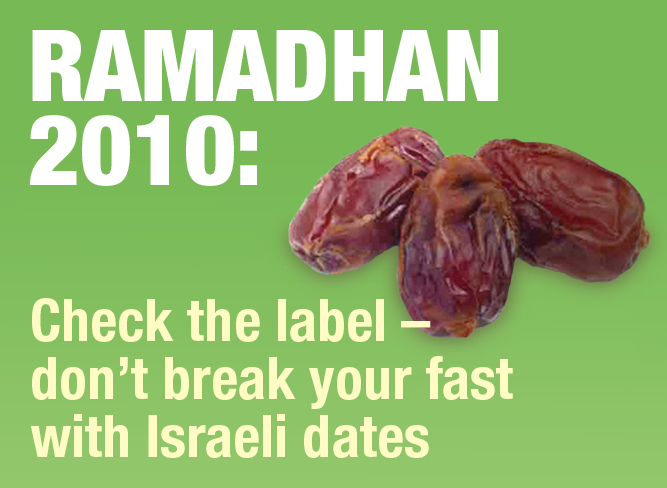
Ramadhan check the labelRamadhan is a time of year when we remember those who are less fortunate than ourselves. When we break our fasts with dates, it would be an affront to us all if the dates were the produce of illegal Israeli settlements built on land stolen from Palestinians.

Israeli produced Medjoul dates are grown in the Jordan Valley within illegal Israeli settlements. They form a large part of the agricultural produce from these settlements which are then exported all over the world. Buying these dates means that you are actually helping Israeli settlers steal Palestinian land.

Israelis claim Palestinians are given jobs working on the land of these settlers and a boycott will harm them. In actual fact, these Palestinians are employed for paltry wages, to do the back-breaking work that the Israeli settlers will not do themselves.

Settlers exploit Palestinian children, who are forced to miss out on their education and work long hours under the hot baking sun for small sums of money. The price of settlement produced dates are cheaper compared to those produced by Palestinian farmers as a result

Don’t let your money go towards entrenching Israel’s occupation of Palestine

Check the label. Do not buy dates that come from: Israel, West Bank or Jordan Valley

Support the Palestinian economy by buying Palestinian produced fair trade Medjoul dates from Zaytoun: find your local stockist at http://www.zaytoun.org.

source

To Know is Not Enough

A new documentary highlights the story of Divestment at Hampshire College.

In the spring of 2009 news sources the world over reported that Hampshire College had become the first United States institution of higher learning to divest holdings from companies benefiting from the military occupation of Palestine. This victory in the international movement for BDS (Boycott, Divestment, and Sanctions), was the product of a 3+ year campaign by the Hampshire college student group, Students for Justice in Palestine.

And though the board agreed to remove those assets involved in the occupation, the administration contested the political significance of the move and denied that the divestment was related to the occupation. Nevertheless, Hampshire’s divestment is considered a significant event in the still-developing history of the BDS movement.

One year after divestment, Hampshire Students for Justice in Palestine worked with a student filmmaker to tell the story of their divestment campaign – the result is a 30 min documentary featuring interviews with a sampling of SJP’s membership and using footage of past SJP events and actions. It highlights the student campaign and this campus movement for Justice in Palestine. The film attempts to show links between SJP’s work and the history of social responsibility at Hampshire College, as Hampshire was also the first US School to divest from Apartheid South Africa in 1979.

“To Know is not Enough” is used in reference to Hampshire College’s official motto (Latin: Non Satis Scire). The school proudly holds this message to affirm that, as an educational institution, it attempts to reach beyond ‘mere’ knowledge, encouraging students to question accepted understandings and to put their knowledge to use for the betterment of our world.

The story of SJP and divestment is only one among many student-led campaigns to hold Hampshire accountable to these founding values, and as part of that enduring legacy the film carries the school’s official slogan as it’s title: “To Know is Not Enough, How Hampshire Became the First to Divest”

The film is being released online, free of charge, and a blanket permission has been issued to hold public screenings of this documentary in any setting. Students are especially encouraged to use the film to educate and inspire, and to support many ongoing BDS campaigns happening throughout the country and world.

Enjoy!

–Hampshire College Students for Justice in Palestine
hsjp.org

The Palestinian Call for Boycott Divestment and Sanctions

Palestinian Civil Society Calls for Boycott, Divestment and Sanctions against Israel until it Complies with International Law and Universal Principles of Human Rights

9 July 2005

One year after the historic Advisory Opinion of the International Court of Justice (ICJ) which found Israel’s Wall built on occupied Palestinian territory to be illegal, Israel continues its construction of the colonial Wall with total disregard to the Court’s decision. Thirty eight years into Israel’s occupation of the Palestinian West Bank (including East Jerusalem), Gaza Strip and the Syrian Golan Heights, Israel continues to expand Jewish colonies. It has unilaterally annexed occupied East Jerusalem and the Golan Heights and is now de facto annexing large parts of the West Bank by means of the Wall. Israel is also preparing – in the shadow of its planned redeployment from the Gaza Strip – to build and expand colonies in the West Bank.

Fifty seven years after the state of Israel was built mainly on land ethnically cleansed of its Palestinian owners, a majority of Palestinians are refugees, most of whom are stateless. Moreover, Israel’s entrenched system of racial discrimination against its own Arab-Palestinian citizens remains intact.

In light of Israel’s persistent violations of international law, and Given that, since 1948, hundreds of UN resolutions have condemned Israel’s colonial and discriminatory policies as illegal and called for immediate, adequate and effective remedies, and

Given that all forms of international intervention and peace-making have until now failed to convince or force Israel to comply with humanitarian law, to respect fundamental human rights and to end its occupation and oppression of the people of Palestine, and

In view of the fact that people of conscience in the international community have historically shouldered the moral responsibility to fight injustice, as exemplified in the struggle to abolish apartheid in South Africa through diverse forms of boycott, divestment and sanctions;

Inspired by the struggle of South Africans against apartheid and in the spirit of international solidarity, moral consistency and resistance to injustice and oppression,

We, representatives of Palestinian civil society, call upon international civil society organizations and people of conscience all over the world to impose broad boycotts and implement divestment initiatives against Israel similar to those applied to South Africa in the apartheid era. We appeal to you to pressure your respective states to impose embargoes and sanctions against Israel. We also invite conscientious Israelis to support this Call, for the sake of justice and genuine peace.

These non-violent punitive measures should be maintained until Israel meets its obligation to recognize the Palestinian people’s inalienable right to self-determination and fully complies with the precepts of international law by:

1. Ending its occupation and colonization of all Arab lands and dismantling the Wall;

2. Recognizing the fundamental rights of the Arab-Palestinian citizens of Israel to full equality; and

3. Respecting, protecting and promoting the rights of Palestinian refugees to return to their homes and properties as stipulated in UN resolution 194.

Endorsed by:

The Palestinian political parties, unions, associations, coalitions and organizations below represent the three integral parts of the people of Palestine: Palestinian refugees, Palestinians under occupation and Palestinian citizens of Israel.
UNIONS, ASSOCIATIONS, CAMPAIGNS

1. Council of National and Islamic Forces in Palestine (coordinating body for the major political parties in the Occupied Palestinian Territory)
2. Palestinian Independent Commission for Citizen’s Rights (PICCR)
3. Union of Arab Community Based Associations (ITTIJAH), Haifa
4. Forum of Palestinian NGOs in Lebanon
5. Palestinian General Federation of Trade Unions (PGFTU)
6. General Union of Palestinian Women (GUPW)
7. General Union of Palestinian Teachers (GUPT)
8. Federation of Unions of Palestinian Universities’ Professors and Employees
9. Consortium of Professional Associations
10. Union of Palestinian Medical Relief Committees (UPMRC)
11. Health Work Committees – West Bank
12. Union of Agricultural Work Committees (UAWC)
13. Union of Palestinian Agricultural Relief Committees (PARC)
14. Union of Health Work Committees – Gaza (UHWC)
15. Union of Palestinian Farmers
16. Occupied Palestine and Syrian Golan Heights Advocacy Initiative (OPGAI)
17. General Union of Disabled Palestinians
18. Palestinian Federation of Women’s Action Committees (PFWAC)
19. Palestinian Campaign for the Academic and Cultural Boycott of Israel (PACBI)
20. Palestinian Grassroots Anti-Apartheid Wall Campaign
21. Union of Teachers of Private Schools
22. Union of Women’s Work Committees, Tulkarem (UWWC)
23. Dentists’ Association – Jerusalem Center
24. Palestinian Engineers Association
25. Lawyers’ Association
26. Network for the Eradication of Illiteracy and Adult Education, Ramallah
27. Coordinating Committee of Rehabilitation Centers – West Bank
28. Coalition of Lebanese Civil Society Organizations (150 organizations)
29. Solidarity for Palestinian Human Rights (SPHR), Network of Student-based Canadian University Associations

REFUGEE RIGHTS ASSOCIATIONS/ORGANIZATIONS

30. Al-Ard Committees for the Defense of the Right of Return, Syria
31. Al-Awda Charitable Society, Beit Jala
32. Al Awda – Palestine Right-to-Return Coalition, U.S.A
33. Al-Awda Toronto
34. Aidun Group – Lebanon
35. Aidun Group – Syria
36. Alrowwad Cultural and Theatre Training Center, Aida refugee camp
37. Association for the Defense of the Rights of the Internally Displaced (ADRID), Nazareth
38. BADIL Resource Center for Palestinian Residency and Refugee Rights, Bethlehem
39. Committee for Definite Return, Syria
40. Committee for the Defense of Palestinian Refugee Rights, Nablus
41. Consortium of the Displaced Inhabitants of Destroyed Palestinian Villages and Towns
42. Filastinuna – Commission for the Defense of the Right of Return, Syria 43. Handala Center, ‘Azza (Beit Jibreen) refugee camp, Bethlehem
44. High Committee for the Defense of the Right of Return, Jordan (including personal endorsement of 71 members of parliament, political parties and unions in Jordan)
45. High National Committee for the Defense of the Right of Return, Ramallah
46. International Right of Return Congress (RORC)
47. Jermana Youth Forum for the Defense of the Right of Return, Syria
48. Laji Center, Aida camp, Bethlehem
49. Local Committee for Rehabilitation, Qalandia refugee camp, Jerusalem
50. Local Committee for Rehabilitation of the Disabled, Deheishe refugee camp, Bethlehem 51. Palestinian National Committee for the Defense of the Right of Return, Syria
52. Palestinian Return Association, Syria
53. Palestinian Return Forum, Syria
54. Palestine Right-of-Return Coalition (Palestine, Arab host countries, Europe, North America)
55. Palestine Right-of-Return Confederation-Europe (Austria, Denmark, France, Germany, Italy, Netherlands, Norway, Poland, Sweden) 56. Palestinian Youth Forum for the Right of Return, Syria
57. PLO Popular Committees – West Bank refugee camps
58. PLO Popular Committees – Gaza Strip refugee camps
59. Popular Committee – al-‘Azza (Beit Jibreen) refugee camp, Bethlehem
60. Popular Committee – Deheishe refugee camp, Bethlehem
61. Shaml – Palestinian Diaspora and Refugee Center, Ramallah
62. Union of Women’s Activity Centers – West Bank Refugee Camps
63. Union of Youth Activity Centers – Palestine Refugee Camps
64. Women’s Activity Center – Deheishe refugee camp, Bethlehem
65. Yafa Cultural Center, Balata refugee camp, Nablus

ORGANIZATIONS

66. Abna’ al-Balad Society, Nablus
67. Addameer Center for Human Rights, Gaza
68. Addameer Prisoners’ Support and Human Rights Association, Ramallah
69. Alanqa’ Cultural Association, Hebron
70. Al-Awda Palestinian Folklore Society, Hebron
71. Al-Doha Children’s Cultural Center, Bethlehem
72. Al-Huda Islamic Center, Bethlehem
73. Al-Jeel al-Jadid Society, Haifa
74. Al-Karameh Cultural Society, Um al-Fahm
75. Al-Maghazi Cultural Center, Gaza
76. Al-Marsad Al-Arabi, occupied Syrian Golan Heights
77. Al-Mezan Center for Human Rights, Gaza
78. Al-Nahda Cultural Forum, Hebron
79. Al-Taghrid Society for Culture and Arts, Gaza
80. Alternative Tourism Group, Beit Sahour (ATG)
81. Al-Wafa’ Charitable Society, Gaza
82. Applied Research Institute Jerusalem (ARIJ)
83. Arab Association for Human Rights, Nazareth (HRA)
84. Arab Center for Agricultural Development (ACAD)
85. Arab Center for Agricultural Development-Gaza
86. Arab Education Institute (AEI) – Pax Christie Bethlehem
87. Arab Orthodox Charitable Society – Beit Sahour
88. Arab Orthodox Charity – Beit Jala
89. Arab Orthodox Club – Beit Jala
90. Arab Orthodox Club – Beit Sahour
91. Arab Students’ Collective, University of Toronto
92. Arab Thought Forum, Jerusalem (AFT)
93. Association for Cultural Exchange Hebron – France
94. Association Najdeh, Lebanon
95. Authority for Environmental Quality, Jenin
96. Bader Society for Development and Reconstruction, Gaza
97. Canadian Palestine Foundation of Quebec, Montreal
98. Center for the Defense of Freedoms, Ramallah
99. Center for Science and Culture, Gaza
100. Chamber of Commerce and Industry, Ramallah- Al-Bireh District
101. Child Development and Entertainment Center, Tulkarem
102. Committee for Popular Participation, Tulkarem
103. Defense for Children International-Palestine Section, Ramallah (DCI/PS)
104. El-Funoun Palestinian Popular Dance Troupe
105. Ensan Center for Democracy and Human Rights, Bethlehem
106. Environmental Education Center, Bethlehem
107. FARAH – Palestinian Center for Children, Syria
108. Ghassan Kanafani Society for Development, Gaza
109. Ghassan Kanafani Forum, Syria
110. Gaza Community Mental Health Program, Gaza (GCMHP)
111. Golan for Development, occupied Syrian Golan Heights
112. Halhoul Cultural Forum, Hebron
113. Himayeh Society for Human Rights, Um al-Fahm
114. Holy Land Trust – Bethlehem
115. Home of Saint Nicholas for the Aged – Beit Jala
116. Human Rights Protection Center, Lebanon

source
Boycott the Israel Ballet

BDS : a reminder

USACBI — While there are many Israeli and multinational companies that benefit from apartheid, we put together this list to highlight ten specific companies to target.

Many of these produce goods in such a way that directly harms Palestinians — exploiting labor, developing technology for military operations, or supplying equipment for illegal settlements. Many are also the targets of boycotts for other reasons, like harming the environment and labor violations.


1. AHAVA

This brand’s cosmetics are produced using salt, minerals, and mud from the Dead Sea — natural resources that are excavated from the occupied West Bank. The products themselves are manufactured in the illegal Israeli settlement Mitzpe Shalem. AHAVA is the target of CODEPINK’s “Stolen Beauty” campaign.

2. Delta Galil Industries

Israel’s largest textiles manufacturer provides clothing and underwear for such popular brands as Gap, J-Crew, J.C. Penny, Calvin Klein, Playtex, Victoria’s Secret (see #10) and many others. Its founder and chairman Dov Lautman is a close associate of former Israeli President Ehud Barak. It has also been condemned by Sweatshop Watch for its exploitation of labor in other countries such as Egypt, Jordan, and Turkey.

3. Motorola

While many of us know this brand for its stylish cellphones, did you know that it also develops and manufactures bomb fuses and missile guidance systems? Motorola components are also used in unmanned aerial vehicles (UAVs or “drones”) and in communications and surveillance systems used in settlements, checkpoints, and along the 490 mile apartheid wall. The US Campaign to End the Israeli Occupation has launched the “Hang Up on Motorola” campaign.

4. L’Oreal / The Body Shop

This cosmetics and perfume company is known for its investments and manufacturing activities in Israel, including production in Migdal Haemek, the “Silicon Valley” of Israel built on the land of Palestinian village Al-Mujaydil, which was ethnically cleansed in 1948. In 1998, a representative of L’Oreal was given the Jubilee Award by Israeli Prime Minister Netanyahu for strengthening the Israeli economy.

5. Dorot Garlic and Herbs

These frozen herbs that are sold at Trader Joe’s are shipped halfway around the world when they could easily be purchased locally. Trader Joe’s also sells Israeli Cous Cous and Pastures of Eden feta cheese that are made in Israel. QUIT, South Bay Mobilization, and other groups have targeted Trader Joe’s with a “Don’t Buy into Apartheid” campaign.

6. Estee Lauder

This company’s chairman Ronald Lauder is also the chairman of the Jewish National Fund, a quasi-governmental organization that was established in 1901 to acquire Palestinian land and is connected to the continued building of illegal settlements. Estee Lauder’s popular brands include Clinique, MAC, Origins, Bumble & Bumble, Aveda, fragrance lines for top designers, and many others. They have been the target of QUIT’s “Estee Slaughter Killer Products” campaign.

7. Intel

This technology company that manufactures computer processors and other hardware components employs thousands of Israelis and has exports from Israel totaling over $1 billion per year. They are one of Israel’s oldest foreign supporters, having established their first development center outside of the US in 1974 in Haifa. Al-Awda (the Palestinian Right to Return Coalition) has urged action against Intel for building a facility on the land of former village Iraq Al Manshiya, which was cleansed in 1949.

8. Sabra

This brand of hummus, baba ghanoush and other foods is co-owned by Israel’s second-largest food company The Strauss Group and Pepsico. On the “Corporate Responsibility” section of its website, The Strauss Group boasts of its relationship to the Israeli Army, offering food products and political support.

9. Sara Lee

Sara Lee holds a 30% stake in Delta Galil (see #2) and is the world’s largest clothing manufacturer, which owns or is affiliated with such brands as Hanes, Playtex, Champion, Leggs, Sara Lee Bakery, Ball Park hotdogs, Wonderbra, and many others. Similar to L’Oreal (see #4), a representative of Sara Lee received the Jubilee Award from Netanyahu for its commitment to business with Israel.

10. Victoria’s Secret

Most of Victoria’s Secret’s bras are produced by Delta Galil (see #2), and much of the cotton is also grown in Israel on confiscated Palestinian land. Victoria’s Secret has also been the target of labor rights’ groups for sourcing products from companies with labor violations, and by environmental groups for their unsustainable use of paper in producing their catalogues. That’s not sexy!

Remember, it’s also important to let these companies — and the stores that sell them — know that we will not support them as long as they support Israeli apartheid!

To view our complete list of Israeli products in Bay Area stores click here. To report more Product Sightings, email products[at]baceia.org.

anti BDS clip : Boycott Divestment Sanction Israel

All you need to know about the BDS (Boycott, Divestment, Sanctions) Movement.

BDS at work

motion below was passed by WEST DUNBARTONSHIRE COUNCIL, WEDNESDAY, 30 JUNE 2010. affirming its current boycott of all Israeli goods

(D) Motion by Councillor Jim Bollan – Boycott of Israeli Goods

This Council condemns the massacre of 9 peace activists by the Government of Israel, and the continuing blockade of Gaza. Council notes these brave people were trying to deliver 10,000 tons of humanitarian aid to Palestinians in Gaza which has been blockaded since 2007 by the IDF. This Council therefore re-affirms its current boycott of all Israeli goods. Council also agrees to write to all Scottish Local Authorities, Westminster and Holyrood Governments calling on them to implement an immediate boycott of all Israeli goods.

Off-Off-Broadway BDS Musical Tour, 7/11/10

AdalahNYC | 20 juillet 2010

On July 11, 2010, members of Adalah-NY, the New York Campaign for the Boycott of Israel, and other members of the New York community participated in a tour of companies profiting from and financially enabling the Israeli occupation and repression of the West Bank and Gaza Strip.

The stores visited include Aroma, Ricky’s, Max Brenner, and Best Buy (Motorola). These stores are targetted as part of the Boycott, Divestment and Sanctions (BDS) campaign against Israel, a non-violent economic and political tool intended to pressure Israel into ending its occupation of the West Bank and Gaza Strip, respecting and promoting the rights of Palestinian refugees, and ensuring equal treatment for its own Palestinian Israeli citizens.

Aroma Cafe is being boycotted because its owner has opened locations in the illegal Israeli settlement Maale Adumim. Maale Adumim is built on lands confiscated from Palestinians, and is part of the expansive settler network that poses an obstacle to a just peace.

Ricky’s sells Ahava Beauty products. The Ahava factory is located on an illegal Israeli settlement in the West Bank called Mitzpe Shalem. In addition, Ahava makes its products using minerals excavated from the Palestinian area of the Dead Sea. See more at http://www.stolenbeauty.org/

Max Brenner is an Israeli chocolate company owned by the Strauss Group, which both publicly and substantively supports the Israeli Army, specifically the notorious Golani Brigade. The Israeli military has been a frequent violator of Palestinian human rights and has been deeply implicated in possible war crimes and crimes against humanity during Operation Cast Lead in Gaza. The Golani Brigade, which the Strauss Group supports with meals and care packages, is implicated in several flagrant abuses of Palestinian civilians. For example, in 2008, members of the Golani Brigade filmed themselves forcing a captive, blindfolded Palestinian to sing humiliating songs, some of a sexual nature or about the brigade itself.

Lastly, Motorola supplies the Israeli military with parts for bombs, communications infrastructure, and the surveillance system used to monitor Palestinian movement in the Occupied Palestinian Territories. It also provides radar and thermal imaging tools that illegal settlements use to observe Palestinians in the West Bank.

Food co-op in Rachel Corrie’s hometown boycotts Israeli goods

The Olympia Food Co-op announced last week that no more Israeli products will be sold at its two grocery stores

Americans are far more supportive of Israel than Europeans, and most initiatives to boycott Israeli goods or to divest funds from companies working with Israel are unsuccessful in the United States.

But such projects have recently become more widespread, especially among students – although most divestment decisions by student bodies are not implemented on the colleges’ management levels.

read on

Blog at WordPress.com.

Up ↑