Hewlett Packard sells the Basel system technology to the Israeli military, so activists targeted stores in California asking back to school shoppers not to buy HP products.
JERUSALEM (JTA) — Three activists, including an Israeli lawmaker, heckled actors during a performance at a theater in Tel Aviv.
Monday night’s disruption was a protest of the more than 50 Israeli theater professionals who signed a petition in late August saying that they will not perform in the new Ariel cultural center in the West Bank when it opens in November. The activists included Knesset member Michael Ben-Ari of the National Union Party.
Both the playwright and the director of Monday night’s show at the Cameri Theater signed the petition.
Lead actor Oded Teomi, one of the Cameri’s veteran performers, did not sign the letter and tried to tell this to the hecklers.
“Because of your behavior, maybe we should consider whether there is anything to perform to in Ariel,” he then told the protesters, Haaretz reported.
The Ariel cultural center, which cost more than $10 million, was built with public funds. Several major Israeli theaters are scheduled to stage productions there this year.
At least 150 Israeli academics and authors, and another 150 American and British television and film professionals, also threw their support behind the boycott.
Ariel is one of the largest Jewish settlements in the West Bank.
Robert Del Naja of Massive Attack tells William Parry why he is boycotting Israel.
The movement for a cultural boycott of Israel in response to its treatment of the Palestinians, modelled on the boycott of apartheid South Africa, could eclipse decades of disingenuous political charades in engaging western intellectuals, academics and artists. Internationally renowned figures such as Naomi Klein and Ken Loach have supported the call, and now one of Britain’s most successful bands, Massive Attack, is publicly backing the boycott.
“I’ve always felt that it’s the only way forward,” Robert Del Naja, the band’s lead singer, tells me when we meet at the Lazarides gallery in Fitzrovia, London. Del Naja is an artist as well as musician and his face and fingers are speckled with paint. Dozens of his pictures are strewn
all over the wooden floorboards, drying. “It’s a system that’s been applied to many countries. It’s a good thing to aim for because it applies the continual pressure that’s needed.”
Musicians have a history of rallying the public to supporting political causes. The global anti-apartheid movement got the fillip it desperately needed when musicians began supporting it. The single “Sun City” by Artists United Against Apartheid in 1985 and the 70th-birthday tribute concert for Nelson Mandela at Wembley in 1988 catapulted the cause into millions of ordinary homes.
“I think musicians have a major role to play,” Del Naja says. “I find the more I get involved, the more the movement becomes something tangible. I remember going to ‘Artists Against Apartheid’ gigs, and ‘Rock Against Racism’ gigs around the same sort of time. Bands like the Clash and the Specials had a lot to do with influencing the minds of the youth in those days.” Those formative experiences are still evident in Massive Attack’s outlook today. A typical gig by the band is a blistering fusion of music with political messages and statistics flashed up on video screens, while the band regularly lends support to humanitarian causes.
Calls for a boycott were first issued five years ago by the Palestinian Campaign for the Academic and Cultural Boycott of Israel, but a series of developments beginning with the Gaza war in winter 2008-2009 have led to rising support for the campaign. After Israel’s deadly raid on the Gaza Freedom Flotilla in May this year, a number of leading artists, including the Pixies, Elvis Costello and Gorillaz, cancelled concerts in Israel. In August, 150 Irish visual artists also pledged not to exhibit in Israel, but it is musicians who have been the most prominent international supporters of the boycott.
Their views are not unanimous, however. Other musicians, from Elton John and Diana Krall (Costello’s wife) to Placebo and John Lydon, have refused to cancel concert dates in Israel. Some have insisted that engagement with Israel is more productive – a stance that Del Naja rejects. “We were asked to play Israel and we refused,” he says. “The question was asked: ‘If you don’t play there, how can you go there and change things?’ I said: ‘Listen, I can’t play in Israel when the Palestinians have no access to the same fundamental benefits that the Israelis do.’ I think the best approach is to boycott a government that seems hell-bent on very destructive policies. And it’s sad, because we’ve met some great people in Israel, and it’s a difficult decision to have to make.”
Beyond the arts world, an increasing number of trade unions, student unions and churches are signing up to the Boycott, Divestment and Sanctions (BDS) movement. Even an Israel-based group, Boycott from Within, backs the campaign, stating that its government’s “political agenda will change only when the price of continuing the status quo becomes too high . . . because the current levels of apathy in our society render this move necessary”.
“We are not going to achieve a quick liberation,” Del Naja concedes, but says the point is to apply “pressure, the continual pressure that’s needed”. And the threat of international isolation and economic repercussions is clearly starting to bite: Israel’s parliament, the Knesset, recently passed the first reading of a bill that would impose heavy fines on Israeli citizens who initiate or support boycotts against Israel, and a bill to bar foreigners – like Del Naja – who do the same from entering Israel for ten years.
“The boycott is not an action of aggression towards the Israeli people,” he says. “It’s towards the government and its policies. Everyone needs to be reminded of this because it’s very easy to be accused of being anti-Semitic, and that’s not what this is about.”
William Parry’s “Against the Wall: the Art of Resistance in Palestine” is published by Pluto Press (£14.99)
In advance of my speech tomorrow in Port Townsend, Washington, anti-Palestinian activists have been privately circulating a 12-page dossier on me, and on how to “counter” and “expose” me.
The document is being circulated by Rob Jacobs, Northwest Regional Director of StandWithUs. StandWithUs is an extreme pro-Israel hasbara group supported by funders with a clear anti-Palestinian and anti-Muslim agenda.
The StandWithUs dossier (attached below as a PDF) is a mishmash of biographical information about me, much of it taken from my own writing, but wildly distorted and wrapped in hostility. Its main purpose it to advise anti-Palestinian activists how to “expose” me. Parts of it are quite complimentary though: “When Ali Abunimah comes to your campus, be prepared for a sophisticated, smooth advocate of radical Palestinian positions.” It warns that my “calmness, highbrow style and constant references to international law and human rights cannot conceal [my] intense hostility about the very founding of Israel… .”
The most interesting part is the advice on what questions to ask to confound me:
Though Abunimah seems calm and even reasonable, he is extremely radical. When countering him, maintain your own composure and be as rational as he is. He has written many article [sic] and made many public statements. Use his own words to expose and challenge him.
But none of the questions designed to “expose” me are particularly difficult to answer — I answer them at almost every lecture I give and I am more than happy to do so again. Mr. Jacobs is welcome to come and ask them in person and need not circulate them secretly to encourage others to do so as if they were spontaneous and not part of a well-funded and planned hasbara operation.
It’s worth recalling that StandWithUs has worked closely with the Israeli government and acted as a public relations arm for the Israeli army to help prettify it following the war crimes and crimes against humanity it committed in the Gaza Strip in early 2009 and thoroughly documented by the United Nations Fact Finding Mission on the Gaza Conflict chaired by Judge Richard Goldstone.
Activists at a recent StandWithUS sponsored rally in San Francisco also shouted ugly anti-Semitic, anti-Muslim and anti-Palestinian slogans and threats at members of the peace and justice groups Bay Area Women in Black and Jewish Voice for Peace.
What the StandWithUs dossier reveals is that in the absence of any credible arguments to defend Israel’s occupation, violent ethnic cleansing and colonization of Palestinian land, war crimes and crimes against humanity, its rank racism and apartheid, and the growing religious extremism motivating its politics, Israel’s defenders must rely on a strategy of ad hominem attacks.
Many of StandWithUs’s tactics would appear to come straight from the “sabotage” and “attack” playbook of Israel’s Reut Institute. These include a StandWithUs produced video that personally targets me and other advocates of Boycott, Divestment and Sanctions (BDS) against Israel in an attempt to discredit BDS.
The video and the dossier also fit the strategy advocated by several anti-Palestinian outfits of “naming and shaming” so-called “delegitimizers” of Israel.
But here is the problem. There is no shame in standing up for universal human rights for everyone in historic Palestine, international law, equality and peace. It is those who deny the Nakba, defend colonization, ethnic cleansing and apartheid, and offer apologias and lies to justify war crimes and crimes against humanity who should be ashamed.
New York City activists have kept the pressure on settlement financier Lev Leviev. (Flickr)
This week, the Norwegian government announced that it has divested from two major Israeli companies involved in settlement construction and land theft in the occupied West Bank. Both companies, Africa Israel Investments and its subsidiary, Danya Cebus, are owned by Israeli billionaire Lev Leviev, and have been at the center of a widespread boycott, divestment and sanctions campaign since 2009.
Along with solidarity groups, Palestinians from the villages of Bilin and Jayyous — where land has been confiscated for ongoing settlement construction by another Leviev-owned company — steadily pressured the Norwegian government to divest from the two Israeli companies.
In a press release from Adalah-NY, the solidarity group that has been instrumental in organizing boycott campaigns against Leviev companies, Sharif Omar of the Palestinian village of Jayyous’ Land Defense Committee stated: “we welcome this decision by the Norwegian government to divest from some of Leviev’s companies. But another Leviev company, Leader Management and Development, continues today to build settlements on Jayyous’ land. We call for additional international action to pressure these companies and the Israeli government to end construction and return our stolen farmland.”
The Norwegian government’s landmark decision comes as the global boycott, divestment and sanctions movement is gaining ground. In recent months, internationally-renowned musicians, including Elvis Costello, Gil Scott-Heron and Carlos Santana, have canceled their scheduled shows in Israel in protest of the state’s ongoing violations of human rights and international law. Last month a food co-operative in Olympia, Washington, became the first US grocery store to refuse to shelve Israeli products.
Earlier this month, Irish artists signed onto a broad-based boycott initiative, pledging to refuse to perform or exhibit their work in Israel and to refuse to accept donations or grant funding from Israeli institutions, becoming participants in the first nation-wide cultural boycott campaign.
Localized direct actions related to the global boycott movement are making an impact as well.
Chicago activist arrested
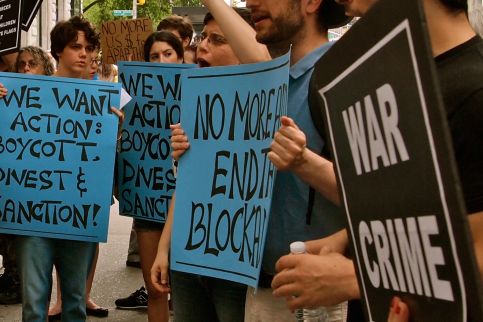
In a demonstration organized by the Palestine Solidarity Group-Chicago on 23 August, more than two dozen activists converged on downtown Millennium Park to call on city leaders to sever ties with Israel and drop Petach Tikva, Israel from the Chicago Sister Cities program. During the annual Chicago Sister Cities’ International Festival, protesters rallied outside — and later, inside — the venue. One activist was arrested and released later that day.
“Petach Tikva — an officially segregated city, the first Jewish-only settlement in historic Palestine and the site of the primary detention center where Israeli forces abuse and torture Palestinian political prisoners — has been dubbed by rights group Amnesty International as ‘Israel’s Guantanamo,'” PSG stated in a press release (“Chicago arrested calling for boycott of Israel’s Guantanamo,” 23 August 2010).
“Upholding the Palestinian call for boycott, divestment and sanctions measures on apartheid Israel, PSG and its allies object to business-as-usual with Israel. Under the false premise of promoting culture and education, Petach Tikva’s inclusion in Chicago Sister Cities promotes Israel-US business ties while it whitewashes Israel’s occupation and human rights abuses,” the statement added.
During the protest activists entered the festival venue and chanted “Drop Petach Tikva!” Activists reported that a pianist who was performing in the hall at the time “stood at attention out of respect once he heard the protesters’ message.”
“The PSG and allies were compelled to bring the message directly into the festival because for the last year and a half, the Chicago Sister Cities International has refused to meet with PSG and members of the community to hear about Petach Tikva’s special role in Israel’s oppression of the Palestinian people,” PSG stated.
The group said it plans to keep up the pressure on city officials until the Chicago’s Sister Cities program drops its partnership with Petach Tikva.
Charges dropped against British activists
In related news, four British activists were recently acquitted of all charges related to their direct action protests against the Israeli cosmetics company Ahava. On 10 August, a British court ruled the activists not guilty of “aggravated trespass” for their involvement in two separate actions inside an Ahava store in London’s Covent Gardens neighborhood in September and December 2009.
In the actions, the four campaigners rolled barrels inside an Ahava beauty products store, locked themselves inside and forced the store to close “while police came to cut open the barrels and arrest the activists,” as reported by the International Middle East Media Center (“Four British Activists Acquitted In Anti-Ahava Action,” 22 August 2010).
All cosmetics on sale at the Ahava store originate from Mitzpe Shalem, an Israeli settlement colony in the occupied West Bank. IMEMC added that Ahava’s products are also unlawfully labeled “made in Israel” despite being manufactured in the settlement. The products are also made with Palestinian natural resources without the permission of, or compensation for, Palestinians on whose land the settlements occupy.
Using the court ruling as a precedent, activists say that they intend to continue the campaign against Ahava. Speaking to the International Solidarity Movement, the acquitted activists said that they will “continue to challenge corporate complicity in the occupation and Israel’s impunity on the international stage” (“,” 11 August 2010).
One of the campaigners added: “The message is clear. If your company is involved in apartheid and war crimes and occupying Palestinian land, people will occupy your shop.”
Additionally, in Ireland this week, the Ireland Palestine Solidarity Campaign (IPSC) announced they will stage a demonstration to protest the Ireland-Israel match during a FIFA Women’s World Cup Qualifier on 25 August.
“In line with the wishes of Palestinian civil society, the protest will call for a sporting boycott of Israel due to the racist and apartheid nature of the Israeli state,” IPSC stated in a press release (“Protest at Ireland v Israel women’s football match …”). “This is in support of the Palestinian Campaign for the Academic and Cultural Boycott of Israel (PACBI) who have confirmed this match falls under their boycott, divestment and sanctions (BDS) guidelines.”
Organizers say the theme of the protest will be “Love Football, Hate Apartheid.” IPSC national chairwoman Freda Hughes said: “While some may suggest that sports and politics shouldn’t mix, we believe there is no place in sport for racism or teams who act as ambassadors for racist or apartheid states.”
Palestinians in the occupied West Bank city of Qalqiliya call for a boycott of Israeli goods. (Khaleel Reash/MaanImages)
Report, The Electronic Intifada, 19 August 2010
Grassroots Palestinian boycott campaigns across the occupied West Bank to take Israeli settlement products off the shelves of local stores have made an impact on the Israeli settlement economy, to the unease of the Israeli government, noted the Israeli daily Haaretz this week (“Palestinians ‘adamant about continuing boycott on settlement goods’,” 8 August 2010).
From the tightly-packed communities in refugee camps, to the sprawling urban areas in major cities, to the rural countryside, Palestinians have galvanized around campaigns to promote locally-made products and locally-harvested food instead of a myriad of items made in illegal settlement colonies on occupied Palestinian land in the West Bank.
The Palestinian Authority (PA), for its part, has produced pamphlets listing Israeli settlement-made products and delivered them to thousands of homes across the West Bank, urging Palestinians to buy Palestinian products and warning that trading of settlement products risks legal prosecution. But grassroots, local community initiatives have been working independent of the PA for years as activists have organized to educate and support business owners in making responsible choices in purchasing and selling merchandise.
Haaretz reports that the Israeli Ministry of Industry, Trade and Labor has asked the PA to cancel the boycott, citing supposed violations of international trade rules and feigning concern for Palestinian laborers who work in the settlements.
International trade laws do not apply to consumer boycotts, however, and the Israeli settlements themselves are entirely illegal under international law, including Articles 46 and 55 of the Hague Convention; Article 49 of the Fourth Geneva Convention and UN Security Council Resolution 465. The illegality of Israel’s settlements was reaffirmed in the 2004 ruling of the International Court of Justice at the Hague (“Israeli settlements fact sheet,” Palestine Monitor, 15 March 2010).
Irish artists pledge to boycott Israel
In international boycott news, more than 150 Irish artists helped to launch a broad-based boycott of Israel, pledging on 13 August to refuse to perform or exhibit their work in Israel, and to refuse to accept funding or grants from institutions connected to the Israeli government. Through this campaign, Ireland has become the first country to enact a nation-wide cultural boycott movement against Israeli apartheid.
In a joint action with the Irish Palestine Solidarity Campaign (IPSC), artists drafted a statement, published on the IPSC website, that “commits signatories to boycotting the Israeli state until it respects international law” and notes that the artists are responding to a call from Palestinian civil society for a cultural boycott of Israel (“Dublin concert sees launch of ‘Irish Cultural Boycott of Israel’ pledge,” 13 August 2010).
Musician Eoin Dillon was amongst the Irish artists who signed the pledge. IPSC states that his brother was on the Gaza Freedom Flotilla in May of this year, and was kidnapped and arrested when Israeli commandos attacked the ships, killing nine and wounding dozens.
Dillon told IPSC, “I encourage all Irish artists to take this pledge and thereby honor not only their own dignity but more importantly, the dignity of the Palestinian people.”
The pledge was recognized by the Palestinian Campaign for the Academic and Cultural Boycott of Israel (PACBI), which remarked in a statement on 11 August — anticipating the artists’ boycott action — that this represents a “groundbreaking strategy in supporting the Palestinian struggle for freedom and justice” (“Irish artists make BDS history …”).
“In the last few years, many international cultural figures have come out in support of the cultural boycott of Israel,” PACBI added. “A statement authored by John Berger in support of the boycott gathered dozens of signatures, including some celebrities. Montreal, Canada, witnessed a most impressive initiative in this respect, where 500 artists issued a statement this last February committing themselves to ‘fighting against [Israeli] apartheid’ and calling upon ‘all artists and cultural producers across the country and around the world to adopt a similar position in this global struggle’ for Palestinian rights. Yet, the Irish artists have raised the bar of solidarity by pioneering the first nation-wide cultural stance in support of the boycott of Israel.”
This cultural boycott initiative comes on the heels of last month’s consumer boycott, divestment and sanctions campaign by the IPSC to deliver more than 6,000 signatures to a national supermarket chain, as customers demanded that the Dunnes markets stop selling Israeli-made products. Trade union officials, Sinn Fein activists and members of the Palestinian and South African communities in Ireland presented the petitions to the Dunnes stores in multiple locations across the country.
IPSC says that this campaign only took two weeks to gather signatures, and “comes a quarter-century after Dunnes was at the center of a bitter two-year campaign of boycott and pickets, when it sacked a group of workers who refused to handle South African goods” (“Petition: Thousands demand that Dunnes stop stocking Israeli goods,” 29 July 2010).
Canadian union supports boat to Gaza
Meanwhile, the Canadian Union of Postal Workers (CUPW) officially called on Canadians to support the Canada Boat to Gaza project. The Canadian boat is to be included in a flotilla led by activists with international human rights organizations planning to deliver humanitarian aid to the beleaguered Gaza Strip in the coming months (“Postal Workers’ Union: Get Mail to Gaza on the Boat,” 12 August 2010).
The union has a long history of solidarity actions in support of justice for Palestinians, including drafting resolutions calling for an immediate end to the illegal occupation of the West Bank and Gaza Strip.
“Following an announcement by Canada Post that Israel Post has suspended mail delivery to Gaza, the union is encouraging people who wish to send mail to Gaza to get their mail onto the Canadian boat bound for the blockaded Palestinian territory,” CUPW stated.
The CUPW says that its support of the Canada Boat to Gaza was elevated when Israel Post recently informed Canada Post that Canadian mail would not be delivered to the Gaza Strip due to circumstances “beyond their control,” according to the Canadian daily Vancouver Sun (“Canadian postal workers put stamp of approval on bid to break Gaza blockade,” 12 August 2010).
Receiving mail in Gaza has been irregular for years, as Israel’s illegal blockade against the strip continues. But according to Gaza’s Director General of the Communications Ministry, Jalal Ismail, the mail delivery system has been delayed and government mail has remained undelivered for at least four months. Speaking to news agency The Media Line, Ismail said that mail disruptions “are not new” in Gaza. The Gaza-based Palestinian postal employee responsible for mail transfer in Gaza was arrested by Israeli forces, and Israel continues to stall in their “vetting” of a new postal liaison.
Israel has also blocked mail between Gaza and the West Bank, according to Maan News Agency (“Israel blocks mail between Gaza, West Bank,” 20 May 2010).
Denis Lemelin, the CUPW’s national president, explained the union’s move to back the Gaza-bound boat actions: “As postal workers, we know very well that cutting off mail creates suffering and hardship for people, who are isolated from their loved ones. How many more abuses will the people of Gaza have to endure?”
“We are heartened by the growing international response to Israel’s cruel treatment of the Palestinian people,” continued Lemelin. “We stand in solidarity with all efforts to break the blockade and end the indignities imposed on the Palestinian people by the state of Israel.”



 band annie's Weblog