Yup we knew it all along. But Gisha dug it out:
Thursday, October 21, 2010: After one and a half years in which Israel at first denied their existence and then claimed that revealing them would harm “state security”, the State of Israel today released three documents that outline its policy for permitting transfer of goods into the Gaza Strip prior to the May 31 flotilla incident. The documents were released due to a Freedom of Information Act petition submitted by Gisha in the Tel Aviv District Court, in which Gisha demanded transparency regarding the Gaza closure policy. Israel still refuses to release the current documents governing the closure policy as amended after the flotilla incident.
“Policy of Deliberate Reduction”
The documents reveal that the state approved “a policy of deliberate reduction” for basic goods in the Gaza Strip. Thus, for example, Israel restricted the supply of fuel needed for the power plant, disrupting the supply of electricity and water. The state set a “lower warning line” to give advance warning of expected shortages in a particular item, but at the same time approved ignoring that warning, if the good in question was subject to a policy of “deliberate reduction”. Moreover, the state set an “upper red line” above which even basic humanitarian items could be blocked, even if they were in demand. The state claimed in a cover letter to Gisha that in practice, it had not authorized reduction of “basic goods” below the “lower warning line”, but it did not define what these “basic goods” were.
“Luxuries” denied for Gaza Strip residents
In violation of international law, which allows Israel to restrict the passage of goods only for concrete security reasons, the decision whether to permit or prohibit an item was also based on “the good’s public perception” and “whether it is viewed as a luxury”. In other words, items characterized as “luxury” items would be banned – even if they posed no security threat, and even if they were needed. Thus, items such as chocolate and paper were not on the “permitted” list. In addition, officials were to consider “sensitivity to the needs of the international community”.
Ban on Reconstructing Gaza
Although government officials have claimed that they will permit the rehabilitation of Gaza, the documents reveal that Israel treated rehabilitation and development of the Gaza Strip as a negative factor in determining whether to allow an item to enter; goods “of a rehabilitative character” required special permission. Thus, international organizations and Western governments did not receive permits to transfer building materials into Gaza for schools and homes.
Secret List of Goods
The procedures determine that the list of permitted goods “will not be released to those not specified!” (emphasis in original), ignoring the fact that without transparency, merchants in Gaza could not know what they were permitted to purchase. The list itemized permitted goods only. Items not on the list – cumin, for example – would require a special procedure for approval, irrespective of any security consideration, at the end of which it would be decided whether to let it in or not.
According to Gisha Director Sari Bashi: “Instead of considering security concerns, on the one hand, and the rights and needs of civilians living in Gaza, on the other, Israel banned glucose for biscuits and the fuel needed for regular supply of electricity – paralyzing normal life in Gaza and impairing the moral character of the State of Israel. I am sorry to say that major elements of this policy are still in place“.
To view the documents revealed today by the state (in Hebrew), click here (excerpted English translations will be available tonight).
To view the FOIA petition submitted by Gisha (in Hebrew), click here.
For translated excerpts of the state’s response initially refusing to reveal the documents, click here.
For an information sheet on the changes in the closure policy since the June 2010 cabinet decision, see: Unraveling the Closure of Gaza.
Dutch police raided the offices of a company leasing cranes for building the West Bank Separation Fence and settlements. Company executives, including the Israeli Doron Livnat, may face trial for violating International Law. Dutch government warned the Riwal Company two years ago not to engage in construction in the Occupied Trritories. Gush Shalom: another warning sign of the abyss of international isolation into which the Government of Israel leads us
A few days ago, the Dutch police’s National Crime Squad raided the offices of the Riwal Holding Group in the city of Dordrecht, confiscating computers documents relating to the leasing of cranes owned by the the company’s Israeli branch for the construction of the “Separation Wall” and of settlements in the Occupied Territories. Police findings have been passed on to the Dutch State Prosecution, which should decide whether or not to prosecute the corporate executives – including the Israeli businessman Doron Livnat – on charges of violating International Law.
The affair started with the 2004 ruling by the International Court in The Hague, which determined that construction of the “Separation Wall” within the West Bank territory constituted a violation of International Law, and that if Israel wants to build a border fence to prevent infiltration into its territory it should have been placed on the border, i.e. on the Green Line. Accordingly, the International Court judges called for upon all UN member states and Geneva Convention signatories not to cooperate with erection of the Wall and to prevent their citizens from any such cooperation.
In 2006, a Dutch television crew filmed cranes active in construction of the Separation Fence and of settlements, which bore the Riwal Company logo. Dutch Labour Party MP’s raised the issue and addressed parliamentary questions to the Minister of Foreign Affairs. As a result, the Dutch Government in 2008 warned the Riwal company not to engage in activities at the Occupied Territories. But the organization “United Civilians for Peace” in Amsterdam found evidence that the company ignored the government warning and continued this activity.
Last year the Palestinian human rights organization Al Haq of Ramallah engaged the Dutch law firm Bohler. On its behalf, Adv. Liesbeth Zegveld lodged this year a complaint to the legal authorities. The raid on the Riwal Dordrecht offices is a tangible result of this activity.
Gush Shalom, the Israeli Peace Bloc, regards this episode as yet another alarming sign of Israel’s deteriorating international position, fast slipping down to a disastrous total isolation. “A decade ago, authorities in the Netherlands would not have considered taking such measures. The Israeli Government, renewing settlement construction, promoting loyalty oaths and ever new provocations, confronts the entire the world, alienates Israel’s best friends and takes us on a mad gallop into the abyss”.
Riwal is the largest company in the Netherlands in the field of building cranes, and among the largest in the world. The Riwal Israel Company, active also under the name “Lia Holding”, was in the news a few years ago when a business dispute between it and the competing “Avi Cranes” escalated into violence and the setting of cranes on fire.
—
Monday, 11 October 2010 14:30


 On Monday (11.10.2010), the Israeli newspaper, Maariv, reported that the Irish Ministry of Defence has cancelled a contract with Israel to supply the Irish army with more than 20 million bullets annually which are used as ammunition by the various Irish military forces.
Maariv quoted the Irish press as saying that after having purchased millions of Euros worth of ammunition from Israel over the past five years, the Irish Ministry of Defence has decided to cancel its contract with Israel and to sign an alternative deals with Belgium and Brazil among others.
Irish newspapers interpret this decision as a response to the Dubai assassination of Mahmoud al-Mabhouh in January of last year. The ring of Mossad assassins, according to international sources, used forged Irish passports.
This indicates that in the past five years, Ireland has bought Israeli made ammunition to the value of 14 million Euros following the government’s insistence on excluding Israel from all boycott – despite international political protest.
However, this year, against the backdrop of developing tensions in relations with Israel due to the Mabhouh assassination, Dublin has decided to transfer the contract to supply the Irish army with ammunition to other countries.
Source: Sama
FOR IMMEDIATE RELEASE
WASHINGTON D.C., October 7, 2010: A comprehensive report examining the minute-by-minute versions of the same events during the Gaza-bound Freedom Flotilla attack by Israel was released by two charity groups today. Contrasting passenger testimonies against official Israeli accounts side-by-side to each other, a complete picture can be seen as to exactly what transpired in the days and hours leading up to the incident as well as its aftermath.
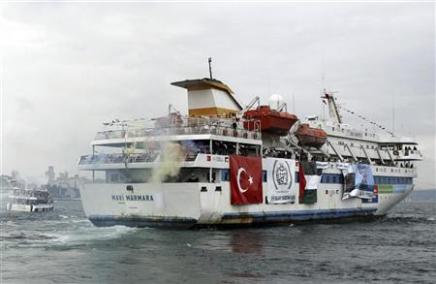
The attack took place in international waters in the early hours of May 31, 2010 as humanitarian aid workers carrying goods and supplies, including medical equipment, attempted to break the Israeli-imposed blockade on Gaza. The attack on the six ships in the flotilla led to the deaths of nine passengers on the Turkish-supported Mavi Marmara ship. The result has been an intense worldwide condemnation of Israeli policies towards the increase in aid missions.
The Timeline and Inconsistencies Report, co-sponsored by the International Bureau of Humanitarian NGOs (IBH) in Geneva and Paris, and the Friends of Charities Association (FOCA) in Washington D.C., takes each individual action as it happened, and aligns the passenger version against the Israeli account. The “conclusions are in sharp contrast to the Israeli official version of events,” the report found.
Released as an advance copy coincidentally on the same day as the United Nations Human Rights Council (UNHRC) issued its damning conclusions of Israeli actions, the timeline analysis lets the evidence speak for itself.
Tom Nelson, lawyer and spokesperson for FOCA, presented the Timeline Report to colleagues in Europe this week. “It got absolutely raving positive reviews here in Brussels,” he said, adding, “It is a powerful supplement to the UN Human Rights Commission report.”
IBH and FOCA conducted the research over a 4-month period based on information gathered from passenger testimonies, government authorities, world press coverage, official videos and film smuggled from the ship, as well as the United Nations report, Israeli self-inquiry, and Turkish Humanitarian Relief Foundation (IHH) report.
Conclusions show that Israel clearly manipulated evidence to bolster its argument that the attack on the Mavi Marmara was in self-defense against armed violent activists. Using second-by-second analysis, the reports shows how the six passengers killed were victims of execution-style murders by the Israeli soldiers.
Examples of manufactured computer-generated images installed into the official Israeli video released are revealed as individual frames.
The report goes on to note that when passengers were detained and independently and consistently testified to being beaten, sexually harassed and abused, “no argument as to imminent threat could be justified” by the Israeli authorities.
The report can be viewed and downloaded at http://www.foca.net/media/documents/timeline-inconsistencies-gaza-flotilla-attack-31052010.pdf
###
ABOUT THE REPORT SPONSORS
International Bureau of Humanitarian NGOs (IBH) and Friends of Charities Association (FOCA)
IBH and FOCA are non-profit organizations that advocate the rights of Islamic charities throughout the world, promote ties with civil society groups, and support the reform of global security laws and policies that impact charities of all denominations.
MEDIA CONTACTS
Wendell Belew: Tel +1202 255 3808; Email wbelew@belewlaw.com
Tom Nelson: Tel +1 503 622 3262; Email nelson@thnelson.com
_________________________________
Friends of Charities Association (FOCA) 1150 Connecticut Avenue NW
Suite 900
Washington, DC 20036
Tel: + 1 202 862 4348
Fax: +1 202 364 8868 Email: info@foca.net
International Bureau of Humanitarian NGOs (IBH)
Geneva and Paris
Tel & Fax: +33 1 4746 1988
Email: ibh@ibh.me
Source: FOCA, IBH
Journalist Lauren Booth was on the first Free Gaza voyage and stayed to work in Gaza after the boats left. Her heartfelt letter to the people of Israel should be read by everyone who hopes for peace in the Middle East. This stunning video tribute to her words was designed and produced by the Free Gaza movement.
Oct 01, 2010 11:15 pm | Philip Weiss
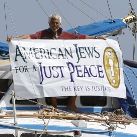
Glyn Secker, the British captain of the Jewish boat to Gaza, reports on its interception earlier this week, and his deportation. Key excerpts:
There then developed a sight which will remain with me for the rest of my life – with the frigate in the background, two gunboats, two landing craft and four high powered ribs spread out in a semi-circle speeding towards us at perhaps 35 knots, with their bow waves and wakes flashing in the sunshine. It was surreal, it was like an action movie, and entranced by the sight I had to remind myself this was actually happening – this overwhelming force for a 9.7 metre 40 yr. old boat, the majority of its Jewish occupants over 60 years old, with no weapons and a publicized policy of passive resistance.
The next we knew there were two ribs very close alongside with the commander on a megaphone again warning us of the dangers if they boarded us. I reiterated our legal rights, and for what it was worth I accelerated, just to make a point that outpacing them was fantasy. Then as planned Itamar addressed the commandos in Hebrew and English, calling on them not to obey the orders to take actions which are illegal under international law. The ribs closed in, and the boarding commenced.
All the crew and passengers (apart from myself as I was steering) held hands.They boarded us simultaneously from both sides.
At that moment we cut the engines and sat over the access points to the cut offs to prevent them restarting the engines. The wheel is on the starboard side of the boat. I was surrounded by three commandos, I held on to the wheel as hard as I could. It reminded me of being on violent picket lines with the police trying to break through. One grabbed my left arm, another my right arm. The third stood by with a Tazer gun. After a struggle they managed to prize my hands from the wheel and threw me down on the floor. I managed to crawl behind them and remove the engine starter keys but one of them saw me and prized the keys from my hands.
On the opposite side of the cockpit Yonatan Shapira and his brother Itamar had been identified by the IDF commander in charge. He sought to separate them from the others. Yonatan clasped Rami in a hug to prevent himself being removed.
The senior officer then moved one sideYonatan’s lifejacket covering his left breast, placed a Tazer gun in contact with his clothing and fired it directly into his heart. Yonatan let out a dreadful scream and the force of the Tazer caused him to lose control of his muscles. He was pulled off Rami and across the cockpit to the middle. He was then hit twice more by the Tazer gun, screaming out again. Both he and Itamar were forcefully pulled off our boat onto the IDF rib on port side.They were driven at very high speed over the waters, which had now become moderately rough (the wind had increased to a F4) and it would have been very uncomfortable especially for Yonatan still recovering from the Tazer shocks…
[The boat was then towed in to Ashdod, at high speed] As a gesture of defiance I decided to cook lunch! Not easy in the circumstance but I managed to produce omlett (with garlic) sandwiches which Reuvan, Lillian and I think Eli and I shared. Whilst in the galley I took the opportunity of chucking out of the window the carving knife, the bread knife, a chisel and two hammers from the tool box, remembering that similar items had been photographed as evidence of weapons on previous boats.
I’d like to point out that in the USA it is illegal for the police or the army to fire Tazers directly into the heart as there have been a number of cases of heart failure and death as a result of such targeting.
The fact that Yonatan was released without charge makes it very clear that the use of the Tazer on him was purely malicious.
Contrary to IDF reports, there was therefore, considerable resistance, be it non-violent, to the IDF’s illegal hijacking of our boat, and there was considerable, unprovoked and very dangerous violence perpetrated by the IDF.
On arriving at Ashdod we were greeted by perhaps 100 people in uniforms of one sort or another within an a secure area created by ships containers. We were obliged to pass through a tent where we were subjected to detailed body searches and luggage searches. I was the last out as I insisted on making an inventory of the boat valuables, though I was unable to get any officer to countersign it it, it was taken by a female officer from I believe their foreign office, but this was not clear. Before I was allowed back on the boat to do the inventory it was searched, including the use of a dog. None of us of course had any illegal drugs, but I have to admit of a nervous moment when someone asked me if any previous owner might have stashed anything away – this hadn’t occurred to me. Whilst waiting I was approached by a Major who stated that he was in charge of Gaza boarder security and he offered to transport our aid to Gaza. He arranged for us to go onto the boat, I extracted the aid from the lockers and he placed it where he could find it later. The boat was in a state of chaos, having been ransacked by those searching it. I don’t suppose they intend clearing out the fridge and other food, so god knows what it will be like after a few weeks in what is still a hot time of year. Combined with the split bellows on the loo pump whoever goes on the boat next will need a good face mask and a strong stomach.
I was taken to the Immigration and Boarder Authority where I experienced a truly Kafkaesque moment. We were presented with a form to sign which stated that I was due to be deported being suspected of residing in Israel illegally. When I pointed out that the only reason I was in Israel at all was that the IDF had kidnapped me and forcefully brought me into Israel on the orders of the government, the reply was that it did not matter who had brought me in, but that now I was there I was there without permission and so due for deportation. They were not amused by my laughter.
source
Sep 27, 2010 11:01 pm | Adam Horowitz
The following appears on pages 30 and 31 of the UN report into the Israeli attack on the Gaza Freedom Flotilla:
Furkan Dogan, a nineteen-year old with dual Turkish and United States citizenship, was on the central area of the top deck filming with a small video camera when he was first hit with live fire. It appears that he was lying on the deck in a conscious, or semi-conscious, state for some time. In total Furkan received five bullet wounds, to the face, head, back thorax, left leg and foot. All of the entry wounds were on the back of his body, except for the face wound which entered to the right of his nose. According to forensic analysis, tattooing around the wound in his face indicates that the shot was delivered at point blank range. Furthermore, the trajectory of the wound, from bottom to top, together with a vital abrasion to the left shoulder that could be consistent with the bullet exit point, is compatible with the shot being received while he was lying on the ground on his back. The other wounds were not the result of firing in contact, near contact or close range, but it is not otherwise possible to determine the exact firing range. The wounds to the leg and foot were
most likely received in a standing position.
Ibrahim Bilgen, a 60 year old Turkish citizen, from Siirt in Turkey, was on the top deck and was one of the first passengers to be shot. He received a bullet wound to the chest, the trajectory of which was from above and not at close range. He had a further two bullet wounds to the right side of the back and right buttock, both back to front. These wounds would not have caused instant death, but he would have bled to death within a short time without medical attention. Forensic evidence shows that he was shot in the side of the head with a soft baton round at such close proximity and that an entire bean bag and its wadding penetrated the skull and lodged in the brain. He had a further bruise on the right flank consistent with another beanbag wound. The wounds are consistent with the deceased initially being shot from soldiers on board the helicopter above and receiving a further wound to the head while lying on the ground, already wounded.
Fahri Yaldiz, a 42 year old Turkish citizen from Adiyaman, received five bullet wounds, one to the chest, one to the left leg and three to the right leg. The chest wound was caused by a bullet that entered near the left nipple and hit the heart and lungs before exiting from the shoulder. This injury would have caused rapid death.
According to the pathology report, Ali Heyder Bengi, a 38 year old Turkish citizen from Diyarbakir, received six bullet wounds (one in the chest, one in the abdomen, one in the right arm, one in the right thigh and two in the left hand). One bullet lodged in the chest area. None of the wounds would have been instantly fatal, but damage to the liver caused bleeding which would have been fatal if not stemmed. There are several witness accounts which suggest that Israeli soldiers shot the deceased in the back and chest at close range while he was lying on the deck as a consequence of initial bullet wounds.
Cevdet Kiliçlar, a 38 year old Turkish citizen from Istanbul, was on the Mavi Marmara, in his capacity as a photographer employed by IHH. At the moment he was shot he was standing on the bridge deck on the port side of the ship near to the door leading to the main stairwell and was attempting to photograph Israeli soldiers on the top deck. According to the pathology reports, he received a single bullet to his forehead between the eyes. The bullet followed a horizontal trajectory which crossed the middle of the brain from front to back. He would have died instantly.
41 year old Cengiz Akyüz from Hatay and 46 year old Cengiz Songür from Izmir, both Turkish citizens, were injured on the bridge deck in close succession by live fire from above. They had been sheltering and were shot as they attempted to move inside the door leading to the stairwell. Cengiz Akyüz received a shot to the head and it is probable that he died instantly.
The pathology report shows four wounds: to the neck, face, chest and thigh. Cengiz Songür received a single bullet to the upper central thorax below the neck, shot from a high angle, which lodged in the right thoracic cavity injuring the heart and aorta. Unsuccessful efforts were made by doctors inside the ship to resuscitate him through heart massage.
Çetin Topçuoglu, a 54 year old Turkish citizen from Adana had been involved in helping to bring injured passengers inside the ship to be treated. He was also shot close to the door on the bridge deck. He did not die instantly and his wife, who was also on board the ship, was with him when he died. He was shot by three bullets. One bullet entered from the top the soft tissues of the right side of the back of the head, exited from the neck and then re-entered into the thorax. Another bullet entered the left buttock and lodged in the right pelvis. The third entered the right groin and exited from the lower back. There are indications that the victim may have been in a crouching or bending position when this wound was sustained.
The location and circumstances of the shooting and death of Necdet Yildirim, a 31 year old Turkish citizen from Istanbul, remain unclear. He was shot twice in the thorax, once from the front and once from the back. The trajectory of both bullets was from top to bottom. He also received bruises consistent with plastic bullet impact
Journalist Lauren Booth was on the first Free Gaza voyage and stayed to work in Gaza after the boats left. Her heartfelt letter to the people of Israel should be read by everyone who hopes for peace in the Middle East. This stunning video tribute to her words was designed and produced by the Free Gaza movement.
 band annie's Weblog