Search

band annie's Weblog

I have a parallel blog in French at http://anniebannie.net

Category

abuses

New poll: 36% of Jewish Israelis back apartheid

Un­sur­pris­ing but im­por­tant new poll that re­veals the deep racism within Is­rael (so often ig­nored in West­ern media cov­er­age of the coun­try).

Mairav Zon­szein re­ports for 972:

Ac­cord­ing to a poll* re­leased Sun­day, a ma­jor­ity of Jew­ish Is­raelis (57 per­cent) be­lieve Is­rael should de­ter­mine its bor­ders uni­lat­er­ally ac­cord­ing to the cur­rent route of the sep­a­ra­tion wall, which cuts deep into the West Bank, wind­ing through Pales­tin­ian land well east of the 1949 Armistice Lines (Green Line).

This con­firms that 1) Is­raelis are ad­mit­ting the coun­try does not have de­fined and rec­og­nized bor­ders 2) Is­raelis are per­fectly happy (in­clud­ing 87 per­cent of Meretz vot­ers) push­ing for­ward uni­lat­er­ally de­spite re­peated claims by both the Is­raeli and U.S. gov­ern­ments that no uni­lat­eral steps should be taken by ei­ther side in the con­flict, and  3) Is­raelis don’t care that the ban­tus­tans cre­ated by the sep­a­ra­tion wall and the set­tle­ments are un­ac­cept­able to Pales­tini­ans or the in­ter­na­tional com­mu­nity, thus ig­nor­ing the im­prac­ti­cal­ity of this op­tion as a long-term so­lu­tion – not to men­tion an un­just one.

But what is even more telling and in­ter­est­ing about the poll is that while 61 per­cent sup­port a two-state so­lu­tion (39 per­cent op­pose), a sub­stan­tial 23 per­cent said they sup­port a bi-na­tional state “with­out giv­ing Pales­tini­ans full civil rights” (up sub­stan­tially from last year’s 13 per­cent). In other words, this can be un­der­stood to mean that 23 per­cent of Jew­ish Is­raelis want to live under an Is­raeli apartheid regime where Pales­tini­ans are in­sti­tu­tion­ally dis­en­fran­chised – though the poll does not men­tion the word apartheid any­where.

The poll also men­tions that 13 per­cent think the sit­u­a­tion should re­main as it is (“de facto Is­raeli con­trol of Pales­tini­ans with­out an­nex­a­tion of Judea and Samaria”), which means main­tain­ing the sta­tus quo. The sit­u­a­tion we live in right now is de facto a bi-na­tional state (or ‘one state’), in which every per­son be­tween the Jor­dan River and the Mediter­ranean lives under vary­ing de­grees of Is­raeli rule, so I think it is fair to add this 13 per­cent to the 23 per­cent  –which es­sen­tially means that a whop­ping 36 per­cent of Jew­ish Is­raelis sup­port Is­raeli con­trol of the West Bank with­out Pales­tin­ian civil rights – what I think can safely be called apartheid.

This may not come as such a sur­prise to some – as back in Oc­to­ber, we re­ported about a Haaretz poll that showed if Is­rael an­nexed the West Bank, a ma­jor­ity of Is­raelis would not want Pales­tini­ans to get the right to vote for Knes­set.

It should also be noted that the seven per­cent of the polled Jew­ish Is­raelis said they sup­port giv­ing Pales­tini­ans full civil rights within a bi-na­tional state – not so tiny con­sid­er­ing how mar­gin­al­ized the left-wing one-state vi­sion is in Is­rael.

The ques­tions in the poll about the bi-na­tional state are worded thusly (trans­lated from He­brew): “Which of the fol­low­ing sce­nar­ios would you pre­fer in order to main­tain Is­rael’s char­ac­ter as a Jew­ish and de­mo­c­ra­tic state 20 years from now?” I think this word­ing is quite telling since the very no­tion that we need to try very hard to “keep” Is­rael Jew­ish and de­mo­c­ra­tic in­her­ently re­flects that being both Jew­ish and de­mo­c­ra­tic isn’t re­ally work­ing out.

The poll was com­mis­sioned by an or­ga­ni­za­tion called Blue White Fu­ture, who pub­lished it in He­brew. The poll ques­tioned 500 Jew­ish Is­raelis, rep­re­sent­ing the adult Jew­ish pop­u­la­tion of Is­rael.

*The poll can­not be found on­line but here is a copy of it in He­brew.

source

‘Do you know any Arabs in London?’ Israeli airport authorities grill British photojournalist before kicking him out

by Mark Kerrison on March 31, 2013 280

IMG 9889 EI
Detail of the Apartheid Wall, Bethlehem Palestine April 30, 2011 (photo: Mark Kerrison)

“I don’t pretend to know night-time from day, but if I were your God I’d have something to say” (Ben Gurion Prison, 14th March 2013)

These words, scrawled inconspicuously on the wall just above my head amid a plethora of other graffiti, drew my eyes as I sat on a dirty, broken bunk in an Israeli ‘facility’.

Or at least that’s what the Israelis call it. In my lexicon, rows of cells with no door handles on the inside and double bars across the windows are found in a ‘prison’.

That’s where I found myself on 13th March, six hours after arriving at Tel Aviv’s Ben Gurion airport at the start of a photographic holiday.

Initially, things were as I would have expected on arrival in Israel.

IMG 0779 EI
Mark Kerrison

At about 4 pm, I waited patiently in a queue to have my passport checked with a colleague from work that I had met by chance on the plane.

I stepped forward and was asked why I was visiting Israel and whether I’d visited before. I told the immigration official that I was visiting as a tourist and that I’d visited before as a child and in 2011.

This answer sufficed for him to tell me that my passport was being retained and that I should direct myself to a room in a quiet corner of the immigration hall for “a few more questions.”

I was surprised – I’ve travelled extensively without problems – but aware that security at Ben Gurion airport is quite unlike anywhere else in the world. I was also uncomfortable at having surrendered my passport, aware that this ran contrary to UK Foreign and Commonwealth Office advice because of the risk of passport cloning by Israeli authorities.

At first sight, the room indicated by the immigration official wasn’t too unwelcoming; generic airport seating and a drinks vending machine for those who travel with currency. Every seat was taken, though. I wasn’t sure if that was reassuring or not.

However: a young German female and I were the only Caucasians present. Travellers to Israel were being selected for interrogation based on their racial or ethnic profile. This appalled me and I set about counting. During the six hours that I was to spend in and around that room, 25 travelers were similarly detained; only three of us were Caucasian.

My turn for interrogation came at 6:40 pm, 2½ hours after my arrival.

“Mark, come.”

I followed a young Israeli woman in uniform into a small office. We sat at either side of a desk and a computer. On my left sat two casually dressed males. I was later informed that they were officers from Shin Bet, Israel’s internal security service.

“Why did you come to Israel?” the woman started aggressively.

“For a much-needed holiday, a photographic holiday,” I replied calmly.

She failed to understand and asked me to speak up.

I repeated my answer, just as loudly and clearly as I had the first time.

It was already clear that no pleasantries were on offer in this office.

“Where are you going in Israel?”

I told her that I would first spend two or three days in and around Jerusalem, visiting the Church of the Holy Sepulchre to pray for my brother (I explained why) and traveling to Bethlehem and Masada, before moving on to Tel Aviv, Haifa, Galilee and, I hoped, Eilat.

I was, of course, faced with the usual conundrum for anyone arriving in Israel wishing to include the West Bank as part of an itinerary. Mention any West Bank destination other than Bethlehem and you will be refused admission to Israel; fail to mention it and have it suspected and you will be refused admission anyway. I did also intend to visit the West Bank.

“Who do you know in Israel?”

“No one.”

“How long in Israel?”

“About three weeks.”

“What? Three weeks in Israel? Three weeks is too long! No one comes for three weeks to Israel!”

I considered pointing out that the Israeli Ministry of Tourism might see things differently, but thought better of it.

Instead, I repeated that I had three weeks in which to see as much of the country as I could.

One of the two men intervened.

“And the Gaza Strip? And the West Bank?”

“I am not visiting the Gaza Strip or the West Bank,” I said firmly but politely.

I felt as though I had been catapulted into a scene from a cheesy spy thriller, but although uncomfortable at being forced to state only a partial truth, I remained completely calm.

“Where are you staying in Israel?” the woman resumed.

I told her the name of my guesthouse, that I had booked two nights and handed her a copy of the reservation.

“Why only two nights?”

I explained that I only ever book one or two nights when I travel, so that I can plan my holiday on the fly and stay longer in places that I like.

“Where have you traveled this year?”

“Paris, Prague, Dublin and Turkey.”

“How can you travel so much? It’s not possible that you can travel so much.”

I explained that some of my trips were for work rather than for pleasure.

More intrusive questions followed, about my family, my marriage and family holidays.  Almost every question was followed by an inevitable “Are you sure?”

One of the men stood up.

“What about the Gaza Strip? When did you go to the Gaza Strip?”

“I have never been to the Gaza Strip,” I replied calmly.

At times, their interrogation, although intimidating, bordered on caricature.

The woman resumed.

“Is it your first time in Israel?”

“No. I came with my school when I was 13 and again in 2011.”

“Why did you come with your school? Are you a teacher?”

“No, I was 13!”

“What’s your job?”

I told her that I work in consumer electronics; I didn’t tell her that I also freelance as a photojournalist.

“When was the second time?”

“2011.”

“How long in Israel?”

“Two weeks.”

“Where did you go?”

“Jerusalem, Tel Aviv and Bethlehem.”

“What? In two weeks? Only Jerusalem, Tel Aviv and Bethlehem? That’s not possible!” she mocked.

I explained that it would easily have been possible to spend the entire two weeks in Jerusalem, so much was there to see in and around the city. I added that this was the main reason for me returning to see more of Israel.

“No one comes to Israel more than once!”

Another strapline for the Israeli Ministry of Tourism.

Other questions followed in quick succession.

I told her the name of the convent where I had stayed and that I had spoken to people in restaurants and shops as well as to other guests in the convent.

I reeled off a couple of random first names from memory and told her that we had spoken about Jerusalem’s religious and other tourist sites.

I recall thinking that it was a bit like conversing with a persistent toddler.

One of the men intervened.

“So you didn’t meet any Palestinians?”

“No, I didn’t,” I said clearly, gathering that there must be some kind of prohibition on speaking to Palestinians.

“Are you sure?”

“Very sure.”

“So if I take your phone I won’t find the names of any Palestinians?”

“No, you won’t.”

“It’s better if you tell me now because if I find them you’ll be in big trouble.”

I repeated my answer.

“Do you know any Arabs in London?”

“I have friends from many different countries owing to my work and studies.”

“What about Mohamed?”

“Mohamed? Who’s he?” I laughed.

He asked for my phone.

For an instant, I considered refusing – this seemed beyond the bounds of reasonable questioning – but any refusal would have been pointless.

He seemed satisfied with a quick check. I later discovered that he had used £5.00 of my PAYG credit without asking permission.

The woman asked me to write down my name, home phone number, mobile phone number, home e-mail address, work e-mail address, father’s name and grandfather’s name.

One of the men asked if I had any other e-mail addresses.

“No.”

“A facebook account?”

I had read an article suggesting that Israeli immigration officers ask travelers to open e-mail and facebook accounts for them to trawl, so I opted to say that I hadn’t.

This was a mistake.

He showed me on-screen an old e-mail address of mine entered in the sign-in page of a facebook account.

I started to explain, entirely truthfully, that I’d not actively used the e-mail address for years and that the facebook account has always remained entirely blank, but he cut me short and yelled at me from close proximity.

“You’ve been lying since the moment you walked through the door! Everything you’ve said has been a lie! Either you start to tell me the truth or you’re going to find yourself in serious trouble. I can make things very difficult for you. If I refuse you entry to Israel, you will have problems in many other countries. You will have to answer lots of questions about why you were refused entry to Israel. Now, tell me about your time in the West Bank. Who did you meet? Which Palestinians did you meet? Which Israelis did you meet? I want names. NOW!”

I repeated, quite simply, that I had not visited the West Bank.

“GET OUT! GET OUT!” he snarled at me.

It was about 7:25 pm. I shrugged my shoulders and walked outside.

He returned ten minutes later with my phone.

“You will not be entering Israel tonight.”

I sensed that there would be no tomorrow.

A shocked fellow detainee asked him why but he walked away.

On the face of it, I had been denied entry because I had forgotten about an e-mail account unused for years and a never-used facebook account; neither contained a single reference to either Israel or Palestine.

At 7.55 pm, an immigration officer led me to the baggage handling area.

The left-luggage attendant joked that he had completed a claim form because my rucksack had remained unclaimed for so long.

I guess he must repeat the same joke every day.

I was then led to a large room, closed to prying eyes. Everything was white. It contained a huge x-ray machine and a long row of tables.

I said that I didn’t have a laptop but that, as a photojournalist, I was carrying a lot of photographic equipment. This was the first time I mentioned that I also freelance as a photojournalist.

My luggage was x-rayed.

Two intelligence officers started to rifle through my rucksack with an electronic device as I was gestured into a small room by the immigration officer.

“Empty your pockets.”

I pulled out some British coins and my press credentials. My passport still hadn’t been returned to me.

I was then asked to remove my shirt and shoes and to unbutton my fly. I fixed the official in the eye as if to question this and he indicated that I should proceed.

I’d never been subjected to a strip search before.

Not in Soviet Russia. Not in Albania. Not in Latin America. Not in the US.

Only in Israel.

He patted me from head to toe and then swabbed me with an electronic device, including around my genitals.

An unwelcome invasion of privacy for me as a Caucasian male, I pondered how degrading and invasive this process must be for other travelers.

The contents of my rucksack and hand luggage had now been security-checked and were strewn all over the tables. I was asked to repack. Just the paraphernalia of modern life required by any backpacker on holiday.

Minus my bottle of water – they’d thrown that away.

At 8.25 pm, I was escorted back to the original room in the immigration hall. There were free seats now. An immigration official sat near to me.

A Muslim woman waiting when I arrived just after 4 pm was still there. There was no change in the ethnic profile of those waiting.

I had had no access to a toilet for over 5 hours and no food for 12 hours.

I phoned my guesthouse, knowing at least that I would no longer need accommodation that evening. I told them that I had been detained by Israeli immigration, that I did not know why and that I may or may not be allowed through the following day.

When I finished the call, the immigration official informed me that I was being deported. He apologised that I had not been told before and pointed out that he was not in charge. I asked him whether he knew why I was being deported; he said he didn’t.

At 9:20 pm, a female intelligence officer entered the room.

She also informed me that I was being deported and said that my flight to the UK would leave at 5 pm the following day.

I again asked why I was being deported.

“Security.”

“But what’s the reason?”

“Security. That’s all I can say.”

At 9:55 pm, two men told me that they were taking me to a ‘facility’ where I could eat and sleep.

One smiled as he read a form bearing my photo given to him by an intelligence officer.

“What did you do? Did you throw stones at the soldiers?”

I explained that I had just arrived in Israel on holiday and asked him if the form explained why I had been denied entry.

He said that my refusal came not from Israeli immigration but from the Shabak. I later learned that Shabak is another name for Shin Bet, Israel’s internal security service.

I was transported to a prison in the back of an armored prison van, a journey of around 10 minutes from the airport.

Once there, a warder told me to leave my baggage downstairs and to take only my money and any jewellery. I could not take my stomach medication.

He asked my nationality and why I was there. I told him that I was from the UK and that I had come to Israel on holiday.

He offered me food – which I refused in protest at my unjust detention – and then apologized as he showed me to my cell, adding before he slammed the door that I should bang on the door if I needed anything.

It was 10:20 pm, over six hours after my arrival.

The lights were off, but I could see that the cell contained three double-bunks. Two were half-occupied and the occupants were trying to sleep.

I sat on the free bunk.

The cell stank of urine. There were double bars on the window. The door had a peephole but no handle on the inside. I could see a toilet and a basin. The walls of the cell and the underside of the bunk above me were covered in graffiti.

I used the toilet – my first opportunity for seven hours – and settled down to meditate on my bunk. I knew I wouldn’t sleep so I didn’t even try. I later discovered that I had been bitten by bed bugs merely from sitting on the filthy bunk.

As the night wore on, I could periodically hear other inmates shouting and banging on the doors of cells in the same corridor. Some of the voices were female. The only response I ever heard was an unsympathetic “Go to sleep!”

Two more men entered at around 7 am. They talked to one of the other occupants in Russian.

As daylight started to penetrate the barred window, I could see more of my surroundings. My bunk was broken in several places and there were bare electric wires sprouting from the wall right next to my head.

I began to read the graffiti. Those detained here had come from all over the globe. There were so many different languages represented.

I was shocked to think that all these people were being deported.

Much, if not all, of the text was harsh in its condemnation of Israel and its human rights record. I noticed a number of slogans calling for a ‘Free Palestine’. The few anti-Semitic comments and swastikas sickened me.

My eyes were most drawn, though, to some words in small, inconspicuous lettering immediately above my head: “I don’t pretend to know night-time from day, but if I were your God I’d have something to say.”

I found these words comforting and I memorized them.

I refused breakfast and lunch and tried to explain to my cellmates – only one of whom spoke a few words of English – that my refusal was in protest at my unjust detention. I should not, in any case, eat without my stomach medication.

I was sharing the cell with a Thai and three Moldovans. The Thai was being deported after four years in Israel and one of the Moldovans after ten years.

At 10 am, a cleaner arrived and we were ushered out of the cell. The Thai and one of the Moldovans left for their deportation flights. I joined the other two Moldovans for a quick cigarette outside, amusing myself with the thought that this was the only sun I would see in Israel. They also left an hour or so later.

At 4:10 pm, 24 hours after my arrival, a warder informed me that I was being taken to catch the 5 pm flight to London. He granted me access to my stomach medication. I had difficulty swallowing it without water. I hadn’t drunk any water for well over 24 hours.

I sat alone in a sealed compartment in the middle of an armored truck. Two immigration officers sat in the front, one carrying handcuffs.

We passed through a number of security checkpoints.

At one, the door to my compartment opened.

“Hello,” said a very young Israeli woman.

I returned her greeting with a smile and had a strong sense that she found it difficult to imagine that I had done anything wrong.

I hadn’t.

Maybe she had that feeling every time she saw someone pass in one of those armored trucks on their way to a deportation flight.

At 5:45 pm, I was escorted across the tarmac towards my flight, the first passenger to board.

One of the immigration officers explained that my passport would be handed to the captain, only to be returned to me when we reached the UK.

I was greeted by the Easyjet crew at the top of the mobile stairway. The captain handed me my passport and smiled.

“You’re on British soil now,” he said.

I still don’t know for sure why I was denied entry to Israel.

I imagine, though, that Israeli intelligence Google-searched my human rights photojournalism in advance of my arrival and decided not to interrogate me around that as to deny access to a holidaying photographer is less likely to attract criticism than to deny access to a photojournalist.

Until such time as our Governments apply genuine pressure on Israel to permit travelers to openly state on arrival that they wish to visit the West Bank without risk of being denied entry, I fear that other people, too, may find themselves in the same distasteful predicament.

IMG 9891 EI
Palestinian stallholder April 24, 2011 (photo: Mark Kerrison)

Some of Kerrison’s work can be seen here.

source

Using secret travel ban, Israel prepares to deport activist Adam Shapiro preventing him from being at the birth of his first child

by on March 6, 2013 41

889sharesFacebook
105tweetsTwitter
 

85 comments. add one }

Huwaida Adam
Huwaida Arraf and Adam Shapiro
(Photo: IMEU/Facebook)

Israel’s deportation policy entered a new phase on Monday when Huwaida Arraf and Adam Shapiro, co-founders of the International Solidarity Movement (ISM), arrived at Ben Gurion airport and discovered an entry ban on Shapiro, despite inquires made in advance by a lawyer for the couple. Arraf and Shapiro, now expecting their first child, are perhaps the most recognizable pair in the Palestine solidarity movement, and architects for building an international activist presence on the ground since the beginning of the second Intifada.

At the airport on Monday afternoon Israeli authorities informed Shapiro that in 2009, unknown to him, the Israeli Ministry of Interior issued a 10-year entry ban for him. Initially the border police “weren’t making much sense,” Arraf told Mondoweiss, but then Shapiro was taken to jail where he remained for two days until he and Arraf were briefly reunited at a court hearing Tuesday.

After Shapiro’s Monday arrest, Arraf sent a letter to friends and supporters on her husband’s arrest:

Adam and I are expecting our first child, a boy in about 5 weeks. As joyful as this blessing is, we’ve had / we have to make some difficult decisions (besides what to name our son that is!) I am an Israeli citizen (in addition to a US citizen). This fact has made it possible for me to continue accessing my homeland all these years in spite of some attempts by Israel to kick me out. Israel did however deport Adam in 2002 because of our human rights work and banned him from re-entering the country (including the occupied Palestinian territory) since, which is why we’ve had to spend so much of our married life apart. In order for us to ensure that in the future, if Israel remains the racist, apartheid state that it is, it won’t deny our son the right to visit his homeland and all his family in Palestine, we’ve had to think about getting Israeli citizenship for our son. However, because I’m Palestinian, and not a Jewish citizen of Israel, our child will not have the automatic right to visit the country or to claim citizenship. The only way for me to pass down my citizenship to our son is to have him in Israel.

Arraf explained that in Tuesday’s court hearing the state claimed that Shapiro was presented “a document all in Hebrew” that stipulated a 10-year entry ban when he was detained by Israeli authorities in 2009 and “they said that Adam refused to sign.” But Arraf says Shapiro was never given such a document, “this is the first time he’s been told he has a 10-year ban.” Yet at the trial, Arraf says the state’s attorney produced a copy of the letter, “it’s the state’s word against Adam’s.”

“When the judge ruled, it was basically a technical ruling,” explained Arraf. He “wouldn’t listen to evidence on the ban itself, whether it is legal,” and Arraf summarizes it was clear “they did not want Adam to enter the country.”

Arraf is Palestinian with U.S. and Israeli citizenship, and Shapiro is a U.S. citizen—facts that dictate the couple’s ability to live together, travel together, and now will impose a separation during the birth of their first child after 11 years of marriage. Because of Arraf’s Palestinian national identity, she traveled to Israel late in her pregnancy so she could give birth to her son in country, ensuring she could bequeath her Israeli citizenship. Although it is technically possible for Arraf to transfer citizenship abroad, for Palestinians it is an arduous task. By contrast, children of Israeli-Jews born outside of the country can be issued Israeli identification numbers, even in instances where the child is not registered by the parents. This past year an American activist born to an Israeli father told Mondoweiss that despite never applying for citizenship, the Israeli Ministry of Interior told her she was already registered in the system. They said it was illegal for her to enter on a U.S. passport as the state already considered her an Israeli citizen.

Last month a lawyer for Arraf and Shapiro twice inquired with the Israeli government on Shapiro’s ability to enter Israel. Both times Arraf said Shapiro “was never given any written notice that he has a 10-year ban.” In addition, in 2008 Arraf wrote a letter to the Ministry of Interior to inquire into Shapiro’s travel status. At the airport on Monday, border officials produced a copy of the letter and told Arraf that she should have waited for a response before entering. “Well it’s been five years, you want us to wait longer for a response?” said Arraf.

Arraf and Shapiro’s current predicament dates back to 2002 when Shapiro was working in the West Bank as a human rights activist. After an arrest that led to deportation Shapiro discovered he was persona non grata, when attempting to re-enter through an Israeli controlled border. Over the next ten years he tried to enter the country three times. The pair was advised that Shapiro had been issued one of the notoriously vague 10-year entry bans, typically given to activists without notice, or formal explanation. Indeed Shapiro was never officially told he had a 10-year ban, but it was a logical deduction.

Later in 2009 while aboard the flotilla to breach the Israeli sea blockade of the Gaza Strip, Shapiro was taken into Israel by Israeli forces against his will and was again deported. According to Arraf, at the time the judge in that case acknowledged that Shapiro did not intend to enter Israel and was taken into the country while under custody of Israeli authorities. Now the state is alleging a new entry ban was issued at that time.

Because Arraf and Shapiro have been in communication with Israeli officials about their travel plans, Shapiro’s secret 10-year entry ban is especially alarming. The couple seems to have taken every measure to ensure Shapiro could be present for the birth of their son. But with Shapiro’s looming deportation anticipated to take place this evening, their case demonstrates that Israel not only issues entry bans, but also conceals them until the time of arrival.

“A couple of years ago,” said Arraf, “a lawyer once told me that [the 10-year entry ban] is not in any official Israeli law.” Yet, the threat of a 10-year ban is considered a final banishment doled out to the most high profile activists. It is viewed as a punitive measure for internationals who are known supporters of Palestinian rights, a fact that is underscored by the fact that only Palestine solidarity activists have received it.

Because of an Israeli policy that allows for anyone who is a perceived “security threat,” to be denied entry on spot, Arraf was aware her husband could face complications upon arrival. It is not uncommon for activists working in the West Bank to be deported from Israel, even without ever exiting the airport. This policy was employed en masse in 2012 and in 2011 when dozens of internationals were denied entry when traveling for a “fly-in,” a protest against the Israeli occupation of Palestinian territories.

“I’m usually very optimistic” said Arraf in regards to Shapiro’s ability to be present for the birth of their son. But with “all of his human rights work and his activism the state doesn’t like him.”

Arraf has a reputation for hopefulness and resilience, and it is not surprising that despite this situation she is still committed to working for the rights of Palestinians. I interviewed her after she was arrested on the 2010 flotilla, and Arraf told me that the Israeli police beat her until she was concussed, ultimately dumping her from their car. She regained consciousness while medics put her on a stretcher after seemingly being left for dead in the middle of the desert. Arraf was then taken to a hospital. After treatment she left on her own and walked until she found a phone to call her family. She didn’t know where she was, or how much time had passed.

But a few days later Arraf was back on the ground, demonstrating and fighting for her cause. Now, just as in 2010, she moves forward even though her husband’s case will likely become a benchmark for secret travel bans.

“We continue our work on the larger picture,” wrote Arraf in her latest update to friends. “If our situation can be used to help shed more light on the racism and inhumanity rampant here (as well as Israel’s contempt for human rights defenders), with the goal of changing the system someday for the future of all the children of this region, that would be one of the best things that we could hope for.”

About Allison Deger

Allison Deger is the Assistant Editor of Mondoweiss.net. Follow her on twitter at @allissoncd.

After Palestinian dies in Shin Bet hands, time to question the interrogators


For years, Palestinian detainees and prisoners have complained about sleep deprivation, painful and prolonged handcuffing, humiliation, beatings and medical neglect. By international standards, this is torture.

By Amira Hass | Feb.25, 2013 | 1:30 AM | 12

Arafat Jaradat, 30, died while under interrogation by the Shin Bet security service. Every week dozens if not hundreds of Palestinians start down the road he began on February 18.An Israeli actor is seen demonstrating one of several standard torture techniques reportedly used by the Shin Bet. Photo by AP

Dozens of Israelis whose names are unknown are on a parallel track: the soldiers who make the arrest in the dead of night, the military doctor who examines the new detainee, Shin Bet interrogators in their changing shifts; Israel Prison Service guards, workers at the prison clinic, and the judge who extends the remand.

True, thousands of others take this road or sometimes a longer and harder one – and stay alive. This is probably what the Shin Bet and the prison service will say in their defense. But from the Palestinian perspective, every stop on the road of detention and interrogation involves enormous physical and psychological pain that the army, the police, the Shin Bet and the prison service inflict intentionally.

This goes well beyond the suffering that should be caused by taking away a person’s liberty and issuing an indictment. For years, Palestinian detainees and prisoners have complained about sleep deprivation, painful and prolonged handcuffing, humiliation, beatings and medical neglect. By international standards, this is torture.

Jaradat was not a ticking bomb. He was arrested on suspicion of throwing stones and an incendiary device at Israeli targets. After three days of interrogation the police asked the court (in the name of the Shin Bet) to extend his remand for another 15 days for questioning. The remand hearing took place on Thursday, February 21, at the Shin Bet’s Kishon interrogation facility, in front of a military judge, Maj. David Kadosh. The judge ordered the remand for 12 days.

Unclear confession

Kamil Sabbagh, an attorney for the Palestinian Authority’s Prisoner Affairs Ministry, asked the police investigator at the hearing whether there were other suspicions against his client; he was told there were not. He asked whether Jaradat had confessed, and the police investigator answered: “partially.” Sabbagh concluded that Jaradat had confessed to throwing stones.

Experience shows that the additional days of interrogation – many, considering the minor nature of the offenses – were not intended merely to extract more confessions, but to get Jaradat to implicate others or to gather personal information, even of an embarrassing nature, to use in the future. From reports by detainees to their attorneys, it’s clear that sleep deprivation combined with painful and prolonged handcuffing is very common. As we learn at military court and elsewhere, people confess to things they haven’t done or implicate others falsely, only to be allowed to sleep.

In the short time Jaradat and his attorney had before the remand hearing, Jaradat, who was suffering from a herniated disc, was able to tell Sabbagh that he was in pain from prolonged sitting. Judge Kadosh knew about the pain from a secret report he had been shown.While the judge was writing his decision, Jaradat told Sabbagh that conditions were difficult for him in isolation and he wanted to be moved to another cell. Sabbagh had the impression that Jaradat was under severe psychological stress, and told the judge this.

The judge then added to his decision: “The defense attorney requests the court’s permission to present the matter of the suspect’s mental health while in a cell alone, and his concerns about psychological damage. He requests that the suspect be examined and properly attended to.”

The role of informants

The remand hearing took place at 10 A.M. Thursday. As of Sunday, Sabbagh did not know when Jaradat had been moved to Megiddo Prison, where he died. Palestinian organizations representing prisoners say one possibility is that he was placed in a cell with informants at Megiddo.

Unlike Shin Bet interrogations, which are documented in memos, the existence of informants is not officially acknowledged by the authorities. Informants use various means to extract information, whether true or false. They boast about their exploits as members of Palestinian organizations, they suggest that the detainee is a collaborator because he does not discuss his actions with them, and they threaten him.

The investigation of Jaradat’s death must go through all phases of his detention and interrogation – and those of thousands of others. But any interrogation will be flawed from the outset because, by authorization of the High Court of Justice, Shin Bet interrogations are not filmed.

Only two weeks ago, on February 6, justices Asher Grunis, Hanan Melcer and Noam Sohlberg turned down a petition by four human rights groups demanding the annulment of a 2003 law letting the police forgo the filming or audiotaping of security suspects’ interrogations. The organizations also asked the court to require the Shin Bet to visually document the questioning of suspects. The justices said that because the law was now under scrutiny, “the time has not yet come to examine the petitioners’ arguments themselves.”

The Palestinians do not need an Israeli investigation. For them, Jaradat’s death is much bigger than the tragedy he and his family have suffered. From their experience, Jaradat’s death isn’t proof that others haven’t died, it’s proof that the Israeli system routinely uses torture. From their experience, the goal of torture is not only to convict someone, but mainly to deter and subjugate an entire people.

A prisoner is dead, a martyr is born

http://www.haaretz.com/news/diplomacy-defense/a-prisoner-is-dead-a-martyr-is-born-1.505677

There is dying a martyr’s death. And then there is dying a martyr’s death under questioning by the Shin Bet security service. This is as lofty as it gets.

By Chaim Levinson | Feb.25, 2013 | 11:58 AM

clip_image001
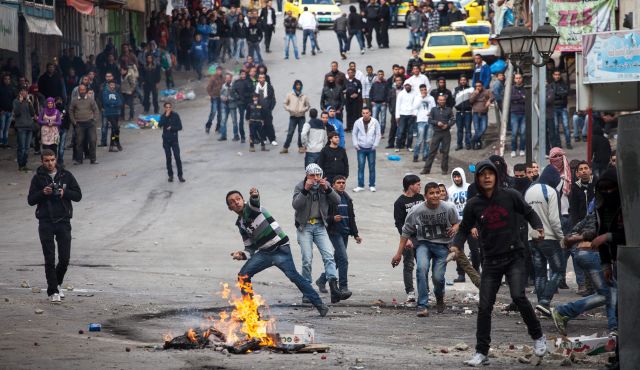
Rioting on Policeman’s Square, Hebron, February 24, 2013. Photo by Emil Salman

Perhaps as a bleak gesture to Purim, on Sunday the stone-throwers of Hebron stockpiled quantities of detonators and firecrackers and hurled them at soldiers. The stores were closed: a strike by all commerce had been declared for the first time in years, as a mark of solidarity with Arafat Jaradat, the Palestinian who died at Megiddo Prison.

Policeman’s Square, the city’s main center of commerce since the Israel Defense Forces shut down the shops on Shuheda Street in 1994, was empty. It looked for all the world like a kind of Palestinian Yom Kippur, but for the roughly 200 teens engaging in a tenacious battle of stones with the army.

Riots in Policeman Square have been a recurring scene of late. Yesterday’s incidents were different in one factor: the Palestinian police didn’t show up.

Usually, after half an hour of letting the steam escape, Palestinian Authority policemen come along and shoo the youngsters home. This time they looked on from afar.

The local police force, which in any case has recently been struggling to sustain its legitimacy, can hardly use force to suppress demonstrations protesting Jaradat’s death.

The IDF deployment at the scene showed supreme restraint. The forces in the field were under the command of an officer who organized a small group of sharpshooters and personally approved every single rubber bullet filed at the main rioters.

Overnight Jaradat has become a symbol of the Palestinian prisoners’ struggle. Paradoxically, this most inconsequential of prisoners, a man arrested for throwing stones, a man who belonged to no organization and of whom no one had ever heard, is the one uniting Palestinian society.

There is dying a martyr’s death. And then there is dying a martyr’s death under questioning by the Shin Bet security service. This is as lofty as it gets.

As in the debate about whether the Jews crucified Jesus, the facts no longer matter. At most, that will be the fief of historians. What matters are emotions and imagination.

Insult to the dead

The demonstrators at Policeman Square yesterday are confident that Jaradat was tortured to death by Shin Bet investigators. Israel’s official version, that he died of heart failure, was scornfully rejected. It was an insult to the dead.

Ultimately, the day passed in relative quiescence. Postponing the deceased’s funeral by 24 hours calmed tempers a bit. But after the funeral, going by precedent, extensive unrest can be expected.

In the meantime disturbances are establishing themselves at every location where there is a permanent military presence, such as the Hwara roadblock at the entrance to Nablus, and the Jalma roadblock at the entrance to Jenin. Stone-throwing along the roads traveled by settlers is rising a notch.

Weapons have not yet been taken out of storage. Armed men have not been seen in the streets. On Saturday a picture of armed men marching came out of the Balata refuge camp but they covered themselves from head to toe, like a bride in Mea She’arim, signaling fear of arrest, be it by the Palestinian Authority or by Israel.

For now, the masses are staying home. One might have expected that in an obstinate city like Hebron, where all the stores have joined the strike to mark Jaradat’s death, more people would have taken to the streets. The army is making a supreme effort not to fuel the protests with more dead and funerals. In the meantime the incidents are like public opinion polls: They are indicative mainly of trends.

The author

Chaim Levinson is a Haaretz correspondent, covering the Jewish settlements in the West Bank.
Previously, he was the Yedioth Ahoronot correspondent for Religious Affairs and the Orthodox communities.
Levinson received his B.A. in Social and Humanities Studies at the Open University and is currently studying for his M.A. in Interdisciplinary Democracy Studies.

Democracy Now : The Gatekeepers

click on image

TheGatekeepers-2


Amidst a spate of killings by Israeli forces of unarmed Palestinians in the occupied West Bank, we turn to the stunning Oscar-nominated documentary, “The Gatekeepers.” The film brings together six former heads of Israel’s internal security agency, the Shin Bet, collectively speaking out for the first time ever. They detail their methods against Palestinian militants and civilians in the Occupied Territories, including targeted killings, torture, recruiting informants, and the suppression of mass protests during two intifadas. But in doing so, they also criticize the occupation they were assigned with defending and warn that successive Israeli governments have endangered their country’s future by refusing to make peace. “We are making the lives of millions unbearable, into prolonged human suffering, [and] it kills me,” Carmi Gillon says in the film. “[We’ve become] a brutal occupation force similar to the Germans in World War II,” adds Avraham Shalom. We are joined by the film’s director, Dror Moreh. [includes rush transcript]

Gaza : Hypocrisy, As Usual

Qunfuz

Robin Yassin-Kassab

Omar al-Masharawi, son of a BBC cameraman in Gaza, murdered by Zionist bombs.

Israel has launched yet another attack against the Gaza Strip, striking the densely-populated and besieged territory from the air and the sea, and as usual the United States, Canada and Britain have lined up in support of Zionist terrorism.

Speaking from a system poisoned by the Israel lobby, State Department spokesman Mark Toner says: “There is no justification for the violence that Hamas and other terrorist organizations are employing against the people of Israel. We call on those responsible to stop these cowardly acts immediately. We support Israel’s right to defend itself.” Confusing Zionist settlers for ‘the Jewish people’, confusing perpetrator with victim, and then parroting outmoded ‘war on terror’ propaganda, Canadian foreign minister John Baird vomits the following: “Far too often, the Jewish people find themselves on the front lines in the struggle against terrorism, the great struggle of our generation.” Then Britain’s foreign minister William Hague makes the following immoral and illogical comment: “I utterly condemn rocket attacks from Gaza into southern Israel by Hamas and other armed groups. This creates an intolerable situation for Israeli civilians in southern Israel, who have the right to live without fear of attack from Gaza.”

Two things must be said. First, this round of escalation, like the 2008/2009 slaughter, was started by Israel. It is totally mendacious to pretend otherwise. The Hamas government in Gaza refrained from stopping other groups from firing missiles as a result of Israel’s murder of a disabled man and of a twelve-year-old boy in Gaza. Here is a timeline of events. Second, the settlers of southern Israel do not have the right to live without fear of attack while the original inhabitants of ‘southern Israel’ are herded into refugee camps. Eighty percent of people in Gaza are descendants of refugees ethnically cleansed from their villages and towns by Zionist militias in 1947 and 1948.

No Western approach to the Middle East will be coherent or helpful so long as the West remains attached to apartheid Israel. America has granted some millions of dollars to support Syrian refugees and to provide a few revolutionary activists with satellite phones, but Obama refuses to recognise the Syrian National Coalition as representative of the Syrian people, and has made it clear that the US won’t be supplying weaponry to the Free Syrian Army. Indeed, the Obama administration has been preventing Qatar and Saudi Arabia from providing effective weaponry to the resistance. Fear of Islamism translates here into fear of anti-Zionism. No weapons can be supplied which might one day be turned against the occupiers of the Golan Heights and the tormentors of the Palestinians.

Oil and geostrategy also ensure that Western policy on the Middle East will continue to lack credibility. After visiting Syrian refugee camps in Jordan David Cameron seemed to incline to arming the Syrian resistance, but he arrived in Jordan after a tour of the Gulf in which he’d offered to arm several tyrannies, including the Bahraini tyranny which is killing, imprisoning and torturing its democratic opposition. Bahrain hosts the US Fifth Fleet.

States and politicians are beholden to interests and lobbies. There is less excuse for individual activists and ‘anti-imperialists’ who are partial to one group’s freedom but make excuses for denying that of another. Many support the Bahraini revolution but not the Syrian, or vice versa, for sectarian reasons or out of blanket thinking (of course, sectarianism is a form of blanket thinking). And many of those who are quite correctly calling for demonstrations today against Zionist terror have not stirred in the last two years as forty thousand Syrians have been slaughtered, except perhaps to explain that the victims are enacting a dastardly plot against a resistance regime. A recent Facebook status from Sharif Nashashibi serves as an excellent rejoinder: “Sadly, there are people who condemn the slaughter of Palestinians but defend the slaughter of Syrians, and vice versa. As a Palestinian and a Syrian, I totally reject these hypocrites’ so-called support. The suffering of Palestine is the suffering of Syria, and vice versa. We are one and the same.”

This is absolutely correct. The slaughter of the people of bilad ash-Sham is as much of an abomination in Syria as it is in Palestine. American support for the frenzied Zionist bombing of Gaza is no more or less disgusting than Russian (and Iranian) support for Asadist barbarism. Furthermore, both Palestinians and Syrians have the right to self-defence. This is why I support providing anti-aircraft weaponry to both the Syrian and the Palestinian resistance.

Many analysts believe the timing of Israel’s attack has been determined by upcoming elections. Netanyahu needs to look tough for his rabid public, so he brings more trauma and death to Gaza. It is grotequely easy for Zionists to act out their impulses on the Palestinians, just as they used to find south Lebanon easy. In this revolutionary age, is no Arab power going to make the slaughter more expensive?

Saad el-Katatny of Egypt’s Muslim Brotherhood says, “The brutal aggression on Gaza proves that Israel has not yet learned that Egypt has changed.” So far, President Morsi has recalled the Egyptian ambassador from Tel Aviv, called a UN Security Council meeting, and opened the Rafah border for medical evacuations. This is far more than Mubarak would have done, but it’s still not nearly enough. The Qatari foreign minister says, “This filthy crime must not pass without a punishment.” Again, words are not enough. (By the by, I wonder if infantile leftists will decide that Palestinian resistance is a foreign plot now that the Qatari emir has visited Gaza and funded some projects there?)

While pointless adventurism would be criminally stupid at this moment of general Arab crisis, the new leaders of revolutionary Egypt, Tunisia and Libya, and old leaders seeking to adapt to the revolutionary wave, should remember that national dignity as expressed through a pro-Arab and anti-imperialist foreign policy is one of the key demands of Arab revolutionaries. This is a test for the Egyptian Muslim Brotherhood in particular. The Palestinians must not be left alone indefinitely.

source

Two new resources: Timeline of Israeli escalation in Gaza and Israel’s history of breaking ceasefires

by on November 14, 2012 7

The Institute for Middle East Understanding has released two useful resources on the current Israeli attack on Gaza. The first presents a timeline of events and the second outlines Israel’s history of breaking ceasefires.

TIMELINE: ISRAEL’S LATEST ESCALATION IN GAZA

THURSDAY, NOVEMBER 8

Following a two-week lull in violence, Israeli soldiers invade Gaza. In the resulting exchange of gunfire with Palestinian fighters, a 12-year-old boy is killed by an Israeli bullet while he plays soccer.

Shortly afterwards, Palestinian fighters blow up a tunnel along the Gaza-Israel frontier, injuring one Israeli soldier.

SATURDAY, NOVEMBER 10

An anti-tank missile fired by Palestinian fighters wounds four Israeli soldiers driving in a jeep along the Israel-Gaza boundary.

An Israeli artillery shell lands in a soccer field in Gaza killing two children, aged 16 and 17. Later, an Israeli tank fires a shell at a tent where mourners are gathered for a funeral, killing two more civilians, and wounding more than two dozen others.

SUNDAY, NOVEMBER 11

One Palestinian civilian is killed and dozens more wounded in Israeli attacks. Four Israeli civilians are also injured as a result of projectiles launched from Gaza, according to the Israeli government.

During an Israeli government cabinet meeting, Transportation Minister Yisrael Katz urges the government to “cut off the head of the snake… take out the leadership of Hamas in Gaza.” He also calls for a cutting off of water, food, electricity, and fuel shipments to Gaza’s 1.7 million people.

MONDAY, NOVEMBER 12

Palestinian militant factions agree to a truce if Israel ends its attacks.

WEDNESDAY, NOVEMBER 14

Israel breaks two days of calm by assassinating Ahmed Jabari, the head of Hamas’ military wing. According to reports, at least eight other Palestinians are killed in Israeli attacks, including at least two children. Palestinian militant groups vow to respond.

FACT SHEET – Self-Defense or Provocation?: Israel’s History of Breaking Ceasefires

Since Israel’s creation in 1948, Israeli political and military leaders have demonstrated a pattern of repeatedly violating ceasefires with their enemies in order to gain military advantage, for territorial aggrandizement, or to provoke their opponents into carrying out acts of violence that Israel can then exploit politically and/or use to justify military operations already planned.

The following fact sheet provides a brief overview of some of the most high profile and consequential ceasefire violations committed by the Israeli military over the past six decades.

2012 – On November 14, two days after Palestinian factions in Gaza agree to a truce following several days of violence, Israel assassinates the leader of Hamas’ military wing, Ahmed Jabari, threatening to escalate the violence once again after a week in which at least six Palestinian civilians are killed and dozens more wounded in Israeli attacks.

2012 – On March 9, Israel violates an Egyptian-brokered ceasefire and assassinates the head of the Gaza-based Popular Resistance Committees, sparking another round of violence in which at least two-dozen Palestinians are killed, including at least four civilians, and scores more wounded. As usual, Israel claims it is acting in self-defense, against an imminent attack being planned by the PRC, while providing no evidence to substantiate the allegation.

Following the assassination, Israeli journalist Zvi Bar’el writes in Haaretz newspaper:

‘It is hard to understand what basis there is for the assertion that Israel is not striving to escalate the situation. One could assume that an armed response by the Popular Resistance Committees or Islamic Jihad to Israel’s targeted assassination was taken into account. But did anyone weigh the possibility that the violent reaction could lead to a greater number of Israeli casualties than any terrorist attack that Zuhair al-Qaisi, the secretary-general of the Popular Resistance Committees, could have carried out?

‘In the absence of a clear answer to that question, one may assume that those who decided to assassinate al-Qaisi once again relied on the “measured response” strategy, in which an Israeli strike draws a reaction, which draws an Israeli counter-reaction.’

Just over two months prior, on the third anniversary of Operation Cast Lead, Israeli army Chief of Staff Lt. Gen. Benny Gantz tells Israel’s Army Radio that Israel will need to attack Gaza again soon to restore its power of “deterrence,” and that the assault must be “swift and painful,” concluding, “We will act when the conditions are right.”

2011 – On October 29, Israel breaks a truce that has maintained calm for two months, killing five Islamic Jihad members in Gaza, including a senior commander. The following day, Egypt brokers another truce that Israel proceeds to immediately violate, killing another four IJ members. In the violence, a total of nine Palestinians and one Israeli are killed.

2008 – In November, Israel violates a ceasefire with Hamas and other Gaza-based militant groups that has been in place since June, launching an operation that kills six Hamas members. Militant groups respond by launching rockets into southern Israel, which Israel shortly thereafter uses to justify Operation Cast Lead, its devastating military assault on Gaza beginning on December 27. Over the next three weeks, the Israeli military kills approximately 1400 Palestinians, most of them civilians, including more than 300 children. A UN Human Rights Council Fact Finding Mission led by South African jurist Richard Goldstone subsequently concludes that both Israel and Hamas committed war crimes and crimes against humanity during the fighting, a judgment shared by human rights organizations such as Amnesty International and Human Rights Watch.

2002 – On July 23, hours before a widely reported ceasefire declared by Hamas and other Palestinian groups is scheduled to come into effect, Israel bombs an apartment building in the middle of the night in the densely populated Gaza Strip in order to assassinate Hamas leader Salah Shehada. Fourteen civilians, including nine children, are also killed in the attack, and 50 others wounded, leading to a scuttling of the ceasefire and a continuation of violence.

2002 – On January 14, Israel assassinates Raed Karmi, a militant leader in the Fatah party, following a ceasefire agreed to by all Palestinian militant groups the previous month, leading to its cancellation. Later in January, the first suicide bombing by the Fatah linked Al-Aqsa Martyr’s Brigade takes place.

2001 – On November 23, Israel assassinates senior Hamas militant Mahmoud Abu Hanoud. At the time, Hamas was adhering to an agreement made with PLO head Yasser Arafat not to attack targets inside of Israel. Following the killing, respected Israeli military correspondent of the right-leaning Yediot Ahronot newspaper, Alex Fishman, writes in a front-page story: “We again find ourselves preparing with dread for a new mass terrorist attack within the Green Line [Israel’s pre-1967 border]… Whoever gave a green light to this act of liquidation knew full well that he is thereby shattering in one blow the gentleman’s agreement between Hamas and the Palestinian Authority; under that agreement, Hamas was to avoid in the near future suicide bombings inside the Green Line…” A week later, Hamas responds with bombings in Jerusalem and Haifa.

2001 – On July 25, as Israeli and Palestinian Authority security officials meet to shore up a six-week-old ceasefire, Israel assassinates a senior Hamas member in Nablus. Nine days later, Hamas responds with a suicide bombing in a Jerusalem pizzeria.

1988 – In April, Israel assassinates senior PLO leader Khalil al-Wazir in Tunisia, even as the Reagan administration is trying to organize an international conference to broker peace between Israelis and Palestinians. The US State Department condemns the murder as an “act of political assassination.” In ensuing protests in the occupied territories, a further seven Palestinians are gunned down by Israeli forces.

1982 – Following Israel’s invasion of Lebanon in June, and after PLO fighters depart Beirut under the terms of a US-brokered ceasefire, Israel violates the terms of the agreement and moves its armed forces into the western part of the city, where the Palestinian refugee camps of Sabra and Shatila are located. Shortly thereafter, Israeli soldiers surround the camps and send in their local Christian Phalangist allies – even though the long and bloody history between Palestinians and Phalangists in Lebanon is well known to the Israelis, and despite the fact that the Phalangists’ leader, Bashir Gemayel, has just been assassinated and Palestinians are rumored (incorrectly) to be responsible. Over the next three days, between 800 and 3500 Palestinian refugees, mostly women and children left behind by the PLO fighters, are butchered by the Phalangists as Israeli soldiers look on. In the wake of the massacre, an Israeli commission of inquiry, the Kahan Commission, deems that Israeli Defense Minister (and future Prime Minister) Ariel Sharon bears “personal responsibility” for the slaughter.

1981-2 – Under Defense Minister Ariel Sharon, Israel repeatedly violates a nine-month-old UN-brokered ceasefire with the PLO in Lebanon in an effort to provoke a response that will justify a large-scale invasion of the country that Sharon has been long planning. When PLO restraint fails to provide Sharon with an adequate pretext, he uses the attempted assassination of Israel’s ambassador to England to justify a massive invasion aimed at destroying the PLO – despite the fact that Israeli intelligence officials believe the PLO has nothing to do with the assassination attempt. In the ensuing invasion, more than 17,000 Lebanese are killed.

1973 – Following a ceasefire agreement arranged by the US and the Soviet Union to end the Yom Kippur War, Israel violates the agreement with a “green light” from US Secretary of State Henry Kissinger. According to declassified US documents, Kissinger tells the Israelis they can take a “slightly longer” time to adhere to the truce. As a result, Israel launches an attack and surrounds the Egyptian Third Army, causing a major diplomatic crisis between the US and Soviets that pushes the two superpowers to the brink of nuclear war, with the Soviets threatening to intervene to save their Egyptian allies and the US issuing a Defcon III nuclear alert.

1967 – Israel violates the 1949 Armistice Agreement, launching a surprise attack against Egypt and Syria. Despite claims Israel is acting in self-defense against an impending attack from Egypt, Israeli leaders are well aware that Egypt poses no serious threat. Yitzhak Rabin, Chief of the General Staff of the Israeli army during the war, says in a 1968 interview that “I do not believe that Nasser wanted war. The two divisions he sent into Sinai on May 14 would not have been enough to unleash an offensive against Israel. He knew it and we knew it.” And former Prime Minister Menachem Begin later admits that “Egyptian army concentrations in the Sinai approaches did not prove that Nasser was really about to attack us. We must be honest with ourselves. We decided to attack him.”

1956 – Colluding with Britain and France, Israel violates the 1949 Armistice Agreement by invading Egypt and occupying the Sinai Peninsula. Israel only agrees to withdraw following pressure from US President Dwight Eisenhower.

1949 – Immediately after the UN-brokered Armistice Agreement between Israel and its neighbors goes into effect, the armed forces of the newly-created Israeli state begin violating the truce with encroachments into designated demilitarized zones and military attacks that claim numerous civilian casualties.

About Adam Horowitz

Adam Horowitz is Co-Editor of Mondoweiss.net.

Shin Bet Arrests Israeli Druze at Syrian Border, Slaps Gag on Media Reporting

by , July 02, 2012

The Syrian news service, SANA, reported on June 29 that Israel’s Shin Bet security service arrested Dr. Eyad Jamil al-Jawhari, a resident of the Golan village of Majdal Shams. Jawhari is completing medical studies inside Syria and was returning home via the Golan border crossing when he was arrested. His family, who had been awaiting his arrival, was told he had been arrested. He is currently being held in the Shabak section of Kishon prison, where numerous Palestinian security detainees are interrogated.

The Shin Bet has secured a gag order on reporting about the incident, so no Israeli media outlet has reported the story. When and if they do, they will not be able to use the detainee’s name because of the gag. This Syrian media report notes that Jawhari has already appeared in the Nazareth court and that his detention has been extended. That means it’s likely he was arrested at least a few days ago.

This is a critical period and explains the Israeli gag. Opacity allows Israel to proceed with a minimum of public scrutiny. It is the time when the suspect likely is refused access to counsel, and when he’s likely to be tortured, as happened in the cases of Dirar Abusisi and Ameer Makhoul. These were both Palestinians arrested by the Shin Bet under gag, which I succeeded in breaking with the help of Israeli sources. That is why I’m publishing this report as urgently as I can. It’s critical that the news be reported widely outside Israel, as this may exert some pressure on the authorities not to mistreat Jawhari under cover of silence and darkness.

There could be two plausible reasons for his detention: given the civil war raging inside Syria, Israeli security forces are eager to obtain any intelligence they can about the situation. Therefore, someone returning from Syria would be a perfect source and worthy of detention and debriefing. The Shin Bet would first approach and ask him to collaborate. But if he refused, it’s plausible that Shin Bet would arrest him.

But given what we know of the incident at this point, I’d say it’s more likely that the security police determined that Jawhari had “nationalist sympathies” (an Israeli catchword for Palestinians who are too outspoken in their political views) and possibly had contact with individuals inside Syria who are verboten as far as Israel is concerned. Perhaps he met someone connected with Hamas or Hezbollah. A charge of contact with an “enemy organization” can bring very long prison sentences. Makhoul accepted a 9-year prison sentence for allegedly meeting a Hamas operative in Jordan at an environmental conference. The actual individual, Hassan JaJa, is a landscape designer in Amman, and the Shin Bet never proved he had any Hezbollah affiliation.

But the truth is that it wouldn’t even take that much for the Shin Bet to persecute you. All you have to do is be a prominent activist supporting the movement for civil rights for Israel’s Palestinian, Druze, or Bedouin minorities.

Israel’s Druze community is generally considered quite loyal to the state and so rarely suspected of such sympathies. But some communities in the Golan retain strong ties to Druze living on the other side of the Syrian border, which would make the security services suspect them of dual loyalty, or not having any loyalty at all (to Israel).

I’ve put out word to Israeli prisoners’ rights activists to try to determine which prison holds Jawhari. From there, we will be able to notify the human rights community of what has happened, and they can try to help make his case more public and transparent.

On a different subject, I reported here recently on the 2010 execution of East Jerusalem Palestinian, Ziad Jilani, by Israeli border police. When the Israeli court and police refused to prosecute those who murdered Jilani, his widow, Moira, appealed to the attorney general. Two days ago, he released a voluminous document rejecting her appeal and refusing to open a criminal investigation. The legal memo, though it didn’t go so far as to say the murder was justified, denied a credible case could be made for murder or any criminal act. It whitewashed the incident and rewarded impunity a legal victory.

source

Blog at WordPress.com.

Up ↑