“Cursed be he who says, ‘Avenge!‘ “
—Chaim Bialik, from “On The Slaughter”
From the moment three Israeli teens were reported missing last month, Israeli Prime Minister Benjamin Netanyahu and the country’s military-intelligence apparatus suppressed the flow of information to the general public. Through a toxic blend of propaganda, subterfuge and incitement, they inflamed a precarious situation, manipulating Israelis into supporting their agenda until they made an utterly avoidable nightmare inevitable.
Israeli police, intelligence officials and Netanyahu knew within hours of the kidnapping and murder of the three teens that they had been killed. And they knew who the prime suspects were less than a day after the kidnapping was reported.
Rather than reveal these details to the public, Israel’s Shin Bet intelligence agency imposed a gag order on the national media, barring news outlets from reporting that the teens had almost certainly been killed, and forbidding them from revealing the identities of their suspected killers. The Shin Bet even lied to the parents of the kidnapped teens, deceiving them into believing their sons were alive.
Instead of mounting a limited action to capture the suspected perpetrators and retrieve the teens’ bodies, Netanyahu staged an aggressive international public relations campaign, demanding sympathy and outrage from world leaders, who were also given the impression that the missing teens were still alive.
Meanwhile, Israel’s armed forces rampaged throughout the occupied West Bank and bombarded the Gaza Strip in a campaign of collective punishment deceptively marketed to Israelis and the world as a rescue mission.
Critical details that were known all along by Netanyahu and the military-intelligence apparatus were relayed to the Israeli public only after the abduction of more than 560 Palestinians, including at least 200 still held without charges; after the raiding of Palestinian universities and ransacking of countless homes; after six Palestinian civilians were killed by Israeli forces; after American-trained Palestinian Authority police assisted Israeli soldiers attacking Palestinian youths in the center of Ramallah; after the alleged theft by Israeli troops of $3 million in US dollars; and after Israel’s international public relations extravaganza had run its course.
The assault on the West Bank arrived on the heels of the collapse of the US-led framework negotiations, for which the US blamed Netanyahu, and immediately after Hamas’ratification of a unity deal with the Fatah-controlled Palestinian Authority. Netanyahu was still smarting from the US recognition of the unity government when news of the kidnapping reached him. Never one to miss an opportunity to undermine the Palestinians, he and his inner circle resolved to milk the kidnapping for maximum propaganda value.
Weeks after the incident, it is now clear that the Israeli government, intelligence services and army engaged in a cover-up to provide themselves with the political space they required for a military campaign that had little to do with rescuing any kidnapped teens.
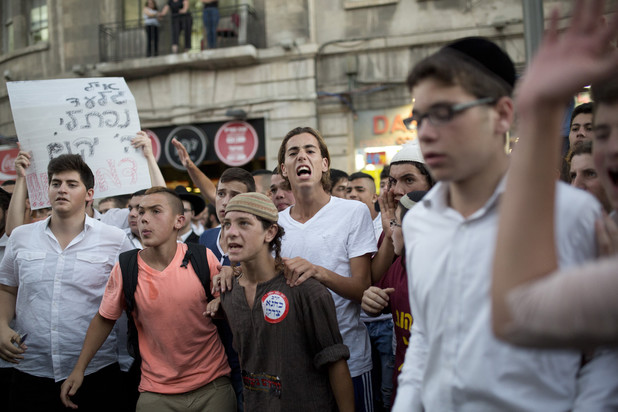
The disinformation campaign they waged sent a heavily indoctrinated, comprehensively militarized population into a tribalistic frenzy, provoking a wave of high-level incitement, the shocking revenge killing of an innocent Palestinian teen and rioting across East Jerusalem.
Where the chaos will end and how far it will spread is unknown. But its origins are increasingly clear.
Gagging the media, lying to teens’ parents
see full article here
The Americans and Europeans have tried being the voice of reason and failed. Now they must speak to Israel in the language it understands best (hint: it’s not Hebrew.)

Israeli settlers of Yitzhar take position during a confrontation with Palestinians over an area in Burin village in the West Bank, January 14, 2014. Photo by AP
If there is a world, let it appear immediately. For now, there’s the sense of an ending of the international intervention in Israel. The Americans folded, the Europeans gave up, the Israelis rejoice and the Palestinians are lost. “Sleep now high road / ending comes, Sleep thou king / here comes the clown” (“Shir Eres” [Lullaby], by Natan Alterman, translated by Avigail Caspi-Lebovic).
Occasionally some pope or foreign minister makes a visit (Norway’s FM was here last week), pays loose lip service in favor of peace and against terror and the settlements, and then disappears again. On the high road ending comes, and the king has been replaced by the clown. But even this waning is a statement, and idleness is action: They leave the conflict to the sighs of the Palestinians and the occupation in the hands of Israel, which is sure to perpetuate it and to ground it even more firmly. For that reason, the world’s withdrawal is unacceptable: The international community does not have the option to leave the status quo as is, even if that is Israel’s most fervent wish.
The current situation is not acceptable in the 21st century. It is easy to empathize with the United States for giving up, with Europe for tiring. How much longer can the same road be trodden? How many times can the same futile proposals be read out to deaf ears.
After a brief recovery from the American failure, the time has come for a new way, one that has never been tried before. Both the message and the medium must change, to a message of civil rights and the medium of punishment. The previous route included sycophancy toward Israel, one carrot after another in order to please it. It was a resounding failure. It only gave Israel an incentive to further entrench its policy of disinheritance.
The message also failed spectacularly: The two-state solution has given up the ghost. The world tried to bring it to life using charm. The proposals came thick and fast, amazing in their resemblance to each other – from the Rogers Plan to the shuttle diplomacy of John Kerry – and each one only collected dust in some drawer. Israel always said no, only its excuses and conditions changing: an end to terror here, recognition of its being a Jewish state there.
In the meantime, the number of settlements in the West Bank grew threefold and fourfold, and the brutality of the occupation increased to the point where soldiers now shoot demonstrators out of nothing but boredom.
The world cannot lend its hand to this. It is unacceptable, in the 21st century, for a state that purports to be a permanent member of the free world to keep another nation deprived of rights. It is unthinkable, simply unthinkable, for millions of Palestinians to continue to live in these conditions. It is unthinkable for a democratic state to continue to oppress them in this way. It is unthinkable that the world stands by and allows it to happen.
The two-state discussion must now become a discussion of rights: Dear Israelis, you wanted an occupation and the settlements – knock yourselves out! Remain in Yitzhar, dig yourselves into the mountainside and build to your hearts’ desire in Itamar. But you absolutely must grant full rights to the Palestinians living alongside, exactly the same rights that you enjoy.
Equal rights for all; one person, one vote – that should be the message of the international community. After all, what could Israel say to this new message? That there cannot be equal rights because the Jews are the chosen people? That it would endanger security? The excuses would quickly run out, and the naked truth would come to light: that in this land, only Jews have rights. Such a message cannot go unchallenged.
At the same time, the entire approach to Israel must be changed. As long as it does not pay the price for the occupation and its citizens go unpunished, they will have no reason to end it, or even to deal with it. The occupation is deep inside the Israeli closet. There is no one to out it, the overwhelming majority want it to remain inside. For this reason, only punitive measures will remind us of its existence. Yes, I mean boycotts and sanctions, which are greatly preferable to bloodshed.
This is the truth, even if it’s bitter. America and Europe have kowtowed to Israel enough. Unfortunately, to no effect. From now on, the world must speak a different language and perhaps it will be understood. After all, Israel has proved, more than once, that the language of power and punishment is its main language.
My name is Andrea Pesce, I am 44 years old and I’m an Italian citizen.
For 15 years I had the chance to visit Israel and Palestine, thanks to my former job (I used to be a travel agent) and also because I’m interested in the political situation over there. I travelled as a normal person, without any official role or mission.
Last December I have been in Israel and Palestine for one week. I always stayed in a hotel in the Old city of Jerusalem and I went for one day visit to Bethlehem (twice), Ramallah and Nablus, always as a tourist. During my visit in Bethlehem I had the chance to learn about a non-profit organization, named Tent of Nations, which follows a non-violent approach to the conflict.
Between January and February I contacted Tent of Nations staff, and planned a visit in March to volunteer over there. Then I bought an El Al air ticket, from Venice to Tel Aviv and back, departure 18th March, return 16th April.
This is the background to my story and I want to say also that I have never participated in any event, manifestation or whatever against Israel, or have written something or declared something against Israel. On the contrary, in 1999 I wrote a book issued by a Italian publisher, specialized in Jewish Literature and subjects, (Casa editrice La Giuntina) with an afterword by Amos Luzzatto, who at that time was President of the Union of Italian Jewish Communities.
Last 18th March, my day of departure, I arrived at Venice airport at 11 am, 3 hours before scheduled take off. For this kind of flight, there is an Israeli security staff interviewing passengers, according to an agreement between the Italian and Israeli governments. I waited around one hour, as Israeli staff are always allowed to pass Israeli passengers before me and other Italians waiting. Then one woman interviewed me, quite softly, but with some incredible questions like:
“You are going to stay one month away from home, isn’t your daughter sad because of this?”
There is no security reason behind this kind of question, not even to check if you get nervous because you have something to hide: it’s pure harassment, nothing more, nothing less.
I asked, “Why are you asking questions like this ? It’s too personal!”
She seemed to understand, and started to apologize.
Then I was told that my backpack had to be searched and that I cannot bring my camera (old fashioned) with me, it had to go in the hold. They checked everything, which included doing a body search on me.
Eventually they told me that maybe my baggage cannot arrive with me in Tel Aviv on the same flight: I complained a lot, saying that I had been waiting for two hours and I couldn’t understand why they waited so long. At the end they let me leave, I have to say, including my backpack.
During the flight I was tired but also happy: eventually everything was ok, and I was on the way to start my holiday and a wonderful life experience for one month in Israel and Palestine.
I couldn’t imagine what was waiting for me at Ben Gurion Airport.
Once I arrived, at passport control, I was told to wait in a corner of the hall, beside the “passport control office”. Several people were there already. I waited around one hour and then I had the first dialogue. It focused on what I was going to do during this month, I said “nothing special, I will go around”, ok, then wait again other half an hour, and then a second person interviewed me about my job, and what I was going to do it in Israel for one month, and I repeated the same answers again.
Then wait again around half an hour, and then the third interview with other people asking same questions, but in harder way, intimidating me and trying to scare me.
They argued that I was a liar because I didn’t say that somebody was waiting for me in Bethlehem, and that those who lie at the border will be not allowed to enter the country.
At that point I had been traveling for almost twelve hours, I was confused, tired and a little bit scared. But I had nothing to hide and I said, “check whatever you want, I’m a normal person, do what you have to do”. At that point it was pretty clear to me that they had read my emails and knew everything in advance.
Finally around 11.30 pm, I was interviewed by other people (they said they were from the Ministry of Internal Affairs) and after some minutes they told me that my entry was denied because I was a liar: I started to cry, more because of the stress itself, than for the final decision to reject me, even though it has been hard to me to accept the “destruction” of my travel, planned for months.
They started to laugh a little bit, saying that if only I said at the beginning I was going to volunteer they would let me in without any problem. But since I lied about it, I have to be rejected.
Until now, it was hard but not terrifying. But I still couldn’t expect what I was in for.
Around 1 am they brought me in another airport room where my baggage has been searched again and I had a second body search. Then they took away my backpack, empty, because they said that it was detained for security reason. They gave me a big plastic bag to put all my belongings in.
Funny detail: the bag has a broken zipper.
They brought me back to the same hall, where I was told to not go around. I had to stay near their office.
Please note that I could only drink some water because another tourist gave me some coins to buy a bottle water from a machine. And security staff gave me a sandwich only because I asked for it. In the meantime every request I made — to have some water or to make a phone call to my embassy or simply to alert my hotel in Jerusalem that I couldn’t go there — was refused. And refused is not the right word: I was not a normal person anymore, I started already to be seen like a second class person. I want to say that for the very first time I really felt what racism is.
As they decided to send me back to Italy, the problem was how and when: flights to and from Venice are only once per week. So I was told that I was going to stay in a separate facility, waiting for the flight back to Italy.
This is the beginning of the nightmare.
The separate facility is a “migration facility”, as they call it, which is actually a sort of prison. Around five minutes by car outside of Ben Gurion Airport, I was transferred to this “house” surrounded by iron net, with bars on windows. I was told to leave everything in a room, including my mobile. Strange, but I definitely realised I was under arrest when I was told I could not bring a ballpoint pen with me to my “room”. But actually it was not a room, it was a jail. So around 3 am on the 19th March started my new life experience: being detained in a prison.
I cannot express my feelings exactly: maybe I can say that, having fallen deeply into a total irrational system, the only way to avoid becoming crazy, was to start to think in a completely different way. But it wasn’t easy.
The jail has soundproof doors, so you cannot ask for anything, not even scream. You can only beat the door until somebody, maybe, is willing to listen to you. But you already feel completely unsafe and you are scared even to ask, because you know that they can do everything with you, about you. I cannot say what I thought and felt during that night.
By 7:00 am I was destroyed, I was imploring them to send me home. One man, never seen before just opened the door and screamed to me: “so you go tonight at 06.30 pm, okay or not ?!” I said “Okay, okay, please let me go, I didn’t do anything, I don’t even know why I’m here”. They say “Okay, you will go tonight”.
At that stage nobody knew where I was, nobody. I was simply disappeared.
At 9:00 am I was allowed to call the Italian embassy: an Italian official told me “once you are in that place we cannot do anything, you simply don’t exist for us if you are in that place”. She also expressed sympathy for what I was going through, but the fact I was leaving in the afternoon was decisive. She also called my wife in Italy, as I was not allowed to do it directly.
Then the wait for departure started: I was in another jail, alone, with the door open. But I couldn’t go out, and it’s hard to explain, but I was afraid to ask anything. When around noon they gave me some food (to consume it in the room, without any table, only sitting on the bed) I did ask for some water, they said “We will bring it to you.” They didn’t and I didn’t ask again.
All and all, during my 14 hours in the “migration facility” I had the chance to stay outside in the open courtyard for a total of around 40-45 minutes (in two visits during the morning, none in the afternoon).
Again: I cannot explain my feelings during the time between 4:30 pm and 5:30 pm, knowing that my flight was scheduled for 6:20 pm. I was scared to death that they wouldn’t let me go….
It the end, at 5:35 pm they did open the door, let me take my belongings (always in their plastic bag), transferred me to the airplane and let me go. My passport was delivered to me by an Italian officer at Milan airport, after it was handled to him by the El Al staff.
I won’t share anything about the fact that being flown to Milan cost me more fatigue, finding a hotel that night and then catching a train to Venice the next day (20th March).
Nobody, never, in those 24 hours, declared their identity or role to me (they all have a badge, but it’s not easy to read and you don’t’ have the courage to show that you want to know their name). In the end there is no written proof of what they did to me, not even the reason for my rejection and detention. Nothing, nothing at all. I only have a stamp on my passport saying “entry denied”.
The lessons for me at this moment are two questions:
- Why do you want me to hate you ?!
- If you can do this to me, what you can do to the Palestinians ?!
from Ilan Pappe
Yossef Vashitz was a senior advisor of Arab affairs to Mapam, whose major military force, the Palmach, were the commando units of the Zionist military effort in 1948. His private collection include this half page – undated – translated here, which just give a short list of atrocities committed in 1948 (mostly in October to November that year during operation Hiram) in the upper Galilee. Here it is: Safsaf –caught 52 men, tied them one to the other, dug a hole and shot them. While they were sill alive, women came and pleaded for their lives. Found 6 bodies of old men, all and all 61 bodies.
Yossef Vashitz was a senior advisor of Arab affairs to Mapam, whose major military force, the Palmach, were the commando units of the Zionist military effort in 1948. His private collection include this half page – undated – translated here, which just give a short list of atrocities committed in 1948 (mostly in October to November that year during operation Hiram) in the upper Galilee. Here it is: Safsaf –caught 52 men, tied them one to the other, dug a hole and shot them. While they were sill alive, women came and pleaded for their lives. Found 6 bodies of old men, all and all 61 bodies.
Three rape cases. One by a Mizrachi Jew from Jaffa of a 14 years old girl. 4 men shot and killed. From The one they cut by knife his fingers to take his ring. Jish – 400 inhabitants. A women embracing a child – both dead. 4 women and 11 soldiers dead. The Logistic Unit. They wipe everything. The Kibbutzim rob everything. Kefar Giladi [robbed] five flower lorries.
Ein Zitun, the logistic went wild…tore women earlobes to take the ear rings. In Birim – the same sight and one dead man for no reason. Sasa. Murders; especially of old men.
Ilabun – 1000 people, the army received surrender, slaughtered [animals], food, and then the expulsion from the village began by shooting. Thirty people died. The order was to expel the villages. Rumours of it across the border. Saliha – ninety two, men, old men women and children [died] when a house was blown on them. Mashhat – the village wanted to surrender already in the days of Qawqji, he revenged, now we.
![Photo : Historical quote of the day</p><br />
<p>Yossef Vashitz was a senior advisor of Arab affairs to Mapam, whose major military force, the Palmach, were the commando units of the Zionist military effort in 1948. His private collection include this half page – undated - translated here, which just give a short list of atrocities committed in 1948 (mostly in October to November that year during operation Hiram) in the upper Galilee.</p><br />
<p>Here it is:<br /><br />
Safsaf –caught 52 men, tied them one to the other, dug a hole and shot them. While they were sill alive, women came and pleaded for their lives. Found 6 bodies of old men, all and all 61 bodies. Three rape cases. One by a Mizrachi Jew from Jaffa of a 14 years old girl. 4 men shot and killed. From The one they cut by knife his fingers to take his ring.<br /><br />
Jish – 400 inhabitants. A women embracing a child - both dead. 4 women and 11 soldiers dead.<br /><br />
The Logistic Unit.<br /><br />
They wipe everything. The Kibbutzim rob everything. Kefar Giladi [robbed] five flower lorries.</p><br />
<p>Ein Zitun, the logistic went wild…tore women earlobes to take the ear rings. In Birim – the same sight and one dead man for no reason.<br /><br />
Sasa. Murders; especially of old men.<br /><br />
Ilabun – 1000 people, the army received surrender, slaughtered [animals], food, and then the expulsion from the village began by shooting. Thirty people died. The order was to expel the villages. Rumours of it across the border.<br /><br />
Saliha – ninety two, men, old men women and children [died] when a house was blown on them.<br /><br />
Mashhat – the village wanted to surrender already in the days of Qawqji, he revenged, now we.](https://scontent-a-lhr.xx.fbcdn.net/hphotos-frc3/p480x480/1505275_752581984771335_929224715_n.jpg)
from Democracy Now click on image

As Israeli Prime Minister Benjamin Netanyahu is continuing a public campaign to cast doubt on U.S. diplomatic engagement with Iran, we speak to journalist Max Blumenthal, author of the new book, “Goliath: Life and Loathing in Greater Israel.” Blumenthal looks at life inside Netanyahu’s Israel and the Occupied Territories. “I was most surprised at the banality of the racism and violence that I witnessed and how it’s so widely tolerated because it’s so common,” says Blumenthal about his four years of reporting in Israel. “And I’m most surprised that it hasn’t made its way to the American public … that’s why I set out to do this endeavor, this journalistic endeavor, to paint this intimate portrait of Israeli society for Americans who don’t see what it really is.” Click here to watch Part 2 of his interview.
1 of 4. French diplomat Marion Castaing lays on the ground after Israeli soldiers carried her out of her truck containing emergency aid, in the West Bank herding community of Khirbet al-Makhul, in the Jordan Valley September 20, 2013.
Credit: Reuters/Abed Omar Qusini
By Noah Browning
KHIRBET AL-MAKHUL, West Bank | Fri Sep 20, 2013 10:51am EDT
KHIRBET AL-MAKHUL, West Bank (Reuters) – Israeli soldiers manhandled European diplomats on Friday and seized a truck full of tents and emergency aid they had been trying to deliver to Palestinians whose homes were demolished this week.
A Reuters reporter saw soldiers throw sound grenades at a group of diplomats, aid workers and locals in the occupied West Bank, and yank a French diplomat out of the truck before driving away with its contents.
“They dragged me out of the truck and forced me to the ground with no regard for my diplomatic immunity,” French diplomat Marion Castaing said.
“This is how international law is being respected here,” she said, covered with dust.
The Israeli army and police declined to comment.
Locals said Khirbet Al-Makhul was home to about 120 people. The army demolished their ramshackle houses, stables and a kindergarten on Monday after Israel’s high court ruled that they did not have proper building permits.
Despite losing their property, the inhabitants have refused to leave the land, where, they say, their families have lived for generations along with their flocks of sheep.
Israeli soldiers stopped the International Committee of the Red Cross (ICRC) delivering emergency aid on Tuesday and on Wednesday IRCS staff managed to put up some tents but the army forced them to take the shelters down.
Diplomats from France, Britain, Spain, Ireland, Australia and the European Union’s political office, turned up on Friday with more supplies. As soon as they arrived, about a dozen Israeli army jeeps converged on them, and soldiers told them not to unload their truck.
“It’s shocking and outrageous. We will report these actions to our governments,” said one EU diplomat, who declined to be named because he did not have authorization to talk to the media.
“(Our presence here) is a clear matter of international humanitarian law. By the Geneva Convention, an occupying power needs to see to the needs of people under occupation. These people aren’t being protected,” he said.
In scuffles between soldiers and locals, several villagers were detained and an elderly Palestinian man fainted and was taken for medical treatment to a nearby ambulance.
The U.N. Office for the Coordination of Humanitarian Affairs (OCHA) said in a statement that Makhul was the third Bedouin community to be demolished by the Israelis in the West Bank and adjacent Jerusalem municipality since August.
Palestinians have accused the Israeli authorities of progressively taking their historical grazing lands, either earmarking it for military use or handing it over to the Israelis whose settlements dot the West Bank.
Israelis and Palestinians resumed direct peace talks last month after a three-year hiatus. Palestinian officials have expressed serious doubts about the prospects of a breakthrough.
“What the Israelis are doing is not helpful to the negotiations. Under any circumstances, talks or not, they’re obligated to respect international law,” the unnamed EU diplomat said.
(Writing by Crispian Balmer; Editing by Louise Ireland)
One of Israel’s most well known journalists casts doubt on one of the most tragic affairs in the country’s history. His conclusion, reached despite self-admitted ignorance on the topic, aligns perfectly with the way the Israeli media handled of Yemenite Baby Affair from day one – glossing over evidence and unquestioningly towing the state line.
By Shoshana Madmoni-Gerber
In a 2011 interview with Jon Stewart on “The Daily Show,” award winning American journalist Bill Moyers paraphrased George Orwell: “Journalism is about what people want to keep hidden, everything else is publicity.” Case in point: famed Israeli television journalist Yaron London’s recent article in Haaretz, “Maybe the kids didn’t disappear?” [Hebrew].
London’s tone and perspective perfectly illustrate Moyers’ assertion; it is a textbook example of how the Zionist hegemonic machine constructs a public discourse to maintain the status quo. At the same time, opposing claims, however legitimate, are silenced. London has considerable influence on the public discourse. But like his colleagues in the Israeli press, instead of using his power to expose the hidden, to ask worthy investigative questions, he chose to defend the state. As Ilana Dayan told Yarin Kimor on Israel’s version of “Meet the Press” in 1996: “the state doesn’t need you… If you think nothing happened, move on to a different topic!”

London admits to having limited knowledge about one of the most tragic affairs in Israel’s history. But his lack of knowledge, and apparent inability to comprehend the magnitude of the tragedy, doesn’t prevent him from forming a conclusion. To no one’s surprise, it aligns perfectly with the state’s efforts to obfuscate and conceal the issue by saying: most of them died; this is really just a one big misunderstanding. This, despite hundreds of testimonies of parents to the contrary, including mothers testifying that their babies were physically kidnapped from their hands, such as Naomi Gavra and Miriyam Ovadia. And despite clear cases such as Miriam Shuker [Hebrew], who was kidnapped and given for adoption, all while her father, David, was looking for her all over the country.
This is the same conclusion all state-appointed commissions reached. And not investigative bodies, by the way – the first two commissions were only inquiry commissions with no subpoena power and no intention to investigate; all commissions, including the last, were exceptional only in how slowly they worked and how little new information they could discover[i].
At the same time, the press showed a remarkable lack of interest in the state’s obvious conflict with a clamor of Yemenite and other Mizrahi voices. With the exception of Haolam Haze in 1967, and a few articles in Haaretz and Ha’ir in the mid 1990s, inquiry into public outcry was nearly non-existent. From the 1960s until the last commission’s findings were published in November 2001, state press releases and media reporting show incredible consistency with each other.
 When I examined the media narrative for my book, based on my Ph.D. dissertation, Israeli Media and the Framing of Internal Conflict: the Yemenite Babies Affair (Palgrave Macmillan, 2009), I found a discourse that was overwhelmingly supportive of state efforts to quash discussion of the affair. Starting with the first articles in the 1960s, writers were eager to dismiss claims of kidnapping. “Don’t you think that if these accusations were true the police would have opened some files to investigate these matters” (Maariv, October 9, 1966). In other words, if there was no investigation, there was no crime in the first place. Others dismissed all calls for an investigation, saying, “all people working in the camps, with no exception, were honest people” (Maariv April, 1, 1966), or, “no child was ever released from the hospital without identification” (Tel-Aviv, December 20, 1985).
Reinforcement of negative racial stereotypes was the other major theme when the media bothered to mention the affair. New Yemenite immigrants were shown as primitive, at best incapable of caring for themselves properly, and at worst, not even caring if a child lived or died. One article in Davar (February 24, 1966) describes the Yemenite immigrants as “peeking through the window and seeing for the first time how to bathe a baby and how to change a baby’s diaper.” Another quoted a nurse as saying Yemenite parents had a cavalier attitude towards the death of a child. “If a child died in the tent they would say, ‘God gives and God takes’” (Davar, February 26, 1966). From this perception, the road to thinking they were unfit parents was very short. Moreover, these racist sentiments, as Naama Katii rightly noted [Hebrew], were echoed years later during nurses’ testimonies to the commission and the press. “Maybe we did them a favor,” said 92-year-old Ahuva Goldfarb, former head nurse in the absorption camps in an interview with me back in 1995. Another head nurse, Sonia Milshtein, told the commission the Yemenite parents “were not interested in their children.” This same nurse shocked even the sleepy Judge Cohen when, during her testimony, she called the babies “carcasses” and “packages.” And further, she added, “oh, after 40 years, I would just be happy that my child got a good education.”
The biggest issue here is not that the commission supposedly disproved an institutional conspiracy. Sanjero’s main contribution is the complete discrediting of this commission’s work. As he writes, “the commission was lacking the most central tool for any investigation: an epistemology of suspicion.” (Page 48, Hebrew) If any journalist bothered to read the last commission’s report, it would have been crystal clear that referring to any conclusion made by this commission using the term “determined with great certainty” is, how should I put it… embarrassing.
But, more importantly, we must realize that in the absence of an honest discussion about the past, the same racist attitudes continue to dictate the present and future. The same racist attitude that likely led to these terrible acts are also motivating the years-long silencing, and the rejection of a legitimate cry for answers. Both the government and the media legitimize this sentiment. This is where London should have focused his deconstruction efforts. There was a massive cover up; this is a fact. And this should have gotten any qualified reporter asking, “why?”
The Kedmi commission’s report, just like the previous commissions, is full of contradictions and factual errors; too many to detail in this short space. Important lines of inquiry were dropped, including an important investigation in the U.S., crucial testimony was given behind closed doors and remains classified for the next 70 years. Source files, hospital archives and burial records were mysteriously lost and even burned.[ii] Birth files requested by the commission from Hillel Yaffe Hospital, for instance, were “accidently burned,” not in the 1950s, but in the late 1990s and during the so called investigative work. Rather than flagging the event, or investigating who corrupted these records, the commission merely dismissed it as an “administrative failure.” I ask, as Sanjero did, how, during a working investigation, could such an overt flouting of procedure remain uninvestigated? I think that even the Hasamba boy would have known what to do here.
The state’s efforts to silence discussion of this perspective has only been possible with the media’s full cooperation over a long period of time. As Claris Harbon noted, in her review of my book[iii], this affair is also part of a larger system of oppression that is consciously maintained and back up by the legal system. What Harbon is offering is a new way to examine the law breaking, “perceiving it as a viable language, as a legitimate form of resistance, invoking greater principles of justice… and aimed at correcting past/present injustices.” It’s important to understand in this context that Rabbi Meshulam’s vilification and ridicule by the media, and his ultimate demise was deliberate and complete, in an effort to delegitimize his protest. In the public eye, the issue at hand was his “insanity,” not the moral obligation of the media and public to demand answers to the question – why and how hundreds if not thousands of babies were forcefully removed from their parents to never be seen again?

Ignorance fuels racism. Not knowing isn’t the weapon for conspiracy theorists, as London wishes us to believe, less than it is a weapon for those who were actively squelching and preventing a legitimate demand for proper investigation. Kidnapping, or the forcible transfer of babies/children from one group to another, is not only a violent act, it is defined by the UN as genocide. This fact alone should have gotten not only the media going, but also the whole country out in protest.
But instead of being motivated by a healthy dose of suspicion, the media eagerly helped by recycling the lame “immigration mess” excuse. Which, by the way, paradoxically didn’t prevent the Kedmi Commission from producing the definitive conclusion that all documentation from that time is accurate. So which is it? Messy or accurate? But why bother with little unimportant terminology when it is so easy to blame the victim. And this is just what the Kedmi Commission did. As Sanjero noted: “throughout the report the commission detailed a dry description of severe actions without the slightest bit of criticism… in the whole entire report the commission doesn’t name even one person, flesh and blood, responsible… but blaming the parents they did…”
What any citizen of Israel, including reporters, should ask him or herself is why as a society we sympathize with one pain, and not another? Why in the case of Yosale Schumer, the Haredi boy who was kidnapped by his grandparent in 1962, the entire state, government and the Mossad got involved until he was brought back to his parents. No effort was too big to get one boy, while hundreds of Yemenite parents were not worthy of a fraction of this sympathy or willingness to fight?
So “what’s between Shmita to Mount Sinai?”, you ask – compassion and humanity. A true fight against injustice should put on its agenda all systems of oppression, for they are interconnected. As Martin Luther King said in 1963: “injustice anywhere is a threat to justice everywhere.” When the Israeli Left will fight against intra-Jewish injustices and racism with the same enthusiasm and passion often used to protest the occupation, we might have a chance at a better future here.
Shoshana Madmoni-Gerber is an associate professor of communications and journalism at Suffolk University in Boston.
This article was first published in Hebrew on Haokets, a non-profit, independent, progressive Israeli web magazine that hosts critical discussion where hundreds of writers publish professional and original pieces on socioeconomic, cultural and philosophical issues, human rights activism, feminism, and Mizrahi politics. Visit their English-language blog.
[i]
The constant usage of the inaccurate phrase “three investigative commissions have investigated this affair…” only made the Yemenite look like nudniks who are standing in the way of closing this story, instead of criticizing the lack of investigation.
[ii]
For detailed examples read Shoshi Zaid’s book And The Child id Gone, Geffen (2001) and Rfai Shubeli’s many articles in the journal Afikim, as well as my book.
[iii]
“Revealing the past – Breaking with the Silence: The Yemenite Babies Affair and the Israeli Media”. In Holy Land Studies 10.2 (2011): 229-248.
For additional original analysis and breaking news, visit +972 Magazine’s Facebook page or follow us on Twitter. Our newsletter features a comprehensive round-up of the week’s events. Sign up here.
 band annie's Weblog