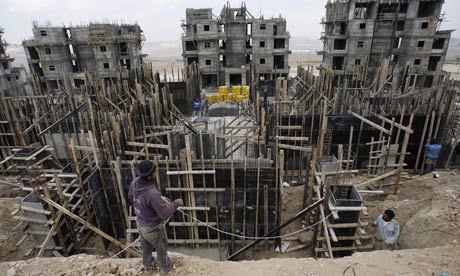
Adrian Agassi believes Israel has a biblical claim to territory beyond its borders. Photograph: Ammar Awad/Reuters
Adrian Agassi believes Israel has a biblical claim to territory beyond its borders. Photograph: Ammar Awad/Reuters
Gaza, October 28, 2009, (Pal Telegraph) – There was much praise for the UN investigations into war crimes committed in Gaza, led by Richard Goldstone. However, I feel that this report did not go far enough to investigate some other more serious allegations that were made.
There is a sense of urgency to bring this investigation forward and to put those responsible on trial but one must understand that something much more sinister did not even get a mention and has since been swept under the carpet.
Let’s take a closer look at some aspects of this report which certainly showed a distinct weakness in the team’s ability to understand what constitutes a breach of the Geneva Convention.

Would you want this person as your neighbor ? LOL
Interesting conversation with an israeli settler (august 17th). I went to a protest against Senator Mike Huckabee, who is here in Jerusalem to support the Israeli settler cause in occupied Palestine and particularly in Sheikh Jarrah. On the way down from the protest, we came across a young woman who asked us where the protest was in Hebrew. We told her we did not speak Hebrew, and she asked us again in English, after which we gave her the directions. She asked us where we were coming from, and we said that we were coming from the Peace Now protest, which is against settlements. Immediately her face changed. She asked us if we were Jewish. When we said no, she asked us why we were in her country. She said that we had no right to be here, and that this country was only for the Jews, who were given this land by God. My friend asked her if she thought God would distinguish amongst people of different religions. She said yes, because she was part of the “Chosen People”. In this video, one of my other friends ask her if this justifies the murder of tens of thousands of Arabs (referring to the massacre that took place with the creation of the State of Israel). You can hear her assert that yes, it does. Not only that, she says that she loves that Arabs are killed. Then she tells us to get off her land, and threatens to break our camera. Her words weren’t empty. Unfortunately, the footage ends when she jumped on me ( I was holding the camera ). She hit us all and would not let us leave. We did not want to react, because we were afraid of being accused by her of attack instead of self-defense (settlers are often favoured by the police in Israel). So, we waited (I was a bit scared, not gonna lie) until police showed up and saw that she was the one attacking us. They told us to leave right away, and told the settler to go away. What is interesting is that if a Palestinian would have attacked us in the same way and the police would have seen, the Palestinian without a doubt would have been arrested and imprisoned. It is a bit windy, so it might be hard to understand her clearly. Listen closely and you should be able to make out what she is saying.
JERUSALEM (AFP) – Israel’s Education Ministry has recalled all copies of a history textbook because of a passage alleging “ethnic cleansing” of Palestinians during the 1948 war, a newspaper reported on Monday.
Israel’s Haaretz newspaper said the secondary school textbook was removed from shelves because it sought to present both Israeli and Arab perspectives on the departure of some 750,000 Palestinians during the fighting that erupted after the creation of the Jewish state.
The Palestinians have always said they were violently expelled by Jewish forces while Israel has maintained they were ordered to flee by invading Arab states or alarmed by inflammatory Arab radio reports.
The fate of the refugees and their descendants, who now number some 4.6 million and are scattered across the region, has been one of the most divisive issues in the decades-old Middle East conflict.
The textbook in question, for 11th and 12th graders, contained both versions of the events side-by-side, but according to Haaretz the ministry took issue with the Palestinian version.
It quoted the passage in question as saying: “The Palestinians and the Arab countries contended that most of the refugees were civilians who were attacked and expelled from their homes by armed Jewish forces, which instituted a policy of ethnic cleansing.”
Haaretz said the textbooks would be reissued after “corrections” are made.
The education ministry could not immediately be reached for comment.
Since assuming office in March, Israel’s right-wing government has sought to reinforce Israel’s Jewish identity, including by instituting a plan to change traffic signs to display only Hebrew place names.
Israel’s former dovish Education Minister Yuli Tamir sparked controversy in December 2006 when she said school textbooks should show Israel’s borders prior to the 1967 Six Day war, during which it conquered Egypt’s Sinai, the Gaza Strip, the Golan Heights and the West Bank including east Jerusalem.
Israel returned the Sinai under a peace treaty with Egypt in 1979 and annexed the Golan and east Jerusalem. The Palestinians have demanded the occupied West Bank, east Jerusalem and Gaza as their future state.
…838 Students Still Trying to Leave Gaza for Study Abroad
Wednesday, October 21, 2009 – Once again, following the start of the academic year at many institutions of higher education around the world, some 838 Palestinian students are still waiting to leave Gaza to study abroad. The students cannot leave due to the Israeli-imposed closure of the Gaza Strip and the rigid criteria for exit via the Erez and Rafah border crossings.
According to figures provided to Gisha – Legal Center for Freedom of Movement – by the Palestinian Interior Ministry in Gaza, 1,983 students who have been accepted into educational institutions abroad have registered for permits to exit via the Rafah crossing since the start of the year, but only 1,145 students have managed to pass through the crossing. 69 additional students have left via Erez crossing.
Overseas travel is no simple matter for Palestinian students because passage through Israel is extremely limited in accordance with a long list of criteria determined by Israel, which include the possession of a “recognized” academic scholarship and enrollment to study in a country which has a diplomatic presence in Israel. In addition, since June 2008 Israel has made the exit of students from Gaza to study abroad conditional on a physical diplomatic escort (see Gisha’s report: “Obstacle Course: Students Denied Exit From Gaza”). The students also have difficulty leaving through Egypt via Rafah crossing due to the fact that it is closed most of the time. The rare openings of Rafah Crossing permit travel for only about 12% of people wishing to pass (see Gisha’s report: “Rafah Crossing: Who Holds the Keys?”).
As a result, 838 students are still waiting in Gaza for permission to leave. An additional unknown number of students were not even eligible to register for a Rafah exit permit since they were unable to attend a visa interview in Jerusalem or the West Bank – a prerequisite for passing through the Rafah crossing. Below are three examples of students harmed by the infrequent opening of the Rafah crossing and the strict exit criteria set by Israel:
Mohammed AbuHajar, 29, was accepted into an MA program in Information Technology and Communications at the Center for Information Technologies in Athens in July 2009, and was even awarded a full scholarship by the Center. Since Israel does not consider this to be a “recognized university” or a “recognized scholarship,” and despite requests by Greek officials on his behalf, all of AbuHajar’s attempts to leave Gaza have so far led nowhere. He only just managed to register with the Palestinian Interior Ministry, but it is not known when the next opening of the Rafah crossing will take place or whether AbuHajar will be able to get through the crossing at all.
Ihab Naser, 38, who holds a graduate degree in Biochemistry, was accepted into doctoral studies in Community Nutrition at a Malaysian university in May 2009, but he has not yet managed to leave Gaza. Since Malaysia has no diplomatic ties with the State of Israel, so long as Israel continues to insist on the diplomatic escort requirement, Naser has no chance of getting out of Gaza via Israel to study abroad. Despite the fact that Naser has been on the list of students with a permit to exit via the Rafah crossing for a long time already, due to the huge crowd of hopeful travelers that converges on the crossing every time it opens, his exit has been delayed time and again.
Wesam Kuhail, 28, who holds a BA in Business Administration, was accepted into an MBA program in the USA, but has been forced this year – for the third time – to renew his application for the program. This is because Kuhail has not yet managed to get an exit permit from Gaza in order to attend a visa interview at the US Consulate in Jerusalem: “I don’t know if I’ll ever make it to the consulate under these circumstances. This wait has prevented me from making important life decisions… All I am doing is waiting for my entry permit to be approved by the Israelis.”
Source: Gisha
 band annie's Weblog