Search

band annie's Weblog

I have a parallel blog in French at http://anniebannie.net

Category

abuses

The secrets in Israel’s archives : Evidence of ethnic cleansing kept under lock and key

By Jonathan Cook in Nazareth

20 August 2010

Jonathan Cook reports that secrets of serious war crimes, such as the ethnic cleansing of the Syrian Golan Heights following the 1967 war, lay behind the Israeli government’s decision to extend from 50 to70 years the period during which sensitive state documents must remain classified.

History may be written by the victors, as Winston Churchill is said to have observed, but the opening up of archives can threaten a nation every bit as much as the unearthing of mass graves.

That danger explains a decision quietly taken last month by Binyamin Netanyahu, the Israeli prime minister, to extend by an additional 20 years the country’s 50-year rule for the release of sensitive documents.
“The state’s chief archivist says many of the documents ‘are not fit for public viewing’ and raise doubts about Israel’s ‘adherence to international law’, while the government warns that greater transparency will ‘damage foreign relations’.”

The new 70-year disclosure rule is the government’s response to Israeli journalists who have been seeking through Israel’s courts to gain access to documents that should already be declassified, especially those concerning the 1948 war, which established Israel, and the 1956 Suez crisis.

The state’s chief archivist says many of the documents “are not fit for public viewing” and raise doubts about Israel’s “adherence to international law”, while the government warns that greater transparency will “damage foreign relations”.

Quite what such phrases mean was illustrated by the findings of a recent investigation by an Israeli newspaper. Ha’aretz revisited the Six Day War of 1967, in which Israel seized not only the Palestinian territories of the West Bank and Gaza, but also a significant corner of Syria known as the Golan Heights, which Israel still refuses to relinquish.

The consensus in Israel is that the country’s right to hold on to the Golan is even stronger than its right to the West Bank. According to polls, an overwhelming majority of Israelis refuse to concede their little bit of annexed Syria, even if doing so would secure peace with Damascus.

This intransigence is not surprising. For decades, Israelis have been taught a grand narrative in which, having repelled an attack by Syrian forces, Israel then magnanimously allowed the civilian population of the Golan to live under its rule. That, say Israelis, is why the inhabitants of four Druze villages are still present there. The rest chose to leave on the instructions of Damascus.

One influential journalist writing at the time even insinuated anti-Semitism on the part of the civilians who departed: “Everyone fled, to the last man, before the IDF [Israel Defence Forces] arrived, out of fear of the ‘savage conqueror’… Fools, why did they have to flee?”
“…all but 6,000 of the Golan’s 130,000 civilians were either terrorized or physically forced out, some of them long after the fighting finished.”

However, a very different picture emerges from Ha’aretz’s interviews with the participants. These insiders say that all but 6,000 of the Golan’s 130,000 civilians were either terrorized or physically forced out, some of them long after the fighting finished. An army document reveals a plan to clear the area of the Syrian population, with only the exception of the Golan Druze, so as not to upset relations with the loyal Druze community inside Israel.

The army’s post-war tasks included flushing out thousands of farmers hiding in caves and woods to send them over the new border. Homes were looted before the army set about destroying all traces of 200 villages so that there would be nowhere left for the former inhabitants to return to. The first Jewish settlers sent to till the fields recalled seeing the dispossessed owners watching from afar.

The Ha’aretz investigation offers an account of methodical and wholesale ethnic cleansing that sits uncomfortably not only with the traditional Israeli story of 1967 but with the Israeli public’s idea that their army is the “most moral in the world”. That may explain why several prominent, though unnamed, Israeli historians admitted to Ha’aretz that they had learnt of this “alternative narrative” but did nothing to investigate or publicise it.

What is so intriguing about the newspaper’s version of the Golan’s capture is the degree to which it echoes the revised accounts of the 1948 war that have been written by later generations of Israeli historians. Three decades ago – in a more complacent era – Israel made available less sensitive documents from that period.

The new material was explosive enough. It undermined Israel’s traditional narrative of 1948, in which the Palestinians were said to have left voluntarily on the orders of the Arab leaders and in the expectation that the combined Arab armies would snuff out the fledging Jewish state in a bloodbath.

“Ethnic cleansing is the common theme of both these Israeli conquests [1948 and 1967]. A deeper probe of the archives will almost certainly reveal in greater detail how and why these ‘cleansing’ campaigns were carried out – which is precisely why Mr Netanyahu and others want the archives to remain locked. ”

Instead, the documents suggested that heavily armed Jewish forces had expelled and dispossessed hundreds of thousands of Palestinians before the Jewish state had even been declared and a single Arab soldier had entered Palestine.

One document in particular, Plan Dalet, demonstrated the army’s intention to expel the Palestinians from their homeland. Its existence explains the ethnic cleansing of more than 80 per cent of Palestinians in the war, followed by a military campaign to destroy hundreds of villages to ensure the refugees never returned.

Ethnic cleansing is the common theme of both these Israeli conquests. A deeper probe of the archives will almost certainly reveal in greater detail how and why these “cleansing” campaigns were carried out – which is precisely why Mr Netanyahu and others want the archives to remain locked.

But full disclosure of these myth-shattering documents may be the precondition for peace. Certainly, more of these revelations offer the best hope of shocking Israeli public opinion out of its self-righteous opposition to meaningful concessions, either to Syria or the Palestinians.

It is also a necessary first step in challenging Israel’s continuing attempts to ethnically cleanse Palestinians, as has occurred in the last few weeks against the Bedouin in both the Jordan Valley and the Negev, where villages are being razed and families forced to leave again.

Genuine peacemakers should be demanding that the doors to the archives be thrown open immediately. The motives of those who wish to keep them locked should be clear to all.

Jonathan Cook is a writer and journalist based in Nazareth, Israel. His latest books are “Israel and the Clash of Civilisations: Iraq, Iran and the Plan to Remake the Middle East” (Pluto Press) and “Disappearing Palestine: Israel’s Experiments in Human Despair” (Zed Books). His website is www.jkcook.net.
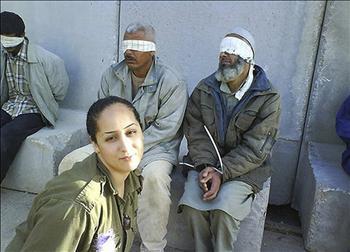
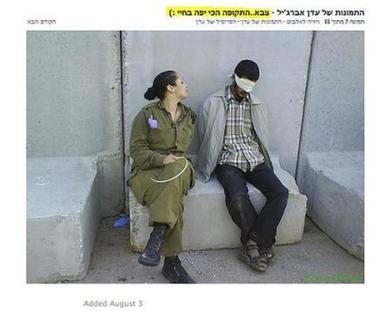
Eden Abergil, The Product Of A Blindfolded Society

Max Blumenthal

Eden Abergil during “the most beautiful time” of her life

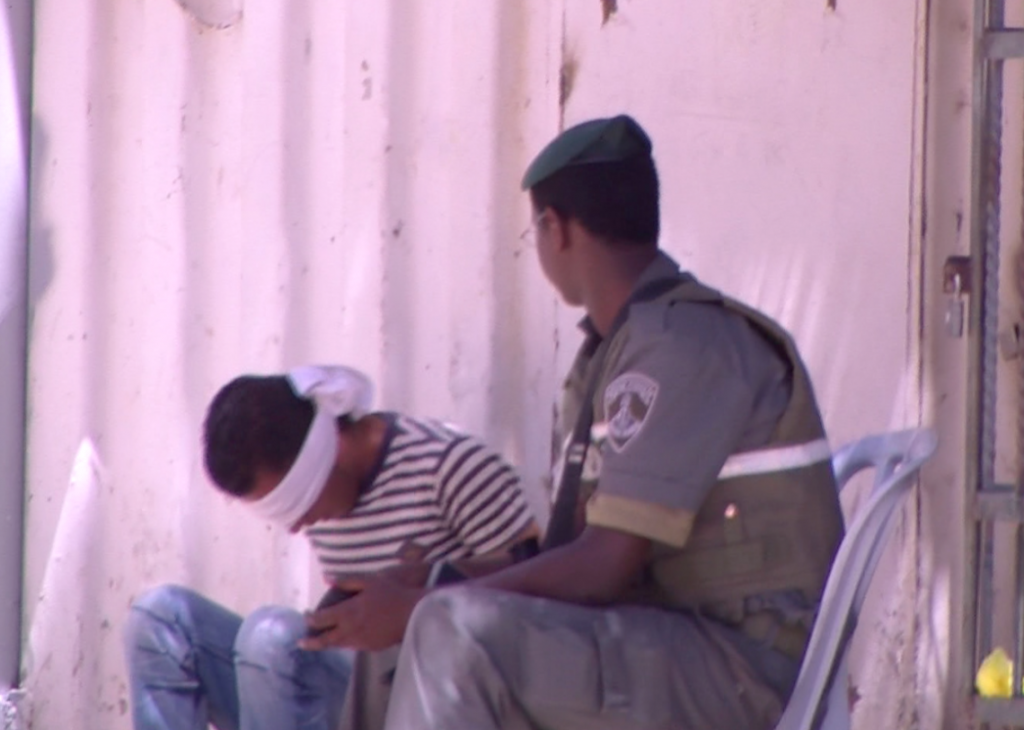
Is there anything shocking about the Facebook photos showing the Israeli female soldier Eden Abergil posing in mocking positions next to bound and blindfolded Palestinian men? While her conduct was abominable, I did not find it especially distinct from the documented behavior of Israeli soldiers and Border Police in the Occupied Territories.

Below is a photo I took in Hebron in June before soldiers demanded that I stop shooting (I will release video from Hebron as soon as I get the chance). Scenes like these can be witnessed on any given day in the West Bank. Not only do they show the dehumanization that the Palestinian Morlocks are subjected to on an hourly basis, they depict the world where Abergil spent what she called “the most beautiful time of [her] life.” It is easy to see how young Israelis (or anyone) would be sapped of their humanity in such an environment.

In July, I waited inside the cafeteria of Israel’s Guantanamo-like Ofer Prison after watching Ibrahim Amira, a leader of the Ni’ilin popular committee, be sentenced by a kangaroo court to six months in prison for the trumped-up charge of “incitement” (he was accused of paying kids to throw rocks at the Israeli soldiers who invade their village at least every week, as if they needed encouragement). While I stood at the counter to order a coffee, I watched four female jailers gather around a laptop to check their Facebook pages. I wondered what their status updates looked like. If they wrote anything relating to their work, would their Facebook pages look different than Abergil’s? Of course not. Just take a trip to Eyal Niv’s blog and look at some of the photos other young Israelis are posting.


I took this photo in Hebron in June before soldiers ordered me to stop shooting. A Palestinian man was being near the Ibrahimi mosque in Hebron.

You don’t have to go to the West Bank or into an Israeli prison to recognize that Abergil is a typical product of Israel’s comprehensively militarized society. Just watch the documentary, “To See When I’m Smiling.” In the film, which tells the soul-crushing stories of four young women conscripted into the Israeli Army, one of the characters recounts posing for a photo beside a dead Palestinian man who had an erection. She was smiling from ear to ear in the photo. However, at the end of the film, when she is compelled to look at the picture for the first time in two years, she does not recognize the monster who bears her image. Her contorted facial expression seems to ask, “Who was I?”

“To See When I’m Smiling” was produced by Breaking The Silence, a human rights group formed by ex-Israeli soldiers who collect testimonies from their peers. Incidentally, Breaking The Silence has published a 132-page booklet of testimonies by female soldiers (PDF here) who participated in acts at least as hideous as those depicted on Abergil’s Facebook page.

Here is Testimony 63, by a female sergeant from the Nahal Unit who served in Mevo Dotan:

I recall once, this was after we moved to Mevo Dotan, to the base there, some Palestinian was sitting on a chair and I passed by several times. Once I thought: Okay, why is he sitting here for an hour? I feel like spitting at him, at this Arab. And they tell me: Go one, spit at him. I don’t recall whether anyone did this before I did, but I remember spitting at him and feeling really, like at first I felt, wow, good for me, I just spat at some terrorist, that’s how I’d call them. And then I recall that afterwards I felt some thing here was not right.

Why?

Not too human. I mean, it sounds cool and all, but no, it’s not right.

You thought about later, or during the act?

Later. At the time you felt real cool.

Even when everyone was watching, you felt real cool.

Yes, and then sometimes you get to thinking, especially say on Holocaust Memorial Day, suddenly you’re thinking, hey, these thing were done to us, it’s a human being after all. Eventually as things turned out he was no terrorist anyway, it was a kid who’d hung around too long near the base, so he was caught or something.

A child?

An adolescent.

Slaps?

Yes.

Blindfolded and all?

Yes. I think that at some point no one even stood watch over him.

The female sergeant recalled the Holocaust when she reflected on her actions. If you are raised in a Jewish home, it is difficult not to see the ravages of the occupation in the light of the Holocaust, regardless of whether you know that the Israeli army’s violence bears little comparison to the exterminationism of the Nazis. Just as when I watched “To See When I’m Smiling,” Abergil’s photos made me think of Costa Gavras’ haunting Holocaust film, “Music Box.” If you have seen it, you will understand my reference. If not, rent it.

I also thought of the first stanza of “Vision,” a poem by the Palestinian writer Muhammad al-Qaisi. The poem reminded me not only of the Abergil’s public unmasking, but also of the many Israelis who told me about their experiences in the army as though they were describing some morally debased person they had never met:

I see the faces change their complexion

peel off their outer skin

I see the faces divested

of makeup and masks

and I see an empty stage

the spectators denying their own images

in the third act.

:: Article nr. 68902 sent on 17-aug-2010 11:18 ECT

www.uruknet.info?p=68902

FAMILIES AT RISK FROM ISRAELI DEMOLITION

Aseel Bseiso August 15, 2010 at 9:59am

Ninety-two people from the Palestinian village of Hmayyir, in the al-Farisiya area of the occupied West Bank, have had their homes demolished as the Israeli authorities continue with large-scale destruction there. On 5 August, 27 tents that people were living in and 10 other properties used for agricultural purposes were demolished. People are at risk across the West Bank.

Israel military officials returned to Hmayyir at around 7.30am on 5 August, using two bulldozers to flatten the area. The 27 tents destroyed were newly erected tents and had been donated to families by the International Committee for the Red Cross (ICRC) and the Palestinian Authority’s Ministry of Local Government as an emergency measure, after the Israeli army destroyed 74 properties, including family homes, on 19 July, affecting over 100 people, including 52 children. The destruction yesterday displaced a further 22 people, of whom 11 are children.

According to the latest figures from the UN Office for Coordination of Humanitarian Affairs (OCHA) in the Occupied Palestinian Territories, 135 people in total were affected by the demolitions on 19 July and 5 August.

Hmayyir lies within the 60 per cent of the West Bank designated as “Area C”, which is completely under Israeli control; Palestinians living there face destruction of their property and severe restrictions on building .

The latest demolitions reflect an extremely worrying trend in the Israeli government’s apparent policy to increase the destruction of property. According to OCHA, 550 Palestinians have lost their homes or sources of livelihood in recent weeks. More than two thirds of demolitions carried out in 2010 occurred in July alone.

Between the beginning of the year and end of July, according to UN statistics, 230 structures were demolished, affecting 1,122 people, of whom 410 are children. Only two days ago, the Israeli army demolished two brick structures used for livestock in ‘Azzun ‘Atma, in Qalqiliya, on grounds the family did not have permission to build.

On 29 July, the UN Human Rights Committee expressed concern at Israel’s “frequent administrative demolition of property, homes, as well as schools in the West Bank and East Jerusalem…” and called on Israel to “review its housing policy and issuance of construction permits with a view to implementing the principle of non-discrimination regarding minorities, in particular Palestinians…”

PLEASE WRITE IMMEDIATELY in Hebrew, English or your own language:
Calling on the authorities to place an immediate moratorium on house demolitions and forced evictions in the West Bank and to “review its housing policy and issuance of construction permits” in accordance with the UN Human Rights Committee’s recommendations;

Condemning the demolition of the homes in al-Farisiya and urging them to cease further destruction;

Calling for responsibility for planning and building regulations in the Jordan Valley to be placed solely with the local Palestinian communities.

PLEASE SEND APPEALS BEFORE 10 SEPTEMBER 2010 TO:

Minister of Defence
Ehud Barak
37 Kaplan Street, Hakirya
Tel Aviv 61909, Israel
Fax: +972 3 691 6940/696 2757
Email: minister@mod.gov.il

Salutation: Dear Minister

Military Judge Advocate General
Brigadier General Avihai Mandelblit
6 David Elazar Street
Hakirya, Tel Aviv, Israel
Fax: +972 3 569 4526/608 0366
Email: avimn@idf.gov.il

Salutation: Judge Advocate General

Four-year-old child begging Israeli forces to release his father

By Zuheir Al-Shaer

August 3, 2010

BETHLEHEM (Ma’an) — Video footage of a four-year-old child begging Israeli forces to release his father from detention on Monday has circulated the globe.

“You dog, give me my dad. I want daddy. I want daddy. Give me my dad,” cried Khalid Fadel Al-Ja’bari, as Israeli border guards detained his father Fadel, 36 in the Al-Baq’a village east of Hebron, where Israel’s Civil Administration began destroying what it described as an illegal water irrigation network. At the time, a spokesman denied forces overturned land.

Badran Jaber, the child’s grandfather, told Ma’an his son-in-law was detained after objecting to Israeli bulldozers overturning fields planted with vegetables near the illegal Kiryat Arba settlement.

“The heart of the soldiers is harder than the rock. The screams of the child did not stop them from attacking his father, but they kicked the child and pulled his hands which were holding his father’s shirt,” said the grandfather. Khaled, he said, has not slept since his father was detained.

The grandfather said border guards have repeatedly prevented him and other residents from accessing the 30 dunums of land, of which 18 belong to him, by deploying riot dispersal means.

Jaber, a leader of the leftist Popular Front for the Liberation of Palestine, said Israel’s Civil Administration, accompanied by border guards, began destroying the irrigation network on his farmland at 9a.m. He said residents and relatives tried to stop forces, but were assaulted.

“When my 15-year-old son Wadi and my son-in-law … Fadel, tried to defend myself and my wife, Israeli soldiers beat them before detaining them,” Jaber told Ma’an at the time.

A spokesman for Israel’s Civil Administration said Monday inspectors destroyed pipes that were illegally set up and stealing water from other sources. He said no farmland was destroyed in the process.

At the time, Locals in Hebron confirmed seeing Israeli bulldozers overturn vast areas of farmland.

http://www.uruknet.info?p=68546

Bridge Experience

This is a short 10 minute rushed video account of over 12 hours on the bridge crossing from Jordan to occupied Palestine on 29 July 2010. Dr. Mazin Qumsiyeh, professor at Bethlehem University, explains what happened to him, not an unusual experience under occupation. He was finally released but with an order to appear before yet another colonial apartheid officer (a Captain Leor) on 9 August 2010. You can stay tuned and connect with Dr. Qumsiyeh via his website http://qumsiyeh.org.

Live Video of Ethnic cleansing in the Israeli?? Negev

Neve Gordon writes in The Guardian about arriving in the Bedouin village of al-Arakib as Israeli bulldozers finish razing it to the ground:

The signs of destruction were immediately evident. I first noticed the chickens and geese running loose near a bulldozed house, and then saw another house and then another one, all of them in rubble. A few children were trying to find a shaded spot to hide from the scorching desert sun, while behind them a stream of black smoke rose from the burning hay. The sheep, goats and the cattle were nowhere to be seen – perhaps because the police had confiscated them.

Scores of Bedouin men were standing on a yellow hill, sharing their experiences from the early morning hours, while all around them uprooted olive trees lay on the ground. A whole village comprising between 40 and 45 houses had been completely razed in less than three hours.

I suddenly experienced deja vu: an image of myself walking in the rubbles of a destroyed village somewhere on the outskirts of the Lebanese city of Sidon emerged. It was over 25 years ago, during my service in the Israeli paratroopers. But in Lebanon the residents had all fled long before my platoon came, and we simply walked in the debris. There was something surreal about the experience, which prevented me from fully understanding its significance for several years. At the time, it felt like I was walking on the moon.

This time the impact of the destruction sank in immediately. Perhaps because the 300 people who resided in al-Arakib, including their children, were sitting in the rubble when I arrived, and their anguish was evident; or perhaps because the village is located only 10 minutes from my home in Be’er Sheva and I drive past it every time I go to Tel Aviv or Jerusalem; or perhaps because the Bedouins are Israeli citizens, and I suddenly understood how far the state is ready to go to accomplish its objective of Judaising the Negev region; what I witnessed was, after all, an act of ethnic cleansing.

Here is another video that was posted on Promised Land:

And here are some amazing images from Activestills

source

Busloads of civilians cheer as Israelis uproot Bedouin village of 200

Mondoweiss

by Philip Weiss on July 27, 2010 · 44 comments

News reports confirm the report we ran last night of Israel’s bulldozing of a Bedouin village in the Negev, uprooting 40 families, 200 people, to make way for what–a forest created with the auspices of the Jewish National Fund? Here’s the shocking report from CNN–shades of the cheering for the war on Gaza:

Witnesses told CNN that the Israeli forces arrived at the village accompanied by busloads of civilians who cheered as the dwellings were demolished. They said armed police deployed with tear gas, water cannon, two helicopters and bulldozers.

Below is a press release from several groups speaking on behalf of the village, which it says was 300 people, and passing along a horrific quote from Netanyahu– that in Sunday’s Cabinet meeting, he sounded a warning about “a situation in which a demand for national rights will be made from some quarters inside Israel, for example in the Negev, should the area be left without a Jewish majority. Such things happened in the Balkans, and it is a real threat.” I can’t find that quote online. I do see that Netanyahu described non-Jewish immigration as a “concrete threat.”

Al Arakib Popular Committee – Negev Coexistence Forum for Civil Equality – Recognition Forum – Tarabut – Gush Shalom Press Release

July 27, 2010

Early this morning police raided the unrecognized Bedouin village of al-Arakib in the Negev, destroyed all 40 of its houses, and evicted more than 300 residents. The residents, mostly children, were left homeless.

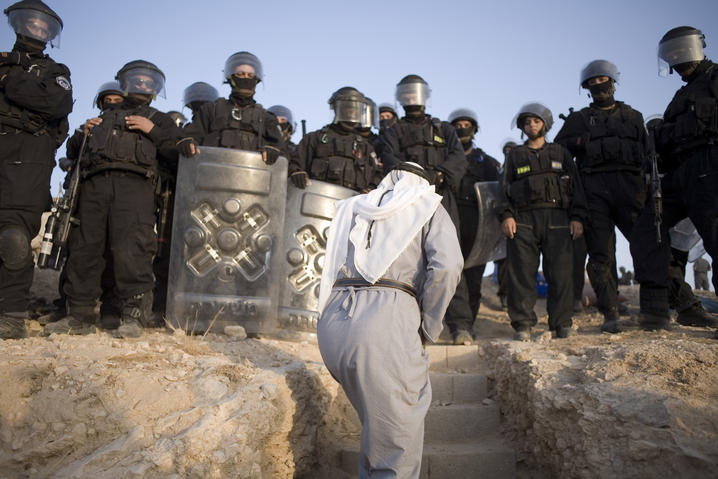
The unprecedented raid began at about 4:30 in the morning, residents were surprised to wake up surrounded by a huge force of 1,500 police with guns, stun grenades, helmets and shields, including hundreds of Special Riot Police (Yasam) as well as mounted police, helicopters and bulldozers.

At the residents’ call, dozens of left-wing activists and volunteers arrived from all over the country, helping them to offer non-violent resistance. Several residents were bruised and beaten by police, though not needing medical attention. One woman demonstrator was detained by the police.

The police removed the residents’ property into prepared containers, and bulldozers demolished the residential buildings and sheepfolds and destroyed the residents’ fruit orchards and olive tree groves. The villagers, mostly children and old people, were left stunned near the destroyed village, shelterless and waterless under the blazing sun.

The destruction of the village was carried out despite dispute over ownership of the land still pending in the courts. Residents of al-Arakib are neither squatters nor invaders: their village has existed many years before the creation of Israel in 1948. Residents had been evicted by the state in 1951, but returned to the land on which they live and which they cultivate. Ownership of the land is now the subject of proceedings in the Be’er Sheva District Court, where academic researchers have already testified in confirmation of the residents’ ownership right in the land.

The destruction’s declared aim is to facilitate plans by the Jewish National Fund to plant a wood on the site. We regard this demolition as a criminal act. Bedouin citizens of Israel are not enemies, and forestation of the Negev is not a reasonable pretext for destroying a community which is more than 60 years old, dispossessing its residents, and violating the basic rights of hundreds of Israeli civilians, men, women and children. This act by the state authorities is no “law enforcement” – it is a act of war, such as is undertaken against an enemy.

This act cannot be dissociated from yesterday’s statement by Prime Minister Netanyahu, who at the cabinet meeting sounded a warning about “a situation in which a demand for national rights will be made from some quarters inside Israel, for example in the Negev, should the area be left without a Jewish majority. Such things happened in the Balkans, and it is a real threat.”

Presenting the Bedouin citizens of Israel as “a real threat” gives legitimacy to the expulsion of Israel’s Bedouin citizens from the Negev in order to “Judaize” it. We call on all who care for democracy to give their support to this threatened community.

http://mondoweiss.net/2010/07/report-bedouin-village-was-uprooted-after-netanyahu-described-non-jews-in-negev-as-real-threat-to-israels-character.html

Israel’s Fingerprints Surface

The Hariri Assassination

By RANNIE AMIRI

In the Middle East, the link between political machinations, espionage and assassination is either clear as day, or clear as mud.

As for the yet unsolved case of the February 2005 murder of Lebanese Prime Minister Rafiq Hariri, mud might be giving way to daylight.

A crackdown on Israeli spy rings operating in Lebanon has resulted in more than 70 arrests over the past 18 months. Included among them are four high-ranking Lebanese Army and General Security officers—one having spied for the Mossad since 1984.

A significant breakthrough in the ongoing investigation occurred in late June and culminated in the arrest of Charbel Qazzi, head of transmission and broadcasting at Alfa, one of Lebanon’s two state-owned mobile service providers.

According to the Lebanese daily As-Safir, Qazzi confessed to installing computer programs and planting electronic chips in Alfa transmitters. These could then be used by Israeli intelligence to monitor communications, locate and target individuals for assassination, and potentially deploy viruses capable of erasing recorded information in the contact lines. Qazzi’s collaboration with Israel reportedly dates back 14 years.

On July 12, a second arrest at Alfa was made. Tarek al-Raba’a, an engineer and partner of Qazzi, was apprehended on charges of spying for Israel and compromising national security. A few days later, a third Alfa employee was similarly detained.

Israel has refused to comment on the arrests. Nevertheless, their apparent ability to have penetrated Lebanon’s military and telecommunication sectors has rattled the country and urgently raised security concerns.

What does any of this have to do with the Hariri assassination?

Outside the obvious deleterious ramifications of high-ranking Lebanese military officers working for Israel, the very legitimacy of the Special Tribunal for Lebanon (STL) is now in question. The STL is the U.N.-sanctioned body tasked with prosecuting those responsible for the assassination of the late prime minister. On Feb. 14, 2005, 1,000 kg of explosives detonated near Hariri’s passing motorcade, killing him and 21 others.

It is believed the STL will issue indictments in the matter as early as September—relying heavily on phone recordings and mobile transmissions to do so.

According to the AFP, “A preliminary report by the U.N. investigating team said it had collected data from mobile phone calls made the day of Hariri’s murder as evidence.”

The National likewise reported, “The international inquiry, which could present indictments or findings as soon as September, according to unverified media reports, used extensive phone records to draw conclusions into a conspiracy to kill Hariri, widely blamed on Syria and its Lebanese allies …”

In a July 16 televised speech, Hezbollah Secretary-General Sayyid Hassan Nasrallah speculated the STL would use information gleaned from Israeli-compromised communications to falsely implicate the group in the prime minister’s murder:

“Some are counting in their analysis of the (STL) indictment on witnesses, some of whom turned out to be fake, and on the telecommunications networks which were infiltrated by spies who can change and manipulate data.

“Before the (2006) war, these spies gave important information to the Israeli enemy and based on this information, Israel bombed buildings, homes, factories and institutions. Many martyrs died and many others were wounded. These spies are partners in the killings, the crimes, the threats and the displacement.”

Nasrallah called the STL’s manipulation an “Israeli project” meant to “create an uproar in Lebanon.”

Indeed, in May 2008 Lebanon experienced a taste of this. At the height of an 18-month stalemate over the formation of a national unity government under then Prime Minister Fouad Siniora, his cabinet’s decision to unilaterally declare Hezbollah’s fixed-line communication system illegal pushed the country to the brink of civil war.

Recognizing the value their secure lines of communication had in combating the July 2006 Israeli invasion and suspecting that state-owned telecoms might be compromised, Hezbollah resisted Siniora’s plans to have its network dismantled. Their men swept through West Beirut and put a quick end to the government’s plan. Two years later, their suspicions appear to have been vindicated.

Opposition MP and Free Patriotic Movement head Michel Aoun has already warned Nasrallah that the STL will likely indict “uncontrolled” Hezbollah members to be followed by “… Lebanese-Lebanese and Lebanese-Palestinian tension, and by an Israeli war on Lebanon.”

Giving credence to Nasrallah and Aoun’s assertions, Commander in Chief of the Israel Defense Forces Gabi Ashkenazi, predicted “with lots of wishes” that the situation in Lebanon would deteriorate in September after the STL indicts Hezbollah for Hariri’s assassination.

Ashkenazi’s gleeful, prescient testimony to the Knesset’s Foreign Affairs Committee betrays what Israel hopes the fallout from the STL’s report will be: fomentation of civil strife and discord among Lebanon’s sectarian groups, generally divided into pro- and anti-Syria factions. Ashkenazi anticipates this to happen, of course, because he knows Israel’s unfettered access to critical phone records will have framed Hezbollah for the crime.

Israel’s agents and operatives in Lebanon and its infiltration of a telecom network have been exposed. At the very least, the STL must recognize that evidence of alleged Hezbollah involvement in Hariri’s death (a group that historically enjoyed good ties with the late premier) is wholly tainted and likely doctored.

The arrest of Qazzi and al-Raba’a in the breakup of Israeli spy rings should prompt the STL to shift its focus to the only regional player that has benefited from Hariri’s murder; one that will continue to do so if and when their designs to implicate Hezbollah are realized.

It is time to look at Tel Aviv.

Rannie Amiri is an independent Middle East commentator. He may be reached at: rbamiri [at] yahoo [dot] com.

source

Saber Kushour: ‘My conviction for “rape by deception” has ruined my life’

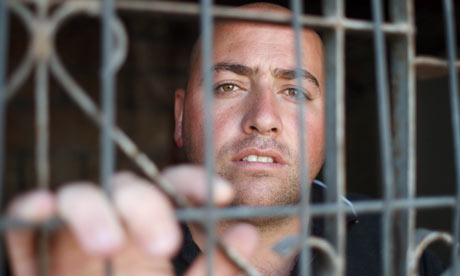
Saber Kushour insists the partner of his casual sexual encounter was willing and never showed any interest in his background. Photograph: Emil Salman /Haaretz

Saber Kushour apologises as he asks his guests to move the plastic chairs on his breeze-block balcony a little closer to the door to his house. If he were to sit where they are now, he explains, the electronic tag attached to his ankle would set off an alarm.

Kushour’s edginess is understandable – he is recalling a 15-minute encounter almost two years ago which he says “has destroyed my life”.

Last week the married father of two from east Jerusalem was sentenced to 18 months in jail for the “rape by deception” of a Jewish woman who claimed she would not have had sex with him had she known he was an Arab. What might have been a tawdry episode – casting neither Kushour nor the woman in a favourable light – exploded into a debate in Israel about racism, sexual mores and justice.

“I am paying the price for a mistake that she made,” Kushour, 30, told the Observer. “I was shocked at the sentence – it shows a very vivid and clear racism.” The message from the judge, he says, was that “because you are an Arab and you didn’t make that clear, we are going to punish you”.

In his verdict, Judge Zvi Segal conceded that it was not “a classical rape by force”. He added: “If she hadn’t thought the accused was a Jewish bachelor interested in a serious romantic relationship, she would not have co-operated. The court is obliged to protect the public interest from sophisticated, smooth-tongued criminals who can deceive innocent victims at an unbearable price – the sanctity of their bodies and souls.”

At his home in Sharafat, where he is confined while awaiting an appeal, Kushour tells a different story. The woman has not been identified and has not gone public with her account.

Kushour was buying cigarettes in September 2008 when an unexpected opportunity presented itself for a casual sexual encounter. “Any person in my shoes would have done the same thing,” he says.

A woman in her 20s struck up a conversation as he left the shop to return to his job delivering legal papers around Jerusalem by scooter. “She said ‘you have a nice bike’ and other things which I don’t remember.” Within minutes, he says, he realised that her interest was not confined to small talk.

Kushour speaks fluent, unaccented Hebrew, as do many Palestinians living and working in Jerusalem. The woman asked his name and Kushour replied “Dudu” – a common Israeli name. “Since I was a kid everyone calls me Dudu – even my wife calls me Dudu. It’s a nickname.” At no point, he says, did the woman – who gave her name as Maya – ask if he was Jewish, although he has acknowledged that he said he was single.

The pair went to a small roof area in a nearby office block. “When we were having sex, she was worried that someone would see us, but she never told me to stop. She was more than willing – she initiated it.”

It has been suggested that Kushour presented himself as a bachelor interested in a long-term relationship. If that had been Maya’s concern, Kushour points out, she might have asked him more about his background. After the brief encounter, Kushour tapped Maya’s mobile number into his phone and left. “I didn’t treat her like garbage – this is what she wanted.”

Unknown to him, Maya contacted the police after the encounter to lodge a complaint. Kushour says he doesn’t know how or when she realised he was not Jewish. The woman was given a medical examination, presented in court, which showed, according to Kushour, no signs of force or injury.

Six weeks later Kushour was idly flicking through numbers in his mobile’s address book. “I saw ‘Maya’ and I thought ‘who is Maya?’ I had already forgotten about her. I rang the number to see who it was, and then I realised it was the girl. I said ‘Can I see you?’ and we arranged to meet.”

Maya didn’t show up and didn’t respond to Kushour’s calls and texts. But, crucially, she now had a vital piece of information for the pursuit of her complaint – his contact details.

Three days later Kushour received a phone call from the police. “They told me I had a problem and to come to the police station.” He was interrogated for five to six hours, without a lawyer.

In the final hour of questioning, the police began to mention a rape claim. Eventually Kushour was handcuffed and taken to a cell. Over three days the questioning continued. “This was the hardest moment of my entire life,” says Kushour. “I didn’t have a clue what they were going to do.” On the third day, Kushour was taken to court – by this time represented by a lawyer found by his brother – and charged with rape. He spent the next two months in prison and since then has been electronically tagged and confined to his home. The case came to court last week. His lawyer has told him that, because of the publicity surrounding the case, the appeal may be expedited. In the meantime, says Kushour, “I can’t leave the house, I can’t work, I can’t feed my children.”

Kushour’s conviction has transfixed Israel. Some see echoes of a primeval – and racist – instinct to protect “our” women against outside marauders. Others are outraged at what they see as a blatant injustice, pointing to a backdrop of widespread, systematic and – some say – growing discrimination against Arabs who make up 20% of Israel’s population.

“This is a most amazing decision by the court,” says Tamar Hermann of the Israel Democracy Institute. “Deception is one thing – but to be convicted of rape?” It has, she says, “struck a sensitive chord in the Israeli mainstream of Arabs pretending to be Jews.”

The issue of identity is paramount in a land where both communities regard each other with suspicion and hostility.

Yuval Yonay, a sociology professor at Haifa University, in one of Israel’s few mixed cities, says Kushour’s behaviour “might be improper but it is not rape”.

He says that in 16 years of teaching at a university where 20-25% of the student population is Arab, he has “never even heard of a mixed relationship”. Discrimination against Arabs is, he says, evident at all levels.

Some have defended the verdict. “We all have different characteristics, and it is a person’s right to have sexual relations with a person knowing the facts about those characteristics,” Dana Pugach of the Noga Centre for Victims of Crime told the Israeli daily Haaretz.

Kushour says he has had a lot of support over the past week from Israeli Jews. “The problem is not with the people themselves, but those in power,” he says. “I just want justice.”

Whatever the outcome of his appeal, his brief encounter with Maya has turned his life upside down. His relationship with his wife has been severely tested. “I asked her last night to forgive me. She said yes, but I can see the pain and hurt in her eyes.”

Blog at WordPress.com.

Up ↑