Search

band annie's Weblog

I have a parallel blog in French at http://anniebannie.net

Category

abuses

‘I’m bored, so I shoot’: The Israeli army’s approval of free-for-all violence in Gaza

Israeli soldiers describe the near-total absence of firing regulations in the Gaza war, with troops shooting as they please, setting homes ablaze, and leaving corpses on the streets — all with their commanders’ permission.

source

Oren ZivByOren ZivJuly 8, 2024

In partnership with

In early June, Al Jazeera aired a series of disturbing videos revealing what it described as “summary executions”: Israeli soldiers shooting dead several Palestinians walking near the coastal road in the Gaza Strip, on three separate occasions. In each case, the Palestinians appeared unarmed and did not pose any imminent threat to the soldiers.

Such footage is rare, due to the severe constraints faced by journalists in the besieged enclave and the constant danger to their lives. But these executions, which did not appear to have any security rationale, are consistent with the testimonies of six Israeli soldiers who spoke to +972 Magazine and Local Call following their release from active duty in Gaza in recent months. Corroborating the testimonies of Palestinian eyewitnesses and doctors throughout the war, the soldiers described being authorized to open fire on Palestinians virtually at will, including civilians.

The six sources — all except one of whom spoke on the condition of anonymity — recounted how Israeli soldiers routinely executed Palestinian civilians simply because they entered an area that the military defined as a “no-go zone.” The testimonies paint a picture of a landscape littered with civilian corpses, which are left to rot or be eaten by stray animals; the army only hides them from view ahead of the arrival of international aid convoys, so that “images of people in advanced stages of decay don’t come out.” Two of the soldiers also testified to a systematic policy of setting Palestinian homes on fire after occupying them.

Several sources described how the ability to shoot without restrictions gave soldiers a way to blow off steam or relieve the dullness of their daily routine. “People want to experience the event [fully],” S., a reservist who served in northern Gaza, recalled. “I personally fired a few bullets for no reason, into the sea or at the sidewalk or an abandoned building. They report it as ‘normal fire,’ which is a codename for ‘I’m bored, so I shoot.’”

Since the 1980s, the Israeli military has refused to disclose its open-fire regulations, despite various petitions to the High Court of Justice. According to political sociologist Yagil Levy, since the Second Intifada, “the army has not given soldiers written rules of engagement,” leaving much open to the interpretation of soldiers in the field and their commanders. As well as contributing to the killing of over 38,000 Palestinians, sources testified that these lax directives were also partly responsible for the high number of soldiers killed by friendly fire in recent months.

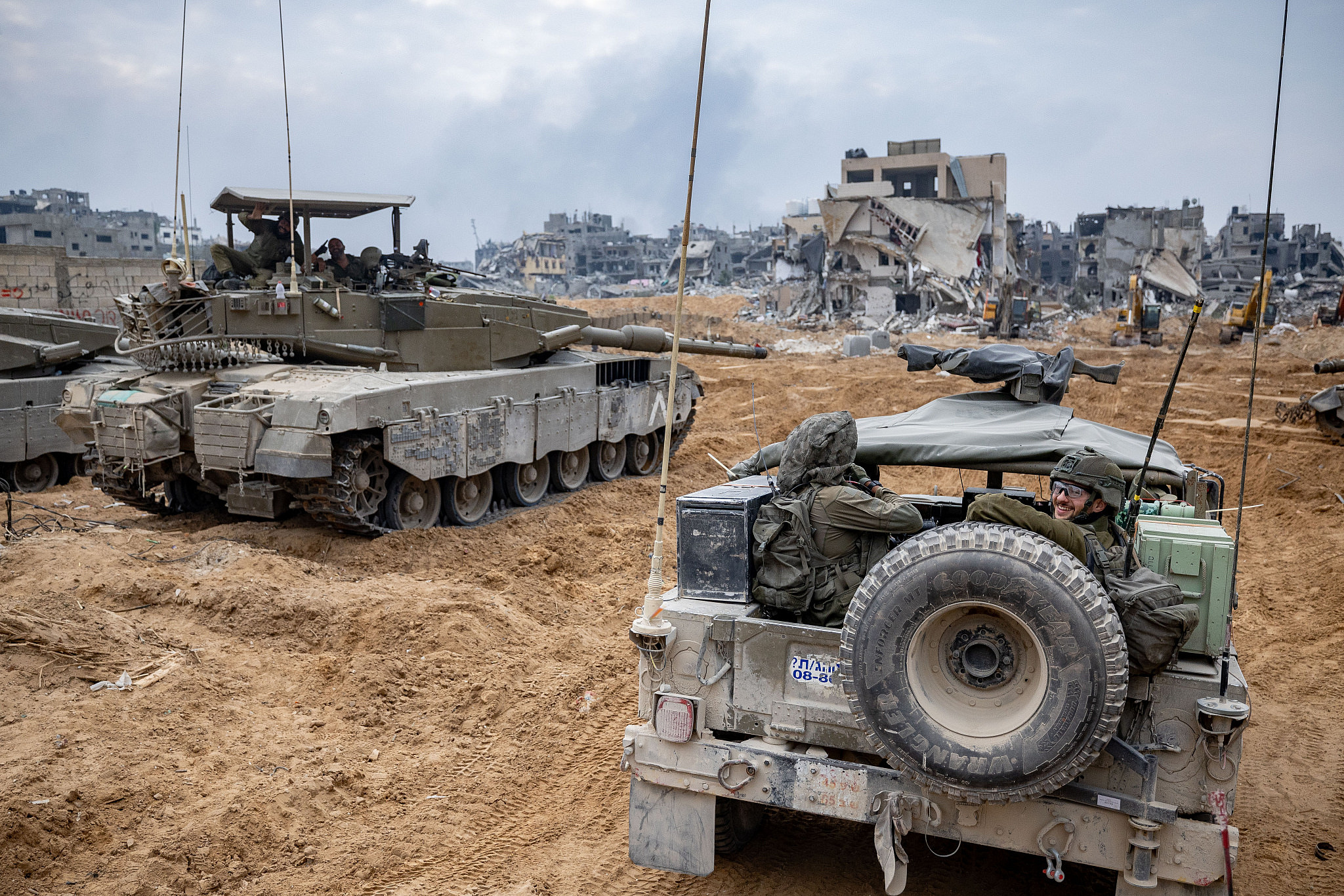
Israeli soldiers from the 8717 Battalion of the Givati Brigade operating in Beit Lahia, in the northern Gaza Strip, during a military operation, December 28, 2023. (Yonatan Sindel/Flash90)

“There was total freedom of action,” said B., another soldier who served in the regular forces in Gaza for months, including in his battalion’s command center. “If there is [even] a feeling of threat, there is no need to explain — you just shoot.” When soldiers see someone approaching, “it is permissible to shoot at their center of mass [their body], not into the air,” B. continued. “It’s permissible to shoot everyone, a young girl, an old woman.”

B. went on to describe an incident in November when soldiers killed several civilians during the evacuation of a school close to the Zeitoun neighborhood of Gaza City, which had served as a shelter for displaced Palestinians. The army ordered the evacuees to exit to the left, toward the sea, rather than to the right, where the soldiers were stationed. When a gunfight erupted inside the school, those who veered the wrong way in the ensuing chaos were immediately fired at.

“There was intelligence that Hamas wanted to create panic,” B. said. “A battle started inside; people ran away. Some fled left toward the sea, [but] some ran to the right, including children. Everyone who went to the right was killed — 15 to 20 people. There was a pile of bodies.”

‘People shot as they pleased, with all their might’

B. said that it was difficult to distinguish civilians from combatants in Gaza, claiming that members of Hamas often “walk around without their weapons.” But as a result, “every man between the ages of 16 and 50 is suspected of being a terrorist.”

“It is forbidden to walk around, and everyone who is outside is suspicious,” B. continued. “If we see someone in a window looking at us, he is a suspect. You shoot. The [army’s] perception is that any contact [with the population] endangers the forces, and a situation must be created in which it is forbidden to approach [the soldiers] under any circumstances. [The Palestinians] learned that when we enter, they run away.”

Even in seemingly unpopulated or abandoned areas of Gaza, soldiers engaged in extensive shooting in a procedure known as “demonstrating presence.” S. testified that his fellow soldiers would “shoot a lot, even for no reason — anyone who wants to shoot, no matter what the reason, shoots.” In some cases, he noted, this was “intended to … remove people [from their hiding places] or to demonstrate presence.”

M., another reservist who served in the Gaza Strip, explained that such orders would come directly from the commanders of the company or battalion in the field. “When there are no [other] IDF forces [in the area] … the shooting is very unrestricted, like crazy. And not just small arms: machine guns, tanks, and mortars.”

Even in the absence of orders from above, M. testified that soldiers in the field regularly take the law into their own hands. “Regular soldiers, junior officers, battalion commanders — the junior ranks who want to shoot, they get permission.”

S. remembered hearing over the radio about a soldier stationed in a protective compound who shot a Palestinian family walking around nearby. “At first, they say ‘four people.’ It turns into two children plus two adults, and by the end it’s a man, a woman, and two children. You can assemble the picture yourself.”

Only one of the soldiers interviewed for this investigation was willing to be identified by name: Yuval Green, a 26-year-old reservist from Jerusalem who served in the 55th Paratroopers Brigade in November and December last year (Green recently signed a letter by 41 reservists declaring their refusal to continue serving in Gaza, following the army’s invasion of Rafah). “There were no restrictions on ammunition,” Green told +972 and Local Call. “People were shooting just to relieve the boredom.”

Green described an incident that occurred one night during the Jewish festival of Hanukkah in December, when “the whole battalion opened fire together like fireworks, including tracer ammunition [which generates a bright light]. It made a crazy color, illuminating the sky, and because [Hannukah] is the ‘festival of lights,’ it became symbolic.”

Israeli soldiers from the 8717 Battalion of the Givati Brigade operating in Beit Lahia, northern Gaza Strip, December 28, 2023. (Yonatan Sindel/Flash90)

C., another soldier who served in Gaza, explained that when soldiers heard gunshots, they radioed in to clarify whether there was another Israeli military unit in the area, and if not, they opened fire. “People shot as they pleased, with all their might.” But as C. noted, unrestricted shooting meant that soldiers are often exposed to the huge risk of friendly fire — which he described as “more dangerous than Hamas.” “On multiple occasions, IDF forces fired in our direction. We didn’t respond, we checked on the radio, and no one was hurt.” 

At the time of writing, 324 Israeli soldiers have been killed in Gaza since the ground invasion began, at least 28 of them by friendly fire according to the army. In Green’s experience, such incidents were the “main issue” endangering soldiers’ lives. “There was quite a bit [of friendly fire]; it drove me crazy,” he said. 

For Green, the rules of engagement also demonstrated a deep indifference to the fate of the hostages. “They told me about a practice of blowing up tunnels, and I thought to myself that if there were hostages [in them], it would kill them.” After Israeli soldiers in Shuja’iyya killed three hostages waving white flags in December, thinking they were Palestinians, Green said he was angry, but was told “there’s nothing we can do.” “[The commanders] sharpened procedures, saying ‘You have to pay attention and be sensitive, but we are in a combat zone, and we have to be alert.’”

B. confirmed that even after the mishap in Shuja’iyya, which was said to be “contrary to the orders” of the military, the open-fire regulations did not change. “As for the hostages, we didn’t have a specific directive,” he recalled. “[The army’s top brass] said that after the shooting of the hostages, they briefed [soldiers in the field]. [But] they didn’t talk to us.” He and the soldiers who were with him heard about the shooting of the hostages only two and a half weeks after the incident, after they left Gaza.

“I’ve heard statements [from other soldiers] that the hostages are dead, they don’t stand a chance, they have to be abandoned,” Green noted. “[This] bothered me the most … that they kept saying, ‘We’re here for the hostages,’ but it is clear that the war harms the hostages. That was my thought then; today it turned out to be true.”

Israeli soldiers from the 8717 Battalion of the Givati Brigade operating in Beit Lahia, in the northern Gaza Strip, December 28, 2023. (Yonatan Sindel/Flash90)

‘A building comes down, and the feeling is, “Wow, what fun”’

A., an officer who served in the army’s Operations Directorate, testified that his brigade’s operations room — which coordinates the fighting from outside Gaza, approving targets and preventing friendly fire — did not receive clear open-fire orders to transmit to soldiers on the ground. “From the moment you enter, at no point is there a briefing,” he said. “We didn’t receive instructions from higher up to pass on to the soldiers and battalion commanders.” 

He noted that there were instructions not to shoot along humanitarian routes, but elsewhere, “you fill in the blanks, in the absence of any other directive. This is the approach: ‘If it is forbidden there, then it is permitted here.’”

A. explained that shooting at “hospitals, clinics, schools, religious institutions, [and] buildings of international organizations” required higher authorization. But in practice, “I can count on one hand the cases where we were told not to shoot. Even with sensitive things like schools, [approval] feels like only a formality.”

In general, A. continued, “the spirit in the operations room was ‘Shoot first, ask questions later.’ That was the consensus … No one will shed a tear if we flatten a house when there was no need, or if we shoot someone who we didn’t have to.” 

A. said he was aware of cases in which Israeli soldiers shot Palestinian civilians who entered their area of operation, consistent with a Haaretz investigation into “kill zones” in areas of Gaza under the army’s occupation. “This is the default. No civilians are supposed to be in the area, that’s the perspective. We spotted someone in a window, so they fired and killed him.” A. added that it often was not clear from the reports whether soldiers had shot militants or unarmed civilians — and “many times, it sounded like someone was caught up in a situation, and we opened fire.”

But this ambiguity about the identity of victims meant that, for A., military reports about the numbers of Hamas members killed could not be trusted. “The feeling in the war room, and this is a softened version, was that every person we killed, we counted him as a terrorist,” he testified.

“The aim was to count how many [terrorists] we killed today,” A. continued. “Every [soldier] wants to show that he’s the big guy. The perception was that all the men were terrorists. Sometimes a commander would suddenly ask for numbers, and then the officer of the division would run from brigade to brigade going through the list in the military’s computer system and count.”

A.’s testimony is consistent with a recent report from the Israeli outlet Mako, about a drone strike by one brigade that killed Palestinians in another brigade’s area of operation. Officers from both brigades consulted on which one should register the assassinations. “What difference does it make? Register it to both of us,” one of them told the other, according to the publication.

During the first weeks after the Hamas-led October 7 attack, A. recalled, “people were feeling very guilty that this happened on our watch,” a feeling that was shared among the Israeli public writ large — and quickly transformed into a desire for retribution. “There was no direct order to take revenge,” A. said, “but when you reach decision junctures, the instructions, orders, and protocols [regarding ‘sensitive’ cases] only have so much influence.”

When drones would livestream footage of attacks in Gaza, “there were cheers of joy in the war room,” A. said. “Every once in a while, a building comes down … and the feeling is, ‘Wow, how crazy, what fun.’”

Palestinians at the site of a mosque destroyed in an Israeli airstrike, near the Shaboura refugee camp in Rafah, southern Gaza Strip, April 26, 2024. (Abed Rahim Khatib/Flash90)

A. noted the irony that part of what motivated Israelis’ calls for revenge was the belief that Palestinians in Gaza rejoiced in the death and destruction of October 7. To justify abandoning the distinction between civilians and combatants, people would resort to such statements as “‘They handed out sweets,’ ‘They danced after October 7,’ or ‘They elected Hamas’ … Not everyone, but also quite a few, thought that today’s child [is] tomorrow’s terrorist.

“I, too, a rather left-wing soldier, forget very quickly that these are real homes [in Gaza],” A. said of his experience in the operations room. “It felt like a computer game. Only after two weeks did I realize that these are [actual] buildings that are falling: if there are inhabitants [inside], then [the buildings are collapsing] on their heads, and even if not, then with everything inside them.”

‘A horrific smell of death’

Multiple soldiers testified that the permissive shooting policy has enabled Israeli units to kill Palestinian civilians even when they are identified as such beforehand. D., a reservist, said that his brigade was stationed next to two so-called “humanitarian” travel corridors, one for aid organizations and one for civilians fleeing from the north to the south of the Strip. Within his brigade’s area of operation, they instituted a “red line, green line” policy, delineating zones where it was forbidden for civilians to enter.

According to D., aid organizations were permitted to travel into these zones with prior coordination (our interview was conducted before a series of Israeli precision strikes killed seven World Central Kitchen employees), but for Palestinians it was different. “Anyone who crossed into the green area would become a potential target,” D. said, claiming that these areas were signposted to civilians. “If they cross the red line, you report it on the radio and you don’t need to wait for permission, you can shoot.”

Yet D. said that civilians often came into areas where aid convoys passed through in order to look for scraps that might fall from the trucks; nonetheless, the policy was to shoot anyone who tried to enter. “The civilians are clearly refugees, they are desperate, they have nothing,” he said. Yet in the early months of the war, “every day there were two or three incidents with innocent people or [people] who were suspected of being sent by Hamas as spotters,” whom soldiers in his battalion shot.

The soldiers testified that throughout Gaza, corpses of Palestinians in civilian clothes remained scattered along roads and open ground. “The whole area was full of bodies,” said S., a reservist. “There are also dogs, cows, and horses that survived the bombings and have nowhere to go. We can’t feed them, and we don’t want them to get too close either. So, you occasionally see dogs walking around with rotting body parts. There is a horrific smell of death.”

Rubbles of houses destroyed by Israeli airstrikes in the Jabalia area in the northern Gaza Strip, October 11, 2023. (Atia Mohammed/Flash90)

But before the humanitarian convoys arrive, S. noted, the bodies are removed. “A D-9 [Caterpillar bulldozer] goes down, with a tank, and clears the area of corpses, buries them under the rubble, and flips [them] aside so that the convoys don’t see it — [so that] images of people in advanced stages of decay don’t come out,” he described. 

“I saw a lot of [Palestinian] civilians – families, women, children,” S. continued. “There are more fatalities than are reported. We were in a small area. Every day, at least one or two [civilians] are killed [because] they walked in a no-go area. I don’t know who is a terrorist and who is not, but most of them did not carry weapons.”

Green said that when he arrived in Khan Younis at the end of December, “We saw some indistinct mass outside a house. We realized it was a body; we saw a leg. At night, cats ate it. Then someone came and moved it.” 

A non-military source who spoke to +972 and Local Call after visiting northern Gaza also reported seeing bodies strewn around the area. “Near the army compound between the northern and southern Gaza Strip, we saw about 10 bodies shot in the head, apparently by a sniper, [seemingly while] trying to return to the north,” he said. “The bodies were decomposing; there were dogs and cats around them.”

“They don’t deal with the bodies,” B. said of the Israeli soldiers in Gaza. “If they’re in the way, they get moved to the side. There’s no burial of the dead. Soldiers stepped on bodies by mistake.”

Last month, Guy Zaken, a soldier who operated D-9 bulldozers in Gaza, testified before a Knesset committee that he and his crew “ran over hundreds of terrorists, dead and alive.” Another soldier he served with subsequently committed suicide.

‘Before you leave, you burn down the house’

Two of the soldiers interviewed for this article also described how burning Palestinian homes has become a common practice among Israeli soldiers, as first reported in depth by Haaretz in January. Green personally witnessed two such cases — the first an independent initiative by a soldier, and the second by commanders’ orders — and his frustration with this policy is part of what eventually led him to refuse further military service. 

When soldiers occupied homes, he testified, the policy was “if you move, you have to burn down the house.” Yet for Green, this made no sense: in “no scenario” could the middle of the refugee camp be part of any Israeli security zone that might justify such destruction. “We are in these houses not because they belong to Hamas operatives, but because they serve us operationally,” he noted. “It is a house of two or three families — to destroy it means they will be homeless.

“I asked the company commander, who said that no military equipment [could be] left behind, and that we did not want the enemy to see our fighting methods,” Green continued. “I said I would do a search [to make sure] there was no [evidence of] combat methods left behind. [The company commander] gave me explanations from the world of revenge. He said they were burning them because there were no D-9s or IEDs from an engineering corp [that could destroy the house by other means]. He received an order and it didn’t bother him.” 

“Before you leave, you burn down the house — every house,” B. reiterated. “This is backed up at the battalion commander level. It’s so that [Palestinians] won’t be able to return, and if we left behind any ammunition or food, the terrorists won’t be able to use it.”

Before leaving, soldiers would pile up mattresses, furniture, and blankets, and “with some fuel or gas cylinders,” B. noted, “the house burns down easily, it’s like a furnace.” At the beginning of the ground invasion, his company would occupy houses for a few days and then move on; according to B., they “burned hundreds of houses. There were cases where soldiers set a floor alight, and other soldiers were on a higher floor and had to flee through the flames on the stairs or choked on smoke.”

Green said the destruction the military has left in Gaza is “unimaginable.” At the beginning of the fighting, he recounted, they were advancing between houses 50 meters from each other, and many soldiers “treated the houses [like] a souvenir shop,” looting whatever their residents hadn’t managed to take with them.

Most read on +972
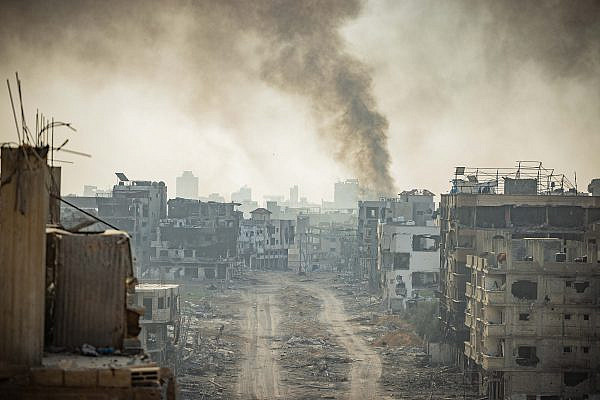
Smoke rises after Israeli airstrikes in Beit Lahia, in the northern Gaza Strip, December 28, 2023. (Yonatan Sindel/Flash90)

‘Lavender’: The AI machine directing Israel’s bombing spree in Gaza
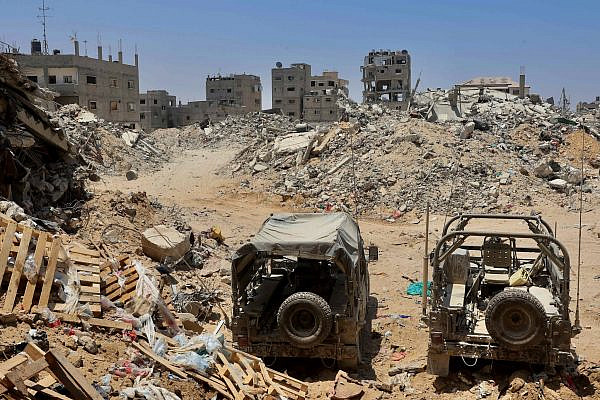
Israeli soldiers operating in Rafah, in the southern Gaza Strip, July 15, 2024. (Oren Cohen/Flash90)

By failing to stop the Gaza genocide, the ICJ is working exactly as intended
Tamer Nafar (courtesy of the author)

What can Palestinian artists do in the face of our slaughter?

Opinion | Israelis Need to Look Past Their New Iron Curtain and See What’s Happening in Gaza

 the News

Palestinian woman reacts as she cradles a wounded boy after Israeli bombardment in central Gaza City, last week.

Palestinian woman reacts as she cradles a wounded boy after Israeli bombardment in central Gaza City, last week. Credit: AFP

Mar 28, 2024 11:58 pm IST

UN Special Rapporteur on the occupied Palestinian territories, Francesca Albanese, released a report this week claiming that the nature and scope of attacks by Israeli Defense Forces in the Gaza Strip, as well as the ruinous living conditions created there by Israel, “can only be interpreted as constituting prima facie evidence of an intention to systematically destroy the Palestinians as a group.”

One Israeli told me he believes there is no need for such explosive terminology, while another asked whether there was any proof of these claims.

A woman who, until October 7 was affiliated with the left wing and has since sobered up, or awakened, had somehow seen – from beyond the Israeli iron curtain – a photograph of a Gazan child who was all skin and bones. She told me: “If these images are true, we must see them.”

So Israelis may wonder, raise questions, doubt, downplay or revoke Palestinians and their tragedy, even when it is clear as day, published in a United Nations report, or broadcast live on a non-Israeli news channel. I recalled how back after October 7, Palestinians and others were forbidden from asking questions, from questioning “facts” or from asking for proof.

It is well known that claims by the Israeli side are viewed as gospel, and that whoever rejects them is an antisemitic supporter of Hamas. But when it happens on the Palestinian side, all claims are an exaggeration, a conspiracy, fake-news, and Israelis can and are even obligated to ask about their authenticity.

It is interesting just how important is it to ask whether the photographs are real, or whether these claims are supported by any shred of proof, when there is an abundance of evidence of children dying of malnutrition in Gaza.

Displaced Palestinians in Gaza.

This doubt that is cast on every Palestinian image, or video, or report, is part of the Israeli iron curtain, with the underlying assumption that all Palestinians are liars.

It is gaslighting of tremendous proportions that Israelis are inflicting upon themselves and on Palestinians, in order to go on ignoring the genocide the entire world has been continually warning about. Israelis refuse to see or listen, and are still convinced that everything is all right.

Israelis are addicted to the iron curtain, and this practice of denying reality is deeply embedded into the Israeli DNA. It is an integral part of the knotted problems Israelis bring upon themselves through their arrogance and boastfulness.

This denial of reality is present at almost every aspect. Are most Israelis aware, for example, that at the core of the current negotiations between Israel and Hamas, or rather at the core of lack of progress in these negotiations, lies the refugee problem? Israel does not want to allow evacuated Palestinians to return to the northern area of the Gaza Strip.

Palestinians flee Israeli strikes in Gaza, earlier this week.

Are Israelis asking themselves what the purpose of permanently uprooting them from the north is and of leaving the area under Israel’s control? That perhaps Israel wants an ethnic cleansing of the Gaza Strip, to be accompanied by establishing settlements just like in the West Bank, which would lead to the same inescapable state of constant warfare and the destruction of relationships with Palestinians everywhere?

From beyond the Israeli iron curtain, reality seems to most Israelis to be essentially good. However, the more they go on looking from behind that iron curtain, so will their distance from reality continue growing, until the inevitable fall into the gaping chasm. Will they still be able to break that curtain?

Testimony From Israel’s Answer to Guantanamo

Violent abuse, humiliation, appalling overcrowding, cold and barren cells, shackles for days on end. A Palestinian who spent three months in Israeli administrative detention amid the Gaza war describes his experience at Ofer Prison

פותחת

Amira, at home in the Aida camp this week, after release from Ofer Prison. “I was in Ofer before, but it was never like this.”Credit: Alex Levac Gideon LevyAlex Levac

Mar 23, 2024 5:31 am IST

Munther Amira has been released from “Guantanamo.” He’d already been arrested a few times in the past, but what he experienced during incarceration in an Israeli prison during the Gaza war is unlike anything he has ever gone through. A friend who spent 10 years in an Israeli prison told him that the impact of his own incarceration during the past three months was the equivalent of 10 years in jail during more normal times.

The detailed testimony we heard this week from Amira in his home in the Aida refugee camp, in Bethlehem, was shocking. He expressed his ordeal with his body, kneeling on the floor repeatedly, describing things in minute detail, without any feeling, until the words became unbearable. It was impossible to go on listening to the harrowing descriptions.

But it seemed as though he had been waiting for the opportunity to relate what he endured in an Israeli prison over the past several months. The descriptions poured from him in an unbroken flow – horror heaped on horror, humiliation after humiliation – as he described the hell he had been put through, in fluent English interspersed with Hebrew prison terminology. Over three months, he had lost 33 kilos (73 pounds).

There are two large pictures in his living room. One is of his friend Nasser Abu Srour, who has been imprisoned for 32 years for murdering a Shin Bet security service agent; the other is of him on the day of his release, exactly two weeks ago. This week Amira appeared to be physically and mentally resilient, looking like a different person than he did on the day he left prison.

Amira at his home this week. What he experienced during incarceration in an Israeli prison during the war in the Gaza Strip is unlike anything he went through in the past.

Amira is 53, married and a father of five; he was born in this refugee camp, whose population includes descendants of the residents of 27 destroyed Palestinian villages. He designed the large key of return that hangs from the camp’s entry gate and bears the inscription, “Not for sale.” Amira is a political activist who believes in a nonviolent struggle, a principle he still holds even after the enormous number of deaths in Gaza in the war, he emphasizes. He is a member of Fatah who works in the Palestinian Authority’s Office for Settlements and the Fence, and a graduate of the social sciences faculty of Bethlehem University.

December 18, 2023, 1 A.M. Loud noises. Amira looks out the window and sees Israeli soldiers hitting his younger brother Karim, who is 40. The troops drag Karim up to the second floor, to Amira’s apartment, and throw him down in the middle of the living room. Amira says his brother fainted. Karim is the administrative director of the cardiac department in Al-Jumaya al-Arabiya Hospital in Bethlehem, and he’s not accustomed to this sort of violence.

The room was packed with soldiers, dozens perhaps. Amira’s daughter, Yomana, was standing behind him. The officer said, “Take her,” and Amira’s heart skipped a beat. Had they come to arrest his 18-year-old student daughter? What was her transgression? The soldiers then bound his 13-year-old son Mohammed and his son Ghassan, who’s 22. Mohammed was wearing a T-shirt emblazoned with a map of the whole of Palestine – soldiers tore it off him.

Amira didn’t understand what was happening. The soldiers took his picture and sent it to wherever they sent it. “It’s him,” he heard them say afterward. He was bound and taken to a military base, where he was thrown onto the floor and kicked by soldiers, he relates. About an hour later, he was taken back home. He was blindfolded, but in the dark he heard Yomana shouting “I love you.” That fleeting, sweet moment would accompany him during the next three months in prison. He replied, “I love you, and don’t be afraid.” For that he was punished, but at least he felt calmer, knowing that Yomana had not been arrested.

The large key of return that Amira designed hangs from the Aida refugee camp's entry gate and bears the inscription, "Not for sale."

He was again taken away and thrown into a military vehicle, where he was stepped on kicked by soldiers incessantly. He’s the age of the fathers of many of those same soldiers. He was then placed in the trunk of the car, and they started to move. After about half an hour, they reached a military base, where he was left outside on a cold winter night. The soldiers spoke among themselves about Gaza. One of them said to him, “Today we will fulfill your dream. You wanted to be a shahid [religious martyr]? We will send you to Gaza.” Amira shuddered, and answered, “I want to live, not die.” He was afraid that the troops would do what they threatened and already imagined his death in Gaza.

Morning came and he found himself in the Etzion detention center. “Now the show begins,” the soldiers said. Amira was taken into an office, where the handcuffs, which were already leaving blue bruises on his wrists, were removed, and he was ordered to strip. When he got to his underpants, he refused to continue. The soldiers kicked him and he fell to the ground. “Suddenly I understood what rape is, what sexual harassment is. They wanted to strip me and take my picture.” He stood naked, the soldiers told him to spread his legs, he felt humiliated as never before in his life. He was afraid that they would post the videos they took. Finally he was taken to a cell.

Supper consisted of a small plate of cream cheese and a slice of bread. But it was the next day’s lunch that truly flabbergasted Amira. Soldiers placed four trays in the four corners of the room, and eight detainees were ordered to kneel and eat off the trays with their hands. The image that came to mind was street cats, he recalls. The food consisted of unrecognizable and inedible mush. He says it was a mixture of leftovers from the soldiers’ meals. He asked what the white part was and was told that it was from an egg. He’s ready to swear that it was not an egg. Amira didn’t touch the food.

The next day he was moved to Ofer Prison, near Ramallah, where he was questioned about a few posts that the interrogators claimed he had uploaded and which he denied. “There is nothing in my Facebook [feed] that supports violence,” he says. The posts included identification with the fate of the residents of Gaza. “‘Mabruk [congratulations],’ the interrogator said. ‘You’re going to administrative detention'” – incarceration without a trial.

Ofer Prison in November. Five times during Amira's three months there, prison service special ops officers employing acute violence raided their cell, each time on a different pretext.

That was Amira’s lot for the next three months. He was sentenced to four months in prison, on the basis of no evidence, let alone a trial. “I was in Ofer before, but it was never like this.” The combination of a war during which Palestinians everywhere can be subjected to abuse, and the fact that the Israel Prison Service is under the purview of Itamar Ben-Gvir, the national security minister, is leaving its mark. Amira decided not to resist anything, in order to survive.

He received a brown prison service uniform, with no underwear and with no connection to his size. Later, he exchanged clothes with another inmate. He had a mattress 5 centimeters (about 2 inches) thick and a wool blanket; he slept with 12 other detainees in a cell designed for five. “That is contrary to a High Court of Justice decision,” he notes. Eight inmates slept on the floor; because of his age he was given the use of a bed.

Amira discovered that he was in Wing 24 of the prison, which is earmarked for problematic detainees. “And I thought I was a good person,” he says with a smile. New prisoners who arrived from Gaza were held in the adjacent wing. He thinks some of them were from Hamas’ Nukhba unit. He will not soon forget their shouts. “People are screaming, people are barking, people are crying, locked up 24 hours a day, blindfolded, and the guards beat them nonstop.”

Not that things were easy in his wing. Five times during the three months, prison service special ops officers employing acute violence raided their cell, each time on a different pretext. The cell didn’t look the way an Ofer cell used to appear: It was completely bare. The television, the electric kettle, the burner, the radio, the books, the pen and paper, the chess, the backgammon – nothing remained, and of course there was no canteen. I came to terms with it, Amira says. This is the price of resistance to the occupation and the war in Gaza.

They assembled a backgammon board using a bread carton, and drew the markings for the game with a solution made from one prisoner’s crushed-up anti-anxiety tablets and water. The pieces were made from eggshells. Then one night, the patrol confiscated the improvised game. Punishment came swiftly. At 6 A.M., the special ops force Keter Ofer showed up with two dogs, and assaulted the inmates. Then they took them to the showers and washed them down in their clothes. The next morning they took away the blankets and mattresses, keeping them until 10 P.M. The cold was brutal.

No coffee, no cigarettes. It was a nightmare for smokers. Sometimes the prisoners would walk by and smoke into the cell to exacerbate their suffering. The aroma of the guards’ coffee also drove the inmates crazy. Two small dishes of jam for 13 prisoners, who fought just to get a taste.

Grafitti  in the Aida refugee camp, in Bethlehem, this week.

“I counted the seconds,” Amira says, but time seemed to stand still in prison. For the first time he saw an inmate who tried to kill himself by throwing himself from the second floor onto the fence outside. Lately there have been more attempts at suicide in the prison, he says, which goes completely against the ethos of Palestinians who have decided to struggle against the occupation. The inmate who jumped was bleeding, his fellow inmates tried to call for a paramedic. But in Ofer you’re not allowed to call for anyone – so again they were punished. The Keter Ofer squad reappeared and this time made them all lie on the floor and beat them with truncheons. They hit Amira in the testicles, too. That too is sexual assault, in his view. “I said to myself: I am going to die. I have a blood pressure problem, and my heart was pounding. Some of us were bleeding from the nose.”

The eggs that were served were not cooked. A few days later, he decided he would eat everything, in order to survive. On one occasion, when they were taken to “waiting” cells (solitary cells for those about to be transferred), and he was handcuffed for an entire day and night. He had to relieve himself in his pants because he wasn’t able to lower them. “And everything has to do with October 7. Everything I asked for, they said ‘October 7.’ When we asked for the eggs to be cooked, they said: ‘October 7.’ It’s Guantanamo, I tell you.”

The Israel Prison Service spokesperson stated this week in response to an inquiry from Haaretz: “We are not aware of the allegations that are described, and as far as we know they are incorrect. If a proper complaint is submitted, it will be examined by the appropriate persons.”

The IDF Spokesperson’s Unit told Haaretz: “The suspect was arrested on December 18, 2023, on suspicion of incitement and activity in a hostile organization. During a hearing in the military court on the military prosecutor’s request to extend his confinement, the suspect raised claims regarding his treatment by the soldiers during his imprisonment. The claims are being clarified.”

Amira was released after three months, a month ahead of schedule. No one told him anything, he was just given clothing supplied by the Red Cross and thought he was being freed as part of a deal (that didn’t happen). He told us in his home this week: “Mahmoud Darwish wrote that the prisoners are the source of hope of the Palestinian people. That is no longer true. It’s the first time that detainees are trying to commit suicide. The first time I felt that the door of the cell is the door of a grave. An Israeli prison is now a graveyard for the living.”

Can Israel Ignore World Court’s Order? 

Amy Goodman

Support our work: https://democracynow.org/give We continue to look at the International Court of Justice’s interim ruling in South Africa v. Israel with Stockton University professor Raz Segal and human rights lawyer Diana Buttu. We discuss Israeli Prime Minister Benjamin Netanyahu’s response to the ruling, the role of the United States in stymying international action and more. We also hear more from ICJ president Joan Donoghue’s delivery of the ruling, including the court’s acknowledgement of the dire humanitarian crisis in Gaza. Democracy Now! is an independent global news hour that airs on over 1,500 TV and radio stations Monday through Friday. Watch our livestream at democracynow.org Mondays to Fridays 8-9 a.m. ET. Subscribe to our Daily Email Digest: https://democracynow.org/subscribe

Palestinian prisoner placed in admin. detention — after serving 15 years

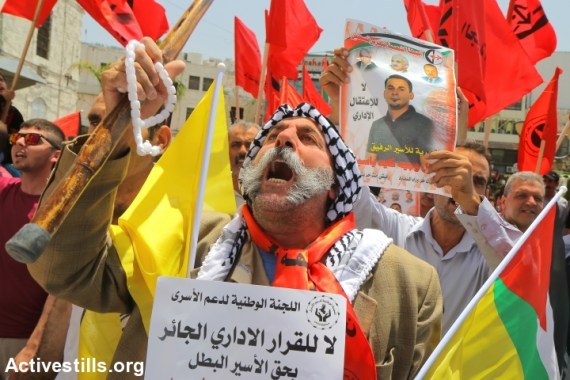
Palestinians take part in a protest in solidarity with the Palestinian prisoner Bilal Khaled, Nablus, West Bank, June 14, 2016. (photo: Ahmad al-Bazz/Activestills.org)

Edo Konrad

972mag.com |

Bilal Kayed was supposed to be released from Israeli prison after serving a nearly 15-year sentence. Instead, he was placed under indefinite detention without charges or trial.

Photos and text by Ahmad al-Bazz/Activestills.org

Palestinian prisoner Bilal Kayed was meant to be released from Israeli prison on Monday after serving 14.5 years. Instead Israeli military authorities decided to put him in administrative detention for a period of six months, which means he will be held indefinitely without charge or trial.

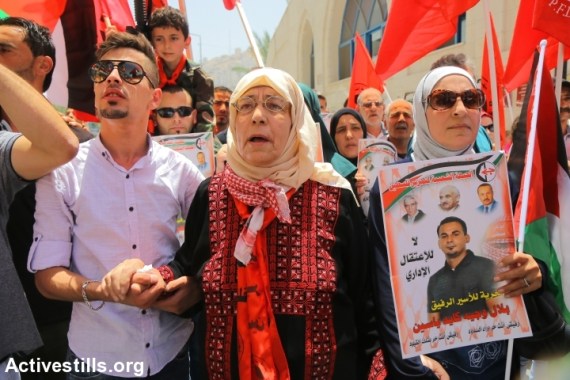
On Tuesday dozens of Palestinians took part in a solidarity protest in the West Bank city of Nablus. Kayed’s detention came as a shock to his family and relatives. ”His lawyer called us to say that he will not be released today,” said his brother Mahmoud Kayed, adding that only a few hours later did they discover that he was put in administrative detention.

During the protest the demonstrators chanted against the decision, while raising photos of Kayed along with Popular Front for the Liberation of Palestine (PFLP) flags, the leftist Palestinian party to which he belongs.

Administrative detention is a procedure that Israel uses to imprison detainees based on secret evidence, without charging them or allowing them to defend themselves at trial. Administrative detention orders may be renewed indefinitely.

The family confirmed that their son is planning on starting a hunger strike to protest his administrative detention. According to a statement released by the PFLP on Monday, its members in prison will begin an initial two-day hunger strike in solidarity with Kayed. “The hunger strike is just the beginning in a series of escalating steps to be implemented by all comrades in Zionist prisons and detention centers,” said the statement.


The mother of the Palestinian prisoner Bilal Kayed (center) takes part in a protest in solidarity with her son, Nablus West Bank, June 14, 2016. (photo: Ahmad al-Bazz/Activestills.org)

Kayed, 34, has been imprisoned by since December 2001 on charges of membership in the PFLP, as well as participation in activities against the State of Israel. He was 19 years old at the time of his arrest. Kayed is now among 750 Palestinians held in administrative detention without charge or trial.

Last Friday Israeli authorities placed a Palestinian prisoners’ rights activist under administrative detention for six months, 40 days after he was first detained and taken in for interrogation.

Mohammed Abu Sakha (photo: Courtesy of Addameer)


Hasan Safadi, who works as media coordinator for Addameer, an NGO that supports Palestinian prisoners in both Israeli and Palestinian prisons, was set to be released from detention on June 10 by order of Jerusalem’s Magistrate’s Court, after paying NIS 2,500 in bail and obtaining third-party guarantees. Later the same day, however, Israeli Defense Minister Avigdor Liberman signed an administrative detention order against Safadi, effectively overriding the court’s decision.

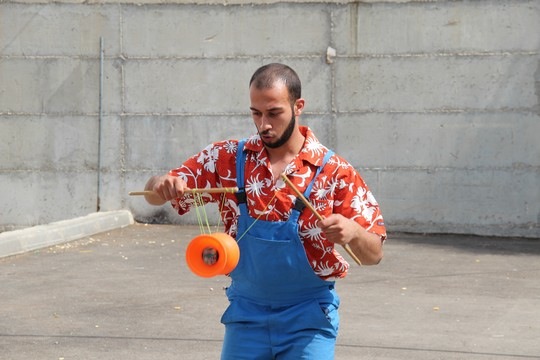
On Monday Israeli military authorities also renewed the administrative detention of Palestinian circus trainer and clown Mohammad Abu Sakha for an additional six months, from June 13 to December 12. Abu Sakha is known for working with special needs children in the West Bank, and runs the Palestinian Circus School. He was first arrested on December 14, 2015 while he was crossing Zaatara military checkpoint near Nablus on his way to work in the village of Birzeit, near Ramallah.

For additional original analysis and breaking news, visit +972 Magazine’s Facebook page or follow us on Twitter. Our newsletter features a comprehensive round-up of the week’s events. Sign up here.

© 2010 – 2016 +972 Magazine


AMIRA HASS: Israel’s right to sweep away Palestinians

Expelling Palestinians is a paradigm that’s alive and well in the Jews’ state – a plan that was carried out and that is always waiting to be replicated.
By Amira Hass | Jun. 8, 2016 | 7:03 PM | 3
Why are people so shocked that Israel has jailed a professor of astrophysics over his posts on Facebook, along with young girls who brandished knives? It has every right to do so. This right follows naturally from Israel’s essence and past, and can be summed up in a term derived from a statement by Uzi Narkiss, who headed the army’s Central Command in the June 1967 war: the right to sweep away.

“I don’t know if anything will happen,” Narkiss said on the eve of that war, according to Israel Defense Forces documents recently released for publication. “But if something does happen, it will take less than 72 hours for us to sweep all the Arabs out of the West Bank.”

Here are three new examples of the exercise of that right that unfortunately haven’t received appropriate media coverage:

* The right to worship, trespass and kill. Some 4,000 Jews (according to Israel National News), including Knesset members, prayed at Joseph’s Tomb in Nablus from late Thursday night to early Friday morning last week, under heavy military protection (this follows from the rights to Judaize graves, to sanctify stones the way a dog marks his territory, and to prioritize memorializing a dead Jew over the daily routine of live Palestinians).

Maj. Elitzur Trabelsi, an officer in the Samaria Brigade’s territorial defense unit, said this unit’s “hard work, before and during the visit” to Joseph’s Tomb “is satisfying when you see the number of people coming here. The Samaria Brigade will continue to enable such visits in accordance with the government’s instructions and work to ensure the visitors’ security.”

The brazen locals, who deny the right to sweep them away, demonstrated. The IDF fired live bullets at them. About 10 demonstrators were wounded, including Jamal Dweikat, 20, who was wounded in the head. He died of his wounds on Monday.

* The right to dismantle a kindergarten (which derives from having turned Area C, the part of the West Bank assigned to full Israeli control by the Oslo Accord, into the rock of our existence). On Sunday, the IDF and Israel’s Civil Administration in the West Bank raided the Hamadin Bedouin community in Sateh al-Bahr (“Sea Level”) on the road leading to the Dead Sea. Accompanied by heavy engineering vehicles (a crane and a digger) and at least eight all-terrain vehicles, they dismantled and confiscated six prefab houses and one prefab that served as a kindergarten for 12 children.

The buildings, a UN donation, were funded by several European countries (including Germany). Twenty-six people, including 13 children, lost their homes.

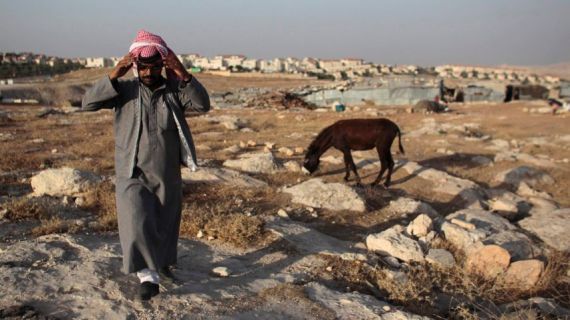
The Hamadin, a clan of the Jahalin tribe, are one of the Bedouin communities which the Civil Administration is planning to sweep out of their place of residence of the past several decades (the Jahalin, of course, had first been swept out of the Negev in the early 1950s) and to concentrate them in a township, so that they will adjust their way of life and their movements to our sacred right to spread southward and eastward and build kosher Jewish villas.

* The right to prepare for the coming and welcome wars. Between May 30 and June 1, five Palestinian communities (made up of 58 families) were ordered to evacuate their homes in the steaming northern Jordan Valley for various periods of time due to IDF exercises. Military exercises within Palestinian communities are nothing new. In April 2014, Col. Einav Shalev, then an officer in Central Command’s operations division, revealed that training exercises and the expansion of firing zones in the Jordan Valley are a way of reducing the number of Palestinians. “When the troops march, people move aside,” he said. “There are places where we significantly reduced the number of exercises, and weeds sprang up there.”

When Narkiss spoke of “sweeping out all the Arabs,” he drew a logical line to the expulsion of 1948. In other words, he revealed that expelling Palestinians is a paradigm that’s alive and well in the Jews’ state – a plan that was carried out and that is always waiting to be replicated. That plan hasn’t succeeded. But “sweeping” the Palestinians into crowded enclaves continues all the time, an inseparable part of our right as masters.

A Bedouin of the Jahalin tribe walks in his encampment near the Jewish settlement of Maale Adumim, east of Jerusalem, June 16, 2012.Reuters read more: http://www.haaretz.com/opinion/.premium-1.723737
A Bedouin of the Jahalin tribe walks in his encampment near the Jewish settlement of Maale Adumim, east of Jerusalem, June 16, 2012.Reuters
read more: http://www.haaretz.com/opinion/.premium-1.723737

Read the darn thing

see also Verdict: balanced report, unbalanced reaction


Rear Admiral John Kirby, taking questions, 2014. Photo from US Defense Department

US says UN Security Council should disregard ‘biased’ Gaza report

State Department says report, which accused Israel of possible war crimes, is intrinsically unfair

By i24 news
June 24, 2015

The United Nations Human Rights Council report on last summer’s war in Gaza should not be brought to the Security Council for a vote or used by the UN for other work, the United States said Tuesday.

Dismissing the report as having a “clear bias” against Israel, State Department spokesman John Kirby said Washington viewed the report, which accused both Israel and the Islamist group of possible war crimes, as intrinsically unfair.

“[W]e challenge the very foundation upon which this report was written, and we don’t believe that there’s a call or a need for any further Security Council work on this,” Kirby said during a press conference. “We reject the basis under which this particular commission of inquiry was established because of the very clear bias against Israel in it.”

The UNHCR is slated to examine the findings of the report on June 29 and may vote in favor of sending it to the Security Council for further action. Kirby had already iterated on Monday that the US would not take part in that endeavor.

The US does not “support any further UN work on this report,” Kirby said regarding whether it should be forwarded to the International Criminal Court in the Hague.

“We’ve made very clear what our issues were at the time about the use of force and we made very clear to the Israeli government our concerns about what was happening in that conflict,” he added. “We have an ongoing dialogue with the government of Israel on all these sorts of matters; that dialogue continued and continues.”

Israeli Prime Minister Benjamin Netanyahu on Sunday rejected the report’s finding and slammed the UN Human Rights Council for spending “more time condemning Israel than Iran, Syria and North Korea put together.”

“Israel does not commit war crimes, but rather defends itself from a terrorist organization that calls for Israel’s destruction,” the PM said.

American jurist Mary McGowan Davis, who headed the independent United Nations probe into the events of last summer’s war in Gaza, has said that the investigation’s report would have looked different if Israel would have cooperated with it.

In an interview with Israeli daily Haaretz, McGowan Davis said that if Israel would have co-operated with the investigation, “we could have met with Israeli victims and seen where rockets landed, talked with commanders, watched videos and visited Gaza. We talked to a lot of witnesses but of course an investigation needs to be as close to the scene as possible and it would have looked different.”

Israel refused to co-operate with the United Nations Human Rights Council (UNHRC) probe, harbouring grave misgivings about the commission’s impartiality.


Think U.N. Gaza ‘War Crimes’ Report Is Biased? Read It First.

By J.J. Goldberg, Jewish Forward
June 23, 2015

When the shouting dies down and folks take the time to read the actual content of the United Nations report on last summer’s Gaza war — all 183 pages plus side documents — you might see some very red faces in the world of pro-Israel activism.

Well, maybe you won’t. The leaders and friends of Israel’s current governing coalition aren’t in the habit of admitting mistakes, especially where Palestinians are involved. But this one will be hard to dodge.

Israeli officialdom and its boosters greeted the report’s June 22 release with a chorus of outrage. They claim it “accuses Israel of deliberately killing civilians,” denies Israel’s right to defend itself, “barely mentioned” Hamas and even “has blood on its hands for allowing the murder of Jews.” None of that is in the report.

What it does contain is a host of questions about the Israeli military actions that led to the deaths of around 2,200 Palestinians, a large proportion of them civilians. It questions whether Israel’s military goals of stopping rocket and mortar fire and tunnel infiltration, goals it admits were legitimate, necessitated all of the actions that caused the massive civilian suffering.

It reads harshly at times, but the events it describes actually happened. Given the numbers killed and left homeless, it’s appropriate to recall. The finger-pointing is actually rather mild, relative to the magnitude of the suffering. And make no mistake: the finger points in both directions.

The report notes that “the threats to the security of Israel remained all too real.” It describes at length the rocket and mortar fire from Gaza, as well as Hamas’s terrifying tunnels into Israeli territory. It describes Israel’s casualties, including children killed, wounded and emotionally scarred. And it charges that the firing of rockets without guidance systems in the direction of civilian residential areas by “Palestinian armed groups” was a blatant violation of international law.

But it cites dozens of cases where Israel’s response might not have been “proportional” to the threat. International laws of war dictate that a military action should be proportional, not to the harm suffered, but to the achievement of a “legitimate military goal.” The investigators studied 15 specific residential buildings out of the thousands that Israel shelled. It found evidence of a military target in nine of them. In the other six it couldn’t find evidence of a military target, raising the suspicion that the building was a purely civilian facility, suggesting that the attack violated international law. Since Israel didn’t cooperate with the investigators, and didn’t allow them entry to Israel or Gaza, the report urges Israel to answer the question of what it was aiming at in each case.

The report praises Israel’s efforts to warn residents by leaflet and telephone to flee before buildings were attacked, even at the cost of losing the element of surprise. However, it claims Israel’s practice of “roof-knocking,” dropping light munitions to warn residents before bombing, was ineffective.

It also raises an explosive question of whether Israel’s top leaders should be culpable for failing to change tactics in midsummer once the high civilian toll of its bombings became clear.

What will evoke the most discomfort and even outrage for many is the report’s lengthy series of grim eyewitness accounts of civilian deaths (“I found the decapitated bodies of my uncle and daughter…”) and destroyed homes. A handful of killings are documented that the report flatly says violated international law, notably a civilian shot twice after falling down wounded, caught on video.

But the report’s most direct, unequivocal allegation of illegality — stripped of “may,” “could” or “should” — involves “executions” of suspected collaborators by “Palestinian armed groups” (its collective term for the military wings of Hamas, Islamic Jihad and several smaller groups). The report describes in detail the arrest, torture and summary execution, often in public, of several dozen suspects, “with the apparent knowledge of the local authorities in Gaza,” the report’s term for the Hamas government. These flatly violated “both international humanitarian law and international human rights law,” along with “Article 6 of the International Covenant on Civil and Political Rights” and “article 3 common to the 1949 Geneva Conventions,” the laws of war.
The report quotes the West Bank-based Palestinian Authority — or, as it terms it, the Ministry of Interior of the State of Palestine — as condemning the executions as “illegal.” In what’s either wry humor or clueless diplo-speak, it says the State of Palestine intends to investigate Palestinian violations and impose justice as soon as it regains control of Gaza.

The report also notes allegations by witnesses that Israeli troops used Palestinians as human shields, forcing them to enter buildings before the soldiers in case of booby traps. One specific case is cited. On the other hand, it notes that Palestinian armed groups made an apparent practice of using human shields by sending civilians to the roof of targeted buildings “to ‘protect’ the house” — one specific case is cited, but others are suspected — “in violation of the customary law prohibition to use human shields.”

Israel condemned the report as biased from the moment it was first commissioned by the U.N.’s human rights council last July, during the heat of the war. The council has a long history of obsessively focusing on Israel and ignoring far more glaring human rights violators. It’s been responsible in the past for such miscarriages of justice as the 2009 Goldstone Report, which baselessly accused Israel of intentionally targeting civilians in the three-week Gaza incursion known as Operation Cast Lead. Israel refused to cooperate with that inquiry, whose chair, South African judge Richard Goldstone, eventually repudiated many of his own commission’s findings.

The council’s initial choice to head the latest inquiry was Canadian academic William Schabas, a longstanding, vehement critic of Israeli behavior. But Schabas quit the inquiry last February following revelations that he’d done paid consulting work for the Palestine Liberation Organization, a conflict of interest. His replacement was a retired New York state judge and onetime Brooklyn federal prosecutor with a reputation for fairness, Mary McGowan Davis.

The report produced by McGowan Davis and her fellow commissioner, veteran U.N. human rights expert Doudou Diene of Senegal, seems to have caught some Israelis off-guard. Where the Goldstone Report was dismissed out of hand, the Foreign Ministry says it will “study” the new one, despite the bias of the council that commissioned it. Some officials are quietly telling reporters it may have been a mistake to continue snubbing the investigation after Schabas resigned, rather than cooperating so McGowan Davis could hear Israel’s side. Indeed, some warn the report’s relative balance will make it harder to ignore the harsher allegations as they move through international bodies and tribunals.

Israel released its own report on the war a week before the U.N. document came out, on June 14, in an apparent attempt to preempt and blunt the expected the U.N. attack. Simultaneously, a pro-Israel organization in Europe released a report by a so-called High-Level International Military Group, comprising 11 retired generals and diplomats from around the world, headed by a former German chief of staff and head of NATO command. They visited Israel for several days in May and concluded that Israel “not only met a reasonable international standard of the laws of armed combat, but in many cases significantly exceeded that standard.”

Neither of those reports, however, addressed the specific incidents and patterns that McGowan Davis questioned.

It remains to be seen whether and how Israel will address her questions regarding the military necessity of its actions.

The Palestinians have initiated action against Israel at the International Criminal Court in The Hague, and McGowan Davis urges Israel to co-operate. But the court doesn’t have jurisdiction over a country that properly investigates and punishes its own crimes. The ball is in Israel’s court. For the rest of us, step one would be to read the darn thing.

Print Friendly

Israel calls on member states to divest from ICC

Beit Lahiya in the far north of the Gaza Strip was badly hit during the 2008-2009 Israeli attacks. / Photo: RafahKid (flickr.com/photos/rafahkid/)

International Criminal Court (ICC) prosecutor Fatou Bensouda initiated on Friday a preliminary probe into whether the Israeli army committed war crimes during last summer’s offensive on Gaza. In addition, Bensouda indicated that Palestine should be recognized as a state following the UN General Assembly’s November 29, 2012 vote recognizing a “State of Palestine.”


From February 2009 until April 2012, Palestinians made attempts to bring war crimes allegations against Israel in relation to the 2008-9 Israeli offensive on Gaza. However, the ICC Prosecutor’s Office dismissed such attempts, declaring that “Palestine” was not yet a state and that only states could seek ICC intervention.

Bensouda’s decision does not mean actual war crimes trials are imminent. However, Israeli analysts perceive it as a most serious escalation toward possible war crimes trials of Israeli military personnel and political leaders.

The Palestinian Foreign Ministry hailed the decision as a “positive and significant step toward achieving justice and respecting international law.”

The ministry added that the Palestinian decided to join the ICC was intended “to put an end to Israeli war crimes and crimes against humanity.”

Fawzi Barhoum, a spokesman for Hamas, said on Saturday his organization appreciates the move.

“What is needed now is to provide the court with thousands of reports and documents that confirm the Zionist enemy has committed horrible crimes against Gaza and against our people,” he added in a statement.

Not unexpectedly, Israeli Prime Minister Benjamin Netanyahu rejected the ICC move, claiming it is absurd.

“I won’t be surprised if ISIS, Al Qaeda and Hizbollah follow suit,” he added on Saturday.

In response to Bensouda’s decision, Israel is lobbying member-states of the ICC to cut funding for the tribunal.

Israel, which is not a member of the ICC, hopes to dent funding for the court which is drawn from the 122 member states in accordance with the size of their economies, Foreign Minister Avigdor Lieberman said on Sunday.

“We will demand of our friends in Canada, in Australia and in Germany simply to stop funding it,” he told Israel Radio.

“This body represents no one. It is a political body,” he said. “There are a quite a few countries – I’ve already taken telephone calls about this – that also think there is no justification for this body’s existence.”

He said he would raise the matter with visiting Canadian counterpart John Baird on Sunday.

Another Israeli official told Reuters that a similar request was sent to Germany, traditionally one of the court’s strongest supporters, and would also be made to Japanese Prime Minister Shinzo Abe, who is separately visiting Jerusalem and whose nation is the largest contributor to the ICC.

source

Settlers: Deport US consulate staff

settlerviolence

Settlement leaders are demanding that Israel deport American consulate staff who clashed with settlers Friday, according to the settler-affiliated news site Arutz 7.


According to Yossi Dagan, acting head of the Samaria Regional Council, the council of northern West Bank settlements, US consulate security guards threatened settlers with a handgun and an M16 rifle.

A confrontation broke out between security personnel from the US consulate in Jerusalem and settlers from the Ramallah-area Adei Ad outpost in the West Bank on Friday, after settlers hurled stones at two vehicles from the consulate.

The consulate staff arrived to the area at the inviation of the village of Turmus Ayya to examine thousands of olive tree seedlings which were uprooted Thursday night. Some of the seedlings belong to Palestinians who are also US citizens.

The Consulate security guards arrived at the agricultural lands to examine the scene and rule out any security risks, while the delegation members waited behind in the village. Settlers claimed they arrived to the area without coordination and brought Palestinians into their territory, saying the American visit was coordinated with the Israeli Civil Administration for next week.

According to police, the settlers pelted the convoy with rocks.

Dagan, wrote to the acting Israeli interior minister that the US consulate security guards crossed all red lines “and participated in a provocative tour with the Palestinians without any coordination as required with the IDF and police, and pulled out a firearm and threatened Israeli civilians.”

“I request that in view of the serious and criminal conduct, that these [US] security guards and officials be deported,” he added.

A State Department spokesman in Washington said US authorities were “deeply concerned” about the stone-throwing incident.

“We can confirm a vehicle from the Consulate General was pelted with stones and confronted by a group of armed settlers today in the West Bank, near the Palestinian village of Turmus Ayya,” said the US State Department spokesman according to AFP.

The spokesman added that “I do want to correct one thing proactively from some of the reporting I’ve read on this incident. No American personnel drew their weapons in the course of these events. What has been reported suggesting otherwise is inaccurate.”

Adei Ad is an unregulated Israeli outpost that was established in 1998 by a group of yeshiva students from the settlement o f Shvut Rachel. The settlement was established on land owned by Palestinians and is also considered illegal under Israeli law. In 1999 Israeli Prime Minister Ehud Barak ordered the outpost dismantled, although it never happened.

On 10 December 2014, Palestinian Minister Ziad Abu Ein died in a confrontation with Israeli soldiers during a a protest march to plant olive trees on this site.

source

Blog at WordPress.com.

Up ↑