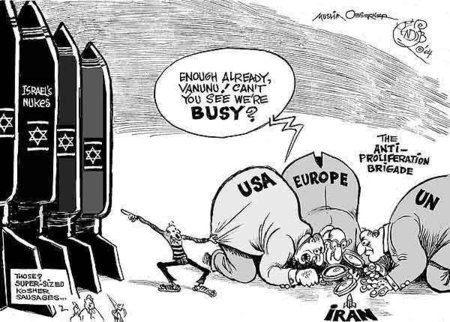
A UN nuclear watchdog report suggests Iran could be developing a nuclear bomb, apparently confirming long-held suspicions in the West. But Tehran denies the claims, again insisting that its atomic intentions are peaceful. Michel Chossudovsky, who’s from an independent Canadian policy research group, believes that what Iran says hardly matters, because the U.S. is planning for war…

By Paul Craig Roberts (about the author) opednews.com Permalink
There’s no word in the Western press, but AlJazeera reports that the US and Israel are conducting tests of the high-altitude missile defense system that the US has provided to Israel.
The anti-missile system is useless against the short-range rockets of Hamas and Hezbollah. Its purpose is to protect Israel from longer-range Iranian missiles.
Everyone understands that Iran would not attack Israel except in retaliation. It is logical to conclude that the missile defense system signals an upcoming Israeli attack on Iran.
If the US were opposed to an Israeli attack on Iran, the US would not provide Israel with protection against retaliation and would not engage in war games with Israel to test the system. The best way to prevent an Israeli attack on Iran is to leave Israel open to retaliation.
This decision by the United States government is irresponsible in the extreme. It enables Israel to spread aggression in the Middle East. By signaling an attack, it would encourage a less cautious country than Iran to strike first before the Israeli missile defense system is operative.
The joint US-Israeli war games involving 2,000 troops from the US European Command, the Israeli Army, and 17 US Navy ships is further indication to the world that no matter what crimes the Israelis commit, the US will protect Israel from being held accountable.
In the world today, the US and Israel are the two threats to peace.

There are some terms that people in Islamic and Western countries should never say to each other, because they confuse and inflame more than they clarify. The most obvious ones would be “jihad”, “crusade” and “great satan”. All of them are used in somewhat innocuous ways by the people who utter them, but mean something completely different – and much more inflammatory – to foreign ears.
I would like to propose a topical addition to the list of words that should never be used, and that would be “myth”. Specifically when it is used in the context in which Iranian President Mahmoud Ahmadinejad and Egyptian Brotherhood leader Mohammed Mehdi Akef have mentioned it in recent months, i.e. to speak of “the myth of the Holocaust” (Egyptian Islamists deny Holocaust; BBC News, 23 Dec 2005) . They know what they mean by the phrase, and I know what they mean, but if they think that most people over here are going to hear it and respond with anything more profound than “Holocaust deniers!” then they are deeply ignorant of how central is the Holocaust in U.S. perceptions of the Middle East, how superficial is the U.S. public discourse on relations with the Muslim world, and how much that discourse is framed by those who are pushing for a “clash of civilizations” and who are currently fixated on finding a justification to bring about regime change in Iran.
 Gareth Porter
The International Atomic Energy Agency (IAEA) has obtained evidence suggesting that documents which have been described as technical studies for a secret Iranian nuclear weapons-related research program may have been fabricated.
The documents in question were acquired by U.S. intelligence in 2004 from a still unknown source — most of them in the form of electronic files allegedly stolen from a laptop computer belonging to an Iranian researcher. The US has based much of its push for sanctions against Iran on these documents.
The new evidence of possible fraud has increased pressure within the IAEA secretariat to distance the agency from the laptop documents, according to a Vienna-based diplomatic source close to the IAEA, who spoke to RAW STORY on condition of anonymity.
By Zahra Hosseinian and Fredrik Dahl
TEHRAN (Reuters) – An Iranian official accused the United States on Friday of involvement in a mosque bombing that killed more than 20 people in volatile southeastern Iran, two weeks before a presidential election.
Washington denied the allegation.
The Israeli armed forces chief of staff, Gabi Ashkenazi, met yesterday with top US officials in Washington, including General James Jones, the national security adviser, and Dennis Ross, the State Department’s special adviser on “the Gulf and Southwest Asia,” and he warned that Israel is preparing for a military strike on Iran. According to Haaretz, the Israeli daily….
 band annie's Weblog