If committed activists needed an additional reason for why what they are doing is essential and just, then the ICJ’s ruling is a chilling reminder of what is at stake here.
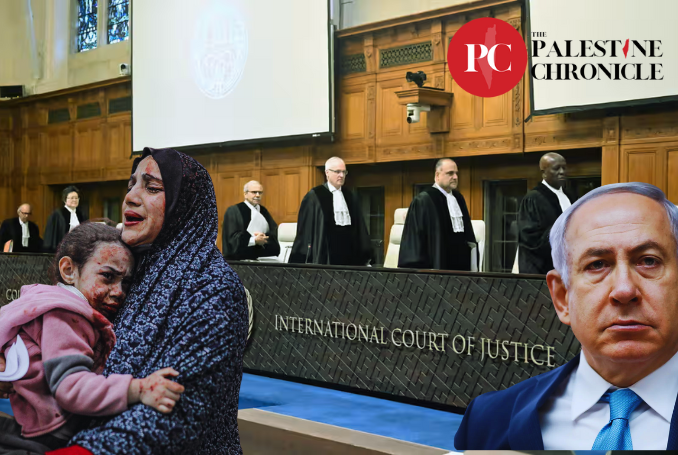
The moral and brave approach by South Africa to the International Court of Justice (ICJ), hoping for a ruling that would bring an end to the genocide of the Palestinians in Gaza, was not matched by the court on Friday, January 26, 2024.
I am not underestimating the significance of the court’s ruling. True, the court confirmed the right of South Africa to approach the ICJ and substantiated the facts it presented, including the assumption that Israel’s actions could be defined as genocide under the terms of the genocide convention.
In the long run, the language and the definitions used by the ICJ in its first ruling will constitute a huge symbolic victory on the way to Palestine’s liberation.
But this is not why South Africa approached the ICJ. South Africa wanted the court to stop the genocide. And therefore, from an operative point of view, the ICJ missed an opportunity to stop the genocide, mainly because it still treated Israel as a democracy and not a rogue state.
Palestinians, and whoever supports any struggle against crimes committed by countries of the global north, ceased a long time ago to be impressed by symbolic actions. Actions against rogue states only are meaningful if they have an operative side to them.
The operative actions suggested by the ICJ are basically a demand from Israel to submit, in one month’s time, a report on measures taken to prevent genocide in Gaza.
No wonder, the Israeli government has already hinted that such an assignment would not be high on its agenda and, most importantly, would not have any impact on its policies on the ground.
Even if the ICJ would have demanded, as it should have, a ceasefire, it would have taken quite a while to implement it, given the Israeli intransigence. But the message to Israel would have been clear – and effective.
License to Commit Genocide
The important thing to remember in any engagement with Israel is that what matters is not how the message is intended but how it is understood by Israeli policymakers.
The Western solidarity with Israel, shown on October 7, 2023, was understood by its policymakers as a free license to commit genocide in Gaza. Similarly, opting for a report instead of action is understood in Israel as a slight slap on the hand, which gives Israel at least another 30 days to continue its genocidal policies.
If this is the case, what would be left of Gaza in a month? What would be the magnitude of the genocide in a month’s time, if not only the West but also the ICJ, refuses to call for an immediate ceasefire? I am afraid that there is no need to answer these terrible questions.
More importantly, the crime has already been committed, it is not as if there is still time to stop it. Therefore, unless the ICJ believes that Israel’s actions be reversed and rectified, it sends a very confused message. It seems to hint that, although the actions may be a crime, if the carnage is limited, then this would be welcomed by the ICJ.
History of Failure in Palestine
The ICJ seemed to lack courage when it refrained from demanding what many countries in the global south and a huge number of people in the global civil society were asking for in the last three months.
If this whole process ends with the usual conclusion that international law has no power to stop the destruction of Palestine and the Palestinians, this will have even a greater impact on the question of Palestine.
In fact, this awareness could severely undermine the confidence, which is already very low, of the global south in the universality of intentional law.
Ever since its final institutionalization after the Second World War, the international law failed to deal properly with colonialism as a crime and was never able to challenge settler colonial projects like Israel.
It also became clear that imperialist policies pursued by the US and Britain, in clear violation of international law, are totally exempt from international law’s jurisdiction. Hence, the US was able to invade Iraq with a stark violation of international law and Britain now plans to send, without fear of reprisal, asylum seekers to Rwanda.
In the case of Palestine, throughout 75 years of the ongoing Nakba, international law – through its official and informal representatives, practitioners and delegations – was completely ineffective. It did not stop the killing of one single Palestinian; it did not lead to the release of one single Palestinian political prisoner, nor did it prevent the ethnic cleansing of Palestine. Indeed, the list of its failures is too long to be detailed here.
But There is Hope
There is a new, important lesson that should shape our activity and inform our hopes for the future.
We already learned that there is no hope for change within Israeli society, a lesson that was ignored by those involved in the so-called peace process.
The failure to understand the DNA of the Zionist society allowed Israel, since its inception, to kill Palestinians incrementally and massively either directly, by shooting them, or indirectly, by denying them basic human conditions for living.
This process, led by the US, was based on the formula that only after “peace” is restored, Israel would be obliged to change its ruthless policies on the ground.
This false paradigm has totally collapsed, even if the Biden Administration attempts, these days, to resurrect it, along with the few Palestinians who, for some reason, still put their faith in the two-state solution.
And now comes the new, important lesson: not only can we not hope for a change within Israel, we cannot rely on international law to protect the Palestinians from genocide.
This, however, does not mean that there is no hope in the future for liberation and decolonization. The Zionist project is in the process of imploding from within.
Israel’s Jewish society is disintegrating, its economy is failing, and its international image is deteriorating.
The Israeli army did not function in October and the government is in tatters and unable to provide basic services to its citizens. Under these circumstances, only wars and cynical Western interests will keep this project alive, but for how long?
And yet, such a process of implosion in history can be long, brutal and violent as it transpires in front of our eyes these days.
And we are not just onlookers. The activists among us understand that we have to double and triple what we already know has to be done.
We continue, outside of Palestine, to try and move the ‘B’ and ‘D’, in Boycott and Divestment, to ‘S’, as in Sanction.
This effort can be intensified by pushing in two directions. On one hand, we should exert more pressure on the governments of the global south to be more active, particularly in the Arab and Muslim worlds. On the other hand, we should find better ways to increase the electoral pressure on our representatives in the global north.
There is no need to tell the Palestinian Resistance what to do to defend itself and its people. There is no need to tell the liberation movement how to strategize for the future. Wherever they are, Palestinians who are involved in the struggle will continue to persevere and be resilient. What they truly need is for any external effort to be more effective, realistic and bold.
One can not but admire what the solidarity movement with Palestine has already achieved, especially in the last three months.
However, if its loyal and committed activists needed an additional reason for why what they are doing is essential and just, then the ICJ’s ruling is a chilling reminder of what is at stake here.
If there is hope to stop the genocide all over historical Palestine, it lies in the ability of the global civil society to take the lead. Because it is far too obvious that governments and international bodies are unwilling or unable to do so.
– Ilan Pappé is a professor at the University of Exeter. He was formerly a senior lecturer in political science at the University of Haifa. He is the author of The Ethnic Cleansing of Palestine, The Modern Middle East, A History of Modern Palestine: One Land, Two Peoples, and Ten Myths about Israel. He is the co-editor, with Ramzy Baroud of ‘Our Vision for Liberation.’ Pappé is described as one of Israel’s ‘New Historians’ who, since the release of pertinent British and Israeli government documents in the early 1980s, have been rewriting the history of Israel’s creation in 1948. He contributed this article to The Palestine Chronicle.
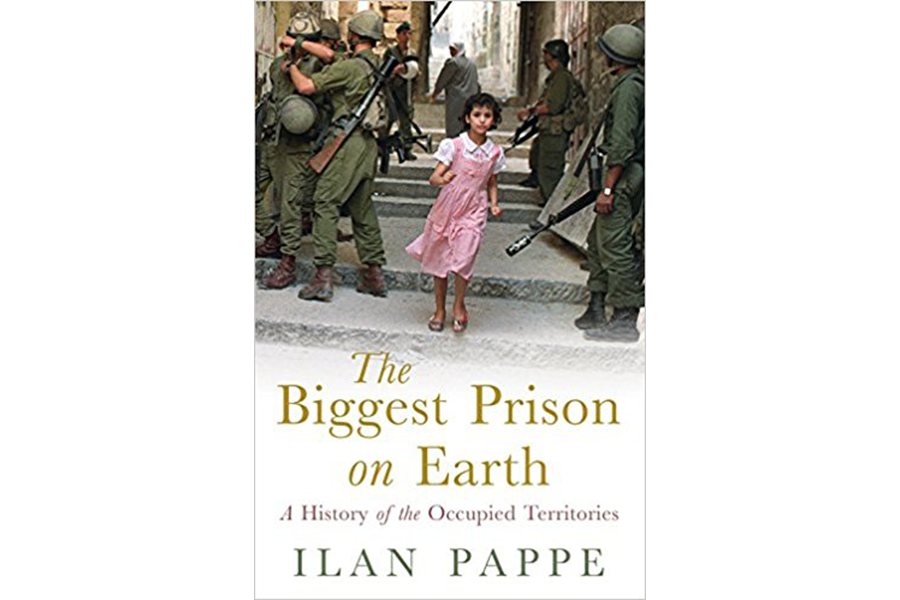
Speaking to the Monitor about his new book ‘The Biggest Prison on Earth,’ historian Ilan Pappe says that – ultimately – he is ‘confident of a peaceful scenario.’
August 15, 2017 —Historian Ilan Pappe’s new book The Biggest Prison on Earth: A History of the Occupied Territories continues his work of shining new analytical light on the seemingly intractable Israel-Palestine conflict, following up earlier books such as “Ten Myths About Israel” and the bestselling “The Ethnic Cleansing of Palestine.” Pappe recently talked with Monitor contributor Steve Donoghue about his work.
Q: Your new book is already sparking the kind of controversy that greeted “The Ethnic Cleansing of Palestine” and “Ten Myths About Israel” – this must be a familiar pattern to you by now, yes? Do you find that the tenor of this conversation has changed at all over the years? Is there more receptivity to your work, for instance?
It depends where. Around the world, yes, the tenor has changed. There is more readiness to change the language that describes Israeli actions in the past and the present; there is less disbelief when a systematic abuse or dispossession is shown as a structure or strategy rather than a policy. As for Israel, the same denial and unwillingness to face the unpleasant chapters of the past persists.
Q: That assertion – that Israeli dispossession of Palestinians is an outcome of premeditated state strategy rather than a policy adapted to circumstances – contradicts the attractive notion of a fledgling state merely doing what it must to survive. It paints a far uglier picture.
This is not an attempt to demonize the Israelis or Israel. My main argument is that the Zionist movement in Palestine until 1948 and the state of Israel are a settler colonial project that is still intact today. The nature of such a project is that the settlers in this particular case study see themselves as natives who return to their home and see the natives as aliens, who at best can be tolerated if they do not challenge to the settlers’ power and ownership. So this is not a matter of planning only or strategic clarity.
Q: Settler colonialism seldom bodes well for the natives, and it certainly hasn’t for the Palestinian population now living in what you describe in the book as “the ultimate maximum security prison.” In “The Biggest Prison on Earth” you’re careful not to offer false or cheap hope for any good resolution to this problem – but do you see any such resolution as possible?
To be honest not in the short run. However, I do believe that in the long run the basic features of the project will diminish and hopefully disappear. I am confident of a peaceful scenario: not in a big bang but in bottom-up evolution. Change will come first and foremost due to Palestinian steadfastness and popular resistance, the intensification of the international pressure on Israel, and it will be cemented by joint Palestinian and Jewish effort to reformulate the relationship between them on the basis of equality, democracy, and respect for human and civil rights.
Joint life on equal footing is possible – the main obstacle is the state’s ideology that dehumanizes the Palestinians and refuses to allow them equal and normal life for the sake of what is deemed “Jewish Security” – namely an ethnic Jewish state that forever has a Jewish majority by all means possible and provides privileges and exclusivity for the Jewish people in it. This is an obsolete ideology and world view which will not hold water for too long in a world that wishes and struggles to ensure that more and more people would be liberated from tyranny, bigotism, religious fanaticism, and racism.
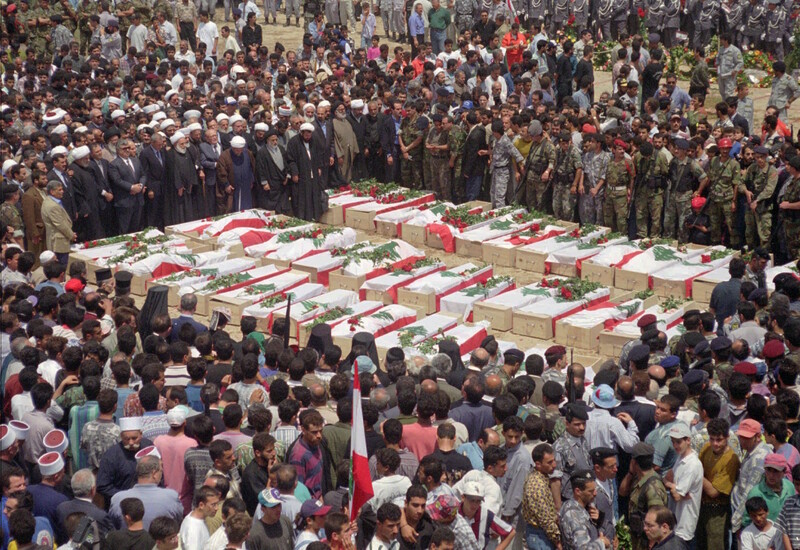
Officials and mourners surround coffins covered with Lebanese flags during a mass funeral in the southern Lebanese town of Tyre, 30 April 1996. The victims were killed in an Israeli artillery attack on a UN base in Qana, in southern Lebanon, on 18 April as part of an operation ordered by then Israeli Prime Minister Shimon Peres. Ahmed AzakirAP Photo
The obituaries for Shimon Peres have already appeared, no doubt prepared in advance as the news of his hospitalization reached the media.
The verdict on his life is very clear and was already pronounced by US President Barack Obama: Peres was a man who changed the course of human history in his relentless search for peace in the Middle East.
My guess is that very few of the obituaries will examine Peres’ life and activities from the perspective of the victims of Zionism and Israel.
He occupied many positions in politics that had immense impact on the Palestinians wherever they are. He was director general of the Israeli defense ministry, minister of defense, minister for development of the Galilee and the Negev (Naqab), prime minister and president.
In all these roles, the decisions he took and the policies he pursued contributed to the destruction of the Palestinian people and did nothing to advance the cause of peace and reconciliation between Palestinians and Israelis.
Born Szymon Perski in 1923, in a town that was then part of Poland, Peres immigrated to Palestine in 1934. As a teenager in an agricultural school, he became active in politics within the Labor Zionist movement that led Zionism and later the young State of Israel.
As a leading figure in the movement’s youth cadres, Peres attracted the attention of the high command of the Jewish paramilitary force in British-ruled Palestine, the Haganah.
Nuclear bomb
In 1947, Peres was fully recruited to the organization and sent abroad by its leader David Ben-Gurion to purchase arms which were later used in the 1948 Nakba, the ethnic cleansing of Palestinians, and against the Arab contingents that entered Palestine that year.
After a few years abroad, mainly in the United States, where he was busy purchasing arms and building the infrastructure for the Israeli military industry, he returned to become director general of the defense ministry.
Peres was active in forging Israel’s collusion with the UK and France to invade Egypt in 1956, for which Israel was rewarded by France with the needed capacity to build nuclear weapons.
No less important was the zeal Peres showed under Ben-Gurion’s guidance and inspiration to Judaize the Galilee. Despite the 1948 ethnic cleansing, that part of Israel was still very much Palestinian countryside and landscape.
Peres was behind the idea of confiscating Palestinian land for the purpose of building exclusive Jewish towns such as Karmiel and Upper Nazareth and basing the military in the region so as to disrupt territorial contiguity between Palestinian villages and towns.
This ruination of the Palestinian countryside led to the disappearance of the traditional Palestinian villages and the transformation of the farmers into an underemployed and deprived urban working class. This dismal reality is still with us today.
Settlers’ champion
Peres disappeared for a while from the political scene when his master Ben-Gurion, Israel’s founding prime minister, was pushed aside in 1963 by a new generation of leaders.
He came back after the 1967 War and the first portfolio he held was as minister responsible for the occupied territories. In this role, he legitimized, quite often retroactively, the settlement drive in the West Bank and Gaza Strip.
As so many of us realize today, by the time the pro-settlement Likud party came to power in 1977, the Jewish settlement infrastructure, in particular in the West Bank, had already rendered a two-state solution an impossible vision.
In 1974, Peres’ political career became intimately connected to that of his nemesis, Yitzhak Rabin. The two politicians who could not stand each other, had to work in tandem for the sake of political survival.
However, on Israel’s strategy toward the Palestinians, they shared the Zionist settler-colonial perspective, coveting as much of Palestine’s land as possible with as few Palestinians on it as possible.
They worked well together in quelling brutally the Palestinian uprising that began in 1987.
Peres’ first role in this difficult partnership was as defense minister in the 1974 Rabin government. The first real crisis Peres faced was a major expansion of the messianic settler movement Gush Emunim’s colonization effort in and around the West Bank city of Nablus.
Rabin opposed the new settlements, but Peres stood with the settlers and those colonies that now strangulate Nablus are there thanks to his efforts.
In 1976, Peres led government policy on the occupied territories, convinced that a deal could be struck with Jordan, by which the West Bank would be within Jordanian jurisdiction but under effective Israeli rule.
He initiated municipal elections in the West Bank but to his great surprise and disappointment, the candidates identified with the Palestine Liberation Organization were elected and not the ones loyal to Jordan’s Hashemite monarchy.
But Peres remained faithful to what he named the “Jordanian option” as an opposition leader after 1977 and when he returned to power in coalition with the Likud in 1984-1988. He pushed forward the negotiations on the basis of this concept until King Hussein’s decision to cede any political connection between Jordan and the West Bank in 1988.
Israel’s international face
The 1990s exposed to the world to a more mature and coherent Peres. He was Israel’s international face, whether in government or outside it. He played this role even after the Likud ascended as the main political force in the land.
In power, in Rabin’s government in the early 1990s, as prime minister after Rabin’s 1995 assassination, and then as a minister in the cabinet of Ehud Barak from 1999 to 2001, Peres pushed a new concept for what he called “peace.”
Instead of sharing rule in the West Bank and Gaza Strip with Jordan or Egypt, he now wished to do it with the Palestine Liberation Organization. The idea was accepted by PLO leader Yasser Arafat, who may have hoped to build on this a new project for the liberation of Palestine.
As enshrined in the 1993 Oslo accords, this concept was enthusiastically endorsed by Israel’s international allies.
Peres was the leading ambassador of this peace process charade that provided an international umbrella for Israel to establish facts on the ground that would create a greater apartheid Israel with small Palestinian bantustans scattered within it.
The fact that he won a Nobel Peace Prize for a process that advanced the ruination of Palestine and its people is yet another testimony to world governments’ misunderstanding, cynicism and apathy toward their suffering.
We are fortunate to live in an era in which international civil society has exposed this charade and offers, through the boycott, divestment and sanctions movement and the growing support for the one-state solution, a more hopeful and genuine path forward.
Qana
As prime minister, Peres had one additional “contribution” to make to the history of Palestinian and Lebanese suffering.
In response to the endless skirmishes between Hizballah and the Israeli army in southern Lebanon, where Hizballah and other groups resisted the Israeli occupation that began in 1982 until they drove it out in 2000, Peres ordered the bombing of the whole area in April 1996.
During what Israel dubbed Operation Grapes of Wrath, Israeli shelling killed more than 100 people – civilians fleeing bombardment and UN peacekeepers from Fiji – near the village of Qana.
Despite a United Nations investigation that found Israel’s explanation that the shelling had been an accident to be “unlikely,” the massacre did nothing to dent Peres’ international reputation as a “peacemaker.”
In this century, Peres was more a symbolic figurehead than an active politician. He founded the Peres Center for Peace, built on confiscated Palestinian refugee property in Jaffa, which continues to sell the idea of a Palestinian “state” with little land, real independence or sovereignty as the best possible solution.
That will never work, but if the world continues to be committed to this Peres legacy, there will be no end to the suffering of the Palestinians.
Shimon Peres symbolized the beautification of Zionism, but the facts on the ground lay bare his role in perpetrating so much suffering and conflict. Knowing the truth, at least, helps us understand how to move forward and undo so much of the injustice Peres helped create.
The author of numerous books, Ilan Pappe is professor of history and director of the European Centre for Palestine Studies at the University of Exeter.
Israeli scholar and historian Ilan Pappe argues the media’s demonization of Hamas provides Israel cover for continuing its siege and occupation of Palestinian territories


 band annie's Weblog