Search

band annie's Weblog

I have a parallel blog in French at http://anniebannie.net

Category

hasbara

NY Times tries to cover up its 7 October “mass rapes” fraud

Please consult the full coverage at Ali Abunimah’s site

Ali Abunimah Media Watch 6 February 2024

https://www.youtube.com/embed/wJcZ4YBUZpY?feature=oembed&The fallout has been growing from the so-called investigation by The New York Times into alleged mass rapes of Israeli women by Hamas fighters on 7 October – as I discuss with my colleague Nora Barrows-Friedman in the video above.

As The Electronic Intifada has reported, Israel’s sensational claims are not backed by any substantial evidence.

Rather, the lurid allegations of sexual violence appear calculated to demonize Palestinians and justify or distract from Israel’s genocide in Gaza.

Yet mainstream media and politicians continue to disseminate this atrocity propaganda without regard for the obvious holes in the Israeli narrative.

The Times article, published in late December, gave added credence to these claims, especially since its lead writer was Jeffrey Gettleman, a Pulitzer Prize-winning reporter.

But as we demonstrated, it is a journalistic fraud.

Members of the family of Gal Abdush, the deceased woman portrayed by Gettleman as a victim of the alleged “broad pattern” of sexual violence have repudiated the article and accused the Times of misleading and manipulating them. They say there is no evidence that Abdush was raped.

Gettleman also relied extensively for “evidence” on ZAKA, an extremist Jewish group that collects bodies and body parts for burial, and whose leaders have fabricated numerous accounts of atrocities from 7 October.

recent investigation by Israel’s Haaretz newspaper accuses ZAKA of using bodies of people killed on 7 October as props for fundraising and that as part of its effort “to get media exposure, ZAKA spread accounts of atrocities that never happened, released sensitive and graphic photos, and acted unprofessionally on the ground.”

Now some of Gettleman’s colleagues at the Times are also raising questions, wary of being caught in yet another of the newspaper of record’s notorious journalistic scandals.

On 28 January, The Intercept revealed that the Times pulled a high-profile episode of its podcast The Daily that was based on Gettleman’s mass rapes article.

The decision not to air the episode was taken “amid a furious internal debate about the strength of the paper’s original reporting on the subject,” according to The Intercept.

The episode was supposed to go out on 9 January but as criticism of Gettleman’s reporting grew internally and externally, The Daily shelved the original script and put the episode on hold.

A new script was drafted, one that according to The Intercept, “allowed for uncertainty, and asked open-ended questions that were absent from the original article.”

But even that new script “remains the subject of significant controversy” within the Times newsroom and has yet to air. Some New York Times staffers fear “another Caliphate-level journalistic debacle,” The Intercept reports.

That’s a reference to the 2018 multipart podcast Caliphate, which the Times had to retract after it turned out that the main character – a Canadian Muslim claiming to have been a former ISIS fighter in Syria – had fabricated his entire story.

But rather than learning the lessons from this – or its false reporting on Iraqi “weapons of mass destruction” that helped pave the way for the 2003 US-led war of aggression against Iraq – the Times leadership appears to be doubling down.

“There seems to be no self-awareness at the top,” one Times staffer told The Intercept.

The newspaper’s editors allowed Gettleman to publish a follow-up article on 29 January, in an attempt to patch up his original story.

As I explain in the video above – a segment from The Electronic Intifada’s livestream of 31 January – Gettleman fails to address the criticisms of his story.

Instead he spins, distorts and provides new claims that lack any credibility – anything but take responsibility for his egregious malpractice and spreading of atrocity propaganda.

In 2011, Hillary Clinton’s State Department disseminated false claims that Libyan forces had been given the drug Viagra so that they could carry out mass rapes as a weapon for war.

These fabrications were part of the Obama administration’s push to justify the US military intervention that overthrew the country’s leader Muammar Gaddafi and, among other things, turned Libya into a haven for human trafficking, including torture and sexual violence.

This week’s event at Columbia University – where Clinton now teaches – is set to be another forum for her to spread atrocity propaganda to justify war, this time on behalf of Israel.

Additional resources on Israel’s “mass rapes” propaganda

A War on Campus? Northeastern University Suspends Students for Justice in Palestine Chapter

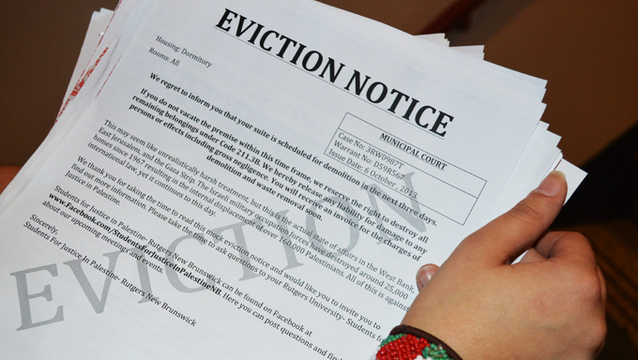
Mock-eviction-notice-Syjil-Ashraf-Targum

The Northeastern University chapter of Students for Justice in Palestine has become the latest student group to face reprimand for organizing around the Palestinian cause. Northeastern has suspended the group until 2015, barring it from meeting on campus and stripping it of any university funding. The move comes just weeks after student activists distributed mock eviction notices across the campus during Israeli Apartheid Week. The notices were intended to resemble those used by Israel to notify Palestinians of pending demolitions or seizures of their homes. We speak to Northeastern Students for Justice in Palestine member Max Geller and Ali Abunimah, co-founder of The Electronic Intifada and author of the new book, “The Battle for Justice in Palestine.” His new book includes a chapter titled “The War on Campus.”

Transcript

          This is a rush transcript. Copy may not be in its final form.

JUAN GONZÁLEZ: The Northeastern University chapter of Students for Justice in Palestine has become the latest student group to face reprimand for organizing around Palestinian issues. Northeastern University has just suspended the group until 2015, barring it from meeting on campus and stripping it of any university funding. The moves comes just weeks after student activists distributed mock eviction notices across the campus during Israeli Apartheid Week. The mock notices were intended to resemble ones used by Israel to notify Palestinians of pending home demolitions or property seizures.

AMY GOODMAN: Northeastern University accused the student group of disregarding university policies over an extended period of time. Michael Armini, Northeastern’s senior vice president of external affairs, said, quote, “The issue here is not one of free speech or the exchange of disparate ideas. Instead, it is about holding every member of our community to the same standards, and addressing SJP’s non-compliance with longstanding policies to which all student organizations at Northeastern are required to adhere.”

We’re joined now by two guests. Max Geller is with us, Northeastern University School of Law student and a member of Students for Justice in Palestine. And Ali Abunimah is with us in studio, co-founder of The Electronic Intifada, author of a brand new book, The Battle for Justice in Palestine. His new book includes a chapter headlined “The War on Campus.” read on and see the video here

Israel army publishes fake image of huge “Gaza shopping mall”

      Submitted by Ali Abunimah on Wed, 08/14/2013 – 20:41

idf_blog.jpg


An enormous shopping mall the Israeli army claims is in the Gaza Strip. (Source: IDF Blog)

In one of its periodic efforts to deny the devastating effects of its siege of Gaza, the Israeli occupation army published a blog post on 12 August claiming that Palestinians in Gaza are “out in force, enjoying themselves in sparkling new malls, beautiful beaches and hotels, and doing their shopping in pristine grocery stores and markets heaving with fresh produce.”

The “IDF blog” includes the impressive photo above of a shopping mall where Palestinians in Gaza are supposedly shopping for the latest imported fashions.

I showed the photo to The Electronic Intifada’s correspondent in Gaza, Rami Almeghari. His reaction: “I can assure you that there is no such mall in Gaza.” Rami is quite right.

Fake image

If you do a Google Image search using the image from the “IDF” blog post, the same image turns up associated with the Metro Plaza shopping mall in Kolkata, India as well as several other places.

kolkata.jpg


A Google image search turned up many examples, like this one, of the image associated with other malls.

Where is it really?

But the “Gaza mall” photo published by the Israeli army is actually an image of the Suria KLCC Mall in Kuala Lumpur, Malaysia, as numerous user-generated photographs on the travel review site TripAdvisor.com attest.

You can also see many people shopping at the mall – in Malaysia – in this video:

Israeli army sources: anti-Palestinian, Islamophobic blogs

Before publishing it on 12 August on its English-language website, the Israeli army published the same post in French on 4 August.

It was then published by the anti-Palestinian website Tribune Juive the same day.

But some of the material had already circulated on many other Islamophobic websites long before.

For example, the same Kuala Lumpur mall photo, purportedly in Gaza, appeared on a virulently Islamophobic blog called “Barenaked Islam” in April 2012, and was disseminated on Facebook by “Geert Wilders supporters,” a page dedicated to the Islamophobic Dutch politician.

It also appeared on “Religion of Peace,” another anti-Muslim hate site.

It would appear that the Israeli army gets its information about Gaza from Islamophobic hate sites.

Forced dependency

The Kuala Lumpur shopping mall is vastly bigger than any commercial facility anywhere in Gaza.

But another image, the supermarket shown on the “IDF” blog, appears to be the Metro supermarket in Gaza. I didn’t visit it, but I did visit the Abu Dallal supermarket in Nuseirat refugee camp.

I was told that Abu Dallal is one of largest supermarkets in Gaza. By American, European, or Jordanian standards it is not very big, smaller than an average CVS or Boots drugstore.

More important than its size, however, is that like other stores in Gaza, it is packed full of Israeli goods.

That’s one of the ways the Israeli blockade creates dependency: While Gaza industry and agriculture are devastated by the siege, Israel is happy enough to see its own companies profiting from people in Gaza, siphoning off what little income they have, whether from work, humanitarian aid or remittances abroad, by selling them Israeli goods.

Poverty and dependency are the real effects of siege

But Israel is much more restrictive when it comes to supplies that meet basic needs and could allow Gaza to move out of dependency. There is, for example, a shortage of 250 schools for Gaza’s children, which cannot be built due to the lack of building supplies.

And the reality is that while there is food in Gaza, “severe poverty has increased over years of closure and because of travel restrictions,” Gisha, an Israeli nongovermental organization that monitors the siege, noted in a recent factsheet.

More than 70 percent of the Gaza population receives some form of humanitarian aid, compared with one third in the year 2000.

For imports of raw materials and many basic goods, Gaza’s economy remains heavily dependent on underground tunnels to Egypt, as I saw myself during my visit, and as Gisha also documents.

Since the Egyptian military coup on 3 July, the Egyptian army, which works closely with Israel, has been instensifying its effort to destroy the tunnels.

Exports crushed

Israel continues to crush Gaza’s export industries. According to the UN Office for the Coordination of Humanitarian Affairs, Israel has allowed a total of 94 trucks out of Gaza in 2013 – that’s about a dozen a month from a population of almost 1.7 million people. Insignificant.

By contrast, in 2007, the year before the siege began to bite, more than 5,000 trucks were allowed out of Gaza. In 2001 it was 15,000.

Cynical propaganda

The Israeli army’s cynical propaganda is supposed to distract people from the fact that the vast majority of people in Gaza live in deep poverty and a very precarious economic situation, without electricity for 8-12 hours per day, and depend on humanitarian aid, due to Israel.

Gaza’s per capita annual GDP is just over $1,000 dollars. Compare that with $32,800 for Israel.

The lesson: learn the facts and don’t be taken in by Israeli army fabrications.

Update: 15 August

Following the publication of this post, the Israeli army removed the photo and told Israel’s Haaretz that it had been a mistake made in “good faith.”

It also tweeted out an acknowledgment that the photo was “incorrectly sourced” – though without noting that its source was an Islamophobic hate site peddling fabrications and anti-Palestinian propaganda.

Here is a screenshot of the entire “IDF blog” post before the Israeli army altered it.

With thanks to Twitter user @sallyidwedar who initially spotted “IDF” fakery, and Omar Ghraieb for answering my queries about Gaza’s supermarkets.

Hasbara fail: the ambassadors mutiny

by Annie Robbins and Phil Weiss on January 3, 2013 37


Some late developments from Israel only solidify the impression that this country is working hard to destroy its international reputation and simply cannot help itself because of internal pressures from rightwing politicians.

First, annexation of the West Bank is being pushed aggressively so that Likudniks can win the Israeli election, in complete disregard of international opinion. Harriet Sherwood in the Guardian:

Prominent members of Israel‘s ruling Likud party have proposed the annexation of part of the West Bank as the battle for rightwing votes intensifies before the general election in less than three weeks.

Government minister Yuli Edelstein told a conference in Jerusalem that the lack of Israeli sovereignty over Area C – the 60% of the West Bank under full Israeli military control in which all settlements are situated – “strengthens the international community’s demand for a withdrawal to the pre-1967 lines”.

About that international opinion: Here is a delicious story in Ynet about the Israeli ambassadors complaining to the home office about the crap they have to push to the world, and a Netanyahu aide slapping them down:

[Ambassador to the UN Ron] Prosor, one of the highest ranking Israeli diplomats in the world, asked [National Security Council head Yaakov] Amidror what was the rationale behind timing the decision to promote construction in area E1 (between Jerusalem and Ma’aleh Adumim)  after the UN resolution to upgrade the Palestinian Authority to an observer state status.

Prosor’s fellow ambassadors, who found it difficult to explain to the world the basis of Israel’s foreign policy on the matter, applauded Prosor….

Ambassadors left the conference feeling highly displeased. “It ended in unpleasant tones. Prosor asked a completely legitimate question and was rebuked. We don’t argue that our job is to represent the state, but those who do have to understand the logic behind its decisions.”…

President Shimon Peres also discussed the Palestinian issue on Monday, for the second time this week. A day after declaring Palestinian President Mahmoud Abbas to be a partner for peace and severely criticizing Netanyahu and Lieberman’s handling of diplomacy, the president said that “there is nothing wrong with talking to Hamas, as long as it accepts the terms of the Quartet

A key point in that Ynet piece is that the government has no choice but to annex, and that it knows it is killing itself internationally:

It should be noted that the Foreign Ministry recommended to the government to postpone any counter-measures to the Palestinian bid so as not to focus international attention on Israel, fearing it may be seen as vindictive.
OK, but there is too much internal political pressure not to annex. Again from that Ynet piece: “Amidror said that there was a need to make it clear to the Palestinians that unilateral moves on their part come with a price.” And check this out, from the Times of Israel, echoing that Guardian piece above:

[Likud member of Knesset] MK Yariv Levin advocated a slow but steady de facto annexation of the West Bank, mainly by expanding existing settlements and taking whatever steps were possible to apply laws on Jewish communities beyond the Green Line.

“In this way, we will try, slowly but surely, to expand the circle of settlements, and to afterwards extend the roads that lead to them, and so forth. At the end of this process, the facts on the ground will be that whatever remains [of the West Bank] will be merely marginal appendages,” he said.

Last week, two senior Likud MKs caused an uproar when they stated that the party does not support a two-state solution, despite Prime Minister Benjamin Netanyahu’s 2009 Bar-Ilan University speech, during which he in principle agreed to a demilitarized Palestinian state, if the Palestinians recognized Israel as a Jewish state.

Israel might think it can annex under the radar. But nothing is escaping European attention; this is what their ambassadors have to sell.

The mutiny by the ambassadors may have been sparked by an upstart Israeli thinktank that released a study last week.

“Israel’s public diplomacy apparatus, contrary to its poor reputation, is well-coordinated and highly sophisticated. Israel’s diplomatic isolation, therefore, cannot be attributed to a mythic ‘hasbara problem’; it can only be a product of Israeli policy itself

Haaretz reported on the study: There is causal connection between Israel’s poor international image and the policies of its government.

“Instead of dealing with the connection between the policies of Israel’s government and the country’s image in the world,” [Molad thinktank study] continues, “a myth is taking hold, one which stresses an ‘advocacy problem’ caused by anti-Israel organizations and institutions which exploit double standards and even anti-Semitic tendencies in the international community in order to damage Israel.”

The study insists that “inflating anti-Israel propaganda on the one hand, and inflating criticism of Israeli advocacy on the other hand, deflects public attention away from the causal connections between the erosion of Israel’s image and of its international status and the policies of its government.”

And interestingly, Haaretz even suggested that the ambassadors should bring the study up:

Next week in Jerusalem, the Foreign Ministry will hold its annual conference of the country’s ambassadors around the word. During past meetings, former Foreign Minister Avigdor Lieberman regularly upbraided and insulted Israel’s ambassadors, the participants of the conference. He claimed that instead of explicating Israel’s policies and positions more assertively, and defending “national honor,” the country’s diplomats cowered and surrendered around the world. But now Lieberman, facing indictment, has left the Foreign Ministry – and the ambassadors conference this year may serve as a good opportunity to discuss Molad’s findings.

About Annie Robbins and Phil Weiss
Philip Weiss is Founder and Co-Editor of Mondoweiss.net.

source

AP: Anti-Muslim filmmaker in hiding after protests

 September 12, 2012 2:35 AM
Egyptians protest outside U.S. Embassy in Cairo TuesdayEgyptians protest outside U.S. Embassy in Cairo Tuesday (AFP/Getty Images)

(AP) LOS ANGELES — An Israeli filmmaker went into hiding Tuesday after his movie attacking Islam’s prophet Muhammad sparked angry assaults by ultra-conservative Muslims on U.S. missions in Egypt and Libya, where one American was killed.


Speaking by phone from an undisclosed location, writer and director Sam Bacile remained defiant, saying Islam is a cancer and that the 56-year-old intended his film to be a provocative political statement condemning the religion.

full article here

Wikileaked: Lobbying firm tried to help Syrian regime polish image as violence raged

Posted By Josh Rogin  

The lobbying firm that brought you a Vogue story featuring the Syrian first lady was still trying to help the Syrian regime improve its image abroad two months after the notoriously ill-timed article was published and then scrubbed, as the country descended into violence, according to a document revealed by Wikileaks.

The international firm Brown Lloyd James (BLJ) was officially employed by the Office of the First Lady of the Syrian Arab Republic Asma al-Assad in Nov. 2010 for $5,000 per month to help arrange and execute the article, which appeared in the March 2011 edition of Vogue. The fawning piece, entitled, “Rose of the Desert,” was actually scrubbed from the Vogue website out of embarrassment when Assad began a brutal crackdown on non-violent protests that month. But you can still read it here.

BLJ’s contract with the Assad regime, signed by BLJ partner Mike Holtzman and Syrian government official Fares Kallas, expired in March of last year, according to documents posted on the Foreign Agents Registration Act website. The firm had claimed its work on behalf of the Assads ended in Dec. 2010.

But in May 2011, BLJ sent another memo to Kallas and the Syrian government, giving them advice on how to improve their image and institute a more effective public relations strategy amid the exploding violence in Syria. The memo was published by the Wikileaks website in their dump of 2.4 million Syrian documents this week.

“It is clear from US government pronouncements since the beginning of the public demonstrations in Syria that the Obama Administration wants the leadership in Syria to survive,” begins the May 19, 2011, memo. “Unlike its response to demonstrations in some other countries in the region, there have been no US demands for regime change in Syria nor any calls for military intervention, criticism has been relatively muted and punitive sanctions — by not being aimed directly at President Assad — have been intended more as a caution than as an instrument to hurt the leadership.”

The memo was sent only days after Syrian military forces stormed the town of Baniyas and moved into the cities of Hama and Homs, where civilian massacres soon followed. Three days before the memo was sent, 20 bodies of murdered civilians were discovered in a shallow grave in the city of Daraa.  President Barack Obama called for Assad to step down that August.

The memo goes on to warn the Assad regime that the mood in Washington is turning against the regime, as evidenced by tougher statements coming from Sen. John Kerry (D-MA) and increasingly critical stories in the U.S. media. BLJ warns the Assads that if they don’t get smart about public relations quick, the U.S. system might just turn against them.

“[Increasing bad PR] not only reinforces the Administration’s change of tone, it is emboldening critics — who maintain that Syria’s reform efforts are not sincere–and building up pressure on the US government to take further, more drastic steps against the country,” the memo states.

BLJ then goes into an extensive set of recommendations for how the Assad regime can put a better spin on the largely government-led violence.

“[S]oft power is needed to reassure the Syrian people and outside audiences that reform is proceeding apace, legitimate grievances are being addressed and taken seriously, and that Syria’s actions are ultimately aimed at creating an environment in which change and progress can take place,” BLJ explains.

The Assad regime should appoint one figure to “own” the reform agenda to convince Syrians and the outside world the reform effort is “sincere,” BLJ advised.

“Refocusing the perception of outsiders and Syrians on reform will provide political cover to the generally sympathetic US Government, and will delegitimize critics at home and abroad,” the memo reads.

BLJ even recommends that First Lady Asma al-Assad should “get in the game,” do a “listening tour” with the president, and start doing press interviews to create an “echo chamber” in the media that reinforces the idea that Assad is reform-minded.

“The absence of a public figure as popular, capable, and attuned to the hopes of the people as Her Excellency at such a critical moment is conspicuous. The key is to show strength and sympathy at once,” BLJ writes.

BLJ also recommends that the Assad regime get more serious about containing negative media stories and the voices of the Syrian opposition around the world, which the memo calls “the daily torrent of criticism and lies.” BJR told the Assads they should institute 24-hour media monitoring in the United States and challenge and then remove any websites that are “false.”

Overall, the memo recommends that the Assad regime get smart on messaging and start trying to convince the world that the Syrian government is benevolent, that all killings by the military were not officially sanctioned, and that the crisis is not as bad as the international community believes.

“Efforts should be made to convey ‘normalcy’ and a contrast to current news depicting Syria as being on the verge of chaos,” the memo reads.

Contacted for comment by The Cable Friday, Holtzman said that their official work with the Syrian government came at a time when many, including the U.S. government, had high hopes for progress in opening up Syria. He also said that the May 2012 memo was a “last-ditch” effort “to encourage a peaceful outcome rather than violence.”

Holtzman said that BLJ was not paid for writing the memo and that the firm hasn’t done any work for the regime since. He framed the memo as an attempt to get the Assad regime to behave better.

“We noted that if the regime was serious about dramatic reform that ‘reform-oriented outreach must be dramatically improved’, and recommended that Syria begin to directly ‘engage families and young people’ in these reforms,” Holtzman said. “Unfortunately, our advice was ignored and our professional involvement in the country ended, just prior to new U.S. sanctions being put into effect.”

David Kenner contributed reporting to this article.

Harvard Israel conference presents ‘innovation’ to hide occupation

by on April 23, 2012 20

herzl
(Image: Facebook)

As a response to the highly successful One State Conference at Harvard held last month, a number of Harvard undergraduate and graduate students recently organized the Israel Conference. According to its website and an op-ed by the conference’s organizers, the conference is meant to showcase Israel’s innovation – in a way that is palatable to all parties involved in activism around the Israeli-Palestinian conflict. Speakers at the conference included Harvard history professor Niall Ferguson, Governor of the Bank of Israel Stanley Fischer, the author of the book “Start-Up Nation” Dan Senor, Dennis Ross and a number of other panelists and entrepreneurs.Unfortunately, the Israel Conference brought to campus individuals whose disregard for international law raises questions regarding the conference’s dubious educational quality.

At least two panelists – Asaf Bar Ilan and Michael Eisenberg – are involved in illegal settlement activities. The first owns a farm in the occupied Golan Heights – territory that belongs to Syria and has been occupied by Israel since 1967. The second sits on the board of a religious and military school in the Gush Etzion settlement bloc in the West Bank. Both of these cases are a direct affront to the Geneva Conventions, which explicitly forbid the expropriation and settlement of occupied land by citizens of the hostile state – in this case, Israel. Sustainable innovation that deserves praise does not stem from illegal activities. The involvement of two panelists who violate international law in their daily lives proves the conference’s lack of credibility, and reflects quite clearly the inextricability of Israeli “innovation” from the occupation of Palestinian land and violation of Palestinian rights.  (Screenshots: http://israelconference2012.org/)

barilan
eisenberg

As troubling as the presence of settlers coming to speak at a university is (we’ve been long since sadly habituated by the presence of both IDF and US military officials as a regular presence), so too is the attempt by the conference organizers to recast Israel purely as an “innovation state” an undeniable propaganda effort.

After being called out for their whitewashing efforts in an op-ed by fellow Palestine Solidarity Committee member Alex Shams, being faced with the facts of Israel’s innovation-Occupation duo in another op-ed, and being faced with a counter-campaign whose posters you can see below, the conference organizers published another op-ed defending their enterprise using the tattered shield of “we self-sacrificing Israelis only want peace but get nothing but rockets in return.” Aside from the fact that any kind of terrorism directed at civilians is a war crime and is never condoned, depicting the so-called peace process as an Israeli-only enterprise blindly buries the efforts of thousands of Palestinians (and citizens of other countries) who have dedicated their lives to achieving a solution for this conflict. It seems, however, that in addition to trying to conceal the unpleasant matter of the Occupation underneath Israeli success stories, the conference organizers are also trying to bury decades of global peace struggle in the same casket where Israel apologists have interred nonviolent Palestinian resistance and where they are trying to (metaphorically) entomb pro-peace Israeli activists and NGOs.

Harvardposter

This poster was part of a media campaign run by a number of independent individuals at Harvard to challenge the assumptions and publicity of the Israel Conference and instead present the public with a different perspective on the roots of Israeli innovation: ethnic cleansing, the Occupation, and foreign subsidies.

The text says: “Come learn the exciting secrets of the vibrant ‘start up nation’ & the realities of Israeli innovation. After ethnically cleansing 700,000 Palestinians in 1948, we demolished their homes and built farms and parks on top. Or as we say, ‘made the desert bloom!’

Since occupying the West Bank and Gaza in 1967, we have explored diverse and exciting new ways to start wars against our neighbors. Indeed, Israel is forever optimistic about its ability to never be held accountable for its crimes under international law!

Is it sustainable? Since 1949, Israel has received about $109 billion in US aid, including $3 billion in 2011, despite being one of the most developed countries on Earth!”

fischer
An image of Mr. Fischer’s presentation.

At the conference itself, a friend of mine who attended told me how Niall Ferguson, Harvard history professor and one of the keynote speakers, engaged in the classic game of listing Arab versus Jewish inventions, proving the point (as if that needed to be done) that the conference is nothing but a political propaganda tool. Stanley Fischer, Governor of the Bank of Israel and other keynote speaker, decided to focus instead on the demographic threat posed by Arab population growth rates – another Zionist trope and indication that the main course “innovation” comes with a side of fear politics and demagoguery.

At the end of the day, no one asked – or rather attempted to coerce – Harvard University to shut down the Israel Conference or dissociate itself from it, as was done by vocal pro-Israel groups for the One State Conference. Instead we hope that all attendees, both Harvard-affiliated and not, will see through this hasbara wall engraved with upward-trending NASDAQ arrows and understand what it hides: the legitimization of the settler movement, a distortion of the history of the “peace process”, a decades-old colonial establishment, and “sustainable innovation” based on extensive foreign aid and lack of legal accountability.

About Giacomo Bagarella

Giacomo Bagarella is a Government and Psychology undergraduate student at Harvard. He is one of the co-chairs of the Harvard College Palestine Solidarity Committee. Giacomo has spent the last two summer in the Middle East, studying Arabic in Jordan and working for a human rights organization in Cairo.

Peace, Propaganda and the Promised Land

This video was included in the previous post from Mondoweis but it is so important that I post it separately

click on image

 U.S. Media & the Israeli-Palestinian Conflict How Israel manipulates and distorts American public perceptions Through the voices of scholars, media critics, peace activists, religious figures, and Middle East experts, Peace, Propaganda & the Promised Land carefully analyzes and explains how–through the use of language, framing and context–the Israeli occupation of the West Bank and Gaza remains hidden in the news media, and Israeli colonization of the occupied terrorities appears to be a defensive move rather than an offensive one. keywords: Palestine Israel Zionist Jew Islam Jewish Idi Amin Noam Chomsky Media Bias Big Brother Rupert Murdoch FOX News Sky News George Orwell Police State Military Occupation Iran Lebanon Terrorstorm Alex Jones manipulation media movements revolution alternative media Video available for sale here : http://www.mediaed.org/videos/MediaRaceAndRepresentation/PeacePropaganda Watch current Israel/Palestine news: http://newstree.org/search.jsp?query=Israel%20palestine%20video:1&hp=10&sort=ndateinmin&reverse=true&vx=1«

“Why Don’t We Dialogue?” SJP-UCLA’s IDF Walkout

[youtube http://youtu.be/kWLk7vm2Zkk?]

Blog at WordPress.com.

Up ↑