Dr. Adnan Al-Bursh was the head of the orthopedic wing at Shifa Hospital in Gaza City. During the war, he had to wander from one hospital to the next, as they were all destroyed by the IDF. He has not been back to his home in Jabalya since the start of the war, and last December all trace of him disappeared. Recently, it transpired that he had died in an Israeli jail, apparently due to the torture of beatings during interrogation.
The last people to see him were other doctors and detainees who have been released. They told Haaretz correspondents Jack Khoury and Bar Peleg that they had barely recognized him. “It was clear he had been through hell, torture, humiliation, and sleep deprivation. He wasn’t the person we knew; he was a shadow of himself.” (Haaretz, May 12.) A photo of him published after his death showed an elegant man. A photo from during the war showed his hospital gown covered in blood. He had a wife, Jasmine, and they had six children. He studied medicine in Romania and did a residency in the United Kingdom. The rapper Tamer Nafar wrote a beautiful lament for him. (Haaretz, May 6.)
A doctor, a hospital ward director, was beaten and tortured to death in an Israeli jail. That did not set off alarms here. Nearly all his physician colleagues, including heads of the medical establishment and those who take part in the horrific torture ongoing at Sde Teiman base and in Israeli prisons, did not say a word. A department director was beaten to death. So what? After all, almost 500 doctors and medical staffers have been killed in the war and their fate failed to arouse any attention. So why should Al-Bursh‘s death attract any attention? Because he was a department director? No war crime committed by Israel in Gaza has aroused any feelings here in Israel, with the exception of the joy felt by the bloodthirsty right-wing.
On top of the doctor’s death came another heinous act: the response of the authorities. The Shin Bet was silent as usual. Ex-Shin Bet officers are now star commentators on television, asked to show us the way, to give us their opinion, but the Shin Bet never talks about those it has interrogated and tortured. The IDF shirked responsibility; the doctor was only “processed” at an army detention facility, and was immediately transferred to the Shin Bet interrogation facility in Kishon, and from there to Ofer Prison, which is under the charge of the Israel Prison Service. The IPS response was pure audacity: “The service does not address the circumstances of the deaths of detainees who are not Israeli citizens.”
A man dies in prison, yet the Israel Prison Service does not think it should report the circumstances of his death to the public because he was not a citizen of the state. In other words, the lives of those who are not citizens have no value in Israeli prisons. We should remember this when an Israeli is arrested in Cyprus for rape, or in Peru for drugs, and we are outraged by the conditions of his detention. We remember this even more poignantly when we complain to the world, and rightly so, about the fate of our hostages.
Dr. Adnan Al-Bursh, who was the head of orthopedics at Al-Shifa Hospital in Gaza City.
How can people identify with the pain felt by Israelis over the fate of the hostages, when these same Israelis turn out to be cold-hearted and indifferent to the fate of the other side’s hostages? Why isn’t there a single banner in Tel Aviv’s “Hostage Square” calling for an investigation into the killing of the doctor from Gaza? Is his blood less red than the blood of the Israeli hostages who died? Why should the whole world take an interest and work only for our for hostages, and not for the Palestinian hostages, whose conditions of imprisonment and whose deaths in Israeli prisons should horrify everyone?
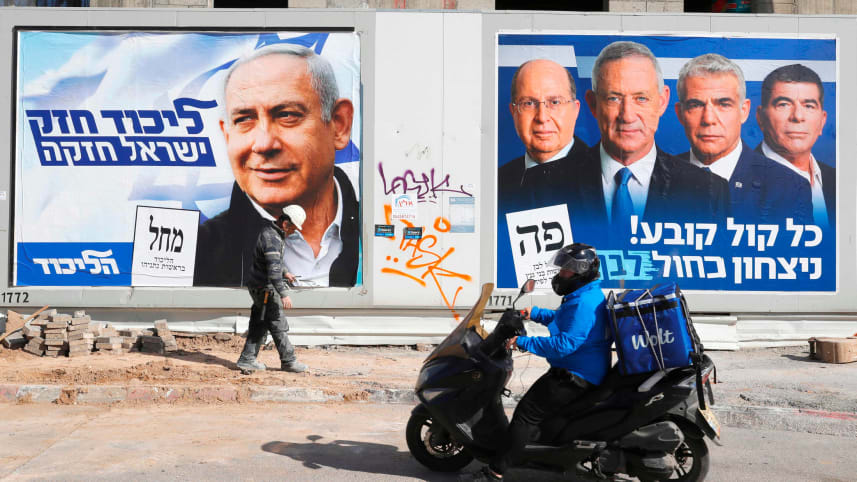
A man walks past electoral campaign posters in Tel Aviv on April 3, 2019.JACK GUEZ / AFP
There will be one certain result from Tuesday’s election: Around 100 members of the next Knesset will be supporters of apartheid. This has no precedent in any democracy. A hundred out of 120 legislators, an absolute of absolute majorities, one that supports maintaining the current situation, which is apartheid.
With such a majority, it will be possible in the next Knesset to officially declare Israel an apartheid state. With such support for apartheid and considering the durability of the occupation, no propaganda will be able to refute the simple truth: Nearly all Israelis want the apartheid to continue. In the height of chutzpah, they call this democracy, even though more than 4 million people who live alongside them and under their control have no right to vote in the election.
Of course, no one is talking about this, but in no other regime around the world is there one community next to another where the residents of one, referred to as a West Bank settlement, have the right to vote, while the residents of the other, a Palestinian village, don’t. This is apartheid in all its splendor, whose existence nearly all the country’s Jewish citizens want to continue.
Prince William watches the World Cup with the Jordanian Crown Prince Hussein in the Beit Al Urdun PalaceTwitter
Suddenly – another world. Suddenly a sense of justice. Suddenly solidarity with minorities, suddenly a chance for the weak. Suddenly, a world without Israel at its center. Without Israel at its navel. Without Israel at all. No referee or usher. Not even security advisers and economic manipulators from Israel, and the world is getting by.
No cherry tomatoes and no Jewish genius. No Benjamin Netanyahu, at least until the finish. Suddenly it’s not important whether it’s good for the Jews or not. Suddenly no America, either. A world without America. Without Donald Trump. Without even China. Suddenly, Croatia is an empire. Nigeria is hope. Egypt shed a tear. Uruguay schooled everyone in its group. Iranians are human beings, determined, sympathy-inspiring fighters, may they only succeed. People in Bat Yam are waving their flag and crossing their fingers for them shamelessly. Another world.
Suddenly a world with equal rules for everyone. With an international law everyone respects. No Holocaust discounts. No chosen people. With a Turkish referee who tells Lionel Messi what’s what and a black referee from Africa who blows the whistle on whites from Europe. Suddenly a nation. Not of hatred, but of pride. Turns out there is something like that, who knew?
Even a nation that isn’t yours can move you and fill you with pride. A nation free of nationalism. Suddenly also an anthem. Loud, but without belligerence. No religion. No race. A black player in Denmark’s uniform, a white player in Nigeria’s uniform. The French team’s tricolor. Only Iceland is all white, and Korea is all Asian. But they too are on the map. And Russia is a model of good taste and organization. Who knew you were like that, mother Russia.
Suddenly even Arabs are human beings. Arabs, imagine that. Arabs. Like in Halhul. Arabs are better than the Israelis, at least in something. How will we hide our shame and what will we do with the cognitive dissonance. They’re better even than Eran Zehavi. And no Eli Tabib. You have to pinch yourself to believe it.
And yet, an Israeli broadcaster wishes Saudi Arabia and Egypt a tie, so neither is humiliated. Would you believe it? Suddenly no “displays of anti-Semitism” around every corner, no Israeli-flag burning, which the knee-jerk broadcasters keep searching for. Suddenly there are no Jews, either. No Jewish organizations. No Jewish philanthropists.
Suddenly there’s something to talk about with the children. Suddenly it’s okay to get excited without restraint. Emotions can overflow. Let Sweden win. Let Germany sweat and be embarrassed, if only for a moment. God help Senegal. Let Egypt not be degraded. Let Peru go home with points. Let Morocco and Tunisia’s fans get some joy.
Suddenly a chance for the weak. Suddenly perhaps they all really are human beings. Even the Iranians, including the Saudis. And all this without America, this must be said again and again, a world without America. Even without Jared Kushner. A world without Roni Daniel and Amit Segal, who always know everything, without Nir Dvori, who recites Israel’s military successes, no Ayala Hasson and no Yonit Levy. A global world without Nadav Eyal. Another world. With Latin America and black Africa, without Miri Regev’s baloney, Bezalel Smotrich’s racism, Avi Dichter’s nonsense, Ofir Akunis’ flatulence, Stav Shafir’s struggles and Avigdor Lieberman’s barking. Can you imagine that?
A world without yarmulkes and without settlers. A tournament without a divine promise, apart from Maradona. Almost without any racist or chauvinist remarks from the broadcasters, except for the Messi and Western Wall affair, which is also, praise God, behind us.
A world almost without blood, and very little violence. No arrogant babble, no “we’ll retaliate at the appropriate time and place” and “prepared for every scenario.” Only the ball speaks and anything can happen.
A world without generals and politicians. Without lawyers and strategic advisers in the studios. A beautiful world, If only for a moment. And look, already a headline is flickering on the news site, putting an end to all this: “Zionist Union in crisis.” End of the world.
Israeli prosecutors concluded that the two soldiers acted properly when they shot and killed an unarmed teenager 10 meters away as he ran away from them
A.G. and A.D. presumably celebrated. Maybe they raised a toast with their lawyers at some fashionable pub, or perhaps they just basked in the good news with their families. It was the relief of their lives. The poor souls’ nightmare is over. How they harassed them when the teenager was killed, but all’s well that ends well: The central district prosecution decided last week to withdraw the indictment against them, two-and-a-half years after it was filed.
True, it was sickeningly ridiculous that they were charged with “an act of haste and negligence” for shooting an unarmed, already wounded teenager in the back as he was running or his life. Still, it was an indictment, which itself was only filed after the deceased’s family and B’Tselem petitioned the High Court of Justice.
For a moment it seemed as if the two would be given a suspended sentence of maybe a day, or even a one-penny fine for killing a boy who had not yet turned 16, even though he didn’t pose any danger or threat to them. But even this faint hope for a remnant of delayed and symbolic justice – for even the faintest likeness of justice – was dashed, and what could be more predictable than that?
The indictment was withdrawn. A.G. and A.D. acted properly when they shot an unarmed teenager from a range of 10 meters as he ran from them. They violated nothing. Their act of killing wasn’t even hasty or negligent. They are good soldiers, excellent ones, even though the day after the killing a senior officer said, “Something that wasn’t right happened there.” Not right, but apparently not wrong enough. So go ahead, dear soldiers; continue to kill Palestinian teenagers who don’t endanger you. You can even kill them as they run away, because no harm will come to you.
A.G. and A.D. were a platoon commander and a soldier from the 71st Battalion of the Armored Corps. They shot from behind and killed Samir Awad, who tried to cross the fence that constricts his village, as he ran from an ambush the soldiers had set up in the prickly-pear bushes. They shot him in the back and will never be punished for their act. They shot him in the leg first, and after he fell wounded and got back on his feet they managed to grab him by the arm, but he got away from them. Then they shot him twice from behind, a bullet to the back of his neck and a bullet in his back, killing him. So now they can calmly fly off to India or Costa Rica for their post-army trip – perhaps they’ve already done so – and forget everything. But the home of the boy they killed in Budrus will never be the same again.
Just before Palestinian teen Ahed Tamimi slapped one of the soldiers who’d invaded her yard, she learned that her 15-year-old cousin Mohammed had been shot in the head at close range
Mohammed Tamimi. Credit Alex Levac
Half a head.
The left side of his face is twisted, swollen, fragmented, scarred; there’s congealed blood by his nose, stitches in his face; one eye is shut, a seam line stretches across his whole scalp. A boy’s face turned scar-face. Some of his skull bones were removed in surgery and won’t be returned to their place for another six months.
Mohammed Tamimi, just 15, and he is already a disabled shooting victim and a released prisoner.
That’s life under the occupation in Nabi Saleh, where people are occupied with the struggle. About an hour after Mohammed was shot in the head at short range by an Israel Defense Forces soldier (or a Border Policeman), his now-better-known cousin, Ahed Tamimi, went to the yard of her house and tried to forcibly expel the two soldiers who had invaded her turf, while the camera rolled. It’s a reasonable assumption that she tried to vent her wrath on the soldiers in part because of the shooting of her cousin an hour earlier.
Mohammed Tamimi, Ahed Tamimi’s 15-year-old cousin who was shot in the head by an Israeli soldier.
Only a few dozen meters separate the place where the soldiers shot Mohammed and Ahed’s home; only an hour separated the two events. People in her family relate that Ahed, 16, burst into tears when she heard that her cousin had been shot and was in serious condition. From the window of her home at the edge of Nabi Saleh, a small village near Ramallah, you can see the stone wall that surrounds the luxurious building, under construction, that Mohammed climbed in order to get a view of the soldiers who were still inside. At that point he was shot in the head with one bullet from a distance of a few meters, and fell bleeding to the ground from a height of three meters (nearly 10 feet).
Now Ahed is in detention and Mohammed is recovering from his shattering head wound. This week, Mohammed still didn’t know about the arrest of his cousin, who has become an icon. In view of his condition, his family hasn’t told him.
We meet him in his uncle’s house, which is adjacent to his own home. He speaks softly, occasionally runs his hand across the scars on his head, lies down from time to time on the sofa to rest. He’s in the 10th grade in the village’s coeducational school, where Ahed is a student one year ahead of him. His father, Fadel, is a taxi driver; his mother, Imtisal, a homemaker. Last year, he spent three months in an Israeli prison.
At 2 A.M. on April 24, 2017, soldiers broke into their home by force, entered the children’s room, snatched Mohammed from his bed, handcuffed him and took him into detention. He wanted to get dressed before being taken to prison; the soldiers initially refused but then consented, he says now. Tamimi was suspected of throwing stones at an army jeep that had broken down next to the gas station at the village’s entrance a few days earlier. He was taken to the Etzion police facility for interrogation, which took place without the presence of a lawyer, as the law stipulates. After all, what does the law have to do with the interrogation of a 14-year-old (as he was then) Palestinian boy? Nor did anyone tell him that he had the right to remain silent. At some point, the interrogators also wanted to get him to sign a form written in Hebrew. Since he does not speak the language, he refused. He says that he wasn’t afraid during the questioning.
After three months of interrogations and hearings, Mohammed was sentenced in a plea bargain to three months in prison and a fine of 3,000 shekels (about $860) – the prosecution had asked for a jail term of a year and a fine of 15,000 shekels. Tamimi was released two days later, as by then he had already been incarcerated for three months. Throughout the period, his parents weren’t allowed to visit their son even once. They only saw him in the courtroom, from a distance, but weren’t allowed to speak with him, or even ask how he was feeling. Routine procedure.
Mohammed was released on July 19. What did you find hardest in jail, we ask. The hardest thing for him, he says, was not being able to fall asleep at night for worrying about his family. IDF and Border Police troops raid Nabi Saleh almost every day and night, and Tamimi was concerned about his parents and his brother. Sharef, his 24-year-old brother, and their father, too, have been arrested quite often and also injured. In 2015, for example, a few people who introduced themselves as employees of the Electric Corporation arrived at their home. It was during the day. They turned out to be mista’arvim, undercover soldiers. They locked everyone in the house in one room. Mohammed managed to escape to his uncle’s house next door, and to report that strangers had invaded the house. His cousin, who is also named Mohammed Tamimi – there are apparently about 100 people in Nabi Saleh with that name – says that at first they, too, didn’t know who the interlopers were. They’d come to arrest Sharef, who wasn’t home. The soldiers waited for him. Sharef was sentenced to two months in prison. This situation of the kidnapping of his brother is also part of Mohammed’s childhood memories. Now he wants to lie down to rest a little again.
Mohammed Tamimi with his father, Fadel. Credit Alex Levac
After Mohammed was released, he went back to taking part in the village’s regular demonstrations – “because they took our lands,” he explains now. Most of the land of Nabi Saleh either was plundered in order to build the settlement of Halamish, on the other side of the road, or simply cannot be accessed because of the presence of the settlement.
In the past three months, the hand of the Israeli security forces has become even heavier in the village. According to Iyad Hadad, a field researcher for the Israeli human rights organization B’Tselem, the IDF and the Border Police have raided Nabi Saleh 70 or 80 times in the past three months. Sometimes the soldiers shut the yellow iron gate to the village, so that residents are unable to reach the main road. They do this most frequently in the early morning hours, when the workers head for their jobs, the patients for treatment and the students for school. The village attributes this policy to the new army commander in the region, whom they know simply as “Eyal.”
Friday, December 15, was another unquiet day in Nabi Saleh. It was a week after U.S. President Trump’s declaration about Jerusalem. As on every Friday, a protest march was set to take place. Tamimi relates that he went that morning with a group of his peers to see whether there were soldiers lurking in ambush, ahead of the march, which always makes its way toward the IDF’s fortified watchtower at the village’s entrance. There were five or six youths. A short time later, they saw about a dozen soldiers who’d come from the south and were trying to take cover in an ambush position. Mohammed and a friend shouted to them: We see you! The soldiers hurled tear-gas grenades at them. In the meantime, the marchers were drawing closer.
The military force positioned itself in the “villa,” a splendid but not yet finished wall-enclosed stone structure at the edge of Nabi Saleh, built by an affluent Palestinian exile who lives in Spain. It’s meant to be an alternative-health clinic, but its opening has been delayed because of the situation. Dozens of villagers surrounded the “villa,” knowing there were soldiers within.
Mohammed Tamimi approached the wall of the building, then climbed it. He wanted to see whether there were still soldiers inside, in the wake of a rumor that they had left. But the instant he appeared above the wall, he was shot in the head with a rubber-coated metal bullet from a distance of a few meters. Tamimi managed to see the soldier aim his rifle at him, he recalls, but that’s all he remembers. He fell to the ground and the other youngsters rushed over to him.
Tamimi was unconscious when he was carried to a private car and driven to the clinic in the village of Beit Rima. His cousin Mohammed Tamimi, a student in his 20s, was with him. The cousin relates that his namesake received first aid at the clinic, where the staff suggested that he be taken to the clinic in the town of Salfit. The cousin refused, thinking that because of the severity of the wound, the clinic would not be able to treat him properly. The driver of the Palestinian ambulance warned that if they encountered an IDF checkpoint, the soldiers were liable to arrest the wounded teen.
The soldiers at the checkpoint at the exit from Nabi Saleh ordered the ambulance to stop. Tamimi the cousin recalls that they were aggressive and extremely edgy, and aimed their weapons at him. They saw the boy’s condition; the cousin told them, “You have 30 seconds to decide: Either you take him to an Israeli hospital, or you let us pass.”
Tamimi relates that a military ambulance was parked next to the checkpoint. One of the soldiers consulted with someone via his radio, and then ordered the ambulance to head for Ramallah, declining to allow its patient to enter Israel for medical treatment. “Get going,” the soldier snapped, when Tamimi tried to persuade him to allow his cousin to be transferred to a hospital in Israel.
The ambulance sped toward Istishari Hospital, a new private institution in Ramallah. Mohammed’s parents, who had in the meantime gone to the Nabi Saleh checkpoint in a panic, were turned back by the soldiers at gunpoint, even after trying to explain that their son had been seriously wounded. They had to take an indirect route to the hospital.
Tamimi’s condition looked serious; he was suffering from intracranial bleeding. Both his cousin and his father say now that they were certain he wouldn’t survive. Specialists were summoned, and they decided to operate. No one knew then how much brain damage he had sustained. A Facebook request for blood donations brought many people to the hospital. The surgery lasted six hours, through the night. Photographs of the boy lying unconscious in the hospital, hooked up to tubes, were disseminated on the social networks the next day. About 24 hours later, Tamimi began to regain consciousness and could soon identify those around him. Now everyone is calling it a miracle.
Mohammed Tamimi was discharged to his home about a week later. As far as is known, he suffered no motor or cognitive damage.
The IDF Spokesman’s Unit this week told Haaretz: “On Friday, December 15, disturbances erupted, involving some 200 Palestinians who set tires alight and threw stones at IDF forces near the village of Nabi Saleh. The troops used crowd-dispersal methods to break up the gathering. We are aware of the claim by the District Coordination and Liaison Office that a Palestinian was injured and evacuated for medical care in the village.”
Tamimi is cuddling next to his father, who’s come back from work and is fawning over his son. The boy soon drifts off. The neighboring house on the hill, the home of Ahed Tamimi, is deserted. Ahed and her mother, Nariman, are in detention. The father, Bassem, is with them in court, to boost their spirits when the serious indictment against them is read out.
If Israel is on the verge of a moral abyss, then Peres had a part in that. If it’s a country en route to apartheid, he was a founding partner. The truth must be told: Shimon Peres wanted peace, but never saw Palestinians as equal to Jews.
He was my private political instructor for four years, day and night. He didn’t act like a teacher, but I learned a lot from him, about what to do, but also what not to do. I was very young, and he was already Shimon Peres. We parted with mixed feelings.
He was the last of the old-time Israelis. What’s “Israeli” to you? Once it was Shimon Peres. Now Miri Regev represents Israeliness much more than he does. But when Israel still wanted to be portrayed as a peace-seeking nation, it had Peres.
read more: http://www.haaretz.com/opinion/1.744906
Haaretz columnist Gideon Levy talks to journalist Max Blumenthal about how the Israeli occupation has poisoned not only the region but much of the world, and how BDS might be the last standing hope to dismantle it– March 22, 2016
GIDEON LEVY, FAMOUS ISRAELI JOURNALIST, EXPLAINS WHY ISRAEL IS LIKE A ADDICT LIVING OFF THE LOOT FROM AMERICANS TO KEEP THEIR “OCCUPATION ADDICTION” GOING!
AIPAC + ROTHSCHILDS JEWISH MAFIA ARE FORCING MIDDLE CLASS AMERICANS TO KEEP FEEDING THE DANGEROUS ADICT!




 band annie's Weblog