[youtube http://youtu.be/ZXUE0bcg2hk?]
if link fails try this http://youtu.be/ZXUE0bcg2hk
[youtube http://youtu.be/ZXUE0bcg2hk?]
if link fails try this http://youtu.be/ZXUE0bcg2hk
Click on image for interview of Ali Abunimah by Amy Goodman on situation in Gaza and Hillary’s illogical comments about the right to resist in Syria or in Palestine


Posted on March 13, 2012 by Nader K.
To my unborn children,
I know you probably won’t be there to read this. Maybe I would be dead before you see the light. Or rather, witness how very inhumane and so unjust this world has become. I’ll just write anyway, maybe at least your elder brother or sister witnesses all that and read this.
Ever since I came to Gaza, I’ve been dreaming of a better life. Peaceful and quiet. No explosions or blood. No injuries or martyrs. Nothing but a regular peaceful life each and every one of us would wish for.
In Gaza, everything is different. In Gaza, Israeli F16s substitute birds. In Gaza, we sleep on the continuous buzzing coming from the ever-existent drones. We wake up to find that there’s no electricity. In Gaza, explosions are the sunshine and the smell of ash is the cent of the city.
Electricity barely comes in Gaza, where it’s very dangerous to live in. Every moment you live is considered a new life because it’s very dangerous and Israelis bring their toys over to Gaza and play with us the hard way.
My beloved unborn children, being a Gazan means that you’re strong willed, courageous, and like no other. As you grow up, you’ll learn all about the different kinds of weapons and arms both allowed and internationally forbidden. What’s different in Gaza is that Israel doesn’t distinguish its targets. Meaning, they kill anything that moves with a smile. Frankly, they would kill us more than once if possible.
Growing up in Gaza isn’t easy. Growing up in Gaza is a challenge. A quest. And the reward is a strong courageous personality. So brave to the point that you’d stand in front of a tank with a bare chest and a rock. Daring it to move forward yelling ‘over my dead body’. More like mashed if you want to know.
Another thing you’ll gain as a Gazan is that you’ll be able to distinguish the sounds of whatever that kills. Be a M-16, AK-47, .50 Cal, Shells from the Israeli warships in the sea, warplanes in the sky, tank shells, and the list goes on forever. Living in Gaza is a challenge of patience. Only the strong and the brave can survive. By survive, I mean living yet another day of struggle and a million hardships a day.
Last but not least, don’t leave Palestine. It’s where you belong. It’s where everything counts and where whatever little will make a huge change. Don’t leave Palestine because it’s my motherland. Your motherland. Don’t leave Palestine because at the end of the day, it’s all you’ve got left. Don’t leave Palestine even if you’ll be living on olive oil and thyme all your life.
PS: tell your mother that I love her so much. Kiss her cheeks and forehead for me.
With all my love,
Papa.

Reposted with permission from www.gazagateway.org
Gaza is not as isolated from the rest of the world as it was a few years ago, but it is still cut off from the West Bank and it’s hard to find convincing security reasons why. For example, Israel prohibits students from traveling from Gaza to the West Bank – individual security checks are not even an option because the ban is sweeping. Israel does not allow goods from Gaza to be sold in the West Bank or Israel, while at the same time allowing exports from Gaza to Europe to be transferred through its own airports and seaports. It also imposes restrictions on the import of building materials into the Gaza Strip. The impact is felt mainly by international organizations rather than the local government, which gets all the cement, gravel, and steel it needs from the tunnels. Ongoing restrictions make it difficult for Gaza’s economy to recover, but they also split families apart and impede Gaza residents’ access to higher education and the opportunity to acquire training in a number of highly needed fields.
True, Israel does give Gaza residents electricity and water. That is, if by “give” you mean “sells”. Israel also does not “give” money to Gaza’s residents – it does transfer tax monies it collects on their behalf, although sometimes with great delay.
The Palmer Commission decided not to examine the legality of the overall closure of the Gaza Strip and determined only that the naval blockade imposed on Gaza was legal. In its report, the commission included a recommendation for Israel to continue easing restrictions on movement “with a view to lifting its closure and to alleviate the unsustainable humanitarian and economic situation of the civilian population”.
Six months ago, we posted the top ten reasons why the opening of Rafah Crossing just doesn’t cut it. The list is still valid, but here’s the gist of it: Even if Egypt fully opens Rafah to movement of people and goods, this would still not provide a solution for the problem of movement restrictions between Gaza and the West Bank. The desire to push Gaza onto Egypt and therefore make it possible to cut the Strip off from the West Bank is a common one, but its implementation would entangle Israel legally and politically.
Firing Qassam rockets on civilians is an unjustifiable war crime. This much is clear. We should keep in mind that the rockets didn’t start after the disengagement from Gaza and that four and a half years of closure have done nothing to reduce the threat of rockets being fired from Gaza into Israel – but don’t take our word for it. As for disengagement, Israel did remove its permanent military installations and civilian settlements from the Gaza Strip, but did this really end Israeli control over Gaza? Try asking a Palestinian from Gaza if she feels that Israel has really “disengaged” from her life. She wouldn’t think twice before responding in the negative. Israel controls her ability to study in the West Bank, export goods, fish, farm her lands and visit relatives. True, it’s hard to imagine control of a territory without permanent military presence on the ground, but this is exactly Gaza’s unique situation today.
Hamas’ victory in parliamentary elections in 2006, shortly after the “disengagement” was met with surprise. Withdrawal from Gaza didn’t bolster those in support of the peace process as many in Israel had expected. Today, more than five years after the elections were held, they are still used as an excuse for the closure.
First of all, it is important to stress that international law prohibits collective punishment of a civilian population and for good reason. Past experience has taught that civilians, irrespective of their political convictions, must remain “off limits”. This principle must be upheld in Gaza, in Israel and in all other places in the world facing conflict.
While we’re on the topic of the elections, and to be accurate, the elections Hamas won were not held just in the Gaza Strip but also in the West Bank and east Jerusalem. It was more than a year after the elections, in June 2007, that Hamas took control of the Gaza Strip.
No elections have been held in Gaza since 2006 and the debate between the various political movements in the Strip has been ongoing. One way of following this debate is through polls, such as those published by the Palestinian Center for Policy and Survey Research. For example, a poll from December 2011 shows that if elections for the Palestinian Legislative Council were to be held now, Hamas would get 35% of the vote and Fatah 43%. It’s worth recalling also that over half of Gaza’s population is below voting age. How can children be blamed for the outcome of elections in which they didn’t take part?
Harriet Sherwood in Jerusalem · guardian.co.uk
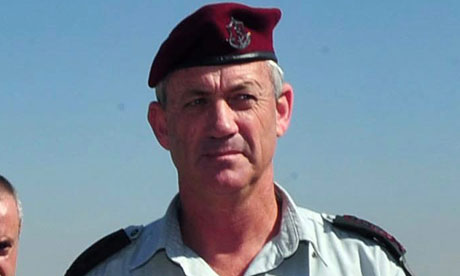 Benny Gantz said there would be ‘no escape from conducting a significant operation’. Photograph: Ariel Hermoni/EPA
A new Israeli military offensive against Gaza will be launched “sooner or later” and will be “swift and painful”, Israel’s most senior military officer has warned.
Benny Gantz, the chief of staff of the Israel Defence Forces, was speaking on the third anniversary of the start of a major three-week assault on Gaza during which around 1,400 Palestinians and 13 Israelis were killed.
That offensive was “an excellent operation that achieved deterrence for Israel vis-a-vis Hamas”, Gantz told Army Radio on Tuesday. He added there were signs that the deterrent effect was wearing thin.
“Sooner or later, there will be no escape from conducting a significant operation,” he said. “The IDF knows how to operate in a determined, decisive and offensive manner against terrorists in the Gaza Strip.”
Within hours of Gantz’s comments, the Israeli military launched two airstrikes on targets in Gaza, killing one person and injuring around 10, according to local reports.
A spokesman for the IDF said direct hits on two “terrorist squads with global jihad associations” had been confirmed. According to security officials quoted by Israel Radio, one of the targets was a cell en route to Sinai with the intention of launching an attack on Israel from Egypt.
Since the end of the Gaza war in January 2009, Hamas has attempted to enforce a ceasefire among militant groups, although sporadic rocket fire has continued. Israel holds Hamas, as the de facto government, responsible for all rocket fire emanating from Gaza.
There have been suggestions in recent weeks that Hamas is ready to distance itself further from attacks on Israel as part of its reconciliation process with its rival faction Fatah.
“They have accepted popular [non-violent] resistance,” senior Fatah official Mohammed Shtayyer said, adding that Hamas would stop “these fireworks” being launched.
However, Hamas officials have also said they reserve the right to self-defence and the prime minister, Ismail Haniyeh, pledged to continue “resistance” at a public rally this month.
Gantz’s comments were meant “to keep [Hamas] on their toes”, according to the Israeli analyst Yossi Alpher, who said: “He’s letting us know that another operation is possible and it would be successful.”
Alpher identified two constraining factors – moves towards Fatah-Hamas reconciliation “which may change the political nature of the Gaza regime”, and Egypt. “In the past, we could assume that if we launched an operation in Gaza, [former president Hosni] Mubarak would be largely sympathetic. That’s not necessarily the case now,” he said.
Hamas’s message was not unequivocal or comprehensive, he said, adding: “The question is, are we witnessing an evolutionary process in which Hamas follows the lead of Islamists in Egypt and Tunisia away from violence and into politics? My sense is we are, but it’s a slow process.”
Shlomo Brom, of the Institute for National Strategic Studies, said a new offensive on Gaza could be pre-empted by political developments, including the opening of a covert dialogue between Israel and Hamas.
“The developments of Hamas’s position taking into account the effects of the Arab spring could open different possibilities,” he said.
Gaza, never forget! Video by Max Blumenthal and Dan Luban. Full story here: http://www.alternet.org/story/119372
|


Two boats full of courageous passengers were on their way to Gaza when they were intercepted on Friday, November 4, by the Israeli military in international waters. We call the passengers courageous because they sailed from Turkey on November 2 with the knowledge that at any moment they might be boarded by Israeli commandos intent on stopping them—perhaps violently, as the Israeli military did in 2010 when they killed nine humanitarian aid workers on the Turkish boat named Mavi Marmara.
The boats—one from Canada and one from Ireland—were carrying 27 passengers, including press and peace activists from Ireland, Canada, the United States, Australia and Palestine. They were unarmed, and the Israeli military knew that. They were simply peace activists wanting to connect with civilians in Gaza, and the Israeli military knew that. Yet naked aggression was used against them in international waters—something that is normally considered an act of piracy.
The passengers on the boats were sailing to Gaza to challenge the U.S. – supported Israeli blockade that is crippling the lives of 1.6 million Palestinian civilians in Gaza. They were sailing to stand up against unaccountable power—the power of the Israeli government—that has been violating the basic rights of the 5.5 million Palestinians that live inside Israel’s pre-1967 borders or in the Occupied Territories. They were sailing for us, civil society, who believe in human rights and the rule of law.
The Arab Spring – which has now spread to cities across the United States in the form of the “#occupy” movement, and has been echoed in protests against economic injustice in Europe and Israel as well – has fundamentally been a challenge to unaccountable power. Some countries experiencing this protest wave are dictatorships under military rule or ruled by monarchies; others are generally considered “democracies.” But in all instances the majority feel that they have been shut out of decision-making and have been harmed by policies benefiting a narrow elite with disproportionate power.
The blockade of Gaza’s civilians is an extreme example of unaccountable power. Palestinians in Gaza aren’t allowed to vote for Israeli or American politicians. But due to political decisions taken in Israel and the United States, Palestinians in Gaza are prevented from exporting their goods, traveling freely, farming their land, fishing their waters or importing construction materials to build their homes and factories.
We have been to Gaza before, where we have seen the devastation firsthand. We have also been to Israel and the West Bank, where we have seen how the Israeli government is detaining Palestinians at checkpoints, building walls that cut them off from their lands, demolishing their houses, arbitrarily imprisoning their relatives and imposing economic restrictions that prevent them from earning a living. We have seen how Palestinians, like people everywhere, are desperate to live normal and dignified lives.
A UN Report released in September found that “Israel’s oppressive policies [in Gaza] constitute a form of collective punishment of civilians”, that these policies violate both international humanitarian and human rights law, and that the illegal siege of Gaza should be lifted. The International Committee of the Red Cross also called the blockade of Gaza a violation of international law because it constitutes “collective punishment” of a civilian population for actions for which the civilians are not responsible. The Red Cross is a neutral humanitarian organization. It doesn’t usually go around making pronouncements on matters of public policy. The fact that it has done so in this case should be a strong signal to the international community that the blockade of Gaza is extreme and must fall.
History has shown us again and again that when political leaders decide it’s in their interest, then peace, diplomacy, negotiations are possible. Recently, Israel and Hamas – with the help of the new Egyptian government – successfully negotiated a prisoner exchange that had eluded them for five years. In speeches, the Israeli government “opposes negotiations with Hamas,” and in speeches, Hamas “opposes negotiations with Israel.” But when they decided it was in their interest, they had no problem sitting down at the table and hammering out an agreement.
If Israel and Hamas can negotiate an agreement to release prisoners, then surely Israel and Hamas can negotiate an agreement to lift the blockade on Gaza’s civilians.
But the people of Gaza can’t wait for political leaders to decide it’s in their interest to negotiate, so it’s up to us—as civil society—to step up the pressure. That’s what these waves of boats are doing. That’s what the boycott, divestment and sanctions movement is doing.
More than a year ago, President Obama called the blockade unsustainable. “It seems to us that there should be ways of focusing narrowly on arms shipments, rather than focusing in a blanket way on stopping everything and then, in a piecemeal way, allowing things into Gaza,” he said. That hasn’t happened. Why not? Why shouldn’t it happen now? What does blocking Palestinian exports from Gaza to Europe or keeping people from getting medical treatment abroad have to do with arms shipments?
The Israeli military stopped these two small ships carrying peace activists to Gaza, but they won’t stop the Palestinians who are demanding freedom, and they won’t stop the solidarity movement. We won’t stop challenging the blockade on Gaza’s civilians—by land and by sea– until the blockade falls. And we won’t stop challenging the denial of Palestinian democratic aspirations until those aspirations are realized.
Medea Benjamin is the cofounder of CODEPINK and Global Exchange. Robert Naiman is the Director of Just Foreign Policy.


