Search

band annie's Weblog

I have a parallel blog in French at http://anniebannie.net

Category

Gaza

The Iron Wall

Uri Avnery

SOMETHING ODD, almost bizarre, is going on in Egypt these days.

About 1400 activists from all over the world gathered there on their way to the Gaza Strip. On the anniversary of the “Cast Lead” War, they intended to participate in a non-violent demonstration against the ongoing blockade, which makes the life of 1.5 million inhabitants of the Strip intolerable.

At the same time, protest demonstrations were to take place in many countries. In Tel-Aviv, too, a big protest was planned. The “monitoring committee” of the Arab citizens of Israel was to organize an event on the Gaza border.

When the international activists arrived in Egypt, a surprise awaited them. The Egyptian government forbade their trip to Gaza. Their buses were held up at the outskirts of Cairo and turned back. Individual protesters who succeeded in reaching the Sinai in regular buses were taken off them. The Egyptian security forces conducted a regular hunt for the activists.

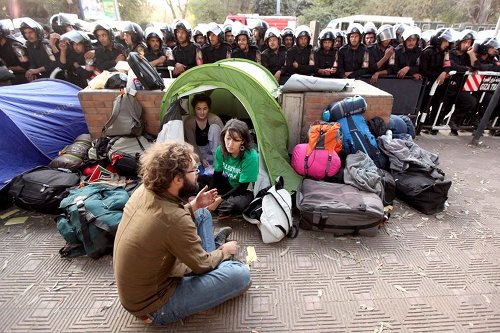
The angry activists besieged their embassies in Cairo. On the street in front of the French embassy, a tent camp sprang up which was soon surrounded by the Egyptian police. American protesters gathered in front of their embassy and demanded to see the ambassador. Several protesters who are over 70 years old started a hunger strike. Everywhere, the protesters were held up by Egyptian elite units in full riot gear, while red water cannon trucks were lurking in the background. Protesters who tried to assemble in Cairo’s central Tahrir (liberation) Square were mishandled.

In the end, after a meeting with the wife of the president, a typical Egyptian solution was found: one hundred activists were allowed to reach Gaza. The rest remained in Cairo, bewildered and frustrated.

WHILE THE demonstrators were cooling their heels in the Egyptian capital and trying to find ways to vent their anger, Binyamin Netanyahu was received in the president’s palace in the heart of the city. His hosts went to great lengths to laud and celebrate his contribution to peace, especially the ‘freeze” of settlement activity in the West Bank, a phony gesture that does not include East Jerusalem.

Hosni Mubarak and Netanyahu have met in the past – but not in Cairo. The Egyptian president always insisted that the meetings take place in Sharm-al-Sheikh, as far from the Egyptian population centers as possible. The invitation to Cairo was, therefore, a significant token of increasingly close relations.

As a special gift for Netanyahu, Mubarak agreed to allow hundreds of Israelis to come to Egypt and pray at the grave of Rabbi Yaakov Abu-Hatzeira, who died and was buried in the Egyptian town of Damanhur 130 years ago, on his way from Morocco to the Holy Land.

There is something symbolic about this: the blocking of the pro-Palestinian protesters on their way to Gaza at the same time as the invitation of Israelis to Damanhur.

ONE MAY well wonder about the Egyptian participation in the blockade of the Gaza Strip.

The blockade started long before the Gaza War and has turned the Strip into what has been described as “the biggest prison on earth”. The blockade applies to everything except essential medicines and the most basic foodstuffs. US senator John Kerry, former candidate for the presidency, was shocked to hear that the blockade included pasta – the Israeli army in its wisdom has designated noodles as a luxury. The blockade is all-embracing – from building materials to school children’s copy books. Except for the most extreme humanitarian cases, nobody can pass from the Gaza Strip to Israel or the West Bank, nor the other way round.

But Israel controls only three sides of the Strip. The Northern and Eastern borders are blocked by the Israeli army, the Western border by the Israeli navy. The fourth border, the Southern one, is controlled by Egypt. Therefore, the entire blockade would be ineffective without Egyptian participation.

Ostensibly, this does not make sense. Egypt considers itself as the leader of the Arab world. It is the most populous Arab country, situated at the center of the Arab world. Fifty years ago the president of Egypt, Gamal Abd-al-Nasser, was the idol of all the Arabs, especially of the Palestinians. How can Egypt collaborate with the “Zionist enemy”, as Egyptians called Israel then, in bringing 1.5 million brother Arabs to their knees?

Until recently, the Egyptian government had been sticking to a solution that exemplifies the 6000-year old Egyptian political acumen. It participated in the blockade but closed its eyes to the hundreds of tunnels dug under the Egyptian-Gaza border, through which the daily supplies for the population were flowing (for exorbitant prices, and with high profits for Egyptian merchants), together with the stream of arms. People also passed through them – from Hamas activists to brides.

This is about to change. Egypt has started building an iron wall – literally – along the full length of the Gaza border, consisting of steel pillars thrust deep into the ground, in order to block all tunnels. That will finally choke the inhabitants.

When the most extreme Zionist, Vladimir Ze’ev Jabotinsky, wrote 80 years ago about erecting an “Iron Wall” against the Palestinians, he did not dream of Arabs doing just that.

WHY DO they do it?

There are several explanations. Cynics point out that the Egyptian government receives a huge American subsidy every year – almost two billion dollars – by courtesy of Israel. It started as a reward for the Egyptian-Israeli peace treaty. The pro-Israel lobby in the US Congress can stop it any time.

Others believe that Mubarak is afraid of Hamas. The organization started out as the Palestinian branch of the Muslim Brotherhood, still the main opposition to his autocratic regime. The Cairo-Riyadh-Amman-Ramallah axis is poised against the Damascus-Gaza axis that is allied with the Tehran-Hizbullah axis. Many people believe that Mahmoud Abbas is interested in the tightening of the Gaza blockade in order to hurt Hamas.

Mubarak is angry with Hamas, which refuses to dance to his tune. Like his predecessors, he demands that the Palestinians obey his orders. President Abd-al-Nasser was angry with the PLO (an organization created by him to ensure Egyptian control of the Palestinians, but which escaped him when Yasser Arafat took over). President Anwar Sadat was angry with the PLO for rejecting the Camp David agreement, which promised Palestinians only “autonomy”. How dare the Palestinians, a small, oppressed people, refuse the ”advice” of Big Brother?

All these explanations make sense, yet the Egyptian government’s attitude is still astonishing. The Egyptian blockade of Gaza destroys the lives of 1.5 million human beings, men and women, old people and children, most of who are not Hamas activists. It is done publicly, before the eyes of hundreds of millions of Arabs, a billion and a quarter Muslims. In Egypt itself, too, millions of people are ashamed of the participation of their country in the starving of fellow Arabs.

It is a very dangerous policy. Why does Mubarak follow it?

THE REAL answer is, probably, that he has no choice.

Egypt is a very proud country. Anyone who has been in Egypt knows that even the poorest Egyptian is full of national pride and is easily insulted when his national dignity is hurt. That was shown again a few weeks ago, when Egypt lost a soccer match with Algeria and behaved as if it has lost a war.

“Consider that from the summit of these Pyramids, forty centuries look down upon you,” Napoleon told his soldiers on the eve of the battle for Cairo. Every Egyptian feels that 6000 – some say 8000 – years of history look upon him all the time.

This profound feeling clashes with reality at a time when Egypt’s situation is getting more and more miserable. Saudi Arabia has more influence, tiny Dubai has become an international financial center, Iran is becoming a far more important regional power. Contrary to Iran, where the Ayatollahs have called upon families to limit themselves to two children, the Egyptian birthrate is devouring everything, condemning the country to permanent poverty.

In the past, Egypt succeeded in balancing its internal weaknesses with external successes. The whole world considered Egypt as the leader of the Arab world, and treated it accordingly. No more.

Egypt is in a bad situation. Therefore, Mubarak has no choice but to follow the dictates of the US – which are, in fact, Israeli dictates. That is the real explanation for his participation in the blockade.

WHEN I spoke today at the demonstration in Tel-Aviv, after we had marched through the streets to protest against the blockade, I refrained from mentioning the Egyptian part in it.

I confess that I liked the people I met during my visits to Egypt very much. The “man in the street” is very welcoming. In their behavior towards each other there is an air of tranquility, an absence of aggression, a particular Egyptian sense of humor. Even the poorest keep their dignity in crowded and often miserable conditions. I have not heard them grumble. In all the thousands of years of their history, Egyptians have risen in revolt no more than three or four times.

This legendary patience has its negative side, too. When people are resigned to their lot, this may prevent economic, social and political progress.

It seems that the Egyptian people are ready to accept everything. From the Pharaohs of old right down to the present Pharaoh, their rulers have faced little opposition. But a day may come when national pride will overcome even this patience.
As an Israeli, I protest against the Israeli blockade. If I were an Egyptian, I would protest against the Egyptian blockade. As a citizen of this planet, I protest against both.
Gaza aid convoy led by British MP Galloway clashes with Egypt police

By Reuters
Tags: Israel News, George Galloway

Egyptian security forces clashed on Wednesday with members of a convoy led by left-wing British politician George Galloway trying to take relief supplies to Palestinians in the Gaza strip.

A Reuters correspondent in the port city of Arish, 40 km (25 miles) from Egypt’s border with Gaza, saw security forces throwing stones at about 520 people traveling with the convoy.

The protestors were holding four members of the Arish harbor police while security forces detained seven members of the convoy, who have been locked in a dispute with Egyptian authorities over the route of the 198 trucks.

Police used water cannon to force the protestors to leave Arish harbor, which they had occupied, a security source said. Around 40 members of the convoy had minor injuries while around 15 police officials were hurt, witnesses said.

Cairo insists the food and other supplies should go to Gaza via an Israeli-controlled checkpoint while the convoy’s leaders want to use the Egyptian-controlled Rafah border crossing.

Egyptian authorities wanted 55 of the trucks to go to the Israeli checkpoint, said Galloway, the sole member of the British parliament for the Respect party who has long campaigned for the Palestinian cause.

“We refused this,” he told Reuters TV. “It is completely unconscionable that 25 percent of our convoy should go to Israel and never arrive in Gaza. Because nothing that ever goes to Israel, ever arrives in Gaza.”

Cairo has imposed strict regulations and restrictions on pro-Palestinian foreign activists who have held protests in Egypt since late December to mark the first anniversary of Israel’s three-week offensive on the Hamas-ruled Gaza Strip.

It has also controlled the movement of Palestinians and some foreigners at Rafah and is building a controversial steel wall along its border with Gaza to prevent smuggling.

Alhamy Aref, a local government official in North Sinai, was trying to negotiate a deal between the two sides on releasing the detained people, the Reuters correspondent reported.

Leaders of the convoy originally refused Egypt’s condition that the aid should be shipped via Arish on the Mediterranean rather than via the Red Sea port of Nuweiba. But they later relented and started arriving at Arish on Thursday

source

An Experiment in Provocation

By BRIAN ENO

It’s a tragedy that the Israelis – a people who must understand better than almost anybody the horrors of oppression – are now acting as oppressors. As the great Jewish writer Primo Levi once remarked “Everybody has their Jews, and for the Israelis it’s the Palestinians”. By creating a middle Eastern version of the Warsaw ghetto they are recapitulating their own history as though they’ve forgotten it. And by trying to paint an equivalence between the Palestinians – with their homemade rockets and stone-throwing teenagers – and themselves – with one of the most sophisticated military machines in the world – they sacrifice all credibility.

The Israelis are a gifted and resourceful people who fully deserve the right to live in peace, but who seem intent on squandering every chance to allow that to happen. It’s difficult to avoid the conclusion that this conflict serves the political and economic purposes of Israel so well that they have every interest in maintaining it. While there is fighting they can continue to build illegal settlements. While there is fighting they continue to receive huge quantities of military aid from the United States. And while there is fighting they can avoid looking candidly at themselves and the ruthlessness into which they are descending.

Gaza is now an experiment in provocation. Stuff one and a half million people into a tiny space, stifle their access to water, electricity, food and medical treatment, destroy their livelihoods, and humiliate them regularly…and, surprise, surprise – they turn hostile. Now why would you want to make that experiment?

Because the hostility you provoke is the whole point. Now ‘under attack’ you can cast yourself as the victim, and call out the helicopter gunships and the F16 attack fighters and the heavy tanks and the guided missiles, and destroy yet more of the pathetic remains of infrastructure that the Palestinian state still has left. And then you can point to it as a hopeless case, unfit to govern itself, a terrorist state, a state with which you couldn’t possibly reach an accommodation.

And then you can carry on with business as usual, quietly stealing their homeland.

Brian Eno is a musician and music producer.

source

Gaza freedom march wrap up

By Sana (Keffiyeh And Onions)

I’m sure its going to take me some time to process everything that has happened in Cairo with the Gaza Freedom March over the past week or so but here are some of my initial thoughts and feelings. Bear in mind, these are my own opinions and reflections and they surely are not the same as the 1300 other people who were in Cairo. So for what its worth – here it goes:

This whole political experience here with CODEPINK, for me, has been honestly disappointing and angering. I’m going to be honest here, I did not participate in many of the protests that took place in Cairo because I had serious issues with the way everything was being handled and the way that the March really seemed to have fallen apart and unraveled once everyone realized that our chances of getting into Gaza were really slim to none. From the very first meeting that was held in Tahrir Square, the individuals who were going to be staying in Gaza longer (past January 2nd) were told to not participate in any of these demonstrations because if we did somehow come up with a way to get into Gaza, if we had any record or history with problems with the Egyptians – this would effectively eliminate any chance of us getting in. People told us to completely “disassociate from the March” and that because Egypt is not a democracy, “nothing we do will change their minds” – which sadly, ended up being quite true despite how often people demonstrated, were barricaded in by people, and some even beaten up. Moral of the story: This is not the U.S., they don’t care that you’re Americans, and we did not fly thousands of miles to protest in Egypt.

Aside from this though, there were so many critical problems with the way things were being done and decisions were being made that I really felt uncomfortable with doing anything that GFM was doing in Cairo.

I felt as though there was no insight to the way the Egyptian government works, or the greater public opinion in Egypt, at all. We cannot simply think that a country, who has religiously served the agenda of the U.S. and Israel, will do a complete 360 and open the borders when a group of activists show up, no matter how big. Anyone who has any familiarity with the politics of this conflict, know that Egypt’s role in ensuring the Palestinian suffering is not a new or novel concept. Given that, the fact that CODEPINK did not prepare for the very unsurprising setback that Egypt delivered by closing its borders, really baffled me. When we got news on Monday, that the borders were going to be closed and no one would enter, I figured that this was a very expected move (especially after news of Egypt’s steel wall just was released as well) and that the steering committee and whoever else also saw this coming and that surely back up plans and strategies were on hand now that Egypt played its cards. But after a couple days when everyone started arriving and it was time to figure out what we were going to do, it just seemed like these small fragmented actions (the hunger strike here, french sit-in there) were things that groups were doing on their own, hardly with any support from the mass collective. There was no unified message besides come out in the streets and protest. It felt like everyone kind of went their own way and that now instead of focusing on the occupation we were going to go after the Egyptian government – which as much as I have issues with that they are doing and how they add to the Palestinian suffering – that is not why I came here.

Lets clarify something here. As much as I hate Egypt, Egypt is NOT occupying the Palestinian territories. ISRAEL is. I mean, to a certain degree, by doing of all this, I feel, we took a lot of heat off of Israel b/c the press coverage just shows a bunch of people demonstrating in Cairo, which is giving the message that we have a problem with Egypt for what they are doing wrong when we were here to raise awareness of the ISRAELI OCCUPATION and Operation Cast Lead which was carried out by ISRAEL one year ago. Why are people shouting “Free Egypt” at the demonstrations? It makes no sense, we had no focus.

I want to believe that GFM tried to do the best that it could, given the circumstances, but honestly it just led to many people feeling as if they had to do something, anything, since we weren’t being allowed in Gaza. Don’t get me wrong, I am a firm believer in public resistance and demonstrating, even getting arrested when its necessary, etc – but you cannot do these things without tons of planning, proper escalation tactics leading up to massive direct action like that, and a solid SOLID solid foundation in Egypt (resources, connections, lawyers, etc) for the people that do take those risks. Otherwise, you just end up looking like a bunch of stupid foreigners (mostly Americans) who are protesting, sitting in, going on hunger strike – for what? We came here to deliver aid and stand in solidarity with the Palestinian people in Gaza – if that was not going to happen then we could have held all of these actions back in our home towns where we know how things work, we know what resources we have, and we can accurately assess what type of risk we are willing to take for this dire cause. After these past few days, I feel that all we’ve done is agitate Egypt for a brief period of time, spent a lot of money fueling this unjust country’s economy, and made the daily lives of the Egyptian people harder.

When our plans fell through, and it did not seem like we were going to get in, there should have been a massive meeting/discussion with a vote with all of the delegates who have come from around the world as to what we think would be the best thing to do. But when people were told to figure it out and come up with ideas, you had serious fragmentation and people, like the French delegates, who were occupying the area in front of the Embassy feeling like they did not have support or instances like when the entire Japanese delegation just left after the first day for the West Bank. All I’ve been asking myself these past few days is “What the hell is going on?” and “What is all of this?”. And to tell the truth, I still really don’t know because I don’t think GFM really even knows.

The “100 people to Gaza” stunt was also another fiasco that only further divided this group and our efforts. At first, CODEPINK accepts this offer and takes credit for it since the women went and talked to Suzanne Mubarak. They come up with a list in a very short time of these people who would get to go, not realizing what a bad mistake this is. After a few hour, they do realize its a bad idea, send out an official message saying how they have ‘rejected’ this offer, and yet, lo and behold people STILL got on the buses and went? Again, “What is going on?”

I realize that this has gotten really long already and these are just some of my preliminary thoughts from the past few days. As of right now this is how I feel: as much as I’d like to really blame fully the repressive Egyptian dictatorship for the Gaza Freedom March falling apart and not succeeding, I believe that CODEPINK, and the same old foreign arrogance/ignorance we have, has a lot to do with it this time as well. Sadly, the Palestinian people are still under occupation and I wish the best of luck to the VIVA Palestina convoys who seem to have a better grasp on how to deal with all this nonsense than we do.

Until later, free free Palestine,

-Sana

Protests held against Gaza siege

Members of Gaza Freedom March, denied entry to Gaza, demonstrated in Cairo [Ali Abunimah]

Activists, both from Gaza and abroad, have held demonstrations on either side of an Israeli border crossing to the Palestinian territory, protesting against its continued siege by Israel.

Hundreds of protesters gathered around the Erez crossing on Thursday, to denounce the blockade that has caused immense suffering to those living in Gaza.

Nisreen el-Shamayleh, Al Jazeera’s correspondent who was on the Israeli side of the crossing, estimated that about 600 protesters were present, many from mainly Arab neighbourhoods in East Jerusalem.

“They represent Israeli-Palestinians as well as other Arab civil society organisations inside Israel and also with the support of some Israeli groups,” she said.

“Their major demand is for Israel to stop the siege on Gaza and to stop the suffocation of Gazans living under this blockade. They’re also calling on the international community to intervene.”

The Gaza Strip has been under Israeli blockade since 2007 when Hamas seized power in the territory.

The Erez crossing is the main entry and exit point to and from Gaza used by medical patients, journalists, diplomats and aid groups.

International support

On the Gaza side of the border, the demonstration was slower to get started, but protesters there were joined by 86 activists from the Gaza Freedom March, an international group that has been trying to get into Gaza with food and supplies.

Most of the Gaza Freedom March’s 1,300-strong group were refused entry into Gaza by Egypt, which controls the Rafah crossing point, because of what Egyptian authorities said was the “sensitive situation” in the territory.

in depth

Many of those remaining in Egypt held separate demonstrations in Cairo.

Ali Abunimah, the co-founder of the Electronic Intifada website, who was at the Cairo protest, told Al Jazeera the group had been surrounded by the police.

“I’ve spoken to some people who were pushed or kicked by police and a few people have [had] their cameras taken away,” he said.

“I’d say there are about 200 people here. We had anticipated quite a few more, but earlier today police barricaded some of the hotels where we are staying … I can’t tell you how many people have been prevented from joining us.”

A separate aid convoy has also been trying to reach Gaza through Jordan’s Red Sea port of Aqaba.

Lorries from the Viva Palestina convoy began crossing from Jordan into Syria on Thursday.

The events around Gaza coincide with the one-year anniversary of Israel’s devastating 22-day war on Gaza which left about 1,300 Palestinians dead. Thirteen Israelis also died in the conflict.

Shoeless in Cairo

Written by Mary Hughes-Thompson, part of the GFM convoy that has been trying to
get into Gaza.

In about an hour the Gaza Freedom Marchers in Cairo will be meeting in Tahrir
Square to celebrate the beginning of 2010. January 1st will be the fifth day
of my hunger strike.

It was an eventful and exhilarating day for all of us here in Cairo. This
morning we began to arrive in small groups at a couple of locations in downtown
Cairo, intending to join and up and begin a solidarity march to Gaza. We
didn’t expect to get far before being stopped, so we took what things we had
that would make it easier to spend the night in the street. As soon as we got
out of our taxi near the Museum, Hedy and I and Hedy’s two friends from St
Louis were immediately surrounded by security police who tried to lead us away
from the area.

All around us we saw other small groups receiving the same reception. After
sitting on a bench in front of the Nile Hilton for half an hour, with half a
dozen police standing close and trying to persuade us to continue walking away,
we suddenly saw a surge of people crossing the street a few yards from us, and
we quickly rushed to join them. Free Gaza signs appeared, chants of “Free
Gaza” were heard. Passengers in cars and buses gave us a wave and a smile. We
were immediately encircled by several hundred policemen who placed barriers
around us and began to push us more tightly together. We tried to keep space
around Hedy, as we were pushed and squeezed. I feared my ribs would be
crushed as I was squeezed tighter and closer to people around me. A few people
fell or tried to sit in the middle of the circle and the police went after
them.

Suddenly I was pushed to the ground and fell flat on my face. As people around
me were pushed more tightly to the center, I feared I would be trampled.
Perhaps the police thought I had been sitting, because they grabbed my arms and
began to drag me along the ground. I felt my one shoe fall off, then the other
I tried to hang onto my things as some French people came to my rescue,
reaching out to help lift me to my feet, then leading me away next to the wall
and away from the police.

My shoes and my cane were swallowed up and could not be located amid the mass
of people. We stayed together for many hours, held tightly in our circle by
the police. It was very warm, but as always spirits were high, some enormous
signs were raised by young men who climbed the only tree we had in our
enclosure. It was a laurel tree, and many people raised branches above their
heads as we called for peace and freedom for Gaza. At the moment we knew the
march was taking place inside Gaza we chanted again: Free Gaza, Free Gaza.
Someone began to play an accordian, and I was pulled, shoeless, into a circle
of women, including Hedy, as we danced in a circle while people around us
cheered.

Eventually, after several hours, some members of American Veterans for Peace
who had been watching over Hedy persuaded her it would be safer if she left.
They felt the police were getting more threatening and were worried they
wouldn’t be able to keep her safe if we were rushed and attacked. Hedy
reluctantly agreed to go outside the circle to talk to some press who wanted to
interview her, so Hedy, Sandra, J’Ann and I were, after some negotiations,
escorted outside where Hedy was greeted by reporters.

So here I stay in Cairo, grateful to be merely shoeless, somewhat bruised and
only slightly battered, still strong and determined, proud and humbled to be a
part of this amazing family that has come together from around the world to
stand in solidarity with Gaza, Palestine and to remember what happened in Gaza
a year ago. We may not get to Gaza this time, but we believe we have made a
joyful noise in Cairo.

Happy New Year everybody. Free Gaza. Free Palestine.

PS: One of my shoes was later found.

Let Gaza live: US rally lights vigils for Palestine

Hundreds of demonstrators have gathered in Washington calling for an end to Israel’s blockade on Gaza. It comes after the first anniversary of the beginning of the war between Israel and Hamas.

Freedom March : 100 went

The Gaza Freedom March continues-in Cairo, we hope in Gaza, and around the world. Because of all your emails and the determination of the almost 1,400 people who came to Cairo to be a part of the March, including 300 French nationals who have been camped out in front of their embassy for three nights, we secured a meeting with Madame Mubarak, the president´s wife. Madame Mubarak arranged for 100 marchers to enter Gaza to deliver the humanitarian aid we had brought with us, under the umbrella of her organization The Red Crescent. This was considered a success until we began the difficult task of figuring out which 100 of the 1,400 would go.

To make matters more complicated, the Foreign Minister, who had not wanted ANY of us to be allowed in and was angry he had been overruled by Mrs. Mubarak, decided to fan the flames by saying in a press conference that the 100 seats were for the “good people”; and the rest of us were bad “hooligans” who were being left behind. Some of the country representatives declined their seats, and some delegations decided they would prefer not to send anyone if the whole group was not allowed to go. Those who boarded the buses towards Rafah included journalists who had come to report on the conditions in Gaza, Palestinians who would be reunited with family they had not seen in years, and some members of the team who were committed to delivering the aid that had been collected.

One of the desired results of the march was to focus world attention on the continuing and devastating effects of the blockade on Gaza. The outpouring of support from around the world for the Palestinians in Gaza has been amazing. Twenty-two marchers began a hunger strike in Cairo, including 85-year-old Hedy Epstein, a Holocaust survivor, who has been interviewed by journalists from around the world. This morning´s New York Times piece on the march and the hunger strike was a huge success in getting the story of Gaza to a wider audience, and reflected the passion of those who had traveled so far to be a part of this historic movement.

The hunger strikers ask that sometime during the period marking the Operation Cast Lead invasion anniversary–December 27-January 18–you join them in remembrance by skipping a meal, or fasting for a day or a week. Sign up here.

And please be a part of the international solidarity movement for the Palestinians of Gaza by doing what you can to spread the story, tweet or Facebook the NY Times story and keep up with the ever changing tides of the march on the PINKtank.

You can find up to the minute information on our Twitter page. Follow us on twitter and march with us virtually!

Solidarity actions for the Gaza Freedom March began taking place December 27th to mark the one year assault on Gaza, with more actions scheduled through January 1, 2010. The massive mobilization includes candlelight vigils, concerts, processions, marches, demonstrations, art installations, house parties and movie screenings all over the world. View solidarity actions worldwide and visit our flickr slide show.

Not attending a March or Solidarity Action? Join us in Solidarity Online.

The Gaza Freedom March site is being updated almost hourly, so check it out, share the photos, videos and articles with your friends! http://www.gazafreedommarch.org.

“The ONLY recognizable feature of HOPE is ACTION”– so ACT today and support CODEPINK with a donation and get your Grace Paley t-shirt, designed by Phillip Niemeyer in our store!

So here’s a toast to our power and our passion — we have our work cut out for us in 2010!

Medea Benjamin and the CODEPINK Team
(Dana, Emily, Farida, Gael, Gayle, Janet, Jodie, Kitty, Marina, Nancy, Paris, Rae, Suzanne, and Whitney)

from the n.y. times

CAIRO — More than 1,000 people from around the world were gathered here on Tuesday for a solidarity march into Gaza despite Egypt’s insistence that the Gaza border crossing that it controls would remain closed to the vast majority of them.

The protest, the Gaza Freedom March, was planned for Thursday and intended to mark a year since Israel’s three-week military assault on the territory. On Tuesday, hundreds of the frustrated activists gathered to press their case on the front steps of the Egyptian Journalists Syndicate here, holding “Free Gaza” signs and chanting, “Let us go.” Some declared a hunger strike.

About 100 French citizens staged a sit-in in front of the French Embassy, and some Americans pleaded for help at the United States Consulate.

The Egyptian government agreed to let 100 activists into Gaza on Wednesday, according to one of the organizers of the march.

The crossing, at Rafah, Egypt, has been closed for most purposes since the summer of 2007, when the militant group Hamas seized control of Gaza from the rival Western-backed forces of Fatah. Israel imposed a blockade on Gaza, and the Egyptian government, citing its own security needs, closed the crossing, drawing criticism from within Egypt and across the Arab world.

International criticism of Israel spiked after the Gaza assault, which left as many as 1,400 Palestinians dead, including hundreds of civilians. Thirteen Israelis were killed. While both sides were accused of war crimes, most of the outrage was focused on Israel because of its overwhelming military strength and the enormous differences in the death tolls.

International activists have been challenging Israel’s control of Gaza’s waters, sending in boats to bring in supplies and convey support; Israel has blocked many.

Egypt repeatedly refused to open its border ahead of the planned march, citing what its officials said were “security reasons,” but participants in the march flew to Cairo anyway, hoping the government would relent.

“We have not come to Egypt to create trouble or cause conflict,” organizers of the march wrote in an open letter to Egypt’s president, Hosni Mubarak. “We have come because we believe that all people — including the Palestinians of Gaza — should have access to the resources they need to live in dignity.”

The letter said the group, which is urging Israel to lift its blockade, raised tens of thousands of dollars for medical aid, school supplies and clothing to take to Gaza.

The Egyptian foreign minister, Ahmed Aboul Gheit, expressed frustration at the activists who came to Cairo despite the warning that the border was closed.

“Those who tried to conspire against us, and they are more than a thousand, we will leave them in the street,” he said.

One protester, Hedy Epstein, 85, a Holocaust survivor, arrived in Egypt from the United States on Saturday. She said she started a hunger strike on Monday.

“My message is for the world governments to wake up and treat Israel like they treat any other country and not to be afraid to reprimand and criticize Israel for its violent policies vis-à-vis the Palestinians,” Ms. Epstein said. “I brought a suitcase full of things, pencils, pens, crayons, writing paper to take to children in Gaza — I can’t take that back home.”
A version of this article appeared in print on December 30, 2009, on page A8 of the New York edition.

Blog at WordPress.com.

Up ↑