In streets of ash and cries and fear, where once the sun would shine so clear, life lies in ruins, crushed and torn, by bombs and fire, grief and scorn. A child that weeps, a mother screams, for all the loss of shattered dreams. No place to play, no place to be, just fear and war’s insanity. And we? We watch, we scroll, we know, each headline part of what we show. We count the dead, we turn away, yet every number had a birthday. O leaders, crowned with voice and might, where is your truth, your moral light? Is peace a word to calm the crowd, while silence hides the screams too loud? In 40 –45 the world looked down, while trains passed through each silent town. The silence killed – we know that well, yet none had dared the truth to tell. “Never again,” we swore so loud, when smoke had cleared from war’s dark cloud. But now we see the same unfold – will “We did not know” again be told? No child deserves a grave this small, no people crushed beneath it all. Our shared humanity’s at stake – and silence is a cruel mistake. So rise, speak out, don’t turn your face. Let justice break through hate’s embrace. The time is now – the cost is clear. A voice can heal what bombs bring near.
My old office in Gaza is a pile of rubble. The streets around it, where I went for a coffee, ordered maftool or manakish, had a haircut, are flattened. Friends and colleagues are dead, or more often have vanished, last heard from weeks or months ago, no doubt buried somewhere under the broken slabs of concrete. The uncounted dead. In the tens perhaps hundreds of thousands.
Gaza is a wasteland of 50 million tons of rubble and debris. Rats and dogs scavenge amid the ruins and fetid pools of raw sewage. The putrid stench and contamination of decaying corpses rises from beneath the mountains of shattered concrete. There is no clean water. Little food. A severe shortage of medical services and hardly any habitable shelters. Palestinians risk death from unexploded ordnance, left behind after over 15 months of air strikes, artillery barrages, missile strikes and blasts from tank shells, and a variety of toxic substances, including pools of raw sewage and asbestos.
Hepatitis A, caused by drinking contaminated water, is rampant, as are respiratory ailments, scabies, malnutrition, starvation and the widespread nausea and vomiting caused by eating rancid food. The vulnerable, including infants and the elderly, along with the sick, face a death sentence. Some 1.9 million people have been displaced, amounting to 90 percent of the population. They live in makeshift tents, encamped amid slabs of concrete or the open air. Many have been forced to move over a dozen times. Nine in 10 homes have been destroyed or damaged. Apartment blocks, schools, hospitals, bakeries, mosques, universities — Israel blew up Israa University in Gaza City in a controlled demolition — cemeteries, shops and offices have been obliterated. The unemployment rate is 80 percent and the gross domestic product has been reduced by almost 85 percent, according to an October 2024 report issued by the International Labor Organization.
Israel’s banning of the United Nations Relief and Works Agency for Palestine Refugees in the Near East — which estimates that clearing Gaza of the rubble left behind will take 15 years — and blockage of aid trucks into Gaza ensures that Palestinians in Gaza will never have access to basic humanitarian supplies, adequate food and services.
The United Nations Development Program estimates that it will cost between $40 billion and $50 billion to rebuild Gaza and will take, if the funds are made available, until 2040. It would be the largest post-war reconstruction effort since the end of World War Two.
Israel, supplied with billions of dollars of weapons from the U.S. Germany, Italy and the U.K., created this hell. It intends to maintain it. Gaza is to remain under siege. Gaza’s infrastructure will not be restored. Its basic services, including water treatment plants, electricity and sewer lines, will not be repaired. Its destroyed roads, bridges and farms will not be rebuilt. Desperate Palestinians will be forced to choose between living like cave dwellers, camped out amid jagged chunks of concrete, dying in droves from disease, famine, bombs and bullets, or permanent exile. These are the only options Israel offers.
Israel is convinced, probably correctly, that eventually life in the coastal strip will become so onerous and difficult, especially as Israel finds excuses to violate the ceasefire and resume armed assaults on the Palestinian population, a mass exodus will be inevitable. It has refused, even with the ceasefire in place, to permit foreign press into Gaza, a ban designed to blunt coverage of the horrendous suffering and mass death.
Stage Two of Israel’s genocide and the expansion of “Greater Israel” — which includes the seizing of more Syrian territory in the Golan Heights (as well as calls for expansion to Damascus), southern Lebanon, Gaza and the occupied West Bank, where some 40,000 Palestinians have been driven from their homes — is being cemented into place. Israeli organizations, including the far right Nachala organization, have held conferences to prepare for Jewish colonization of Gaza once Palestinians are ethnically-cleansed. Jewish-only colonies existed in Gaza for 38 years until they were dismantled in 2005.
Washington and its allies in Europe do nothing to halt the live-streamed genocide. They will do nothing to halt the wasting away of Palestinians in Gaza from hunger, disease and bombs and their eventual depopulation. They are partners in this genocide. They will remain partners until the genocide reaches its grim conclusion.
But the genocide in Gaza is only the start. The world is breaking down under the onslaught of the climate crisis, which is triggering mass migrations, failed states and catastrophic wildfires, hurricanes, storms, flooding and droughts. As global stability unravels, industrial violence, which is decimating the Palestinians, will become ubiquitous. These assaults will be committed, as they are in Gaza, in the name of progress, Western civilization and our supposed “virtues” to crush the aspirations of those, mostly poor people of color, who have been dehumanized and dismissed as human animals.
Israel’s annihilation of Gaza marks the death of a global order guided by internationally agreed upon laws and rules, one often violated by the U.S. in its imperial wars in Vietnam, Iraq and Afghanistan, but one that was at least acknowledged as a utopian vision. The U.S. and its Western allies not only supply the weaponry to sustain the genocide, but obstruct the demand by most nations for an adherence to humanitarian law.
The message this sends is clear: We have everything. If you try and take it away from us we will kill you.
The militarized drones, helicopter gunships, walls and barriers, checkpoints, coils of concertina wire, watch towers, detention centers, deportations, brutality and torture, denial of entry visas, apartheid existence that comes with being undocumented, loss of individual rights and electronic surveillance are as familiar to the desperate migrants along the Mexican border or attempting to enter Europe as they are to the Palestinians.
Israel, which as Ronen Bergman notes his book “Rise and Kill First” in has “assassinated more people than any other country in the Western world,” employs the Nazi Holocaust to sanctify its hereditary victimhood and justify its settler-colonial state, apartheid, campaigns of mass slaughter and Zionist version of Lebensraum.
Primo Levi, who survived Auschwitz, saw the Shoah, for this reason, as “an inexhaustible source of evil” which “is perpetrated as hatred in the survivors, and springs up in a thousand ways, against the very will of all, as a thirst for revenge, as moral breakdown, as negation, as weariness, as resignation.”
Genocide and mass extermination are not the exclusive domain of fascist Germany. Adolf Hitler, as Aimé Césaire writes in “Discourse on Colonialism,” appeared exceptionally cruel only because he presided over “the humiliation of the white man.” But the Nazis, he writes, had simply applied “colonialist procedures which until then had been reserved exclusively for the Arabs of Algeria, the coolies of India, and the blacks of Africa.”
The German slaughter of the Herero and Namaqua, the Armenian genocide, the Bengal famine of 1943 — then British Prime Minister Winston Churchill airily dismissed the deaths of three million Hindus in the famine by calling them “a beastly people with a beastly religion” — along with the dropping of nuclear bombs on the civilian targets of Hiroshima and Nagasaki, illustrate something fundamental about “western civilization.”
The moral philosophers who make up the western canon – Immanuel Kant, Voltaire, David Hume, John Stuart Mill and John Locke – as Nicole R. Fleetwood points out, excluded enslaved and exploited people, indigenous peoples, colonized people, women of all races and the criminalized from their moral calculus. In their eyes European whiteness alone imparted modernity, moral virtue, judgment and freedom. This racist definition of personhood played a central role in justifying colonialism, slavery, the genocide of Native Americans, our imperial projects and our fetish for white supremacy. So when you hear that the western canon is an imperative, ask yourself — for whom?
“In America,” the poet Langston Hughes said, “Negros do not have to be told what fascism is in action. We know. Its theories of Nordic supremacy and economic suppression have long been realities to us.”
The Nazis, when they formulated the Nuremberg laws, modeled them on our Jim Crow-era segregation and discrimination laws. Our refusal to grant citizenship to Native Americans and Filipinos, although they lived in the U.S. and U.S. territories, was copied to strip citizenship from Jews. Our anti-miscegenation laws, which criminalized interracial marriage, was the impetus to outlaw marriages between German Jews and Aryans. American jurisprudence, which determined who belonged to which race, classified anyone with one percent of Black ancestry, the so called “one drop rule,” as Black. The Nazis, ironically showing more flexibility, classified anyone with three or more Jewish grandparents as Jewish.
Fascism was quite popular in the U.S. in the 1920s and 1930s. The Ku Klux Klan, mirroring the fascist movements sweeping through Europe, experienced a huge revival in the 1920s. Nazis were embraced by American eugenicists, who lauded the Nazi goal of racial purity, and disseminated Nazi propaganda. Charles Lindberg, who accepted a swastika medal from the Nazi Party in 1938, along with the evangelist Gerald B. Winrod’s pro—Hitler Defenders of the Christian Faith, William Dudley Pelley’s Silver Shirts (the initials SS were intentional) and the veteran-based Khaki Shirts were just a few of our openly fascist organizations.
The idea that America is a defender of democracy, liberty and human rights would come as a huge surprise to those Frantz Fanon called “the wretched of the earth” who saw their democratically elected governments subverted and overthrown by the United States in Panama (1941), Syria (1949), Iran (1953), Guatemala (1954), Congo (1960), Brazil (1964), Chile (1973), Honduras (2009) and Egypt (2013). And this list does not include a host of other governments that, however despotic, as was the case in South Vietnam, Indonesia or Iraq, were viewed as inimical to American interests and destroyed, in each case inflicting death and immiseration on millions.
Empire is the external expression of white supremacy.
But antisemitism alone did not lead to the Shoah. It needed the innate genocidal potential of the modern bureaucratic state.
The millions of victims of racist imperial projects in countries such as Mexico, China, India, the Congo and Vietnam, for this reason, are deaf to the fatuous claims by Jews that their victimhood is unique. So are Black, Brown and Native Americans. They also suffered holocausts, but these holocausts remain minimized or unacknowledged by their western perpetrators.
Israel embodies the ethnonationalist state the far-right in the U.S. and Europe dreams of creating for themselves, one that rejects political and cultural pluralism, as well as legal, diplomatic and ethical norms. Israel is admired by these proto-fascists, including Christian nationalists, because it has turned its back on humanitarian law to use indiscriminate lethal force to “cleanse” its society of those condemned as human contaminants. Israel is not an outlier, but expresses our darkest impulses, ones being turbo-charged by the Trump administration.
I covered the birth of Jewish fascism in Israel. I reported on the extremist Meir Kahane, who was barred from running for office and whose Kach Party was outlawed in 1994 and declared a terrorist organization by Israel and the United States. I attended political rallies held by Benjamin Netanyahu, who received lavish funding from rightwing Americans, when he ran against Yitzhak Rabin, who was negotiating a peace settlement with the Palestinians. Netanyahu’s supporters chanted “Death to Rabin.” They burned an effigy of Rabin dressed in a Nazi uniform. Netanyahu marched in front of a mock funeral for Rabin.
Prime Minister Rabin was assassinated on Nov. 4, 1995 by a Jewish fanatic. Rabin’s widow, Lehea, blamed Netanyahu and his supporters for her husband’s murder.
Netanyahu, who first became prime minister in 1996, has spent his political career nurturing Jewish extremists, including Avigdor Lieberman, Gideon Sa’ar, Naftali Bennett, and Ayelet Shaked. His father, Benzion — who worked as an assistant to the Zionist pioneer Vladimir Jabotinsky, who Benito Mussolini referred to as “a good fascist” — was a leader in the Herut Party that called on the Jewish state to seize all the land of historic Palestine. Many of those who formed the Herut Party carried out terrorist attacks during the 1948 war that established the state of Israel. Albert Einstein, Hannah Arendt, Sidney Hook and other Jewish intellectuals, described the Herut Party in a statement published in The New York Times as a “political party closely akin in its organization, methods, political philosophy and social appeal to Nazi and Fascist parties.”
There has always been a strain of Jewish fascism within the Zionist project, mirroring the strain of fascism in American society. Unfortunately, for us, the Israelis and the Palestinians these fascistic strains are ascendant.
“The left is no longer capable of overcoming the toxic ultra-nationalism that has evolved here,” Zeev Sternhell, a Holocaust survivor and Israel’s foremost authority on fascism, warned in 2018, “the kind whose European strain almost wiped out a majority of the Jewish people.” Sternhell added, “[W]e see not just a growing Israeli fascism but racism akin to Nazism in its early stages.”
The decision to obliterate Gaza has long been the dream of far right Zionists, heirs of Kahane’s movement. Jewish identity and Jewish nationalism are the Zionist versions of the Nazi’s blood and soil. Jewish supremacy is sanctified by God, as is the slaughter of the Palestinians, who Netanyahu compared to the Biblical Amalekites, massacred by the Israelites. Euro-American settlers in the American colonies used the same Biblical passage to justify the genocide against Native Americans. Enemies — usually Muslims — slated for extinction are subhuman who embody evil. Violence and the threat of violence are the only forms of communication those outside the magical circle of Jewish nationalism understand. Those outside this magic circle, including Israeli citizens, are to be purged.
Messianic redemption will take place once the Palestinians are expelled. Jewish extremists call for the Al-Aqsa mosque – the third holiest shrine for Muslims, built on the ruins of the Jewish Second Temple, which was destroyed in 70 CE by the Roman army – to be demolished. The mosque is to be replaced by a “Third” Jewish temple, a move that would set the Muslim world alight. The West Bank, which the zealots call “Judea and Samaria,” will be formally annexed by Israel. Israel, governed by the religious laws imposed by the ultra-orthodox Shas and United Torah Judaism parties, will become a Jewish version of Iran.
There are over 65 laws which discriminate directly or indirectly against Palestinian citizens of Israel and those living in the occupied territories. The campaign of indiscriminate killing of Palestinians in the West Bank, many by rogue Jewish militias who have been armed with 10,000 automatic weapons, along with house and school demolitions and the seizure of remaining Palestinian land is exploding.
Israel, at the same time, is turning on “Jewish traitors” who refuse to embrace the demented vision of the ruling Jewish fascists and who denounce the horrific violence of the state. The familiar enemies of fascism — journalists, human rights advocates, intellectuals, artists, feminists, liberals, the left, homosexuals and pacifists — are targeted. The judiciary, according to plans put forward by Netanyahu, will be neutered. Public debate will wither. Civil society and the rule of law will cease to exist. Those branded as “disloyal” will be deported.
The zealots in power in Israel could have exchanged the hostages held by Hamas for the thousands of Palestinian hostages held in Israeli prisons, which is why the Israeli hostages were seized. And there is evidence that in the chaotic fighting that took place once Hamas militants entered Israel, the Israeli military decided to target not only Hamas fighters, but the Israeli captives with them, killing perhaps hundreds of their own soldiers and civilians.
Israel and its western allies, James Baldwin saw, is headed towards the “terrible probability” that the dominant nations “struggling to hold on to what they have stolen from their captives, and unable to look into their mirror, will precipitate a chaos throughout the world which, if it does not bring life on this planet to an end, will bring about a racial war such as the world has never seen.”
I know the killers. I met them in the dense canopies in the war in El Salvador and Nicaragua. It was there that I first heard the single, high-pitched crack of the sniper bullet. Distinct. Ominous. A sound that spreads terror. Army units I traveled with, enraged by the lethal accuracy of rebel snipers, set up heavy .50 caliber machine guns and sprayed the foliage overhead until a body, a bloodied and mangled pulp, dropped to the ground.
I saw them at work in Basra in Iraq and of course Gaza, where on a fall afternoon at the Netzarim Junction, an Israeli sniper shot dead a young man a few feet away from me. We carried his limp body up the road.
I lived with them in Sarajevo during the war. They were only a few hundred yards away, perched in high rises that looked down on the city. I witnessed their daily carnage. At dusk, I saw a Serb sniper fire a round in the gloom at an old man and his wife bent over their tiny vegetable plot. The sniper missed. She ran, haltingly, for cover. He did not. The sniper fired again. I concede the light was fading. It was hard to see. Then, the third time, the sniper killed him. This is one of those memories of war I see in my head over and over and over and do not like to talk about. I watched it from the back of the Holiday Inn, but by now I have seen it, or the shadows of it, hundreds of times.
These killers targeted me, too. They struck down colleagues and friends. I was in their sights traveling from northern Albania into Kosovo with 600 fighters from the Kosovo Liberation Army, each insurgent carrying an extra AK-47 to hand off to a comrade. Three shots. That crisp crack, too familiar. The sniper must have been far away. Or maybe the sniper was a bad shot, although the bullets came close. I scrambled for cover behind a rock. My two bodyguards bent over me, panting, the green pouches strapped to their chests packed full of grenades.
I know how killers talk. The black humor. “Pint sized terrorists” they say of Palestinian children. They are proud of their skills. It gives them cachet. They cradle their weapon as if it is an extension of their body. They admire its despicable beauty. This is who they are. Their identities. Killers.
In the hypermasculine culture of Israel and our own emergent fascism killers, lauded as exemplars of patriotism, are respected, rewarded, promoted. They are numb to the suffering they inflict. Maybe they enjoy it. Maybe they think they are protecting themselves, their identity, their comrades, their nation. Maybe they believe the killing is a necessary evil, a way to make sure Palestinians die before they can strike. Maybe they have surrendered their morality to the blind obedience of the military, subsumed themselves into the industrial machinery of death. Maybe they are scared to die. Maybe they want to prove to themselves and others that they are tough, they can kill. Maybe their mind is so warped that they believe killing is righteous.
They, like all killers, are intoxicated by the god-like power to revoke another person’s charter to live on this earth. They revel in the intimacy of it. They see in fine detail through the telescopic sight,the nose and mouth of their victims. The triangle of death. They hold their breath. They pull slowly, gently on the trigger. And then the pink puff. Severed spinal cord. It is over.
They are numb and cold. But it does not last. I covered war for a long time. I know, even if they do not, the next chapter of their lives. I know what happens when they leave the embrace of the military, when they are no longer a cog in these factories of death. I know the hell they enter.
It starts like this. All the skills they acquired as a killer on the outside are useless. Maybe they go back. Maybe they become a gun for hire. But this only delays the inevitable. They can run, for a while, but they cannot run forever. There will be reckoning. And it is the reckoning I will tell you about.
They will face a choice. Live the rest of their life, stunted, numb, cut off from themselves, cut off from those around them. Descend into a psychopathic fog, trapped in the absurd, interdependent lies that justify mass murder. There are killers, years later, who say they are proud of their work, who claim not a moment’s regret. But I have not been inside their nightmares. If this is the route they take they will never again truly live.
Of course, they do not talk about what they did to those around them, certainly not to their families. They are feted as heroes. But they know, even if they do not say it, that this is a lie. The numbness, usually, wears off. They look in the mirror, and if they have any shred of conscience left, their reflection disturbs you. They repress the bitterness. They escape down the rabbit hole of opioids and, like my uncle, who fought in the South Pacific in World War II, alcohol. Their intimate relationships, because they cannot feel, because they bury their self-loathing, disintegrate. This escape works. For a while. But then they go into such darkness that the stimulants used to blunt the pain begin to destroy them. And maybe that is how they die. I have known many who died like that. And I have known those who ended it quickly. A gun to the head.
I have trauma from war. But the worst trauma I do not have. The worst trauma from war is not what you saw. It is not what you experienced. The worst trauma is what you did. They have names for it. Moral injury. Perpetrator Induced Traumatic Stress. But that seems tepid given the hot, burning coals of rage, the night terrors, the despair. Those around them know something is terribly, terribly wrong. They fear this darkness. But they not let others into their labyrinth of pain.
And then, one day, they reach out for love. Love is the opposite of war. War is about death. It is about smut. It is about turning other human beings into objects, maybe sexual objects, but I also mean this literally, for war turns people into corpses. Corpses are the end products of war, what comes off its assembly line. So, they want love, but death has made a Faustian bargain. It is this. It is the hell of not being able to love. They carry this death inside them for the rest of their lives. It corrodes their souls. Yes. We have souls. They sold theirs. The cost is very, very high. It means that what they want, what they most desperately need in life, they cannot attain.
They spend days wanting to cry and not knowing why. They are consumed by guilt. They believe that because of what they did, the life a son or daughter or someone they love is in danger. Divine retribution. They tell themselves this is absurd, but they believe it anyway. They start to include little offerings of goodness to others as if these offerings will appease a vengeful god, as if these offerings will save someone they care about from harm, from death. But nothing wipes away the stain of murder.
They are overwhelmed with sorrow. Regret. Shame. Grief. Despair. Alienation. They face an existential crisis. They know that all the values they were taught to honor in school, at worship, at home, are not the values they upheld. They hate themselves. They do not say this out loud.
Shooting unarmed people is not bravery. It is not courage. It is not even war. It is a crime. It is murder. And Israel runs an open-air shooting gallery in Gaza and the West Bank as we did in Iraq and Afghanistan. Total impunity. Murder as sport.
It is exhausting trying to ward off these demons. Maybe they will make it. Being human again. But that will mean a life of contrition. It will mean making the crimes public. It will mean begging for forgiveness. It will mean forgiving themselves. This is very hard. It will mean orientating every aspect of their lives to nurturing life rather than extinguishing it. This is the only hope for salvation. If they do not take it, they are damned.
We must see through the empty jingoism of those who use the abstract words of glory, honor, and patriotism to mask the cries of the wounded, the senseless killing, war profiteering, and chest-pounding grief. We must see through the lies the victors often do not acknowledge, the lies covered up in stately war memorials and mythic war narratives, filled with stories of courage and comradeship. We must see through the lies that permeate the thick, self-important memoirs by amoral statesmen who make wars but do not know war. War is necrophilia. War is a state of almost pure sin with its goals of hatred and destruction. War fosters alienation, leads inevitably to nihilism, and is a turning away from the sanctity and preservation of life. All other narratives about war too easily fall prey to the allure and seductiveness of violence, as well as the attraction of the godlike power that comes with the license to kill with impunity.
The truth about war comes out, but usually too late. We are assured by the war-makers that these stories have no bearing on the glorious violent enterprise the nation is about to inaugurate. And, lapping up the myth of war and its sense of empowerment, we prefer not to look.
We must find the courage to name our darkness and repent. This willful blindness and historical amnesia, this refusal to be accountable to the rule of law, this belief that we have a right to use industrial violence to exert our will marks, I fear, the start, not the end, of campaigns of mass slaughter by the Global North against the world’s growing legions of the poor and the vulnerable. It is the curse of Cain. And it is curse we must remove before the genocide in Gaza becomes not an anomaly but the norm.
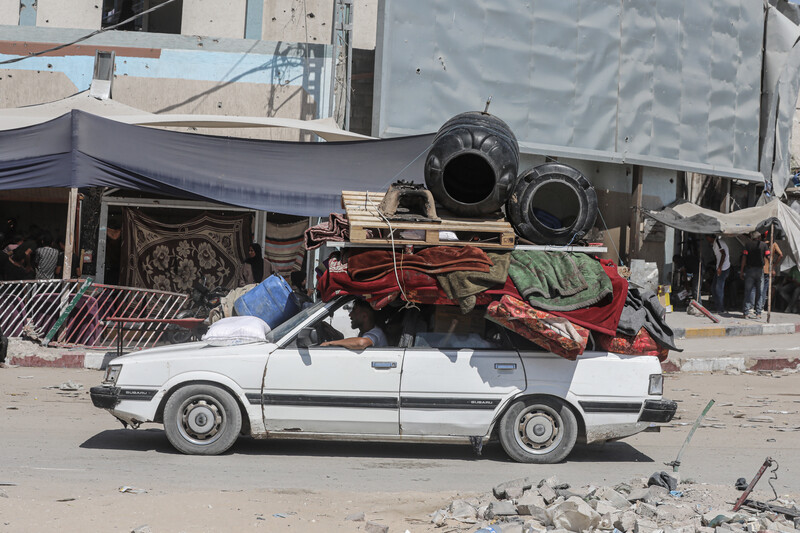
Palestinians were again forcibly displaced from homes in Khan Younis when the Israeli army ordered an evacuation on 1 July. Omar AshtawyAPAimages
At the end of June, I was wandering down Jalal Street in Khan Younis with my younger brother Khalid.
Jalal Street used to be my favorite street in my hometown. Even if I was just withdrawing money from an ATM on the street, I would take my time to absorb the scenes: the vendors selling their wares, the families eating out at one of the street’s many restaurants.
When the Israeli army invaded Khan Younis in December 2023, they razed Jalal Street to the ground.
No more vendors. No more restaurants. No more life.
My brother and I, during our late June walk, stepped over the piles of rubble that now make up Jalal Street. Every pile of rubble was once a colorful or historic building that I loved.
It was then that we heard a few men talking about news of another Israeli ground invasion, of the Shujaiya neighborhood of Gaza City.
Indeed, that day, 27 June, Israel would invade Shujaiya, destroying its streets just like it did in Khan Younis.
Where to go
I asked myself, what if the Israeli army again invades Khan Younis? Where would we be forced to evacuate to then?
In Gaza, we are always asking ourselves, where do we go? Yet people outside of Gaza might not be able to fully visualize what this means.
“Where do we go” is barely a question anymore – just an expression of despair.
Where to go when the scale of destruction in Khan Younis is apocalyptic.
Where to go when Rafah is no longer an option.
Where to go when Gaza’s central area is packed, and when al-Mawasi, a desert region by the sea, is equally packed.
Israel is moving us around left and right like pieces on a chess board.
Another forced displacement
Then, on 1 July, the Israeli army once again ordered a mass evacuation of the eastern part of the city of Khan Younis, including my neighborhood Sheikh Nasser.
When I first saw an Israeli spokesman’s Facebook post announcing the evacuation, I asked myself if this meant we would be going back to square one. This square one, when I imagine it, is featureless – a gray, unidentifiable space of misery.
I took a short walk to the Bani Suhaila roundabout, the main roundabout of Khan Younis, where I saw cars, trucks and minivans stuffed with residents’ belongings.
People were pulling carts, and kids were pushing their elders in wheelchairs. It was a near duplicate of the scene of the first evacuation in December 2023.
At that time, my family and I were forced from our home under a shower of bombs. We walked the distance from Khan Younis to Rafah on foot, over 10 kilometers, carrying all of our belongings when the wheels on our luggage broke.
Now, I looked at my people being forced to evacuate once again. I looked at their pale faces, heavy steps and absent minds.
I saw one of my neighbors standing on the corner of our street. With an uncertain look, he was intercepting each car that passed by him, asking those inside where they were going, in hopes that they would offer him a seat in the car.
He was desperate for a ride.
The sun went down and so did his spirit. He went back home. And so did I.
My family gathered in the living room. We decided to spend the night at home because it would be hopeless to find a ride to west Khan Younis, the designated (and unlikely) “safe” area.
Pieces on a chess board
We stayed in Khan Younis, waiting. Yet nothing “big” happened in Khan Younis.
It was 11 July, and many of those who were forced to evacuate returned, even though Khan Younis is still labeled a “danger zone” by the Israeli army.
I believe that those evacuation orders on 1 July were an Israeli test to see how Palestinians would respond to their orders.
It’s like those horror movies where a psychopath terrorizes their victims with every possible demented method so that, by the end of the movie, they have subjugated their victim.
Yet throughout the beginning of July, the Israeli army continued to move us around like chess pieces.
On 7 July, the Israeli army ordered those in eastern Gaza City to evacuate to Deir al-Balah following its attacks on Gaza City, including a raid of the al-Tofah neighborhood.
“The quadcopter directly targeted numerous people as they fled Yafa school, where many people took shelter inside,” A.W., who was sheltering at the school, told The Electronic Intifada.
“I had to jump over dead bodies that were thrown all over the street as I ran to al-Nasser Street, [west of Gaza City], where the rest of my family had fled.”
The bombing intensified all over Gaza City.
“From midnight till dawn of 9 July, the bombs kept falling all over our street in al-Sabra area, in the southern Rimal neighborhood [of Gaza City],” said Ala’a Sbaih, a young Palestinian writer.
The Israeli tanks opened fire indiscriminately, and the snipers, accompanied by their quadcopters, shot at every moving body in their sight. As with every Israeli ground operation, the Israeli tanks and snipers provided a 500-meter-wide cover for their troops. This is something that has become common knowledge among Palestinians in Gaza.
“My neighbor tried to escape his house that night, but he got shot by an Israeli sniper, and was left to bleed all night long until he was found dead in the morning,” Alaa said.
“It felt as if the war had just started all over again.”
Qasem Waleed El-Farra is a physicist based in Gaza.
The Israeli army committed another massacre against displaced Palestinians in tent encampments, this time in the coastal Mawasi area, which Israel had designated as a “safe zone.”
THE AFTERMATH OF THE MAWASI MASSACRE, JULY 13, 2024. (PHOTO: OMAR ASHTAWY/APA IMAGES)
In a crater in the ground almost larger than a schoolyard, a group of young men dig through the sand and pull out the bodies.
“His head is there! His head is there!” someone yells. A man emerges from the hole, carrying a child.
“Who knows who this child is? Who knows his family? Where are his parents?” he calls out.
Behind him are dead bodies and severed limbs scattered across the ground. Some poke out from beneath the sand, half-buried.
When the Israeli army struck the coastal displacement camp in al-Mawasi, west of Khan Younis, there was no rubble. The Israeli-designated “safe zone” was little more than a sea of tents on the beach, so people were buried in the sand instead.
At 10 a.m. on Saturday, while people were starting their day, the Israeli military targeted the area with successive airstrikes, leading to a massacre that, according to the Ministry of Health in Gaza, has, as of the time of writing, killed 90 people and injured over 300 others. Half of them are women and children, the health ministry says.
Shaima Farwaneh, 16, was near the site of the massacre when it happened. She was preparing to make breakfast for her family when the bombs fell.
People and sand scattered everywhere, limbs that were once attached to bodies flying over their heads.
“A leg hit me, and I saw dismembered bodies a few meters away,” Shaima told Mondoweiss. “I saw a young child screaming. He lost his lower limbs and was crawling on his hands and screaming. The bombs didn’t stop, and suddenly the boy disappeared. I saw how he vanished before me while we ran and lowered our eyes to the ground, unable to do anything but run.”
Shaima describes hearing seven explosions in short succession before it was over. “What a life we live in these tents that we have to see the dismembered bodies of our siblings and families fly over our heads.”
SHAIMA FARWANEH AFTER THE MAWASI MASSACRE. (PHOTO: HASAN SULEIH)
When the ambulance and Civil Defense crews arrived near a well-known crowded market for residents of the area, their vehicles were targeted as well, according to the director of the Civil Defense in Khan Younis, Yamen Abu Suleiman. Two Civil Defense workers were killed in the strike.
Abu Suleiman said that the occupation targeted Al-Mawasi with a large barrage of missiles, which led to many casualties. “The occupation targeted the area more than once to prevent us from any rescue operation,” he tells Mondoweiss, denouncing the silence of the International Committee of the Red Cross over Israel’s prevention of rescue teams from doing their work.
Israel claims that the airstrikes were an attempt to assassinate Muhammad al-Deif, the head of the armed wing of Hamas, the al-Qassam Brigades, as well as the commander of al-Qassam’s Khan Younis District Brigade, Rafi Salama. The Gaza government media office denies the Israeli claims, emphasizing that they are nothing but a way of diverting the world’s attention from the reality of the massacre the Israeli army committed as part of the genocide of Gaza’s people.
According to local sources, over 80,000 displaced people currently reside in tents in that area.
‘No state does this’
Fawzia Sheikh Youssef, 82, was buried in the sand from the bombing but survived. She describes what she experienced during the massacre as something she had never seen in her entire life. She tells Mondoweiss that she was already displaced during the Nakba of 1948 when she was only 6 years old, coming to the Khan Younis area and staying with her family for two years in a tent. 76 years later, she found herself back where she started, but this time witnessing massacres the likes of which she had never seen even during the Nakba.
“There is no country in all the world that does this to children, women, and civilians,” she says. “This isn’t how wars are.”
Fawzia was eating her breakfast when the bomb ripped through her encampment, demolishing her tent and trapping her underneath it. She found herself covered in sand and trapped inside but was not critically injured. She began crawling on the ground and extricated herself from beneath the tent, eventually escaping to a place far away from the shrapnel and missiles, closer to the main road.
“I saw before my eyes one missile after another descending next to the tents. Missiles I have never seen in my life in all of Gaza’s wars. Isn’t this internationally forbidden? Shouldn’t the civilian population be protected and not face genocide and mass killing? Isn’t this forbidden?”
FAWZIA SHEIKH YOUSEF, WHO WENT THROUGH THE NAKBA, SAYS THE MASSACRE SHE WITNESSED WAS WORSE THAN WHAT SHE SAW IN 1948. (PHOTO: HASAN SULEIH)
“They killed young people and old women. They do not respect humans. Aren’t we human?” she continues. “There is nothing to protect us from these missiles. The tents fell on our heads, and I was hit with two pieces of shrapnel in my leg. I may get poisoned, and I did not harm anyone.”
“These are not humanitarian actions,” Fawzia says. “A normal state would know that children have value, and women have value. Their lives are respected. Killing them is forbidden. There are wars. Some countries fight in the world, but not like this. Not like what happens with us.”
‘I left my son and fled from the horror of the bombing’
Samah al-Farra, a survivor of the massacre, says she fled from the horror of the missiles, leaving her son behind without knowing what she was doing. She describes what she saw after the incident as witnessing the horrors of the Day of Resurrection. The sound of the explosions, the panic of the people around her, the stampede in the attempt to escape, women leaving their tents without even wearing their clothes — Samah has to live with witnessing all these brutal scenes.
“People were running. There was sand in our eyes and fire over our heads. I left my son behind me and started running. I found the world turned upside down. The bodies of the martyrs were next to us, cut into pieces. It was a massacre. The fragments, sand, and bodies flew over our heads as we ran,” Samah describes.
She says that if this density of missiles had fallen on fortified buildings, it would have destroyed them. “But what about when they fall on tents whose owners are protected only by a piece of cloth?”
She describes the scene as a shower of missiles falling four times in a row, with more than one explosion occurring during each shower. “We saved ourselves. If we had stayed where we were, we would have been cut up and buried under the sand.”
Media reports have said that the bombs used in the al-Mawasi attack were JDAMs made in the U.S., which turn highly destructive unguided bombs into more precise missiles.
‘The entire area was overturned‘
Aziza Abu Tahir sits in front of the devastation after the bombing. Scattered bags of flour, gallons of water, vegetables, pillowcases, and utensils litter the area. She owns an oven and sits beside it every day. The women of the camp send their dough to her to bake for a small fee.
“When they dropped the bombs above our heads, all the people were running and screaming and saying that these were incendiary bombs, and this is the first time we have heard a sound like this,” Aziza tells Mondoweiss. “We ran away, and no one knew where to run. Some people went from one direction and were bombed, and some of them went from another direction and survived. But no one knew where they were going.”
AZIZA ABU TAHER IN AL-MAWASI. (PHOTO: HASSAN SULIEH)
As she speaks, a small child is hugging her, the son of her neighbor. Aziza says his mother takes care of orphans, and explains that when the attack started, his mother was bringing some dough for Aziza to bake in order to then resell to get an income for her family. “She was just here, and I baked what she wanted, and she went to sell it. As soon as she walked away, the bombing started. I don’t know where she is now, and I don’t know if she will return. The entire area she was walking in was overturned, and everything was buried.”
Hassan Suleih conducted interviews and provided photography for this report.
Tareq S. Hajjaj Tareq S. Hajjaj is the Mondoweiss Gaza Correspondent, and a member of the Palestinian Writers Union. He studied English Literature at Al-Azhar University in Gaza. He started his career in journalism in 2015 working as a news writer and translator for the local newspaper, Donia al-Watan. He has reported for Elbadi, Middle East Eye, and Al Monitor. Follow him on Twitter at @Tareqshajjaj.
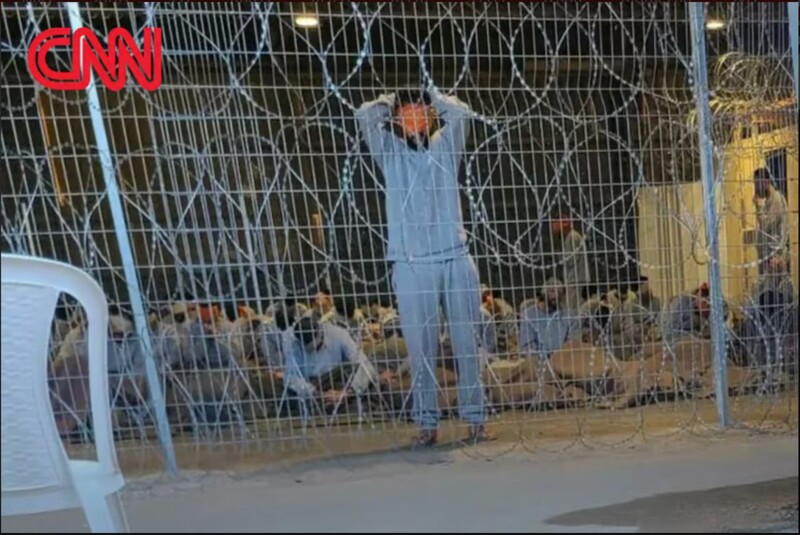
Ibrahim Salem’s family are convinced that he is the man standing in this photograph, leaked to CNN.
Ibrahim Salem had been missing for months.
In December, the Israeli military attacked his home in Jabaliya refugee camp, northern Gaza. Many of his family were killed or injured.
Ibrahim made arrangements for three of his children to be treated for their wounds in Kamal Adwan hospital.
While he was at the hospital – located in the city of Beit Lahiya – it came under an Israeli attack.
The Israeli troops went on a killing spree. Those who stayed alive were arrested.
Ibrahim’s family have been unable to contact him since that time.
At first they thought he had been killed. But there was no sign of his body in the hospital.
When it appeared that he had been taken into detention, the family sought assistance from lawyers and other human rights advocates. Yet they were unable to find information about him.
“This made me feel more helpless,” said Wasim, Ibrahim’s brother.
A CNN report broadcast in May provided the family with some basic details.
The report focused on Sde Teiman, the Israeli military camp in the Naqab desert, where Palestinians from Gaza are being detained. It featured leaked photographs from the camp.
One of them showed a prisoner standing up, blindfolded and with most of his face covered.
When Wasim saw the image from the CNN report, he was taken aback at first. When he zoomed in on it, he was sure that it was Ibrahim.
Despite how the detainee’s face was mainly covered, the family are sure from the features that were visible that it was Ibrahim in the photo. As Ibrahim was barefoot in the picture, the family could confirm that one of his toes has a distinctive shape as he had undergone surgery.
Although it was a relief to learn that Ibrahim was still alive, his family are distressed by how he looked unwell.
“He was very thin and it appeared that his health was failing,” Wasim said. “It was obvious that he had been abused and tortured.”
Located in the Naqab desert, Sde Teiman has been used to lock up thousands of Palestinians since October.
Detainees who have been subsequently released have given testimony of how they were beaten and subjected to electric shocks while being interrogated. Medical neglect is rife and food inadequate.
As prisoners have been prevented from communicating with the outside world, Ibrahim’s family lacks solid information about him. All they have is a grainy photograph indicating that he is still alive.
Dr. Adnan Al-Bursh was the head of the orthopedic wing at Shifa Hospital in Gaza City. During the war, he had to wander from one hospital to the next, as they were all destroyed by the IDF. He has not been back to his home in Jabalya since the start of the war, and last December all trace of him disappeared. Recently, it transpired that he had died in an Israeli jail, apparently due to the torture of beatings during interrogation.
The last people to see him were other doctors and detainees who have been released. They told Haaretz correspondents Jack Khoury and Bar Peleg that they had barely recognized him. “It was clear he had been through hell, torture, humiliation, and sleep deprivation. He wasn’t the person we knew; he was a shadow of himself.” (Haaretz, May 12.) A photo of him published after his death showed an elegant man. A photo from during the war showed his hospital gown covered in blood. He had a wife, Jasmine, and they had six children. He studied medicine in Romania and did a residency in the United Kingdom. The rapper Tamer Nafar wrote a beautiful lament for him. (Haaretz, May 6.)
A doctor, a hospital ward director, was beaten and tortured to death in an Israeli jail. That did not set off alarms here. Nearly all his physician colleagues, including heads of the medical establishment and those who take part in the horrific torture ongoing at Sde Teiman base and in Israeli prisons, did not say a word. A department director was beaten to death. So what? After all, almost 500 doctors and medical staffers have been killed in the war and their fate failed to arouse any attention. So why should Al-Bursh‘s death attract any attention? Because he was a department director? No war crime committed by Israel in Gaza has aroused any feelings here in Israel, with the exception of the joy felt by the bloodthirsty right-wing.
On top of the doctor’s death came another heinous act: the response of the authorities. The Shin Bet was silent as usual. Ex-Shin Bet officers are now star commentators on television, asked to show us the way, to give us their opinion, but the Shin Bet never talks about those it has interrogated and tortured. The IDF shirked responsibility; the doctor was only “processed” at an army detention facility, and was immediately transferred to the Shin Bet interrogation facility in Kishon, and from there to Ofer Prison, which is under the charge of the Israel Prison Service. The IPS response was pure audacity: “The service does not address the circumstances of the deaths of detainees who are not Israeli citizens.”
A man dies in prison, yet the Israel Prison Service does not think it should report the circumstances of his death to the public because he was not a citizen of the state. In other words, the lives of those who are not citizens have no value in Israeli prisons. We should remember this when an Israeli is arrested in Cyprus for rape, or in Peru for drugs, and we are outraged by the conditions of his detention. We remember this even more poignantly when we complain to the world, and rightly so, about the fate of our hostages.
Dr. Adnan Al-Bursh, who was the head of orthopedics at Al-Shifa Hospital in Gaza City.
How can people identify with the pain felt by Israelis over the fate of the hostages, when these same Israelis turn out to be cold-hearted and indifferent to the fate of the other side’s hostages? Why isn’t there a single banner in Tel Aviv’s “Hostage Square” calling for an investigation into the killing of the doctor from Gaza? Is his blood less red than the blood of the Israeli hostages who died? Why should the whole world take an interest and work only for our for hostages, and not for the Palestinian hostages, whose conditions of imprisonment and whose deaths in Israeli prisons should horrify everyone?
There are very few independent accounts that corroborate allegations that the IDF used drones to lure people into their sights with the sounds of infants in distress. The claim is similar to common urban legends and rumors, including one lodged by the IDF against Hamas in December 2023.
These facts alone are not enough to disprove the reality of these events, however, and claims that the IDF does not have technology capable of performing these tasks are misguided.”
Israel is pioneering yet another deadly innovation in drone warfare. What happens in Gaza won’t stay there.
(An Israeli quadcopter seen near the Israel-Gaza border in 2018. AFP via GETTY IMAGES / Said Khatib)
The besieged people of Gaza’s Nuseirat refugee camp got a terrifying glimpse this month of the shape of war to come.
Disturbing sounds of crying infants and women were audible throughout the camp. When they went out to investigate, “Israeli quadcopters reportedly opened fire directly at them,” the award-winning Palestinian journalist Maha Hussaini reported for Middle East Eye. The quadcopters – small, cheap, and disposable drones usually used for civilian photography and, more recently, military reconnaissance – had been blasting the sorrowful recordings as a lure.
Once the lure worked, it created a self-fulfilling prophecy: those who ran to help the fake victims became real ones. Residents struggled to help those real victims as the “quadcopters were firing at anything that moved,” eyewitness Samira Abu al-Leil, a 49-year-old Nuseirat resident, told Middle East Eye.
Gaza is the scene of Israeli carnage so pitiless that the International Court of Justice in January found it to be plausibly genocidal. Palestinian journalists and health workers on the ground are documenting that it’s also something else: a laboratory for the wars of the future. Playing a recording of a crying baby to kill those who seek to save children is a risible cruelty but hardly an innovative one. Arming a quadcopter, however, is an inevitable idea that Israel now appears to have been the first to bring into battlefield usage. And Gaza will by no means be the last conflict where armed quadcopters kill.
Foreign journalists cannot enter Gaza to see these drones for themselves. Asked for comment on the reports of armed quadcopters, an Israeli military spokesperson told Zeteo, “We do not comment on operational tools.”
Israel’s armed quadcopter innovation is not the only harbinger of future wars at work in or emanating from Gaza. Yuval Abraham, reporting for the Israeli outlets +972 and Local Call, revealed a terrifying targeting artificial intelligence, Lavender, that purports to sift through the accumulated data Israel gathers through surveillance on Gazans and predict who matches the profile of a vaguely defined “militant.” Particularly at the beginning of its onslaught through Gaza, Abraham reported, the Israeli military “almost completely relied on Lavender, which clocked as many as 37,000 Palestinians as suspected militants.”
Much of the recent focus on emerging Middle Eastern military capabilities – especially where drones are concerned – has been on Iran, not Israel. Iran’s contributions to the changing face of drone warfare have come on a larger scale. The Iranian drone air fleet launched against Israel this month – retaliation for the deadly April 1 attack on an Iranian diplomatic facility in Damascus, presumed to be the work of Israel – neither killed anyone nor survived the combined air defenses of Israel, the U.S., UK, France, and Jordan, though shrapnel seriously wounded 7-year-old Amina Hassouna. But a fleet estimated at 170 mid-sized armed drones capable of making a flight more than 620 miles from Iran to Israel is a grim advance in drone history.
National militaries will have to spend significant portions of their budgets if they wish to purchase or develop a fleet of combat-capable drones, even though those drones are far cheaper than piloted combat aircraft. But tricking a quadcopter out with a gun is something that everyone from sophisticated defense establishments to insurgent, terrorist, militia, and rebel groups will find irresistibly affordable and technologically feasible. Drone experts consider the quadcopter’s weaponization to have been a matter of time, following as it does the trends in drone development toward miniaturization and affordability.
The battlefield emergence of the armed quadcopter is an uncomfortable reminder that the scale of destruction that has prompted observers of Gaza to compare it to 20th-century warfare is being accomplished with the weapons of the 21st – weapons often purported to make warfare more precise, or even more “humane.” Instead, the Israeli assault on Gaza is showing us a glimpse of wars simultaneously fought at the scale of AI-generated target selection and, as with the armed quadcopter, with terrifying intimacy.
“Heavy Gunfire Coming From Above”
Accounts of quadcopter attacks in Gaza began circulating on social media from Palestinians early in the war. The British-Palestinian surgeon Ghassan Abu-Sittah posted in mid-November that he and his colleagues at al-Ahli hospital had seen “over 20 chest and neck [gunshot] wounds fired from Israeli Quadcopter drones… When it comes to killing they are so innovative.”
Hussaini, in January, contributed a thorough report for Middle East Eye about the emergence of quadcopters as an Israeli military tool. She described their contributions to a horrific scene on Jan. 11, on the coastal al-Rashid Street in northern Gaza, in which the Israeli military opened fire on a crowd of hungry people who massed after hearing a truck packed with food was on the way.
“We were taken by surprise by the heavy gunfire coming from above, there were quadcopters shooting directly at the crowd,” eyewitness Qassem Ahmed, 42, told Hussaini, who wrote that the current war is “the first time in the Palestinian territories, remote-controlled quadcopters have been deployed on a large scale against suspected Palestinian fighters and civilians.” A similar account, reported from Gaza the next month by Tareq S. Hajjaj in Mondoweiss, quoted 39-year-old Abdallah Shaqqura, whose wife Ulfat was shot multiple times by a quadcopter in front of their 5-year-old son. Ulfat told the boy to run before bleeding out in the street.
In February, Euro-Med Monitor compiled a study of what they said was “systemati[c]” Israeli usage of the armed quadcopters in Gaza and corroborated accounts of quadcopters opening fire during the Jan. 11 bloodbath on al-Rashid Street. Euro-Med Monitor said it had confirmed “dozens of civilians” targeted and shot by quadcopters “fitted with machine guns and missiles from the Matrice 600 and LANIUS categories, which are highly mobile and versatile, i.e., ideal for short-term operations.” Citing the Palestinian Health Ministry, the study reported that health workers in Gaza noticed corpses with “evidence of unusual gunshots,” which, according to Euro-Med Monitor, indicated “not bullets fired from rifle-type weapons, but from quadcopter drones.” Hussaini’s Middle East Eye colleague in Gaza, Mohammed al-Hajjar, said the quadcopter’s rounds resembled nails.
Among the attacks Euro-Med Monitor documented were a quadcopter shooting into a tent at the al-Shaboura refugee camp in Rafah, killing 17-year-old Elyas Osama Ezz El-Din Abu Jama, “who was mentally and physically disabled,” and his 19-year-old brother Muhib. The father of 13-year-old Amir Odeh described seeing his son “suddenly hit by a gunshot from a quadcopter through the window of the room” while the boy was playing with his cousins on the eighth floor of the Palestinian Red Crescent Society’s headquarters in Khan Younis. He carried Amir to al-Amal hospital, “where he was proclaimed dead.”
Thaer Ahmad, a Chicago doctor who volunteered at Gaza’s Nasser Hospital, recently told The Guardian‘s Chris McGreal that a drone shot one of his colleagues in the head. The doctor was reported to have survived.
The exact make and model of the quadcopters over Gaza is unknown. But the Matrice 600 referenced by the Euro-Med Monitor is a six-rotor, nine-plus kilogram (19-plus Ib.) drone intended for photography. According to manufacturer DJI’s specs, the Matrice 600 has a maximum flight time of 18 minutes when carrying a payload.
Lanius, made by Israeli drone heavyweight Elbit, is a smaller, loitering robot that can be launched from, apparently, a Matrice-like quadcopter. It’s capable of sending a 3-D map of what its camera scans back to its operator. Looking like a Viewfinder of doom, the Lanius flies autonomously – until an operator sends it a command to detonate. After Elbit released a Lanius promotional video in November 2022, tech journalist David Hambling wrote that “the most impressive feature of Lanius is that [it] exists here and now, and may already be in use with Israeli forces.”
DJI and Elbit did not respond to Zeteo’s requests for comment.
An Aura of Inevitability
“Quadcopter” can be a bit of a misnomer. Some of the drones identified in Palestinian reporting and the Euro-Med Monitor report have appeared to have six rotors, and my experience as a defense reporter for WIRED magazine taught me that some people are very pedantic about these things. But the term “quadcopter” is a catch-all for a small, rotary-winged drone, distinguished from large fixed-wing, missile-armed robotic airframes like the U.S. Predator.
The quadcopter’s battlefield use has usually been to perform reconnaissance. And when it comes to payload, small drones have been rigged for self-detonation for years. The U.S. military has experimented with so-called “loitering munitions” for at least 13 years. Israel deployed loitering munitions in its attack on the Iranian city of Isfahan earlier this month, according to Iranian officials – and has deployed them since at least 2019 in operations in Iran and Lebanon.
The point here is not that armed quadcopters like those the Israeli military reportedly uses in Gaza are unprecedented. It’s that they are very, very precedented, to the degree that they have the aura of inevitability.
Russia’s assault on Ukraine is another merciless conflict that is yielding drone creativity from military necessity. There, Russian forces have used small “first-person-view” drones, rigged to explode, to cripple U.S. and German-supplied tanks. As Lara Jakes of the New York Times recently observed, that means a $500 robotic munition is defeating a $10 million armored vehicle.
Still, Sam Bendett, a defense analyst at the influential CNA think tank who pays close attention to battlefield developments in the Ukraine war, considers the armed quadcopter an “emerging technology,” not yet one that various governments or militias actively employ in combat. “There are experiments and examples of larger, heavier Ukrainian drones equipped with machine guns. It’s not clear yet how widespread this tactic is across the front,” he told me. Considering his area of focus, Bendett wasn’t familiar with the reported use of armed quadcopters by Israel in Gaza. But he commented that “Israel’s UAV [unmanned aerial vehicle] capabilities are very advanced, so it’s not surprising.”
Among the problems with arming a small drone with a gun is recoil, which will affect accuracy. Larger and heavier drones are better equipped to deal with that than small quadcopters, Bendett said. “You want to make sure that whatever you do, you fire precisely,” he noted.
Gaza as a Proving Ground
Drone warfare began in the Middle East. With a November 2002 strike in Yemen from a flimsy robotic airframe carrying an anti-tank missile, the U.S. inaugurated a new method of assassination from a distance. Israel, another drone pioneer, first used drones in the 1973 Yom Kippur War and its 1982 invasion of Lebanon as decoys to confuse air defenses in Syrian-controlled parts of the country. The Israeli military added strikes into its drone repertoire during the Second Palestinian Intifada in the early 2000s.
Twenty years later, armed drone usage is unremarkable, if no less terrifying. Militaries looking to add aerial capability but without the money or the industrial resources for piloted fighter aircraft instead pay hundreds of thousands or low millions of dollars for an Iranian Shahed or Turkey’s wildly popular Bayraktar-TB2. Across the African continent, 149 civilians died from drone strikes in 2020. Last year, that figure rose to 1,418 people, Bloomberg recently reported, citing the Armed Conflict Location and Event Data Project.
The subjugation of Palestine rendered it a military proving ground long before Oct. 7. Israel’s “occupation, in the West Bank and Gaza, is the perfect place to develop and test new weapons systems including surveillance drones, intelligence gathering tools and artificial intelligence weapons,” Antony Loewenstein, author of the 2023 book The Palestine Laboratory, said in a Q&A with the book’s publisher last October. “Once they’ve been used against Palestinians, the relevant companies market them at global weapons fairs” as “battle-tested.”
Elbit, maker of the Lanius, manufactured the first drones that the U.S. Department of Homeland Security tested over the U.S.-Mexico border. Israel has become the ninth-biggest arms dealer in the world, according to the Stockholm International Peace Research Institute. Its clientele includes some of the “most repressive regimes on the planet, including Myanmar and Saudi Arabia, [which] have purchased Israeli tech and weapons in the last decade with the authority and encouragement” of the Israelis, according to Loewenstein.
As the drones miniaturize alongside their options for carrying lethal payloads, militias will follow the same economic logic as national militaries, just on a different scale, like a Moore’s Law of death. Only this time, drone warfare may be a ground-up development, as modifications on commercially available quadcopters prove a viable, cheap workaround to export controls surrounding larger lethal drones. And the devolution and normalization of drone use don’t stop with rebel groups. The War on Terror demonstrated how battlefield innovations for well-funded militaries find their way to local law enforcement.
On April 11, Ghassan Abu-Sittah became rector of the University of Glasgow. In his address, he reflected on the solidarity he had seen so many of the peoples of the world extend to Palestine. He attributed some of it to an understanding that what happens in Gaza will not stay there.
“[T]hey understood that the weapons that Benjamin Netanyahu uses today are the weapons that Narendra Modi will use tomorrow,” Abu-Sittah said. “The quadcopters and drones fitted with sniper guns…used today in Gaza will be used tomorrow in Mumbai, in Nairobi and in Sao Paulo. Eventually, like the facial recognition software developed by the Israelis, they will come to Easterhouse and Springburn.”
This is Palestine, in your Inbox, Making Sense of the Madness Audio text By Asem al-Jerjawi, a Palestinian writer, activist, and journalist with We Are Not Numbers and the 16th October Media Group.
It was 4am on Friday, October 13, 2023 and I was asleep together with my mom and three brothers in our home in Al-Rimal, Gaza City. We had gathered in one room to sleep because the sound of warplanes buzzing overhead had become relentless, too petrifying for any of us to bear on our own. An unfamiliar number flashed on my mother’s phone. It was a pre-recorded warning from the Israeli military. Our home was in the danger zone and we were ordered to move south. We awoke in horror and ran outside, only to see Israeli army leaflets everywhere. We had no other choice but to flee. We decided to go to a friend’s home in Deir al-Balah. We were only able to bring a few pieces of clothes, blankets and some bedding. We waited for nearly an hour but couldn’t find any means of transportation as everyone was rushing to leave. Finally, our neighbor, Robin Al Mazlom, approached us and said he could take us south in his truck. Alhamdulillah.
Robin dropped us off at Wadi Gaza Street. We continued on foot for another 2 kilometers, carrying our bags, blankets and bedding on our backs. Thousands of displaced people were walking with their families south, everyone carrying their life’s possessions on their backs. This must have been what it was like during the Nakba of 1948, with one key difference: we have no illusions anymore about Israel’s ultimate aim: our annihilation.
Dozens of friends, uncles, aunts, cousins and my little old grandmother were already sheltering at our friend’s house in al-Zawaida by the time we arrived. 47 of us in a single apartment. For 2 months, I slept on the floor, catching a cold and waking up every day with back pain. Oh, the good old days, when it was a common cold and common back pain that afflicted me. The house was right near Salah ad-Din street, a major traffic artery now completely empty. At least we had easy access to an escape route, if necessary.
The day was January 5, 2024 and we were sitting at home. As the afternoon hours passed, the sounds of whistling snipers and gunshots grew louder. Then came the artillery shells and bombs. I don’t know whether it was a 1,000lb bomb or a 2,000lb bomb that Israel dropped near us, but it shattered all of the windows of the house. It felt as if the fighting was outside our front door for three straight days, the most miserable three days of my life.
The Israeli army soon declared this area a military zone as well, forcing us all to flee. Again. We packed our clothes, blankets and bedding, and together with our cats, we were off. My grandmother is old and frail and could not keep up, but we had no choice but to move south. I told my family to move ahead to Deir al-Balah, and I would help my grandmother, holding her hand tight, helping her walk, as sniper shots, artillery fire and missiles landed around us in every direction. As we walked south, I saw the body of a toddler girl. Her eyes were missing and all I could see was dried blood flowing from her empty sockets. There were bodies without limbs and human bones strewn around. Animals had clearly devoured their corpses. I felt horror. Anger.
We reached our new home in Deir al-Balah, an 8-person tent. There were hardly any provisions nearby, just thousands and thousands of people in every direction. As I ventured out to buy provisions for my family, I noticed a large crowd outside the Green Cafe in Deir al-Balah. So many desperate people, so little food. We were five people, and for two days, we shared a small amount of tainted water and a single loaf of bread. We were weak and hungry. This was my first experience with starvation. Then we received word that Robin, our neighbor who had generously given us a ride south in his truck, had been martyred along with his two sons. Allah Yarhamhum.
All I hoped for at that moment was to return to normal life. But life was anything but normal. In addition to the weakness and hunger, we were also exhausted from the sleepless nights. At night I am awoken seven times, sometimes more. It is impossible to sleep amidst the deafening sounds of rockets, bombs, tanks, bulldozers and heavy-arms fire.
The rain and the cold are also unbearable. Rain drips through the gaps in our tent’s nylon roof. I go days at a time without getting any sleep at all. Not because I’m not tired, but because our tent was soaking wet. How can one sleep in a pool of freezing water in the freezing cold? Meanwhile, whenever I try to think, to take my mind away from our plight, Palestinian souls flash before my eyes in the shape of a long beard that has lost its head, limbs, legs and eyeballs. I’ve never felt as hopeless as I feel now. My life consists of a constant search for water, bread and firewood, just to have a single meal.
I’ve already survived five wars in 2008-9, 2012, 2014, 2018-19 and 2021, but I’m not sure if I’ll survive this one. I was raised in Gaza, I’ve planted all my memories here in Gaza. This is where I belong, in Gaza. Whatever happens to me, my memories will live on here in Gaza.
Palestinian woman reacts as she cradles a wounded boy after Israeli bombardment in central Gaza City, last week. Credit: AFP
Mar 28, 2024 11:58 pm IST
UN Special Rapporteur on the occupied Palestinian territories, Francesca Albanese, released a report this week claiming that the nature and scope of attacks by Israeli Defense Forces in the Gaza Strip, as well as the ruinous living conditions created there by Israel, “can only be interpreted as constituting prima facie evidence of an intention to systematically destroy the Palestinians as a group.”
One Israeli told me he believes there is no need for such explosive terminology, while another asked whether there was any proof of these claims.
A woman who, until October 7 was affiliated with the left wing and has since sobered up, or awakened, had somehow seen – from beyond the Israeli iron curtain – a photograph of a Gazan child who was all skin and bones. She told me: “If these images are true, we must see them.”
So Israelis may wonder, raise questions, doubt, downplay or revoke Palestinians and their tragedy, even when it is clear as day, published in a United Nations report, or broadcast live on a non-Israeli news channel. I recalled how back after October 7, Palestinians and others were forbidden from asking questions, from questioning “facts” or from asking for proof.
It is well known that claims by the Israeli side are viewed as gospel, and that whoever rejects them is an antisemitic supporter of Hamas. But when it happens on the Palestinian side, all claims are an exaggeration, a conspiracy, fake-news, and Israelis can and are even obligated to ask about their authenticity.
It is interesting just how important is it to ask whether the photographs are real, or whether these claims are supported by any shred of proof, when there is an abundance of evidence of children dying of malnutrition in Gaza.
This doubt that is cast on every Palestinian image, or video, or report, is part of the Israeli iron curtain, with the underlying assumption that all Palestinians are liars.
It is gaslighting of tremendous proportions that Israelis are inflicting upon themselves and on Palestinians, in order to go on ignoring the genocide the entire world has been continually warning about. Israelis refuse to see or listen, and are still convinced that everything is all right.
Israelis are addicted to the iron curtain, and this practice of denying reality is deeply embedded into the Israeli DNA. It is an integral part of the knotted problems Israelis bring upon themselves through their arrogance and boastfulness.
This denial of reality is present at almost every aspect. Are most Israelis aware, for example, that at the core of the current negotiations between Israel and Hamas, or rather at the core of lack of progress in these negotiations, lies the refugee problem? Israel does not want to allow evacuated Palestinians to return to the northern area of the Gaza Strip.
Are Israelis asking themselves what the purpose of permanently uprooting them from the north is and of leaving the area under Israel’s control? That perhaps Israel wants an ethnic cleansing of the Gaza Strip, to be accompanied by establishing settlements just like in the West Bank, which would lead to the same inescapable state of constant warfare and the destruction of relationships with Palestinians everywhere?
From beyond the Israeli iron curtain, reality seems to most Israelis to be essentially good. However, the more they go on looking from behind that iron curtain, so will their distance from reality continue growing, until the inevitable fall into the gaping chasm. Will they still be able to break that curtain?
 THE AFTERMATH OF THE MAWASI MASSACRE, JULY 13, 2024. (PHOTO: OMAR ASHTAWY/APA IMAGES)







 band annie's Weblog