video of speech subtitled in English
Call to the Israeli people
Today I do not only want to speak to my dear people but to all of humanity.
I want to call to the conscience and hearts and minds of the whole of humanity, I would like to share courageously my feelings.
Yesterday, in the darkest moment of the night two bloody attacks occurred.
The first of them was the terrorist attack against our military troop at the Iskenderun Naval Base. In this malicious, vicious attack six of our soldiers died, and they have become martyrs. Seven of our soldiers have been injured.
The second, at dawn in the waters of the Mediterranean Sea, the heart of humanity has taken one of her heaviest wounds in history. The aid ships, from the humanitarian heart, these flowing aid ships have been hindered with guns, by violence, despotism.
Staff Sergeant Brags of Role in Massacre
Jason Ditz
June 4, 2010
Autopsies are coming out today revealing some details about the circumstances of the Israeli attack which left at least nine aid workers dead. Doctors say that several of the victims were shot in the head and that in at least one case the gun was just inches from the aid worker’s head when fired.
But additional information is also coming in in the form of a report from an unnamed Israeli staff-sergeant, who claims proudly to have single-handedly killed at least six of the civilian aid workers.
The staff-sergeant says he has no doubt everyone on board was a “terrorist” and claimed there were secretly dozens of “hardcore mercenaries” on board.
The staff-sergeant’s story is being well received in Israel, where the killings have been lionized by a sympathetic media and by government officials eager to cash in on the latest jingoist craze. He is now being praised for “stabilizing the situation” and is being considered for a medal of valor for his killings.
The Israeli military insists that, far from the straightforward massacre of civilians that it appears to be, they are the victims of a massive conspiracy to frame them, and that 50 “well trained” Turks with communication devices, who they said were likely ex-military, were on board shooting and throwing grenades at them. The fact that no grenades or guns or communication devices or, indeed, “terrorists” were found on board is being claimed as another coverup, that after the massacre the “terrorists” somehow had the presence of mind to throw all the evidence overboard. Exactly how they all disappeared themselves in unclear, but not a single captive was charged with any crime.
ISLAMIC0NTENT — 5 juin 2010 — Nine Turkish activists killed in an Israeli raid on a Gaza-bound aid ship were shot a total of 30 times and five died of gunshot wounds to the head, Britain’s Guardian newspaper has reported.
Preliminary autopsy results showed the men were hit mostly with 9mm bullets, many fired at close range, the Guardian said, quoting Yalcin Buyuk, vice-chairman of the Turkish council of forensic medicine which carried out the autopsies on Friday.
Ghassan Hage
June 3, 2010
I don’t write poems but, in any case, poems are not poems.
Long ago, I was made to understand that Palestine was not Palestine;
I was also informed that Palestinians were not Palestinians;
They also explained to me that ethnic cleansing was not ethnic cleansing.
And when naive old me saw freedom fighters they patiently showed me that they were not freedom fighters, and that resistance was not resistance.
And when, stupidly, I noticed arrogance, oppression and humiliation they benevolently enlightened me so I can see that arrogance was not arrogance, oppression was not oppression, and humiliation was not humiliation.
I saw misery, racism, inhumanity and a concentration camp.
But they told me that they were experts in misery, racism, inhumanity and concentration camps and I have to take their word for it: this was not misery, racism, inhumanity and a concentration camp.
Over the years they’ve taught me so many things: invasion was not invasion, occupation was not occupation, colonialism was not colonialism and apartheid was not apartheid.
They opened my simple mind to even more complex truths that my poor brain could not on its own compute like: “having nuclear weapons” was not “having nuclear weapons,” “not having weapons of mass destruction” was “having weapons of mass destruction.”
And, democracy (in the Gaza Strip) was not democracy.
Having second class citizens (in Israel) was democracy.
So you’ll excuse me if I am not surprised to learn today that there were more things that I thought were evident that are not: peace activists are not peace activists, piracy is not piracy, the massacre of unarmed people is not the massacre of unarmed people.
I have such a limited brain and my ignorance is unlimited.
And they’re so fucking intelligent. Really.
Ghassan Hage is professor of anthropology and social theory at the University of Melbourne.
Huwaida Arraf, 34, is the Palestinian-American co-founder of the International Solidarity Movement and Chair of the Free Gaza Movement, which organised the aid flotilla that came under attack by the Israeli military on Monday.
Arraf was aboard a small boat – the Challenger I – with 16 other American, British, Australian and Irish passengers which was boarded by Israeli commandos. This is her eyewitness account of what happened, as told to Saeed Taji Farouky.
“I was at sea for about five days total before the attack by the Israelis.
At approximately midnight from Sunday to Monday, the Israelis started radioing all the vessels and asking questions.
They started telling us the area that we were navigating into was a blockaded area. They demanded that we turn around, and they told us if we did not turn around, they would be willing to use all necessary force in order to enforce the blockade.
We responded we were unarmed civilians, we were carrying only humanitarian aid and we didn’t constitute any kind of threat to Israel, therefore they were not justified in using any kind of force against us.
Some time between 4:00 and 4:30 (on Monday), we saw that their naval vessels were starting to approach our vessels so we knew there was going to be some kind of takeover. On my boat, we all put our life jackets on and went outside the boat because we were fully intent on trying to defend our boat using our bodies, by preventing the soldiers from getting on, if possible.
Our ship took off and tried to outrun the Israeli navy who had started coming after us. We were only able to keep outrunning them for about ten minutes before they were able to take over our boat.
They did not open fire on us but they were pretty rough. One girl’s face was bloodied. They grabbed me, wrestled me to the ground, and at one point smashed my head against the deck of the boat and one soldier had his boot on my head.
They were trying to cuff my hands behind my back and at one point they dragged me to the front of the boat and put a bag over my head. We weren’t shot at but we were being roughed up, and in 15 minutes maximum they took over the boat. They had guns. I know they’re trying to say they didn’t, but they had M16s.
I think three or four hours later, we made it to the port of Ashdod.
I was the last one pulled off the boat and I didn’t see any of my friends after that. I also hold Israeli citizenship so I can’t be deported like the others. [The Israelis’] choice was either to prosecute me or release me and they decided not to prosecute me, presumably because they didn’t want to draw more attention to their actions.
They used violence to push me into a police van, literally pulling my hair, punching me, elbowing me in the face in order to subdue me, and then they drove outside the port and at some point stopped the van and pushed me out of it.
When they opened the car to push me out I fell onto the ground.”
Huwaida woke up in hospital where she was kept for several hours and given medical checks.
“At most I’m bruised, but compared to what I later learned happened to our friends on the other boat it’s nothing to complain about. I’m pretty happy and lucky to be alive and not seriously injured.
I am devastated about the loss of lives…But at the same time, I am heartened to see that there has been an international response and an outcry in many circles. That is very promising and we hope to build upon that. So despite the violent attack on our last flotilla, we’re already planning the next steps.”
Another aid ship, the MV Rachel Corrie is currently docked somewhere in the Mediterranean. The Free Gaza movement still intends for it to reach Gaza, but is investigating ways to ensure its safety before it is allowed to set sail.
—
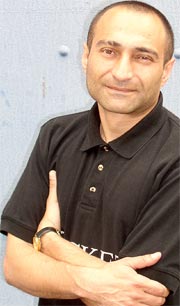
Kevin Ovenden, a representative of Viva Palestina, was on the main ship of the Freedom Flotilla when Israeli soldiers descended onto the deck – he spoke from Turkey to Siân Ruddick
“We knew the Israelis were going to attack, or intercept us in some way. At 11pm we had the first contact. A visual warning was that two Israeli warships were approaching us, followed by a third.
“We were 90 miles north of the Israeli coast, and 22 miles away from the buffer zone that Israel has set from its shores.
“We had tight organisation procedures in place and people were prepared.
“The captain and the most experienced activists on board said that people should rest. Many people did while others stayed on the look out.
“At 4.25am the attack began. The warship had neared and commandoes were lowering themselves onto the deck from helicopters. There were two motorised dinghies, carrying 14-20 commandoes, on either side of the boat.
“It was clear they were armed – it was the equivalent to an SAS raid. They were all wearing paramilitary style balaclavas.
“The first soldiers landed on the roof of the ship, people responded instinctively with their bare hands and things you would find on a ship – pieces of wood and piping and so on. No sharp objects were used.
Two soldiers were overpowered and pushed below deck. They were disarmed to prevent further injury or death.
“The attack opened with percussion grenades.
“These don’t just make a noise but send shockwaves of heavy vibration. They were trying to create terror and panic.
“They also used rubber coated bullets in the earlier stage. But very quickly they turned to live rounds and we were taking heavy casualties.
“Niki Enchmarch was on the top deck standing next to a Turkish man who was holding a camera. An Israeli soldier shot him in the middle of the forehead. It blew off the back of his skull and he died.
“I was on the second deck. A man standing a metre in front of me was shot in the leg, the man to the right of me in the abdomen. There was pandemonium and terror.
“The youngest person on the ship was not yet a year old, the eldest 88. The crew included German and Egyptian parliamentarians, NGO workers and representatives from various charities. This is who Israel was targeting.
“While they opened fire we struggled in our defence and to limit the massacre.
“They attacked with lethal force to terrorise the movement for the end of the siege of Gaza and the wider movement of solidarity with Palestine. They used violence to instill terror for political ends. This is the definition of terrorism.
“But they failed. The people aboard, their families and the people who donated to the €20 million aid, are not afraid – neither are those in the wider movement.
“This must become a turning point in the lifting of the siege and an end to the policies pursued by governments in relation to Israel.
“Israel has completely isolated itself. Around the world we must redouble our efforts and commit to action to end the siege. This is a political opportunity in which big advances can be made.
“The statements of condemnation by David Cameron and William Hague betray how isolated Israel is. These are leaders of a pro-Israeli party, and yet these statements have been more damning than anything Gordon Brown said when Israel was bombing Gaza in December 2008 and January 2009.
“Governments claim to recognize the siege is unsustainable. We have to force the UN, the EU and all the other governments to turn their words of condemnation into action.”
 band annie's Weblog