Search

band annie's Weblog

I have a parallel blog in French at http://anniebannie.net

Category

Egypt

Transcript: TIME’s Interview with Egyptian President Mohamed Morsi

cover_1210.jpg

[Note: TIME had spelled the president’s surname as “Morsy” based on his Ph.D. dissertation for the University of Southern California; his advisers in Cairo say the preferred spelling is now Morsi. Protocol required President Morsi to answer questions from TIME editors and reporters in his native Arabic, the official language of Egypt.  Instead, as a courtesy to his guests, he spoke for most of the hour in English, which he last spoke regularly three decades ago.]

TIME: You’re on the world stage now.

President Mohamed Morsi: (In English) The world stage is very difficult. It’s not easy to be on the world stage. The world is now much more difficult than it was during your revolution. It’s even more difficult. The world. More complicated, complex, difficult. It’s a spaghetti-like structure. It’s mixed up. So we need to somehow take things, easily, so we can go together, the whole world — peacefully, peacefully, hopefully, all kinds of peace. I think you know that in general people like to say that we should keep peace by all means. I’m not talking about peace by its traditional meaning. Peace of mind, peace of heart, peace of living together, socially, culturally, not only militarily.

(MORE: Should Mohamed Morsi be TIME’s Person of the Year?)

Mursi decree “crippling to democratic transition” – Former presidential adviser

24/11/2012

By Mohamed Abdu Hassanein

Cairo, Asharq Al-Awsat – Coptic presidential adviser, Samir Morcos, officially announced his resignation yesterday in protest to President Mursi’s controversial constitutional declaration which allows the president to assume sweeping powers, placing his decisions above legal challenge until a new parliament is elected. Morcos served less than three months as President Mohamed Mursi’s adviser on democratic transition. President Mursi’s surprise announcement on Thursday incurred widespread criticism from across Egypt and resulted in violent protests in Cairo, Alexandria, Port Said and Suez on Friday. Speaking exclusively to Asharq Al-Awsat, the former presidential adviser stressed that “I refuse to remain [in my position] in light of this presidential decision that is crippling to the democratic transition process…and which is contrary to what I am trying to achieve through my position.”

Morcos stressed that he had accepted this position “in order to participate in the democratization process in Egypt, however what has happened, regarding President Mursi’s decision, represents a disregard of this process.” He also revealed that he was not consulted on this new constitutional declaration, which ultimately places control of the legislative, executive, constitutional and judicial authority in Mursi’s hands, adding that he only learnt of this when the decree was officially announced on television. Morcos asserted that this decision “violates all the democratic norms and traditions” as well as the special portfolio – democratic transition – that he was appointed to oversee.

The prominent Egyptian Copt revealed that he had presented President Mursi with his two-page resignation letter, in which he outlined the reasons for his decision and his objection to the president’s decisions. His resignation described this decision as being “discouraging for the democratic transition project in Egypt” adding “I cannot remain [in my position] in light of presidential decisions that are crippling to democratic transition, particularly with regards to retroactively granting Mursi immunity”. He added “this is not acceptable.”

He confirmed that this decision is final and that he will announce his position clearly regarding everything that is happening in the country after his resignation has officially been accepted.

Morcos was elected as one of the 100 members of the constitutional committee charged with drafting Egypt’s new constitution, however he later resigned from this committee over his objections to the manner in which it was formed, stressing that this committee was not balanced and did not reflect the genuine diversity of Egyptian society. He also informed Asharq Al-Awsat that he had been pressured, from several sides, including by Egyptian President Mursi himself, to retract his resignation and return to the constitutional committee. However Morcos asserted his objection to the manner in which this committee had been formed as well as the ongoing conflict that is raging within it.

Morcos stressed that the constitutional draft being drawn up by this committee is unworthy of Egypt, dubbing it “the constitution of the majority.”

For its part, Egypt’s Supreme Judicial Council, the country’s highest judicial authority, also strongly rejected Mursi’s latest decree, describing it as an “unprecedented attack” on their authority. It added that work would be suspended in all courts and prosecution offices until the decree passed by the president earlier this week is reversed.

Whilst the liberal Constitution Party issued a statement saying “we are facing a historic moment in which we either complete our revolution or we abandon it to become prey for a group that has put its narrow party interests above the national interest.”

Protests continued on Saturday across Egypt, with demonstrators pitching tents in the middle of Cairo’s Tahrir Square, pledging to remain there until Mursi reverses his decision. Protest organizers said more than 20 different groups had joined a week-long sit-in against the Egyptian president’s reform, describing Mursi as the new “pharaoh.”

Defending his decision at a rally at Cairo’s presidential palace on Friday, Mursi said that he was taking these “exceptional measures” because “my people, nation and the revolution of Egypt are in danger.”

He said “I am for all Egyptians. I will not be biased against any son of Egypt” adding “ I am the guarantor of that and I will protect for my brothers in the opposition all their rights so they can exercise their role.”

source

A marriage of convenience

Political Islam after the ‘Arab Spring’

Political Islam came to life after the Arab defeat of June 1967, with a new alliance between the Muslim Brotherhood and Egypt’s president Anwar Sadat.
by Eric Rouleau

In June 1967, after the Arab defeat in the Six Day war, many believed they were witnessing the death throes of the regime of Gamal Abdel Nasser (1). Yet Nasser opened the first meeting of the council of ministers on 19 June, declaring in a barely audible voice: “The old regime is dead; a new regime is born today.” The old regime had in fact died on 5 June, with the ignominious collapse of all the leftwing nationalist forces (Nasserist, Ba’athist, socialist, communist), held responsible for Egypt’s military defeat and the collapse of its political system. Political Islam soon filled the void created by the disappearance of these secular movements from the political scene.

At the time, my attention was caught by an unprecedented phenomenon: mosque attendance rose to the point that the faithful spilled into the surrounding streets, spreading their prayer mats in the road and blocking the traffic as far as the eye could see. All this was perfectly normal: religion is after all a refuge for those in distress and brings hope to those in despair. “Islam is the solution” (al-islamhouwa al-hal), the slogan later adopted by the Islamists, gained popularity. And many people I spoke to attributed Israel’s victory to the attachment of Jews to their religious traditions and their faith in their holy books, which for them legitimised their state in Palestine. They felt the Muslims had lost because they had abandoned their religion for secular ideologies — Nasserism, Ba’athism, socialism and communism.

Nasser was quick to notice the change that was taking place in Egyptian society. To general surprise, he ordered the release of a thousand members of the Muslim Brotherhood, who had been arrested two years earlier over a plot to avenge the state’s execution of their spiritual leader Sayyid Qutb, a theoretician of jihad. In parallel, he opened a dialogue with their leaders who had gone into exile, with a view to achieving “national unity”. With the Nasserist party (Egypt’s only legal political party) no longer in the ascendant, the Brotherhood was now the only political force with a structured, dynamic organisation. Egyptian radio and television were ordered to broadcast verses of the Qur’an on a regular basis and give conservative preachers airtime as often as possible. Saudi funds flowed into Egypt, financing mosques, Qur’anic schools and Islamic associations; these were to contribute, directly or indirectly, to the creation of a breeding ground for terrorism. Other countries in the region benefited from the same Wahhabi generosity. The face of the Arab world was changed forever.

Anwar Sadat (2) was conscious that the ideological void left behind by Nasser’s socialism was now being filled by Islam. So he harnessed the teachings of the Prophet to his own ends, progressively Islamising Egypt’s society and state. He was well placed to achieve this goal: he had learned to read and write at a Qur’anic school and could recite the holy book by heart. He made several pilgrimages to Mecca and assiduously attended mosques where, in front of the cameras, he prostrated himself alongside ordinary Egyptians. Photos of Sadat in the press showed off to best advantage his “prayer bump” (zebib), a callus the shape and colour of a raisin that had appeared on his forehead, a sign that his head made frequent contact with the ground during his daily prayers. The “father of the nation” also had himself referred to as “the pious president”. Religious ceremonies and sermons flooded the radio and television airwaves. Religious education became a core element of school curriculums. Egypt’s transformation was completed in 1980 with a new article in the constitution declaring that Islam was the state religion and sharia was the principle source of inspiration for legislation.

The establishment of a quasi-theocracy was without precedent in Egypt’s ancient or recent history: the secularism of Nasser’s era became just a memory. To secure his position, Sadat needed political alliances. Unable to find allies on the left, he naturally started courting the Muslim Brotherhood as soon as he came to power. He ordered the release of hundreds of their members who had been imprisoned by Nasser and began a dialogue with their leaders. He hoped to win the Brothers over by reminding them of his respect and profound admiration for their founder Hassan Al-Banna, whom he had met in 1940, and his gratitude for the regular financial support Al-Banna had given his family while he was in prison.

But the Brothers could not forget that Sadat had carefully failed to mention in his memoirs that he had ordered the execution of a number of their senior leaders, accused of plotting to assassinate Nasser in 1954. Nasser’s former protégé was a member of a “revolutionary” tribunal formed for the purpose of decapitating the Brotherhood.

In spite of their distrust, the Islamist leaders made a show of accepting an alliance with Sadat: they had everything to gain from the deal he was proposing. Sadat wanted their help in eliminating common adversaries — the Nasserists and the communists, who were still the dominant force in some sectors of Egyptian society, particularly factory workers and students. The Brothers were promised freedoms denied to other movements, which would allow them to extend their influence. This marriage of convenience only came to an end when Sadat’s determination to make peace with Israel took concrete form a few years later.

source

Eric Rouleau is a journalist with Le Monde and author of Dans les coulisses du Proche-Orient Fayard, Paris, 2012.

(1) Gamal Abdel Nasser and the “Free Officers” seized power on 23 July 1952. Nasser became the region’s most popular leader, combining pan-Arab nationalist rhetoric with a policy for Egypt’s development based on industrialisation. He also formed a solid alliance with the Soviet Union.

(2) Anwar Sadat was one of the “Free Officers” but a minor figure until Nasser’s death, on 28 September 1970, which propelled him into the presidency. He moved closer to the US and launched the process of economic opening-up. In 1977 he travelled to Jerusalem, paving the way for a peace treaty with Israel.

Islamic Scholar Tariq Ramadan on the Growing Mideast Protests and “Islam & the Arab Awakening”

http://www.democracynow.org/2012/9/13/islamic_scholar_tariq_ramadan_on_the

Transcript

JUAN GONZÁLEZ: To talk more about the protests across the Middle East, we’re joined by Tariq Ramadan, professor of contemporary Islamic studies at Oxford University and a visiting professor at the Faculty of Islamic Studies in Qatar. He is considered one of the most prominent Muslim intellectuals in Europe and was named by Time magazine as one of the most important innovators of the 21st century. He was barred from entering the United States for many years by President George W. Bush. In 2004, Ramadan had accepted a job to become a tenured professor at the University of Notre Dame, but nine days after he was set to arrive, the Bush administration revoked his visa, invoking a provision of thePATRIOT Act. He wasn’t allowed into the United States for another six years.

AMY GOODMAN: Tariq Ramadan is the author of a number of books, includingRadical Reform: Islamic Ethics and Liberation and, most recently, Islam and the Arab Awakening.

We welcome you back to Democracy Now!, Professor Ramadan.

TARIQ RAMADAN: Thank you. Thank you. Thank you for your invitation.

AMY GOODMAN: So, can you talk about the latest that’s happening right now, the beginning in Libya with the killing of the U.S. ambassador, the protests now happening throughout the Arab world? We just heard from what’s happening in Yemen, the protests in Sana’a at the U.S. embassy, in Cairo at the U.S. embassy.

TARIQ RAMADAN: Look, it’s very, very difficult and very sensitive times for many reasons, because just—you know, we were celebrating or at least remembering 11 years after September 11 in the country here. And what happened is, as you were referring, there are two scenarios. One is to say what happened in Libya was not in fact first connected to the movie, but connected to the killing Abu Yahya al-Libi in June, and this was planned—

AMY GOODMAN: And explain who he was.

TARIQ RAMADAN: He was one of the leaders of al-Qaeda, and he was killed in June. And the point was that people were saying there will be retaliation, and they choose the very same date of the September the 11th. So it might be that this connection was in fact used with the symbol at the same time we’re remembering what happened in the States. Add to this that what we have here is very much people who are behind the movie, and it’s very important to check who is behind the movie. What do they want exactly? They were using exactly the same symbol, 11 years later, just before the election, to put the president, also, Barack Obama, and the United States onto something which is a psychological pressure by releasing this and hoping that there will be reactions. It’s a provocation. And I think that here we have something which is very important for us is, first, to condemn what happened, the killing of the ambassador and what is happening in the embassies around the—in the Muslim-majority countries, to start with this, but also to understand that there are people from behind the scenes who are playing on symbols, emotional politics, and pushing toward something which is a clash.

And the second thing that we have to say—and this is important because you were talking about Mohamed Morsi and people, the Islamists in Muslim-majority countries—there is something which is going to be one of the main challenges in the Muslim world today, in the Muslim-majority countries in the Arab world, is the religious credibility. How are you going to react to what is said about Islam? So, by touching the prophet of Islam, the reaction should be, who is going to be the guardian? And you can see today that the Muslim Brotherhood are in a situation where the Salafis, then the literalists, are pushing. And they were in Libya, they were in Egypt, they are now in Yemen. So, everywhere the Salafi are pushing by saying, “We are the guardian, and we are resisting any kind of relationship to the West or provocation coming from the West.” And internally, it’s unsettling the whole situation. Now in Tunisian, in Libya, in Syria, in Egypt, the clash between the literalists and—the Islamists or the reformists is something which is going to be part of what we have to deal with as to the future of this country.

JUAN GONZÁLEZ: Interestingly, in this—in the incident in Libya yesterday, there appear to be now, as some reports are coming out, two very separate incidents that occurred. There was a mass protest that occurred early in the evening in response to the film, and then there was a much more coordinated military attack that occurred later in the night on the consulate itself. And apparently, the attackers may have known that the ambassador was in Benghazi, when he normally was not in Benghazi. So, this clearly seems to have been more of a—some would call it a blowback on the United States government for its support, its military support, of all kinds of fighters in Libya against Gaddafi, including Islamist extremists.

TARIQ RAMADAN: Yes, I think that this is a very fair point. You know, even after the whole democratization process, it’s quite clear that the United States are not seen in a positive way in all the Muslim-majority countries—in Egypt, in Libya, even in Tunisia—even though we have now a kind of trying to be recognized as democrats by the Islamists who are running, you know, Tunisia and Egypt. But the popular sentiment is very, very negative. So, what happened in Libya, it’s clearly connected to the role of the United States when it comes to dealing with terrorists, dealing with the factions in Libya. This is something which is there, and it’s clearly a bad perception, a negative perception. The point is how this is going to evolve when people are trying to deal with emotions and pushing towards this. So this is where the Islamic reference in such a way is going to be on two fronts. First, what we have within the Sunni tradition is this clash between the literalists and all the other trends and the Salafi movement, that are very much acting on the ground and using the popular sentiment to act against the West.

AMY GOODMAN: People might not know what you mean by the literalists and the Salafi movement.

TARIQ RAMADAN: Yes, that’s a very important point. We have to define this, because, you know, Salafi is a very broad concept in Islam. What we have now is, like, for example, the Nour Party in Egypt or the Salafi in Tunisia are people who, in fact, we call very often Wahhabi, following the Saudi school of thought and law. And they are literalists in the way where it’s black and white, there’s a very narrow interpretation of the scriptural sources. For decades, we knew that they were there, but they were not involved in politics. What is completely new for all of us over the last three years is that they are now within the political arena and playing the democratic game. One year ago, the people from the Nour Party, before even creating a party, was saying democracy is not Islamic. And all of a sudden, in eight months, they enter into the political game, and they got 24 percent, meaning that this is a political power. And they are—they have some credentials, and they are playing with this. And the perception in the West is, oh, they are the same as the Muslim Brotherhood. In fact, no. They were even supporting the candidate who left the Muslim Brotherhood, to put the Muslim Brotherhood in a very difficult situation. And they are backed and supported by financial, you know, support by organizations that are coming from Saudi Arabia, even Qatar, and these organizations are supporting them financially. And they are now in Tunisia. When I was in Tunisia talking to the president, he was telling me, “We didn’t know about these people before. How come, in less than six months, they are there, and they are pushing?” And this is to make the whole democratization process unsettled, on the basis of the Islamic reference.

So this is why, as Muslims and as Muslim scholars and intellectuals, we have to be very clear on what is acceptable and what is this accepted diversity in Islam, and things that are done like yesterday, then the day before yesterday, that are completely non-Islamic, against our principles, because there is now a connection between some literalists and violent extremists, who want to kill, who want to get the kind of popular support. And populism is everywhere. We have religious populism in the Muslim-majority countries as much as we have populism in the United States of America. The reaction of Mitt Romney about saying, “Oh, you don’t have to apologize, and you have first to be clear on the fact that this is our values,” is playing with symbols. It’s just to put Barack Obama in a situation where he has to condemn first what happened and to celebrate the American values. I think it’s tricky.

JUAN GONZÁLEZ: Well, in your book, Islam and the Arab Awakening, you really concentrate on the complexity of this enormous movement that has developed, that escapes most observers here in the West. And you particularly focus on the question of whether it’s wrong to consider this really revolutions that are occurring here or whether they are more uprisings or popular movements that, yes, are expressing the desires of the people for freedom, but yet are being manipulated and, to some extent, attempts at controlling them from all sides, not just from the West—

TARIQ RAMADAN: Exactly, yeah.

JUAN GONZÁLEZ: —but from the religious and other political groups within Islam itself.

TARIQ RAMADAN: Yes, I’m very happy that you are saying “being manipulated” or try to be manipulated from many sides, not only from the West. What I’m advocating in the book, after having studied the whole thing before, is to tell us today that this was not known, that the people were not aware, that they were bloggers and cyber-dissidents, this is completely wrong on both sides. Even the president, Mubarak, and Ben Ali, they knew about people being trained. So, this is one thing.

What is irreversible in the Arab world is this intellectual revolution, the awakening that we can get rid of dictators. That is here, and the people have this sentiment and this political power. They feel that they can do it, and it’s still there. At the same time, we don’t know what is going to happen. So to be very quick by saying, “Oh, revolutions and Arab Spring,” and—you know, what I’m advocating is to take a cautious optimism as the starting point of our analysis and to look at what is happening.

The perception in the Arab world now is that we are dealing—having secularists against Islamists, and that’s it. So the secularists are progressive; the Islamists are reactionary, conservative. This perception is wrong. It’s not only coming from the West, by the way; it’s even in the Muslim-majority countries. In Tunisia, this is where the debate is very superficial on ideological positioning. We have to come to the true questions about which kind of social policy, which kind of state. It’s not enough to tell us it’s a civil state with Islamic reference. We need to know what Islamic reference, because this is exactly where the Salafi are telling us Islamic reference means that you cannot say what you are saying about the prophet, for example, you cannot ridicule, and you’re going to be judged or tried if you do this. So we don’t have a clear understanding of all this challenges. And when it comes to social justice, when it comes to corruption, when it comes to the role of the army—because now we are talking about Mohamed Morsi representing Egypt—we should be much more cautious with the role of the army in Egypt to be playing a very important role from behind the scene.

AMY GOODMAN: On that issue of President Morsi, I want to turn to President Obama’s comments on Egypt. He made them on Wednesday during an interview with Telemundo’s José Díaz-Balart. Obama said he does not consider the new Egyptian government led by the Muslim Brotherhood to be an ally. Excerpts of the interview first aired last night on MSNBC.

JOSÉ DÍAZ-BALART: Would you consider the current Egyptian regime an ally of the United States?

PRESIDENT BARACK OBAMA: You know, I don’t think that we would consider them an ally, but we don’t consider them an enemy. They are a new government that is trying to find its way. They were democratically elected. I think that we are going to have to see how they respond to this incident, how they respond to, for example, maintaining the peace treaty in—with Israel. So far at least, what we’ve seen is that in some cases they’ve said the right things and taken the right steps; in others, how they’ve responded to various events may not be aligned with our interests. And so, I think it’s still a work in progress. But certainly, in this situation, what we’re going to expect is that they are responsive to our insistence that our embassy is protected, our personnel is protected. And if they take actions that indicate they’re not taking those responsibilities, as all other countries do where we have embassies, I think that’s going to be a real big problem.

AMY GOODMAN: So, here you have President Obama saying that the Egyptian government is not considered an ally, but not our enemy, either, he says. NBC is saying Obama’s strong words could mark a dramatic shift in the U.S. relationship with Egypt, which has been consistently pro-American since the late President Anwar Sadat. Tariq Ramadan?

TARIQ RAMADAN: Yeah, look, it’s a very smart and diplomatic statement. I think that he cannot say anything but this, for two reasons. First, if he was to say Egypt, with the Muslim Brotherhood, is an ally, he’s going to be destroyed here by, you know, the opposition saying, “How come you can say that the Islamists are your ally when these people are the same who are Hamas, and Hamas is against Israel?” It’s the end of it. So he’s saying, “We are just wait and see; we are trying to deal.”

At the same time, we should know that the American administration is very much involved with the Egyptian army. And when you talk about the Egyptian army, we don’t only talk about, you know, political power, we talk about economic power. And in all the discussion, what I’m saying in the book, which is for me very important, is that not to underestimate the economic reasons of all what is happening there, because we have China, and we have Russia, and we have new actors in the region that are helping us to understand the situation from another angle.

On the other side, he is saying about the Muslim Brotherhood, we are talking—we know that they were in touch with the Muslim Brotherhood for years trying to understand what is their stand and what is their vision. And if he was to say now—

AMY GOODMAN: Your grandfather, the founder of the Muslim Brotherhood.

TARIQ RAMADAN: Yeah, yes, yes. So, this is the—what I’m saying here is that, in his positioning with the Muslim Brotherhood, what he’s saying is we wait and see, and we know that they were dealing with them. The Muslim Brotherhood on this, if he was to say, “They are our allies,” they will lose their credibility within. So the Muslim Brotherhood should be perceived as not very much Western, not very much with the current Obama administration. From behind the scenes, there are some questions that we have to ask the Muslim Brotherhood, when it comes to economic options and choices with the IMF, straightaway, with the World Bank. So I think that on many economic—on other sides, economic sides and political sides, it’s quite clear that, for the time being, there is an agreement between the American administration and the Muslim Brotherhood to try to find a way to deal to one another and to try to find solutions. So, this is why I’m critical of what is happening with the Muslim Brotherhood, not only on the political side, but the economic choices.

JUAN GONZÁLEZ: I wanted to ask you about the economic imperatives in another battle of the Arab awakening, in Libya. You, in your book, give a masterful recounting of the behind-the-scenes operations of France and the United States in the only popular uprising in which they interceded directly. Could you talk about that and the role of France in cornering much of the oil market in Libya even before the Western intervention?

TARIQ RAMADAN: Yes. If we study the facts before and what was happening in Libya, you know, the reaction of Russia and China should be understood in the light of what happened in Libya, their reaction on Syria, because they lost the economic—their economic interest and their access to the oil resources in Libya because of what happened. They took the United Nations, you know, resolution on no-fly zone as, you know, a permission for NATO to go there and intervene. In fact, this was not for the sake of, you know, the Libyan blood. It was for economic geostrategic interests and to secure their interests. So, Barack Obama was unable to go there for many reasons, because he had internal crisis, and there is these Afghani and Iraqi fronts. It’s impossible to add another one. So there was a deal with France. And France was involved, you know. Even we had, you know, a new foreign ministers, like [inaudible]. He went there, and he was, you know, the figure who was helping France to find the [inaudible] and to create this transitory national council. But this was not done for the sake of, you know, the democratization in Libya. It’s quite clear now that all the economic interest and the access to resources is secured between four countries. The first one is the United States of America, France, Britain and Qatar, who are also involved in the whole thing. So we need to be less naive in the whole process and to deal with the situation, country per country, and understanding that there are challenges, there are from behind-the-scene alliances that are now important.

There is something that I want to say. All this discussion about the Islamists—and I’m studying it in the book—you know, we have to deal with the Islamists on the ground, see what they are going to do. Remember 10 years ago what was said about Erdogan? He’s going to change the country into an Islamist country, a new Iran? It’s not going to happen.

AMY GOODMAN: The Turkish leader.

TARIQ RAMADAN: The Turkish leader. So now we have to deal with them and see what they are going to do. But there is one point which is clear: the United States of America or the Western countries, they don’t have a problem with Islamists as long as they are neoliberal capitalists and promoting the economic order. And the best example is the petro-monarchies. The petro-monarchies, they don’t want democracy. They say there is no democracy in Islam. But they are within the economic system. So the question—

AMY GOODMAN: Who are the petro-monarchists? Which countries?

TARIQ RAMADAN: The petro-monarchies are Saudi Arabia, Qatar, even Bahrain. Bahrain, we had protests in Bahrain, and they were tortured and repression. We don’t cover this. We didn’t cover this. And no one was saying that the government—it was translated into Shia-Sunni clashes. It’s wrong. There is clearly a lack of democracy there. And we need to come with something which is, don’t tell us that Islam in itself is a problem—is exactly what Barack Obama just said yesterday. If they are with us, protecting our interests, we will deal with them; if not, we will struggle.

AMY GOODMAN: Al Jazeera’s role in covering the Arab world?

TARIQ RAMADAN: Yes, I’m talking about it in the book, saying it’s quite—it’s quite—we have to look at the way they were dealing with this, pushing in Egypt, pushing In Tunisia, silent in Bahrain, silent in—so, it’s a selective—

JUAN GONZÁLEZ: And pushing Libya, as well.

TARIQ RAMADAN: Exactly. Of course, they were, even, you know, sending armies and people. So, all—you know, Jazeera in itself, perceived as a counter, you know, Fox News Channel, has to be also questioned as to the intention. And we know now—you know, the Arabs and the people in the Arab world are very much supportive of Al Jazeera, taking it as a credible source of news. Now it’s much more questioned by the people. When I was in Tunisia, I say, “What do they want exactly? For whom are they running ? What do they want?” And there is something which is connected to the government. So I think that in all this, it’s clear that it played a very positive role in Egypt by pushing the people. But we need to look at political—the whole scene and the whole region to understand that there are much more questions to be asked about what are the intentions from behind—you know, from supporting some uprisings and forgetting others.

AMY GOODMAN: Like?

TARIQ RAMADAN: Like Bahrain, for example, as I was saying, and being silent, for example, about what also was happening in Libya, what also is happening in Iraq, and very much nurturing this sense of “be careful, al-Qaeda is there, the terrorists.” You know, it’s also nurturing a mindset. It’s as if, you know, doing the job of “be careful, terrorism is around the corner,” and I think that this is—this is to be questioned.

AMY GOODMAN: Comparison of how the U.S. has dealt with Syria and Bahrain?

TARIQ RAMADAN: Well, I think that—no, they are not dealing with; they are supporting silently what the Saudi are doing with Bahrain, which is supporting the current regime. You can’t have anything happening today within the petro-monarchies, is going to be too risky for the United States and the oil interests there.

In Syria, for eight months—and this is why I’m saying it’s not all under control—all the people who are saying, “Oh, it’s all done by the U.S., and it’s a conspiracy.” I say, no, in Syria for eight months, President Barack Obama and the European administrations were hoping Bashar al-Assad was going to reform the regime from within, and it appeared that the people were more courageous. They didn’t want him to stay. So they were trying to find opposition and people with whom they can deal, because they had two problems. The driving force of the opposition in Syria was also the Muslim Brotherhood and leftists who were not very much supportive of the Americans. So they were trying to find who are the people with whom we can deal. And it took eight months. Now they want to change the government, but it’s as if they are facing Russia and China, and both are in agreement not to agree on what to do.

And, in fact, the unsettled situation in Syria could be, in fact, interesting for both sides. And unsettled Middle East, in these times where the people are trying to find their way towards democracy, could be interesting for many reasons—for weapons to be sold, for new geostrategic interests to be protected, and something that we are not talking about, which is the Israeli-Palestinian conflict. The people who are lost in the whole discussion here are the Palestinians. We have demonstrations in Palestine in West Bank. Nobody is covering this. It’s as if they don’t exist anymore. And this is, in fact, central. And Israel is silent. The only thing that we heard once is Mubarak should stay because, if he’s not going to come, we would have Islamists, and then we have the Muslim Brotherhood, and this is what—and then nothing. It’s as if Israel is not playing in the whole run. And I think that this is wrong.

Add to this a second question, which will be very important for the United States, but also for the European countries, is the new actors. What I’m saying here is theBRIC countries—Brazil, India, China, Turkey, South Africa, Indonesia even, and Russia—are now new actors. Over the last eight years, China multiplied by seven its economic presence and penetration in the Middle East. And if this happens on economic terms and there is a shift towards the East, the relationship between these countries and Israel is completely different from the United States. And it means that the challenges are going to be different, because China is not supporting Israel the way the U.S. are supporting Israel. So we need to have all these factors in mind. I’m trying to analyze this in the book by saying, be cautious, but there is still optimism, because the people now are facing challenges. A what I would like, knowing that in the Muslim-majority countries you can’t do without Islam, we can’t do without their culture, in which way they are going to come back to this Islamic reference to find a way to deal with the true challenges and not the superficial political questions.

AMY GOODMAN: We want to thank you very much for being with us, Tariq Ramadan, heading back now to Britain. His latest book is called Islam and the Arab Awakening. Tariq Ramadan is a professor of Islamic studies at Oxford University and visiting professor at the Faculty of Islamic Studies in Qatar. He is the author of a number of influential books. Time magazine has named Tariq Ramadan one of the most important innovators of the 21st century. This isDemocracy Now! When we come back, the Poverty Tour 2.0. We’ll speak with Tavis Smiley and Cornel West as they travel the country confronting poverty. Stay with us.

Egypt President Mursi explains army chief replacement

Egyptian President Mohammed Mursi (centre), Field Marshal Mohamad Hussein Tantawi (left) and ex-Chief of Staff Sami Annan. Photo: July 2012
Relations between President Mursi (centre) and Egypt’s two top generals have been tense

Egyptian President Mohammed Mursi has said his move to order the retirement of two of the country’s top generals was for “the benefit of this nation”.

He was speaking after replacing the powerful head of the armed forces, Field Marshal Mohamad Hussein Tantawi, and Chief of staff Sami Annan.

Mr Mursi also said a constitutional declaration aimed at curbing presidential powers had been cancelled.

Mr Mursi, who was elected in June, is linked to the Muslim Brotherhood.

Relations between Islamists and the military have been increasingly tense since the fall of President Hosni Mubarak last year amid mass street protests.

‘Holy mission’

“The decisions I took today were not meant ever to target certain persons, nor did I intend to embarrass institutions, nor was my aim to narrow freedoms,” Mr Mursi said during a speech to mark the Muslim fasting month of Ramadan.

Continue reading the main story

Analysis

image of Kevin Connolly Kevin Connolly Middle East correspondent
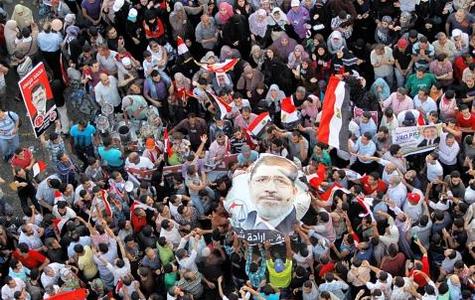
As he took office it seemed President Mohammed Mursi would be governing within narrow limits set by Egypt’s generals – who had exercised power behind the throne for decades and then exercised it directly in the months since the fall of Hosni Mubarak.

But it is possible Mr Mursi’s opponents may have underestimated him.

Egypt’s army was unprepared for a recent attack on a security base in the Sinai desert by Islamic militants in which 16 soldiers died.

Mr Mursi appears to be seizing on that failure – which shocked ordinary Egyptians – to move against two key members of the high command.

It may be that the move has been co-ordinated secretly with other influential generals behind the scenes but for now, no-one can be sure.

“I did not mean to send a negative message about anyone, but my aim was the benefit of this nation and its people,” he said.

The president also praised the armed forces, saying they would now focus “on the holy mission of protecting the nation”.

It was announced earlier that a career army officer, Gen Abdel-Fattah al-Sisi, would replace Field Marshal Tantawi as both armed forces chief and defence minister.

Field Marshal Tantawi, 76, has not yet indicated whether he accepts the moves.

However Gen Mohamed el-Assar, a member of the Supreme Council of the Armed Forces (Scaf), told Reuters news agency the decision had been “based on consultation with the field marshal, and the rest of the military council”.

A presidential spokesman said Gen Annan and Field Marshal Tantawi had been appointed as presidential advisers and were given Egypt’s highest state honour, the Grand Collar of the Nile.

Islamist raid

BBC Middle East correspondent Kevin Connolly says the dismissal of senior military officers will be seen by Egyptians as a decisive move in a struggle for real power between the country’s newly elected politicians and the generals who have exercised power for many years.

As head of Scaf, Field Marshal Tantawi became Egypt’s interim ruler after President Mubarak was ousted following last year’s mass protests.

Under the interim constitutional declaration issued by Scaf before Mr Mursi was sworn in, the president could not rule on matters related to the military – including appointing its leaders.

The council also dissolved parliament, which is dominated by the Muslim Brotherhood.

Tensions between the presidency and Scaf were further exacerbated after Islamist militants in the Sinai peninsula killed 16 border guards last week, in a raid that embarrassed the military.

The president, whose own Brotherhood movement renounced violence long ago, sacked Egypt’s intelligence chief and two senior generals following the attack.

Mr Mursi resigned from his positions within the Brotherhood, including his role as chairman of its Freedom and Justice Party (FJP), when he won the presidential election in June.

The Egyptian presidential election @ DM

Sharif Abdel Kouddous: Historic Egypt Election Outweighed by Continued Dominance of Military Rule
CLICK ON IMAGE

Mohamed ElBaradei warns Egypt it is letting a ‘new emperor’ take over

  • Nobel laureate blames Muslim Brotherhood and revolutionary youth for letting the generals engineer cou
egypt mohamed elbaradei

Mohamed ElBaradei speaking to protesters in Tahrir Square, Cairo, in January last year, when he hailed a ‘historic day’. Now he says Egypt is suffering more than under Hosni Mubarak. Photograph: Hannibal Hanschke/EPA

Egypt is suffering under worse conditions now than under Hosni Mubarak‘s dictatorship, Mohamed ElBaradei has told the Guardian, and it is on the brink of allowing a “new emperor” to establish total domination over the country.

He gave a withering assessment of the Muslim Brotherhood movement, which dominated the now defunct new parliamentary assembly and whose presidential candidate, Mohamed Morsi, will face a run-off against Mubarak’s last prime minister in elections this weekend.

ElBaradei said political Islamists had tried to take “the whole cake” for themselves following the overthrow of Mubarak last February, and as a result Egypt’s ruling generals had been able to engineer an assault on the revolution.

“We are in a total mess, a confused process that – assuming good intentions – has led us nowhere except the place we were at 18 months ago, but under even more adverse conditions,” said the Nobel laureate, who withdrew from the presidential race this year arguing that a fair vote could not be held while the country remained in the grip of a military junta.

“We are going to elect a president in the next couple of days without a constitution and without a parliament. He will be a new emperor, holding both legislative and executive authority and with the right to enact laws and even amend the constitution as he sees fit.”

On Thursday two hasty constitutional court decisions by Mubarak-appointed judges appeared to strike a hammer blow at the revolution, in effect dissolving the democratically elected parliament and overturning a law that would have barred members of the old regime from running for high office.

The rulings came less than two days after the ministry of justice extended the powers of the Supreme Council of Armed Forces (Scaf) and its soldiers to arrest and investigate civilians, a move Amnesty International labelled as “the legal sanctioning of abuse”.

ElBaradei, a former UN nuclear weapons inspector turned prominent Egyptian dissident, predicted Ahmed Shafiq – Mubarak’s last prime minister and the man seen by many as an embodiment of the old regime – would emerge victorious from the poll.

“Shafiq as president of the ‘new Egypt’ is an oxymoron,” said the 69-year-old. “In this scenario the new president would be backed by Scaf and political authority in the country will continue to be held by Scaf, but I think it most likely that he is the one that is going to win.”

ElBaradei confirmed he would not be casting a vote but refused to formally endorse the growing boycott campaign – because, he argued, the failure to turn it into a mass movement could hand a propaganda boost to the regime.

At times ElBaradei has been viewed as an opposition figurehead who occupied the rare position of being able to command respect from revolutionaries, secular liberals and political Islamists. On Friday, though, he spoke out against a catalogue of revolutionary mismanagement on all sides, with his harshest words reserved for the Muslim Brotherhood – whose role in the past year’s “transition process” has led many pro-change activists to blame political Islamists for empowering the military and being sucked into an electoral game designed to give the old regime a façade of democratic legitimacy.

Scared

“The Brotherhood have not served themselves well — they have scared people right, left and centre with some of the extremist views put forward from them and other Islamist groups,” said ElBaradei.

“The Brotherhood should have realised that the vote they got at the parliamentary elections was not a true reflection of their support in the street – it was the product of a specific set of political conditions at the time. They should have reached out to other segments of society and built a broad coalition but they haven’t done that – they started by saying we want to be part of big cake but they ended up wanting to have the whole cake for themselves. And that created a backlash, which will be visible in the next couple of days. People have called on them to withdraw from the presidential race, but they insist on going forward – why?”

He also argued that revolutionary momentum had been stalled by the failure of young protesters to embrace institutional leadership – wading into a thorny debate over the relative merits of horizontal and “leaderless” political change about which many activists feel strongly.

“The mortal mistake was that from day one the youth never agreed on a unified demand and never agreed to delegate authority to a group of people to speak on their behalf,” said ElBaradei.

“They were very happy, and we understand that, to say the revolution is leaderless and that every one of us is the revolution. But they ended up being crushed by [armoured personnel carriers] and massacred at [the TV building] Maspero.

“I hope that they have learned the lesson and I think people are now talking about getting organised under a unified leadership and engaging the new president to find a way of working together, preparing themselves for future elections and push for national reconciliation.”

The call on young radicals to engage with the new president – particularly if it is Shafiq – is likely to be ignored by many revolutionaries, some of whom believe the only solution is to return to mobilisation on the street. But ElBaradei said that the broader population was fatigued with violent clashes and insisted that a process of national reconciliation was necessary to drive the revolution forward.

“Not co-operating with the new president and saying he has no legitimacy will be difficult because he will have been selected by ballot,” he said. “Either we try that or we have to get into a process of national reconciliation, where people say ‘well this isn’t what we wanted, the process has been screwed, but for the sake of the country we need to find a formula to coexist together’. It’s the question the revolution will face in the next few weeks.

“People are tired,” he continued. “I’m not sure street protests will get a lot of support from the rank and file after the elections – people want so-called stability.

“I think we need national reconciliation for the sake of the people in whose interests the revolution was staged – the 50% of Egyptians who are below the poverty line and who have seen nothing good coming out of the revolution. In fact, for them things have got worse.”

See also Democracy Now here :
A Judicial Coup in Egypt: Muslim Brotherhood-Controlled Parliament Dissolved, Military Gains Power

Syrian dissidents start to call Cairo home

Posted By Nate Wright Friday, January 20, 2012 – 1:27 PM Share

On the top floor of a towering apartment block in Cairo, half a dozen Syrian activists are hunched over their laptops. Each man organized demonstrations in his home town before escaping the Assad regime’s intelligence agents in the last few months. Now, armed with a list of trusted contacts that stretches across the borders from southwest Syria to Lebanon and Jordan, they have become a key link in the supply chain of an opposition movement that is struggling to outmaneuver a brutal crackdown. Donations collected from Syrians and well-wishers in Cairo are used to purchase cell phones, satellite communications equipment, medicine, and money, which is smuggled to friends and family members on the inside. In turn, protesters send out video evidence of attacks, which the men in Cairo catalogue, upload to YouTube, and forward to media outlets.

The men work with close contacts in their own villages and neighborhoods, independently of organizing committees or opposition bodies. Abdel Youssef fled from Ad Dumayr, a city northeast of Damascus. Syrian authorities went door to door there searching for military defectors on Wednesday night and he spent the day following their movements through eyewitness accounts. As he tells the story of how he fled, a Skype window flashes up on his screen. A woman he knows tells him that security forces attempting to arrest a man have captured his daughter instead. “Now I’m looking out the window,” the message reads. “She is being beaten up by the security forces because she is saying ‘Allahu Akhbar’.” Abdel Youssef passes on information like this to a contact in the Free Syrian Army, who he says use this information to block roads and set up ambushes in an attempt to protect demonstrations.

“In our area, the Free Syrian Army is very well organized,” says Abdel Youssef, who acts as a communications hub for demonstrators in his city. He knows the location of the seven government roadblocks in Ad Dumayr. In one video, a friend holds up a pad of paper with the names and birth dates of those killed so that family members can claim the bodies.

He forwards his information to Omar Idlibi, a spokesman for the Syrian National Council, as well as international media outlets. But he works independently. Like the other activists in this safe house, six men in their 20s and 30s when I visited, Abdel Youssef only coordinates with his city. Abdel Rahman, from Damascus, works with his neighborhood and Omar, from Yabroodi, is in touch with his friends. All three gave only their first names to protect family members still in the country. Wary of people they don’t know and unimpressed with the politicians talking shop in Turkey, they work around the clock on the regional logistics of localized resistance. “I know about Damascus. Others know about other places,” said Abdel Rahman. “When we come together we know about everywhere in Syria.”

Turkey remains the political center for the opposition in exile, but Cairo is emerging as a vital logistical hub for the supply of dissidents within Syria and the dissemination of videos emerging from the country. They have come to Cairo for many reasons. As Foreign Policy reported in November, Assad’s allies are hunting Syrians in Lebanon. In Istanbul, activists say the Turkish intelligence wants to sign off on any political activities. “Because I am Syrian, the Turkish government wanted to know everything I did,” said Abdel Rahman, who flew to Istanbul before coming to Cairo. He pointed to the men with him in the safe house: “We couldn’t do this in Turkey.”

Syrian intelligence operatives are keeping a low profile here, but activists are not taking any chances. In November, the wife of Syrian television presenter, Thaer al-Nashef, was kidnapped in Cairo. He received text messages threatening to slit her throat and throw her in the Nile. She was later dumped, bruised but alive, in the street. When Syrian MP Emad Ghalioun arrived in Cairo, Akram Abdel Dayam took four cars to pick him up and drove through back streets to see if he was being followed. “Syrian intelligence is here, but it’s not as extreme,” said Rami Jarrah, a Syrian activist who spoke to journalists under the pseudonym Alexander Page before he fled to Cairo.

The promise of safety, cheap prices, and a supportive local population that cheered on Syria’s revolution after ousting their own president in February, make Cairo an attractive destination for opposition members able to reach the country. With no land borders, activists are flying in and getting visas at the airport. Those who escaped without passports, like military defectors, are forced to go to elsewhere and most head to Turkey, according to Jarrah.

The Syrian National Council has noticed. Lina Tibi, a press officer working with the Council in Cairo, hopes to have a media center up and running in the city next week. Burhan Ghalioun, who heads the Council, flew in on Friday to meet with Secretary General of the Arab League, Nabil al-Araby, a day before the League meets to discuss the results of its monitoring mission in Syria. “We are here in Cairo because the Arab League is here,” said Walid al-Bunni, the Syrian National Council’s director of foreign affairs.

While Syria’s opposition struggles to form a united front, most of the coordination with activists inside the country is happening through small, ad-hoc command and control centers like the safe house where Abdel Rahman, Abdel Youssef, and Omar live and work. Toby Cadman, a British lawyer engaged by the Syrian Emergency Task Force, has been working with activists to document crimes committed in Syria. He hopes to build a case to bring to the International Criminal Court. “The activists in Cairo have been extremely influential in this process,”he said. “A lot of what I obtain comes directly or indirectly from Cairo.”

Jarrah, who is not connected to the activists in the safe house, says weapon smuggling into Syria has already begun. But Omar insists his group is holding off on supplying arms, for now. “As soon as the Free Syrian Army was created, it began communicating with the local coordinating communities,” he said. “The Syrian National Council does nothing. It is all the local councils.” Abdel Youssef, Abdel Rahman, and Omar agreed that their patience was wearing thin. “If no one from the outside helps, if the Arab League keeps giving [Assad] time, then we will arm ourselves,” said Abdel Rahman. They say that March 15th, a year from the first major demonstrations in Daraa, is their deadline. “There will be a war if he has not stepped down by the anniversary of the revolution.”

Nate Wright is a journalist in Cairo. He writes for the Times of London and Middle East Report. Read his blog at www.themelian.com and follow him on Twitter at @nwjourno.

Rest In Peace, Ibrahim Aslan

The great Ibrahim Aslan (1935-2012) died yesterday after entering the hospital with heart trouble. He was 77.

His funeral will be held today at the Mosque of Bilal bin Rabah in Moqattam, according to Shorouk News. Numerous writers, friends, and readers have expressed their sorrow at the loss.

From acclaimed Egyptian novelist Radwa Ashour, on Twitter, “Short sentences; words calculated as though their author were anxious to keep them from harm. Fos7a saturated with colloquial. Sorrow blended with laughter. I’m referring to the methods of Ibrahim Aslan.”

From novelist and journalist Mansoura Ez Eldin on Facebook: “With you, we say goodbye to a cherished part of our memory and our relationship to writing and culture.”

Popular author Bilal Fadl wrote on Twitter that Ibrahim Aslan’s work is widely available, adding, that, “An author does not die unless people stop reading him.”

And Palestinian poet Mourid Barghouti added, also on Twitter, “The most beautiful of the Nile’s birds leaves the lake this evening. Goodbye Ibrahim Aslan.”**

On Aslan:

ArabLit: Ibrahim Aslan on His Regrets: ‘I Was A Little Too Afraid of Writing’

Mohammad Shoair at Al Ahram: The old man and the river

Excerpts of Aslan’s work:

“Training,” trans. Maya Abu-Deeb

Excerpts of his books in Arabic are available on his Shorouk website.

Read on here

Blog at WordPress.com.

Up ↑