
Egyptians pray in front of army tanks in Tahrir Square (Scott Nelson/NYT)
Deputy Israeli prime minister Silvan Shalom made a telling comment in an Israel Radio interview that was captured in Al Ahram (Google cached version) during the Tunisian revolution:
“I fear that we now stand before a new and very critical phase in the Arab world. If the current Tunisian regime collapses, it will not affect Israel’s present national security in a significant way,” he said. “But we can, however, assume that these developments would set a precedent that could be repeated in other countries, possibly affecting directly the stability of our system.”
Shalom added that if regimes neighbouring the Israeli state were replaced by democratic systems, Israeli national security might significantly be threatened. The new systems would defend or adopt agendas that are inherently opposed to Israeli national security, he said.
The deputy indicated that Israel and most of the Arab regimes have a common interest in fighting what he referred to as “Islamic fundamentalism” and its “radical” organisations which threaten Israel.
This threat, he added, is the reason behind much of the direct and indirect intelligence and security coördination between Israel and the Arab regimes.
Shalom emphasised that a democratic Arab world would end this present allegiance, because a democratic system would be governed by a public generally opposed to Israel.
You can gussy this view up in many ways that explain Israel’s concerns, but when it comes down to it Israel fears the Arab street and Arab democracy. Yes, it’s true that Arab democracies would hold harsher views concerning Israel than the current autocrat rulers. Though this isn’t necessarily so in the case of a Muslim democracy like Turkey which, until its citizens were murdered en masse in the Flotilla, actually had constructive relations with Israel.
All that aside, the issue goes beyond what Shalom said, as I wrote last night. Arab democracy threatens Israel especially because it is outside Israel’s control. It cannot be bought and dominated militarily or diplomatically. A democracy represents the interests of the majority and not those of the élite. Israel needs lackeys and strong men. It needs the go-to guy it can do deals with. Having to negotiate its way through the cross-currents and multiple sets of interests at work in the typical democracy has to be bewildering, even frightening to Israel’s leaders. If Mubarak goes then there are big changes in store…for Egypt and Israel.
The Nation is reporting that Mubarak’s son, long considered the heir to the Egyptian throne, er presidency, has fled the country for London, along with the ruler’s daughters and even his wife. Given the dynasticism of Arab regimes and family closeness and solidarity in Arab culture, an eldest son’s desertion of his father has to be big blow to Hosni Mubarak. This too is a development every Egyptian will take note of. This could be the beginning of the end for Mubarak. But the question is who and what will take his place. Will it be a loyalist like Suleiman who will be a slightly different face pinned on the same body? Or will Suleiman be content to be a caretaker for new, truly free elections and a new government?
What role will the Muslim Brotherhood play? Is there a possible path that integrates an Islamist vision with a democratic one? In a country that has suffered decades, if not longer, of unalloyed despotism?
Finally, Israel will have to get used to living in a region that is even less hospitable to its policies than it was before. It will have to negotiate a dense thicket of national interests none of which will be obsequious toward it. Welcome to a brave new world, Mr. Netanyahu. Good luck.
One thing especially frightening to Israel is the potential Islamist nature of the incoming governments. For Israel, Islamism is a synonym for terror. Most reasonable observers know this isn’t true. Another thing Israel fears is that it may become as much an obstacle to regional development as the octogenarian strongmen whose rule is being toppled in Tunisia and Egypt. Israel has identified itself so closely with the oligarchs that the new rulers, whoever they may be, may (probably will) see Israel as an extension of them. That’s why I’ve argued that a course correction in Israeli policy has been long overdue.
It’s worth quoting Gideon Levy, as usual eloquent on the subject of Middle Eastern tyranny:
The people of Egypt had their say, and had the nerve not to fall in line with Israeli wishes. A moment before Mubarak’s fate is sealed, the time has come for drawing the Israeli conclusions.
Not a plague of darkness in Egypt but the light of the Nile: the end of a regime propped up by bayonets is foretold. It can go on for years, and the downfall sometimes comes at the least expected time, but in the end it will happen. Not only Damascus and Amman, Tripoli and Rabat, Tehran and Pyongyang: Ramallah and Gaza are also destined to be shaken.
The hypocritical and sanctimonious division of countries by the U.S. and the West between the “axis of evil” on the one hand, and the “moderates” on the other, has collapsed. If there is an axis of evil, then it includes all the non-democratic regimes, including the “moderates” and the “stable” and the “pro-Western.” Today Egypt, tomorrow Palestine. Yesterday Tunis, tomorrow Gaza.
Not only is the Fatah regime in Ramallah and the Hamas regime in Gaza destined to fall, but perhaps also, one day, the Israeli occupation, which certainly meets all the criteria of criminal tyranny and an evil regime. It too relies only on guns. It too is hated by all levels of the ruled people, even if they stand helpless, unorganized and unequipped, facing a big army. The first conclusion: Better to end it well, with agreements based on justice and not on power, a moment before the masses have their say and succeed in banishing the darkness.
A second, no less important conclusion: Alliances with unpopular regimes can be torn up overnight. As long as the masses in Egypt and in the entire Arab world continue seeing the images of tyranny and violence from the occupied territories, Israel will not be able to be accepted, even it is acceptable to a few regimes.
The Egyptian regime became an ally of the Israeli occupation. The joint siege of Gaza is irrefutable proof of that. The Egyptian people didn’t like it. They never liked the peace agreement with Israel, in which Israel committed itself to “respect the legitimate rights of the Palestinian people” but never kept its word. Instead, the people of Egypt got the scenes of Operation Cast Lead.
It is not enough to have a handful of embassies in order to be accepted in the region. There also have to be embassies of goodwill, a just image and a state that is not an occupier. Israel has to make its way into the hearts of the Arab peoples, who will never agree to the continued repression of their brothers, even if their intelligence ministers will continue to cooperate with Israel.
A real alliance with Egypt and its sister-states can only be based on the end of the occupation, as desired by the Egyptian people, and not on a common enemy, as an interest of its regime.
A comparison between the impact of Islamism and Jewish extremism is also warranted. Israel itself has done the same as what these new potentially Islamist-oriented regimes may. It has focussed on the sectarian Jewish nature of its state to the exclusion of its non-Jewish citizens. It has fueled the cries of racism from its Palestinian citizens and Jewish peace activists alike. For many Muslims, unfortunately, Judaism has become synonymous with terror, as they see Israelis like Meir Dagan kill Muslims while invoking the name of the “Jewish people.” Can Israel truly blame the Muslims of the Middle East for doing what the “Jewish State” itself has done? What we truly need in the Middle East is democracy that focuses on the political interests of each nation to the exclusion of religious sectarianism. Mixing religion and politics is deeply toxic whether it happens in Israel or Iran.
Related posts:
- British Prime Minister Calls for End to Gaza Siege, Obama Doesn’t
- Internal Security Minister: Israel Not Enough of Police State Already, Tens of Thousands More Officers Needed, We’ve ‘Lost Control of Arab Sector’
- Limits of Israeli Democracy
- Israeli Investigation of Gaza Flotilla in Disarray, Chairman Threatens Resignation, Bibi Relents
- Israeli Deputy PM, Dan Meridor, Cancels London Trip Fearing Arrest
Buildings and vehicles set alight across the country as anti-government protests continue.
“]
A nighttime curfew has begun in the Egyptian cities of Cairo, Alexandria and Suez, after a day where thousands of protesters took the streets, demanding an end to Husni Mubarak’s 30-year presidency.
The curfew was implemented on Friday on the orders of the president, along with an order that the military take charge of security, amid violent clashes occurred between police and protesters.
Mubarak, “as commander in chief, has declared a curfew in the governorates of Greater Cairo, Alexandria and Suez from 6pm to 7am starting on Friday until further notice,” state television announced.
The president “has asked the armed forces, in cooperation with the police, to implement the decision, and maintain security and secure public establishments and private property,” it said.
Al Jazeera’s Ayman Mohyeldin, reporting from Cairo said that a building belonging to the ruling National Democratic Party was set ablaze along with several police vehicles. Firefighters did not appear to be on the streets, and the buildings continue to remain torched.
Rawya Rageh, reporting from the port city of Alexandria, said that protesters were defying the curfew.
“The situation remains very tense, and many are still out here, openly defying this curfew.”
According to the Associated Press, thousands of protesters have stormed the foreign ministry, and state television building in Cairo.
At least 870 people were wounded during Friday’s protests some in a serious condition with bullet wounds, medical sources said.
Police officers were also wounded, but numbers were not immediately clear, the sources told Reuters news agency. There was no official confirmation of the figures.
In the city of Suez, at least two people killed during ongoing demonstrations, and armoured vehicles were reportedly set alight. Correspondent Jamal Elshayyal also said that police stations were also set alight during protests.
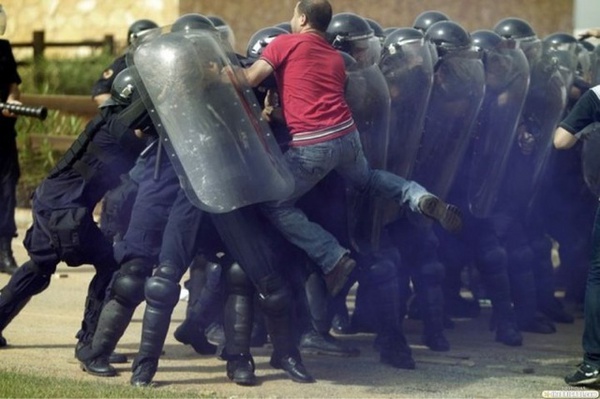
Dozens of people were also wounded as security forces fired rubber bullets, tear gas and water cannon at the crowds and baton charged them.
During the clashes, plain clothes security forces also dragged off protesters. At the Fatah mosque in central Ramses Square, several thousand people were penned in and teargassed.
Egyptian military vehicles meanwhile, were sighted on the streets of the capital, and protesters had previously chanted slogans calling for the army to support them, complaining of police violence during clashes in which security forces fired teargas and rubber bullets.
Unconfirmed reported however, have emerged that the army and police were involved in clashes in the capital.
Ayman Mohyeldin said that if confirmed, it points to the chaos that has filled the streets of Cairo.
“The army is a respected establishment in Egypt, and many feel they need their support against what they see as excessive force by the police and security forces,” our correspondent in Cairo said.
However, Husni Mubarak ordered troops to back up police as they struggled to control crowds who continue to flood the streets of Cairo and other Egyptian cities.
But in a sign of escalating tensions, fires and thick black smoke have been seen across parts of Cairo.
Friday’s demonstrations were by far the biggest of four consecutive days of protests by people fed up with unemployment, poverty, corruption and the lack of freedom under Mubarak.
“This protest is not going to stop. They won’t and can’t trick the people again and give us some lame concessions. Hosni has to go,” protester Mohamed Taha said after fleeing a police attack.
“I am 70 years old, I am going to die, but these people have to fight to live,” he said.
Protesters often quickly dispersed and regrouped.
Some held banners saying: “Everyone against one” and chanted “Peaceful peaceful peaceful, no violence.” Others threw shoes at and stamped on posters of Mubarak.
As clashes intensified, police waded into the crowds with batons and fired volleys of
tear gas.
“Leave, leave, Mubarak, Mubarak, the plane awaits you,” people chanted.
Mohamed ElBaradei, the former head of the United Nations’ nuclear watchdog and an opposition leader in Egypt, was briefly detained by police after he prayed at a mosque in the Giza area but he later took part in a march with supporters.
The countrywide violence has so far left seven people dead.
Government crackdown
In response, the government had vowed to crack down on demonstrations and arrest those participating in them. It has blocked internet, mobile phone and SMS services in order to disrupt the planned demonstrations.
Before Egypt shut down internet access on Thursday night, activists were posting and exchanging messages using social networking services such as Facebook and Twitter, listing more than 30 mosques and churches where protesters were to organise on Friday.
Meanwhile, the United States says the situation in Egypt is of “deep concern” and is calling on Egyptian authorities to enact reforms and allow peaceful protests and open communications.
PJ Crowley, a state department spokesman said on Friday that Egypt must respect the “fundamental rights” of its people and avoid violence.|
He also said reform is vital to the country’s long-term stability and security, and urged the government to view its people as a partner and not a threat.
It is far from a foregone conclusion that the protesters will force Mubarak out. They face two key challenges, said Amon Aran, a Middle East expert at London’s City University, told Reuters news agency.
“One is the Egyptian security apparatus, which over the years has developed a vested interest in the survival of President Mubarak’s regime. This elaborate apparatus has demonstrated over the past few days that it is determined to crush political dissent,” he said.
“Another obstacle derives from the fact that, so far, the protesters do not seem to form a coherent political opposition.
The popular outcry is loud and clear, but whether it can translate into a political force is questionable.”
Source:
Al Jazeera and agencies
|
|||||||||


Top 10 Free Proxy Softwares
By Young | Published: June 16, 2010
To visit YouTube, Twitter, Facebook and some other websites that are blocked in China, sometimes I use free online proxy tools, but most of the time, I like using free proxy softwares, since they are faster and free of ADs.
Among those free proxy softwares, below 10 are the most popular.
1. Freegate

The Freegate proxy software supports both English and Chinese languages, you can download and run it without any installation.
When Freegate runs, it will automatically open Dynaweb homepage in IE, which you can turn off in the settings. For any other browser, you can set the browser HTTP proxy to 127.0.0.1:8580.
2. UltraSurf

The free proxy software UltraSurf also supports English and Chinese, and you can also download and run it without any installation.
When UltraSurf runs, it will automatically open Ultrareach homepage in IE, and of course you can turn it off in the settings. For any other browser, you can set the browser HTTP proxy to 127.0.0.1:9666.
3. GTunnel

The GTunnel proxy software also supports Chinese and English languages.
The most powerful feature of GTunnel is that you can access the proxy network with your GTalk or Skype account.
When GTunnel runs, it will automatically open Garden Networks homepage in IE, if you like to use GTunnel on any other browser, just set the browser HTTP proxy to 127.0.0.1:8081.
4. Tor

The free proxy software Tor supports a lot of languages, such as English, Chinese, French, and so on.
For windows, you can download the Tor Browser Bundle, which can be used directly without any installation, or you can download the Installation Bundle and install it.
To run the Tor proxy software, just set the browser HTTP proxy to 127.0.0.1:8118, but most of the time, you also need to add some bridges.
5. GappProxy

GappProxy is an http proxy software based on Google App Engine, and its instructions are written in Chinese, here is the English instructions translated by Google.
You can download the GappProxy windows client and run it without installation, but most of the time, you need to create a new FetchServer with Google App Engine and Python.
To run GappProxy, you need to set the browser HTTP proxy to 127.0.0.1:8000, or you can check out this post for how to install and use GappProxy.
6. Hyk-proxy

The free proxy software Hyk-proxy is also built on Google App Engine and Java with Chinese instruction, here is the English instruction offered by Google Translate.
You need to create a Google App Engine application to use the hyk-proxy client, for more details, you can check out this post.
To run Hyk-proxy, you need to set the browser HTTP proxy to 127.0.0.1:48100.
7. Your Freedom

Create a free account on the Your Freedom website, download and install the suitable client for your computer system, change your browser HTTP proxy to 127.0.0.1:8080, then you can visit those blocked websites.
The configuration will take a few minutes, but automatically.
8. GPass

You can download the GPass proxy software and run it without installation.
The most powerful feature of GPass is that you can access the proxy network with Tor or Skype.
You need to set the browser HTTP proxy to 127.0.0.1:8000.
9. Tunnelier

You need a SSH account to use the free proxy software Tunnelier.
For SSH account, you can use your own hosting, or search for a free account.
You need to set the browser HTTP proxy to 127.0.0.1:7070.
Bonus:
Install the Firefox add-on AutoProxy , then you can switch the above nine free proxy softwares from one to another easily, no need to change the browser HTTP proxy address every time.
Or you can use below free proxy software, which is free of browser network settings.
10. Hotspot Shield

Besides English, French and Chinese, Hotspot Shield also supports Arabic, Persian, Russian and Vietnamese.
You download the Hotspot Shield software and install it, then you can use the free proxy services, but there will be ADs when you visit open any web page.
Bonus:
Since most of the websites of the above 10 free proxy softwares are also blocked by GFW or something like that, you can visit them with these free online proxy Websites or VPN services.
Update: Strictly speaking, Hotspot Shield is considered as a VPN and not proxy.
Related free web apps:
This entry was posted in Other Free Nuts and tagged proxy, softwares. Bookmark the permalink. Post a comment or leave a trackback: Trackback URL.


 band annie's Weblog
20 Comments