Lady / Madame Catherine Ashton.
*Neither patronizing nor despising the Egyptian people, tuesday 02-08.
“The critical thing that we want to do is make sure that the Egyptian people are able to have democracy. Democracy is not a moment in time, it’s a process that you have build for. It’s for the Egyptian people to have to work out who takes them forward with that transition. What we’ve urged is that it’s quick and that it moves forward meaningfully. The institutions, the way in which you develop society so that it is able to have democracy, to have human rights, to ensure that you’ve got in place everything you need, that takes a little bit of time, but a lot of support. What we’re clear about is we’ll be offering that support to ensure it will happen.”
Only a thousand families count in a country that Mubarak and his cronies regard as their fiefdom
* Salwa Ismail
* guardian.co.uk, Sunday 6 February 2011 19.00 GMT
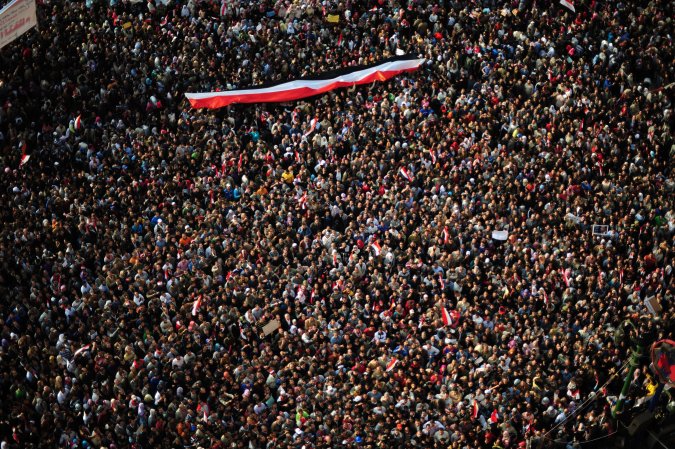
There is a lot more behind Hosni Mubarak digging in his heels and setting his thugs on the peaceful protests in Cairo’s Tahrir Square than pure politics. This is also about money. Mubarak and the clique surrounding him have long treated Egypt as their fiefdom and its resources as spoils to be divided among them.
Under sweeping privatisation policies, they appropriated profitable public enterprises and vast areas of state-owned lands. A small group of businessmen seized public assets and acquired monopoly positions in strategic commodity markets such as iron and steel, cement and wood. While crony capitalism flourished, local industries that were once the backbone of the economy were left to decline. At the same time, private sector industries making environmentally hazardous products like ceramics, marble and fertilisers have expanded without effective regulation at a great cost to the health of the population.
A tiny economic elite controlling consumption-geared production and imports has accumulated great wealth. This elite includes representatives of foreign companies with exclusive import rights in electronics, electric cables and automobiles. It also includes real estate developers who created a construction boom in gated communities and resorts for the super-rich. Much of this development is on public land acquired at very low prices, with no proper tendering or bidding.
It is estimated that around a thousand families maintain control of vast areas of the economy. This business class sought to consolidate itself and protect its wealth through political office. The National Democratic party was their primary vehicle for doing so. This alliance of money and politics became flagrant in recent years when a number of businessmen became government ministers with portfolios that clearly overlapped with their private interests.
Mubarak presided over a process in which the national wealth passed into a few private hands while the majority of the population was impoverished, with 40% living below the poverty line of less than $2 a day, rising rates of unemployment, and job opportunities for the young blocked. In the last few months of 2010, Egyptians protested for an increase of the minimum monthly wage to less than $240, but the now departed Nazif government decreed that less than $100 was sufficient as a basic income. This, at a time when the prices of food staples and utilities tariffs increased at very high rates. Indeed, as one local economist asserted, every single commodity and service cost significantly more under the Nazif government – which is the government of business that ended progressive taxation and replaced it by a single unified income tax.
Additionally, public social services underwent masked privatisation, taking health and education beyond the reach of vast segments of the population. Many poor families were forced to give up the hope of educating children and had to send them to do menial work to contribute to the income of the household. There was little public investment in most services, and in infrastructure such as roads, water and sewerage. In the 2000s, Egypt witnessed numerous demonstrations by ordinary people across the country for the construction of overpass bridges on fast roads and for clean water in towns and villages.
The legitimate social and economic demands of the people were repressed and denied, and the regime used the police to control the population. Under emergency laws, the police acquired extensive powers and engaged in surveillance and monitoring of the population. Torture and abuse in police stations became routine. Police roadblocks and checks were part of the daily reality of Egyptians. Under the generalised corruption, the police engaged in extortion and offered their services to private interests.
Egypt was governed as a private estate. Mubarak’s immediate family is implicated in crony capitalist activities as partners of most of the businessmen who benefited from the regime’s corruption. These beneficiaries do not want to leave their palaces, beaches and resorts, lucrative businesses and extreme riches. These are fixed assets that could not be transferred outside the country – although it should be noted that the ruling elites have siphoned off much capital to foreign banks. Nonetheless, it is the country-turned-private-estate they do not wish to abandon – that’s why they deployed the thugs in Tahrir Square to terrorise the population. This is a tactic that the National Democratic party has used on many previous occasions. In the national elections to the people’s assembly and to the shura council, thugs are hired to intimidate voters and to support rigging the results. At all popular protests, the police set thugs to attack the protesters using all means of intimidation, including the sexual harassment of women participants. Thugs have become an arm of the police and they have been used as informants in popular quarters of the city. They are rewarded with licences to operate kiosks or run minibus services. In a sense, practices of thuggery have been adopted by the regime to maintain itself and protect the interests of the ruling elite for decades now. Facing the growing possibility of losing their illegitimately acquired wealth and power, the regime and its cronies resorted to the techniques and practices that they have previously used with impunity to silence all opposition and resistance. However, the magnitude of popular mobilisation and the resolve to fight for dignity and freedom have rendered the regime’s tactics obsolete.

Text in Arabic
Proof
British Intelligence: The Egyptian Interior Ministry has exploded the Church
Full details: A British Diplomat has uncovered to the French authorities at the Elysee the reasons behind the insistence of the UK on the departure of the Egyptian President and his team, in particular the apparatus of the Ministry of Interior (MoI) that was headed by the Minister Habib El Adly (H El-A). The reason is that the British Intelligence is in possession of evidence made up of paper documents and sound recordings that the deposed Minister of Interior has founded – since 6 years – a special team that he personally directs, and which is made up of 22 officers. The team groups members from:
-the Islamic “gama’aat” or groups that have passed years in the prisons of the MoI;
-drug dealers;
-the security services personnel; and
-registered dangerous criminals that have a criminal record.
All the above were divided into groups and distributed in function of geographic zones and political affiliations. This “apparatus” is programmed to form an apparatus capable of causing total destruction all over Egypt if the Regime is exposed to any threat.
The British Intelligence have also discovered that the Lieutenant (grade Ra’id in Arabic) Fathi Abdel Wahid who is close to the former Minister H El-A has, since 11 December 2010, been preparing a certain Ahmed Mohamed Khaled, who spent 11 years in the prisons of the Egyptian MoI, to contact extremist groups in Egypt to incite them to attack the Alexandria church. He therefore contacted an extremist group called Guond Ellah (or soldiers of allah) and told them that he has explosives and equipment that he obtained from Gaza that can explode the church so that we “punish the Copts”. The leader of Guond Ellah, Mohamed Abdel Hadi, liked the idea and assigned for that operation an element called Abdel Rahman Ahmed Ali who was told that : you will just put the car in position and it will afterwards explode alone. However, it was the Lieutenant Fathi Abdel Wahid who exploded the car through a remote control device, and he did that before the “victim” Abdel Rahman Ahmed descends from the car. This was the horrific crime that shook Egypt and the world on the past new year’s eve.
Then the Lieutenantt immediately went to Ahmed Khaled and asked him to call the leader of the Guond Ellah,Mohamed Abdel Hadi to come to an apartment in Alexandria to discuss with him the outcomes. As soon as they met in the apartment situated on Abdel Moneim Riad street in Alexandria, Lieutenant Fathi arrested them and sent them to Cairo in very modern ambulance. They arrived at a special building that belongs to the MoI in Giza neighborhood where they were imprisoned till the uprising of last Friday when they were able to escape and sought refuge at the British Embassy.
The British Diplomat said that the decision for exploding the church originated from the Egyptian Regime for the following reasons:
– The pressure that is exerted on the Regime from inside Egypt and from the external Islamic countries because of their continued siege of Gaza – hence, accusing the army of Islam of Gaza “Gueish El Islam Al Ghazzawy” as being the author of the explosion is, in a way, an invitation to Egyptians to accuse the armed elements from Gaza of plotting sabotage/destroy Egypt, so as to reinforce a feeling of national unity (or solidarity) with the Regime and to make the outside world believe that the Regime protects the Christians.
– Offer the Israeli Administration a gift – a reason to continue the siege of Gaza and to prepare a major operation “on it”. These Egyptian gifts are offered to the Israeli Administration so that their leaders support – across the world — the candidacy of Gamal Mubarak to become president of Egypt.
– Creating (spreading) a kind of cover for the Regime that will make it possible for it to move from the fever of (against) the falsified elections and turn it into a fever accusing the Islamists of extremism and aggression on the Christians, so that the Regime can benefit from a Western legitimacy for (that justifies) the falsified election results and the right (for the Regime) to arrest its opponents. This is what happened after the explosion when the number of arrested Islamists rose to more than four thousand persons.
The British diplomat concluded that the Mubarak Regime has lost all the foundations of its legitimacy and that the “Church Operation” may push several international and civil organizations to demand that the Regime is put on trial. This, in addition to what the Regime has done to the Egyptian people over the past 30 years, the most significant of which is what the Regime did over the past week.
|
 band annie's Weblog