Search

band annie's Weblog

I have a parallel blog in French at http://anniebannie.net

Category

Democracy Now

Is India on a Totalitarian Path? Arundhati Roy on Corporatism, Nationalism and World’s Largest Vote

A painful eye-opener on Democracy Now CLICK ON IMAGE

?????????????

AMY GOODMAN: Before we end, and before you come out with this next novel that we’ll ask you to read next time when you come to the United States, I was wondering if you could read from an earlier essay. It’s an excerpt that you read at the New School, when hundreds of people came out to see you here recently.
ARUNDHATI ROY: Well, it was—it was really the first—in a way, the first political essay I wrote, anyway, after The God of Small Things, and it was an essay called “The End of Imagination,” when the Indian government conducted a series of nuclear tests in 1998.
“In early May (before the bomb), I left home for three weeks. I thought I would return. I had every intention of returning. Of course, things haven’t worked out quite the way I planned.” Of course, by which I meant that India just wasn’t the same anymore.
“While I was away, I met a friend of mine whom I have always loved for, among other things, her ability to combine deep affection with a frankness that borders on savagery.
“’I’ve been thinking about you,’ she said, ‘about The God of Small Things — what’s in it, what’s over it, under it, around it, above it…’
“She fell silent for a while. I was uneasy and not at all sure that I wanted to hear the rest of what she had to say. She, however, was sure that she was going to say it. ‘In this last year,’ she said, ‘less than a year actually—you’ve had too much of everything—fame, money, prizes, adulation, criticism, condemnation, ridicule, love, hate, anger, envy, generosity—everything. In some ways it’s a perfect story. Perfectly baroque in its excess. The trouble is that it has, or can have, only one perfect ending.’ Her eyes were on me, bright with a slanting, probing brilliance. She knew that I knew what she was going to say. She was insane.
” She was going to say that nothing that happened to me in the future could ever match the buzz of this. That the whole of the rest of my life was going to be vaguely unsatisfying. And, therefore, the only perfect ending to the story would be death. My death.
“The thought had occurred to me too. Of course it had. The fact that all this, this global dazzle—these lights in my eyes, the applause, the flowers, the photographers, the journalists feigning a deep interest in my life (yet struggling to get a single fact straight), the men in suits fawning over me, the shiny hotel bathrooms with endless towels—none of it was likely to happen again. Would I miss it? Had I grown to need it? Was I a fame-junkie? Would I have withdrawal symptoms?
“I told my friend there was no such thing as a perfect story. I said in any case hers was an external view of things, this assumption that the trajectory of a person’s happiness, or let’s say fulfillment, had peaked (and now must trough) because she had accidentally stumbled upon ‘success.’ It was premised on the unimaginative belief that wealth and fame were the mandatory stuff of everybody’s dreams.
“You’ve lived too long in New York, I told her. There are other worlds. Other kinds of dreams. Dreams in which failure is feasible. Honorable. And sometimes even worth striving for. Worlds in which recognition is not the only barometer of brilliance or human worth. There are plenty of warriors that I know and love, people far more valuable than myself, who go to war each day, knowing in advance that they will fail. True, they are less ‘successful’ in the most vulgar sense of the word, but by no means less fulfilled.
“The only dream worth having, I told her, is to dream that you will live while you’re alive and die only when you’re dead.
“’Which means exactly what?’
“I tried to explain, but didn’t do a very good job of it. Sometimes I need to write to think. So I wrote it down for her on a paper napkin. And this is what I wrote: To love. To be loved. To never forget your own insignificance. To never get used to the unspeakable violence and the vulgar disparity of life around you. To seek joy in the saddest places. To pursue beauty to its lair. To never simplify what is complicated or complicate what is simple. To respect strength, never power. Above all, to watch. To try and understand. To never look away. And never, never to forget.”
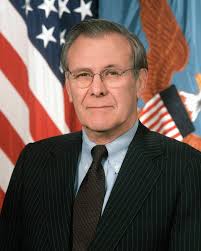
The Unknown Known: Errol Morris’ New Doc Tackles Unrepentant Iraq War Architect Donald Rumsfeld (DM)

click on image

ronald

Academy Award-winning documentary filmmaker Errol Morris joins us to talk about his new film, “The Unknown Known,” based on 33 hours of interviews with former Defense Secretary Donald Rumsfeld. The title refers to an infamous press briefing in 2002 when Rumsfeld faced questions from reporters about the lack of evidence of Iraqi weapons of mass destruction. “The Unknown Known” is Morris’ 10th documentary feature. He won a Best Documentary Oscar for his film “The Fog of War: Eleven Lessons from the Life of Robert S. McNamara.” His other films include “Standard Operating Procedure,” about alleged U.S. torture of terror suspects in Abu Ghraib prison, and “The Thin Blue Line,” about the wrongful conviction of Randall Adams for the murder of a Dallas policeman. The release of “The Unknown Known” comes in a month marking 11 years since the U.S. invaded Iraq, leaving an estimated half a million Iraqis dead, along with at least 4,400 American troops.

Dear White People: Film Tackles Racial Stereotypes on Campus & Being a “Black Face in a White Space”

click on image
amy_goodmanMonday, March 24, 2014 FULL SHOW | HEADLINES

2014-03-24

As colleges across the country, from Harvard to University of Mississippi, continue to witness racism on campus, we look at a new film that tackles the issue through comedy and satire. “Dear White People” follows a group of black students at a fictional, predominantly white, Ivy League school. One of the main characters, Sam, hosts the campus radio show “Dear White People,” where she confronts the racist stereotypes and dilemmas faced by students of color. Racial tensions on campus come to a head when a group of mostly white students throw an African-American-themed party, wearing blackface and using watermelons and fake guns as props. We speak to actor Marque Richardson and award-winning, first-time director Justin Simien.

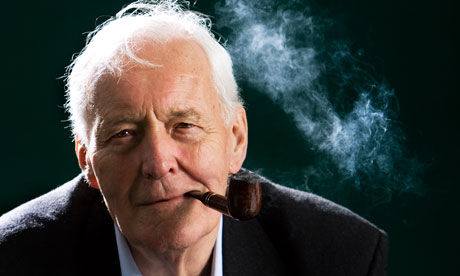
Remembering British MP Tony Benn, a Lifelong Critic of War and Capitalism

CLICK ON IMAGE

Tony-Benn-003

Tony Benn, the former British Cabinet minister, longtime Parliament member and antiwar activist, has died at the age of 88. He was the longest-serving member of Parliament in the history of Britain’s Labour Party, serving more than half a century. He left Parliament in 2001, saying he planned to “spend more time on politics.” In 2009 he appeared on Democracy Now! to talk about the war in Afghanistan and Britain’s fight for a nationalized healthcare system. “You’ve got to judge a country by whether its needs are met and not just by whether some people make a profit,” Benn said. “I’ve never met Mr. Dow Jones, and I’m sure he works very, very hard with his averages — we get them every hour — but I don’t think the happiness of a nation is decided by the share values in Wall Street.”
Transcript

This is a rush transcript. Copy may not be in its final form.

AMY GOODMAN: We wrap up now with this latest news that just came in hours ago, and this is the death of Tony Benn. Today we remember Tony Benn. The former British Cabinet minister, longtime member of Parliament, antiwar activist has died at the age of 88, the longest-serving member of Parliament in the history of Britain’s Labour Party, serving more than half a century. He left Parliament in 2001, saying he planned to “spend more time on politics.”

Sharif Abdel Kouddous and I interviewed Tony Benn in 2009, one day after he led a protest against the war in Afghanistan in London. At the rally, Benn and others read the names of British soldiers and Afghan civilians who died in the war. I began by asking Tony Benn about the protest and Afghanistan.

TONY BENN: Well, it was a solemn occasion, and the names were read.

But, you see, I think you have to understand the history of this. Britain invaded Afghanistan in 1839, captured Kabul, and was defeated the following year, and 15,000 British troops were killed in the retreat. Britain invaded Afghanistan in 1879. Britain was in Afghanistan in 1919. The Russians were in Afghanistan. I led a delegation to the Russian ambassador in London to protest that. The United States government, President Bush, the first one, funded Osama bin Laden to fight the Russians to get them out of Afghanistan.

And the situation we’re in now is very straightforward. The United States and NATO, 40 countries with 64,000 troops, in eight years have been unable to defeat the Taliban. And this is a Vietnam War for America and for the rest of the—well, for the people involved, soldiers and civilians on both sides, it’s an absolute tragedy.

SHARIF ABDEL KOUDDOUS: And Obama defended the war yesterday, calling it “a war of necessity.” Your response to that?

TONY BENN: Well, I think you just have to ask yourself the question: Is it a war on terror, or is it a war on Afghanistan? It’s a war on Afghanistan. And to call it a war on terror just entitles you to do what you like. And I don’t think it’s going to succeed.

The other thing I have in mind is very simple. A few years ago, London was bombed by terrorists. And how did it end—from northern Ireland. How did it end? It ended when we talked to Gerry Adams, who was the IRA leader in prison. Nelson Mandela was denounced as a terrorist by Mrs. Thatcher, and peace came in South Africa when the South African government talked to Mandela, and he came out and became president. I mean, history tells you, and Churchill put it very clearly: Jaw-jaw, talking, is better than war-war. And there will have to be negotiations with al-Qaeda and Taliban to secure the end of this conflict. Of that, I have no doubt whatsoever.

SHARIF ABDEL KOUDDOUS: Well, Tony Benn, we also wanted to talk to you about the issue of healthcare.

AMY GOODMAN: Tony Benn, you’re a former Cabinet minister, longest-serving MP in the history of the British Labour Party. Explain your system in Britain and what the battle looks like to you across the Atlantic in the United States.

TONY BENN: Well, I mean, for me—and I love, know America. I’m married to an American, known America for 70 years. It’s amazing. I think most people in Britain just regard it as being uncivilized for a great, rich country to ignore the health of 47 million people. And I don’t say that as an insult; we just don’t understand it.

It was set up in Britain in 1948, 61 years ago. And I have with me the statement made by the government at the time. “Your new National Health Service begins on the 5th of July. […] How do you get it?

“It will provide you with all medical, dental, and nursing care. Everyone—rich or poor, man, woman or child—can use it or any part of it. There are no charges, except for a few special items. There are no insurance qualifications. But it is not a ‘charity’. You are all paying for it, […] as taxpayers, and it will relieve your money worries in time of illness.”

And, I mean, my family has benefited enormously. I had an operation a few days ago in London. I’ve got a pacemaker put in under the Health Service. My wife died of cancer and for four years had the most brilliant healthcare.

And I suppose one way of looking at it is this: There’s a lot unemployment in the United States, as there is in Britain, and one way of creating jobs would be to build hospitals, recruit nurses, train doctors, and then meet the health needs of the country, as well.

I just don’t understand what’s being said. Well, I do understand, because I know the people who are saying it. But it’s absolutely no relation to the Health Service in Britain or the needs of the United States.

AMY GOODMAN: Finally, any thoughts on the comparison of the debate you’re seeing today with what happened before the British—the National Health Service was ushered in in Britain? Are you seeing an echo of it?

TONY BENN: Yes, in a way. I mean, some of the doctors were opposed to it, but they all came around. Some of the consultants said, “We don’t want to be civil servants.” But they’re not civil servants. You had a little bit of it.

But I’ll tell you what really changed it, and it takes you back to the 1930s. We had mass unemployment, as you did in the United States. And I was a pilot in the Royal Air Force in the war, and we were discussing on a troop ship coming home once how we would deal with the problems of unemployment. And one lad got up, and he said something I’ve never forgotten. He said, “In the 1930s we had mass unemployment, but we don’t have unemployment when we’re killing Germans.” He said, “If you can have full employment by killing Germans, why can’t you have full employment by building hospitals, building schools, recruiting teachers, recruiting nurses, recruiting doctors?” And that’s how we got it.

We took the view that a government had a responsibility to focus on the needs of a nation in peacetime in the way in which it does in wartime. And if that principle is followed, then all the ideological language can be set aside. You’ve got to judge a country by whether its needs are met, and not just by whether some people make a profit. I’ve never met Mr. Dow Jones, and I’m sure he works very, very hard with his averages—we get them every hour—but I don’t think the happiness of a nation is decided by the share values in Wall Street.

AMY GOODMAN: That’s Tony Benn appearing on Democracy Now! in 2009. He has died at the age of 88.

A War on Campus? Northeastern University Suspends Students for Justice in Palestine Chapter

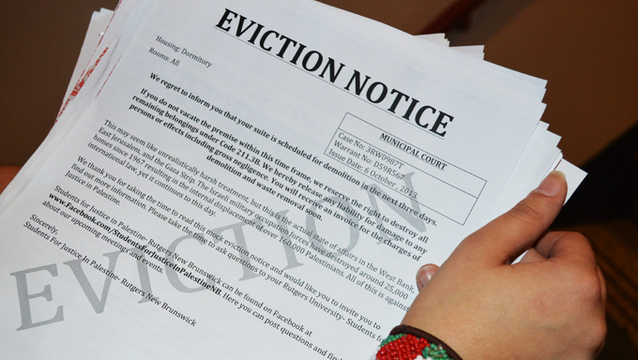
Mock-eviction-notice-Syjil-Ashraf-Targum

The Northeastern University chapter of Students for Justice in Palestine has become the latest student group to face reprimand for organizing around the Palestinian cause. Northeastern has suspended the group until 2015, barring it from meeting on campus and stripping it of any university funding. The move comes just weeks after student activists distributed mock eviction notices across the campus during Israeli Apartheid Week. The notices were intended to resemble those used by Israel to notify Palestinians of pending demolitions or seizures of their homes. We speak to Northeastern Students for Justice in Palestine member Max Geller and Ali Abunimah, co-founder of The Electronic Intifada and author of the new book, “The Battle for Justice in Palestine.” His new book includes a chapter titled “The War on Campus.”

Transcript

          This is a rush transcript. Copy may not be in its final form.

JUAN GONZÁLEZ: The Northeastern University chapter of Students for Justice in Palestine has become the latest student group to face reprimand for organizing around Palestinian issues. Northeastern University has just suspended the group until 2015, barring it from meeting on campus and stripping it of any university funding. The moves comes just weeks after student activists distributed mock eviction notices across the campus during Israeli Apartheid Week. The mock notices were intended to resemble ones used by Israel to notify Palestinians of pending home demolitions or property seizures.

AMY GOODMAN: Northeastern University accused the student group of disregarding university policies over an extended period of time. Michael Armini, Northeastern’s senior vice president of external affairs, said, quote, “The issue here is not one of free speech or the exchange of disparate ideas. Instead, it is about holding every member of our community to the same standards, and addressing SJP’s non-compliance with longstanding policies to which all student organizations at Northeastern are required to adhere.”

We’re joined now by two guests. Max Geller is with us, Northeastern University School of Law student and a member of Students for Justice in Palestine. And Ali Abunimah is with us in studio, co-founder of The Electronic Intifada, author of a brand new book, The Battle for Justice in Palestine. His new book includes a chapter headlined “The War on Campus.” read on and see the video here

War Workers: Vulnerable Foreign Laborers Swindled & Exploited to Toil on U.S. Bases in Afghanistan

Democracy Now

A new investigation by Al Jazeera America looks at the human trafficking
system that brings tens of thousands of foreign laborers to work on
U.S. military bases in Afghanistan. “America’s War Workers” examines how
these laborers regularly end up deceived and indebted, victims of local
 SEE HERE

A selection from Democracy Now of Friday February 28 2014

Peeping Webcam? With NSA Help, British Spy Agency Intercepted Millions of Yahoo Chat Images

Worse than Big Brother 1984

Freed Bahraini Activist Zainab Alkhawaja on Her Year in Prison, Continued Detention of Her Father

I salute the courage of that woman who by speaking out now, could be sent back to jail

I Was Beaten, Tortured: Pakistani Anti-Drone Activist Karim Khan on Being Abducted by Masked Men

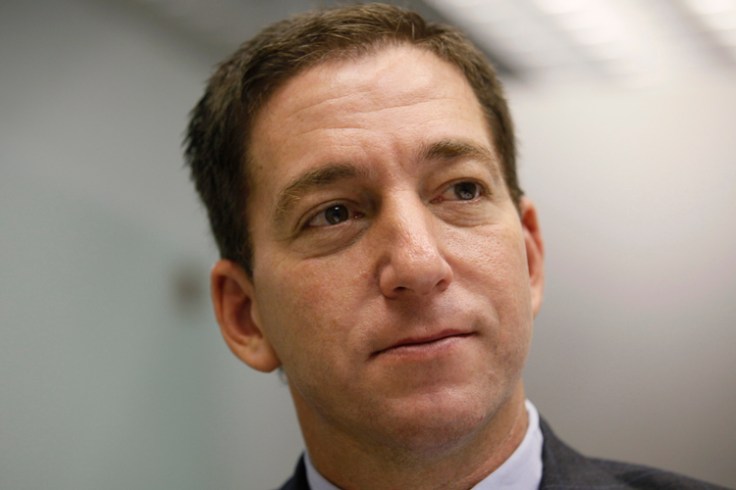
Wallace Shawn on Artistic Solidarity: As Glenn Greenwald Can’t Return to U.S., I Took My Play to Him

CLICK ON IMAGE
Glenn Greenwald

UNMANNED: America’s Drone Wars (full film)

see the DM report on the film here

Blog at WordPress.com.

Up ↑