Search

band annie's Weblog

I have a parallel blog in French at http://anniebannie.net

Category

culture

Tarkovsky Films Now Free Online

Andrei Tarkovsky (1932-1986) firmly positioned himself as the finest Soviet director of the post-War period. But his influence extended well beyond the Soviet Union.  The Cahiers du cinéma consistently ranked his films on their top ten annual lists. Ingmar Bergman went so far as to say, “Tarkovsky for me is the greatest [director], the one who invented a new language, true to the nature of film, as it captures life as a reflection, life as a dream.” And Akira Kurosawa acknowledged his influence too, adding, “I love all of Tarkovsky’s films. I love his personality and all his works. Every cut from his films is a marvelous image in itself.”

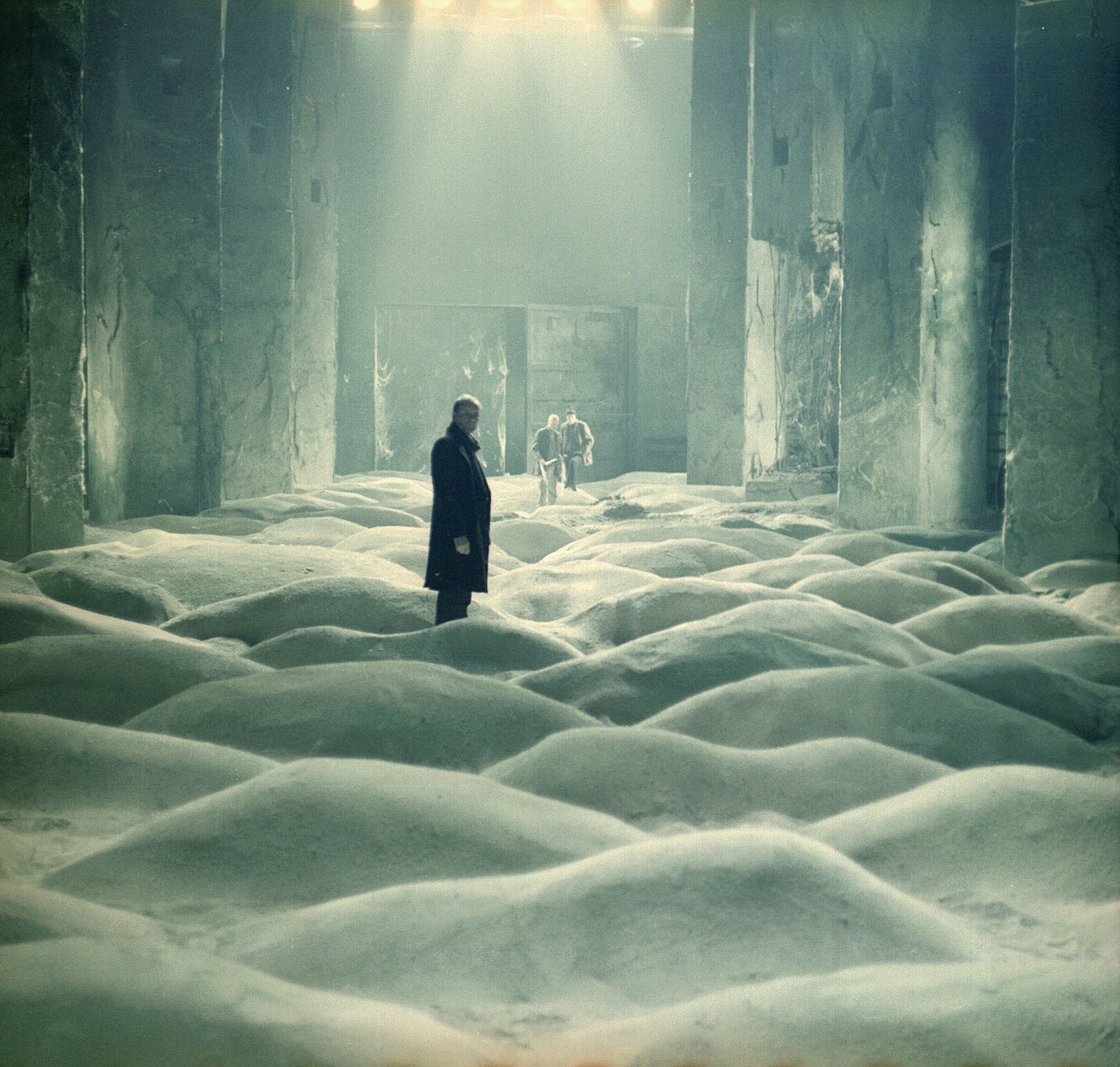
Shot between 1962 and 1986, Tarkovsky’s seven feature films often grapple with metaphysical and spiritual themes, using a distinctive cinematic style. Long takes, slow pacing and metaphorical imagery – they all figure into the archetypical Tarkovsky film. (Watch the scene from Stalker above.)

You can now watch Tarkovsky’s films online – for free. Each film is listed in our collection, 700 Free Movies Online: Great Classics, Indies, Noir, Westerns, etc.. But here you can access the films in the order in which they were made. Most all of the films below were placed online by Mosfilm, the largest and oldest film studio in Russia.

NOTE: if you access the films via YouTube, be sure to click “CC” at the bottom of the videos to access the subtitles.

Don’t forget to follow us on Twitter, Facebook and now Google+, and add a pinch of culture to your daily social media diet.

Related Content:

The Masterful Polaroid Pictures Taken by Filmmaker Andrei Tarkovsky

Tarkovsky’s Advice to Young Filmmakers: Sacrifice Yourself for Cinema

A Poet in Cinema: Andrei Tarkovsky Reveals the Director’s Deep Thoughts on Filmmaking and

Stephen Fry on God | The Meaning Of Life | RTÉ One

The salt of the earth – trailer

During the last forty years, the photographer Sebastião Salgado has been travelling through the continents, in the footsteps of an ever changing humanity. He has witnessed the major events of our recent history ; international conflicts, starvations and exodus… He is now embarking on the discovery of pristine territories, of the wild fauna and flora, of grandiose landscapes : a huge photographic project which is a tribute to the planet’s beauty. Sebastião’s Salgado’s life and work are revealed to us by his son, Juliano, who went with him during his last journeys, and by Wim Wenders, a photographer himself.

The Global Worth of Human Life

By Jahanzeb Hussain

29 January, 2012
Jahanzebjz.tumblr.com

I wonder how Europe and North America would react if the victims of 9/11, 7/7 and Madrid bombings were universally declared as nothing but “collateral damage”. It is simply unthinkable that victims who happen to be citizens of imperialist countries can be deprived of their humanity, the value of their life negated and their memories brushed under the rug. It would be totally wrong if we dismissed the lost lives as a mean to an end. Human life is an end in itself and its worth can never be diminished.

However, it is culturally accepted that when an innocent Iraqi, Palestinian, Afghan and a Pakistani dies they are not automatically accorded the same human right that Westerners and whites are. They are not viewed as valuable lives, but they are looked down upon as “collateral damage”. They are not human beings, but they are objects and chattel. They are subordinates and secondary. There are no memorials for them. There are no events for them to mark their death anniversaries. Nobody cares about them. Why should anyone as they are just sorry people who are getting in our way as we “light up” the world with “freedom” and “democracy”? After all they are just “terrorists” by our interpretation of the world, therefore all these people should not be deserving of the rights that North America and Europe take for granted. They are less human than us, so it doesn’t matter what they go through as they don’t feel and breathe. They can be killed and it’s all right as long as we keep deriving self-satisfaction out of it, because we are doing something “good” and “noble”.

Here is what will happen if tomorrow morning if there is a bomb attack in London or Paris or NY or any other European or North American city vs. a drone attack in Pakistan:

The citizens of imperialist nations will be remembered till the end of living days, their personal stories will be told a million times over, their pictures will be all over the media, tears of their families will be broadcasted, leaders around the world will pay visits to the attacked sites, there will be compensations to the families, there will be fierce rhetoric against the attackers and a promise of revenge. On the other hand, Pakistani women and children killed in a bomb attack will be a tool for an end, meaning their murder will be justified under the name of “fighting terrorism” and making the “world safe for democracy”. They will not be humans but tools and a means to some supposedly higher end. Moreover, the leaders and intellectuals of the “Free World” will preach to these barbarians that they actually don’t understand what a noble act America and her allies are undertaking. The immature children, as Pakistanis clearly are given the fact that they are Pakistanis, will be taught that they are incapable of seeing that what is being done is in reality good for them. American and her allies are angels who can’t commit sins and they will say to Pakistanis that they should be silent and let the masters carry on and not be ungrateful, and one day you will comprehend what an amazing service has been done to Pakistanis – or Iraqis, Afghans, and whoever else happens to be “benefiting” from Western “benevolence”.

According to the Western narrative, the lives lost of these people are not actually anything wrong, but a sacrifice. The divine European and North American men are busy in some grand project, which once completed, will reveal itself worthy of millions of lost lives of Iraqis, Afghans, Pakistanis and others.

This article was originally published on http://jahanzebjz.tumblr.com. Jahanzeb Hussain is the editor of Collateral Damage Magazine. He is a 22-year old student based in Vancouver, where he goes to Simon Fraser University. He also represents the Vancouver chapter of Afghans For Peace.

This article was also republished on http://passittotheleft.org and Afghansforpeace.org

Jahanzeb Hussain is the editor of Collateral Damage Magazine. He is a 22-year old student based in Vancouver, where he goes to Simon Fraser University. He also represents the Vancouver chapter of Afghans For Peace.

Tagged :

Jabra Ibrahim Jabra’s house destroyed

source
The Baghdad home of great Palestinian writer Jabra Ibrahim Jabra—who settled in Iraq following the nakba—was destroyed by a car bomb last month.

Jabra’s widow and son were both killed; countless papers, books, and paintings from the Iraqi and greater Arab art world were also ruined or destroyed. The NYTimes article about the event and its aftermath, which ran yesterday, is at times depressingly, at times irritatingly sweeping. The article is suffused with lyrical nostalgia: Jabra’s legacy of beauty and art has been destroyed. An era (in Iraq, or in the Arab world) is over.

Roger Allen, the translator of Jabra’s brilliant and celebrated In Search of Walid Masoud sounded the death knell for (Arabic?) literature:

“We’re in an era when cultures habitually and even deliberately misunderstand each other,” Mr. Allen said.

Someone like Mr. Jabra, he said, echoing others, “may not be possible anymore.”

But professor and translator Issa Boullata, a friend of Jabra’s, refused to go along with the sweep of the NYTimes story:

…he disagreed with the notion that the house was the atlal, the ruins, of a bygone era. “Too pessimistic,” he said, adding that Mr. Jabra was never pessimistic.

Remember Jabra Ibrahim Jabra:

* Read a piece by him that ran in Al Ahram in 2003, a year before his death: Mystery in Mesopotamia:

Mystery in Mesopotamia
By Jabra Ibrahim Jabra

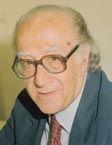
Jabra Ibrahim Jabra Following the occupation of Palestine in 1948, Palestinian writer Jabra Ibrahim Jabra (1920-1994), sought work in Baghdad, a city he fell in love with, one of whose natives he married, and which was to become the backdrop for most of his novels. The extract below deals with his early years in the city and his introduction to its then bustling social and cultural life. It is taken from his autobiography Shari’ Al-Amirat (Princesses’ Street), Amman and Beirut, 1994.

ROBERT HAMILTON was an archaeologist, and for several years the director of the Rockefeller Museum of Palestinian Monuments in Jerusalem, where we often met, sharing a passion for Palestinian monuments and ancient history. We also shared a love of music and art, especially sculpture, or of what was available of that in the Jerusalem Museum that lay outside the gates close to Bab Al-Sahera and in the neighbourhood of the Rashidiya College, at which I was a professor for four years until coming to Baghdad. It seems that at the beginning of 1948 he left Jerusalem and joined the British archaeology mission in Baghdad, an institution dating back to the beginning of the 1920s.

[…] read on

Palfest: Palestine Festival of Literature

Girls of Riyad

Their stories :

Girls of Riyadh was written by Rajaa Alsanea.

There now follows a summarised version of Girls Of Riyadh.
Girls Of Riyadh – Beginnings

An unknown girl in her early twenties decides to tell the story of her friends. She is like a modern Scheherazade who narrates these stories every weekend. Her motivation is to avenge the tyranny of life and society against her friends. Each chapter in the novel starts with a piece of poetry, a verse from the Quran, or lyrics from a famous song that captured the idea of the chapter.

The Book Stirs The Media

The narrator sends e-mails from her internet group to the subscribers. Those e-mails, as the narrator forecasts in the novel, stir the media. Popular newspapers in Saudi like Al-Riyadh, Al-Watan and Al-Jazeerah are all buzzing – mirroring what happened in real life after the novel was published. This kind of forecasting adds reality and intrigue to the novel. In one segment, the narrator says that she will probably be interviewed on Al-Arabiya TV by one of the most important interviewers in the Arab World: Turki Al-Dakheel (his style is similar to Tim Sebastian in Hard Talk on BBC or Ted Koppel on ABC news) which also took place in real life.

The Girls Of Riyadh

The novel describes four Saudi girls who are studying at the university in Riyadh, the Capital of Saudi Arabia. Their names are Sadeem, Qamrah, Lamees and Mashael (her name is similar to Michelle in pronunciation. She is half Saudi and half American. Her American mother and friends prefer to call her Michelle).
Lamees

The four girls are bound by a strong friendship despite their differences. Each one of them explores her own failures – except Lamees who finds success in both her professional career and her love life. She marries a man of her choosing and moves with her husband to Canada to get her Boards in Medicine. There, she commences research into MRSA infection, as part of her doctorate. Lamees is the fortune teller of the group. She is consulted by her friends about their future matches and emotional relationships. At one point in the novel she has to sever her friendship with a girl called Fatima due to religious differences. Fatima was from the Shiites minority while Lamees belonged to the Sunnites majority. Lamees likes Fatima’s brother who is studying Medicine at the same University, but the relationship has to end abruptly after they are both caught in a café by the Police of Morals and Virtue (dating is not allowed in Saudi and is an offense punishable by the Men of Religion). Her father is more like her friend and was very understanding. However, he insists that she never meet anyone outside the university in the future. Fatima’s brother, on the other hand, suffers at the hands of the Moral Police and his suffering is compounded since he is a Shiite.

Lamees has a kind heart. She helps her friends solve their problems and supports them in times of need. For example, she teaches her ill-treated friend, Qamrah, how to use the internet, send e-mails and chat online to break through the isolation that is imposed upon her after she is divorced and left with a baby.

Qamrah

Qamrah marries Rashid after an arranged sighting where the two families allow the prospective husband to see the girl only once to decide whether he likes her or not. As it happens he does and they marry. There is no dating, no exchange of ideas or thoughts. “See the girl once and make up your mind!” The girl also uses the same chance to see the man and give her opinion. Since they both agree, their families proceed with the marriage. The story unfolds with this beginning as the narrator continues to describe the Muslim wedding of Qamrah and how the tape for the walk-down the aisle music gets stuck which symbolically signals the failure of that marriage. The newlyweds go to Chicago so that Rashid can finish his postgraduate studies in electronic commerce. Seven nights pass and he does not care about his wife’s feelings. He stays away from her and doesn’t touch her. Soon the quarrels start and ecentually reach a climax when Rashid declares his hate for his new wife. He forces her to give up her hijab and she does so in the hope that she can win his heart (Moslem women are supposed to wear lose garments that do not reveal the silhouette of their bodies and they should not reveal any body parts except their face and hands). When he sees her without hijab, he thinks she looks very ugly and asks her to wear the Hijab again to hide the ugliness. Qamrah loves Rashid despite his cruelty. When she learns of his betrayal with an American-Japanese woman called Carry, she loses her mind. She insists on meeting the mistress and Carry mocks her by calling Rashid in front of her. Qamrah in return takes revenge by not taking her contraceptive pill. She becomes pregnant. In the back of her mind, she thinks she can change the behaviour of her husband through her pregnancy as her mother advised her. When Rashid finds out she is pregnant, he slaps her and sends her back to Riyadh followed by her divorce papers. Her second tragedy unfolds when Qamrah uses the first name of Rashid’s father to name her new baby in a last attempt to win the sympathy of her husband (it is a tradition in Saudi that babies are first-named after the first name of their grandparents as a gesture of love and respect). The husband does not care and his family shows callous reactions. Qamrah becomes a single parent and lives at her father’s house in isolation. Her family prevent her from going out since she is now divorced and such actions from a divorced woman may bring her ill-reputation. Divorced women in their opinion only bring problems. But her friends manage to get her out of that unbearable jail every now and then.

Sadeem

Sadeem’s story is not less tragic than that of Qamrah. This girl, who was raised by her father as her mother died soon after her birth, would lose her first love and the second one. She avenges both through her marriage to her cousin Tarik whom she never thought would marry despite his strong feelings towards her (Consanguineous marriages are discouraged by Islam but are not prohibited. In a society that separates men from women in all social gatherings, there is no chance to see a woman except those who are relatives, which is another reason why consanguineous marriages make a big share of all marriages in Saudi). Her first emotional tragedy is caused by her fiancé Walid who deserts her after they are officially wed for a few months and before their wedding party. She gives herself to him one night considering that he is her husband officially despite the wedding not having yet taken place. He suddenly disappears after that night and never shows up again. He eventually sends her divorce papers. It is a shock that she blames on herself as she did not wait until after the wedding party. Sadeem never tells her family about that night and she collapses emotionally into herself. She believes the reason that Walid divorced her was that he thought she had previous sexual experiences (In Saudi, engagement is different from the West. The man and woman are considered officially engaged when their marital vows are exchanged and documents are signed. The period from the time of signing the documents till the night of the wedding when they practice sex together for the first time is the engagement period. The virginity of the woman is flowered on that night. There is nothing in Islam to prevent them from practicing sex before that night as they are officially wed, but that is considered a big mistake by the society and men usually get the impression that the girl is too easy or she had extra-marital relations with others if she does such a thing.

The second shock is caused by Firas whom she met in London while she was recuperating from her first tragedy. She fell in love with him as he did with her. But his elite position in Saudi and the fact that he has never married before prevents him from getting married to a divorced woman as it would have brought him bad gossip which he does not need (divorced women in the Saudi society are associated with ill-reputation especially if they traveled outside the country and met men as Sadeem did). Instead, Firas marries one of his relatives. He later calls Sadeem and offers to continue the relationship without leaving his wife. Sadeem refuses the offer and becomes more desperate. Her suffering increases as Firas continues to call her. She finally decides to forget all about him and establishes her own bridal arrangement company which is an irony in itself. Her friends help her establish the company. In the end, Sadeem finds herself in front of her cousin Tarik who adores and reveres her. She cannot help but marry him and revenge both men in her past who nearly destroyed her.

Mashael

Mashael as her real Arabic name or Michelle as her mother and friends used to call her is more realistic and more liberal. She enjoys more freedom than her friends. Michelle was born to a Saudi father and an American mother. One day, she stumbles into Faisal by coincidence when he asks her along with her girlfriends to allow him to enter the shopping mall with them as a brother (In Saudi, single young men are not allowed to enter certain famous shopping malls to avoid the harassment and flirting they initiate towards women). This brief encounter is the start of a mutual love and a happy Valentine’s Day for the first time in her life. After Valentine memorabilia is spread everywhere, the university officially decides, based on the request of the Police of Morals and Virtue, to ban all forms of festivity of Valentine’s Day since it was a Christian event that ignited unvirtuous feelings between boys and girls. The love lasts a year and when Michelle asks Faisal to marry her, he backs off since his mother refuses to allow him to marry a girl not of the family’s choosing and on top of that born to an American mother. She loses her faith in men. After such a disappointment, she travels to San Francisco to study in the company of her American cousin. They develop a mutual admiration, but things never progress to love. Faced with this confusing relationship, she travels back to her father who decides to move the whole family to Dubai to avoid the gossip and ill-reputation that haunts his daughter. He is a liberal and adores his American wife who lost her uterus to cancer. They decide to adopt a baby boy whom they called Mish-´al and they nickname him Misho. Being forthcoming and simple characterises Michelle’s personality. She hates hypocrisy and lies. When she moves to Dubai, she works at one of the satellite TV channels owned by the father of her Emirati girlfriend, Jumanah (Emirati belonging to United Arab Emirates where Dubai is located). She succeeds in her work and lives freely. Michelle admires a TV director who works with her, but remains confused about whether she loves him or not. She asks her father if he will allow her to appear on TV as there is an opening for a TV hostess, but he refuses and convinces her that her appearance on TV would lead to reverberations that might reach Saudi and his family. He explains that he does not want that kind of headache. Michelle does not speak Arabic fluently and always uses English words when her Arabic fails her. She took revenge on Faisal when she attends his wedding uninvited and leaves him a message on his cell phone telling him that she is in the ballroom. Michelle bewilders him. After some delay, he enters and finds Michelle dancing among the girls. He starts to worry: “what next?”, but Michelle leaves before others recognise her. She feels so happy after what she did.
Um Nowayer

There is one more character who is connected with the four girls: Um Nowayer. In the Arab World, the mother and the father are nicknamed after their offspring as a sign of respect. The offspring name appears preceded by a prefix Abu for the father and Um for the mother. Um Nowayer was a Kuwaiti lady who was married to a Saudi who left her and her son after 15 years of marriage. She opens her house to the girls to meet when they cannot find anywhere else. She becomes a friend to them all, helps them in times of need and works sometimes with them. Um Nowayer is in her 39th year, a bald woman who is able to face her only son’s problem with courage. Her son’s name is Nouri, but he is gay and that made people call him Nowayer which is a feminine name close to Nouri. Consequently, everyone calls her Um Nowayer instead of Um Nouri. At first, she does not mind the ridicule, but she defies her neighbours and insists later on being called Um Nowayer. She seeks medical treatment of her son’s condition. One doctor tells her it is a psychological problem and not a physical one and that it may be related to the loss of the parental figure in the family. The son eventually grows out of it after two years of psychological treatment.

The title of the novel is full of irony. It was taken from a song by a very famous Saudi singer and the internet address of the group was called “Memoirs Exposed” which is a twist on the name of a famous TV show called “Memoirs Disclosed”. The novel was also full with humour and laughs as the narrator comments on the events with her trademark witty style. For example, she describes how the girls dance in the wedding in a hilarious way and the way women look at each other with jealousy. She also describes how men walk in their ugly underwear in the house after marriage and makes fun of that.

The novel ends with one success which is the marriage of Lamees to her colleague in Medical School. It seems that Lamees learns from the mistakes of her friends and never repeats them. In fact, she plans a strategy to win her colleague’s heart after she saw him and fell in love with him at first sight. She uses everything at her disposal to lure him into her net. Her successful strategy culminates with a lovely wedding and a trip to Canada to obtain her boards in Medicin

The Best 100 Arabic Books (According to the Arab Writers Union):

Somehow, I thought I could quickly track down each of these 100 titles, translate them (roughly), note whether or not an English translation or excerpt exists, and be done with it.

Apparently, my eyes were bigger than my…fingers?

So here you have it! The first 10 of the best hundred Arab novels selected by the Arab Writers Union. Tomorrow, insha’allah, the second 10.

1 The Cairo Trilogy by Egyptian (Nobel-prize winning) author Naguib Mahfouz. Yes, of course it’s available in English: Trans. William Maynard Hutchins, Everyman’s Library, 2001.

read on

In polyglot Lebanon, Arabic falls behind


Many university students are not able to recite Arabic alphabet as youths consider language not very ‘cool’.

By Rana Moussaoui – BEIRUT

Lebanon, a tiny, vibrant Mediterranean country, prides itself on its polyglot society but for the country’s youths native Arabic is not very “cool.”

“Hi, kifak? Ca Va?” — or “Hi, how are you doing? Okay?” — is a typical multi-linguistic Lebanese greeting so popular it now appears on bumper stickers and teeshirts sold around the world.

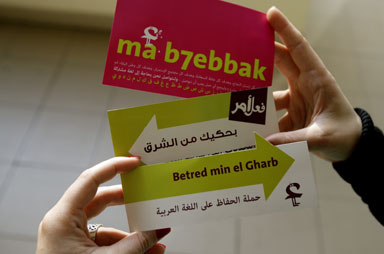
English and French often replace the local dialect in conversation, especially among the urban youth, and one organisation has launched a campaign to preserve Arabic in Lebanon.

“Arabic is still very much alive as a language, but young people are moving farther and farther away from it,” said Suzanne Talhouk, who heads the organisation “Fael Ummer” (Imperative) which is running the campaign.

“Some of our youngsters are incapable of writing correctly in Arabic, and many university students we interviewed were not even able to recite the alphabet,” Talhouk said.

Urban youths are often unable to hold a conversation in one language, causing amusement but also irking those around them with such home-grown expressions as the popular farewell: “Yalla, bye.”

“At my school it’s more cool to speak French. Arabic is looked down upon,” said high school student Nathalie.

On Thursday the Tunis-based Arab Organisation for Education, Culture and Science decided to set aside March 1 of each year to celebrate the Arabic language.

A statement from the organisation said the move was an attempt to “preserve the heritage of the Arab nation in the face of globalisation.”

The message was heard loud and clear in Lebanon, which was once the Francophone hub of the Arab world.

The country of four million was under French Mandate from 1920 until its independence in 1943, and it is still widely considered the most “Western” country in the conservative Middle East.

In Lebanon most schools teach Arabic, French and English to their students from a young age, and the education authorities allow students with dual nationality to waive Arabic classes and government examinations.

“Having a second language is an asset, provided students do not forget their native language,” said Talhouk.

Experts are divided on who should shoulder the responsibility, with some blaming schools which they say have placed Arabic at the bottom of the educational pyramid.

“Schools often treat Arabic as a secondary subject,” says Henri Awaiss, who heads the department of translation at Saint Joseph University in Beirut.

“Also, students are bored because of the way classes are taught,” Awaiss said. “We have to open the door to more creative teaching methods,” he said.

But some teachers say the problem starts at home.

“Many parents tend to speak to their children in English or French,” said Hiba, who teaches Arabic at a primary school.

“The problem is that I find myself teaching six-year-olds who do not speak their own language and who are utterly shocked by formal Arabic,” which differs from spoken Arabic, she added.

According to Talhouk “some parents even request teachers address their children in French or English if they do not understand Arabic.”

“It’s sad. One shouldn’t be ashamed of their language,” she said.

And with the Internet age in full swing, “writing in Arabic is no longer fashionable among the young,” Talhouk said.

“Arabic today is a sort of ‘Facebook Arabic’.”

The Lebanese have even devised a web-friendly script for their dialect, using Latin font. Numbers such as 2, 3, and 7 are used to represent Arabic phonetic sounds that do not exist in English or French.

The United Nations cultural body UNESCO designated Beirut World Book Capital of the year (April 2009-April 2010). But reading, generally not a popular activity in Lebanon, is even less popular in Arabic.

“I don’t read Arabic novels because they don’t speak to the youth,” said Bilal, a Lebanese university student studying television broadcasting.

Leila Barakat, who manages the World Book Capital programme, stressed the need for more modern Arabic texts that address the new generation.

“We must support and encourage Arabic literature for young adults, which is today underdeveloped,” Barakat said.

Talhouk insisted that Lebanon should invest in preserving the nation’s cultural and literary heritage, as well as develop Arabic technological and scientific terms.

“Young people should feel that this beautiful language speaks to them too, that it is of their day and age,” she said

source
Blog at WordPress.com.

Up ↑