Once Arabs began the shift in their way of life, of their nomadic tendencies and slowly became urbanised, the internal conflict between their tribal belief and behavioural systems continued for many centuries. In actuality, it continues today through the recent incorporation of many Bedouin tribes into new nation states within the Middle East.
There hasn’t been enough time elapsed to gradually migrate the mindset from one shaped in the desert versus the new mentality that required a new set of rules, civil rules and behaviour. Even those that had been modernised for many decades or centuries, to this day, retain certain fundamental traditions of the collective tribal consciousness.
This video illustrates the internal conflict that characterizes modern Arabs in many various nations, the challenges that confront them and the resolutions that need to be realised. #duality #civilisation #tribalism #clanhood #arab #middleeast #arabsociology #arabbehaviour #hypocrisy #honour #pride #bedouin #urban #nomad #tribe #internalconflict #themodernarabman #civillaw #blooddebt #justice #modernity Subscribe: https://bit.ly/3jCXuCw: Instagram: http://www.instagram.com/tareqkandari Twitter: http://www.twitter.com/tareqkandari Patreon.com/TheKandariChronicles
The dramatic story of the Crusades seen through Arab eyes. In this first of a four-part series, we look at the background to the holy wars and the First Crusade’s conquest of Jerusalem, a holy city for Jews, Christians and Muslims.
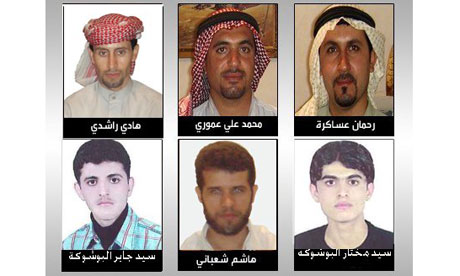 Arab prisoners from left: Hadi Rashedi, Mohammad-Ali Amori, Rahman Asakera, Mokhtar Alboshokeh, Hashem Shabani, Jaber Alboshokeh
Thursday 19 July 2012
Five Arab minority prisoners in Iran are at imminent risk of execution after being sentenced to death on terrorism charges
Iran has stepped up its crackdown against its Arab minority with mass arrests of activists and death sentences passed in closed-door courts.
At least five Arab prisoners who are currently kept at Karoun prison in the southern city of Ahwaz are at imminent risk of execution, activists have warned.
The men, Hadi Rashedi, 38, Hashem Shabani, 32, and Mohammad-Ali Amouri, 34, and two brothers Seyed Mokhtar Alboshokeh, 25, and Seyed Jaber Alboshokeh, 27, have been sentenced to death following trials described by activists as grossly unfair.
According to Human Rights Watch, the five were arrested by security forces in February 2011.
They have all been found guilty of being linked to a terrorist organisation and involvement in shootings that authorities say occurred in and around the town of Ramshir (also known as Khalafabad) in Khuzestan province.
“The judiciary has put forth no public evidence suggesting that these men should spend one more day in prison, let alone hang from the gallows,” said Sarah Leah Whitson, Middle East director at Human Rights Watch. “The lack of transparency surrounding these men’s convictions and sentences is just one more reason why these execution orders should be quashed.”
Ahwazi Arabs in Iran often face state discrimination in spheres including education, employment politics and culture. In recent years, many members of the community have taken to the streets to protest at the discrimination against them. Groups advocating a separate Arab state have also been demonstrating, but not all protesters have been separatists.
In June, three members of Iran’s Ahwazi Arab minority, Abd al-Rahman Heidarian, Taha Heidarian and Jamshid Heidarian, were executed in connection with killing of a law enforcement official. The activists said the charges might have been trumped up and politically motivated because of the secrecy surrounding their trials and the fact that they have had poor legal representation.
Several other Arab activists have also been arrested in recent years and sentenced to lengthy prison terms, including Rahman Asakereh, 34, who has been sentenced to 20 years and Esmaeel Abiat, 29, who has received five years in jail. Ali Badri, 31, has got 6 years, and Shahid Amouri, 42, one year, according to Human Rights Watch.
“The source told Human Rights Watch that the nine men are among at least a dozen Iranian-Arab activists from Khalafabad arrested by security forces since February 2011,” the HRW said. “Authorities have since released several others on bail, but Human Rights Watch has no specific information regarding the status of their cases.”
In the face of recent crackdowns, Justice for Iran, a non-profit human rights organisation, has called on the European Union to impose sanction on Iranian officials involved in the persecution of the country’s Arab minority.
The group has accused Morteza Kiasati and Seyed Mohamad Bagher Moussavi of Ahwaz’s revolutionary court of being responsible for the persecutions against the minority. Justice for Iran also pointed its finger at Iran’s state-run English language television, Press TV, for broadcasting the “force false confessions” of the men on television.
“January and February 2012 saw the start of a wave of arrests of Arab activists in Iran,” said Justice for Iran. “In the city of Shush alone, agents of the Ministry of Intelligence arrested over 30 people who were actively supporting and advertising the boycotting of the March 2012 parliamentary elections.”
It added: “Shortly after these arrests, which resulted in the detention of over 60 people in the province of Khuzestan, sources close to the families of some of the detainees reported that at least two of the protesters were killed under torture while in custody at the detention centres.”
-
 Muammar Qaddafi destroyed the
Libyan nation.
 –Muhammad al-Zawam, 25, student
Benghazi, Libya
A new beginning
As social revolutions sweep through the Arab world, how will they affect the role of the US in the region? Riz Khan, click on photo
Mazin Qumsiyeh
Here in Palestine, we face a relentless assault not only on us and our lands
but on truth, on decency, on nature, on dignity, and, dare I say, on God.
Israeli authorities are working overtime to transform the Holy City of
Jerusalem from a multi-ethnic and multi-religious city to a distorted vision
of what Zionists think Judaism is about (supremacy, ethnic purity, tribalism
etc).
They will be debating in the next few days a project for an additional
1400 “housing units” near Gilo colony. The land targeted belongs to the
village of Al-Walaja and the Town of Beit Jala. The Negev village of
Al-Araqib was also just demolished for the 9th time*. More home and business
demolitions were carried out in Jerusalem and the Jordan valley.
Taking
lands from Christians and Muslims, destroying over 2 million trees and
countless homes and businesses are not just war crimes but crimes against
humanity. We must continue to challenge these destructive policies and
demand the international community bring those responsible to justice.
Please write to media, politicians, and all others (the internet allows you
to get hundred of emails very quickly for decision makers).**
I think the empire’s hold on the Arab World has begun to unravel and I think
we see in Tunisia the first spark of a revolution that will reshape the Arab
world for the better and spell the end of repression. In 1948, the insertion
of Israel in the Middle of the Arab world was designed to dominate the area,
keep the people disjointed, disunited and ruled by (Western-appointed)
dictators. In 1953, the US and Britain engineered the coup that removed the
democratically elected government of Mousaddeq and placed the brutal Shah in
power in Iran.
These moves worked for many years because people in the Arab
world let them happen and offered limited resistance. Things have been
changing. In retrospect, the year 1973 was pivotal as for the first time
two Arab countries decided to fight to take back their stolen lands.
Unfortunately, the US chose to save its monstrous creation from having to
return all the stolen lands (and Sadat was willing to walk a separate line).
Then came the nonviolent people’s revolution in Iran which got rid of the
Shah in 1979.
Since then Israel and its benefactor has attempted in vain to
crush any Arab resistance by might. Fom their invasion and occupation of
Lebanon to invasion and occupation of Iraq, these evil forces attempted to
keep the lid on Arab democracy and keep their hegemony. Arab dictators were
useful tools in implementing these destructive policies. But many of us
have long argued that these shenanigans will and must come to an end.
As people around the world evolved beyond dictatorship and racism, we in the
Arab world will too. After all, why should people in Latin America (some
that used to be called banana republics) be able to say NO to the
neo-liberal and neo-colonial systems while we in the Arab world could not?
Why should Iran and Turkey be able to say NO to violations of International
law and NO to hegemony while we in the rich Arab world stay silent? The
directions may be coming from Tunisia. I have visited Tunisia twice and
have many colleagues and friends that hail from Tunisia’s beautiful towns
and villages. My single largest scientific collaborator is a Tunisian
scientist living in Paris.
I have commented on the similarity that
Palestine and Tunisia has in geography, topography, climate, and village
life. Tunisians used popular resistance methods I discussed in my recent
book on Palestine to get rid of a corrupt leader who had hung on to power
for over 23 years.
But there are other Arab leaders who have been in power
even longer. It is time for real change, a change not to replace one face
with another but to begin to form truly democratic institutions throughout
the Arab world. Our demands include democracy, transparency (including
totally free and critical press), plurality, and justice.
We have enough natural and human resources to build new vibrant societies.
All we have to
do is muster the will to free our minds. Those of us who have done so and
shed their inhibitions should also begin to discuss and ORGANIZE for the day
after (after Zionism and after imperialism). We have to begin to examine
how we may repair the damage caused by the corrupt systems and build a
better future.
*
http://english.pnn.ps/index.php?option=com_content&task=view&id=9407&Itemid=
56
 band annie's Weblog