Yup we knew it all along. But Gisha dug it out:
Lifeline 5, the fifth aid convoy organized by the UK-based charity Viva Palestina, has crossed Rafah, the border crossing between Egypt and the Gaza Strip.
http://www.vivapalestina.org/home.htm

The Viva Palestina convoy of almost 150 vehicles, 370 people from 30 different countries and $5 million of aid has entered Gaza.
Amidst scenes of jubilation from thousands of Palestinians there to greet the convoy, Kevin Ovenden, the convoy director, expressed his joy at being in Gaza once again. “We have driven more than 3,000 miles to bring this essential aid and to break this illegal siege of Gaza. We have been joined by supporters from Morocco and Algeria and from the Gulf States and Jordan, to make this the biggest convoy ever to break the siege of Gaza. We are absolutely overjoyed to be here and to bring with us the soil from the graves of those who were massacred on the Mavi Marmara which will be used to plant trees as a memorial to their sacrifice.”
The convoy set out four weeks and five days ago from London. It travelled through France, Italy, Greece, Turkey and Syria. Everywhere the reception was fantastic and the generosity of well-wishers unsurpassed. Towards the end there was a frustrating delay in Syria whilst negotiations at the highest levels were conducted with the Egyptian authorities. In the end it was all worth it as the Egyptian authorities decided to allow passage of the whole convoy, sadly excluding just 17 members of the convoy including George Galloway.
The convoy will be handed over in its entirety to the relevant bodies tomorrow and the members of the convoy then expect to leave Gaza and return home in the next 48 hours after celebrations and formal thanks are given.
![]() |
| Hundreds of peace activists have arrived in Gaza carrying humanitarian supplies [Reuters] |
Pro-Palestinian activists in more than 100 cars and trucks have crossed into the Israeli-blockaded Gaza Strip through Egypt’s Rafah crossing with aid worth nearly $5m.
The multinational “Viva Palestina” ship arrived at Egypt’s port city of al-Arish from Lattakia, Syria, earlier on Thursday.
About 300 activists then flew into al-Arish airport and converged with the ship’s passengers before entering Gaza.
The activists had initially joined up in Syria from Turkey, Algeria, Morocco, Jordan, and more than two dozen other countries.
The convoy, which was organised by George Galloway, a British politician, originally departed from London on September 18 and arrived in Syria two weeks later.
The activists then waited for over two weeks in Lattakia for permission from the Egyptian authorities for the shipment, which includes medical supplies and school equipment, to be allowed to enter al-Arish port.
The aid does not include any building materials, which the Egyptian authorities did not allow, as part of the agreement permitting the activists to enter Gaza for three days.
Israel has kept Gaza under a blockade since 2007, saying it is a necessary step to stop arms reaching the Hamas group running the strip.
Several dozen survivors from the Israeli attack on May 31 on the Turkish aid ship the Mavi Marmara were among those in the “Viva Palestina” convoy.
‘Summary executions’
Israeli commandos killed nine pro-Palestinian Turkish activists when they boarded the Mavi Marmara, the main vessel in a ‘Freedom Flotilla’ also attempting to deliver aid to Gaza.
Israel’s leaders said their troops opened fire in self-defence after being set upon by activists.
However, a UN inquiry last month found that Israeli troops broke international law by boarding the flotilla and found that the killings of activists on-board were comparable to “summary executions”.
After an international outcry over the Mavi Marmara raid, Israel relaxed its embargo but construction materials remain restricted.
Gazans have limited freedom of movement and Israel still enforces its naval blockade.
-Brings tremendous prestige
– And envy as well.
In activist circles
The groups try their best
To get to the Top Ten.
They’re greatly distressed
If, despite all their efforts
The League has the gall
To simply ignore them with
No mention at all.
The usual hard workers
are there, it is true,
The US Campaign,
If Americans Knew,
JVP and Sabeel,
And Al-Awda too.
Before the List’s published
The groups are so fraught,
Oscars and Nobels
And Emmies are naught
Compared to winning
A place on The Ten.
Gossip runs rife till
The List’s out, and then
Those failing to make it
Feel put out and jealous,
They think that their work
Has been equally zealous
As those on the List
So how can it be
They’re omitted?
They feel really pissed.
“We’ve worked, oh, so hard
To expose the Apartheid
And cruel Occupation
by Israel” they cried.
“We’re not on the list
But it’s our firm belief
That we should be;
It’s causing us grief!”
Meanwhile Abe Foxman
Complains and asks why
We all criticize Israel;
Yet he really won’t try
To open his eyes
And see the oppression
Of Arabs is now
An Israeli obsession.
Occupation, sheer cruelty,
And Apartheid – no less,
Is why all the groups
Now support BDS.
The evil of Zionism’s
Apartheid is great.
Israel is clearly
A Terrorist State.
“Anti-Semites!” cries Foxman
God – what an old trick!
Can he really not come up
With something more slick?
What he’s yet to discover
– it will give him the blues –
that many who oppose this Apartheid
are Jews.
– a humble activist.
Dedicated to the memory of the Turks and of Farrakhan Dogan, Turkish-American citizen murdered by Israel, May 31st 2010.
The Top 10 Anti-Israel Groups, as identified by ADL, are:
· Act Now to Stop War and End Racism (ANSWER)
· Al-Awda
· Council on American-Islamic Relations
· Friends of Sabeel-North America
· If Americans Knew
· International Solidarity Movement
· Jewish Voice for Peace
· Muslim American Society
· Students for Justice in Palestine
· US Campaign to End the Israeli Occupation
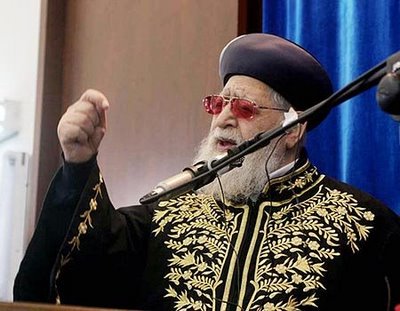
Non-Jews were born only to serve us. Without that, they have no place in the world-only to serve the People of Israel.”
From Khalid Amayreh in occupied East Jerusalem
A major Jewish religious figure in Israel has likened non-Jews to donkeys and beasts of burden, saying the main reason for their very existence is to serve Jews.
Rabbi Ovadia Yosef, spiritual mentor of the religious fundamentalist party, Shas, which represents Middle Eastern Jews, reportedly said during a Sabbath homily earlier this week that “the sole purpose of non-Jews is to serve Jews.”
Yosef is considered a major religious leader in Israel who enjoys the allegiance of hundreds of thousands of followers.
Shas is a chief coalition partner in the current Israeli government,
Yosef, also a former Chief Rabbi of Israel, was quoted by the right-wing newspaper, the Jerusalem Post, as saying that the basic function of a goy, a derogatory word for a gentile, was to serve Jews.
“Non-Jews were born only to serve us. Without that, they have no place in the world-only to serve the People of Israel,” Yosef said in his weekly Saturday night sermon which was devoted to laws regarding actions non-Jews are permitted to perform on the Sabbath.
Yosef also reportedly said that the lives of non-Jews in Israel are preserved by God in order to prevent losses to Jews.
Yosef, widely considered a prominent Torah sage and authority on the interpretation of Talmud, a basic Jewish scripture, held a comparison between animals of burden and non-Jews.
“In Israel, death has no dominion over them…With gentiles, it will be like any person-They need to die, but God will give them longevity. Why? Imagine that one’s donkey would die, they’d lose their money.
“This is his servant…That’s why he gets a long life, to work well for this Jew.”
Yosef further elucidated his ideas about the servitude of gentiles to Jews, asking “why are gentiles needed? They will work, they will plow, they will reap; and we will sit like an effendi and eat.”
“That is why gentiles were created.”
The concept of gentiles being infra-human beings or quasi-animals is well-established in Orthodox Judaism.
For example, rabbis affiliated with the Chabad movement, a supremacist but influential Jewish sect, teach openly that at the spiritual level, non-Jews have the status of animals.
Abraham Kook, the religious mentor of the settler movement, was quoted as saying that the difference between a Jew and a gentile was greater and deeper than the difference between humans and animals.
“The difference between a Jewish soul and souls of non–Jews — all of them in all different levels — is greater and deeper than the difference between a human soul and the souls of cattle.”
Some of Kook’s manifestly racist ideas are taught in the Talmudic college, Merkaz H’arav, in Jerusalem. The college is named after Kook.
In his book, Jewish History, Jewish Religion: The Weight of Three Thousand Years, the late Israeli writer and intellectual Israel Shahak argued that whenever Orthodox rabbis use the word “human,” they normally didn’t refer to all humans, but only to Jews, since non-Jews are not considered humans according to Halacha of Jewish law.
A few years ago, a member of the Israeli Knesset, castigated Israeli soldiers for “treating human beings as if they were Arabs.” The Knesset member, Aryeh Eldad, was commenting on the evacuation by the Israeli army of a settler outpost in the West Bank.
Faced with the negative effect of certain Biblical and Talmudic teachings on inter-religious relations, some Christian leaders in Europe have called on the Jewish religious establishment to reform the traditional Halacha perceptions of non-Jews.
However, while the Reform and Conservative sects of Judaism, have related positively to such calls, most Orthodox Jews have totally rejected the calls, arguing that the Bible is God’s word which can’t be altered under any circumstances.
The Bible says that non-Jews living under Jewish rule must serve as “water carriers and wood hewers” for the master race.
In Joshua (9:27), we read ” That day, Joshua made the Gibeonites woodcutters and water carriers for the community and for the altar of the Lord at the Place the Lord would choose. And that is what they are to this days.”
Elsewhere in the Bible, Israelites are strongly urged to treat “strangers living in your midst” humanely “because you yourselves were strangers in Egypt.”
For text see here
Seán Clinton, The Electronic Intifada, 29 March 2010
Every year, consumers the world over unwittingly spend billions of dollars on diamonds crafted in Israel, thereby helping to fund one of the world’s most protracted and contentious conflicts. Most people are unaware that Israel is one of the world’s leading producers of cut and polished diamonds. As diamonds are normally not hallmarked, consumers cannot distinguish an Israeli diamond from one crafted in India, Belgium, South Africa or elsewhere. The global diamond industry and aligned governments, including the EU, have hoodwinked consumers into believing the diamond trade has been cleansed of diamonds that fund human rights abuses, but the facts are startlingly different.
Israel — which stands accused of war crimes, crimes against humanity, ethnic cleansing, genocide, the crime of apartheid, extrajudicial executions within and outside the territory it controls and persistent serious breaches of the Geneva Conventions — is the world’s leading exporter of diamonds (see Figure 1 below). Israeli companies import rough diamonds for cutting and polishing, adding significantly to their value, and export them globally via distribution hubs in Antwerp, London, Hong Kong, New York and Mumbai.
![]() |
| Figure 1 |
In July 2000, the global diamond industry set up the World Diamond Council (WDC). The WDC was established as a response to public outrage about the use of diamonds to fund bloody conflicts in western African countries and it includes representatives from the World Federation of Diamond Bourses and the International Diamond Manufacturers Association. The council’s ultimate mandate is “the development, implementation and oversight of a tracking system for the export and import of rough diamonds to prevent the exploitation of diamonds for illicit purposes such as war and inhumane acts.” Significantly, the WDC limits its concern about human rights violations to those funded by rough diamonds only.
In 2003, the WDC introduced a system of self-regulation called the Kimberly Process Certification Scheme to stem the flow of “conflict” or “blood diamonds.” In keeping with the limited concerns of the WDC the UN-mandated Kimberly Process adopted a very narrow definition of what constitutes a conflict or blood diamond: “rough diamonds used by rebel movements or their allies to finance conflict aimed at undermining legitimate governments.” As a result of this tight ring-fencing, the much more lucrative trade in cut and polished diamonds avoids the human rights strictures applying to rough diamonds, provided the industry uses only Kimberly Process-compliant rough diamonds. Regardless of the human rights violations and atrocities funded by revenue from the Israeli diamond industry, governments and other vested interests party to the Kimberly Process facilitate the unrestricted access of diamonds crafted in Israel to the multi-billion dollar global diamond market.
The WDC created a web site called Diamondfacts.org to promote the virtues of the industry. It lists 24 facts extolling the benefits of the diamond industry — primarily to India and countries in Africa. Some of the benefits include that an estimated 5 million people have access to appropriate healthcare globally thanks to revenues from diamonds; diamond revenues enable every child in Botswana to receive free education up to the age of 13; the revenue from diamonds is instrumental in the fight against the HIV/AIDS pandemic.
While these facts are laudable the list makes no mention of other less savory facts, including the fact that revenue from the diamond industry in Israel helps fund atrocities and human rights abuses such as the killing, maiming and terrorizing of thousands of innocent men, women and children in Palestine and Lebanon — the sort of atrocities the Kimberly Process is supposed to prevent being funded by revenue from diamonds.
The list of “Diamond Facts” paints a one-sided, positive image of the industry. It implies that the greatest benefits are being felt in some of the poorest nations of the world. But Israel, one of the wealthiest nations, towers over all other countries in terms of the net benefit derived from the diamond industry. The added value to the Israeli economy from the export of diamonds was nearly $10 billion in 2008 (see Figure 2 below).
![]() |
| Figure 2 |
The WDC website is equally selective when it comes to providing information about which countries are most dependent on diamonds. It explains that Namibia, one of the minor diamond exporting countries in monetary terms, derives 40 percent (<$1 billion) of its annual export earnings from diamonds and that 33 percent ($3 billion) of the GDP of Botswana, another minor player, is derived from diamond exports. The WDC fails to mention that the much more lucrative, high-value end of the diamond industry is the main artery of the Israeli economy, accounting for more than 30 percent of Israel’s total manufacturing exports worth nearly $20 billion in 2008 (“Trade Performance HS: Exports of Israel” accessed 25 March 2010) (See Figures 3 and 4). By comparison, the budget for Israel’s Ministry of Defense was $16 billion in 2008.
![]() |
| Figure 3 |
![]() |
| Figure 4 |
Revenue from the diamond industry helps fund Israel’s illegal occupation of the Palestinian territories, its brutal subjugation of the Palestinian people and its international network of saboteurs, spies and assassins. None of this is alluded to in the WDC’s “Diamond Facts.”
Contrary to claims by the diamond industry and jewelers that all diamonds are now conflict free, they are not. Israel’s dominant position in the industry means that diamonds crafted in Israel are interspersed globally with diamonds crafted in other countries. Consumers who purchase diamonds that are not laser-inscribed to identify where they were crafted run a significant risk of purchasing a diamond crafted in Israel, thereby helping to fund gross human rights violations. The Kimberly Process Certification Scheme strictures only apply to rough diamonds, thus allowing diamonds crafted in Israel to freely enter the market regardless of the criminal actions of the Israeli government and armed forces. The Kimberly Process is seriously flawed and is being used by the diamond industry and jewelers to pull the wool over consumers’ eyes by telling them that all diamonds are now “conflict free” without explaining the limitations and exactly what that means.
All this is hardly surprising given Israel’s dominant position in the diamond industry. Israel currently chairs the Kimberly Process. The notion of self-regulation by any industry that is intrinsically linked to the violations it purports to want to eliminate is something that neither governments nor the general public should tolerate. It is impossible for the public to have confidence in the diamond industry’s attempt to self-regulate as long as it facilitates the trade in diamonds crafted in Israel, which, if the Kimberly Process applied the same standards to all diamonds, would rightly be classified as blood diamonds and treated accordingly.
Given the failure of Western governments to hold Israel to account for numerous breaches of international law including international humanitarian law, breaches of the UN Charter, its failure to abide by more than 30 binding UN Security Council Resolutions, breaches of EU Agreements and disregard for the 2004 advisory opinion of the International Court of Justice, they are unlikely to insist that the diamond industry broaden the definition of a conflict diamond to include cut and polished diamonds that fund human rights abuses.
Consumers should have the right to know where a diamond was crafted and consequently the right to choose an Israel-free diamond. These rights are not available to consumers today.
In 2005, Palestinian civil society called for an international campaign of boycott, divestment and sanctions (BDS) against Israel similar to that which helped bring an end to the apartheid regime in South Africa. The international BDS campaign has to date focused much of its boycott activities on the most easily targeted Israeli products including fruit, vegetable, cosmetics and some plastic products. Targeting these products helps to increase public awareness of Israeli crimes and to some extent satisfies the public’s desire to register disapproval of Israel’s actions. However, these products account for only a small fraction of Israel’s total manufacturing exports. Even if the boycott of these products was totally successful it would not make a significant difference to the Israeli economy or to Israel’s ability to further its expansionist goals.
![]() |
| Figure 5 |
The diamond industry is a major pillar of the Israeli economy (see Figure 5 above). No other developed country is so heavily dependent on a single luxury commodity and the goodwill of individual consumers globally. Anything that threatens the carefully-nurtured image of diamonds as objects of desire, romance and purity could have serious consequences for the Israel diamond industry and the country’s ability to continue funding its illegal occupation of the Palestinian territories, the construction of illegal colonies and other associated criminal activities that render it the pariah of the modern age.
The international BDS campaign needs to focus global attention on the diamond trade that facilitates Israel’s ongoing crimes against the Palestinian people and its neighbors in the region.
Seán Clinton is the chairperson of the Limerick branch of the Ireland Palestine Solidarity Campaign and a former Boycott Officer on the National Committee of the Ireland Palestine Solidarity Campaign.