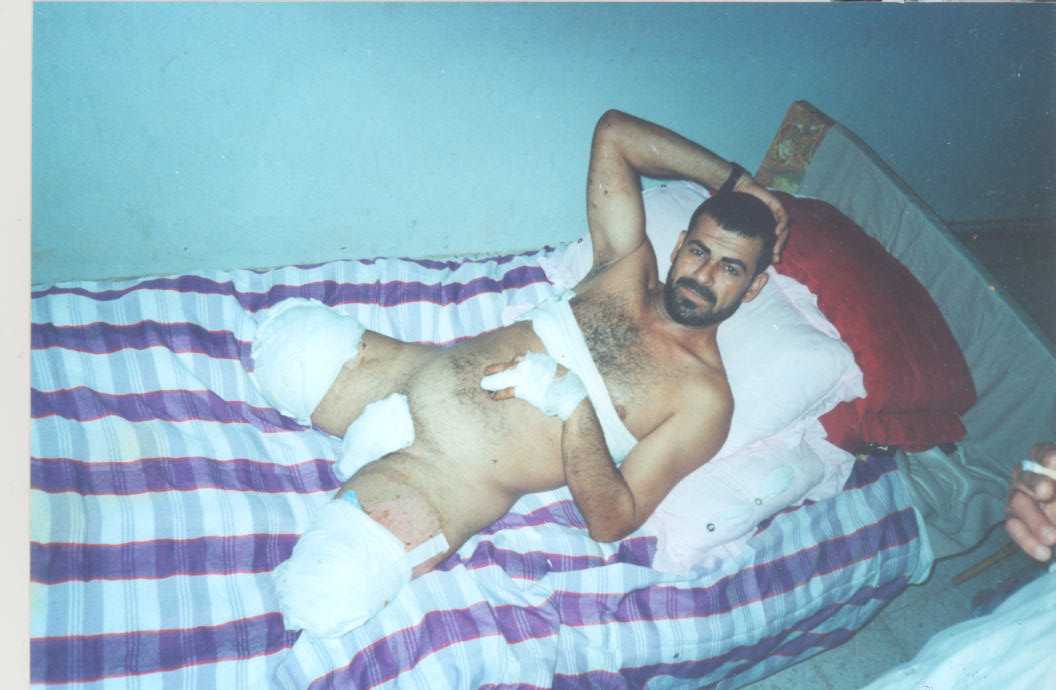
See Max Blumenthal’s commentary.
Former US marine & former US citizen Ken O’Keefe speaks here about being on board the MV Mavi Marmara when it was attacked and boarded by Israeli commandos in international waters on 31st May 2010.
The ship was one of a flotilla carrying humanitarian aid from 37 countries to the people of Gaza, who have suffered more than three years of privation under the internationally condemned Israeli blockade.
During the attack 9 people were killed by the Israelis, two of whom were shot as they lay injured, a UN report found.
By Jacob Berkman · October 24, 2010
NEW YORK (JTA) — The Jewish Federations of North America and the Jewish Council for Public Affairs are launching a multimillion-dollar joint initiative to combat anti-Israel boycott, divestment and sanctions campaigns.
The JFNA and the rest of the Jewish federation system have agreed to invest $6 million over the next three years in the new initiative, which is being called the Israel Action Network. The federations will be working in conjunction with JCPA, an umbrella organization bringing together local Jewish community relations councils across North America.
The network is expected to serve as a rapid-response team charged with countering the growing campaign to isolate Israel as a rogue state akin to apartheid-era South Africa – a campaign that the Israeli government and Jewish groups see as an existential threat to the Jewish state. In fighting back against anti-Israel forces, the network will seek to capitalize on the reach of North America’s 157 federations, 125 local Jewish community relations councils and nearly 400 communities under the federation system.
“There is a very, very high sense of urgency in [fighting] the delegitimizing of the State of Israel,” the JFNA’s president and CEO, Jerry Silverman, told The Fundermentalist. “There is no question that it is among the most critical challenges facing the state today.”
In fact, Silverman added, Israeli leaders identify this as the second most dangerous threat to Israel, after Iran’s pursuit of nuclear weapons.
Under a plan approved in late September during a special conference call of the JFNA’s board of trustees, the JCPA’s senior vice president, Martin Raffel, will oversee the new network. He will be working in concert with the head of the JFNA’s Washington office, William Daroff. Over the next several months, Raffel will be putting together his team, including six people in New York, one in Israel and one in Washington.
The network will monitor the delegitimization movement worldwide and create a strategic plan to counter it wherever it crops up. It will work with local federations and community relations councils to enlist the help of key leaders at churches, labor unions and cultural institutions to fight anti-Israel boycott, divestment and sanctions campaigns.
Organizers of the network are looking at the response to an attempted boycott of the Toronto International Film Festival last year as a model for how the system could potentially work.
When the festival organizers decided to focus on filmmakers from Tel Aviv, more than 1,000 prominent actors and filmmakers signed a statement saying that the organizers had become part of Israel’s propaganda machine, and they threatened to boycott the event. In response, the UJA Federation of Greater Toronto and the Jewish Federation of Greater Los Angeles worked together to come up with a counter statement supporting the festival. The counter statement won the signatures of even more prominent Hollywood figures, including Jerry Seinfeld, Natalie Portman, Sacha Baron Cohen, Lisa Kudrow, Jason Alexander and Lenny Kravitz.
“The partnership started last year around the Toronto international film festival,” said Ted Sokolsky, president of the Toronto federation. “We jointly produced an ad saying that we don’t need another blacklist.”
Sokolsky went on to say, “I spoke to Jay [Sanderson, the CEO of the Jewish Federation of Greater Los Angeles] and said, ‘Here, there are a lot of prominent Hollywood types on the delegitimization protest. Can you reach out to the Hollywood community and find some pro-Israel leadership?’ He reached out to some key leadership in Hollywood. And it was like waking up a sleeping giant. Then we realized we can’t all fight this alone.”
He added that “It was a great lesson and set a template on how to respond because clearly, the other side is running a linked campaign with international funding and global strategy but local implementation.”
When similar delegitimizing attempts erupt, leaders of the new network plan to respond early, according to Silverman.
“If the community in Chattanooga all of a sudden is faced with [a boycott of] Israeli products in the mall, they should be able to call the [Israel] Action Network and have response and implementation within 12 hours, and not spend time thinking about how to do it,” he said. “We should be able to do that in every community.”
Toronto and Los Angeles are two of the largest federations in the JFNA system, but the smaller federations feel that the network will benefit them as well.
Michael Papo, executive vice president of the Jewish Federation of Greater Indianapolis, said that Indiana has not yet witnessed a full-fledged anti-Israel boycott campaign.
“But it could happen,” he said. “It could happen quickly. It could happen on our college campuses, and it would be helpful to have that national network to call for help.”
Papo said he sees the network as being able to provide guidance when his federation has to face situations such as the one it faced several years ago, when the Presbyterian Church (USA) pursued a divestment strategy against Israel. At that time, he and his colleagues were able to influence local Presbyterian churches in Indiana to vote against the divestment campaign at their national convention.
“As a Jewish community, we have a huge range of contacts in the general community,” he said. “We are connected politically, culturally, socially, academically and in the business world — anyplace we work and live, we have connections with neighbors. … If and when we need support, we are quite capable.”
Steven Nasatir, president of the Jewish United Fund/Jewish Federation of Metropolitan Chicago, said that federations and their local partners are uniquely positioned to take on delegitimization campaigns against Israel.
“A top-down approach cannot fully comprehend or appreciate local nuance, and after each and every incident, when the headlines recede, it is the local community that is in the best position to strengthen the community for the future,” Nasatir said in an e-mailed statement. “Over the past few years, active local Federations have countered the boycott of Israeli products by buyout of those same products. They have demanded that university institutions require civility from anti-Israel protestors trying to drown out Israeli speakers. And, through ongoing contact with local elected leaders, they have sensitized public officials and institutions to the need for fairness, civility and appropriate monitoring of anti-Israel thuggery.”
While other groups, including the American Israel Public Affairs Committee, the Zionist Organization of America and J Street, focus primarily on influencing the political arena, and others, such as the Israel Project and CAMERA (the Committee for Accuracy in Middle East Reporting in America), key in on the media, the new network will aim to influence civic leaders.
The Jewish federations have agreed to give the JFNA $1.6 million to fund the project fully in its first year. In the two subsequent years, the federations will split the cost 50-50 with JFNA.
“Israel’s government has been advocating for this, especially over the past six months or eight months,” Silverman said. “It has been in dialogue within our federation movement for a while, especially following the Toronto incident and the incident in San Francisco with the film festival, and divestment movements in the Protestant and Presbyterian churches. This idea was born out of the large city executives meeting that said, ‘It is time. And time is running out.’ We have to do this quickly and we have to be armed in our community and be offensive, not defensive.”
Silverman said that he expects the Israel Action Network to be fully staffed and up and running by Jan. 1.
Benefit for the Belgium to Gaza project
 When Time Magazine carried an article on “Why Israel Doesn’t Care about Peace“, a whole coterie of American Zionist supporters reacted as if Time had become anti-Semitic.
For any writer to cast the slightest aspersion on Israel’s claim to wish for peace is tantamount to alleging that there never was a Sermon on the Mount.
Author of the Time article, Karl Vick, writes, “Asked in a March poll to name the ‘most urgent problem’ facing Israel, just 8% of Israeli Jews cited the conflict with Palestinians, putting it fifth behind education, crime, national security and poverty.”
Referring to the same poll, Vick adds, “Israeli Arabs placed peace first, but among Jews here, the issue that President Obama calls “critical for the world” just doesn’t seem – critical.”
Time’s cover and story on life in Israel prompted more than 1,000 letters, mostly in protest. Several of those letters allege the usual canard that the article is anti-Semitic.
They berated Vick for lacking reliable support for his claim. However, they ignored a journalist with impeccable credentials who writes for the influential daily journal Ha’aretz.
“The good life in Israel is real, while all the rest is somehow blurred, says Ari Shavit who writes a regular column for Ha’aretz.”
Here are some of the ludicrous, though typical, comments made by readers:
“So Time Magazine is really sucking up to their Arab bosses. Without those petro dollars, Time would have folded years ago. We Jews have a long memory & will get even in the future.”
A typical anti-Arab writer says, “‘Never Again’ only applies to the Jews. Not the Goy vermin. How much are you getting paid to post here, Arab?”
The type of comment by those who believe that Israel can do no wrong goes like this:
“This story and the cover graphic are worthy of a supermarket tabloid. Time has lowered its standards by using provocative and misleading graphics on its cover, and stooped even further by publishing an article better suited to a blog than a news magazine.”
If they find nothing else wrong, they complain about the timing, “This is disgusting! On one of the holiest days of the Jewish calendar Rosh Hashanah, I am greeted by an inexcusable cover story by Time magazine.”
One commentator simply said, without support, “What an unfounded article !!!!”
If a publication doesn’t say what you want it to say, cancel your subscription. You may have to explain how you happened to read the offending article. This one doesn’t:
“Hurrah for all of those who were nauseated by this latest piece of crass and untrue journalism by Time Magazine. I cancelled my subscription long ago and can only recommend that, if you are interested in what is going on in the Middle East, Time is not the place to find out.”
Here’s the gold-medal winner. “Wow! What’s next? An update to the Protocols of the Elders of Zion?”
Calling “the article and its arguments wrong, inappropriate and offensive,” Anti-Defamation League Director Abe Foxman repeated the age-old propaganda line about Israel’s desire for peace:
“Ignored is the decades-long yearning of Israelis for peace and the tremendous efforts successive Israeli governments have made in pursuit of reconciliation.”
Both the Israelis and the American Zionists have been lying and brainwashing others for so long they believe the propaganda themselves.
If there’s any sincerity in the minds of those who say that Israel wants peace, they need to stop believing that Israel can do no wrong.
Israel needs to stop being a propaganda machine refusing to accept criticism and failing to indulge in self-criticism.
* Paul J. Balles is a retired American university professor and freelance writer who has lived in the Middle East for many years. For more information, see http://www.pballes.com.
by Flora Nicoletta