Search

band annie's Weblog

I have a parallel blog in French at http://anniebannie.net

Author

bandannie

32 protesters held for hurting Syria’s ‘image’

DAMASCUS — Syria on Thursday charged 32 demonstrators with attacking the reputation of the state a day after they joined a rally calling for the release of political prisoners, a rights group said.

The 32 protesters, including rights activist Suhair Atassi, were detained on Wednesday at a Damascus rally organised by the relatives of political prisoners to petition for their release.

“The Syrian authorities on Thursday charged 32 activists who took part in protest outside the interior ministry with attacking the reputation of the state, provoking racism and sectarianism and damaging relations between Syrians,” the Syrian Observatory for Human Rights said.

The rights group listed the names of 25 detained demonstrators, including Atassi and four relatives of opposition figure Kamal Labwani, who is serving a 12-year jail sentence.

It said security services broke up the sit-in “by force.”

Syrian rights groups have repeatedly urged the authorities to free prisoners of conscience and to stop arbitrary detention of political opponents and civil society activists.

They have also called for a law on political parties “to enable citizens to exercise their right to participate in managing the affairs of the country.”

On Thursday five protesters detained at Wednesday’s rally were freed, a rights group said amid international calls for more to be released.

Human Rights Watch called for the release of all demonstrators, estimating that at least 34 people were arrested based on a list compiled by participants.

“Instead of beating families of Syria?s political prisoners, President (Basgar) al-Assad should be reuniting them with their loved ones,” said Sarah Leah Whitson, HRW’s Middle East director.

HRW quoted one released activist as saying security services had asked those arrested for their Facebook passwords.

Whitson said if Assad “is serious about reform, he should hold his security services to account.

“Syrians deserve no less than the Egyptians and Tunisians who finally succeeded in forcing their political leadership to disband the feared state security services.”

France on Thursday condemned violence against protesters in Damascus, and the United States called on Syria to exercise restraint.

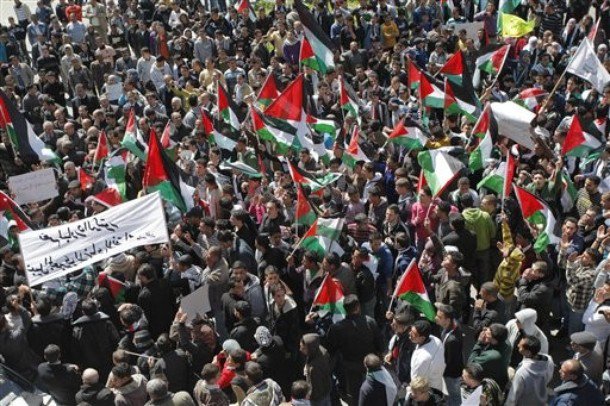
and Syria too

Midan Tahrir au Caire

“Al Midan” by Abdel Rahman al-Abnoudi

Posted on March 13, 2011 by Jan 25 Translators

Our first assignment was the translation of a selection from “Al Midan”, a poem by Abdel Rahman al-Abnoudi composed in colloquial Egyptian Arabic on the occasion of the January 25th Revolution. Listen to his recitation in Arabic here.

A few of these lines also accompany the brilliant Sout el-Horreya video
(link), and we came across two English translations of these lines.

Version I

Dark Egyptian hands that know how to characterize
Reach out through the roar to destroy the frames
The creative youth came out and turned autumn into spring
They have performed the miracle and raised the murdered from murder
Kill me, killing me will not bring back your country
In my blood I shall write a new life for my home
My blood is it or the spring? Both in green color
Am I smiling because of my happiness or my sorrows?

Version II

Egyptian hands understanding how to differentiate
Breaking the mirrors of deception
The beautiful youth showed up to change it is winter to spring
And made the miracle and awoke the deadened country from its death
Kill me, killing me won’t return your rule again
I’m writing with my blood a new life for my country
This is my blood or is it the spring
Both of them are green
And am I smiling from my happiness or my sadness?

These transliterations are just that: literal, word for word translations, designed to address a perceived immediacy of communicating meaning. They deprive the reader and listener from the full body of the poem: its music, rhythm, image, linguistic register, social and cultural signification and so on.

Our assignment focused on an introductory segment of the poem:

ايادي مصرية سمرا ليها في التمييز

ممددة وسط الزئير بتكسر البراويز

سطوع لصوت الجموع شوف مصر تحت الشمس

آن الآوان ترحلي يا دولة العواجيز

عواجيز شداد مسعورين اكلوا بلدنا اكل

ويشبهوا بعضهم نهم وخسة وشكل

طلع الشباب البديع قلبوا خريفها ربيع

وحققوا المعجزة صحوا القتيل من القتل

اقتلني قتلي ما هيعيد دولتك تاني

بكتب بدمي حياة تانية لأوطاني

دمي دة ولا الربيع الاتنين بلون اخضر

وببتسم من سعادتي ولا احزاني

Our class is divided into three groups that bring together native and non-native speakers of both the Source Language (Arabic) and Target Language (English) in a collective approach to the process of translation, which is fraught with a myriad of challenges. The role of non-Arabic (specifically native English) speakers is particularly important in the production of the translations: they harbor a natural affinity for the use and signification of the various symbols that constitute the language, and always necessarily inform the decision-making process in a variety of ways. Similarly, native Arabic speakers carry the responsibility, as translators, of applying their command of Arabic, as well as a degree of social and cultural insight, to unpacking, deconstructing and rethinking signification: what does a word, sentence, idiom, or even an image, or a particular juxtaposition, actually mean. In all cases, the translators’ awareness of subjectivity, difference and diversity is at the forefront of decision-making, and the interactive process of translation is therefore incomplete without a profound appreciation and navigation of audience: that which prompts the production and dissemination (that is, the life) of a work, and that which attracts and guides the process of translation itself.

What follows is each group’s translation, followed by their comments. It is important to remember that there is no singular, final product, and therefore, we encourage your feedback. Please comment below or e-mail us your thoughts, reflections, and insights, or even alternative translations, at translatingrev@gmail.com

Enjoy!
source

______________________________

Maher Zain – Palestine Will Be Free | ماهر زين – فلسطين سوف تتحرر

The Tunisian revolution

Syria !

Gaza March 15

March against the division

Photos : Osama Mattar Full album on fb

Islamophobia for dummiez 1-2-3

Story of a Jan 25 Martyr

We are all Khaled Said
par We are all Khaled Said, samedi 12 mars 2011, 11:42

Writtern by: Marwa Abdelrahman (The martyr’s cousin)

The hardest part of a story to write is always the end. The writer sits and wonders how best to phrase their final words and touch the audience that is to read their story. The hardest ending to a story of all is when you’re talking about the end of someone’s story: their life.  Harder still is to write about the violent end to a life. Words cease to become adequate. These words are about the end of one man’s life. A man who gave the ultimate sacrifice for expressing his desire of change like any human has the right to. This man was Tarek Abdelatif Mohamed AlAktash.

Tarek was 36-years-old. He was happily married with kids and had a wonderful job and a loving family. He lived his life according to his faith and values and always lent a helping hand when needed. He was a man you could lean on in difficult times and a man you could rely on to make you feel better when you were sad. He had no political leanings to the left or right and was not affiliated with any political party, much like countless others living in Egypt prior to the events that began on January 25th 2011. On January 28th, Tarek, along with millions of others in Egypt, took to the streets to express his want of a new governmental system and for change from the 30-year rule of one man and his cronies. Late in the morning he marched towards Tahrir Square to shout out his longing and yearning. He was full of life and vibrantly participating in a revolution, but devastatingly, by eleven p.m. that night, Tarek was dead. Later, it was to be revealed that he was shot in the neck by a 4mm bullet that severed his arteries, killing him instantly. However, Tarek’s story was not over.

By the morning of January 29th, Tarek’s wife had alerted his brothers and family members that Tarek had not come home the night before. Worry hadn’t fully set in for them all yet because during that time, cell phone service had been shut off inside Egypt so it was assumed Tarek had spent the night in Tahrir Square. By the morning of January 30th, with no sign of Tarek and no contact from him, his family and friends began to mount a search for him by looking for him in the local hospitals, expecting that he had been injured. Their search led them to the French Qasr Al-Ainy hospital where they were told that all the injured and deceased they had treated and received had been identified and that Tarek was not one of them. Needless to say, relief was the prevalent emotion, but its close companions were worry and the beginnings of fear. If Tarek wasn’t there, where was he?

The next chapter in the story spans almost a month and a half. From January 28th to March 9th, Tarek became one of the most searched for people in Egypt. His story was on local and international news stations. Prominent journalists in Egypt spoke of him on their TV programs. They even had contacts within the military and state security that they exhausted day and night asking about him and his whereabouts. The answers they were given by these governmental entities were conflicting and vague at best.  Some claimed Tarek was being held as a prisoner and others said they did not where he was. As the days went by, the hopes of finding Tarek dwindled. Tarek’s wife and family left no stone unturned in the search for him. They became frantic, almost obsessive when looking for him. They knew that every day that passed with no Tarek meant that the likelihood of his wellbeing was jeopardized. The trips to the morgues and hospitals became more frequent and the calls to the military slowly ceased.  Tarek’s family could do no more in their search for him.  All they could do was pray and hope for a miracle.

On March 9th, Tarek’s brothers received a phone call from a stranger telling them that they knew of Tarek’s whereabouts. When asked where, the man on the phone told them his body was at a morgue. The jarring news hit hard. No one had fully expected that Tarek had died but rather, that he was being held prisoner in an undisclosed location.  Tarek’s brothers rushed to the morgue and it was there that the ending to his story was written.

On January 28th 2011, at around eleven p.m. at night, Tarek was shot and killed. His body was transported to the Qasr Al-Ainy hospital and was ID’s as “unknown”. On February 26th, his body was moved to the morgue where it was found by the stranger who made the phone call to Tarek’s family. This stranger was there on March 9th to claim Tarek’s body as the body of his missing brother, but was told by the mortician that this was not his family member; it was Tarek Abdelatif Mohamed AlAktash. Why hadn’t he contacted the family, the stranger asked? He was told that Tarek’s family was repeatedly called but no one had answered. This Good Samaritan then took it upon himself to contact the family and within hours, Tarek had been found at last. His journey had ended in a morgue with a bullet wound to the neck; violently and ruthlessly.

Tarek’s family now must wait for a DNA test to undoubtedly prove what they know: that the body they found is indeed Tarek’s. This is typical procedure according to the local law enforcement, when there is more than one family claiming a body as that of their loved one. As far as Tarek’s family is concerned, it was their son.

The events that started on January 25th in Egypt captured not just the hearts and minds of the millions in Egypt, but the hearts and minds of millions around the world. The revolution lasted 18 days and claimed hundreds of lives. Each life a loss and yet each life was a gift to those who would survive after it. Tarek gifted his life to his country. On January 28th, he became the greatest thing a person can become; he became a martyr. His memory will live on in his children and his family and his sacrifice will never be forgotten.  His death will be mourned but it must also be celebrated. Tears of sadness should become tears of happiness and gratitude for a man who cared not for himself, but for the greater good of his fellow brothers and sisters. It was what he would have wanted, and, as he now rests in a much better place, gone and missed but certainly never forgotten; it must become what everyone wants as well.

source : facebook

Blog at WordPress.com.

Up ↑