 A mangled version of this review appeared in the Independent.
What is happening in the Middle East? Tariq Ramadan, one of the foremost Muslim intellectuals, calls the contemporary events ‘uprisings’, more concrete and permanent in their effect than ‘revolts’ but still short of thoroughgoing ‘revolutions’. So far, Tunisia is the only clear democratising success, and even there it remains unclear if the new dispensation will be fundamentally more just economically than the last.
Half of this slim volume is spent examining whether the uprisings were staged or spontaneous. Ramadan counsels against both the naive view that outside powers are passive observers of events, and the contrary belief that Arab revolutionaries have been mere pawns or useful idiots in the hands of cunning foreign players.
Certainly the US and its allies helped to guide events by collaborating with the military hierarchies which removed presidents in Tunisia and Egypt, and by full-scale intervention in Libya – this for a variety of obvious reasons. An agreement signed by Libya’s NTC in March last year, for instance, guaranteed France 35% of future oil exports.
There’s been Gulf and Western hypocrisy over Bahrain, home to Formula One and the US Fifth Fleet, and al-Jazeera’s coverage has been tailored to reflect its Qatari host’s strategic concerns.
Then, less convincingly, the social media conspiracy: trainees from 37 countries learned non-violent cyberactivism in Serbia. Google, Twitter and Yahoo offered training in the US. Google provided satellite access codes to Egyptian activists so they could evade censorship, but not to their Syrian counterparts.
Ramadan also remarks on Syria’s abandonment by the ‘international community’. “It would have been possible to isolate the country in an effective way with a military option,” he writes in one of the more breathless journalistic pieces which make up the last third of the book. His belief that there could be such a thing as disinterested intervention is characteristically idealistic.
Ramadan pays too much attention to the foreign conspiracy red herring, in part because the “conspiratorial paranoia of those who have lost their faith in the ability of human beings to assert themselves as the subjects of their own history” necessitates it, but also because, like the media he criticises, he focuses too much on cyberactivists and not at all on organised labour, whose strike actions in Tunisia and Egypt were finally more effective than mass demonstrations, or on the rights advocates in Syria and Yemen who kept anti-regime struggles alive.
Ramadan comes into his own not as a political writer but as a historian and provoker of ideas. He notes how, in their Western representation, Muslim Arabs have shifted during the uprisings from the benighted, terrorist ‘other’ to the “alterego of the Western Universal.” He is worried by the Arab internalisation of this false universalism, and of the fruitless, inaccurate and Orientalist binary opposition of Islamism and secularism.
Both schools of thought are in crisis. Secularists lack mass support; indeed ‘secularism’, associated with colonialism and post-colonial oppression, has become a dirty word in Arabic. Islamism has support but no coherent programme. Its proponents are divided by contentious issues from the rights of women and minorities to attitudes to sharia and statehood. The Iranian theocratic model, once an inspiration, is now tarnished. In opposition the Islamist current concentrated on the symbols of an Islamic society – hijabs and the like. Political Islam may be as diverse as political Judaism or Christianity, but is unified by its failure to even claim to offer answers to pressing economic, social and environmental crises.
In recognition of their weaknesses, both parties to the argument now prefer the term ‘civil state’ over ‘Islamic’ or ‘secular’ state labels.
Ramadan blames the ideological void on “the deadening weight of dictatorship” which impoverished “the life of ideas in society.” Specifically, “critical, creative economic thinking appears to have deserted the Arab political debate”. Rejecting the superficiality of ‘Islamic finance’, he calls for a fuller critique of capitalism’s unethical and undemocratic content.
More than that: He wants the Arab Muslims to “draw upon their collective cultural and symbolic capital to produce something new, something original, something distinct.” He calls for social justice based on the Quranic verse “We have conferred dignity on human beings,” and for an all-encompassing spiritual, cultural and “intellectual jihad.”
He calls for revolution, in other words.
Source : Qunfuz

Introduction by Gilad Atzmon: A very interesting review of The Wandering Who by Dr. Mazin Qumsiyeh in the current Holy Land Studies Journal. The entire review can be read on Dr. Qumsiyeh’s website: http://www.qumsiyeh.org/giladatzmon/
“I see in Atzmon writings a number of memes that are seeping into the common discourse. A meme is a persuasive idea that spreads in a population like a useful gene spreads in a population. Some of those memes include:
-The now well-established fact that Jews are not a racial group but an ideological religious belief that spread many centuries ago among people of diverse background (this meme came from studies of the Khazars and others by authors like Arthur Koestler, Kevin Alan Brooks, Shlomo Sand, and now Atzmon)
-The idea of a conflict between chauvinistic nationalism and universal humanism.
-The weird mix of religious heritage/belief with tribal notions in Jewish political discourse
-The distorted recruitment of archaeological and other studies to support the political ideology of a connection between Jews of today and Israelites of the bible
-The recruitment of the ideology of suffering as a quasi-religious belief that is no longer subject to normal historical examinations (and in fact shielded from such historical examination via laws)”
To read more: http://www.qumsiyeh.org/giladatzmon/
Astonishing video from #Syria. Shells fall, but protesters continue to dance & sing
This is Friday in Bashar Al Assad’s Syria, still uprising after 14 months and possibly 12,000 lives have passed.
1000 GMT: Syria. Ahmad Fawzi, the spokesman for United Nations envoy Kofi Annan, has declared that the proposals for peace are still on course to be fulfilled, “The Annan plan is on track and a crisis that has been going on for over a year is not going to be resolved in a day or a week. I agree with you that there are no big signs of compliance on the ground. There are small signs of compliance.”
Annan will brief the United Nations Security Council on the Syria situation next Tuesday by video link from Geneva.
The Local Co-ordination Committees in Syria claim 16 people have died today: five in Idlib Province, three each in Aleppo and Homs Provinces, two each in Deir Ez Zor and Hama Provinces, and one in Daraa Province.
0630 GMT: Syria. According to the Local Co-ordination Committees of Syria, 32 people died across the country on Thursday at the hands of security forces.
On this day. however, it would be a specific set of casualties that would hold political significance. At least four students — the LCCS claims six — were killed when their dormitories were stormed after campus protests. The decision to attack the students brought a defiant response, with their colleagues continuing to express anger and resistance even as authorities announced classes were suspended until 13 May.
Beyond the immediacy of young people challenging the Assad regime, the decision to attack them had a whiff of desperation. Amidst the uprising from March 2011, Aleppo has had the reputation of being a city unlikely to rise up, given its business and financial interests linking it to the regime’s survival. Now security forces were having to take over its university, ending the lives of some of those who might have been expected to be among Syria’s elite.
Whether President Assad’s men can close off that incident or whether it is yet another spark for the fire of demands for significant reform or even the removal of the regime remains to be seen. However, given that the dead students do not fit the official model of the “armed terrorist groups” who must be defeated, this event has undercut Damascus’s claim of legitimacy.
The story of 4 kids of the extended Samouni family in Gaza. By animated drawings they express what happened to them and their family during operation ‘Cast Lead’
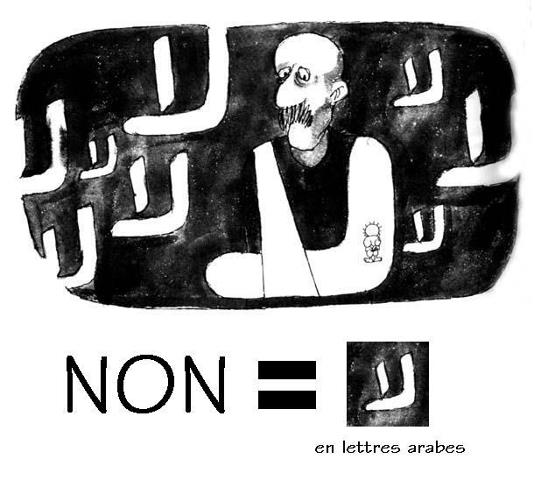
Second part
Third part
CLICK ON IMAGE

In 1965, Booker Wright, an African-American waiter in Greenwood, Mississippi, dared to be interviewed by NBC about racism in America, a decision that forever changed his and his family’s lives. Wright said during the interview, “I always learned to smile. The meaner the man be, the more you smile. Do all your crying on the inside.” He would later lose his job, be beaten by police, and ultimately be murdered. Wright’s story is told in the new documentary film, “Booker’s Place: A Mississippi Story,” a collaboration between our two guests: co-producer Yvette Johnson, Wright’s grand-daughter, and director Raymond De Felitta, whose father, Frank De Felitta, originally filmed the interview with Wright and later said he regretted it. [includes rush transcript]

