Search

band annie's Weblog

I have a parallel blog in French at http://anniebannie.net

Author

bandannie

Defector general Manaf Tlass calls for Syrian unity

  • July 25, 2012 10:45AM

The battle for Aleppo

Amateur video appears to show Syrian tanks in Aleppo as a Syrian general, who defected, calls on Russia to stop supporting Assad. Deborah

Reuters21 July 2012

Watch  Video of battle for Aleppo
SYRIAN general Manaf Tlass has called on Syrians to unite and start building a post-President Bashar al-Assad Syria as he made his first public appearance since defecting from the regime.

Reading a prepared statement on the Saudi-based Al-Arabiya television channel, Tlass called on Syrians to “unite… to serve a Syria after Assad… and do the impossible, to ensure the unity of Syria, and to be sure to start building a new Syria.”

Tlass, who defected on July 6, said he was “reaching out to (Syrians) in these difficult times for the country, as the blood of its innocents is being shed, and whose only crime has been to call for freedom.”

Manaf Tlass

Syrian defector Manaf Tlass, right, pictured in 1999 with Syria’s Bashar al-Assad. Picture: AFP Source: AFP

The defector said the “new Syria … should not be built on revenge, exclusion or monopoly.”

He said he was speaking as “one of the sons of the Syrian Arab Army, who has rejected this regime’s criminal and corrupt ways … and who cannot accept its crimes to our country.”

The defector said he did not blame those troops who had not defected, adding that “whatever mistakes made by some members of the Syrian Arab Army … those honourable troops who have not partaken in the killing … are the extension of the (rebel) Free Syrian Army.”

It is “the duty of Syrians to unite, to build a free, democratic Syria,” said Tlass.

A high-profile military figure and former member of Assad’s inner circle, Tlass has been mentioned as someone who could play a leading role in a transition phase in Syria should Assad fall.

On July 6, sources close to the regime told AFP that general Tlass had defected and left Syria, information later confirmed by French foreign minister Laurent Fabius.

Until Monday’s televised address, Tlass had yet to make a public appearance.

A general in the elite Republican Guard charged with protecting the regime, Tlass is the son of former defence minister Mustafa Tlass, a close friend of Assad’s late father and predecessor, Hafez al-Assad.

His defection was hailed in Western capitals as a key setback for the regime while the opposition umbrella group the Syrian National Council called it an “enormous blow” to Assad.

However Tlass has faced criticism and suspicion among Syrian rebels, who say that he and his 80-year-old father, who lives in Paris, should have made their positions clear at the start of the uprising against the Assad regime last year.

The Killing Of America (1982) Uncut

[youtube http://youtu.be/MameAk4FVo8?]

A documentary of the decline of America. It features a lot a footage (most exclusive to this film) from race riots to serial killers and much-much more. While this documentary is easily available everywhere else, it has never been released, distributed, televised nor made available for sale in the USA. This documentary argues that the turning point was when John Kennedy was assassinated in Texas 1963 combined with poverty, racism, the Vietnam war, and gun violence but unlike Michael Moores heavy handed 2002 documentary “Bowling for Columbine” (Which is often compared to this documentary) this film never becomes preachy nor does it blame guns in the same way.

Iran steps up crackdown against its Arab minority

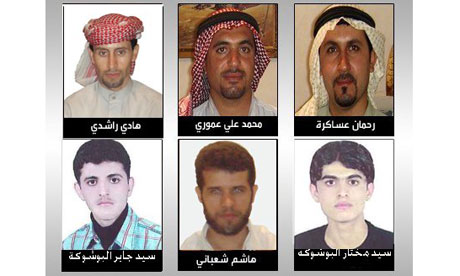
Arab prisoners from left: Hadi Rashedi, Mohammad-Ali Amori, Rahman Asakera, Mokhtar Alboshokeh, Hashem Shabani, Jaber AlboshokehArab prisoners from left: Hadi Rashedi, Mohammad-Ali Amori, Rahman Asakera, Mokhtar Alboshokeh, Hashem Shabani, Jaber Alboshokeh

Thursday 19 July 2012

Five Arab minority prisoners in Iran are at imminent risk of execution after being sentenced to death on terrorism charges

Iran has stepped up its crackdown against its Arab minority with mass arrests of activists and death sentences passed in closed-door courts.

At least five Arab prisoners who are currently kept at Karoun prison in the southern city of Ahwaz are at imminent risk of execution, activists have warned.

The men, Hadi Rashedi, 38, Hashem Shabani, 32, and Mohammad-Ali Amouri, 34, and two brothers Seyed Mokhtar Alboshokeh, 25, and Seyed Jaber Alboshokeh, 27, have been sentenced to death following trials described by activists as grossly unfair.

According to Human Rights Watch, the five were arrested by security forces in February 2011.

They have all been found guilty of being linked to a terrorist organisation and involvement in shootings that authorities say occurred in and around the town of Ramshir (also known as Khalafabad) in Khuzestan province.

“The judiciary has put forth no public evidence suggesting that these men should spend one more day in prison, let alone hang from the gallows,” said Sarah Leah Whitson, Middle East director at Human Rights Watch. “The lack of transparency surrounding these men’s convictions and sentences is just one more reason why these execution orders should be quashed.”

Ahwazi Arabs in Iran often face state discrimination in spheres including education, employment politics and culture. In recent years, many members of the community have taken to the streets to protest at the discrimination against them. Groups advocating a separate Arab state have also been demonstrating, but not all protesters have been separatists.

In June, three members of Iran’s Ahwazi Arab minority, Abd al-Rahman Heidarian, Taha Heidarian and Jamshid Heidarian, were executed in connection with killing of a law enforcement official. The activists said the charges might have been trumped up and politically motivated because of the secrecy surrounding their trials and the fact that they have had poor legal representation.

Several other Arab activists have also been arrested in recent years and sentenced to lengthy prison terms, including Rahman Asakereh, 34, who has been sentenced to 20 years and Esmaeel Abiat, 29, who has received five years in jail. Ali Badri, 31, has got 6 years, and Shahid Amouri, 42, one year, according to Human Rights Watch.

“The source told Human Rights Watch that the nine men are among at least a dozen Iranian-Arab activists from Khalafabad arrested by security forces since February 2011,” the HRW said. “Authorities have since released several others on bail, but Human Rights Watch has no specific information regarding the status of their cases.”

In the face of recent crackdowns, Justice for Iran, a non-profit human rights organisation, has called on the European Union to impose sanction on Iranian officials involved in the persecution of the country’s Arab minority.

The group has accused Morteza Kiasati and Seyed Mohamad Bagher Moussavi of Ahwaz’s revolutionary court of being responsible for the persecutions against the minority. Justice for Iran also pointed its finger at Iran’s state-run English language television, Press TV, for broadcasting the “force false confessions” of the men on television.

“January and February 2012 saw the start of a wave of arrests of Arab activists in Iran,” said Justice for Iran. “In the city of Shush alone, agents of the Ministry of Intelligence arrested over 30 people who were actively supporting and advertising the boycotting of the March 2012 parliamentary elections.”

It added: “Shortly after these arrests, which resulted in the detention of over 60 people in the province of Khuzestan, sources close to the families of some of the detainees reported that at least two of the protesters were killed under torture while in custody at the detention centres.”

source

Som Sabadell flashmob

Syrian opposition’s foreign funders — no laughing matter

July 23, 2012 § Leave a Comment

A message from the Syrian opposition: “We just want to thank our sponsors in the CIA, MI6, Mossad, al-Qaeda, Qatar and the House of Saud for their generous financial support and high tech communications equipment.”

Also check out Jess Hill’s report on Syria’s subversive comedians, and David Kenner on Kafr Anbel’s revolutionary art.

source

Analysis: The myth of Palestinian neutrality in Syria

Published yesterday (updated) 23/07/2012 04:17
A Palestinian demonstrator holds the Syrian opposition flag at a protest
against Syria’s President Bashar Assad in the central Gaza Strip in
late June. (Reuters/Ibraheem Abu Mustafa, File)
On July 14, thousands of Palestinian refugees marched in a funeral procession for 11 unarmed protesters shot dead by Syrian security forces in the al-Yarmouk refugee camp. Raucous and seething with rage, mourners chanted for Syria and Palestine, called for the downfall of Bashar Assad’s regime, and sang for freedom.Whether this burgeoning civil disobedience movement will grow into an open, durable rebellion remains to be seen, but the significance and the potential influence of the latest wave of protests that has swept Syria’s largest Palestinian camp cannot be overlooked.

As the Syrian uprising gathered momentum and the Syrian regime escalated its repression against what started out as a peaceful revolt, concerns have emerged about the impact of the uprising on Palestinian refugees in Syria, who make up just over 2 percent of Syria’s total population.

The Palestinian political elite in Syria have been divided. Some factions have desperately attempted to appear neutral, distancing themselves from the unrest. Others, such as Ahmad Jibril’s PFLP-GC, Fatah al-Intifada, and the Palestinian-Baathist militia al-Sa’iqa, have actively supported the regime, bolstering its propaganda campaigns and crushing civil dissent inside the camps.

In stark contrast to the moribund, aging political leadership, Palestinian-Syrian youth activists, who prior to the eruption of the uprising had focused their activism on Palestine, have participated in the uprising since the very beginning as demonstrators; organizers of aid and relief work for wounded and internally-displaced Syrians; or as citizen journalists, photographers and media activists. The hub of their activism, however, remained outside the camps for most of the uprising.

Never were the tensions among Syria’s Palestinians as discernible as during the aftermath of last year’s Naksa Day protests on June 5, when dozens of unarmed Palestinians were killed by the Israeli occupation army in the occupied Golan Heights border area. Yarmouk inhabitants and martyrs’ families set the PFLP-GC building ablaze in a strong denunciation of the faction’s role in mobilizing to instigate the youths to march back home without any protection despite the anticipated deadly reaction by the Israeli army.

The faction engaged in a pathetically naked attempt to deflect attention from the regime’s crackdown. Several Palestinians were killed in the clashes that ensued between Yarmouk residents and armed PFLP-GC gunmen following the funeral. However, with the exception of the Syrian navy’s attack on the al-Raml refugee camp last summer and the occasional Syrian army shelling on refugee camps in Daraa, Hama and Homs, the situation in the refugee camps remained cautiously quiet.

Intifada in the camps

Since February, the al-Yarmouk camp has regularly held protests in solidarity with the besieged Syrian cities and towns. It participated in the Damascus general strike on May 29, 2012. The protests would normally pass quietly without being attacked by Syrian security forces.

The straw that broke the camel’s back was the abduction and then killing of 13 Palestinian Liberation Army fighters from the Nayrab refugee camp in Aleppo. Though the identity of the killers is unknown, the killings sparked a large protest in Yarmouk on July 12, and an even larger protest the next day. Buoyant chants of “God bless the Free Syrian Army”, “From Syria to Palestine, one people not two”, and “Long live Syria and down with Assad” echoed in the camp’s streets. The Syrian army opened fire at protesters and for the first time, clashes between the regime army and the FSA broke out inside the camp, marking a significant tipping point. The Local Coordination Committee of Yarmouk camp called for mass protests and a general strike to protest the killings.

Jihad Makdissi, the spokesman of the Syrian Foreign Ministry, described Palestinians in Syria as “guests” and cynically told them to “leave Syria for one of the Arab democracies” if they misbehave. Makdissi’s Facebook statement, which he later deleted, triggered outrage and highlighted the complicated nature of Palestinian participation in the uprising.

“We always warned against pushing the camp into the uprising, but no one listened,” tweeted an anti-Assad Yarmouk resident following the massacre. The International Committee of the Red Cross recently described the situation in Syria as a civil war. Thus, concerns of being “stuck” in the middle of a civil war or intervening in “internal” affairs are perfectly legitimate and understandable. Active opposition to the Syrian regime poses serious risks to Palestinian refugees.

The most imminent scenario is that the general violence that has marred the country for the last 16 months would spill over to the camps. Despite their under-privileged status as stateless refugees, Palestinians in refugee camps have been relatively safer than neighboring Syrian districts in besieged cities, leading several internally displaced families to seek asylum in the Palestinian camps. Meanwhile, the regime has mostly avoided launching direct attacks on refugee camps, particularly Yarmouk, in order not to alienate an already divided population.

However, as shown by the attack on unarmed protesters in Yarmouk, the Syrian regime has not backed down on attacking Palestinian refugees, dare they “misbehave.”

The situation could further deteriorate in the event of clashes between the regime army and armed opposition fighters. Yarmouk camp is a strategically important area that borders Midan, Tadamun, and al-Hajar al-Aswad — Damascene neighborhoods that have seen intense clashes between the army and the FSA in the last few days. This raises the possibility that the camp could turn into a niche area of battle. A less likely – but perhaps more dangerous – scenario is an intra-Palestinian collision between regime loyalists and opponents. The clashes that followed the Naksa Day protests last year served to expose the tensions enveloping the Palestinian community in Syria; the current unrest could foment them.

The searing memories of the destruction of Nahr al-Bared refugee camp in north Lebanon are still haunting and vivid five years on; the fears of a similar scenario taking place in Syria are not completely far-fetched despite the glaring differences between the two situations.

The myth of neutrality

In spite of the aforementioned perils, the participation of Palestinian-Syrian youth in the uprising seems inevitable and unavoidable. Contrary to Palestinian refugees in neighboring Lebanon who are dehumanized and denied basic rights, Palestinians in Syria have long enjoyed rights equal to those of Syrian citizens in most respects, including health, education and employment. Equality is not a favor that the Assad family bestowed upon Palestinians: Law 60, which grants Palestinian refugees near equality with Syrian nationals, was passed in 1956 by a democratically elected parliament under the leadership of the widely admired former president, Shoukri al-Quwatli. Though strongly bound to the Palestinian cause, many Palestinians in Syria, particularly second- and third-generation refugees, have assimilated into Syrian society.

So, how all of a sudden, have Palestinians become “outsiders” who should refrain from intervening in “internal” Syrian affairs?

The irony is especially striking since the Syrian regime has long crowned itself as the guardian of the Palestinian cause and Pan-Arabism. Moreover, it has – since the uprising – used the Palestinian cause to whitewash its crimes and defend the indefensible. Another question that begs to be asked is: What are ‘internal’ Syrian affairs, and what constitutes an intrusion in those affairs? Should Palestinians cease providing shelter and aid for wounded and displaced Syrians in the name of respecting “internal” affairs? Should they abstain from protesting against Assad’s military tyranny in the name of respecting Syria’s sovereignty? Not only are the boundaries extremely vague, neutrality in the Syrian crisis is a myth.

Additionally, it is impossible to expect Palestinians who were born, raised, educated in Syria – who have lived their entire lives there – to sit on the fence. It is also a false dichotomy to think that a sense of belonging to Syria negates the Palestinian identity and roots of refugees, who have a sacred, inalienable right of return to Palestine. Moreover, to claim that they are “used by both sides” is a profound insult to the Palestinians who freely chose to protest against the Syrian regime. Such a claim suggests that anti-regime Palestinians have no free will or autonomy. The Palestinian population in Syria is diverse and no one, including prominent Palestinian intellectuals and activists outside Syria, has the right to speak in their name and decide for them.

When one considers all the complexities and uncertainty plaguing the situation in Syria, staying on the sidelines no longer appears to be a feasible option.

It is both painfully ironic and incredibly moving that Yarmouk, built to host ethnically cleansed Palestinians, has now turned into a safe haven for Syrians fleeing the shelling on Tadamon and Midan; that UNRWA schools became shelters in the last few days; and that Palestinian residents of the camp have donated mattresses, meals and medicine for their wounded Syrian neighbors. These acts of solidarity have been beacons of inspiration amid the endless cycle of violence and grief that has descended upon Syria.

المجلس العسكري في حلب يعلن النفير العام في المحافظة

Hopefully a subtitled English version soon


[youtube http://www.youtube.com/watch?v=bjg2tsC6XGY&feature=colike?]

Syria embodies the end of colonialism

July 21, 2012 01:26 AM
By Rami G. Khouri
The Daily Star
A+ A-

The accelerating pace of events inside Syria has raised expectations that Bashar Assad’s regime is on the verge of collapsing, though nobody seems to know when and how this will happen, or how the post-Assad transition will play out. The regime is fatally injured, because it is losing control of strategic patches of territory to the rebels, and it is losing credibility and confidence with those who have supported and served it for decades, especially security agency personnel.

This week’s fighting in Damascus and the bombing of the national security council meeting indicate that if the regime cannot protect its top military officers, whom can it protect? That is the question certainly being asked by thousands of Syrians who now serve in the regime’s military and political organizations. If Bashar and Maher Assad cannot protect their brother-in-law and chief muscle man and enforcer Assef Shawkat, how can they possibly protect lowly foot soldiers, senior officers, Shabbiha gangs, and the three-dozen remaining Baath Party faithful in the country? The consequences of such hesitation and questioning by regime loyalists and apparatchiks when it comes to the regime’s will determine the pace of the regime’s collapse.

Trying to predict how and when the Assad regime will fall is fascinating, but an inexact science. All we can say for sure now is that the regime is moving down that fateful path that has been traveled by all other such militarily strong regimes that eventually collapse when they lose the single most important ingredient for their incumbency: public confidence that the regime and the single top leader can stay in power and provide the combination of protection, patronage and privilege that are the glue of such regimes.

This was the case with the shah of Iran, Ferdinand Marcos in the Philippines, Nicolae Ceausescu in Romania, Suharto in Indonesia, Moammar Gadhafi in Libya, and dozens of other collapsed autocracies around the world. Assad, like them, is strong in military terms, but weak and vulnerable by any other standard, and totally lacking in legitimacy and respect in the eyes of the majority of his own people – the ultimate criteria that determine the fate of a regime.

The battles in Damascus, the lethal bombing of the meeting of top security officials Wednesday, and the Free Syrian Army’s capture of several border posts on Thursday indicate that the situation in Syria will continue to evolve as it has for the past 16 months: Incremental and continuing military and diplomatic advances by the opposition groups will combine with the government’s inability to do anything beyond using brute force to quell the rebellion, leading to the steady contraction of the regime’s control of Syrian land and people.

At some point soon, the movement of those loyalists deciding to flee the regime will abruptly increase. Panicked low- and mid-level security personnel will abandon their posts and uniforms and melt back into civilian life, and opposition forces will take control of key installations, such as border crossings and provincial police posts. When opposition fighters obtain more sophisticated anti-tank and shoulder-mounted ground-to-air missiles, as is happening now, the regime will lose two of its key military advantages, and the end will then come quickly.

Everything going on at the U.N. Security Council is now irrelevant, and has been for about a month, for the center of gravity of this political struggle shifted some time ago to military developments inside Syria. U.S. Ambassador Susan Rice’s protestations against the Russian and Chinese vetoes of resolutions to pressure Syria are pathetic gibberish, given the much worse track record of the United States in vetoing resolutions that seek to force Israel to comply with international law and morality. The U.S. and Russia at the U.N. are acting like children, with their self-serving hypocrisy and selfishness. We just have to accept that the Security Council does not function when the superpowers shift into infantile mode, and talk nonsense. We should keep our gaze instead on more important things, like developments inside Syria.

This leads me to conclude that the bigger story that links Syria with the other Arab uprisings and recent Middle Eastern developments is that the will and actions of indigenous Arabs, Iranians and Turks will always have a greater impact than anything done by powers abroad. The striking inability of the Americans, Russians and their assorted allies to shape events in Syria follow similar serial failures in recent decades in their attempts to promote Arab-Israeli peace, democratic transformations, economic trajectories or other such strategic issues.

Only when local people across the Middle East took matters into their own hands did conditions change, and history resume. The sentiments of ordinary people such as those in Bab al-Hawa, Midan, Deir al-Zor and Deraa are far more significant that the pronouncements of the world’s powers. The sooner we learn this lesson, the better off we will all be.

The colonial era may finally be drawing to a close.

Rami G. Khouri is published twice weekly by THE DAILY STAR.

MUST SEE flash mob for SYRIA! !أروع اعتصام مفاجئ لأجل سوريا

[youtube http://youtu.be/6O2aEHbfQqQ?]

Blog at WordPress.com.

Up ↑