Search

band annie's Weblog

I have a parallel blog in French at http://anniebannie.net

Author

bandannie

Robert Fisk: Syria welcomed them – now it has spat them out

 The Palestinians caught in Syria’s crossfire have fled. Our writer met them in Bourj el-Barajneh, Beirut

Bourj el-Barajneh, Beirut

Saturday 11 August 2012

Syria’s tragedy began 10 years before she was born. Her parents were driven from their home in Haifa – in that part of Palestine that became Israel – and fled to Lebanon in 1948, then to Syria in 1982. “God bless his soul, our Dad called me Syria and another sister he called Palestine,” she says, sitting in the corner of a hovel of oven-like heat in the largest Palestinian refugee camp in Beirut. A fan fights the dust-filled 35C air. Syria’s sister Palestine lives down the same alleyway. Um Hassan, a third sister, listens with narrowed eyes, nodding in agreement, freeze-framed face for most of the time. Both wear black.

Syria – the country – was a welcome place when Syria the refugee arrived there with her young husband as a refugee from the Lebanese civil war. The early Hafez el-Assad years – how quickly the West and Syria’s Arab enemies forget this today – assured homes, equal rights as citizens, employment and free hospital services to the half million Palestinians who lived under the Baathist regime: better conditions than any other Arab nation offered. “The government was ‘strict’ but treated us the same as Syrians,” Syria says. “We were neutral in Syria.”

She started her family – she has five boys and two girls, she says – in the refugee camp at Deraa, the southern Syrian city where the revolution started nearly 18 months ago, when government agents tortured an 11-year-old Syrian boy to death for painting anti-government graffiti on a wall.

“After 1982, they were beautiful years and we had a very nice life,” she says. “We were treated well and with dignity – and my children, they feel they belong to Syria, not to Lebanon where their parents came from. My sons married Syrian women.” She has not yet spoken of her tragedy.

Um Hassan agrees. She is 48, the youngest of the sisters, now the mother of five sons and five daughters. She settled in the Beirut refugee camp of Tel al-Zaatar which came under siege by the Christian Tiger militia of Dany Chamoun in 1975.

“My two brothers died in the massacre there the following year,” she says. “Their names were Nimr and Korfazeh.” She speaks without emotion. Nimr, ironically, means “tiger” in Arabic. A tiger killed by a tiger. She and her family moved to Deraa in 1981; her memories are the same as Syria’s. “A secure life; as a Palestinian, everything was available to us, any job opportunity, hospitals were free…” Her smile does not last long.

“Things started to go wrong 18 months ago. We were treated well, but the shooting started in Deraa and we sympathised with the Syrian people. We tried to bring them medical supplies and to help the wounded. Then the armed rebels came to our camp last month and the word went round that the Syrians wanted us Palestinians to leave our homes.

“Some left, some stayed. Then helicopters came and started to bombard the houses. I ran away with my family, so quickly I even left the key in the house and the door unlocked. When I returned briefly, I found the house destroyed and all our furniture and property looted – stolen by the rebels, by the regime, even by our own neighbours.”

Syria has sat through Um Hassan’s account in silence. “The government thought some Palestinians were with the protesters and some were arrested. They took one of my sons to the prison and tortured him for two or three weeks. Then he died from the torture.” There is silence in the room.

So she has four sons out of the five she originally mentioned, I say quietly. “No, I already took him from the total number,” she says. “I have five sons living. I had six sons.” Her surviving children are now living in a school and a mosque in a village outside Deraa. They all have Lebanese identity papers. She came to Beirut to find the documents and take them back to Syria so her sons and daughters can enter Lebanon.

The Palestinians of Syria have been treated well by Lebanon’s border officials, allowed to enter the country after recording their names and ages. Ahmed Mustafa, who collates details of all the Palestinian refugees arriving in Beirut from Syria, says that there are 80 families registered in Bourj el-Barajneh, 70 in the Sabra and Shatila camps – scene of the 1982 massacre by Israel’s Christian militia allies – and 10 in the tiny Mar Elias camp. Three hundred more Palestinian families from Syria have settled in the huge camp at Ein el-Helweh outside Sidon, another 60 in Rashidieh, scarcely 17 miles from the Israeli border.

Ehud Barak, the Israeli Defence Minister, says that his country will accept no refugees from Syria. The Palestinians of Syria – there are more than half a million of them – believe that Mr Barak’s comment was directed at them. The homeland of the Palestinians will remain forbidden territory.

Um Khaled arrived from Deraa this week but her tragedy began, of course, 23 years before she was born when her grandfather, a camel-dealer, fled with his family – including her eight-year old father – from the suburb of Tir al-Haifa in what is now Israel’s largest northern city: first to Jordan and then to Egypt, where her grandmother’s family lived. When she died, the family moved to the Damascus suburb of Doumar and then into the Palestinian camp of Yarmouk. Um Khaled was 17. She now has 10 children – her husband set off for Europe four years ago to find a job. She fled Damascus just four days ago and her story is as instructive as it is tragic.

“I suppose we were sympathetic to the protesters in the streets and we were probably upset that unarmed people were being killed. The Popular Front for the Liberation of Palestine General Command were with the regime, but some of their officers were not. Even some of the Palestine Liberation Army (part of the Syrian armed forces) are not with the regime. Violence began in Yarmouk two weeks ago. PLA men came to protect the camp. Shells landed on the camp – we don’t know who fired them.

“Then Syrian helicopters flew over us and dropped leaflets. They showed a picture of a boy smiling, and the caption said: ‘If you want to keep your son smiling, evacuate the area’.”

Irony again. In 1982, the Israeli air force dropped almost identical leaflets over civilian areas of besieged Beirut which said: “If you value the lives of your loved ones, leave West Beirut.” Did the Syrian authorities learn from the Israelis?

“Syrian tanks then came to Arouba Street and started firing. A neighbour of mine, Maafeq Sayed, was in the Araba area and was hit in the neck by a sniper and died. His mother said the government television claimed he was a terrorist. The government hospital registered him as the victim of a heart attack. The ‘GC’ Palestinians did not shoot back.

“Then came rumours that the Alawi in the Syrian army were going to massacre us. Some women were slaughtered in the Asali area next to the Yarmouk camp. Palestinians came to rescue people trapped in their homes. Then there were more rumours that people had come with knives to slaughter the Alawis.”

On Friday of last week, shells fell across Yarmouk, killing 20 and wounding 54 Palestinians, 18 of whom lost limbs. There were women and children among the victims. Um Khaled sold her family furniture and set off to friends in Beirut, praying that her husband – now an unemployed refugee in the Swedish city of Malmo – might be able to help her. She still insists that life was good before the conflict in Syria. “We had dignity,” she says. “But this is our tragedy.”

Insight: Syria rebels see future fight with foreign radicals

Residents gather at the body of Ahmed Assaf, whom activists say was killed by shelling by forces loyal to Syria's President Bashar al-Assad, during his funeral in Binsh near Idlib, August 7, 2012. REUTERS/Shaam News Network/Handout

By Erika Solomon

ALEPPO, Syria | Wed Aug 8, 2012 5:05am EDT

(Reuters) – Abu Bakr, a Syrian rebel commander on the outskirts of Aleppo, is a devoted Islamist determined to overthrow President Bashar al-Assad. But the radical allies that have joined the rebels in recent months alarm even him.

“Let me be clear. I am an Islamist, my fighters are Islamists. But there is more than one type of Islamist,” he told Reuters. “These men coming fought in insurgencies like Iraq. They are too extreme, they want to blow up any symbol of the state, even schools.”

Seventeen months into the uprising against Assad, Syria’s rebels are grateful for the support of Islamist fighters from around the region. They bring weapons, money, expertise and determination to the fight.

But some worry that when the battle against Assad is over they may discover their allies – including fighters from the Gulf, Libya, Eastern Europe or as far as the Pakistan-Afghanistan border area – have different aims than most Syrians.

“Our goal is to make a new future, not destroy everything,” Abu Bakr said, sighing as he rattled his prayer beads. “As bloody as it is now, this stage is simple. We all have the same cause: topple the regime. When Bashar falls, we may find a new battlefront against our former allies.”

Abu Bakr and his comrades say they envision Syria as a conservative version of Turkey’s moderate Islamist rule, not an autocratic theocracy. They are unnerved by a recent kidnapping of foreign journalists and attacks on state infrastructure.

Western powers have warily watched the signs of an increasing presence of foreign Sunni Islamist fighters in Syria.

They fear a repeat of the mass sectarian slaughter that followed the American invasion of Iraq. Sunni Islamist suicide bombers affiliated with al Qaeda there are still targeting security forces and Shi’ites in large-scale bomb attacks.

Some fighters who have come to Syria are idealists who believe in jihad, or holy war, for oppressed Muslims, and would probably return home in a post-Assad era. But others are al Qaeda-linked fighters who may want a base in Syria.

Their numbers are still low, but enough to worry countries fearing Iraq-style bloodshed in Syria, a country straddling the lines of most ethnic and regional conflicts in the Middle East.

LOOK FOR THE BOMBS

Abu Bakr, a short man with a long black moustache, says right now there is no choice but to allow foreign fighters. On a summer night, he and his small daughter waved off a truck crammed with rebels heading into Aleppo.

The fighters have brought in rocket propelled grenades and boxes of homemade explosives. And wherever you find improvised bombs, you’re likely to find foreign fighters, says a rebel called Mohammed in another local unit.

“They brought a lot of bomb making experience from the insurgency in Iraq. With their help, our bombs have 3-7 kilometer detonation range. Now, we can even set them off by mobile phone,” said Mohammed, who still walks with a slight limp from a freshly healed wound.

He was shot when his unit planted bombs near an airforce base. Like other fighters interviewed by Reuters, he denied that he had worked with radicals from abroad.

In some Aleppo neighborhoods hit by heavy army shelling over the past week, there were signs that foreign fighters appeared to be present among rebels.

Some men crouching among gutted buildings wore shalwar kameez, the loose trousers and shirts worn in Afghanistan and Pakistan but uncommon in Syria. They had long beards cleanly cut along their jaw line, a style associated with Salafism, an austere Sunni school which seeks to replicate life in the age of the Prophet Mohamed. As soon as journalists approached, the men vanished into buildings.

Not all rebel groups work with foreigners, and not all Syrian rebels work well with each other. In Aleppo for example, the largest group is the 2,000 strong Tawheed Brigade. It says it accepts foreign fighters, but only if they play by its rules.

“There are some really extremist battalions that don’t cooperate well with us. They stay on their own,” said a fighter from the Tawheed brigade.

“We’re trying to fold jihadis into our group so they back off their more aggressive tactics. That doesn’t mean we aren’t nervous. They could still turn and rebel against us,” he said.

WEAK UNIONS

The Tawheed brigade’s leaders, none of whom were military officers, are trying to keep the battle in Aleppo more organized than previous campaigns. Commander Abdulqader Salheen says they aim to divide the city into nine administrative districts and set up leaders for each area to streamline communication.

But there are several other brigades and dozens of independent battalions working independently, and fights are common. The Tawheed brigade’s advances in unifying the three-week-old battle for Aleppo began to fall apart when smaller groups complained they were not getting a fair share of the weapons spoils from ransacked police stations.

Some units have even withdrawn back to the countryside over disputes. Tempers are short and everyone has lost siblings, cousins and friends. Most fighters are young, anywhere from 15 to 28 years old, and they are grappling with one of the bloodiest conflicts in the region. Confusion reigns.

At an abandoned military site held by rebels in Aleppo, one young fighter with a scuffed up kalashnikov drew a blank when asked what unit he was in. He consulted a comrade, who told him they were part of a newly formed “Victory Battalion”.

One of the most effective and elusive groups in Aleppo now sending reinforcements into Damascus is called Ahrar al-Sham, “The Free Men of Syria.” Its fighters accept the bulk of jihadist foreign fighters in Idlib and Aleppo, rebels say.

“They’re extremely effective and secretive. They coordinate with us to attack the regime but they don’t take orders from anyone. They get weapons and explosives smuggled from abroad that are much better,” said a rebel in Aleppo called Anwar.

Other groups are amateurs working alone, and it shows.

When the army fires its helicopter gunships and mortars on them, they crouch in an alley while dust and concrete rains down on them. They peek over their rifles or grenade launchers, and fire randomly.

GULF CASH

It’s little surprise then that battle-hardened fighters from abroad, with wads of cash from the Gulf, appeal to rebels. One opposition activist said that groups like Ahrar al-Sham get money from Gulf Islamists in Kuwait and Saudi Arabia.

“In a period of several months when I was checking, they sent about 3 million Kuwaiti dinars ($10.6 million) to hardliners like them,” he said, requesting anonymity.

At a hotel in one Turkish border town, men in short white robes and Salafi beards whisper in the lobby as the reception desk sorts a stack of Saudi and Kuwaiti passports.

“We’re getting so many guests from the Gulf now, and Islamists from Europe too. Sometimes groups as big as 25 people. And if they get chatty they tell me all about the money they’re sending in. One guy told me he alone brought more than $100,000,” said a hotel employee who also asked not to be named.

Given their willingness to put their money and their lives on the line, foreign radicals and the ideas they represent could have a growing influence.

The concrete alleyways of rebel-held areas are now littered with graffiti slogans such as “Hey apostate regime, the Islamic Syria is coming,” or “The people demand (Islamic) Sharia law”.

ISLAMIC STATE

But most rebels don’t have clear answers for what they mean when they say they are Islamist or want an Islamic state.

“We want to build a state where our citizens are equal, Muslims and minorities,” said the young rebel Anwar, as he watched an Islamic TV station from a safe house in Aleppo.

“We want to be able to choose our own future, not have it be determined by poverty or our religion.”

The fighters from Syria are mostly poor, uneducated young men from rural areas. Decades of repressed anger have helped shape their ideas. Most say that as members of the country’s Sunni Muslim majority, their families were harassed and discriminated against by security forces.

Elite members of President Assad’s Alawite sect, an offshoot of Shi’ite Islam, hold most of the power in the security forces and government. The Assad family brutally crushed an Islamist Sunni uprising in the 1980s. Tens of thousands were massacred in the city of Hama.

“My brother was tortured and arrested for a year in 2008 for criticizing the regime in a cafe. I had neighbors interrogated for growing a beard and going to prayers more often,” says Anwar, who comes from a tiny farming and smuggling town on the Syrian-Turkish border.

Like most rebels, Anwar and his friends have grown long dark beards, which they see as a defiant fashion statement.

“We could never grow them before the uprising. This is the tough rebel look,” laughs one of his friends.

Commander Abu Bakr says that while he objects to the severe radical approach, he too hopes for an Islamic state.

“Let’s first get rid of the regime, re-establish stability, have national dialogue, and then gradually try to create the Islamic state and give people time to get used to it,” he said.

“I don’t want to immediately impose Sharia law and start cutting off people’s hands for stealing. I believe in Sharia. But if we force it on people, we will create fear. We have to assure minorities we will treat them well.”

Rebel fighters are exhausted and can’t afford to take on new opponents, said fighters from northern Idlib, in a convoy heading to the battle in neighboring Aleppo. Amr, a 20-year-old rebel, said his comrades had their hands full trying to topple the government and maintain order in areas they control.

“We already are fighting the regime and now we’re fighting crime. We just don’t have time to deal with these extremists,” he sighed. “But don’t worry, their day will come.”

(Editing by Peter Graff)

source

WHY I STARVE: A RAMADAN TALE

[youtube http://youtu.be/GJtiPkoQBsg?]

An Unusually Candid Interview With Mitt Romney

Posted by
romney-victory.jpg

NEW YORK (The Borowitz Report) – Republican presidential candidate Mitt Romney dropped by The Borowitz Report today and gave what some are calling his most candid interview ever:

Q: What do you see as the biggest challenge of your campaign going forward?

A: Well, I suppose the biggest challenge would be the same one I’ve faced all my life: that no one likes me. But as I’ve found in the past, money usually takes care of that.

Q: What do you need to do to persuade the right wing of your party that you’re one of them?

A: Well, first and foremost, I have to do a better job of convincing them that I believe in the crazy things they do. The problem is, the media keeps emphasizing aspects of my resume that make me sound sane, like when I gave people in Massachusetts healthcare. Talk about something I’d like to have a Mulligan on! Now, there’s stuff in my biography that would help me with the Republican base—like the time in prep school when I pinned that gay boy to the ground and cut his hair off—but that gets little if any coverage. This is a clear case of media bias, and I wish it would stop.

Q: How are you working to change the perception that you’re sane?

A: Well, obviously, by saying stuff that makes me sound like I’m off my rocker. Sheldon Adelson has been super helpful with this. If I could just channel that guy, I’d be ready for the booby hatch! I mean, you want to talk about a few bricks shy of a load. [Makes circular motion by the side of his head.] Anyway, he’s given me some of my best lines for my stump speech. Like the one about how on Day One I’m going to move Obamacare and Planned Parenthood to Iran and then bomb the hell out of all three. That’s pure Sheldon.

Q: Speaking of your stump speech, recently you’ve been talking about how President Obama has fostered a “culture of dependency.” What’s the impetus behind that?

A: Oh, that’s to appeal to voters who don’t like Black people. I thought that was obvious! Laughing Out Loud. Well, I’m afraid that’s all I have time for. I have to take some of the old Bain gang out for dinner and make sure we “keep our stories straight” about when I worked there.

Get the Borowitz Report delivered to your inbox for free by clicking here.

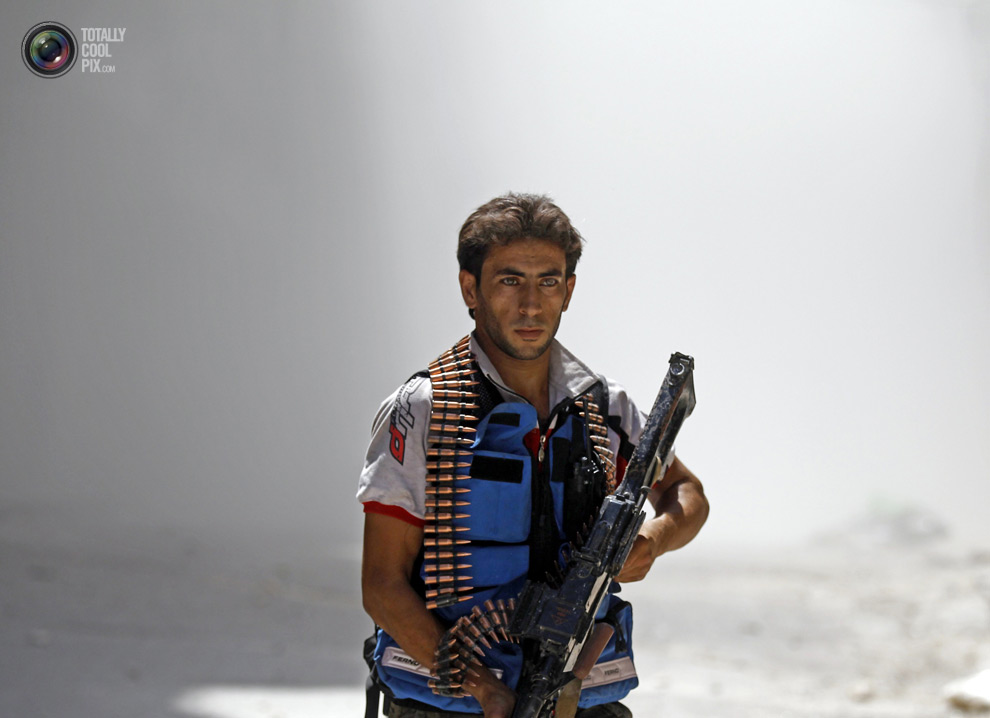
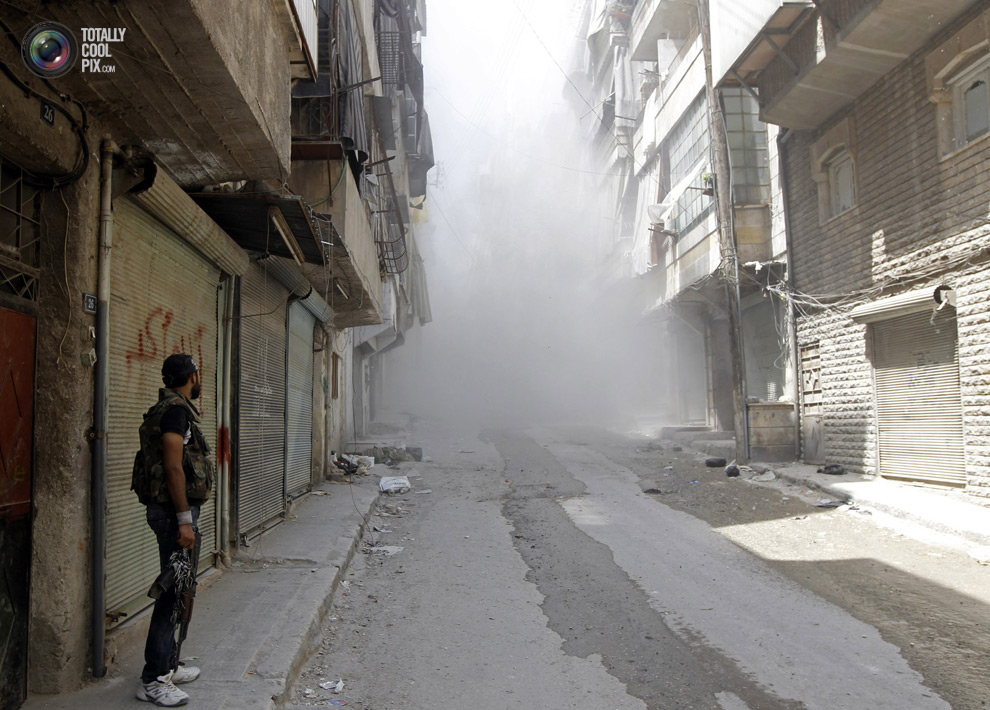
A dramatic pic from the battle of #Aleppo

Oust Assad With a Plan in Place

Rafif Jouejati

Rafif Jouejati is the English spokeswoman for the Local Coordinating Committees in Syria, a network of activists. She is also the director of FREE-Syria, a nonprofit humanitarian organization that focuses on women’s empowerment, and a member of the Day After Project, which is developing a transition plan for the country. She is on Twitter.

AUGUST 8, 2012

The situation in Syria is deteriorating at lightning speed as regional and international actors enter the fray. Some are there out of a genuine desire to help, while others are capitalizing on the chaos. Meanwhile, more than 20,000 people have been killed, more than 2 million have been internally displaced; and incalculable damage has been inflicted on infrastructure and society. Syrians must avoid civil war to ensure that those who suffered did not do so in vain.

How can they do this?

By overthrowing the Assad regime. No attempts to stabilize the country can be successful unless the originator of the armed conflict – Assad and the single-party system he represents – is deposed.

The Free Syrian Army must adhere to a code of conduct, Syrians must agree on a transitional government plan, and Assad must go.

However, the Syrian opposition – inside the country and abroad – can take specific actions now. It can accelerate the development, dissemination and acceptance of a transitional framework assuring minorities – who have been in the country for thousands of years – that they play an instrumental role in building the new Syria.

The transitional framework, already in progress and known as the Day After Project, can leverage the recent high-level diplomatic defections to “keep the lights on” post-Assad. This transitional government – created by Syrians for Syrians – must immediately address the humanitarian crisis, rebuild infrastructure, revive the tattered economy and implement a system of transitional justice.

Meanwhile, the Free Syrian Army must develop and adhere to a code of conduct based on international law and the Geneva Conventions. This is already in progress, as several Free Syrian Army battalions have begun signing a code of conduct, which will be instrumental in differentiating between the Free Syrian Army and other armed elements that are creating further chaos.

Lastly, it’s not too early to create a new constitution that will protect the rights of all Syrians and establish a framework for free and fair elections.

Avoiding a civil war in Syria is no easy task, but it can be done – with a carefully planned transitional framework, an ethical code of conduct that is implemented, and a focus on the revolution’s original goals: freedom, democracy and dignity.

Join Room for Debate on Facebook and follow updates ontwitter.com/roomfordebate.

Source

The battle for Aleppo


…..


…

source

Egypt, Syria (and Beyond) Live Coverage: Airstrikes in Sinai Kill 20

1530 GMT: Syria. The towns around Daraa have been fiercely attacked today. Yesterday, intense fighting and shelling occurred in the town of Busr al Harir. Today more shelling has occurred there, but the towns of El Taebeh and Dael have also been heavily shelled (map). A terrible video from Dael shows a severely wounded man, and yet another shows a severely injured teenager. There are videos of smoke rising above Dael, and another shows smoke rising near the border with Jordan. The video below claims to show people trying to rescue the injured after a shell hits in Dael. It is also disturbing:

1456 GMT: Syria. Not all the news is about insurgents and armies and death – the protest movement is still strong in many places, away from the heaviest fighting. What’s interesting is that now that the heaviest fighting in Damascus is over, we may be seeing a resurgence of protests there, protests that were growing larger and more bold before the fighting erupted several weeks ago.

An activist shares this video:

Hijaz square (map) is at the very center of the city – the railway station is clearly visible in the video.

1445 GMT: Syria. With reports of anti-aircraft weapons and heavy machine guns in the hands of Syrian insurgents, videos like this add explanation for why the Syrian helicopters and fighters have been flying higher today than in the past:

1408 GMT: Syria. We’ve been reporting about the worsening conditions in Zabadani, northwest of Damascus (map). Today, as shelling renewed, the Local Coordination Committees have declared the city a disaster area:

For the past 60 days, the regime has continued its brutal siege and bombardment of the town. This has resulted in the destruction of more than half the area neighborhoods and infrastructure…

In addition, the remaining neighborhoods have sustained partial destruction, and approximatly 22,000 residents have fled to neighboring districts and towns. The regime’s shelling has continued into these areas, and therefore is threatening the lives of those who had fled. Thus far… 22 people have been martyred during the daily shelling…

In addition, hundreds of wounded have been reported, and they cannot be rescued due to the daily nonstop shelling and the increasingly choking siege on the town. The area is now surrounded by more than 56 military points, including Lebanse Hezbollah soldiers.

There is a total power outage and all humanitarian relief and basic supplies have been cut off.

In light of these dire humanitarian conditions, and given the extent of Assad crimes against civilians, we request that the international community and humanitarian organizations implement and secure humanitarian corridors to provide direct relief to save the lives of the more than 8,000 remaining civilians who are living under continuous, direct bombing.

1358 GMT: Syria. Global Post News has had a camera inside Aleppo, and has posted a collection of raw footage taken in the city between July 30th and August 6th. It is a must see, but many images are disturbing:

1352 GMT: Syria. The Local Coordinating Committees have published a “Code of Conduct” for Free Syrian Army fighters to follow. What’s striking is that some of the most important members of the FSA have already signed it.

We’ve published the complete text, as well as our snap analysis, in a separate feature.

See also Syria Analysis: The Local Coordination Committees Issue a “Code of Conduct” for Free Syrian Army

1334 GMT: Syria. It’s hard to get a feeling for how the fighting in Aleppo is going, but there are reports that the FSA has withdrawn from Saleh el Dine. Other reports suggest that this is not true. Hala Jaber suggests that the FSA has withdrawn, but that Saleh el Dine is not fully under regime control. Kurt Pelda suggests that FSA fighters are still moving to the front.

All we do know is that fighting there has been extremely intense – this video was reportedly taken earlier today:

1256 GMT: Syria. A colonel with the Free Syrian Army describes the significance of the Saleh el Dine district of Aleppo (map):

All the weapons we have to combat this onslaught are guns, Kalashnikovs, anti-tanks, RPGs and some anti-aircraft rockets.

Salahedin district is the western gateway for Aleppo and one of the first districts liberated in the city. It is close to the college of artillery and armament – all the regime’s forces are piled nearby in al-Hamadaniah district. That is why it is so important for the regime to get it back from the hands of the FSA.

The Saleh el Dine district is exposed to direct fire and Assad reinforcements from two major bases, an artillery college to the west (map) and a major military base to the south (map). Furthermore, Saleh el Dine is west of the Citadel, a massive fortress that still has many Assad soldiers inside it, the focus of the last few days of fighting (map). If Saleh el Dine does not fall to the Assad military, it would be a major blow, because the regime’s tactical advantage is much smaller in some of the other areas, and some of the narrow streets, to the west of Saleh el Dine.

1206 GMT: Syria. Another dramatic video from Kafranbel (map, see previous update) – a shell falls in the town, and the cameraman and fighters from the Free syrian Army rush to the scene. The result – devastation:

1152 GMT: Syria. The little Idlib town of Kafranbel (map) is well known to many of our readers, and to many across the globe. The town is known for its defiant protests and its witty signs, usually written in English, a clear demonstration of the Syrian opposition’s understanding of the power of new media.

But Kafranbel has been under sustained and intense attack for more than two days. This video shows some of the artillery, reportedly stations about 14 kilometers from the town, that is attacking the area. Another disturbing video shows the aftermath of some of the attacks:

1134 GMT: Syria. According to the Local Coordinating Committees, 65 people have been killed so far today,

“…including 11 women and 10 children: 22 martyrs in Hama most of whom were killed in Jerjisa, 17 martyrs in Aleppo, 9 martyrs in Deir Ezzor, 5 martyrs in Idlib, 4 martyrs in Homs, 4 martyrs in Damascus and its suburbs, 3 martyrs in Daraa and 1 martyr in Lattakia.”

Jarjeezah is nestled near a lake near al Rastan, between Hama and Homs (map). The LCC has released a list of 20 names – including children – of the people reportedly killed so far in that small town today.

We haven’t seen other information on JarJeezah, but Al Rastan has been absolutely pounded by shelling and air strikes today. The videos tell the tale, and here is one example:

Another video shows a group of well armed men, reportedly a fresh defection from the military.

1128 GMT: Syria. Yesterday’s video claiming to show Riad Hijab in Daraa (see previous update):

1122 GMT: Syria. One of the most curious claims yesterday were reports from the anti-Assad activists that Riad Hijab, the Syrian Prime Minister who defected this week, was not in Jordan, as had been reported, but was actually still in Syria – meeting with opposition activists and Free Syrian Army leaders in Daraa.

We didn’t cover those reports. They seemed too weird to be true.

Well, according to a Jordanian official, Riad Hijab and other members of his family have just arrived in Jordan today, adding credence to the original activist reports:

Sameeh Maaytah said Hijab “entered Jordan in the early hours of dawn today along with several members of his family.” Maaytah spoke to the state Petra News Agency. He did not elaborate.

Maaytah did not answer repeated calls by The Associated Press to comment on conflicting reports that Hijab was already in Jordan, having come there after he defected to the opposition on Monday.

On Monday, Maaytah denied that Hijab was in the country. But another Jordanian official and the rebel Free Syrian Army said he fled to Jordan that day along with his seven brothers, two sisters and their families. They said he was planning to travel onward to Qatar, but did not specify when.

1115 GMT: Syria. Two videos, both dated yesterday, show what this conflict looks like. The first shows one of the roads into Aleppo, littered with the results of an FSA attack on a military convoy:

The second, a MIG performing a strafing run over Saleh el Dine.

1055 GMT: Syria. The long anticipated military assault on Aleppo appears to have started. The Syrian army moved into the Saleh el Dine district of Aleppo (map) with force today. The Telegraph reports that the regime may have had some success, though there is confusion as to how much:

“The regime forces advanced into Al-Malaab Street with tanks and armoured vehicles and fierce fighting is now taking place in the area,” said Wassel Ayub, a commander in the rebel Free Syrian Army.

Syrian government security sources have said that the army is poised to take control of the Salaheddin district.

“The army is advancing from west to east to cut Salaheddin in half horizontally. It will not take a long time to control the district, even if there are some pockets of resistance remaining,” an official told AFP.

But Abu Firas, a member of the rebel Free Syrian Army, said the insurgents had left only one building in Salaheddin.

“We did not withdraw, our guys are still there and the situation is in our favour. We just left a building that we had in one of the streets, but it’s not like we are retreating”.

The Guardian’s Martin Chulov reports that there is also fighting is the suburbs. He also reports that the Free Syrian Army is holding ground in Saleh el Dine, though it has withdrawn from some buildings:

They say they have made a tactical withdrawal from a couple of streets … but they say the regime hasn’t yet advanced into those areas, but they are expecting that advance very soon. They insist they hold the vast majority of the district, and that the withdrawal they have made is only a matter of 15 or so metres and is tactical.

Salahedin was always going to be ground zero for the battle for Aleppo, and the only way to dislodge rebels was going to be a ground invasion. It is being led by tanks, from what we understand there are not too many infantry. But they could follow later in the day. There are no ground forces in the rest of the city, but in Salahedin some kind of a push in under way.

Rebels claimed to have hit some tanks in Salahedin, Martin said. “The way this battle is going to play out is more of a war of attrition rather than a quick decisive battle,” he said.

According to Chulov, the loss of tanks and the lack of infantry is the key point. The Free Syrian Army is fairing better than expected because of the last minute defections of generals that tipped them off about the attack. The lack of infantry guardian the tanks is a sign, according to Chulov who is inside Aleppo, that the regime is worried that too many forces would defect. But dead tanks in roads block advances, and jeopardize the other tanks in the line, so despite having a massive advantage in shear strength, the regime’s advance, thus far, has been slow.

James Miller takes over today’s live coverage. Thanks to Scott Lucas for getting us started.

0845 GMT: Syria. Iranian Foreign Minister Ali Akbar Salehi has acknowledged that some of the 48 Iranians abducted near Damascus on Saturday are retired members of the Revolutionary Guards and Army and others “were from other ministries”; however, he denied any still had a military or official role and said they were on pilgrimage.

read on here

New Battalions Sign the Code of Conduct

par لجان التنسيق المحلية في سوريا, mercredi 8 août 2012, 14:41 ·

New Battalions Sign the Code of Conduct

As the ranks of the Free Syrian Army expand and its brave fighters fight a national, multi-front battle, there has become a need for rules to govern their work. These rules must combine the spirit of the national duty they carry out today in facing the aggressor, Bashar Al-Assad and his regime, and moving towards the regime’s ouster and the interests of justice and military discipline.

The Local Coordination Committees presents this brief code of conduct to the fighters and to the public, so as to draw attention to and highlight the moral and political ethics of military action. These ethics are, in essence, the same as positions the Free Syrian Army has taken in recent days, as well as the principles they have announced. These ethics and principles represent the essence of our revolution and its moral and national foundation.

=======================

The Syrian Revolution erupted in Mid-March 2011 against a corrupt and despotic regime that weakened a country and humiliated its people, raising a small group of elites above the Syrian general public. From the very beginning, the regime responded to popular protests with violence and hatred, and pitted the national army against the revolutionary citizens to protect the oppressive regime.

The Free Syrian Army was formed by honorable officers, junior officers, and soldiers who defected from the regime because they refused to kill their fellow citizens. They were joined by brave civilians whose families and homes were destroyed by Assad’s aggression.

Today, the Free Syrian Army plays a genuine military role in the glorious Syrian revolution. Therefore, the values and goals of the revolution (freedom, dignity, and justice for Syria and the Syrian people, and the protection and unity of the country), must serve as the military doctrine and governing principles for the Army’s actions and the behavior of its members.

The Free Syrian Army looks forward to the day when Syria will be free, so that it might be at the core of a new national army that protects the country’s independence, sovereignty, constitution, and democratic institutions. The Free Syrian Army is sacrificing its blood in order for that day to come.


Article I

In the Free Syrian Army, as an independent, defected soldier, or civilian volunteer, my first responsibilities are to:

Defend Syrian revolutionaries in the face of tyranny and ensure the continuation of the revolution to oust the regime. I will direct my weapons exclusively against Assad aggressors. I will serve my nation, Syria, and the freedom of the Syrian people. I am a fighter in the battle to defend my people.

I will use my weapons to overthrow the criminal regime that has been imposed upon us.


Article II

I pledge to my people and my revolution that I will refrain from any behavior or practice that would undermine the principles of our revolution: the principles of freedom, citizenship, and dignity. I will respect human rights in accordance with our legal principles, our tolerant religious principles, and the international laws governing human rights – the very human rights for which we struggle today and which we intend to implement in the future Syria.


Article III

Any person who takes up arms in the name of the regime, regardless of their rank, should be arrested and remain in the custody of the Free Syrian Army. In the event that an individual is arrested, and it is determined that the individual was working for the regime, voluntarily or for payment, to supply information about revolutionary activists, that individual shall be considered a prisoner and treated in accordance with laws governing prisoners of war.


Article IV

I pledge not to practice any form of torture, rape, mutilation, or degradation. I will preserve prisoners’ rights and will not exercise any of the above practices in order to obtain confessions.


Article V

I will not issue any executive orders, particularly with regard to death or corporal punishment. Only an appropriate legal authority, with relevant expertise, may conduct trials and find perpetrators guilty.


Article VI

I will not engage in any practice that leads to the physical torture or murder of prisoners or informants, and I will not participate in any public execution.


Article VII

I pledge not to engage in any form of theft or looting on the pretext that I am helping to finance the armed struggle. I pledge not to take any person hostage for ransom.


Article VIII

I pledge not to use my weapon against activists or civilians, whether or not I agree with them; and I pledge to not use my weapon against any other Syrian citizen. I pledge to limit my use of weapons to the defense of our people and myself in facing the criminal regime.


Article IX

I pledge not to exercise reprisals on the basis of ethnicity, sect, religion, or any other basis, and to refrain from any abusive practices, in word or in deed, against any component of the Syrian people.


Article X

I pledge to surrender my weapons to the Transitional Authority, which will manage the country’s affairs during the transitional period after the fall of the regime.


Article XI

If found guilty of violating any of these articles, I agree to submit to a fair trial undertaken by specialized committees formed under the supervision of the Free Syrian Army’s leadership and monitored by an independent judiciary body.


Initial Signatories:

Lieutenant Colonel Muhannad Ahmad Al-Talaa, Commander of the Military Council of Deir Ezzor

Colonel Qassim Saad Eddin, Commander of the Military Council in Homs

Sergeant Ismail Sheikh Saleh, Jisr Al-Shoghour, Idlib

Lieutenant Colonel Zahid Hourani, head of the Military Office in Homs

Major Ibrahim Moutawaa, Commander of the Al-Nour Battalion in Qosair

Colonel Radwan Ayyoush, Commander of the Military Office in Homs

Lieutenant Colonel Jamil Ra’adoun, Commander of the League of Battalions in the Hama Countryside

Colonel Khaled Alqatini of Khan Sheihoun and its countryside

First Lieutenant Hamza Qaziz, Al-Baraa Brigade in Douma

The Al-Baraa Brigade in Douma

Major Abou Mohammad Al-Homsi, the Soldiers of God Brigade in Damascus

The Falcons of the Land Brigade in Hama

The Martyrs of Latamna Battalion

The Martyrs of Asi Battalion in Hama

The Abi Al-Fidaa Battalion in Hama

The Special Operations Battalion in Hama

The Sunna Lions Battalion in Mayadeen

The Omar Al-Mukhtar Battalion in Deir Baalba, Homs

Abdul Baset Sarout


New Signatures


Lieutenant Colonel Mohammad al-Aboud Commander of the Revolutionary Military Council in Deir Ezzor


Captain Mostafa Shawardi/ Ansar Mohammad Battalion in Mawrak


Lieutenant Colonel Hafez Jad AlKaeem Faraj Commander of the Military Council in the Governorate of Sweida


Lieutenant Maher al-Tamer Commander of Shuhada al-Hurriya (Martyrs of Freedom) Battalion in Mawrak


Al-Haq (The Truth) Battalion in Mqeilbiya


Burkan al-Sham (Damascus Volcano) Battalion


New Signatures


Major Qassem Najem/ Tahrir alJanoob Battalion in Daraa


Captain Khaled Fatehallah Commander of the Free Syrian Army in Daeel


Captain Ali Shakerdi/ al-Amjad Battalion in Aleppo

source

Blog at WordPress.com.

Up ↑