Search

band annie's Weblog

I have a parallel blog in French at http://anniebannie.net

Author

bandannie

Hasn’t he crossed the line already ?

line

Seven people have died in Homs after they inhaled a “poisonous gas” used by government forces in a rebel-held neighbourhood, activists said.Activists also told Al Jazeera on Sunday night that scores of others were affected in al-Bayyada neighbourhood. Side effects reported include nausea, relaxed muscles, blurred vision, and breathing difficulties.Residents said they did not know the nature of the gas used.”The situation is very difficult. We do not have enough facemasks. We don’t know what this gas is but medics are saying it’s something similar to Sarin gas,” Raji Rahmet Rabbou, an activist in Homs, told Al Jazeera.

A doctor treating patients subsequently said the gas seemed to be a concentrated form of tear gas that has not been used in Homs before. Inhaling large amounts can lead to suffocation and death, he said.

The gas appears to have been used during a battle with rebel fighters.

Christmas Night In Syria, A Message To The World

[youtube http://youtu.be/PstTOKHOaew?]

The Salt of the Earth

[youtube http://youtu.be/aXTcDUxu22A?]

Al Qaeda Disbands; Says Job of Destroying U.S. Economy Now in Congress’s Hands

December 28, 2012

Posted by
fiscal-cliff-al-qaeda-465.jpg
WASHINGTON (The Borowitz Report)—The international terror group known as Al Qaeda announced its dissolution today, saying that “our mission of destroying the American economy is now in the capable hands of the U.S. Congress.”In an official statement published on the group’s website, the current leader of Al Qaeda said that Congress’s conduct during the so-called “fiscal-cliff” showdown convinced the terrorists that they had been outdone.

“We’ve been working overtime trying to come up with ways to terrorize the American people and wreck their economy,” said the statement from Al Qaeda leader Ayman al-Zawahiri. “But even we couldn’t come up with something like this.”

Mr. al-Zawhiri said that the idea of holding the entire nation hostage with a clock ticking down to the end of the year “is completely insane and worthy of a Bond villain.”

“As terrorists, every now and then you have to step back and admire when someone else has beaten you at your own game,” he said. “This is one of those times.”

The Al Qaeda leader was fulsome in his praise for congressional leaders, saying, “We have made many scary videos in our time but none of them were as terrifying as Mitch McConnell.”

As for the future of Al Qaeda, the statement said that it would no longer be a terror network but would become “more of a social network,” offering reviews of new music, movies and video games.

In its first movie review, Al Qaeda gave the film “Zero Dark Thirty” two thumbs down.

Get the Borowitz Report delivered to your inbox.

Photograph by Scott J. Ferrell/Congressional Quarterly/Getty.

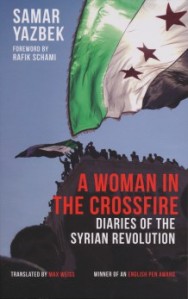
Woman in the Crossfire

leave a comment »

womaninthecrossfire_72A Woman in the Crossfire: Diaries of the Syrian Revolution’ by novelist Samar Yazbek is part journalism, part personal memoir, and all literature. It’s literature of the instantaneous sort, a staggered snapshot of the first four months of the revolution, a public history of  “a country succumbing to the forces of death,” and an interior history too. Yazbek tells us about her headaches, her insomnia and Xanax addiction, her crying fits, her fears for her daughter and herself, her constant panic. How sometimes in the speeded-up context the rush of information precedes all feeling: “The daily news of killing,” she writes, “was more present inside of me than any emotion.”

Samar Yazbek has always been problematic. Having consecrated herself “to the promise of a mysterious freedom in life,” she left home (in Jableh, on the coast) at sixteen, later divorced her husband and lived in Damascus, a single mother, working in journalism and writing sexually controversial novels. When Syria rose up against the Asad regime she publically supported the victims and their cries for freedom. And she’s an Alawi, a member of the president’s largely loyalist sect, of a well-known family. As an unveiled and obviously independent woman, a secularist and daughter of a minority community, her support for the revolution proved the lie of regime propaganda, which characterised the uprising as Salafist from the start.

So leaflets slandering her were distributed in the mountains. She was called a traitor, made  recipient of death threats, publically disowned by family and hometown. Naturally she was visited by the mukhabarat and made to experience, vicariously at least, the domestic wing of regime propaganda – for the theatre of blood is as important inside Syria as the projection of civilised moderation used to be abroad – by being walked through a display of meat-hooked and flayed torturees.

The Samar Yazbek of these diaries is an imposing presence but not one who crowds the reader. Indeed a reader who isn’t in Damascus, who hasn’t experienced the strangeness first hand (and what strangeness! – a known city, a home country, transforming into a death zone) requires a strong character through whom to experience and understand, just as he would if reading a novel. But beyond locating the reader, Yazbek more often plays her “favourite role, pretending not to know anything in order to learn everything,” and she gives most space over to the accounts of others.

Through these reports we learn of the horrors of detention and torture, of the pleasures and pains of protesting, of the plights of conscripts and refugees. Yazbek interviews secret sympathisers of the revolution, a state TV employee for instance, or a soldier who shot his own foot to escape the order to kill his countrymen, as well as committed revolutionary activists, the kind of people who are still very influential on the ground in Syria despite the inevitable arming of the revolution and the consequent rise of resistance militias. While the armed men fight, the activists are organising liberated and besieged areas.

One of the book’s most useful sections describes the early development of the Coordination Committees, the revolution’s backbone. Yazbek describes a spontaneous meritocracy in which talents are distributed into political, medical, media, even arts and culture committees, an organisational process entirely opposite to Asad’s corrupt, sectarian and nepotistic state.  She also very usefully describes the non-ideological compromise secularist activists made with the religious culture of the masses, recognising religion’s centrality to many people’s experience of existence, as well as its obvious mobilisational power.

Her informants’ accounts illustrate how from the revolution’s earliest days the regime instrumentalised sectarian hatred, particularly in the coastal cities, Banyas, Jebleh and Lattakia, and the surrounding countryside, areas shared between Sunnis and Alawis. Rumours of roving Sunni mobs intent on murder were spread in the mountains and reinforced by false flag operations carried out by shabeeha. If this nonsense hadn’t largely worked, its memory would be comical. In Jebleh the alarm was frequently raised that an ‘infiltrator’ was at large in a neighbourhood, so the people would come out to catch him. When the same infiltrator was captured twice, each time in different neighbourhoods, a bystander was prompted to advise security to use different bait next time, if they still wished to be believed.

For the historian and analyst Yazbek’s diaries also provide important local information of a strategic nature, details often missed by newspaper articles, such as the fact that the Maydan and Qaboon areas of Damascus came out against the regime early because of the residents’ kinship ties to Dera’a, the revolution’s cradle.

But the main reason to read the book is for the immediacy and breadth of perspective (religious or not, Sunni, Alawi, Christian, of various class backgrounds) it offers, for the human element, and for its sense of shock:

“I stared into his eyes, which were like every other murderer’s eyes that have appeared these days, eyes I had never seen before in Damascus. How could all those murderers be living among us?”

It’s a narrative brimming with stark images. One, for example, of security forces attacking a funeral, shooting and critically injuring three pallbearers, causing the mourners to flee, leaving the coffin alone on the ground in an empty but blood-spattered street. It’d be a great image for a novelist to dream up, but reality got there first; reality in Syria outstrips imagination.

After four fraught months Yazbek and her daughter fled to Paris. She’s written about visits to liberated parts of Syria since, and like every Syrian inside or outside, like everyone connected to Syria, she sits and she wonders what terrors or glories the future might hold. “Fire scalds,” the book finishes. “Fire purifies. Fire either reduces you to ash or burnishes you. In the days to come I expect to live in ashes or else to see my shiny new mirror.”

The translation is by Max Weiss, and is excellent.

source

Syrian Children’s Requests from Santa Claus

[youtube http://youtu.be/1htbROlB5DQ?]

Saudi Novelist Turki al-Hamad Arrested for Tweets

Yesterday in Saudi Arabia, best-selling novelist Turki al-Hamad, one of the KSA’s most well-known writers, was arrested for remarks he posted on Twitter. 

turki

The tweets in question — about a dozen of them, published on Dec. 22 – criticize religion. These two are trans. Guardian journalist Brian Whitaker, who has written about the arrest on his blog:

One said: “The Prophet came with a humanitarian religion but some changed it into anti-human religion.” Another said: “All religions call for love … practices and rituals do not mean what is going on in the heart.”

Others include the tweet, “Our Prophet came to rectify the faith of Abraham, and now is a time when we need someone to rectify the faith of Mohammed.” And: “Neo-Nazism is on the rise in the Arab world in the guise of Islamism. But the time of Nazism is over and the sun will shine again.” (Read the rest here.)

Al-Hamad, best-known for his coming-of-age trilogy, Phantoms of the Deserted Alley, must have known what he was doing might be dangerous. His arrest follows not long after the arrest of young Saudi poet Hamza Kashgari, who was taken in last February after tweeting an imaginary conversation with Prophet Muhammad.

Also yesterday, a Saudi court decided to pursue apostasy charges against online activist Raif Badawi, who edited the website “Saudi Arabian Liberals.”

Al-Hamad was jailed in his youth for political activism before moving to the US for graduate school. His novels have by and large not been well-reviewed, but they certainly stirred readership and controversy in the KSA. On the front cover of one of his novels, it says: “Where I live there are three taboos: religion, politics and sex. It is forbidden to speak about these. I wrote this trilogy to get things moving.”

source

Thousands of Syrians leave Jordan for the front lines

By Taylor Luck,

MAFRAQ, Jordan — Encouraged by what they view as fatal setbacks to the Syrian regime, several thousand of an estimated 250,000 Syrian exiles in Jordan have left in recent weeks to join the rebellion in their homeland.The exodus has emptied hundreds of the safe houses, apartments and refu­gee tents that housed Syrians in Mafraq and other northern Jordanian cities, according to Syrian activists and Jordanian officials. Jordanian security officials, who spoke on the condition of anonymity because they were not authorized to speak on the record, said as many as 8,000 Syrians have crossed the border back into Syria in the past 10 days alone.

Graphic

Timeline: Major events in the country’s tumultuous uprising that began in March 2011.

Click Here to View Full Graphic Story

Timeline: Major events in the country’s tumultuous uprising that began in March 2011.

Graphic

Interactive: Recent events in Syria

Click Here to View Full Graphic Story

Interactive: Recent events in Syria

According to Syrian activists in Syria and Jordan, the sudden returns are a response to a call for reinforcements issued in early December by the rebel military council, the main umbrella organization of army defectors locked in a bloody war of attrition against regime forces loyal to Syrian President Bashar al-Assad. Activists said the response has been greatest among refugees in Jordan, because pro-Assad militias in Lebanon have prevented similar returns from that country and many Syrians in Turkey were already involved in the fight.Syrian rebels said the call for more forces comes as the opposition faces a critical stage in the months-long conflict, with their offensive inching closer to the heart of Damascus, capturing several military bases and fending off counteroffensives on rebel strongholds in Aleppo, the southern city of Daraa and the Damascus countryside.

“Now, Jordan has become our number one source of manpower,” said Abu Hani Darawi, a Free Syrian Army coordinator whose battalions in Daraa have received the bulk of the returnees from Jordan. “We are now entering the final battles for Syria, and we need every able Syrian to join us.”

The call for recruits has sparked a steady stream of voluntary returnees from Jordan’s Zaatari refugee camp, near Mafraq. Jordanian officials are facilitating the repatriation of as many as 150 military-aged Syrians every day, according to Interior Ministry statistics. Ahmed Rifai, a 25-year-old camp resident, said FSA gains in Daraa had prompted him and two of his cousins to request repatriation in a bid to join the rebels.

“We can feel that Bashar’s final days are coming,” Rifai said. “We want to experience liberation day placing our boots on the neck of the regime, not cowering in a refugee camp.”

In addition to former and would-be fighters, activists said the returnees from Jordan include hundreds of doctors, nurses, lawyers and engineers who aspire to rebuild their homeland even as the conflict continues.

Abu Muuath Hamad, a 44-year-old paramedic, said he fled the central Syrian town of Douma after the regime persecuted him for offering assistance to suspected protesters. He said he sought refuge in the Jordanian city of Mafraq for six months, spending his time tending to the injuries and the rehabilitation of the hundreds of wounded FSA fighters who have crossed into Jordan for treatment. On Dec. 10, he was repatriated and returned to Douma, where he was appointed as chief field medic by the FSA.

source

James Stewart – It’s a Wonderful Life ~ Complete Original/Unedited, Colorized

Merry Xmas

[youtube http://youtu.be/wl0BWUsAYyY?]

Blog at WordPress.com.

Up ↑