Search

band annie's Weblog

I have a parallel blog in French at http://anniebannie.net

Author

bandannie

Fasting for Humanity

If somebody asks me whether I fast Ramadan for some higher deity I’d be lying if I said I was. I don’t know what I’m doing anymore with this stuff. I haven’t for a very long time. When I read posts that were written in the midst of spiritual passion, passion that felt as if it was going to burst out of my chest, I feel as if they were written by somebody else a lifetime ago. I can’t feel like that at the moment, and the reserves that I drew upon then are now completely depleted.

Then I think about stories I’ve heard of Syrians in refugee camps, of people in desperate circumstances that they didn’t ask for and facing trials they weren’t prepared to undergo. I think how easy it is for me to fast knowing I have food ready for me at the end of the day. But what would I do or say if I didn’t? Or if I had children who didn’t? I don’t know but even considering that thought gives me a chill. For all my failings as an individual the past three years have taught me so much more about what it means to be human and fallible.

We like to think of ourselves as paragons of virtue when we speak with the moral clarity of some high priest for this or that dogma. The “Resistance” with a capital “R” for example, or when we refer to the sacrifices necessary to fight some nebulous great Enemy. I used to feel like that. But isn’t it ironic that the great narrative of a titanic clash between good and evil that the resistance narrative uses comes from the same strip of land which introduced that concept into organized religion through Zoroastrianism? Was it not the great clash between Ahura Mazda and a mysterious “hostile spirit” which was the precursor to our own Abrahamic faiths? And within the story of an epic war to end all wars weren’t there also the seeds of oppression? And from oppression didn’t we also see the rise of self deceit?

Most religions emerged out of a genuine desire to do good, but it seems almost universal that the dogmatic hierarchy which follows that initial creative impulse subverts far more than it preserves. Today we have people who wish to uphold that hierarchy as guardians of some supreme truth – possessing the right to absolve any sin and to damn any soul. These people forget that even the Zoroastrians believed the followers of the “Lie” would fall forever into a hell fire of some sort. To hell with the Lie, and to hell with them I say. Isn’t self deceit the greatest of lies?

If I’m fasting, it would be a lie to say I’m doing it for some bearded old man sitting on a throne in the clouds. It’d be far more sincere to say that I’m fasting because it puts me in touch with my humanity and the suffering of others. I can’t give them relief, but I can carry the same burden as them even if for a while. Maybe then they can feel better knowing they are not alone in this world even if nobody can help.

Posted by Maysaloon at 8:30 pm  


A Tribute to Helen Thomas

July 21, 2013

Sadly the renowned journalist Helen Thomas passed away on Saturday at the age of 92. In the following two videos we see Helen help Colbert roast Bush at the legendary White House Correspondents’ dinner in 2006 and, in 2010, in a Real News interview, we see her defend herself admirably after her resignation. For more of Helen on the Real News see here or for more on her passing see the following by Ralph Nader: There will Never be Another Helen Thomas.

……

source

White House journalist Helen Thomas remembered as a trailblazer

Alex Wong / Getty Images file

Veteran reporter Helen Thomas (C) asks a question to U.S. President Barack Obama during a news conference at the East Room of the White House May 27, 2010 in Washington, DC. Thomas passed away Saturday at age 92.

By Andrew Rafferty, Staff Writer, NBC News

As news spread of Helen Thomas’ death Saturday, journalists, politicians and admirers paid homage to the trailblazing reporter who was a fixture at White House daily briefings for decades.

“Michelle and I were saddened to learn of the passing of Helen Thomas.  Helen was a true pioneer, opening doors and breaking down barriers for generations of women in journalism,” President Barack Obama said in a statement.

“She never failed to keep presidents – myself included – on their toes.  What made Helen the ‘Dean of the White House Press Corps’ was not just the length of her tenure, but her fierce belief that our democracy works best when we ask tough questions and hold our leaders to account,” he added.

Former President Bill Clinton and Hillary Clinton said in a statement that Thomas was “a pioneering journalist” who added “more than her shares of cracks to the glass ceiling.”

“Her work was extraordinary because of her intelligence, her lively spirit and great sense of humor, and most importantly her commitment to the role of a strong press in a healthy democracy,” the Clintons said in the statement.

Female journalists took to Twitter to thank the woman who many said helped shatter the perception that political journalism was a profession only suited for bourbon-quaffing men.

“Helen Thomas made it possible for all of us who followed: woman pioneer journalist broke barriers died today,” tweeted NBC News’ Andrea Mitchell.

“Any woman who has had the privilege of sitting in the front row of the White House briefing room owes huge debt of gratitude to Helen Thomas,” tweeted Julie Pace, White House correspondent for the Associated Press.

“RIP Helen Thomas – died this morning at 92. Amazing trail blazer, fearless journalist and friend & mentor to so many women reporter,” Judy Woodruff, host of PBS Newshour, tweeted.

Thomas was also remembered fondly by those who faced her brash style of questioning in the White House briefing room.

“Rest in peace, Helen Thomas. First day I ever took the podium she came to encourage me,” tweeted Dana Perino, who served as press secretary to President George W. Bush.

She loved her job, and Thomas’ colleagues said it showed in all of the 49 years she spent as a member of the White House press corps.

“I asked Helen Thomas about her life choices she said, ‘I would still be a reporter. I consider that my greatest decision in life,'” tweeted CBS News White House correspondent Peter Maer.

Thomas career ended in 2010 when she abruptly retired after saying Israel should “get the hell out of Palestine.”

“Helen Thomas died Saturday in D.C. Glass ceiling breaking journalist–1st female Gridiron member. Later controversial. Rest in Peace,” tweeted Chicago Sun-Times Washington bureau chief Lynn Sweet.

“Women and men who’ve followed in the press corps all owe a debt of gratitude for the work Helen did and the doors she opened,” White House Correspondents Association President Steven Thomma said in a statement. “All of our journalism is the better for it.”

source

Related:

Arab TV star Abbas al Nouri of Syria grieves for his nation

The actor has criticism to go around — for Assad, the rebels and Arab leaders in general. Syria ‘lived through a large lie,’ he says, and is paying the price.

BEIRUT — Abbas al Nouri pauses as a particularly loud car roars past the cafe on the main thoroughfare. The overly solicitous waitress lingers, a hint of recognition in her eyes.
for video click here
At the table, the conversation inevitably focuses on Al Nouri’s native Syria.

“The father who cannot listen to his children is a failure, and this is something that destroys the family,” Al Nouri says, the metaphor describing the war pitting armed rebels against the government of President Bashar Assad.

“This revolution happened so that people could express themselves,” he continues, choosing words carefully between drags on his cigarette. “This regime, which is military in nature, did not have the culture to digest the idea that some people have an opinion.”

He shakes his head as he places his teacup on the table. “It couldn’t believe that it can be criticized, so it fired upon the people … and fired upon culture and knowledge even before it started firing at bodies.”

Al Nouri, 60, is known to millions across the Arab world as the star of the smash-hit Syrian television series “Bab al Hara” (“The Neighborhood’s Gate”). In real life he sports a full head of hair, unlike his character, Abu-Issam, a bald barber and doctor in an early-20th century Damascus struggling against French colonial domination. Though he was famous even before “Bab al Hara,” the show — no longer in production but seen year-round in syndication — cemented his reputation as one of the region’s top actors.

Al Nouri has worked steadily since his television debut in 1976, and holds the distinction of starring in the only Arab TV program to win an International Emmy Award. The Jordanian-produced “Al Ijtiyah” (“The Invasion”), a Palestinian-Israeli love story set during the 2002 Israeli assault on the Jenin refugee camp, captured the Emmy in 2008 for best telenovela.

On a recent afternoon, he sat down for an interview after one of his many road trips from Damascus to Beirut, where he was working on a new project, “The Passing,” described as a science-fiction series with social implications.

Politically engaged for decades, Al Nouri isn’t shy about criticizing Arab leaders generally or the Syrian government and some of its extremist enemies in particular.

“I don’t want to take away the freedom of people putting on the hijab,” he says. “But I do want to take away the covering of the brain.”

Asked whether he feared retribution for voicing his opinion, he brushed off any concern.

In his native Damascus, Al Nouri lives in Dumar, a suburb a mile from the presidential palace. The district is northwest of Qaymariya, where his parents still live in a “house like those you would find in the television series I work in,” he says, smiling as he remembers the open-courtyard stone homes of a bygone Damascus.

But the smile fades as he contemplates the new reality of his city, where the 10-minute drive to visit his parents has become an hour-plus slog “that makes you wonder how this city is living between one checkpoint and another.”

Checkpoints also slow the drive between Damascus and Beirut, but a heavy Syrian army presence has kept the route relatively safe. Al Nouri commutes to the Lebanese capital to work and to visit his children, two of whom live here at their father’s insistence. The third attends a university in the United States.

He’s forbidden his children to return to Damascus, he explains, not so much for “the oppression on the street as much as the fall of mortars right and left and the fear from the sky.” He says his parents are too elderly for him to consider moving. “My father is almost 100 years old and my mother is 90. I cannot leave them.”

And, he acknowledges, something else draws him back to the ancient capital.

“Even if I lived in a five-star hotel, being away from the site of the pain hurts even more,” he says. “So I don’t envy those who left, because of the worry they must be enduring.” He expels the smoke from his cigarette slowly, watching it waft away. “And I love Damascus.”

With production companies no longer working in Syria and with many artists in exile, the country’s once-prodigious TV and film industry has all but shut down.

Performers, writers and other creative Syrians have not been immune to the bloodshed. Each side in the conflict has targeted artists for their political stances, though that hasn’t discouraged Al Nouri from expressing his political views.

As for his fellow actors’ mass departure, he’s sympathetic but distressed. “This is painful for them, but also painful for me, because I have lost some real partners, and we need them and they are great stars.”

Al Nouri grew up under Syria’s Baath leadership, which seized power in 1963 and continues to rule. He became politically aware in his university days, when Arab nationalism, the fate of the Palestinians and the existential struggle against Israel were the defining issues on campus and on the street.

He was one of the youngest Syrians to speak on the radio in honor of the late Gamal Abdel Nasser, the Egyptian president, who is still revered in Arab nationalist circles even as Islamist movements have eclipsed his secular, pan-Arab vision. But Al Nouri eschews the nostalgia for those days that’s often heard among Arab intellectuals, instead describing the era as one when “freedom of expression was confiscated in favor of slogans.”

He picks up a spinach-filled fatira pastry before elaborating. “They would chant, ‘Our enemy is Israel!’ or ‘We want democracy!’ — when in reality it was the citizens who were the enemy. Whenever a new slogan would come, there would be new branches of intelligence to protect it.”

Here he pauses again, momentarily uncomfortable with what he wants to say. “I hope people don’t misunderstand me, but we did not deserve independence in the way it should have been,” he says, his voice taking on a regretful tone. Slogans often substituted for democracy and creation of a civil society in much of the Arab world. Syria “lived through a large lie, and what is happening now is an abscess that blew up.”

Like many Syrian intellectuals, he is torn about the revolution. He supports the goal of a more democratic nation, but knows the future could be even worse, perhaps some form of Islamist state or Syria balkanized into sectarian cantons, with foreign powers backing different factions.

“I can’t even look at a nation that still lives the problems that were finished 1,400 years ago,” he says, referring disdainfully to the ultraconservative Salafist rebel brigades that would seek restrictions on free speech and artistic expression. He says he fears “a nation that looks to history but not to the future,” adding, “I want my country to be completely free, with complete dignity.”

But after more than two years of a devastating war that has left more than 100,000 dead and millions homeless and reduced large swaths of the country to rubble, Al Nouri concludes, “People just want a solution, no matter how it is.”

The waitress approaches with knafeh, a cheese pastry dripping with sugar syrup. She finally blurts out what has been on her mind for the last 90 minutes: “Are you Abbas al Nouri from ‘Bab al Hara’?”

Bulos is a special correspondent. Times staff writer Patrick J. McDonnell in Beirut contributed to this report.

Copyright © 2013, Los Angeles Times

Inside Syria: Dispatches from the Times' Patrick J. McDonnell Inside Syria: Dispatches from the Times’ Patrick J. McDonnell

source

Andreas Brantelid plays Schubert Arpeggione

Israeli soldiers have depraved “fun” making “Rachel Corrie pancakes”


      Submitted by Ali Abunimah on Fri, 07/19/2013 – 14:26


Israeli soldiers had a “fun” time making what they called “Rachel Corrie pancakes.”

Photos of the event were posted on the Facebook page of the “Heritage House,” a settlement in occupied East Jerusalem that houses so-called “lone soldiers,” men recruited from overseas to join the Israeli occupation forces.


Nesim Pesarel, one of the “Heritage House” residents, seen in a photo from his personal Facebook page.

Above the photos of young men, some in Israeli army fatigues or apparently carrying guns, is the caption “Afternoon of ‘rachel corrie’ Pancakes and fun!”

Rachel Corrie is the young American woman murdered by an Israeli soldier who crushed her to death with a bulldozer as she tried to prevent the demolition of a Palestinian family home in the occupied Gaza Strip on 16 March 2003.

The depraved joke that these men were presumably making is a play on the English idiom “flat as a pancake.” Their celebration and joking about Rachel Corrie’s death is utterly vile and reflects the culture of dehumanization inculcated into Israeli soldiers.

Ben Packer, the director and rabbi of “Heritage House,” hit back at some negative comments about the images, posting this response:

In honor of the all the hate messages from the anti-Israel/Jewish crowd, one of our supporters has pledged $5 towards Israeli settlements (maybe for additional bulldozers) for each additional comment. keep’em coming anti-semites! We love our Israeli soldiers and will not back down in the face of those who attempt to endanger them!

Packer added, “Anti-Israel activists are all in a tizzy about these pictures! makes them even funnier!!!”

The page also appeals for donations “to support our guests and ‘lone soldiers.’” Residents of the “Heritage House” settlement also take part in colonization activities in other parts of the occupied West Bank, including Hebron.


Alex Winston is the “den mother” of The Heritage House men’s dormitory. Alex Winston is a member of the Israeli army’s Givati Brigade.


Nesim Pasarel (right with weapon) and Jonathan Leibovits (seated)


(Update: The gallery was removed shortly after the publication of this post.)

The true face of the “IDF”

In recent months, The Electronic Intifada has highlighted incidents of Israeli soldiers using social media to advocate brutal violence, and acts of sadistic torture and murder of children.

The Electronic Intifada also revealed images soldiers posted on the photo-sharing site Instagram of nudity, drug use and violence and most notoriously of a Palestinian child seen through the scope of a sniper’s rifle.

This week, the army began investigating a video posted online of Israeli soldiers frying a small bird alive, an act that had no purpose but gratuitous animal cruelty.

Israeli army attempts to halt social media scandals

The “Rachel Corrie pancakes” photos provide yet another window into the Israeli army’s culture of violence and come just as the occupation forces have tried to staunch the flow of embarrassing incidents on social media that have hurt its propaganda efforts.

The campaign, which includes this YouTube video, urges soldiers to “improve their image online.”

The voiceover in the video commands:

Soldier! Improve your appearance! Always remember: You are the face of the IDF. So improve your appearance – online!

The IDF is glad to invite you to get connected, share, love, tweet, respond, and show the pretty face of the IDF.

So go into the official pages and send us pictures, videoclips, and stories. The IDF on the Internet. One army, everybody’s face.

The “lone soldiers” at the Heritage House settler-colony have clearly not got the message.

With thanks to Dena Shunra for assistance with research and translation and Benjamin Doherty for assistance with research.

Syrian Rap and hope

Syria specialisation in torture

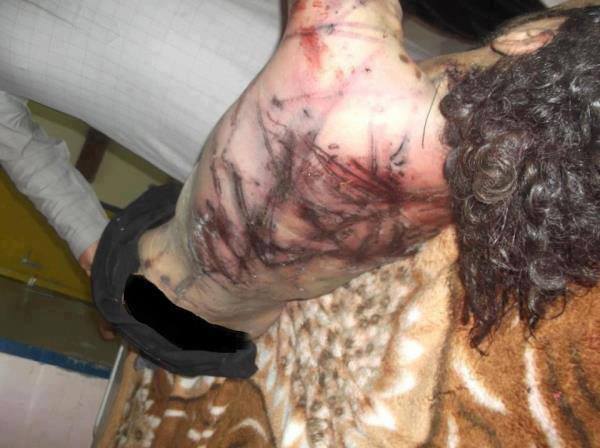
Radio Free Syria ‪#‎Hama‬: These are some of the horrific scars left on just one recent former detainee by torture in one of the Assad regime’s detention centres.

yort

The detainee’s face, torso and other body parts were also horribly disfigured by his torturers, who also hung him by his arms from a hook in the cell ceiling for days on end while carrying out their monstrous and inhuman brutality.

This is not unusual, not an isolated incident; this is the nightmarish norm for Assad regime detainees, male and female, young and old, many of whom are imprisoned and tortured simply for voicing opposition to or protesting peacefully against the regime.

Many die under torture in regime detention –

70 people were documented killed under torture in regime detention in the first week of Ramadan this year alone.

Those are only the documented cases.  These crimes against humanity did not begin with the revolution; this has been the Assad regime’s standard ‘punishment’ for dissidents for over 40 years.

Indeed, so globally infamous is the Assad regime’s unparalleled talent for torture that other nations have even outsourced their own inhumanity to the regime’s universally acknowledged world leaders in the field.

In the words of Bob Baer, former CIA agent, writing about the CIA’s ‘extraordinary rendition’ program in the ‘War on Terror’, “If you want a serious interrogation, you send a prisoner to Jordan. If you want them to be tortured, you send them to Syria.”

A Gift from Europe

Uri Avnery
July 20, 2013

ON MY 70th birthday, I received a gift from Yitzhak Rabin: he signed
the document recognizing the existence of the Palestinian people, after
many decades of denial. He also recognized the Palestinian Liberation Organization (PLO) as its representative. I had demanded this, almost alone, for many years.

Three days later, the Oslo agreement was signed on the White House lawn.

This week I received another gift of similar magnitude, obviously in
anticipation of my 90th birthday, which is due in less than two months.

No less an institution than the European Union has declared what
practically amounts to a total boycott of the settlements, 15 years
after Gush Shalom, the peace organization to which I belong, had issued a
call for such a boycott.

The European decision says that no
Israeli institution or corporation which has any direct or indirect
connection with Israeli settlements in the West Bank, East Jerusalem or
the Golan Heights will receive any contract, grant, prize or suchlike
from the EU or any  member state. To assure compliance, every contract
between Israelis and the EU will contain a paragraph stating that the
settlements are not part of Israel.

A friend of mine sent me a message consisting of one word: Mabrouk (Congratulations, in Arabic).

If all this sounds a bit megalomaniac, please make allowances. I am just happy.

WHEN WE decided to organize our boycott in 1998, we had several interconnected aims in mind.

A boycott is an eminently democratic instrument, a form of non-violent resistance.

Every single individual can decide for himself or herself whether to join the boycott or not.

Also, every individual can decide whether to boycott all the
enterprises on the recommended list, or exclude some. Some of our
supporters refused to boycott the Golan settlements, which they
considered different from the others, some refused to boycott the East
Jerusalemites. A famous artist declared that he was quite unable to live
without the excellent Golan wines.

Many enterprises in the
settlements did not go there for ideological reasons – capitalists are
not generally known for their ideological fervor – but because the
Israeli government gave them (stolen) land for free, as well as all
kinds of grants, exemption from taxes and other incentives. It made
economic sense for a corporation to sell their very high-priced site in
Tel Aviv and get free land in Ariel. A boycott may counterbalance these
gains.

Contrary to getting out into the streets and joining a
demonstration, not buying something in the supermarket is a private
affair. In a demonstration, one may get tear-gassed, water-cannoned or
clubbed. One exposes oneself and may be put on a list somewhere or even
dismissed from a government job.

Everybody can boycott. One
doesn’t need to join an organization, sign a petition, identify oneself.
Yet one has the satisfaction of doing something useful, in accordance
with one’s convictions.

But our main purpose was conceptual.
For decades, successive Israeli governments have striven to eradicate
the Green Line from the map and the minds of the people. The main aim of
the boycott was to reinstitute the real borders of Israel in the public
mind.

We distributed many thousands of copies of the list of settlement enterprises, all on request.

The Israeli government paid us the unique compliment of enacting a
special law that penalizes all calls for a boycott of the settlers’
products. Every person who feels harmed by such a call can demand
unlimited compensation, without having to prove any actual damage. This
could amount to millions of dollars.

We asked the Supreme Court
to strike down this law, but the court has been dragging its feet for
several years already, obviously afraid of passing judgment.

YET WHILE we were doing this, the European Union did the opposite.
It practically helped to finance the settlements – the very settlements it declared illegal.

Actually, the new measures are not new at all. The agreement between
the EU and Israel exempts Israeli products from European customs, as if
Israel were a European country. Israel is already a participant in the
European football league, the Eurovision Song Contest and other events
and organizations. Israeli universities receive huge research grants
from Europe and take part in European scientific projects.

All
these agreements are in principle restricted to Israel proper and do not
apply to the settlements. Yet for decades, the Brussels
super-government had consciously closed both its eyes.

I
know, because I myself traveled to Brussels years ago, to protest
against this practice, explaining to commissioners, officials and
parliamentarians that they are in practice encouraging the settlements
and inducing companies to relocate there. I was given to understand that
they sympathize with our stand but are powerless, because several
European countries, such as Germany and the Netherlands, block all
attempts in the Union to act against apparent Israeli interests.

It seems that this obstacle has now been overcome. So I am happy.

IN ISRAEL, the government received the news with consternation. Just a
few days earlier, they could not have dreamed that this was possible.

In Israel, the European Union is an object of ridicule. Secure in the
knowledge that we have absolute control of US policy, we could treat the
EU with contempt, though it is our major trading partner. A large share
of Israeli exports, including military equipment, goes there.

Government leaders are now sputtering with rage. Not one single
politician has dared to speak in favor of the European decision. Right
and Left are united in condemning it. Binyamin Netanyahu declared that
only Israel would decide where its borders were, and this only in direct
negotiations. Never mind that he has obstructed significant direct
negotiations for years.

Naftali Bennett, the Minister of
Economy, who also happens to be the chief representative of the
settlers, rejected the decision out of hand.  Only a few days before,
this political genius (and self-declared “brother” of Ya’ir Lapid) had
announced that there was absolutely no pressure on Israel.

Lapid himself voiced his opinion that the European step was a “miserable decision”.

Bennett now proposes to punish Europe by stopping all EU humanitarian
projects in the West Bank. (Recalling the joke about the Polish nobleman
whose Jew had been beaten up by another nobleman and who threatened:
“If you don’t stop beating my Jew, I shall beat your Jew!”)

But
the most telling argument marshalled by  Israeli leaders was that the
European decision was undermining the valiant efforts of John Kerry to
start negotiations between Israel and the Palestinian Authority.

This is the height of chutzpah. For months now, Netanyahu and his
government has been doing everything possible to prevent the hapless
Kerry from achieving his goal. Now they use his fruitless efforts as a
fig leaf for the settlements.

The Labor Party’s Shelly
Yachimovich, the official “Leader of the Opposition”, contented herself
with repeating the call for negotiations. No hint of criticizing the
settlers, for whom she has publicly declared her sympathy.

AS USUAL in such situations, Israeli public opinion started a search for those to blame.  But there is no one around.

Israel has no Foreign Minister, only a deputy, who happens to be one of
the most extreme right-wingers in the Knesset. The last minister,
Avigdor Lieberman, is facing trial for corruption, and the job is being
kept open for him. Netanyahu obviously believes that no judge would dare
to convict the fearful Lieberman, after the Attorney General has
already shrunk back from indicting him on the most severe charges.

With no minister (officially, the Prime Minister is filling the vacuum)
and a demoralized foreign service, there could be no prior warning.

Some people claim that the European decision was actually a pro-Israeli
gesture, since it forestalls a general boycott of Israel, which is
advocated by a growing number of personalities and NGOs around the
world. A boycott of the settlements is the minimum.

In this respect too, the Europeans have also adopted a stance that my friends and I have advocated for years.

Contrary to several Israeli leftists, I believe that a general boycott
of Israel is counter-productive. While our boycott is designed to
isolate the settlers and drive a wedge between them and the bulk of the
Israeli population, a general boycott (called BDS) would drive almost
all Israelis into the arms of the settlers, under the venerable Jewish
slogan “The whole world is against us!”  It would strengthen the
argument that the real aim is not to change Israeli policy, but to wipe
out Israel altogether.

True, there are some good reasons for a
general boycott, including the historic example of the boycott of
Apartheid South Africa. But the Israeli situation is quite different.

THE TERM “boycott” was coined in 1888 in a situation not dissimilar
from ours now. It was about foreign domination, land and settlers.

In Ireland, then under British occupation, there was a famine. Charles
Boycott, the agent of an absentee English landlord, evicted local
tenants who were unable to pay the rent. An Irish nationalist leader
called on his countrymen not to attack Boycott physically, but to shun
him. All his neighbors stopped all dealings with him, working for him or
speaking with him. Boycott became the word for ostracizing.

The EU boycott of the settlements and their supporters will have a major
economic impact. No one knows yet how much. But the moral effect is
even more significant.

Even if massive Israeli-American
pressure thwarts or at least postpones the European action, the moral
blow is already devastating.

It tells us: The settlements are
illegal. They are immoral. They inflict a huge injustice on the
Palestinian people. They prevent peace. They endanger the very future of
Israel.

Thank you, Europe!

Blog at WordPress.com.

Up ↑