My latest for Guernica Magazine.
Earlier this month, the British street artist Banksy produced a video on Syria that attracted over five million viewers in three days. At a time of intensifying state repression, the target of Bansky’s satire was not the regime in Damascus but its opponents. By contrast, the most watched video from the chemical attack in August, showing a traumatized young survivor, managed only half a million hits in over a month.
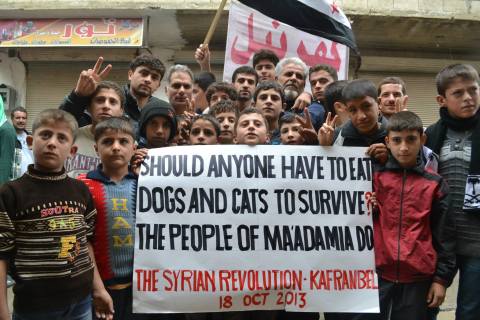
Six weeks after the attacks on Ghouta that killed hundreds of civilians, regime forces have choked off food supplies to the targeted neighborhoods. Survivors of the chemical attack are now facing the threat of starvation. Children have been reduced to eating leaves; clerics have issued fatwas allowing people to eat cats and dogs.
The belated discovery of the Syrian conflict by “anti-imperialists” after the US government threatened war inspired impassioned commentary. The strangulation of its vulnerable population has occasioned silence. But dog whistles from issue-surfing provocateurs like Banksy are unexceptional; they merit closer scrutiny when they come from respected essayists like David Bromwich.
In a recent front-page article for the London Review of Books, Bromwich identifies many rogues in the Syrian drama: Barack Obama, John Kerry, Saudi Arabia, Qatar, “the jihadists”. But conspicuously absent is Assad’s Baathist regime. Vladimir Putin is the closest Bromwich admits to a hero. The Syrian people are denied even a cameo.
When the Yale literature professor uses a tautology like ”anti-government insurgency” to refer to Assad’s opponents, it is reasonable to assume intention. The word “government” conveys a certain benign authority; and when it is also said to be opposed by the universally reviled “jihadists,” then there is only one place a bien pensant reader can invest sympathy—and its not with the opposition.
Bromwich’s elegant prose barely conceals his clunky polemical apparatus. The validity of his claim—that the Obama administration was engaged in illegal aggression against Syria until Putin intervened—hinges entirely on his treatment of the events of August 21.
“Nobody doubts that an attack took place,” writes Bromwich. But “nobody yet knows with reasonable certainty who ordered it.”
The words are carefully chosen. It is true, nobody knew with reasonable certainty who ordered it—but it had been established beyond reasonable doubt who carried it out. One can perhaps dismiss the conclusions of British, French and German intelligence agencies given their earlier record of failure. But by early September even independent munitions experts and Human Rights Watch had ruled out the possibility that anyone other than the regime could have carried out the attacks.
To understand the absurdity of Bromwich’s dodge, consider the napalming of a school in Aleppo a week after the sarin attack. The bomb was dropped from a jet; and since only the regime possesses airpower, the responsibility for the attack was easy to establish. But as in Ghouta, no one could know “with reasonable certainty who ordered it”. Nor was it relevant.
Upholding the fiction that the responsibility for the attack remained in doubt, in a September 9 radio interview, Bromwich chided the US government for assuming Assad’s guilt even though no “international body” had confirmed it. Bromwich was no doubt aware that the Assad regime had agreed to the UN inspections on the strict condition that they would not assign blame. The inspectors’ remit was confined to investigating if CW were used. Days before Bromwich’s LRB article appeared, the inspectors confirmed the use of sarin and, though their remit excluded identifying perpetrators, they also established the make and trajectory of the delivery system. It left no doubt as to the regime’s responsibility.
Facts, however, rarely sway beliefs. Evidence might point to Assad’s responsibility. But for Bromwich, Assad “was winning the war and such a move was plainly suicidal, his arrival at such a decision is hard to make sense of.”
Harder perhaps than the regime’s indiscriminate use of barrel bombs, cluster munitions, and ballistic missiles; or the bombing of civilians queuing at breadlines that Human Rights Watch documented on 20 separate occasions; or the case of 13-year-old Hamzah al Khateeb whose body was returned to his family badly bruised, with burn marks, severed genitals, and three gunshot wounds days after he was arrested at an anti-Assad protest.
This incredulity is disingenuous. “Making sense of” is precisely what Bromwich was doing when in the Huffington Post article he advised Congress to ask Obama:
Whether the entry into Syria on August 17 and 19 of US-trained guerrilla forces of the Free Syrian Army, numbering more than 300 — and the passage of those forces through Ghouta about the time of the chemical attack, as documented in the Jerusalem Post on August 23 — did, or did not, make them targets of the attack; and if not, what information about the activity of the forces leads to this conclusion.
Not only did the regime not use sarin; it used it for a reason. Freud called this the logic of dreams.
But lest anyone doubt Bromwich’s fairness, he also finds it “hard to make sense of” the claim that the rebels carried out the attack. Though, for the sake of balance, he puts them in the “possession of some chemical weapons”—because “there are reports.” The reports in fact originated on an obscure website called Mint Press in a highly implausible story, and had been debunked by this author in the New Republic, by Robert Mackey in the New York Times, and Dan Murphy in the Christian Science Monitor. A week before Bromwich wrote his article, even the report’s own author disavowed it.
Bromwich, however, was not daunted. In a bravura performance, he turned the dubiousness of his source into the measure of its validity. He alleges that the administration’s case blaming Assad “was effectively discredited in less than a week, but only below the radar of the mainstream press and policy establishment.” It doesn’t occur to Bromwich that the criticism might have been too absurd to receive mainstream traction. So absurd, in fact, that the one source Bromwich does name also belatedly repudiated it. In a Facebook message to his followers, the journalist Gareth Porter, wrote:
in truth I cannot come up with an explanation that I can document. I can talk about seemingly contradictory facts, theories, possibilities, ideas, and I can throw in a lot of interesting observations, but in the end, it is still something I cannot make sense of.
For this reason, Porter was “letting go of this issue” because he “can only write what my conscience and my analytical instincts allow.”
Bromwich’s conscience however is made of sterner stuff. In none of Bromwich’s articles is there a mention of Syrian victims. The man who rightly bristles at the persecution of Bradley Manning and Edward Snowden is silent on the peaceful political activists, humanitarian workers, journalists, doctors and lawyers tortured or disappeared by the regime; or the tens of thousands of political prisoners rotting in Assad’s jails. No mention of the mutilated dissidents, tortured children, napalmed schools, leveled cities, gassed neighborhoods or bombed breadlines.
Bromwich, who is willing to give Assad the benefit of every doubt, is unforgiving when it comes to his opponents. He invariably paints them in a negative light. “Syria has already largely disintegrated,” says Bromwich.
The government and its Alawite and Christian supporters have secured the west, the Kurds are in the northeast, and the Islamist rebels are in the east (where the al-Nusra Front has already begun to enforce sharia law)
No mention here of the nation-wide Local Coordination Committees, or the vast network of non-violent civil society groups; no word on the head of the Syrian National Council George Sabra, a Christian, or the opposition’s first ambassador to France, an Alawite; omitted too are Christians who support the uprising. Bromwich is unaware that the most eloquent voice of the revolution, the novelist Samar Yabek, is an Alawite. He wouldn’t tell you that the jihadists have been in open conflict with the nationalist Free Syria Army (FSA) for over a year. Nor would you learn how the conflict assumed its increasingly sectarian character.
Such ignorance would be bad enough. But Bromwich compounds it by reprising tropes from the right’s “war on terror” discourse. In his ecumenical approach to sourcing, he approvingly quotes Tea Partier Rand Paul and the rightwing shock jock Rush Limbaugh. The fact that their opposition to US foreign policy might derive partly from their antipathy toward Muslims and their ideological opposition to the ‘socialist’ president was seemingly no barrier.
Paul is no pacifist; he has suggested that Assad “deserves death” for his use of chemical weapons. And Limbaugh is a cesspool of venomous opinion on everything from migrants, minorities, the disabled, to—of course—Muslims. Why Bromwich would feel that quoting them would strengthen his argument is mystifying. But it might explain where Bromwich picked up his rebels-with-sarin conspiracy theory. After the story debuted on an obscure conspiracy site, it was Limbaugh who first amplified it. (Bromwich also described an attack on a regime checkpoint in the historic Christian town of Maaloula as an “attack on Christians”, a claim rejected by the town’s residents).
The mix of nativist isolationism and Kissingerian realism that Bromwich espouses was perhaps better articulated by Sarah Palin: “Let Allah sort it out”.
Such indifference to massive state repression would sound inhuman if Bromwich weren’t careful to cover it up with the magic phrase “both sides”. It allows him to assert moral superiority while obfuscating context and scale. True, elements of the opposition have committed crimes; some of them horrific. They must be condemned. A just cause does not excuse criminality (though the collapse of law and order does make them inevitable).
Only someone with no moral perspective or sense of proportion would compare the regime’s wholesale criminality with the retail crimes of the opposition. The actions of an individual or a group in a diffuse, uncoordinated and disorganized opposition merely reflect on the perpetrator; the crimes of the regime, with its functioning hierarchies and chains of command, reflect policy.
The Baathist regime has a monopoly on airpower, armor, artillery, ballistic missiles, and unconventional weapons. It is confronted by a diffuse, poorly equipped opposition, whose members were forced by the regime’s brutality into picking up arms. But in Bromwich’s reading this becomes a contest between a beleaguered Assad and “jihadists” backed by the American goliath. And though he has made no reference to the Syrians’ right to self-determination, he generously pronounces the regime in Damascus “sovereign” — a “sovereign government” that is facing the threat of “violent overthrow”. The real victim, it turns out, is Assad.
Bromwich is of course entitled to oppose intervention – it is a perfectly respectable position. Who wouldn’t be leery after the disastrous and unprovoked war in Iraq; or the ongoing bombings of Afghanistan, Pakistan, Yemen and Somalia? After the lies that led to a war that resulted in at least 461,000 unnecessary deaths (perhaps more), it is natural to feel betrayed. There is good reason also to be skeptical of humanitarian conceits that might be used to justify foreign intervention. It certainly makes sense to be dubious about a media that gave warmongers a pass.
But these lessons could be overlearned. If a boy cries “wolf!” while being set-upon by a wolf pack, then fixating on his propensity for lies will not conjure away the threat. Memory can distort sight; it can’t override it. Where skepticism hardens into cynicism and dogma precludes context, ignorance and apathy parade as virtues. Bromwich and the anti-imperialists forget that in Iraq only the possession of unconventional weapons was being alleged; in Syria they have actually been used. In Iraq pretexts had to be manufactured for intervention; in Syria their abundance has done little to encourage action. It is one thing to distrust the government and quite another to extend this skepticism to the supposed objects of its humanitarian concern.
The threat of a US intervention was momentary; it passed. But the people who had shown little concern for protecting Syrians from Assad went to unusual lengths to protect Assad from the US. Though only a handful openly embraced Assad, many opted for a subtler approach, focusing exclusively on the opposition, caricaturing it, amplifying its failings and erasing its suffering. They manufactured doubt to exculpate the regime. Uri Avnery has derided this tendency as “leftist monsterphilia” – one that in times of crises turns otherwise sensible people into apologists for tyrants.
It is no accident that Syrians have received such little sympathy. Western citizens usually sympathize with perfect victims; moral ambiguity dissuades many. Such ambiguities have been reinforced by the regime’s sophisticated PR campaign and the dog whistles of friendly ideologues. Together they have heaped insult upon injury and drained the reservoirs of potential sympathy.
With over 100,000 killed by conventional weapons, sarin was the least of Syrians’ worries. The international drama over the use of CW has obscured the fact that recent developments have left Assad fully in control of his conventional arsenal with no red lines — real or imagined — constraining him. Syria might see bleaker days yet. But as the abandoned and vulnerable population is subjected to intensified repression, the world will have to worry about protecting them not just from the regime’s killers, but also the calumnies of the monsterphiles.
– Muhammad Idrees Ahmad is a political sociologist and the author of the forthcoming The Road to Jerusalem: American Neoconservatism and the Iraq War (Edinburgh University Press). Twitter: @im_pulse
source