This is an OpEd written by Jewish Israeli youth Yuval Green, age 26.
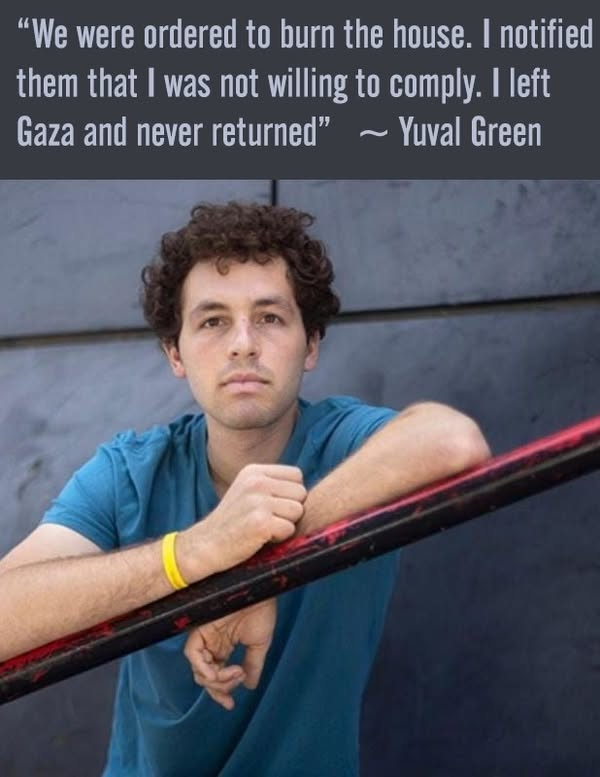
It was published in hebrew in Haaretz, on March 21 2025.
From FB Dave Meslin
_________________________________________________________
We were ordered to burn the house; I notified them that I was not willing to comply. I left Gaza and never returned
Yuval Green, Haaretz, March 21 2025
Like many Israelis, I enlisted in the military out of a sense of loyalty to the state and a willingness to sacrifice. After a challenging combat service, I continued to serve as a reserve soldier. On October 7th, I was called, along with my comrades, to defend the borders of the country. That very evening, I arrived at the supply warehouses of my reserve unit. There, we received old and faulty equipment and witnessed how the military, on which we relied, failed to prepare for an extreme scenario.
In the following days, we entered the affected settlements around the Gaza Strip. I saw the deserted paths of Gaza villages, corpses lying in them, cars riddled with bullets, destroyed homes.
After the first days of the war, my unit entered a period of waiting and training. During that time, doubts began to take root in me. I believed that Israel’s primary commitment should be toward the hostages, who had been taken cruelly from their homes due to the security failure. I thought that there was no military solution to the hostage problem.
It was clear to me that military action in Gaza was endangering the lives of the hostages. At the same time, I assumed that Hamas would be willing to sign a deal — after all, they kidnapped the people to free prisoners in Israel. Moreover, after the terrible disaster we experienced on October 7th, I thought that the last thing we needed was more fallen soldiers.
Beyond the consequences of the war for us, Israelis, I watched in pain what was happening in Gaza. Already in the early days of the war, there were thousands of casualties, thousands of destroyed homes, displaced persons, suffering, and pain.
Despite my doubts, I chose to enter Gaza with my comrades. I did this because, as a platoon medic, I felt a strong sense of commitment to them. Furthermore, at that time, I still struggled to know what the right thing was — maybe I am wrong? Maybe the way to bring back the hostages does go through military action?
A few days after we entered Gaza, in early December 2023, I heard a news report on the radio stating that Israel was refusing to end the war in order to bring back the hostages. This news devastated me. My motivation for service was shaken even more. Still, my sense of duty as a medic kept me in Gaza.
A few weeks later, 50 days after entering Gaza, we received an order from our company commander: after we leave the house we are staying in, we must burn it. The order left me in shock. I asked the commander why we were burning the house. His first response — which, in my eyes, exemplifies the indifference to Palestinian lives — I will never forget: “We are burning the house because we don’t have a D9 bulldozer available.” After I insisted on understanding, he added: “We burn every house we leave.” My requests to reconsider the act went unanswered, and that evening, around four buildings were burned in Khan Yunis. I witnessed those fires, the black smoke. How many families lost their homes that evening?
I informed my commander that I was not willing to cooperate with this action, and I was leaving the fighting. I set a clear moral boundary in the face of immoral actions. I left Gaza in the first supply vehicle and never returned, five days before my unit withdrew from the fighting.
The commentators in the studios engage in debates about “total victory” or the “collapse of Hamas.” I don’t know the military situation of Hamas, but I know one thing — it doesn’t matter at all. The reasons that led to the rise of Hamas in Gaza are the same reasons that led to the rise of the fedayeen in the 1950s and the rise of the PLO in the 1960s. Without a political settlement, when the Palestinians are under our control, they will always rise against us, carry out attacks, and fight. Even if Hamas is eradicated, another movement will rise in its place.
This war, despite being sold to us as a change in the reality of the Middle East, in fact entrenches exactly the same reality. Another waste of blood, more killing, leading to more violent opposition, which leads to more killing.
The war in Gaza continues primarily because of a rotten and corrupt political culture, where cynical and unworthy politicians are dragged into a messianic struggle led by religious fanatics, who view settling the land as a higher value than human life.
I believe that Israeli culture, which blindly elevates military service above any other human value, is what allows extremists to lead us down this path. I see many people around me who recognize reality as I see it. They understand that the military pressure is killing the hostages, understand that the war is killing soldiers, understand that we are fighting mainly due to pressure from extreme elements. But they continue to show up for service. They don’t connect their military service with the continuation of the war.
We are often accused, those of us who refuse to participate in the war, of harming the army and thereby endangering the security of the state. However, I believe that in a country walking the path of fascism, where ending the war is seen as a “painful concession” in negotiations, there will never be enough soldiers. Even if we recruit all the yeshiva students, send all the youth to the front, and even mobilize the Arab population, there will always be more land to conquer in Syria, another enclave in the West Bank to seize.
In my opinion, strengthening the security of the state lies in a firm opposition to the war that endangers our soldiers, harms our economy, kills many Palestinians, and thus sows deep seeds of hatred — and of course, abandons our brothers and sisters in captivity.
My comrades and I in the organization “Soldiers for Hostages” declared that we will not be willing to continue cooperating with the abandonment of the hostages. If the government does not change course, we will not continue to serve. In such an extreme political climate, our role has become more important than ever. In recent months, since the publication of our letter in an article by Liza Rozovsky (“Haaretz”, 9.10.2024), we have received significant responses that indicate how much our movement is troubling the leadership. This, despite the fact that at the time of publication, we were only 130 soldiers. The Prime Minister addressed our group in a cabinet meeting and said about us: “They’ve lost their national compass.” In addition, each signatory of the letter received a personal phone call from their battalion or brigade commander, demanding they remove their signature.
It is important to clarify that we, the signatories of the letter, now more than 200 soldiers, are neither deserters nor evaders. Among us are fighters and officers who fought in Gaza and Lebanon. We choose this path not out of a desire to evade our duties and not because of the burden of reserve duty, but precisely because of our deep commitment to the state.
Just as we were willing to risk ourselves, strive, and fight in battle, today we believe we must give of ourselves to stand up to social pressure. We do this because we think it’s time to draw a red line for the war.
 band annie's Weblog
Leave a comment