Zachary Foster July 19, 2024 |
| copied from here |
 This is Palestine, In Your Inbox, Making Sense of the Madness The 8 Tiers of Israeli Apartheid, Explained The State of Israel recognizes 8 tiers of people under its control. For all 8 tiers, Israel controls the registration of births, marriages, divorces, deaths and address changes. Israel controls the telecommunication networks, electricity grids, water supply, airspace and currency. Israel controls the movement of people in and out of the country. All tiers of people are controlled by a single state, with a single Prime Minister, a single Defense Minister, a single cabinet and a single chain of military command. But each tier has different legal rights. That’s why every major human rights organization has called Israel an apartheid state. This is a brief survey of how it operates. Tier 1: Jewish citizens of Israel (7.2 million people) Jewish citizens of Israel have full voting rights. They can rent, buy or own property in 900+ localities in Israel. They can buy property from the Jewish National Fund, which owns about 13% of the land of Israel. There are no family reunification restrictions on Jews. Jews can destroy Palestinian property in the West Bank with near total impunity. Jews who protest their government rarely encounter lethal or even disproportionate violence by the Israeli police. The Israeli Parliament is likely to forbid the state from placing Jews in “administrative detention,” in which a person is imprisoned without trial and without having committed an offense. In 2018, Israeli lawmakers passed the nation-state law, defining Israel as a state for the Jewish people. The state exists for the purpose of serving the interests of Jews. This is not the case for any other tier. Tier 2: Palestinian (& other non-Jewish) citizens of Israel (2.5 million people) Palestinian citizens of Israel have full voting rights. But they are in practice barred from buying or owning land in 900+ localities in Israel. They cannot buy property from the Jewish National Fund, which owns about 13% of the land of Israel. Palestinian citizens are prohibited from having their family members in the West Bank or Gaza live with them in Israel. Palestinians who protest the Israeli government often face disproportionate violence or retribution, such as a 1997 protest where Israeli forces injured hundreds of Palestinians protesting the confiscation of 10,000 acres of land near Umm al-Fahm. Palestinian schools, local councils and municipalities receive far less funds per capita than Jewish ones. The Israeli Parliament is likely to pass a law allowing the state to limit the effective use of its “administrative detention” policy to Palestinians only. Tier 3: Unrecognized Palestinian Citizens of Israel, (85,000 people) These citizens of Israel live in dozens of communities unrecognized by the State of Israel. They are primarily of Bedouin origin and have been living in Israel long before Israel existed, indeed, before Zionism existed. Their communities are denied access to the Israeli electrical grid, water mains and trash-pickup. Israel does not allow public buses to reach them. Israel does not pave the roads nor does it allow new construction in the unrecognized towns. There are outstanding home demolition orders on thousands of homes and structures in the unrecognized towns that can be executed on at any moment. In May 2024, for example, Israeli forces demolished 47 homes in Wadi al-Khalil, an unrecognized Palestinian Bedouin village in southern Israel resulting in the forcible displacement of over 300 Palestinian Bedouins. Tier 4: Palestinians living in Israeli occupied East Jerusalem (360,000 people) Palestinian residents of East Jerusalem are not given Israeli citizenship at birth, even though they live in territory annexed by Israel in 1967. Instead, they are provided residency permits that can be revoked. Since 1967, Israel has stripped more than 15,000 East Jerusalem Palestinians of their residency permits. Israel also rejects 93% of Palestinian building permit applications in E. Jerusalem, which has meant that 85% of Palestinian homes in E. Jerusalem are considered illegal and could be demolished at any moment. Israeli law also allows Jews to take over property in E. Jerusalem once owned by Jews before 1948, but does not allow Palestinians to take over property they once owned before 1948 in West Jerusalem or anywhere else. In Jerusalem, Palestinian schools, clinics, hospitals, parks and roads are all underfunded relative to Jewish ones. Tier 5: Palestinians living in Area A of the West Bank (1.6 million) Palestinians living in Area A of the West Bank are stateless peoples who have been subject to a 57-year long Israeli military occupation. They do not have the right to vote for the government that controls their lives. They do not have freedom of movement within the West Bank nor can they leave the West Bank without a permit. And, If they leave for more than 3 years, they can lose their right to be an occupied, stateless person. They can be imprisoned indefinitely without charge, a policy known as “administrative detention.” The water under the ground and the sky over their heads is controlled by Israel. In addition, the Israeli military’s subcontractor, the Palestinian Authority (PA), further restricts their freedom of assembly and freedom of speech through violent crackdown on protests and imprisonment or murder of political opponents, such as Nizar Banat. Tier 6: Palestinians living in Area B of the West Bank (1.3 million) Palestinians living in Area B of the West Bank are stateless peoples who have been subject to a 57-year long Israeli military occupation. They face the same restrictions on their freedom of movement and speech and right to residence and assembly as Area A West Bank Palestinians. In addition, they encounter Israeli checkpoints whenever passing into Area A or C of the West Bank. They must obtain permits to access their lands if they happen to be in Area A or C. Moreover, the current Israeli government has begun expanding its control over Area B just as it has over Area C (discussed subsequently), making it the next major site for Israel’s ongoing land seizures and depopulation efforts. This has involved the legalization of five settlement outposts in the West Bank, and the issuance of tenders for thousands of new housing units in Israeli settlements in Area B. Tier 7: Palestinians living in Area C of the West Bank (100,000 people) Palestinians living in Area C of the West Bank are stateless peoples who have been subject to a 57-year long Israeli military occupation. They face even more restrictions on their freedom of movement and speech, as well as right to residency and assembly as Area A and B West Bank Palestinians. Less than 1% of the land in Area C is currently available to Palestinians for construction. Palestinians living in Area C are 100 times more likely to have demolition orders placed on their homes than be granted permits to build homes. Meanwhile, a dozen some Palestinian communities in Area C have been ethnically cleansed in the past few years in Khirbet Humsa, Masafer Yatta, Ein Samiya, Ras a-Tin, Lifjim, Khirbet Zanuta, Khirbet al-Ratheem, al-Qanub, Ein al-Rashash and Wadi al-Seeq. Tier 8: Palestinians Living in Gaza (2.2 million people) Palestinians living in Gaza are stateless peoples who have been living under Israeli military occupation for 57 years, as well as a 17-year long siege and a 9-month genocidal onslaught. In just the past 9+ months, Israel has denied the people of Gaza the right to shelter, health care, water, food, electricity and the right to life itself: Israel has killed at least 39,000 Palestinians in Gaza with as many as 186,000 likely to die from the genocide. Israel is also starving to death more than 1 million Palestinians in Gaza and leaving the rest in conditions of hunger and catastrophic food insecurity. Israel has reduced the amount of water available in Gaza by 94%. Israel has damaged or completely destroyed every single hospital in Gaza and completely destroyed 76% of Gaza’s schools. Israel has also forcibly displaced nearly all 2.2 million Palestinians in Gaza. |
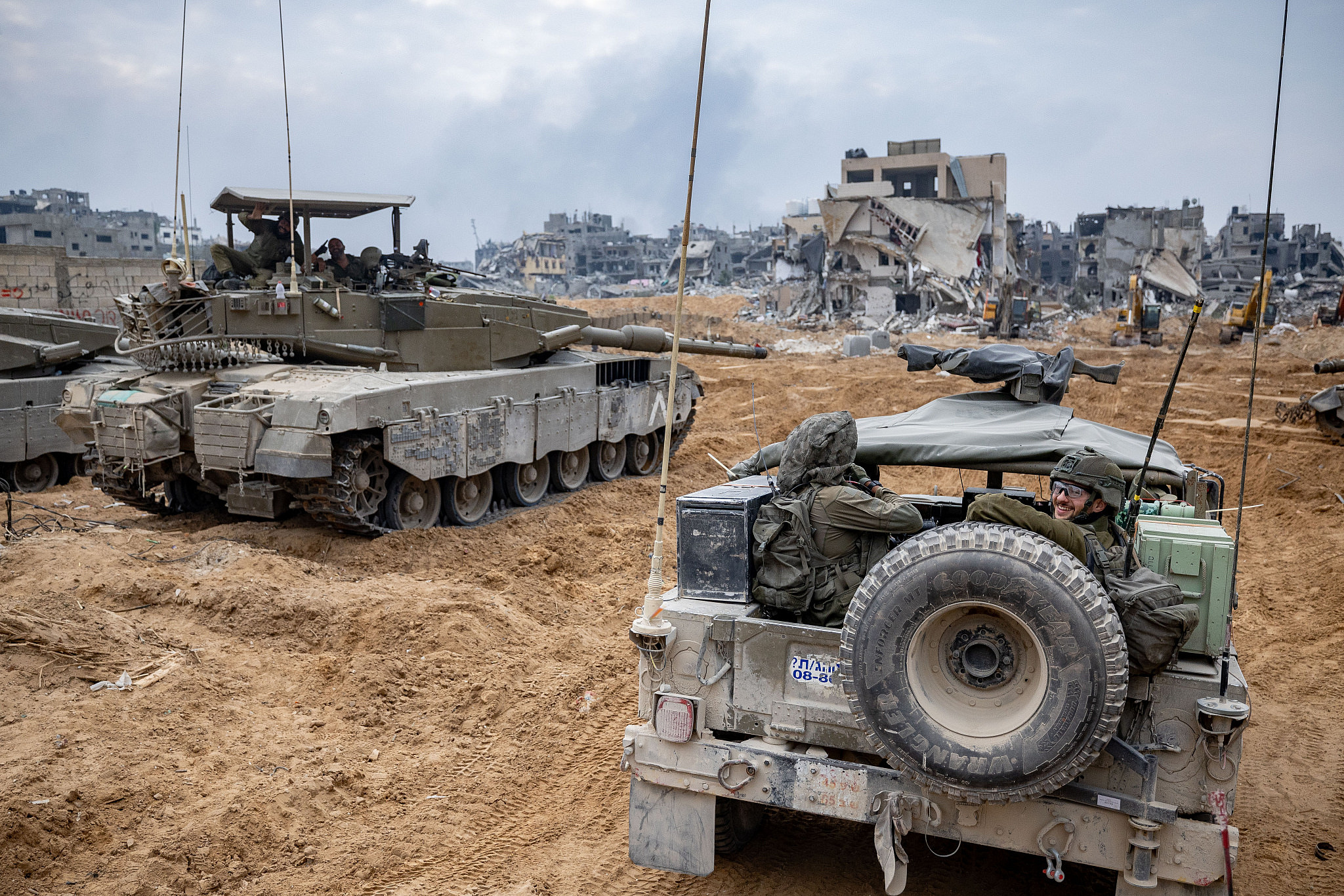
Israeli soldiers describe the near-total absence of firing regulations in the Gaza war, with troops shooting as they please, setting homes ablaze, and leaving corpses on the streets — all with their commanders’ permission.
 ByOren ZivJuly 8, 2024
In partnership with

In early June, Al Jazeera aired a series of disturbing videos revealing what it described as “summary executions”: Israeli soldiers shooting dead several Palestinians walking near the coastal road in the Gaza Strip, on three separate occasions. In each case, the Palestinians appeared unarmed and did not pose any imminent threat to the soldiers.
Such footage is rare, due to the severe constraints faced by journalists in the besieged enclave and the constant danger to their lives. But these executions, which did not appear to have any security rationale, are consistent with the testimonies of six Israeli soldiers who spoke to +972 Magazine and Local Call following their release from active duty in Gaza in recent months. Corroborating the testimonies of Palestinian eyewitnesses and doctors throughout the war, the soldiers described being authorized to open fire on Palestinians virtually at will, including civilians.
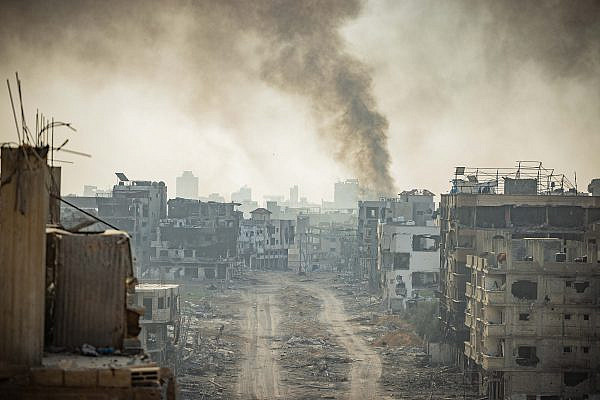
The six sources — all except one of whom spoke on the condition of anonymity — recounted how Israeli soldiers routinely executed Palestinian civilians simply because they entered an area that the military defined as a “no-go zone.” The testimonies paint a picture of a landscape littered with civilian corpses, which are left to rot or be eaten by stray animals; the army only hides them from view ahead of the arrival of international aid convoys, so that “images of people in advanced stages of decay don’t come out.” Two of the soldiers also testified to a systematic policy of setting Palestinian homes on fire after occupying them.
Several sources described how the ability to shoot without restrictions gave soldiers a way to blow off steam or relieve the dullness of their daily routine. “People want to experience the event [fully],” S., a reservist who served in northern Gaza, recalled. “I personally fired a few bullets for no reason, into the sea or at the sidewalk or an abandoned building. They report it as ‘normal fire,’ which is a codename for ‘I’m bored, so I shoot.’”
Since the 1980s, the Israeli military has refused to disclose its open-fire regulations, despite various petitions to the High Court of Justice. According to political sociologist Yagil Levy, since the Second Intifada, “the army has not given soldiers written rules of engagement,” leaving much open to the interpretation of soldiers in the field and their commanders. As well as contributing to the killing of over 38,000 Palestinians, sources testified that these lax directives were also partly responsible for the high number of soldiers killed by friendly fire in recent months.

Israeli soldiers from the 8717 Battalion of the Givati Brigade operating in Beit Lahia, in the northern Gaza Strip, during a military operation, December 28, 2023. (Yonatan Sindel/Flash90)
“There was total freedom of action,” said B., another soldier who served in the regular forces in Gaza for months, including in his battalion’s command center. “If there is [even] a feeling of threat, there is no need to explain — you just shoot.” When soldiers see someone approaching, “it is permissible to shoot at their center of mass [their body], not into the air,” B. continued. “It’s permissible to shoot everyone, a young girl, an old woman.”
B. went on to describe an incident in November when soldiers killed several civilians during the evacuation of a school close to the Zeitoun neighborhood of Gaza City, which had served as a shelter for displaced Palestinians. The army ordered the evacuees to exit to the left, toward the sea, rather than to the right, where the soldiers were stationed. When a gunfight erupted inside the school, those who veered the wrong way in the ensuing chaos were immediately fired at.
“There was intelligence that Hamas wanted to create panic,” B. said. “A battle started inside; people ran away. Some fled left toward the sea, [but] some ran to the right, including children. Everyone who went to the right was killed — 15 to 20 people. There was a pile of bodies.”
‘People shot as they pleased, with all their might’
B. said that it was difficult to distinguish civilians from combatants in Gaza, claiming that members of Hamas often “walk around without their weapons.” But as a result, “every man between the ages of 16 and 50 is suspected of being a terrorist.”
“It is forbidden to walk around, and everyone who is outside is suspicious,” B. continued. “If we see someone in a window looking at us, he is a suspect. You shoot. The [army’s] perception is that any contact [with the population] endangers the forces, and a situation must be created in which it is forbidden to approach [the soldiers] under any circumstances. [The Palestinians] learned that when we enter, they run away.”
Even in seemingly unpopulated or abandoned areas of Gaza, soldiers engaged in extensive shooting in a procedure known as “demonstrating presence.” S. testified that his fellow soldiers would “shoot a lot, even for no reason — anyone who wants to shoot, no matter what the reason, shoots.” In some cases, he noted, this was “intended to … remove people [from their hiding places] or to demonstrate presence.”
M., another reservist who served in the Gaza Strip, explained that such orders would come directly from the commanders of the company or battalion in the field. “When there are no [other] IDF forces [in the area] … the shooting is very unrestricted, like crazy. And not just small arms: machine guns, tanks, and mortars.”
Even in the absence of orders from above, M. testified that soldiers in the field regularly take the law into their own hands. “Regular soldiers, junior officers, battalion commanders — the junior ranks who want to shoot, they get permission.”
S. remembered hearing over the radio about a soldier stationed in a protective compound who shot a Palestinian family walking around nearby. “At first, they say ‘four people.’ It turns into two children plus two adults, and by the end it’s a man, a woman, and two children. You can assemble the picture yourself.”
Only one of the soldiers interviewed for this investigation was willing to be identified by name: Yuval Green, a 26-year-old reservist from Jerusalem who served in the 55th Paratroopers Brigade in November and December last year (Green recently signed a letter by 41 reservists declaring their refusal to continue serving in Gaza, following the army’s invasion of Rafah). “There were no restrictions on ammunition,” Green told +972 and Local Call. “People were shooting just to relieve the boredom.”
Green described an incident that occurred one night during the Jewish festival of Hanukkah in December, when “the whole battalion opened fire together like fireworks, including tracer ammunition [which generates a bright light]. It made a crazy color, illuminating the sky, and because [Hannukah] is the ‘festival of lights,’ it became symbolic.”

Israeli soldiers from the 8717 Battalion of the Givati Brigade operating in Beit Lahia, northern Gaza Strip, December 28, 2023. (Yonatan Sindel/Flash90)
C., another soldier who served in Gaza, explained that when soldiers heard gunshots, they radioed in to clarify whether there was another Israeli military unit in the area, and if not, they opened fire. “People shot as they pleased, with all their might.” But as C. noted, unrestricted shooting meant that soldiers are often exposed to the huge risk of friendly fire — which he described as “more dangerous than Hamas.” “On multiple occasions, IDF forces fired in our direction. We didn’t respond, we checked on the radio, and no one was hurt.”
At the time of writing, 324 Israeli soldiers have been killed in Gaza since the ground invasion began, at least 28 of them by friendly fire according to the army. In Green’s experience, such incidents were the “main issue” endangering soldiers’ lives. “There was quite a bit [of friendly fire]; it drove me crazy,” he said.
For Green, the rules of engagement also demonstrated a deep indifference to the fate of the hostages. “They told me about a practice of blowing up tunnels, and I thought to myself that if there were hostages [in them], it would kill them.” After Israeli soldiers in Shuja’iyya killed three hostages waving white flags in December, thinking they were Palestinians, Green said he was angry, but was told “there’s nothing we can do.” “[The commanders] sharpened procedures, saying ‘You have to pay attention and be sensitive, but we are in a combat zone, and we have to be alert.’”
B. confirmed that even after the mishap in Shuja’iyya, which was said to be “contrary to the orders” of the military, the open-fire regulations did not change. “As for the hostages, we didn’t have a specific directive,” he recalled. “[The army’s top brass] said that after the shooting of the hostages, they briefed [soldiers in the field]. [But] they didn’t talk to us.” He and the soldiers who were with him heard about the shooting of the hostages only two and a half weeks after the incident, after they left Gaza.
“I’ve heard statements [from other soldiers] that the hostages are dead, they don’t stand a chance, they have to be abandoned,” Green noted. “[This] bothered me the most … that they kept saying, ‘We’re here for the hostages,’ but it is clear that the war harms the hostages. That was my thought then; today it turned out to be true.”

Israeli soldiers from the 8717 Battalion of the Givati Brigade operating in Beit Lahia, in the northern Gaza Strip, December 28, 2023. (Yonatan Sindel/Flash90)
‘A building comes down, and the feeling is, “Wow, what fun”’
A., an officer who served in the army’s Operations Directorate, testified that his brigade’s operations room — which coordinates the fighting from outside Gaza, approving targets and preventing friendly fire — did not receive clear open-fire orders to transmit to soldiers on the ground. “From the moment you enter, at no point is there a briefing,” he said. “We didn’t receive instructions from higher up to pass on to the soldiers and battalion commanders.”
He noted that there were instructions not to shoot along humanitarian routes, but elsewhere, “you fill in the blanks, in the absence of any other directive. This is the approach: ‘If it is forbidden there, then it is permitted here.’”
A. explained that shooting at “hospitals, clinics, schools, religious institutions, [and] buildings of international organizations” required higher authorization. But in practice, “I can count on one hand the cases where we were told not to shoot. Even with sensitive things like schools, [approval] feels like only a formality.”
In general, A. continued, “the spirit in the operations room was ‘Shoot first, ask questions later.’ That was the consensus … No one will shed a tear if we flatten a house when there was no need, or if we shoot someone who we didn’t have to.”
A. said he was aware of cases in which Israeli soldiers shot Palestinian civilians who entered their area of operation, consistent with a Haaretz investigation into “kill zones” in areas of Gaza under the army’s occupation. “This is the default. No civilians are supposed to be in the area, that’s the perspective. We spotted someone in a window, so they fired and killed him.” A. added that it often was not clear from the reports whether soldiers had shot militants or unarmed civilians — and “many times, it sounded like someone was caught up in a situation, and we opened fire.”
But this ambiguity about the identity of victims meant that, for A., military reports about the numbers of Hamas members killed could not be trusted. “The feeling in the war room, and this is a softened version, was that every person we killed, we counted him as a terrorist,” he testified.
“The aim was to count how many [terrorists] we killed today,” A. continued. “Every [soldier] wants to show that he’s the big guy. The perception was that all the men were terrorists. Sometimes a commander would suddenly ask for numbers, and then the officer of the division would run from brigade to brigade going through the list in the military’s computer system and count.”
A.’s testimony is consistent with a recent report from the Israeli outlet Mako, about a drone strike by one brigade that killed Palestinians in another brigade’s area of operation. Officers from both brigades consulted on which one should register the assassinations. “What difference does it make? Register it to both of us,” one of them told the other, according to the publication.
During the first weeks after the Hamas-led October 7 attack, A. recalled, “people were feeling very guilty that this happened on our watch,” a feeling that was shared among the Israeli public writ large — and quickly transformed into a desire for retribution. “There was no direct order to take revenge,” A. said, “but when you reach decision junctures, the instructions, orders, and protocols [regarding ‘sensitive’ cases] only have so much influence.”
When drones would livestream footage of attacks in Gaza, “there were cheers of joy in the war room,” A. said. “Every once in a while, a building comes down … and the feeling is, ‘Wow, how crazy, what fun.’”

Palestinians at the site of a mosque destroyed in an Israeli airstrike, near the Shaboura refugee camp in Rafah, southern Gaza Strip, April 26, 2024. (Abed Rahim Khatib/Flash90)
A. noted the irony that part of what motivated Israelis’ calls for revenge was the belief that Palestinians in Gaza rejoiced in the death and destruction of October 7. To justify abandoning the distinction between civilians and combatants, people would resort to such statements as “‘They handed out sweets,’ ‘They danced after October 7,’ or ‘They elected Hamas’ … Not everyone, but also quite a few, thought that today’s child [is] tomorrow’s terrorist.
“I, too, a rather left-wing soldier, forget very quickly that these are real homes [in Gaza],” A. said of his experience in the operations room. “It felt like a computer game. Only after two weeks did I realize that these are [actual] buildings that are falling: if there are inhabitants [inside], then [the buildings are collapsing] on their heads, and even if not, then with everything inside them.”
‘A horrific smell of death’
Multiple soldiers testified that the permissive shooting policy has enabled Israeli units to kill Palestinian civilians even when they are identified as such beforehand. D., a reservist, said that his brigade was stationed next to two so-called “humanitarian” travel corridors, one for aid organizations and one for civilians fleeing from the north to the south of the Strip. Within his brigade’s area of operation, they instituted a “red line, green line” policy, delineating zones where it was forbidden for civilians to enter.
According to D., aid organizations were permitted to travel into these zones with prior coordination (our interview was conducted before a series of Israeli precision strikes killed seven World Central Kitchen employees), but for Palestinians it was different. “Anyone who crossed into the green area would become a potential target,” D. said, claiming that these areas were signposted to civilians. “If they cross the red line, you report it on the radio and you don’t need to wait for permission, you can shoot.”
Yet D. said that civilians often came into areas where aid convoys passed through in order to look for scraps that might fall from the trucks; nonetheless, the policy was to shoot anyone who tried to enter. “The civilians are clearly refugees, they are desperate, they have nothing,” he said. Yet in the early months of the war, “every day there were two or three incidents with innocent people or [people] who were suspected of being sent by Hamas as spotters,” whom soldiers in his battalion shot.
The soldiers testified that throughout Gaza, corpses of Palestinians in civilian clothes remained scattered along roads and open ground. “The whole area was full of bodies,” said S., a reservist. “There are also dogs, cows, and horses that survived the bombings and have nowhere to go. We can’t feed them, and we don’t want them to get too close either. So, you occasionally see dogs walking around with rotting body parts. There is a horrific smell of death.”

Rubbles of houses destroyed by Israeli airstrikes in the Jabalia area in the northern Gaza Strip, October 11, 2023. (Atia Mohammed/Flash90)
But before the humanitarian convoys arrive, S. noted, the bodies are removed. “A D-9 [Caterpillar bulldozer] goes down, with a tank, and clears the area of corpses, buries them under the rubble, and flips [them] aside so that the convoys don’t see it — [so that] images of people in advanced stages of decay don’t come out,” he described.
“I saw a lot of [Palestinian] civilians – families, women, children,” S. continued. “There are more fatalities than are reported. We were in a small area. Every day, at least one or two [civilians] are killed [because] they walked in a no-go area. I don’t know who is a terrorist and who is not, but most of them did not carry weapons.”
Green said that when he arrived in Khan Younis at the end of December, “We saw some indistinct mass outside a house. We realized it was a body; we saw a leg. At night, cats ate it. Then someone came and moved it.”
A non-military source who spoke to +972 and Local Call after visiting northern Gaza also reported seeing bodies strewn around the area. “Near the army compound between the northern and southern Gaza Strip, we saw about 10 bodies shot in the head, apparently by a sniper, [seemingly while] trying to return to the north,” he said. “The bodies were decomposing; there were dogs and cats around them.”
“They don’t deal with the bodies,” B. said of the Israeli soldiers in Gaza. “If they’re in the way, they get moved to the side. There’s no burial of the dead. Soldiers stepped on bodies by mistake.”
Last month, Guy Zaken, a soldier who operated D-9 bulldozers in Gaza, testified before a Knesset committee that he and his crew “ran over hundreds of terrorists, dead and alive.” Another soldier he served with subsequently committed suicide.
‘Before you leave, you burn down the house’
Two of the soldiers interviewed for this article also described how burning Palestinian homes has become a common practice among Israeli soldiers, as first reported in depth by Haaretz in January. Green personally witnessed two such cases — the first an independent initiative by a soldier, and the second by commanders’ orders — and his frustration with this policy is part of what eventually led him to refuse further military service.
When soldiers occupied homes, he testified, the policy was “if you move, you have to burn down the house.” Yet for Green, this made no sense: in “no scenario” could the middle of the refugee camp be part of any Israeli security zone that might justify such destruction. “We are in these houses not because they belong to Hamas operatives, but because they serve us operationally,” he noted. “It is a house of two or three families — to destroy it means they will be homeless.
“I asked the company commander, who said that no military equipment [could be] left behind, and that we did not want the enemy to see our fighting methods,” Green continued. “I said I would do a search [to make sure] there was no [evidence of] combat methods left behind. [The company commander] gave me explanations from the world of revenge. He said they were burning them because there were no D-9s or IEDs from an engineering corp [that could destroy the house by other means]. He received an order and it didn’t bother him.”
“Before you leave, you burn down the house — every house,” B. reiterated. “This is backed up at the battalion commander level. It’s so that [Palestinians] won’t be able to return, and if we left behind any ammunition or food, the terrorists won’t be able to use it.”
Before leaving, soldiers would pile up mattresses, furniture, and blankets, and “with some fuel or gas cylinders,” B. noted, “the house burns down easily, it’s like a furnace.” At the beginning of the ground invasion, his company would occupy houses for a few days and then move on; according to B., they “burned hundreds of houses. There were cases where soldiers set a floor alight, and other soldiers were on a higher floor and had to flee through the flames on the stairs or choked on smoke.”
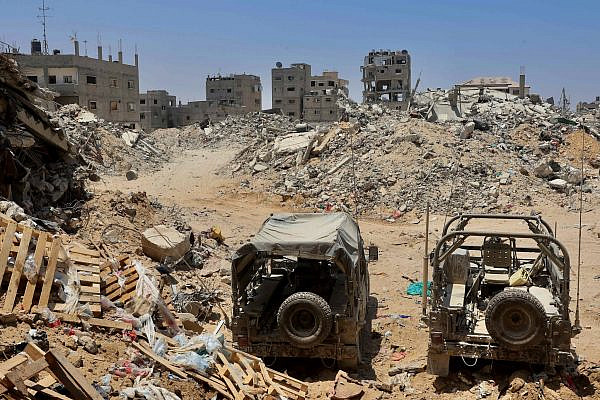
Green said the destruction the military has left in Gaza is “unimaginable.” At the beginning of the fighting, he recounted, they were advancing between houses 50 meters from each other, and many soldiers “treated the houses [like] a souvenir shop,” looting whatever their residents hadn’t managed to take with them.
Most read on +972
‘Lavender’: The AI machine directing Israel’s bombing spree in Gaza
By failing to stop the Gaza genocide, the ICJ is working exactly as intended
What can Palestinian artists do in the face of our slaughter?
Qasem Waleed El-Farra The Electronic Intifada 16 July 2024
At the end of June, I was wandering down Jalal Street in Khan Younis with my younger brother Khalid.
Jalal Street used to be my favorite street in my hometown. Even if I was just withdrawing money from an ATM on the street, I would take my time to absorb the scenes: the vendors selling their wares, the families eating out at one of the street’s many restaurants.
When the Israeli army invaded Khan Younis in December 2023, they razed Jalal Street to the ground.
No more vendors. No more restaurants. No more life.
My brother and I, during our late June walk, stepped over the piles of rubble that now make up Jalal Street. Every pile of rubble was once a colorful or historic building that I loved.
It was then that we heard a few men talking about news of another Israeli ground invasion, of the Shujaiya neighborhood of Gaza City.
Indeed, that day, 27 June, Israel would invade Shujaiya, destroying its streets just like it did in Khan Younis.
Where to go
I asked myself, what if the Israeli army again invades Khan Younis? Where would we be forced to evacuate to then?
In Gaza, we are always asking ourselves, where do we go? Yet people outside of Gaza might not be able to fully visualize what this means.
“Where do we go” is barely a question anymore – just an expression of despair.
Where to go when the scale of destruction in Khan Younis is apocalyptic.
Where to go when Rafah is no longer an option.
Where to go when Gaza’s central area is packed, and when al-Mawasi, a desert region by the sea, is equally packed.
Israel is moving us around left and right like pieces on a chess board.
Another forced displacement
Then, on 1 July, the Israeli army once again ordered a mass evacuation of the eastern part of the city of Khan Younis, including my neighborhood Sheikh Nasser.
When I first saw an Israeli spokesman’s Facebook post announcing the evacuation, I asked myself if this meant we would be going back to square one. This square one, when I imagine it, is featureless – a gray, unidentifiable space of misery.
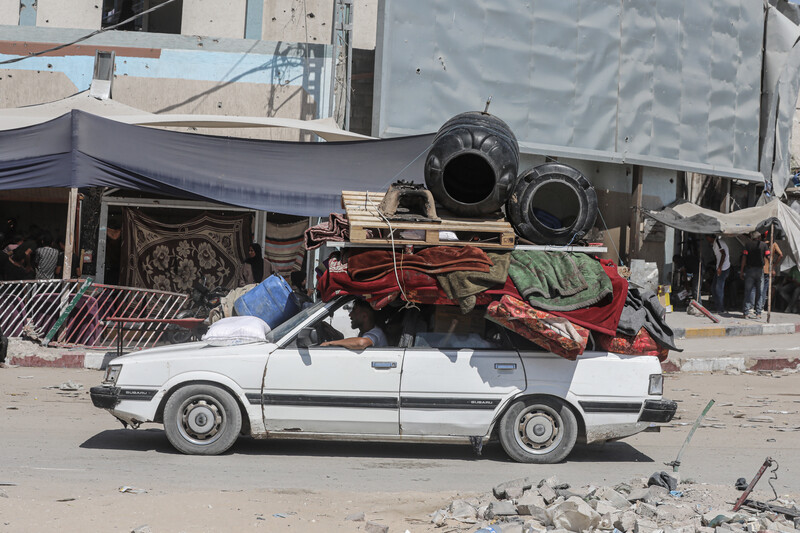
I took a short walk to the Bani Suhaila roundabout, the main roundabout of Khan Younis, where I saw cars, trucks and minivans stuffed with residents’ belongings.
People were pulling carts, and kids were pushing their elders in wheelchairs. It was a near duplicate of the scene of the first evacuation in December 2023.
At that time, my family and I were forced from our home under a shower of bombs. We walked the distance from Khan Younis to Rafah on foot, over 10 kilometers, carrying all of our belongings when the wheels on our luggage broke.
Now, I looked at my people being forced to evacuate once again. I looked at their pale faces, heavy steps and absent minds.
I saw one of my neighbors standing on the corner of our street. With an uncertain look, he was intercepting each car that passed by him, asking those inside where they were going, in hopes that they would offer him a seat in the car.
He was desperate for a ride.
The sun went down and so did his spirit. He went back home. And so did I.
My family gathered in the living room. We decided to spend the night at home because it would be hopeless to find a ride to west Khan Younis, the designated (and unlikely) “safe” area.
Pieces on a chess board
We stayed in Khan Younis, waiting. Yet nothing “big” happened in Khan Younis.
It was 11 July, and many of those who were forced to evacuate returned, even though Khan Younis is still labeled a “danger zone” by the Israeli army.
I believe that those evacuation orders on 1 July were an Israeli test to see how Palestinians would respond to their orders.
It’s like those horror movies where a psychopath terrorizes their victims with every possible demented method so that, by the end of the movie, they have subjugated their victim.
Yet throughout the beginning of July, the Israeli army continued to move us around like chess pieces.
On 7 July, the Israeli army ordered those in eastern Gaza City to evacuate to Deir al-Balah following its attacks on Gaza City, including a raid of the al-Tofah neighborhood.
“The quadcopter directly targeted numerous people as they fled Yafa school, where many people took shelter inside,” A.W., who was sheltering at the school, told The Electronic Intifada.
“I had to jump over dead bodies that were thrown all over the street as I ran to al-Nasser Street, [west of Gaza City], where the rest of my family had fled.”
The bombing intensified all over Gaza City.
“From midnight till dawn of 9 July, the bombs kept falling all over our street in al-Sabra area, in the southern Rimal neighborhood [of Gaza City],” said Ala’a Sbaih, a young Palestinian writer.
The Israeli tanks opened fire indiscriminately, and the snipers, accompanied by their quadcopters, shot at every moving body in their sight. As with every Israeli ground operation, the Israeli tanks and snipers provided a 500-meter-wide cover for their troops. This is something that has become common knowledge among Palestinians in Gaza.
“My neighbor tried to escape his house that night, but he got shot by an Israeli sniper, and was left to bleed all night long until he was found dead in the morning,” Alaa said.
“It felt as if the war had just started all over again.”
Qasem Waleed El-Farra is a physicist based in Gaza.
For years, The Lever has exposed the Ohio senator’s hypocrisies and what they mean for the American people.


Former President Donald Trump just named Ohio Sen. J.D. Vance as his 2024 running mate, and the country’s largest labor federation is already using The Lever’s coverage of Vance to declare the move “A corporate CEO’s dream and a worker’s nightmare.”
For years, we have been pointing out Vance’s hypocrisies and what they mean for the American people.
Vance authored the 2016 blockbuster memoir Hillbilly Elegy and fashioned himself as a “conservative outsider” fighting for everyday people. But during his 2022 U.S. Senate campaign, we revealed that the one-time venture capitalist counted himself among the elite few able to take advantage of a notorious carried-interest tax loophole that allows private equity and hedge fund moguls to pay a fraction of what they’d otherwise owe on their income.
In 2023, following our coverage of lax railroad safety regulations and the toxic train derailment in East Palestine, Ohio, Vance co-authored the Railway Safety Act, designed to quickly improve the poor rail conditions that contributed to the disaster in his home state.
“Through this legislation, Congress has a real opportunity to ensure that what happened in East Palestine will never happen again,” Vance said at the time.
But three months later, we exposed that Vance had since quietly amended his own legislation to delay the safety reforms at the request of rail and chemical industry lobbyists.
In its statement on Trump’s running-mate announcement, the AFL-CIO labor federation cited our coverage on Vance to argue that the senator would be “nothing more than a rubber stamp for [Trump’s] anti-worker vision” and would help usher in “a corporate CEO’s dream and a worker’s nightmare.”
Before he became a rabid Trump supporter, Vance wrote in The Atlantic that instead of believing Trump’s false promises to help the country, “I hope Americans cast their gaze to those with the most power to address so many of these problems: each other.”
We agree. Together, we have the power to hold Vance and his cohorts accountable. That fight starts now.
https://www.levernews.com/j-d-vances-wall-street-tax-dodge/
https://www.levernews.com/j-d-vance-helped-lobbyists-weaken-his-rail-safety-
Mondoweiss
The Israeli army committed another massacre against displaced Palestinians in tent encampments, this time in the coastal Mawasi area, which Israel had designated as a “safe zone.”
BY TAREQ S. HAJJAJ 1
 THE AFTERMATH OF THE MAWASI MASSACRE, JULY 13, 2024. (PHOTO: OMAR ASHTAWY/APA IMAGES)
In a crater in the ground almost larger than a schoolyard, a group of young men dig through the sand and pull out the bodies.
“His head is there! His head is there!” someone yells. A man emerges from the hole, carrying a child.
“Who knows who this child is? Who knows his family? Where are his parents?” he calls out.
Behind him are dead bodies and severed limbs scattered across the ground. Some poke out from beneath the sand, half-buried.
When the Israeli army struck the coastal displacement camp in al-Mawasi, west of Khan Younis, there was no rubble. The Israeli-designated “safe zone” was little more than a sea of tents on the beach, so people were buried in the sand instead.
At 10 a.m. on Saturday, while people were starting their day, the Israeli military targeted the area with successive airstrikes, leading to a massacre that, according to the Ministry of Health in Gaza, has, as of the time of writing, killed 90 people and injured over 300 others. Half of them are women and children, the health ministry says.
Shaima Farwaneh, 16, was near the site of the massacre when it happened. She was preparing to make breakfast for her family when the bombs fell.
People and sand scattered everywhere, limbs that were once attached to bodies flying over their heads.
“A leg hit me, and I saw dismembered bodies a few meters away,” Shaima told Mondoweiss. “I saw a young child screaming. He lost his lower limbs and was crawling on his hands and screaming. The bombs didn’t stop, and suddenly the boy disappeared. I saw how he vanished before me while we ran and lowered our eyes to the ground, unable to do anything but run.”
Shaima describes hearing seven explosions in short succession before it was over. “What a life we live in these tents that we have to see the dismembered bodies of our siblings and families fly over our heads.”

When the ambulance and Civil Defense crews arrived near a well-known crowded market for residents of the area, their vehicles were targeted as well, according to the director of the Civil Defense in Khan Younis, Yamen Abu Suleiman. Two Civil Defense workers were killed in the strike.
Abu Suleiman said that the occupation targeted Al-Mawasi with a large barrage of missiles, which led to many casualties. “The occupation targeted the area more than once to prevent us from any rescue operation,” he tells Mondoweiss, denouncing the silence of the International Committee of the Red Cross over Israel’s prevention of rescue teams from doing their work.
Israel claims that the airstrikes were an attempt to assassinate Muhammad al-Deif, the head of the armed wing of Hamas, the al-Qassam Brigades, as well as the commander of al-Qassam’s Khan Younis District Brigade, Rafi Salama. The Gaza government media office denies the Israeli claims, emphasizing that they are nothing but a way of diverting the world’s attention from the reality of the massacre the Israeli army committed as part of the genocide of Gaza’s people.
According to local sources, over 80,000 displaced people currently reside in tents in that area.
‘No state does this’
Fawzia Sheikh Youssef, 82, was buried in the sand from the bombing but survived. She describes what she experienced during the massacre as something she had never seen in her entire life. She tells Mondoweiss that she was already displaced during the Nakba of 1948 when she was only 6 years old, coming to the Khan Younis area and staying with her family for two years in a tent. 76 years later, she found herself back where she started, but this time witnessing massacres the likes of which she had never seen even during the Nakba.
“There is no country in all the world that does this to children, women, and civilians,” she says. “This isn’t how wars are.”
Fawzia was eating her breakfast when the bomb ripped through her encampment, demolishing her tent and trapping her underneath it. She found herself covered in sand and trapped inside but was not critically injured. She began crawling on the ground and extricated herself from beneath the tent, eventually escaping to a place far away from the shrapnel and missiles, closer to the main road.
“I saw before my eyes one missile after another descending next to the tents. Missiles I have never seen in my life in all of Gaza’s wars. Isn’t this internationally forbidden? Shouldn’t the civilian population be protected and not face genocide and mass killing? Isn’t this forbidden?”

“They killed young people and old women. They do not respect humans. Aren’t we human?” she continues. “There is nothing to protect us from these missiles. The tents fell on our heads, and I was hit with two pieces of shrapnel in my leg. I may get poisoned, and I did not harm anyone.”
“These are not humanitarian actions,” Fawzia says. “A normal state would know that children have value, and women have value. Their lives are respected. Killing them is forbidden. There are wars. Some countries fight in the world, but not like this. Not like what happens with us.”
‘I left my son and fled from the horror of the bombing’
Samah al-Farra, a survivor of the massacre, says she fled from the horror of the missiles, leaving her son behind without knowing what she was doing. She describes what she saw after the incident as witnessing the horrors of the Day of Resurrection. The sound of the explosions, the panic of the people around her, the stampede in the attempt to escape, women leaving their tents without even wearing their clothes — Samah has to live with witnessing all these brutal scenes.
“People were running. There was sand in our eyes and fire over our heads. I left my son behind me and started running. I found the world turned upside down. The bodies of the martyrs were next to us, cut into pieces. It was a massacre. The fragments, sand, and bodies flew over our heads as we ran,” Samah describes.
She says that if this density of missiles had fallen on fortified buildings, it would have destroyed them. “But what about when they fall on tents whose owners are protected only by a piece of cloth?”
She describes the scene as a shower of missiles falling four times in a row, with more than one explosion occurring during each shower. “We saved ourselves. If we had stayed where we were, we would have been cut up and buried under the sand.”
Media reports have said that the bombs used in the al-Mawasi attack were JDAMs made in the U.S., which turn highly destructive unguided bombs into more precise missiles.
‘The entire area was overturned‘
Aziza Abu Tahir sits in front of the devastation after the bombing. Scattered bags of flour, gallons of water, vegetables, pillowcases, and utensils litter the area. She owns an oven and sits beside it every day. The women of the camp send their dough to her to bake for a small fee.
“When they dropped the bombs above our heads, all the people were running and screaming and saying that these were incendiary bombs, and this is the first time we have heard a sound like this,” Aziza tells Mondoweiss. “We ran away, and no one knew where to run. Some people went from one direction and were bombed, and some of them went from another direction and survived. But no one knew where they were going.”

As she speaks, a small child is hugging her, the son of her neighbor. Aziza says his mother takes care of orphans, and explains that when the attack started, his mother was bringing some dough for Aziza to bake in order to then resell to get an income for her family. “She was just here, and I baked what she wanted, and she went to sell it. As soon as she walked away, the bombing started. I don’t know where she is now, and I don’t know if she will return. The entire area she was walking in was overturned, and everything was buried.”
Hassan Suleih conducted interviews and provided photography for this report.
Tareq S. Hajjaj
Tareq S. Hajjaj is the Mondoweiss Gaza Correspondent, and a member of the Palestinian Writers Union. He studied English Literature at Al-Azhar University in Gaza. He started his career in journalism in 2015 working as a news writer and translator for the local newspaper, Donia al-Watan. He has reported for Elbadi, Middle East Eye, and Al Monitor. Follow him on Twitter at @Tareqshajjaj.
Doaa Shaheen The Electronic Intifada 3 July 2024
Ibrahim Salem had been missing for months.
In December, the Israeli military attacked his home in Jabaliya refugee camp, northern Gaza. Many of his family were killed or injured.
Ibrahim made arrangements for three of his children to be treated for their wounds in Kamal Adwan hospital.
While he was at the hospital – located in the city of Beit Lahiya – it came under an Israeli attack.
The Israeli troops went on a killing spree. Those who stayed alive were arrested.
Ibrahim’s family have been unable to contact him since that time.
At first they thought he had been killed. But there was no sign of his body in the hospital.
When it appeared that he had been taken into detention, the family sought assistance from lawyers and other human rights advocates. Yet they were unable to find information about him.
“This made me feel more helpless,” said Wasim, Ibrahim’s brother.
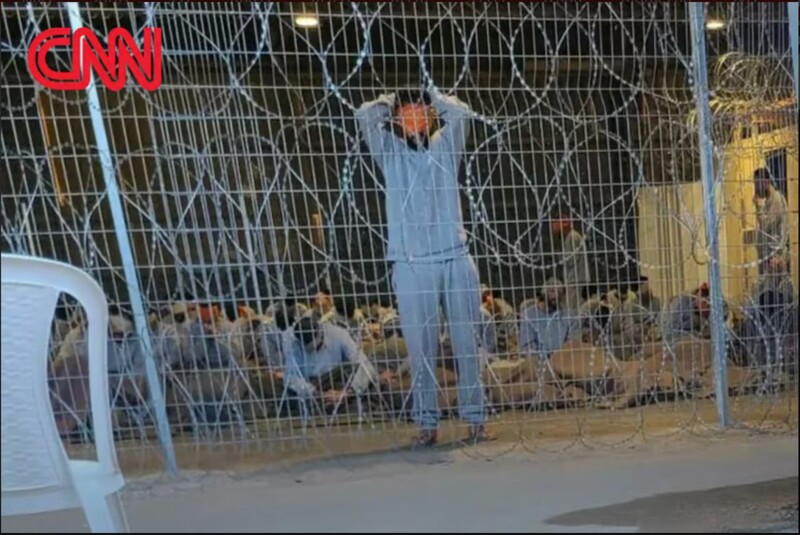
A CNN report broadcast in May provided the family with some basic details.
The report focused on Sde Teiman, the Israeli military camp in the Naqab desert, where Palestinians from Gaza are being detained. It featured leaked photographs from the camp.
One of them showed a prisoner standing up, blindfolded and with most of his face covered.
When Wasim saw the image from the CNN report, he was taken aback at first. When he zoomed in on it, he was sure that it was Ibrahim.
Despite how the detainee’s face was mainly covered, the family are sure from the features that were visible that it was Ibrahim in the photo. As Ibrahim was barefoot in the picture, the family could confirm that one of his toes has a distinctive shape as he had undergone surgery.
Although it was a relief to learn that Ibrahim was still alive, his family are distressed by how he looked unwell.
“He was very thin and it appeared that his health was failing,” Wasim said. “It was obvious that he had been abused and tortured.”
Located in the Naqab desert, Sde Teiman has been used to lock up thousands of Palestinians since October.
Detainees who have been subsequently released have given testimony of how they were beaten and subjected to electric shocks while being interrogated. Medical neglect is rife and food inadequate.
Dozens of detainees in Sde Teiman have died.
As prisoners have been prevented from communicating with the outside world, Ibrahim’s family lacks solid information about him. All they have is a grainy photograph indicating that he is still alive.
Doaa Shaheen is a journalist from Gaza.

Alon Mizrahi on X

Can you imagine how much bleaker, hopeless, and shitty this world would be if Roger Waters were on the side of the massacres, starvation and mass-scale brutality and sadism?
‘Thanks for small mercies’, the cliche goes, and it is so true in the case of the political stances one of the greatest, most glorious, and admired musicians in history took in real time, in defiance of the cultural and political establishment of his era Personally, I’d be heartbroken if the musical hero of my youth went from singing ‘Mother do you think they’ll drop the bomb?’ to supporting genocide; it would have been too terrible. I hate to even think about it.
Waters remained true to his lyrics, his vision, and his integrity. His pain as a fatherless child who lost his political and brave father in WW2, and who made generations of listeners cry and feel the wound of his fatherlessness. I remember listening to The Final Cut as a teenager and being mesmerized by ‘The Gunner’s Dream’, which starts
‘Floating down, through the clouds
Memories come rushing up to meet me now
But in the space between the heavens
And the corner of some foreign field
I had a dream I had a dream’
We all had a dream. We all do. Roget Waters remained true and faithful to his. and for this, for this absolute show of character and grace, he has my eternal love and admiration
 band annie's Weblog