FARHANG JAHANPOUR 02/08/2024
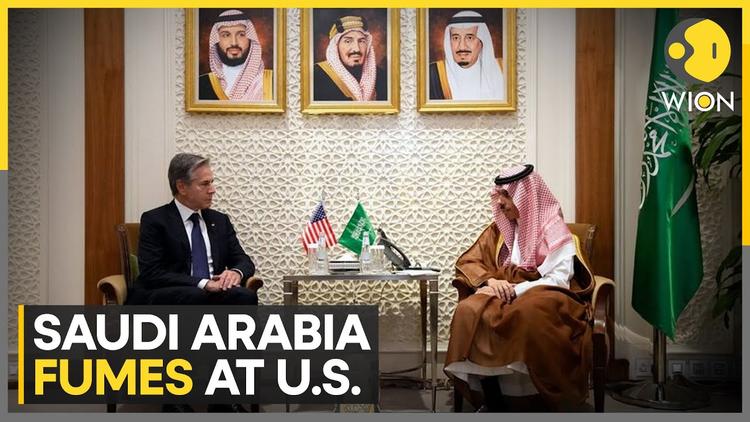
Oxford (Special to Informed Comment; Feature) – On Tuesday afternoon (6 February 2024), U.S. Secretary of State Antony Blinken took part in a joint press conference with Qatari Prime Minister and Minister of Foreign Affairs Mohammed bin Abdulrahman Al Thani in Doha. The press conference was mainly about the war in Gaza and the possibility of a new pause in the fighting and exchange of hostages and prisoners.
However, Blinken was also asked about his recent meeting with the Saudi Crown Prince Mohammed bin Salman and the possibility of normalisation of relations between Saudi Arabia and Israel. Blinken said (as quoted by the US Department of State): “But with regard specifically to normalization, the crown prince reiterated Saudi Arabia’s strong interest in pursuing that. But he also made clear what he had said to me before, which is that in order to do that two things are required: an end to the conflict in Gaza and a clear, credible, time-bound path to the establishment of a Palestinian state.”
In other words, the Saudis are strongly in favour of normalisation but, in addition to ending the conflict in Gaza, they believe that there should be a “clear, credible, time-bound path to the establishment of a Palestinian state.” This paints a fairly rosy and optimistic picture of Israel-Saudi negotiations and the prospects for normalisation of relations.
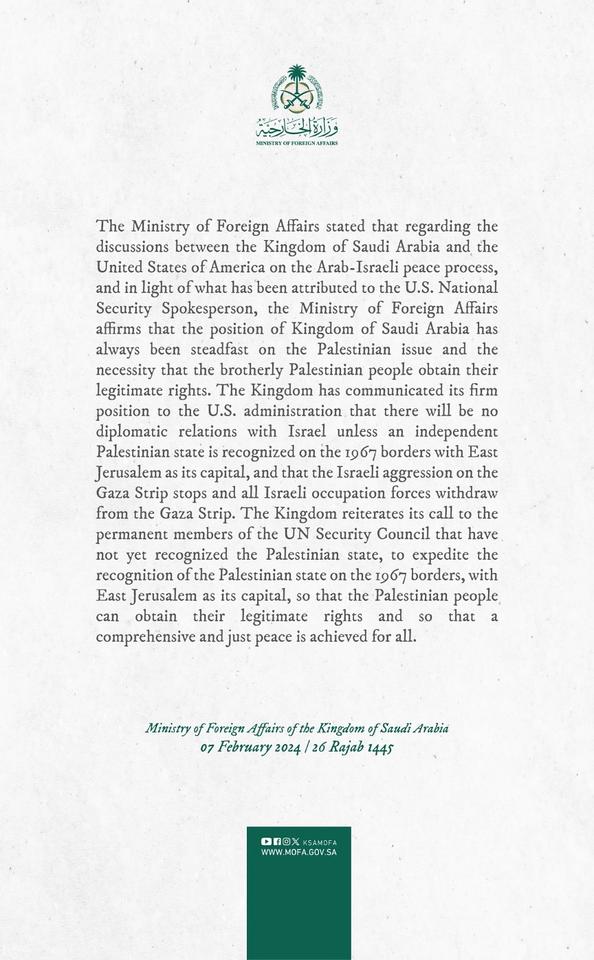
Shortly after that press conference, the Saudi Ministry of Foreign Affairs issued a statement which puts the record straight and which seems to contradict the main thrust of what Blinken said. The difference between what Blinken said and what the statement of the Saudi Ministry of Foreign Affairs stresses is stark and revealing.
There has been a “clear, credible, time-bound path to the establishment of a Palestinian state” for the past 30 years, called the Oslo Accords. However, despite that process, which has been as long as a piece of string, the Israelis and especially Israeli Prime Minister Netanyahu have opposed it and prevented its implementation.
What the Saudis are clearly saying is that they are not happy with a similar process, but want to go back to the Saudi Plan for the establishment of a Palestinian state with East Jerusalem as its capital, as well as a reference to the Palestinian refugee problem and the right of the Palestinians to return to their occupied land.
That plan was adopted unanimously by all the members of the Arab League in 2002 at their summit in Beirut. Subsequently, it was also approved by all 57 states of the Organisation of Islamic Cooperation (formerly known as the Organisation of Islamic Conference) at a summit meeting that was held in Riyadh, including Iran which was represented by President Mahmud Ahmadinezhad. The Palestinian Authority led by Yasser Arafat immediately embraced the plan.
In 2015, Israeli Prime Minister Benjamin Netanyahu also expressed tentative support for the Initiative, but in 2018 he rejected it as a basis for future negotiations with the Palestinians. In his infamous speech at the United Nations’ General Assembly on 22 September 2023 in New York, he held a map of “The New Middle East”, with Palestine completely wiped out. The elimination of Palestinian territories from the map of the Middle East angered the Palestinians and was one of the reasons that led to the 7th October attack by Hamas militants on Israel. Since the start of the Gaza war, Netanyahu has emphatically opposed the establishment of a Palestinian state and has even said that it will reoccupy Gaza for the foreseeable future.
The statement by the Saudi Ministry of Foreign Affairs clearly shows that the Saudis are not happy with Israeli policies and that there will be no prospect of normalizing relations with Israel under the current circumstances.
It states: “The Kingdom has communicated its firm position to the U.S. administration that there will be no diplomatic relations with Israel unless an independent Palestinian state is recognised on the 1967 borders with East Jerusalem as its capital, and that the Israeli aggression on the Gaza Strip stops and all the Israeli occupation forces withdraw from the Gaza Strip. The Kingdom reiterates its call to the permanent members of the UN Security Council that have not yet recognized the Palestinian state, to expedite the recognition of the Palestinian state on the 1967 borders, with East Jerusalem as its capital, so that the Palestinian people can obtain their legitimate rights and so that a comprehensive and just peace is achieved for all.”
Abraham Accords
Towards the end of the Trump Administration (between August 2020 and January 2021), a series of agreements were reached between the UAE, Bahrain, Morocco, Sudan and Israel to normalise their relations, which came to be known as the Abraham Accords. The ceremonies were held with great fanfare on the Truman Balcony of the White House, hosted by President Trump, flanked by Secretary of State Mike Pompeo and his son-in-law Jared Kushner, in order to give the impression that they represented major and historic peace agreements. It should be stressed that at least the first three countries on the list were not at war with Israel and in fact had covert cordial relations with her.
A close examination of the Abraham Accords shows that they were a series of cynical moves to bribe some Arab regimes to normalise relations with Israel by bypassing the Palestinians. Israel’s long-term plan to isolate and bypass the Palestinians by reaching agreements with Arab regimes outside the immediate neighbourhood was enthusiastically championed by Pompeo and Kushner, and behind them by Netanyahu.
The UAE wanted to buy some advanced US weapons, including F-35 fighter jets. They were promised that they would be able to buy them if they normalised relations with Israel. After doing so, the United States reneged because Congress opposed the sale of those sophisticated weapons to the UAE. Once the UAE decided to normalise relations with Israel, little Bahrain also decided to follow suit.
In 1993, Sudan was first added to the list of states that sponsored terrorism, but the overthrow of President Al-Bashir in April 2019 improved relations between Sudan and the United States and in December 2019 the two countries announced their intention to exchange ambassadors. Sudan’s Ambassador to the United States presented his credentials in September 2020.
US government promised to remove Sudan from the State Sponsor of Terrorism (SST) list if the Sudanese government agreed to normalise relations with Israel. Sudan agreed, and on 14 December 2000 the US Government removed Sudan from the SST list, just in time for Sudan to normalise her relations with Israel and to join the Abraham Accords. Of course, after the breakout of the latest civil war in Sudan between various army factions, the situation has gone from bad to worse.
There has been a long-lasting conflict between Morocco and the Polisario Front, backed by Algeria, about the ownership of the Western Sahara. Large parts of Western Sahara were controlled by the Moroccan Government and known as the Southern Provinces, whereas some 20% of the Western Sahara was controlled by the Sahrawi Arab Democratic Republic (SADR), the Polisario state with limited international recognition.
The United Nations officially considers Morocco and the Polisario Front as the main parties to the conflict and has called on them to reach a negotiated settlement. The Obama administration disassociated itself from the Moroccan autonomy plan in 2009 and put the option of an independent Western Sahara on the table. Clearly, the issue had to be settled by the UN negotiation through consultation with both sides. However, Trump unilaterally and illegally gifted the Sahara to Morocco if she normalised relations with Israel.
Then it was the turn of Saudi Arabia, which came under enormous pressure to normalise relations with Israel but, even before the events of 7th October, Saudi Arabia refused to join the Abraham Accords without the acceptance of the two-state solution by Israel. The latest statement by the Saudi Ministry of Foreign Affairs shows that Saudi normalisation of relations with Israel is dead in the water, at least for the time being.
Of course, genuine peace between Israel and the Arab states would be very Welcome, provided that it brought with it positive gains for both sides and was not at the expense of the Palestinians.
Instead of rejecting those phony agreements and pushing for some real and lasting solutions to the Arab-Israeli conflict, the Biden Administration supported those agreements and even pressured Saudi Arabia to join them. The realization of total US support, created a feeling of impunity among the Israeli right-wing government and was responsible for excessive demands by Netanyahu’s latest extreme right government, which contributed to the disastrous terrorist attack on 7th October and Israel’s indiscriminate war and genocide in Gaza.
Given the events of the past four months and the collective punishment that Israeli government has inflicted on Gaza and the West Bank, it would be highly unlikely that any Arab government would dare to normalise relations with Israel due to their fear of their own populations.
A Statement from the Ministry of Foreign Affairs regarding the discussions between the Kingdom of Saudi Arabia and the United States of America on the Arab-Israeli peace process:
Filed Under: Featured, Israel/ Palestine, Joe Biden, Saudi Arabia, US Foreign Policy
Source : Informed Comment

 band annie's Weblog