CLICK ON IMAGE
CLICK ON IMAGE
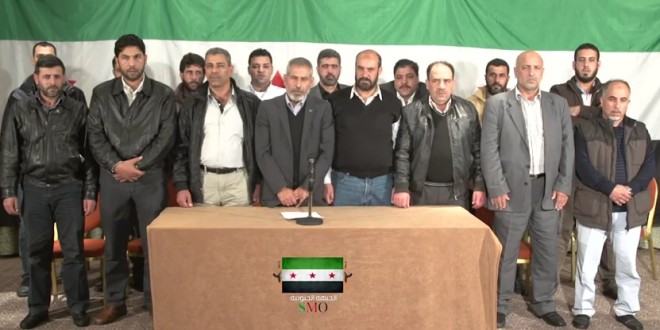
Transitional Phase
10.12.2014
STATEMENT NO. 4
THE TRANSITIONAL PHASE
The collapse of the current Assad led regime will not be the end of the Syrian people’s revolution. The end of the regime will be only the start of a new and, hopefully, final phase of the people’s struggle for freedom. In order to ensure that the final phase succeeds the establishment of a new national model of governance based on respect for human dignity and a rebirth of Syria’s tremendous potential will be initiated. It is imperative that all nationalist forces commit to a course of action during the period of transition from authoritarianism that will fulfil the popular will.
Therefore,
The Southern Front announces that it will dedicate its efforts during the period of transition following the collapse of the regime to supporting:
First: the protection of all Syrian citizens, their property and their rights without any distinction of religion, culture, ethnicity, or political affiliation in accordance with International Humanitarian Law and the international standards of Human Rights.
Second: the maintenance of Syrian state institutions, including all ministries and military institutions.
Third: the integrity of the economic and service infrastructure of the state, including telecommunications, energy, water, and public and private transportation networks.
Fourth: the establishment of a process of inclusive, national, political reconstruction.
GENERAL FRAMEWORK
1- The Civil Defence Force:
Once the Assad regime collapses, the Southern Front of the Free Syrian Army intends to transition from a military organization into a civilian defence force to contribute to establishing the appropriate conditions to enable a successful political transition in Syria. Among the primary objectives of a civilian defence force will be: protecting all citizens, maintaining all state institutions, and securing the infrastructure for the economic prosperity of the country.
The Joint Command of the Southern Front is currently preparing itself for the moment of transition and is committed to implementing a detailed day-after plan to protect Damascus (the seat of government), prevent looting, protect citizens and state employees, and ensure that governmental institutions remain fully operational.
2- The Transitional Administration:
To guide the period of transition, the Southern Front will support efforts to establish a Transitional Administration. The Southern Front believes that no current state employees, identified for their competence and loyal service to the state, should be excluded from continuing to serve. In addition, the Transitional Administration should be open to senior defected government officials who return to the country to help in its reconstruction. The Southern Front, which by this time will have transformed into the the Civil Defence Forces, will support such an interim governing arrangement granted that it is non-political, and led by technocrats whose terms will end upon the completion of the interim or transitional phase. .
The first task of the Transitional Administration will be announcing the cessation of all military operations and demanding foreign fighters to leave the country within a specified period of time. The Transitional Administration will also take steps to ensure that state institutions continue their routine work. It will announce to government officials including the judicial authority that their work will be guaranteed within the framework of the General Law. The civilian police will be requested to continue their work. The armed forces will be requested to remain temporarily in their barracks until security and order restored.
The current constitution will be immediately suspended and replaced by the original constitution of 1950 as an interim constitution until the drafting of a permanent constitution for the country that shall be approved by a popular referendum.
To ensure neutrality with respect to key decisions that need to be made during the critical transitional period, the Transitional Administration should issue an immediate appeal to the United Nations to form a “Syrian Transitional Phase Office” in Damascus as soon as possible with a special envoy of the UN Secretary General. This Office will be necessary to advise the Transitional Administration, coordinate foreign aid, and identify key requirements for the transition. It is also needed to recommend and supply experts and advisers to help rebuild the institutions of the state.
To ease the pressure on the Transitional Administration, and to benefit from the best Syrian minds and intellects in guiding the transition, the “Syrian Transitional Phase Office” will be requested to appoint a Syrian Advisory Committee composed of qualified professionals to draft a framework and plans for the transitional period, according to a specific timetable. The Office will also request the presence of a UN observer missions and specialist teams.
The key tasks for UN and the Syrian Advisory Committee will be:
First: to establish the High Electoral Commission.
Second: to oversee general elections to choose an “interim” legislative authority within six months, paving the way for the formation of a constituent committee for the drafting of the constitution.
Third: to form a constituent committee to draft the permanent constitution for the country within one year.
Fourth: to hold a public referendum on the constitution after the completion of the work of the constituent committee.
Fifth: to implement national elections for a new parliament and government.
All bodies formed by the “Syrian Transitional Phase Office” or by the Advisory Committee should be independent bodies. They should advise the Transitional Administration, but they should not be subject to it or overlap with it. The mandate of the Transitional Administration should be considered officially over after the holding of elections for a new parliament and government.
Long Live Free Syria
The Southern Front
10.12.2014
The composition is based upon a poem by Henri Cazalis, on an old French superstition: Zig, zig, zig, Death in a cadence, Striking with his heel a tomb, Death at midnight plays a dance-tune, Zig, zig, zig, on his violin. The winter wind blows and the night is dark; Moans are heard in the linden trees. Through the gloom, white skeletons pass, Running and leaping in their shrouds. Zig, zig, zig, each one is frisking, The bones of the dancers are heard to crack— But hist! of a sudden they quit the round, They push forward, they fly; the cock has crowed.
According to the ancient superstition, “Death” appears at midnight every year on Halloween. Death has the power to call forth the dead from their graves to dance for him while he plays his fiddle (represented by a solo violin with its E-string tuned to an E-flat in an example of scordatura tuning). His skeletons dance for him until the first break of dawn, when they must return to their graves until the next year.
The piece opens with a harp playing a single note, D, twelve times to signify the clock striking midnight, accompanied by soft chords from the string section. This then leads to the eerie E flat and A chords (also known as a tritone or the “Devil’s chord”) played by a solo violin, representing death on his fiddle. After which the main theme is heard on a solo flute and is followed by a descending scale on the solo violin. The rest of the orchestra, particularly the lower instruments of the string section, then joins in on the descending scale. The main theme and the scale is then heard throughout the various sections of the orchestra until it breaks to the solo violin and the harp playing the scale. The piece becomes more energetic and climaxes at this point; the full orchestra playing with strong dynamics.Towards the end of the piece, there is another violin solo, now modulating, which is then joined by the rest of the orchestra. The final section, a pianissimo, represents the dawn breaking and the skeletons returning to their graves.
The piece makes particular use of the xylophone in a particular theme to imitate the sounds of rattling bones. Saint-Saëns uses a similar motif in the Fossils part of his Carnival of the Animals.
[from Wikipedia]
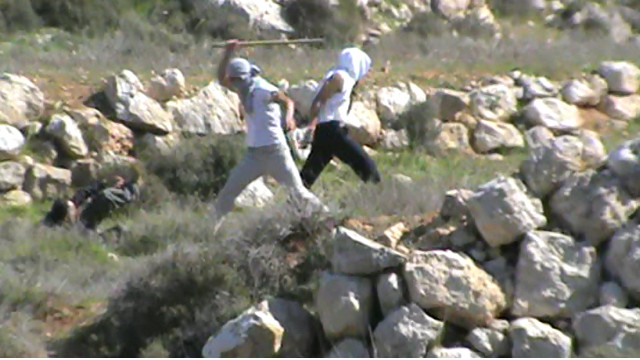
Settlement leaders are demanding that Israel deport American consulate staff who clashed with settlers Friday, according to the settler-affiliated news site Arutz 7.
According to Yossi Dagan, acting head of the Samaria Regional Council, the council of northern West Bank settlements, US consulate security guards threatened settlers with a handgun and an M16 rifle.
A confrontation broke out between security personnel from the US consulate in Jerusalem and settlers from the Ramallah-area Adei Ad outpost in the West Bank on Friday, after settlers hurled stones at two vehicles from the consulate.
The consulate staff arrived to the area at the inviation of the village of Turmus Ayya to examine thousands of olive tree seedlings which were uprooted Thursday night. Some of the seedlings belong to Palestinians who are also US citizens.
The Consulate security guards arrived at the agricultural lands to examine the scene and rule out any security risks, while the delegation members waited behind in the village. Settlers claimed they arrived to the area without coordination and brought Palestinians into their territory, saying the American visit was coordinated with the Israeli Civil Administration for next week.
According to police, the settlers pelted the convoy with rocks.
Dagan, wrote to the acting Israeli interior minister that the US consulate security guards crossed all red lines “and participated in a provocative tour with the Palestinians without any coordination as required with the IDF and police, and pulled out a firearm and threatened Israeli civilians.”
“I request that in view of the serious and criminal conduct, that these [US] security guards and officials be deported,” he added.
A State Department spokesman in Washington said US authorities were “deeply concerned” about the stone-throwing incident.
“We can confirm a vehicle from the Consulate General was pelted with stones and confronted by a group of armed settlers today in the West Bank, near the Palestinian village of Turmus Ayya,” said the US State Department spokesman according to AFP.
The spokesman added that “I do want to correct one thing proactively from some of the reporting I’ve read on this incident. No American personnel drew their weapons in the course of these events. What has been reported suggesting otherwise is inaccurate.”
Adei Ad is an unregulated Israeli outpost that was established in 1998 by a group of yeshiva students from the settlement o f Shvut Rachel. The settlement was established on land owned by Palestinians and is also considered illegal under Israeli law. In 1999 Israeli Prime Minister Ehud Barak ordered the outpost dismantled, although it never happened.
On 10 December 2014, Palestinian Minister Ziad Abu Ein died in a confrontation with Israeli soldiers during a a protest march to plant olive trees on this site.

She tried to stay quiet, she really did. But after eight years of keeping a heavy secret, the day came when Alayne Fleischmann couldn’t take it anymore.
“It was like watching an old lady get mugged on the street,” she says. “I thought, ‘I can’t sit by any longer.'”
Fleischmann is a tall, thin, quick-witted securities lawyer in her late thirties, with long blond hair, pale-blue eyes and an infectious sense of humor that has survived some very tough times. She’s had to struggle to find work despite some striking skills and qualifications, a common symptom of a not-so-common condition called being a whistle-blower.
Fleischmann is the central witness in one of the biggest cases of white-collar crime in American history, possessing secrets that JPMorgan Chase CEO Jamie Dimon late last year paid $9 billion (not $13 billion as regularly reported – more on that later) to keep the public from hearing.
read article at Rolling Stone here


 band annie's Weblog