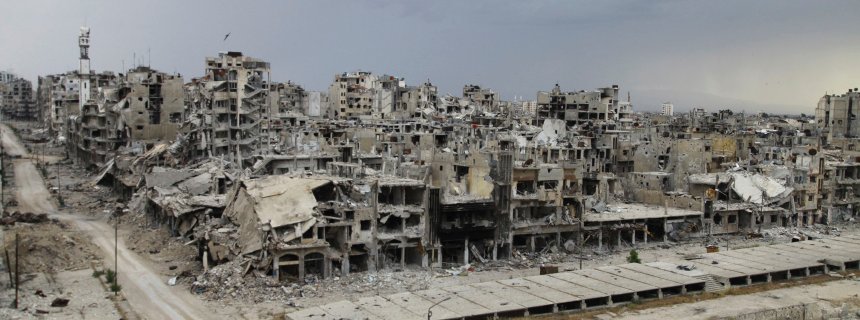
Homs in May: “People are telling me that Homs looks like Berlin in 1945.”
Mr. Brahimi, in May, you stepped down as the United Nations special envoy to Syria. When you took the position in 2012, many considered the task of achieving peace in Syria to be a mission impossible. What did you hope to achieve?
Brahimi: The idea was, and still is, for Bashar al-Assad to agree to become the kingmaker instead of staying on as president, an orderly transition with his participation to go to the new Syria. This is what I was and still am dreaming of.SPIEGEL: Can you point to a particular incident that showed you that it was time to give up?
Brahimi: When I ended the second round of discussions at the so-called Geneva II conference at the beginning of this year, I realized that this process was not going to move forward any time soon.
SPIEGEL: What happened?
Brahimi: Neither Russia nor the US could convince their friends to participate in the negotiations with serious intent.
SPIEGEL: To what degree is the dispute about the person of President Bashar al Assad?
Brahimi: The issue of President Assad was a huge hurdle. The Syrian regime only came to Geneva to please the Russians, thinking that they were winning militarily. I told them “I’m sure that your instructions were: ‘Go to Geneva. But not only don’t make any concessions, don’t discuss anything seriously.'”
SPIEGEL: What about on the other side?
Brahimi: The majority among the opposition were against coming to Geneva. They preferred a military solution and they came completely unprepared. But at least they were willing to start talking with President Assad still there as long as it was clear that, somewhere along the line, he would go.
SPIEGEL: So, you didn’t have a chance at all?
Brahimi: I told the Americans and the Russians several times while we were preparing for Geneva that they were bringing these two delegations kicking and screaming, against their will.
SPIEGEL: For the sake of his country, why couldn’t President Bashar accept a replacement leader that everybody could live with?
Brahimi: It is his regime. He still has an appetite for power. The regime is built around his person and he still has enough authority over people that having him stay in power is a fundamental part of their vision of the future. The way he puts it is, “The people want me there and I cannot say no.” He said, “I am a Syrian national. If I have 50 percent plus one vote at the elections, I’ll stay. If I have 50 percent less one vote, I will go.” Yesterday he was just re-elected for another seven years! You have a situation where one side says there can be no solution unless Assad stays in power. While the other side says there can be no solution unless Assad goes. Do you know how to square a circle?
SPIEGEL: Is Assad aware of the way the war is being conducted by his army?
Brahimi: One-hundred percent.
SPIEGEL: The barrel bombs being thrown from helicopters on civilian populations? The targeted bombing of hospitals? The systematic torture and killing of thousands or tens-of-thousands?
Brahimi: He knows a hell of a lot. Maybe he doesn’t know every single detail of what is happening, but I’m sure he is aware that people are being tortured, that people are being killed, that bombs are being thrown, that cities are being destroyed. He cannot ignore the fact that there are 2.5 million refugees. That number is going to be 4 million next year, and there are 6 million people who are internally displaced. He knows that there are 50,000 to 100,000 people in his jails. And that some of them are tortured every day.
SPIEGEL: Did you confront him with those facts?
Brahimi: Sure! I spoke to him of a list of 29,000 people in his prisons and I gave a copy of the list to his office.
SPIEGEL: Is the regime the major culprit or are war crimes also committed by others?
Brahimi: War crimes are being committed every day, by both sides. Starvation is being used as a weapon. When you prevent water and food from reaching 250,000 people, what else can you call that? And at the same time, some of the armed groups are using civilians as human shields. But the regime has a state, has an army with 300,000 men, has airplanes, which the opposition doesn’t have.
SPIEGEL: Does anybody track those war crimes and hold people responsible?
Brahimi: There is an investigation commission, working under the umbrella of the High Commission of Human Rights, that has been trying to look at all these human rights abuses and they are systematically collecting facts. People will be held responsible one day.
SPIEGEL: Who is the dominating force in the armed opposition?
Brahimi: The opposition is very fragmented, even the Free Syrian Army. But everybody understands that the jihadi group ISIS (Eds. Note: The Islamic State of Iraq and the Levant) is not really interested in Syria. They seek to establish a new order in the region. As long as there are no negotiations, the armed groups as well as the political opposition will continue to be fragmented.
SPIEGEL: Are any of those groups capable of winning the fight against Assad and his regime?
Brahimi: The United Nations secretary general has been saying all along that there is no military solution. Neither the regime, nor the opposition can win a decisive military victory.
SPIEGEL: What is your prediction for the future of Syria and the region?
Brahimi: Unless there is a real, sustained effort to work out a political solution, there is a serious risk that the entire region will blow up. The conflict is not going to stay inside Syria. It will spill over into the region. It’s already destabilizing Lebanon, there are 1.5 million refugees in the country; that represents one third of the population. If it were Germany, it would be the equivalent of 20 million. It is destabilizing because ISIS …
SPIEGEL: … the most radical and brutal armed opposition group, which seeks to establish a militant Islamic state …
Brahimi: … is active in both Syria and Iraq already, and Jordan is really struggling to continue resisting. Even Turkey! According to a senior Iraqi official, ISIS has carried out 100 operations in Syria and 1,000 operations in Iraq in just three months.
SPIEGEL: How could these radical forces emerge so quickly? Sources say that the Syrian regime itself helped unleash this phenomenon deliberately — that they have released hundreds of extremists from their prisons, even encouraging them to create an enemy that they can legitimately fight against. Is this correct?
Brahimi: I have heard this several times. People will tell you that ISIS controls one province and the government never attacks them. It is probably the government’s way of saying: “This is the future you will have if we are not there anymore.”
SPIEGEL: Will the states of Jordan, Iraq, Lebanon and Syria be able to survive?
Brahimi: They will not completely disappear as states, but it reminds me a lot of 1999. Then, I resigned from my first assignment as UN special envoy to Afghanistan because the UN Security Council had no interest in Afghanistan, a small country, poor, far away. I said one day it’s going to blow up in your faces. It did.
SPIEGEL: What is the link to Syria?
Brahimi: Syria is so much worse! This ISIS, they don’t believe in just staying there. And they are training people. Your countries are terribly scared that the few Europeans that are there may come back and create all sorts of problems. So just imagine what the feelings are next door!
SPIEGEL: Did the West make significant mistakes when the conflict broke out?
Brahimi: Most people did, the product of a wrong reading of the situation inside Syria — just as events in Tunisia and even in Libya were misread by most people. People have got it wrong every time. Which is understandable. It is complicated and these events erupted on us when we weren’t looking. What is difficult to understand is that the early, mistaken assumptions have not been revised. On all sides, people still help the war effort instead of the peace effort, and it is making things worse.
SPIEGEL: If the international community had only supported the Free Syrian Army with the right weaponry in the early stages, Assad could have been ousted and a peaceful transition could have prevailed. Do you share this assessment?
Brahimi: No, because I think they did help the Free Syria Army. But the thing is they thought that the regime was going to fall easily — complete misconception. Syria has a state, it has an army, and it was assumed that it was going to fall just like Libya did.
SPIEGEL: Might the Assad regime fall at some point?
Brahimi: So far he is still President and Russia and Iran still support him.
SPIEGEL: Is there any plan you can think of that might put an end to this conflict?
Brahimi: Iraq tells us that military intervention is a very, very dangerous way of solving problems. UN intervention is something else. If you have a peace-keeping mission that comes as part of an agreed solution, that would be different.
SPIEGEL: What should such a mission look like?
Brahimi: The UN has, I think, 20,000 or 30,000 soldiers that would be there to help the Syrians implement something they have agreed upon. And then you would need to face the ISIS, Jabhat al Nusra and (other radical groups). But first, the Syrians would have to agree for the UN to come in. It doesn’t look likely today or tomorrow, but this conflict has got to be resolved. And it will be at some point. The question is: How much killing and destruction are we going to have before that happens? People are telling me that Homs looks like Berlin in 1945.
SPIEGEL: Could the recent ceasefire in Homs be a model for other places like Aleppo?
Brahimi: The government starved the people there into surrender. The negotiation in Homs took place within the war project of the government, and it led to a victory by the government. But a lot of the things that have taken place during the last phase of negotiations over Homs could be part of a peace process. On previous occasions, many among the people who surrendered were arrested. It is alleged that some have been tortured or even killed.
SPIEGEL: What role do the countries backing each party play?
Brahimi: The Russians have consistently said it was not up to them to ask President Assad to leave office: “We do not have that much influence over him, even if we wanted,” they said. The Iranians said they accept that the crisis needs to be solved through negotiations, that at the end there must be free and fair elections and that this could be organized and observed by the United Nations. But then they said that, of course Assad would be allowed to stand if he wants. All three — Russia, Iran and Iraq — are supporting Damascus and delivering a lot of aid to them; probably money and definitely weapons.
SPIEGEL: How about the support for the armed opposition?
Brahimi: The Saudis, the Qataris and the Turks are supporting all kinds of political groups and armed groups. The foreign minister of Saudi Arabia said several times that the Syrian people are defending themselves against a brutal regime and it is legitimate to help them protect themselves.
SPIEGEL: We have been told that the Saudis even refused to meet with you.
Brahimi: That’s a fact. I think they didn’t like what I was saying about a peaceful and negotiated settlement with concessions from both sides. I am only guessing because I did not hear that from them. The irony is that hired pens for the regime are saying that I am Saudi Arabia’s man!
SPIEGEL: Could the Saudis and the Iranians come up with a solution if they were just to sit down together instead of letting their proxies fight about who will dominate the region?
Brahimi: Saudi Arabia is a very important country. King Abdullah is a very wise man and the Iranians, I think, with the new government that they have, also want to be constructive and responsible. Both countries have a responsibility. The region has to start discussing not how to help warring parties, but how to help the Syrian people, their neighbors. The other country that can help is Egypt.
SPIEGEL: To what degree does this conflict pose a threat to Israel?
Brahimi: Israel is very happy. Things are going very, very well for them. If Bashar goes it’s great; if Bashar stays it’s great. Syria is being weakened. Syria had some kind of strategic weapon with their chemical weapons and that’s gone. So Israel is doing very well, thank you very much. You don’t need to worry about them.
SPIEGEL: It sounds like you are saying that the Israelis are leaning back and saying: “Great, our enemies are killing each other.” Is the world that cynical?
Brahimi: I’m sure they are saying that. It’s a realistic point of view. Ask your Israeli friends; they will tell you it’s so.
SPIEGEL: What is the true story about the use of chemical weapons in this war?
Brahimi: They have been used, but there are conflicting views about who the culprits were. The UN was specifically requested by the Security Council to merely establish that chemical weapons were used. Not everyone agrees that it was the Syrian government who used these chemical weapons.
SPIEGEL: The West considers it fact that the Syrian government was responsible.
Brahimi: As I said, the UN investigating mission was strictly ordered NOT to try to determinate who the guilty party was. Now, from the little I know, it does seem that in Khan al-Assal, in the north, the first time chemical weapons were used, there is a likelihood that it was used by the opposition. Regarding the use of chemical weapons on Aug. 21, 2013 in the suburbs of Damascus, it is a fact that for the West and perhaps most people in the region, the responsibility lies with the regime. Moscow and Tehran say they are equally certain that the government DID NOT use chemical weapons anywhere. It is a great pity the UN was under strict instructions not to try to point the finger at anyone. More recently, there are again allegations that chemical substances have being used. I hope this time the UN will be asked to do its best to find out who the guilty party is.
SPIEGEL: What was the effect of US President Barack Obama not having done anything after poison gas was deployed in Syria; after the red line had clearly been crossed twice? Is America’s unwillingness, or inability, to intervene a dangerous portent?
Brahimi: I think that Obama — and the Russians — decided that, rather than take punishing action, they would solve the problem at its roots, and they may have done that. From their point of view, and from Israel’s, that is the better solution. But many Syrians on both sides are rather unhappy that the government is giving up the only strategic weapons they have; a weapon that was acquired at enormous cost to the people of Syria.
SPIEGEL: What do you think will ultimately become of Syria?
Brahimi: It will be become another Somalia. It will not be divided, as many have predicted. It’s going to be a failed state, with warlords all over the place.
SPIEGEL: What can the international community do, Europe in particular? What should Germany do?
Brahimi: The people in your governments know how dangerous this crisis is and how important it is to support a political solution.
SPIEGEL: Are you referring to the 320 Germans that have thus far joined ISIS?
Brahimi: And to the 500 or 600 French, the 500 or 600 British, and so on and so forth. There are several thousand non-Syrians. My goodness! These are your nationals that are training in Syria and that are part of ISIS, which believes that you have got to build an Islamic state all over the world, starting with Berlin. That’s a threat to you, isn’t it?

 band annie's Weblog