Holier than the Pope himself, Palin and Buchanan take Francis to task.

Photo Credit: Jennifer A. Walz/Shutterstock.com
November 16, 2013 |
It’s been a busy week for all manner of charlatans, religious and otherwise.
1. One-woman parade of idiocy, Sarah Palin: The Pope is too liberal; social programs are similar to slavery.
Sarah Palin was on book tour this week, telegenically spewing some of the stupidest nonsense we’ve heard since she announced she could see Russia from her house. We’d like to ignore her, but the fact is she’s hugely popular among a certain segment of the population, and her book about the “war on Christmas,” Good Tidings and Great Joy, is destined for best-sellerdom. Just don’t wish her “Happy holidays!” That is waging war, my friend.
As Christian as she is, though, during an interview with CNN, Palin complained about Pope Francis. She’s taken aback by his liberal attitudes, she says. Taken aback by his unayswillingness to go after the LGBT community and atheists, we suppose, and his sympathy for the lonely elderly, and unemployed youth. As Bill Maher said, Palin’s really going to be shook up when she finds out what Jesus said. Be sure to have tranquilizers available when she encounters the Sermon on the Mount.
Palin hopped right on that highly offensive bandwagon of equating the social safety net with slavery. “Our free stuff today is being paid for today by taking money from our children and borrowing money from China,” she said. “When that note comes due — and this isn’t racist so try it anyway, this isn’t racist — but it’s going to be like slavery when that note is due, right? We are going to be beholden to a foreign master.”
Insisting that you are not being racist when you’re comparing slavery to something far more benign is always a really convincing way to make people believe that you are in no way racist.
2. Pat Buchanan: The Pope is bordering on moral relativism. The horror!
Pat Buchanan is another conservative who is very upset that the Pope is not willing to use the Catholic Church to bully people anymore. Specifically, he misses license to bully atheists, women who use birth control and have abortions, and gay people. In his refusal to berate or convert atheists, and tell LGBT people that they are going to hell, Pope Francis is bordering on— cue music of dread — moral relativism.
Two of the statements that upset Buchanan the most: Pope Francis describing the attempt to convert people to Christianity as “solemn nonsense,” and saying that Christians should spend less time lecturing people than listening to them to “discover new needs.”
Why, that dastardly Pope Francis even acknowledged that people can be good no matter what their religious belief, or lack thereof. And he committed the cardinal sin (sorry, pun intended) of stressing helping the poor, rather than focusing on distractions like the gay lifestyle. As Buchanan wrote at Townhall on Friday, Pope Francis is leading “the Catholic Church to a stance of non-belligerence, if not neutrality, in the culture war for the soul of the West.”
A non-belligerent church?! What the hell?
3. Pat Robertson: Ask your gay son if he has been molested.
Ever the dispenser of sound parenting advice, 700 Club host, evangelical bigot par excellence Pat Robertson advised a caller to be “understanding” when talking to her gay son. By being “understanding,” he meant asking her son if the reason he is gay is because he was molested. Because that is always how people become gay.
“Is there a biological thing going on or has he been influenced — has a coach molested him?” Robertson asked the viewer who called in.
Either way, of course, the mother must immediately enroll her son in one of those gay conversion therapies; yes, the abusive form of pseudo-counseling that even ultra-conservative New Jersey Gov. Chris Christie was forced to acknowledge should be illegal.
(h/t Right Wing Watch)
4. Sandy Rios: Gay-waiter-refused-tip story just a clever ruse to help ENDA.
No doubt you’ll remember the story two weeks ago of the Kansas City waiter who, in lieu of a tip, received a note from his oh-so-considerate Christian customers saying that, despite his superb service, they couldn’t let him share in their riches because they, and god, disapproved of his lifestyle. That story went viral, and even Bill Maher picked up on it, suggesting that if you want to be selfish and cheap, just do it. Don’t claim it’s for the worker’s own good.
Unfortunately, the behavior has spread, with another family refusing a tip this week to a server they assumed was a lesbian. They were even less nice about it, treating her rudely from the start, racking up a sizable bill and gleefully stiffing the hardworker, who happens to be an ex-Marine, out of her gratuity.
But wait, back up, this just in: Sandy Rios of the American Family Association says the first story was a ruse — a hoax staged by the tricky LGBT community to drum up sympathy for ENDA (Employment Non-Discrimination Act) to pass in the Senate.
“I smell a rat in this story,” Rios said. “I don’t believe a Christian couple wrote this note, I think it was a ruse because it was the week ENDA was being voted on.”
If only progressives were as willing to engage in dirty tricks and outright deception as ultra-conservatives. If only… hatred was something that was merely stagecraft.
5. Rafael Cruz: Atheism leads to sexual abuse of children.
Ted’s dad. At it again. Downloading his unique combo of spurious lies, bile and nonsense.
This week, speaking at a gathering of a group we must look into joining, OK2A, described on its website as “Oklahoma Premiere Second Amendment advocacy group,” Rafael Cruz said, straight up, that atheism leads to sexual abuse of children.
Here is the logic he laid out to the assembled gun-toting crazies: “If there is nothing, if there is no God, then we are ruled by our instincts.”
Atheism leads to moral anarchy, he said. “Do we know any politicians that have done that?” he asked the crowd.
“Hitler!” answered Larry Pratt of Gun Owners of America, who, coincidentally, was in the audience.
“Oh, we don’t have to go that far, Larry,” Cruz chummily replied. “Just go to Washington. Just go to the White House.” From there, it’s a short hop to sexual immorality, perversion and sexual abuse, Cruz concluded.
Follow?
6. “Historian” David Barton: True Christian soldiers wouldn’t have PTSD.
Atheism is apparently a problem in the military, too. Because if soldiers were true Christians, they would not feel bad about killing enemies and sometimes non-combatants. They would not come home traumatized and have all these psychological problems.
Christian “historian” David Barton, the one who blamed Typhoon Haiyan on women having legal abortions, celebrated Veteran’s Day by criticizing veterans who feel at all guilty for what they do on the battlefield. If they read their Bible, he and televangelist Kenneth Copeland agreed on Believer’s Voice of Victory, they’d read in Numbers 32 that soldiers “shall return and be guiltless before the Lord” and that means that they wouldn’t have PTSD.
“You don’t take drugs to get rid of it, it doesn’t take psychology; that promise right there will get rid of it,” Copeland said.
When you go to war God’s way, Barton chimed in, “not only are you guiltless for having done that, you’re esteemed.”
So, get it together veterans!
(h/t: Right Wing Watch)
7. Rand Paul: Obamafascists are coming for your donuts.
This is truly terrifying. Right-wing libertarian wackadoodle Rand Paul took to the microphone this week to warn Americans that the federal government is targeting donuts. That’s what he said: “They’re coming after your donuts!”
Way to scare people. First, Madam Dictator Michelle Obama tries to get kids to eat more vegetables and exercise; now, the FDA is banning trans fats. Give me obesity or give me death! Or both, as the case may be.
You know who libertarian Paul is not so libertarian about? Gubb’mint employees.
“I say we should line every one of them up. I want to see how skinny or how fat the FDA agents are that are making the rules on this,” he said in his rousing donut hysteria-invoking speech.
Donuts, as Esquire’s Charles Pierce pointed out, don’t need trans fats to be delicious. The two largest donut purveyors, Krispy Kreme and Dunkin’ Donuts are making pretty tasty round pastries without them.
Credit where due, though: There’s no indication, yet, that Paul’s recent call to arms was plagiarized.
8. Rush Limbaugh makes deranged comments on Obamacare.
There have been a lot of deranged comments on Obamacare this week, including from theNew York Times when it idiotically compared the bumpy rollout of healthcare.gov to Bush’s handling of Hurricane Katrina. Hmmm, website = hurricane. Thousands dead = millions potentially getting health insurance. Yep, that analogy works.
Actually, all kidding aside, it’s monstrous.
While arguably Rush Limbaugh is less influential than the Times, and perhaps a tad more right-wing, he was not to be outdone in the crazy Obamacare hysteria that ran rampant this week. Rush, of course, does not like women, or sluts as he calls them, who use birth control. And Obamacare making it easier for them to do so is one of the healthcare act’s greatest evils in his view. Because he cares so much about millennials and their virtue, Rush took it upon himself to warn them on Wednesday’s show not to fall into this trap. What Obamacare is really advocating is not safer sex, he says—it’s prostitution.
“If you like being promiscuous, you can keep on being promiscuous,” Limbaugh, friend of the young, said. “If you like being a prostitute, then have at it!”
And summing up for emphasis:
“If you like your risky, promiscuous lifestyle, you can keep it. That’s what Obama is promising.”
Wait, that sounds kind of good, Rush. Thanks!
9. Phyllis Schlafly: Calling all border agents—be on the lookout for polygamist Muslims.
In a world that made any sense, conservative mouther-offer Phyllis Schlafly would have long ago faded into irrelevance. Frankly, we had assumed she was dead by now, but she’s alive and kicking, and still getting airtime to broadcast her ignorance.
While the Eagle Forum founder has long been preoccupied with fighting feminism, she also wants to make sure that those really sexist Muslims with multiple wives are not being let into our country. Yes, immigration, the changing complexion of America, and what that means for the welfare rolls is very much on Schlafly’s increasingly enfeebled mind these days.
She expressed these concerns on a radio show called “Crosstalk” the other day, saying:
“I would like to know if our immigration authorities are letting in people who believe in polygamy. Polygamy is against our law. We’ve brought in thousands of Muslims — I want to know if they made them sign a pledge to assure they’re not bringing in a bunch of wives who will now go on our welfare. Nobody can answer that question; I can’t get any answers to that question.”
Luckily, a caller to the show had an answer. He asserted without an iota of doubt that the Obama administration was bringing in 40 to 50 million Muslims and that they will destroy our constitution and implement Sharia law.
On the bright side, Phyllis: feminism and Sharia law do not go well together. Time to make friends with the enemy of your enemy?
10. Louisiana official: Close the libraries so those Mexicans can’t learn English; build a jail instead.
Most immigration hardliners also believe that anyone who comes to this country damn well ought to learn English. No bilingual education, no chance of Americans ever rubbing elbows with people who don’t speak Amurrican.
But Lindel Toups, who sits on the Lafourche Parish City Council, is upset that Mexicans are trying to learn English, and he’d like to divert funding from libraries to a new jail because of that fact. Toups played down the importance of libraries in recent comments to the Tri-Parish TimesandBusiness News, by pointing out that the Spanish-language Biblioteca Hispana section helps Spanish-speakers learn English.
“They’re teaching Mexicans to speak English,” Toups said “Let that son of a bitch go back to Mexico.”
Libraries are apparently a great source of evil. “There’s just so many things they’re doing that I don’t agree with… Them junkies and hippies and food stamps [recipients] and all, they use the library to look at drugs and food stamps [on the Internet]. I see them do it.”
The citizens of Lafourche Parish are voting this week on whether to keep $800,000 in the library system or put it toward the $25 million needed for a new jail. That way, they might be able to avoid an increase in taxes.
Be afraid. Be very afraid.
Belgian movie “Het Vonnis” (“The Verdict”) is more than just entertainment. The first few minutes, during which the lead character sees everything he cares about shattered and destroyed, are very good. The director creates intensity with some creative aerial shots and fast focus changes. The courtroom scenes at the end are another highlight. Director Jan Verheyen chooses to muffle the sound of the judge reading the final verdict, but he shows in an indirect way if the suspect is guilty or not. The story is based on true events, what makes the movie more interesting to see. This film brought me more than I expected, and so I can recommend it!


We are going through hell and our friends inside Syria are being torn limb from limb. You come in after three years of it and tell us what our uprising is and isn’t and what it should be and shouldn’t. We all started out together in it, hopeful, finding each other, Syrians, talking to each other again after years of monstrous silence twisted by so many layers of fear, generations of fear handed down by the trauma of families with absent members in prison. Young people began hearing their own voices for the first time, shouting “freedom.” “It was the first time I ever heard my own voice,” young women, young men, street protesters, have told me over and over. Working-class urban neighborhoods and farming- and middle-class rural villagers across the country came out for clearly stated goals of human rights and democratic freedoms and no more being ruled by police state, and it had nothing to do with Islamists but that was before you bothered to notice. Some 920 different locales were protesting nonviolently on a weekly basis by summer 2011, with at least 4 million of Syria’s 23 million people having protested at the height of 2011. Even this first reality, you won’t acknowledge.
Stunning arrogant brutality is how this police state met this uprising. Insane brutality and duplicity. House-to-house raids, tank and machine gun fire, ground troops, snipers, home burnings, the capture and torture of children, the siege of Daraa—all this before the uprising began to arm. The pressure for self-defense was intense. Come live in it for a day. I don’t think you’ve ever been stopped cold by the tears and the anguish in the individual self-defense argument from a real Syrian human being demanding, “if a regime militia is raiding my home, about to kill my children, how dare you tell me not to lift arms to try to save them.” I am stopped cold by it, every day.
My only answer is: “look, I’m really sorry, but look at the facts; after the revolution lifted arms, your children are dead and so is the whole neighborhood. Arms are not working; self-defense is not defending; it is making you a more legible target for the lethal regime. It defended that home for two hours or two weeks, but in the end the entire neighborhood was flattened by the regime, because the regime is hugely more armed. Nor will outside military intervention save you. You can only win if you band together in slow, organized, nonviolent resistance.”
I say this and I staunchly advocate nonviolence over the din of shelling, but my voice breaks saying it to someone whose children are cowering tonight because the home is shaking because the town is being shelled and his parents are already dead. Some far-sighted Syrians got that having the (secular) FSA only drew heavier regime fire. Most Syrians did not get it—gasp, they live in a pro-violence culture like most of the world—and felt the only answer to the inequity in arms only means all their problems would be solved by heavier arms for the (secular) FSA which they see as defending them. I know they’re only harming themselves in believing this romance of armed liberation, but I know it from their pain, and I can only tell them with my voice shaking because I am at a privileged distance from them, and because I haven’t been able to help them in any other way stronger than they see the (secular) FSA helping them, and then the armed Islamists—who did not come in until 2012, able to wedge in because of the regime devastation wreaked on nonviolent uprising Syrians whose screams went unheard by you, able to ride in on the false promise of armed liberation and humanitarian aid not provided by others.
And you hear their cry for arms, and you brand them intransigent militants, and demand why they won’t go to Geneva. I demand that too, but I do it from inside a Syrian anguish, at far higher damage to myself than it costs you. You then turn around and cast aspersions on me and Syrians with similar stands, not even allowing us our embattled path, because of our “associations;” we wake up damned if we do advocate nonviolence, and damned if we don’t.
Our “associations?” We are Syrians. We all started out together. Hopeful. Three years ago, we did not know how things would unfold. We began working together and creating histories and relationships. And now that different paths have been trod in this revolution, you come in and tell us we are not allowed to be associates, to be related to other Syrian people in this revolution who’ve taken other paths? There are people on the pro-FSA side who I think have done no end of damage to this revolution, but for whom I’d give my life as much as for people in civilian resistance. Yeah, those are my associations.
You breeze in and say, in effect, “how dare these Syrians fall for the romance of armed liberation. They offend my anti-imperialist stance as a progressive American. Every leftist revolution has fallen for that romance and every other revolution too, but how despicable and primitive of these Syrians to fall for it.” You demand we apologize for “associating” with each other. You demand we devote our energies to proving we are nonviolent and meet your standards, like a man demanding a feminist prove she is not a man-hater and has never associated with militant separatist feminists. This, while we get derision from fellow Syrians every day for insisting that this brutal regime can be stopped by nonviolence, hisses from starving freezing impoverished people facing its gun barrels in their faces every day, before whose trauma we tremble. Insulated from realities on Syrian ground, you point to one of us and say, in effect, “How dare any of you Syrian activists abroad be tempted, even for a moment, to see an iota of use in bombing assad’s military airports that are bombing your people?” In the din of this shriek of pain that we hear unceasingly, to the edge of our insanity, from Syrians in Syria, how dare we as Syrian peace activists abroad ever register the temptation to sympathize with the primal desire that someone, anyone just come and bomb the fuck out of this monster killing people we know daily. How dare I have a friend like that.
Instead of offering one bit of solidarity, you come in to tell us who we are and who we should be and are suspicious of us if we are not packaged into discrete separate compartments for you. We’re not up to your standards. We are Syrians and yes, we associate with each other, nonviolent proponents and Coalition and FSA-proponents and hard-drinking Syrian atheists and Muslim Brotherhood and gay Syrians and Nusra sympathizers, all fighting the regime
together in our different ways; and some of us even have nephews in assad’s army just as much as nephews in Assad’s prisons and in the FSA, and regime loyalist aunts, and military officer dads about whom we are terrified they could be killed and horrified they could be torturing someone.
Yes, simultaneously. Because that is what it is to be Syrian today. Yes we are all cousins, all in-laws, all related, all family, and we all will have to live with each other for years to come in this Syria boat that is a life and a home and a country for Syrians even if it is an equation on a piece of paper for you, and we in this Revolution hate and love each other and fight with each other all while struggling against a brutal regime for a future Syria that has some ounce of justice, some human dignity and freedom in it, and for us there is green and good in Syrians worth struggling for still, and who on earth are you to drain one drop of our precious few remaining energies.
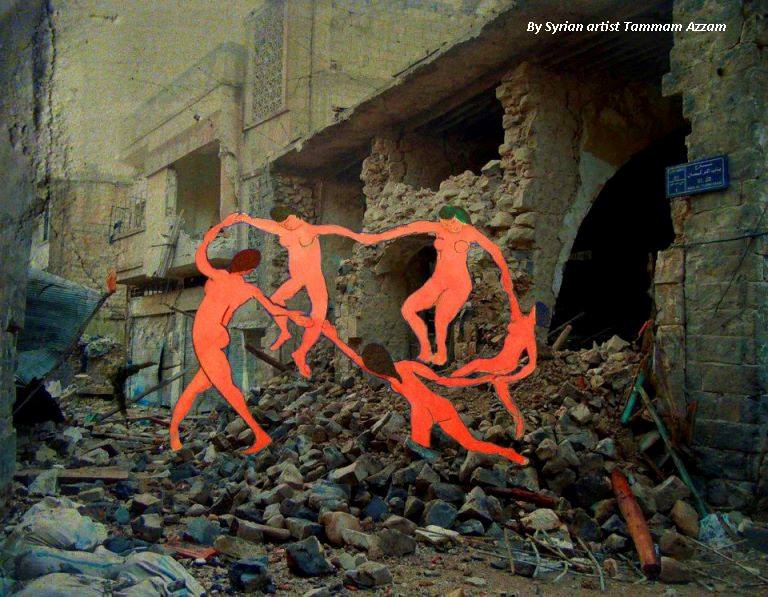
source : Syrian activist Mohja Kahf to American leftists
Adam Shatz
On the afternoon of Saturday, 4 April 2011, Juliano Mer-Khamis walked out of the Freedom Theatre in the Jenin refugee camp and got into his old red Citroën. It was four o’clock, the sun was hot and the street crowded. He put his baby son, Jay, on his lap, placing the boy’s fingers on the steering wheel; the babysitter sat next to them. As he set off, a man in a balaclava came out of an alleyway and told him to stop. He had a gun. The babysitter told Juliano to keep driving, but he stopped. The gunman shot him five times, then walked back down the alley. He left his mask in the street. Jay survived; the babysitter escaped with minor injuries. When Israeli soldiers arrived, less than thirty minutes later, Juliano was dead. They took his body to Israel, along with his car, computer, wallet and other effects.
see also this article on same subject
BEIRUT – The mainstream rebel Free Syrian Army has laid out the conditions for its participation in Geneva peace talks, including the demand that a transitional authority be given full powers.
The international community has been seeking for months to convene a Syria peace conference in Geneva, but proposed dates have come and gone with no progress towards talks.
In a statement issued on Monday night, the FSA’s military command high council welcomed “any political solution [to the conflict] based on clear objectives.”
The so-called Geneva II conference, it said, should “announce precisely that its objective is the formation of a transitional national government with full powers.”
It called for an “agreement in principle on the abdication of [President Bashar al-] Assad.”
The Free Syrian Army also sought a “specific timetable” for negotiations under Chapter VII of the UN Charter which authorizes use of force.
It demanded the formation of an “independent judiciary charged with bringing to justice the perpetrators of crimes against the Syrian people” and the release of prisoners.
In addition, it called for an end to “killings and bombings” carried out by the Assad regime and the “opening of humanitarian corridors” to areas besieged by government forces.
It also said that fighters from neighboring countries that back Assad’s forces should leave Syria, including those from Iran, Iraq and the Lebanese Shiite movement Hezbollah.
And it said the opposition should be represented in Geneva by a “single delegation” made up of the National Coalition and the FSA’s military council.
The announcement coincides with a similar declaration by the umbrella opposition National Coalition, which has threatened to spurn the conference to end Syria’s 32-month conflict unless the FSA backs the initiative.
Opposition figures have long demanded that Assad should step down and have no role in any political transition, but the regime insists his departure is not up for discussion.
Rebels fighting Assad’s forces are split between the FSA and guerrillas linked to Al-Qaeda.
Stuxnet Infected Russian Nuclear Plant, International Space Station
on November 12, 2013 at 12:47 AM
11/08/2013
SC Magazine:
Stuxnet had ‘badly infected’ the internal network of a Russian nuclear plant after the sophisticated malware caused chaos in Iran’s uranium facilities in Natanz.
The malware, widely considered to have been developed by the US and Israel as a means to disrupt Iran’s uranium enrichment plans, had crossed a physically separated ‘air-gapped’ network in the Russian plant after it was carried across on a USB device.
Eugene Kaspersky, the charismatic boss of the Russian antivirus company bearing his name, said a staffer at the unnamed nuclear plant informed him of the infection.
“[The staffer said] their nuclear plant network which was disconnected from the internet … was badly infected by Stuxnet,” Kaspersky said.
But USB devices were used to ferry malware cross a far greater air-gap: Russian astronauts had carried a virus on removable media to the International Space Station infecting machines there, Kaspersky said.
In a presentation given at the Canberra Press Club designed to give mainstream journalists a broad overview of the state of information security, the chief executive offered his view of the state of online crime and state-sponsored espionage.

