see also
Palestinians know that if Cairo sneezes then Palestine, especially Gaza, is first to get the flu. Indeed, Gaza often serves as a tool of regime policy, as was the case during the Mubarak years and during the short-lived government led by the Muslim Brotherhood’s Freedom and Justice Party, and is still the case with the current regime since July 2013.
The Mubarak regime’s policy towards Gaza was generally repressive. It participated in Israel’s draconian siege of the enclave, underway since 2006, and was fully complicit in Israel’s brutal offensive against Gaza in 2008-9. Former Egyptian foreign minister Ahmed Aboul Gheit was standing next to his Israeli counterpart Tzipi Livni when she declared war on Gaza during her visit to Cairo in 2008.
Aboul Gheit went so far as to threaten to break the legs of the Palestinians of Gaza if they “encroached on Egypt’s national security” after they breached the border wall with Egypt, seeking to buy medicines and other necessary supplies in Al-Arish City. Naturally, such a repressive policy had to involve demonization of the Gaza Palestinians, painting them all as members of Hamas.
Hamas had great expectations of change after the downfall of the Mubarak regime, including the permanent opening of the Rafah Crossing and the free passage of people and goods, thus eliminating the need for the tunnels connecting Gaza to Egypt. Some optimists further hoped that the efforts for reconciliation between Hamas and Fatah would finally bear fruit, given that the Mubarak regime had been biased towards Fatah.
However, the transitional rule by the Supreme Council of the Armed Forces (SCAF) that took power after Mubarak’s downfall did not lift the siege on Gaza or change the Egyptian political approach to Palestine. The tunnels continued to ply their trade to compensate for the massive shortage of supplies blocked by Israel. The Rafah Crossing was partially opened for very limited periods of time, depriving 1.7 million Palestinians of the basic right of freedom of movement.
The high hopes were therefore deferred until the Egyptian presidential elections. Palestinians believed that a democratically elected president would have the power to take sovereign decisions and implement the nationalist and Islamist position of ending the blockade on the Gaza Strip, revisiting the Camp David Accords, and responding to the Palestinian Call For Boycott, Divestment and Sanctions until Israel abided by international law. Some even believed that the newly elected president’s first trip abroad would be to Gaza. Ironically, the first visit Mohamed Morsi made after his election was to Saudi Arabia, which had been hostile to the Egyptian revolution; a visit to Gaza was never in the cards.
In fact, the Muslim Brotherhood was unable to rise to the challenge of government. They came late to the January 25 revolution, seeking first to appease the Mubarak regime. They then forged a temporary alliance with the SCAF and endorsed some of its most violent actions, including the October 2011 assault on peaceful demonstrators, many of them Egyptian Copts, protesting the demolition of a church in Upper Egypt. Once in government, they lacked a clear political vision; one could have easily mistaken the president’s speeches for a Friday sermon or an address by a tribal leader.
On the home front, the Brotherhood failed to make even limited progress in realizing the demands of the January 25 revolution for bread, freedom, social justice, and human dignity. The economy nearly collapsed and security worsened. Radical Islamist Takfiri groups increased their hold in the Sinai and Israel appears to freely wander through the area, to the extent of reportedly abducting a Palestinian there this June. Despite this reality, the Gaza Palestinians are forced to pay the price of any criminal act that takes place in Sinai.
The Brotherhood’s slogans against Israel – such as “we shall march to Jerusalem in our millions” – and the United States disappeared after they came to power. Instead, it adopted a pragmatic position well to the right of the political spectrum. Pragmatism meant a commitment to international agreements, a special relationship with the U.S., loans from the International Monetary Fund, and diplomatic ties with Israel.
There was no attempt to abrogate the 1979 peace treaty nor even to put it to a popular referendum. On the contrary, a few months into his term, Morsi sent a very friendly letter to Israeli President Shimon Peres regarding the appointment of the new Egyptian ambassador to Tel Aviv. He described Peres as his “great and good friend” and expressed his “strong desire to develop the cordial ties” between the two countries. Meanwhile, the blockade against Gaza was tightened: Almost all the tunnels were shut down and the Rafah Crossing functioned at a snail’s pace.
The Morsi presidency took credit for brokering a ceasefire agreement between Palestinian factions and Israel in November 2012 but failed to intervene to hold Israel to its commitments, including lifting the blockade against Gaza. The fact that Morsi’s Egypt did not stand by Gaza during that short but ruthless war that killed more than 200 Palestinians, mostly civilians, was a bitter disappointment to the Palestinian leadership in Gaza, especially as Palestinian fighters had successfully stood their ground against the Israeli onslaught and had expected political gains as a result.
Instead, Morsi capitalized on his “victorious” mediator role to achieve his aims at home. Just three days after the war on Gaza ended he issued his notorious Constitutional Declaration giving himself powers unprecedented in Egypt’s modern history.
In short, Mubarak’s policy toward the Palestinian cause and especially toward Gaza was passed on to the Brotherhood, which did not dare challenge the crime against humanity taking place on Egypt’s border – a crime that human rights organizations and the United Nations have condemned as collective punishment with some saying it amounted to slow genocide. The victimized Palestinians were asked to be “understanding” of the transitional period that the Brotherhood needed and not to demand the impossible, as if opening the Rafah Crossing for the passage of people and goods was an impossibly heroic act.
The Egyptian military regime in power since July 3, 2013 is now demonizing everything Palestinian. The Gaza Strip is facing a far harsher blockade affecting all the crossings, including an almost complete closure of the Rafah Crossing and destruction of the tunnels. An unprecedented incitement campaign is underway in several Egyptian media outlets, especially those financed by businessmen affiliated to the Mubarak regime and some Gulf countries hostile to the January 25 revolution. Palestinians are regularly excoriated on Egyptian TV. Some commentators are gleeful over the fate awaiting Gaza’s Palestinians while others assert Hamas’s involvement in Egypt’s internal affairs and call on the Egyptian Army to launch a military attack against the Gaza Strip. Some even “accuse” Morsi of being of Palestinian origin.
Once again, the Palestinians have become the target of the Egyptian authorities’ security complex: They are the weakest link in the Arab chain and have no strong government to represent them. They are regularly harassed at and deported from Egyptian airports and crossings, even if they are simply transiting to and from Gaza. The Palestine Liberation Organization (PLO) has issued no statement calling on the Egyptian government to alleviate the stifling blockade or ensure decent treatment of Palestinian passengers. On the contrary, the PLO and particularly Fatah are rejoicing over the Brotherhood’s downfall and the difficulties this will pose for Hamas. Meanwhile, the Gaza government now faces an impasse and has no idea how to respond.
There is no doubt that this chauvinistic campaign to hold Gaza responsible for all of Egypt’s ills – from the fuel shortages to terrorism in Sinai – serves the feloul (remnants) of Mubarak’s regime, who are now in full resurgence. It is very disturbing that Egypt’s progressive voices have been silent in this regard, with some notable exceptions, even though all Palestinians, at both the official and popular levels, have condemned the terrorist acts in Sinai.
Moreover, no evidence has been found of Palestinian involvement in Egypt, including Sinai. Even if there had been, the collective punishment the Egyptian authorities are applying against the Palestinians of Gaza violates international law. By contrast, Egypt did not cut diplomatic ties with Israel, threaten military intervention, nor impose any restraints on Israelis visiting Egypt despite the many Israeli crimes against Egypt since the Camp David Accords, including the killing of five Egyptian soldiers in an Israeli airstrike in 2011.
Besides, isn’t Sinai a problem of Egypt’s making? Everyone knows that Mubarak’s regime neglected the Sinai, treating its population as second-class citizens and denying them essential services even though they are Egypt’s first line of defense. Gaza is a natural extension of the Sinai Peninsula and is therefore also part of Egypt’s national security. It is vital that the valiant Egyptian revolutionaries that brought down the Mubarak regime stand up to that regime’s feloul and their counter-revolution, which is using Palestine as a scapegoat.
There is no question that the Egyptian people as a whole remain passionately committed to Palestine and its people, despite the best efforts of the feloul. This spirit was captured in the statement issued by several intellectuals and politicians protesting the media campaign targeting the Palestinian people, demanding that the government clarify “Egypt’s policy and commitments toward the Palestinian people,” and calling on the government to preserve “all the rights of Palestinians in Egypt.”
The Egypt we want and the Egypt we need is a pluralistic, democratic and free Egypt with full sovereignty over its territory from its western border with Libya to its eastern border with Palestine, an Egypt that honors the principles for which so many laid down their lives in the January 25 revolution.
This article was first published by Al Shabaka: The Palestinian Policy Network.

With corpses filling Cairo’s streets and both sides vowing to escalate, any glimmers of revolutionary hope have been all but extinguished.

A trampled poster of Egypt’s ousted President Mohammed Morsi is seen on the ground outside the Rabaah al-Adawiya mosque, where supporters of Morsi had a protest camp in Nasr City, Cairo, Egypt, Friday, August 16, 2013. (AP Photo/Hassan Ammar)
Cairo at night has become a city of silence. Once among the world’s most crowded and raucous nocturnal metropolises, it is now home to ghosts, a place haunted by fear and despair. Never ones to abide by past military-imposed curfews, Egyptians stay indoors after sunset. The night is owned by helicopters roaming the skies, fat army tanks sitting heavily in the streets and bands of men wielding knives, clubs and guns at makeshift checkpoints. The occasional crackle of gunfire rings out, a reminder that the violence has only slowed, not stopped.
Most of the killing is done during the day. Over 1,000 dead in three days of carnage. As a reporter covering conflicts over the years, I have seen many dead bodies—but never have I seen so many people dying before my eyes. The last gurgling gasp of air, the eyes turning lifeless, the rising wails of grief.
As Egypt plunges headfirst into a deadly downward spiral with no end in sight, many of its citizens are baying for still more blood. Both sides leading the conflict, the military and the Muslim Brotherhood, are playing a zero-sum game, based on a false binary demanding that Egyptians choose one or the other. Both are defined by hierarchy, patriarchy, secrecy, mendacity and a blinding sense of their own superiority. Both are juggernauts in the Egyptian body politic that have heedlessly clawed away at Egypt’s social fabric in their struggle for power, proving time and again that their own political and economic interests trump all.
In meting out violence, the military and security apparatus has an overwhelming advantage, and its forces have done so with unflinching brutality. The storming of the sit-ins supporting deposed president Mohammed Morsi on August 14 marked the bloodiest day in Egypt’s modern history, with more than 800 dead. Cairo was inundated with corpses. In the al-Iman mosque the day after the raids, more than 230 bodies lay on the floor. The smell of death hung heavy in the summer heat, as family members placed blocks of ice on the bloodied shrouds to try to stave off the decay. Many of the bodies were charred beyond recognition, blackened by the fire that burned down the field hospital and the Rabaa al-Adeweya mosque, the epicenter for Morsi’s supporters over the past six weeks.
Justifying the crackdown, the government and police repeatedly assured Egyptians and the rest of the world that, in fact, they had acted with the utmost self-restraint. “Terrorism” was the word repeatedly used, with Army spokesman Ahmed Ali succinctly summarizing the state’s logic of violence. “When dealing with terrorism,” he said, “the consideration of civil and human rights are not applicable.” The military-backed cabinet, the security establishment and the allied so-called “liberal” elite have vilified an entire swathe of society as violent extremists unfit for political life.
Those who don’t toe the line are demonized. Mohamed ElBaradei, the Nobel peace laureate who resigned as vice president of international affairs in protest of the violent storming of the sit-ins, has been subjected to a merciless defamation campaign. One popular cartoon shows him stabbing Egypt, depicted as a woman, in the back. On Sunday, August 18, he boarded a plane to Austria, declining to give interviews about the reasons for his departure.
Any media coverage remotely critical of the crackdown has been met with vicious rhetoric from all sides, manifesting itself on the streets as a rising number of attacks on journalists, particularly foreigners. On August 17, Egypt’s State Information Service released a statement to foreign correspondents, criticizing international coverage as biased in favor of the Muslim Brotherhood and accusing them of conveying “a distorted image that is very far from the facts…. This raises many questions about the neutrality of the media and its goals.”
Within Egypt, local media have helped whip up chauvinistic nationalism and a wave of state worship that has gripped the country. Millions of Egyptians have run headlong into the arms of the military and the police state to oust Morsi and his ilk, seeking a security blanket that is really a straightjacket.
As it stands now, much of Egypt is now under a month-long state of emergency and a nighttime curfew. The interior ministry has granted itself the authority to use live ammunition against anyone who assaults police or state institutions. Among those who have survived the bloodshed, more than 1,000 Islamists have been arrested and much of their leadership jailed. The prime minister has proposed disbanding the Muslim Brotherhood—or what is left of it—altogether.
Morsi’s supporters have engaged in violence of their own, killing civilians and security officials, attacking government institutions and sparking a low-level insurgency in Sinai. The security establishment appears to welcome the escalation, intentionally provoking the Islamists to adopt even more hardline tactics and commit more violence, in a bid to justify further repression and forever push them outside of politics.
Egypt’s largely helpless Christian population, meanwhile, is being forced to pay the price for the state’s brutality against the Islamists. For months the Brotherhood and its allies have used divisive religious rhetoric to further their political goals, a trend that reached new heights following Morsi’s ouster, with sectarian vitriol frequently emanating from the stage at Rabaa. After the sit-ins were forcibly dispersed, dozens of Christian churches, monasteries, schools and facilities across the country have been attacked and burned down in a wave of reprisal attacks. The police and the army have done nothing to protect them.
Each day brings new horrors, nightmarish scenes Egyptians could never have imagined. Nuns paraded on the streets like “prisoners of war.” Urban warfare with hovering choppers kicking up dust. Citizens opening fire on one another. People jumping off bridges to avoid bullets, falling and crumpling to the floor motionless. The scale of human loss is staggering—and with both sides vowing to escalate, worse days surely lie ahead.
Today, many of the revolutionaries who fought the country’s successive authoritarian regimes—first Mubarak, then the Supreme Council of Armed Forces, then the Muslim Brotherhood—now find themselves sitting on the sidelines, pushed out of the discourse and forced to watch as the bloodletting continues. The transformative revolutionary moment that exploded on January 25, 2011, has become a faint glimmer, in danger of being extinguished completely. “Despair is betrayal” is the mantra that has echoed throughout Egypt during the many tough times over the past two and half years. Today, it is very hard not to feel like a traitor.
The violent clampdown by security forces has all but ended the possibility of a rapprochement with the Muslim Brotherhood.
At least seventy-four people were killed in skirmishes between Morsi supporters and armed men this weekend.
Aug 16, 2013 04:16 pm | Tom Suarez

The BBC has confirmed that it will censor a statement made by violinist Nigel Kennedy from its television broadcast of his performance with the Palestine Strings at a prestigious music festival last week. The BBC made the censorship move because he used the word “apartheid” to describe the world in which his Palestinian colleagues live while performing at the BBC Proms.
Click here for a recording of the actual statement the BBC is excising from its broadcast[1]. The following is a transcript:
“It’s a bit facile to say it, but we all know from the experience of this night of music, that giving equality and getting rid of apartheid gives a beautiful chance for things to happen.”
According to The Jewish Chronicle[2], BBC governor Baroness Deech called for an apology from Mr. Kennedy and said that “the remark was offensive and untrue. There is no apartheid in Israel.” Not only is there no apartheid in Israel, she claimed, but nor is there any in Gaza or the West Bank. (She made no mention of East Jerusalem.)
In fact, nearly all aspects of Apartheid, as defined by the UN, apply to Israel in all four of its guises: domestically, its military occupation of the West Bank, its military ‘annexation’ of East Jerusalem, and its siege of Gaza.
This legal definition includes [3]:
• Any measures including legislative measures, designed to divide the population along racial lines by the creation of separate reserves and ghettos for the members of a racial group or groups, theprohibition of mixed marriages among members of various racial groups, the expropriation of landed property belonging to a racial group or groups or to members thereof;
• Any legislative measures and other measures calculated to prevent a racial group or groups from participation in the political, social, economic and cultural life of the country and the deliberate creation of conditions preventing the full development of such a group or groups, in particular by denying to members of a racial group or groups basic human rights and freedoms, including the right to work, the right to form recognised trade unions, the right to education, the right to leave and to return to their country, the right to a nationality, the right to freedom of movement and residence, the right to freedom of opinion and expression, and the right to freedom of peaceful assembly and association;
• Denial to a member or members of a racial group or groups of the right to life and liberty of person;
• The infringement of their freedom or dignity, or by subjecting them to torture or to cruel, inhuman or degrading treatment or punishment;
• Arbitrary arrest and illegal imprisonment of the members of a racial group or groups;
• Deliberate imposition on a racial group or groups of living conditions calculated to cause its or their physical destruction in whole or in part;
• Inhumane acts committed for the purpose of establishing and maintaining domination by one racial group of persons over any other racial group of persons and systematically oppressing them.
1. The volume of Mr. Kennedy’s voice has been raised slightly for clarity.
2. Marcus Dysch, “BBC to cut Kennedy slur from Proms broadcast“, The Jerusalem Chronicle Online, August 16, 2013.
3. Source: UN, International Convention on the Suppression and Punishment of the Crime of Apartheid. Bold emphasis added.

An enormous shopping mall the Israeli army claims is in the Gaza Strip. (Source: IDF Blog)
In one of its periodic efforts to deny the devastating effects of its siege of Gaza, the Israeli occupation army published a blog post on 12 August claiming that Palestinians in Gaza are “out in force, enjoying themselves in sparkling new malls, beautiful beaches and hotels, and doing their shopping in pristine grocery stores and markets heaving with fresh produce.”
The “IDF blog” includes the impressive photo above of a shopping mall where Palestinians in Gaza are supposedly shopping for the latest imported fashions.
I showed the photo to The Electronic Intifada’s correspondent in Gaza, Rami Almeghari. His reaction: “I can assure you that there is no such mall in Gaza.” Rami is quite right.
If you do a Google Image search using the image from the “IDF” blog post, the same image turns up associated with the Metro Plaza shopping mall in Kolkata, India as well as several other places.

A Google image search turned up many examples, like this one, of the image associated with other malls.
But the “Gaza mall” photo published by the Israeli army is actually an image of the Suria KLCC Mall in Kuala Lumpur, Malaysia, as numerous user-generated photographs on the travel review site TripAdvisor.com attest.
You can also see many people shopping at the mall – in Malaysia – in this video:
Before publishing it on 12 August on its English-language website, the Israeli army published the same post in French on 4 August.
It was then published by the anti-Palestinian website Tribune Juive the same day.
But some of the material had already circulated on many other Islamophobic websites long before.
For example, the same Kuala Lumpur mall photo, purportedly in Gaza, appeared on a virulently Islamophobic blog called “Barenaked Islam” in April 2012, and was disseminated on Facebook by “Geert Wilders supporters,” a page dedicated to the Islamophobic Dutch politician.
It also appeared on “Religion of Peace,” another anti-Muslim hate site.
It would appear that the Israeli army gets its information about Gaza from Islamophobic hate sites.
The Kuala Lumpur shopping mall is vastly bigger than any commercial facility anywhere in Gaza.
But another image, the supermarket shown on the “IDF” blog, appears to be the Metro supermarket in Gaza. I didn’t visit it, but I did visit the Abu Dallal supermarket in Nuseirat refugee camp.
I was told that Abu Dallal is one of largest supermarkets in Gaza. By American, European, or Jordanian standards it is not very big, smaller than an average CVS or Boots drugstore.
More important than its size, however, is that like other stores in Gaza, it is packed full of Israeli goods.
That’s one of the ways the Israeli blockade creates dependency: While Gaza industry and agriculture are devastated by the siege, Israel is happy enough to see its own companies profiting from people in Gaza, siphoning off what little income they have, whether from work, humanitarian aid or remittances abroad, by selling them Israeli goods.
But Israel is much more restrictive when it comes to supplies that meet basic needs and could allow Gaza to move out of dependency. There is, for example, a shortage of 250 schools for Gaza’s children, which cannot be built due to the lack of building supplies.
And the reality is that while there is food in Gaza, “severe poverty has increased over years of closure and because of travel restrictions,” Gisha, an Israeli nongovermental organization that monitors the siege, noted in a recent factsheet.
More than 70 percent of the Gaza population receives some form of humanitarian aid, compared with one third in the year 2000.
For imports of raw materials and many basic goods, Gaza’s economy remains heavily dependent on underground tunnels to Egypt, as I saw myself during my visit, and as Gisha also documents.
Since the Egyptian military coup on 3 July, the Egyptian army, which works closely with Israel, has been instensifying its effort to destroy the tunnels.
Israel continues to crush Gaza’s export industries. According to the UN Office for the Coordination of Humanitarian Affairs, Israel has allowed a total of 94 trucks out of Gaza in 2013 – that’s about a dozen a month from a population of almost 1.7 million people. Insignificant.
By contrast, in 2007, the year before the siege began to bite, more than 5,000 trucks were allowed out of Gaza. In 2001 it was 15,000.
The Israeli army’s cynical propaganda is supposed to distract people from the fact that the vast majority of people in Gaza live in deep poverty and a very precarious economic situation, without electricity for 8-12 hours per day, and depend on humanitarian aid, due to Israel.
Gaza’s per capita annual GDP is just over $1,000 dollars. Compare that with $32,800 for Israel.
The lesson: learn the facts and don’t be taken in by Israeli army fabrications.
Following the publication of this post, the Israeli army removed the photo and told Israel’s Haaretz that it had been a mistake made in “good faith.”
It also tweeted out an acknowledgment that the photo was “incorrectly sourced” – though without noting that its source was an Islamophobic hate site peddling fabrications and anti-Palestinian propaganda.
Here is a screenshot of the entire “IDF blog” post before the Israeli army altered it.
With thanks to Twitter user @sallyidwedar who initially spotted “IDF” fakery, and Omar Ghraieb for answering my queries about Gaza’s supermarkets.
CLICK ON IMAGE

Muslim Brotherhood Calls for New Protests After Massacre by State Forces
Egypt’s political crisis is growing after the country’s deadliest violence since the Egyptian revolution broke out in 2011. At least 525 people were killed and more than 3,500 people wounded on Wednesday in government raids on protest encampments filled with supporters of ousted President Mohamed Morsi in Cairo. Police and troops used bulldozers, tear gas and live ammunition to clear out the two sit-ins. Makeshift clinics were overrun with the dead and wounded. Members of the Muslim Brotherhood responded by storming and torching police stations. Forty-three police officers were reportedly killed. Three journalists also died in Wednesday’s violence. Egypt’s army-installed government has declared a month-long state of emergency and imposed a dusk-to-dawn curfew on the capital of Cairo and 10 other provinces. The move came shortly after it installed 25 provincial governors, including 19 military generals and two loyalists of ousted dictator Hosni Mubarak. Interim Vice President Mohamed ElBaradei, a Nobel Peace laureate, resigned hours after Wednesday’s crackdown began, saying the conflict could have been resolved by peaceful means. The Muslim Brotherhood has called for new rallies in Cairo today. Mohamed el-Beltagy, a senior Muslim Brotherhood leader who lost his daughter in Wednesday’s violence, urged supporters to protest Egypt’s military.
Mohamed el-Beltagy: “I swear to God that if people don’t keep protesting, Abdel Fattah al-Sisi will just drag this country into more troubles. He will drag this nation into a civil war, so he can escape the death penalty. Be aware, Egyptian people, and go onto the streets now to announce the end of the armed forces’ political life.”
U.S. Calls Egypt Killings “Deplorable,” But No Policy Shift Announced
Facebook_20 Twitter_20
Reddit_20 Email_20 Addthis_20
In Washington, Secretary of State John Kerry condemned the violence, but the Obama administration announced no moves to cut aid to the Egyptian military.
Secretary of State John Kerry: “Today’s events are deplorable, and they run counter to Egyptian aspirations for peace, inclusion and genuine democracy. Egyptians inside and outside of the government need to take a step back. They need to calm the situation and avoid further loss of life. We also strongly oppose a return to a state of emergency law, and we call on the government to respect basic human rights including freedom of peaceful assembly and due process under the law.”
Robin Yassin-Kassab
This account of my trip into Syria’s partially liberated Idlib province was published by the Guardian.
 To cross the border I had to climb a wall three times my height. It was the most frightening part of my trip into liberated Syria.
At Atmeh camp (where I’d been working, just inside Syria on the Turkish border) there’s no passport control but only a gap in the barbed wire. On the day of our journey, however, the Free Syrian Army and PKK-linked Kurds were facing off nearby and the Turkish authorities blocked access as a result. This meant we had to go through the official border at Bab al-Hawa. Two of our party possessed Syrian passports, and were waved through. Two of us didn’t, and so were smuggled across by Kurdish teenagers.
We skirted a deserted shack which our escorts pretended was a policeman’s house. One disappeared for a while, pretending to pay an expensive bribe. Our winding path led through a red-soiled olive grove, far away from the border post, but then wound back towards it, and to the wall. I could see the backs of soldiers through the trees, smoking not patrolling.
There were no security cameras. The boys told me they’d taken Chechens across like this.
At wallside a whispered negotiation ensued. We soon haggled a price for their service. The next part was more difficult – They wanted us to scale the wall into what was obviously still the Turkish border post.
I looked at my fellow smugglee. “Do you believe this?” I asked in English.
“I don’t know. Talk to them some more.”
So it went on, until at last Abdullah, one of our hosts inside Syria, phoned to advise me to do as the boys said.
So I climbed too fast for vertigo to strike, scissored my legs over the railings, dropped onto concrete, rolled, picked myself up, then endeavoured to walk across the neatly-trimmed lawn with a nonchalant but entitled and entirely legal air. I strolled through the airconditioned duty free zone and rejoined my companions to wait for the bus through no-man’s-land. (No private cars have been allowed here since a car bombing in February killed thirteen). Sitting in front of me on the bus: a fattish version of Che Guevara, in curls, beard and black beret, but with nogodbutgod printed on the beret.
On the Syrian side a fighter from the Farouq Battalion glanced at the passports. Behind him, unthreatening men milled about with kalashnikovs. They were of various militias, bearded and clean-shaven, wearing mix-and-match military, sports and farming gear. Behind them, a 6th-Century Byzantine triumphal arch announced in its own way our passage into Syria, a land which possesses an unbroken archeological heritage, from Sumerian times to the present.
But this was Syria as I’d never seen it. Something unthinkable a year and a half ago: a territory liberated and defended by poorly armed armed volunteers and defectors. Instead of Assad’s blue-eyed visage, therefore, the Free Syrian flag was painted on a barrier. Revolutionary grafitti flourished at the roadside, from Freedom Forever through Zero Hour Approaches, O You Dogs of Assad to Death to the Enemies of God. The triumphalism of the slogans was immediately crushed by the onrush of the small but shocking Bab al-Hawa camp, tents of bright blue flammable plastic planted direct on concrete, a surface which burns in the sun and floods under the merest shower.
Two ambulances whizzed past towards Turkey, both caked in mud as camouflage from airstrikes.
At this point we expatriate Syrians were squeezed into a car with friends from Kafranbel, our destination, a rural town in the south of Idlib province become famous for the witty English-language slogans on show at its weekly demonstration. Our driver was Ra’ed Fares of the town’s Revolution Committee. Following the logic of the mud-caked ambulances, we switched off our foreign phones.
At first the strangest sensation was the normality of the surrounds. A hot and breezy afternoon ran past the windows – stubbled wheat fields, rocky outcrops, smooth-topped tells. But the villages seemed much poorer than before, some of their roads gnarled up by tanks. In one hamlet, Jabhat an-Nusra’s logo was printed on the walls. Our secular hosts explained that the Jabha (designated a terrorist organisation by the US) had liberated this stretch.
We diverted to avoid al-Fu‘aa, a Shia village still held by the regime, and drove on towards Taftanaz, where the scale of the damage wrought by shelling and aerial bombardment became terribly apparent. We passed streets of crumpled buildings, long banks of debris, shopfront shutters buckled by the vacuum bombs which suck in and ignite the air to create fireballs.
White paint on the walls warned: Watch out – Taftanaz Airfield Ahead!
 The airfield was liberated in January after two months of siege. The resistance lost many men here – the burnt and cratered fields around offer no cover whatsoever. Now ruined tanks and lopsided helicopters rest inside the perimeter, and Free Army militia sit guard at the entrance.
Next we drove into Saraqeb, a city of significant size, again notable for its war damage, and victim of a chemical attack in April. We stopped in the busy centre so one of us could vomit into roadside rubbish, while the others (one an uncovered woman) entered a café to eat Haytaliyeh, a local speciality. The Jabha runs a Sharee‘a court here. Its black flag flies atop the famous TV mast. Nevertheless, nobody looked twice at our friend’s unveiled hair. Saraqeb felt not like the Taliban’s Afghanistan but like Syria minus the regime: socially conservative but largely tolerant of difference.
*
The media image of the liberated areas suggests the regime has been replaced by heavy-handed militias. At least in Idlib province (Aleppo has suffered much more from thuggery, corruption and Islamist fanaticism, a fact much lamented by the activists and fighters I spoke to), it’s not like that at all. No checkpoint stopped us. The men with guns were locals, and were considered protectors, not oppressors.
Very many men have fought. They fight for a while, then take time off to visit their families in the camps or to harvest the fields (those which haven’t been burnt). Most have no political aim other than defending themselves by ending the regime. Some are Islamists, usually moderate and democratic. One such is Abu Abdullah, who, before his leg injury, fought with Liwa al-Islam in Douma in the Damascus suburbs. He shocked me with his statement, “We aren’t fighting for freedom, but for Islam,” but the follow-up was more reassuring. “Europe,” he said, “is implementing Islam without being aware of it. It educates its people, it respects their rights, there’s one law for all.”
This is an Islamist who shakes hands with unveiled women and opines that Christians often have more self-respect than Muslims. He doesn’t fight for ‘freedom’ because to him the word means people doing anything they like, regardless of the rights of others. His vision of an Islamic state is one compatible with democracy; it wouldn’t enforce dress codes or ideological allegiances because (he quotes the Qur’an) “there is no compulsion in religion.” His idealist conception of the future is one free of crime. He illustrated this by example of today’s Douma, where, he assured me, nobody steals, despite the opportunities provided by bombing.
 As for the foreign fighters, Abu Abdullah, like everybody I spoke to, views them with disdain. Syria has enough men, he told me. Syria needs weapons, not men. Foreigners only cause problems. They increase the sectarian element, as Assad and Iran want. They ruin the revolution’s reputation. In any case, most of them aren’t fighting but resting, waiting for ‘the next stage’.
He muttered against the Turks who, on the one hand, collaborate with the Americans to hold back the heavy weapons which the Free Army so desperately needs (this was certainly true until late June), yet on the other, do nothing to stop the flow of foreign jihadists. “It’s a plot so America can do to us what it did to Afghanistan.” It wasn’t difficult to sympathise with his conspiracy theory. I’d seen how easy it was to cross the border illegally.
*
After Saraqeb comes Ebla, an excavated city of the third millenium BC, and after Ebla the once beautiful town of Ma‘arat an-Nou‘man. Here the Crusaders resorted to cannibalism, and here Assad’s forces engage in savage bombardment. Abutting the ongoing battle for control of the Hama-Aleppo motorway, many of Ma‘ara’s apartment blocks are sheared into ragged slices. Shelling resumed shortly after we passed back through the next day.
The town used to house one of Syria’s finest museums, a collection of Byzantine mosaics in an Ottoman caravanserai. For months the museum stood between the regime barrier and the resistance, and was looted and bombarded by both. Ma‘ara was also once home to Abu Ala’a al-Ma‘ari, the 11th-century atheist and poet, one of the most important of the classical tradition, whose statue was beheaded – to great popular outrage – by Salafist militiamen last February.
We turned west over heights where fir trees are bent by the wind, and through villages built of breezeblock or local white stone, some depopulated, some overcrowded, according to the vicissitudes of battle.
 We slowed when we reached Kafranbel to note the walls almost everywhere cratered by bullets, a pancaked mosque, and the blasted remains of a secondary school which the regime had used as a barracks until its forces were expelled. Ra’ed pointed out two sites of mass slaughter and a list of martyrs engraved on a plinth at the central roundabout (this reminded me of similar memorials in Palestine). Since the regime was driven out last August, a central stretch of wall has been painted in revolutionary murals. Perhaps the cleverest is a cartoon heart reading ReLOVEution.
Evening passed pleasantly, surreally, in the Revolution Committee building, on a terrace studded with potted plants overlooking olive trees and a jostle of fat-tailed sheep. There was a waxing midsummer moon, a cool breeze, and the usual Syrian night sounds: animated conversation, laughter, tunes from the ’oud, and a noise like thunder which was the regime launching missiles from Wadi Deif, twelve kilometres away. A safe distance. Kafranbel hadn’t been bombed in all June.
We ate apples and deliciously sweet plums. Food still tastes better in Syria than anywhere else, at least when you can get it. Manar Ankeer, a young Syrian who refuses to join his family in the Gulf, with kind, sad eyes, and energetic to the point of tension, runs a free bakery which feeds 40 villages. Without this aid (the bakery is funded by expatriate Syrians), some families would starve. (In Turkey I met an activist from Selemiyyeh, a solidly revolutionary Ismaili town, who showed me a photograph of his last meal in Syria – a trapped hedgehog.)
As we talked, chewed and smoked, Kafranbel’s activists uploaded films, updated Facebook statuses, and planned and painted slogans for the next day’s demonstration. The Free Army’s local commander dropped by for tea and conversation. The woman who drives the Karama (Dignity) Bus from school to shell-shocked school decided which cartoons to screen the following week, which stories to read aloud.
People are doing what they can. On the ground the revolution continues, not only the fight against the regime but also the protests against Salafist militias in Raqqa and the Kurdish PYD militia in Amouda, as well as the daily effort to self-organise and survive. In the absence of government, not the militias, not the absent Syrian National Coalition, but civil society has stepped into the breach. Not many inside have even heard of the Coalition, whose representatives spend their time in Istanbul hotels instead of with their people on the ground.
Much more relevant than those outsiders are the grassroots activists, both the locals and those – a photographer and a writer – who’ve escaped from regime-held Damascus. (One of our party had just left the capital, where everyone is off the streets by 8pm. Here people were out walking and playing in pool halls at one in the morning.) The expatriate presence was bolstered by a group of young Syrian American women, Muslim and Christian, so much braver than the elites of the external opposition.
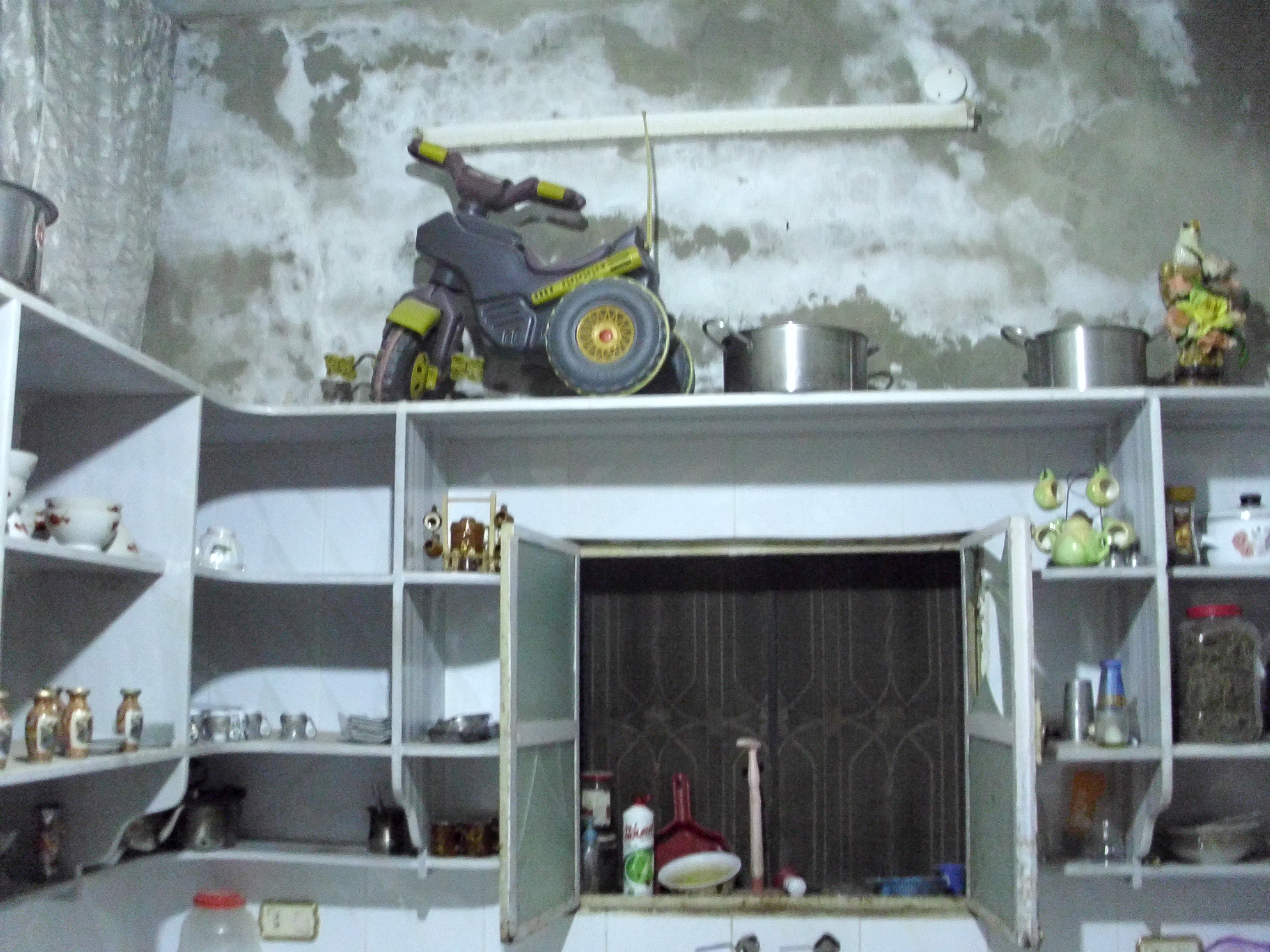
I slept in Hamood’s house. One wall is raggedly punctured where a rocket struck, and the interior walls, still pitted by shrapnel, have been scrubbed back to the concrete after being blackened by fire. He shows me the damage, then shows off his radishes and parsley, newly planted and vigorously flourishing. The sight of a child’s toy bike on a shelf in the kitchen made me sadder than the rocket damage. Hamood’s wife, children and parents are in a camp inside Turkey.
Next door a family of ten, displaced from a worse place, share a doorless, windowless building with snakes and rats.
*
Before the liberation, the residents held their demonstrations in the fig orchards outside town. After the liberation, the post-Friday prayer gathering became a target for shelling. So this Friday Ra’ed scheduled the protest for 11am, before prayers, and in a sidestreet, so as not to draw a crowd. (He was stopped later by a townsman angry that he’d missed the demonstration). “What’s the point of attracting disaster?” Ra’ed asked. “At this stage, the most important aspect of the protest is the media aspect.”
It’s this canny media awareness that has made obscure Kafranbel one of the unlikely focal points of the revolution. Each week produces witty and topical slogans in English as well as Arabic. The first, in April 2011, declared Freedom Emerged From Under the Fingernails of Dera‘a’s Children. One threatened to “spank” Kim Jong-Un for his “childish attempt” to deflect attention from Syria. One punned on a Shakespeare quote (O Judgment! Thou Art Fled Brutish Beasts, And UN and Annan Have Lost Their Reason). One, which went viral, offered condolences to the people of Boston after the bombing there, and reminded the world that such things happen in Syria every day.
This week the slogans read:
Obama! You Send Us “Weapons” To Only Continue This Conflict?! Send Us Weapons To Win Our Revolution Once And For All!
And, referring to the sudden death of actor James Gandolfini: We Are So Sorry That Tony Soprano Is Dead. We Wish Assad, the Syrian Mafia Boss, Had Died Instead
A cartoon entitled Negotiations Forever depicted the Regime and Free Syria flags hanging above Israeli and Palestinian versions. Another, alluding to the media popularity of the rebel liver-eater video, showed Putin and Assad stirring a pot of blood, and Putin saying, Let’s say…. FSA are cannibals.
*
After the protest an activist drove me outside town. Standing on a red pile of rocks, he traced a frontline in the blue distance between the Alawi mountains and the liberated Ghab valley. In the absence of a serious effort to arm the Free Army, it’s likely that the line will remain static for the forseeable future.
Despite Kafranbel’s stirling efforts, the larger media war has been lost. The Western narrative is that this is no longer a revolution but a civil war, a conflict with its roots not in Assad’s repression but in the theological disputes of the ninth Century. Since the regime and Hizbullah’s joint conquest of al-Qusair, the Syrian people are struggling against the odds.
The regime probably will eventually fall. If it had fallen a year ago there might have been a happy ending. But by now over a quarter of the population is displaced and far more have been traumatised. The social fabric is torn. If Syria remains one nation, it will be a nation of orphans and widows, of the maimed, the raped, the tormented. How does a country return from this?
*
 We ate a quick lunch before Ra’ed drove us back north. We stopped in Hass to talk to a pharmacist about Leishmaniasis, a disease spread by sand flies now rampant in the country. Abu Farouq complained that he had the syringes (treatment involves injections into the skin ulcers caused by the disease) but not the medicine to fill the syringes.
Mercifully, Atmeh was open, which saved us from climbing that wall once again. As we approached the camp through the olive groves, we asked Ra’ed a final, uncomfortable question. “If you’d known what would happen, would you have still joined the revolution?”
“No,” he said, matter-of-fact. “The price was too high. Just in Kafranbel we’ve had 150 martyrs. As many as that are missing; they’re probably dead too.”
He rubbed his massive nose.
“As for me, I can’t cry anymore. I don’t feel properly. I’ve taken pictures of too many battles. I’ve photographed the martyrs.”
Hands on the wheel, he shrugged his shoulders.
“But it’s too late now. There’s no going back. We have to finish what we started.”


 band annie's Weblog

