Search

band annie's Weblog

I have a parallel blog in French at http://anniebannie.net

Month

April 2013

ANONYMOUS Revolution 2012 New Message What we are capable of!

[youtube http://youtu.be/V9ykKgKWb8g?]

04/06/2013

Below is a transcript of a brilliant speech by Jacob Appelbaum, given a year ago but which has resonance to events that have happened since and are happening right now. Appelbaum examines the role of Anonymous, as well as the anti-dissident role of the FBI and much, much more. The above video is from a year ago too but is probably representative of those issued under the name ‘Anonymous’ for that period and fits well with what Jacob says…

Note: Jacob Appelbaum is a core member of the Tor Project . For more on COINTELPRO, click here .


[youtube http://youtu.be/JR-8Mexy15o?]

Today I’m here to talk about the past, the present and the future. I apologize in advance for the American centric story I’m about to tell, it’s an obscure but very important part of American history. It probably sounds familiar to those who lived in East Germany. However, I’m telling it because it relates to our present and how we will shape the future. I highly encourage everyone interested in this topic to read the book “Spying on America: The FBI’s Domestic Counterintelligence Program”, by James Kirkpatrick Davis; it, along with a specific watch listed friend, are the inspiration for what I am about to say.

From 1956 to 1971, the Federal Bureau of Investigation (a.k.a. the FBI) ran a series of counter-intelligence programs collectively known as Counter Intelligence Program or COINTELPRO. Realistically, the Anarchists of the early 20th century such as Emma Goldman, faced similar measures, but under totally different legal and usually illegal authority. COINTELPRO was different. It was authorized by US President Truman and the FBI Director, J. Edgar Hoover, to fight the supposed threat of communism under the cover of total secrecy. So began McCarthyism – a great shame for my country that destroyed countless lives under the banner of patriotic nationalism.

The first COINTELPRO operation was against the Communist Party USA (CPUSA). Over the years COINTELPRO expanded, like all so-called law enforcement does, until it covered nearly every anti-Vietnam war protester group, the civil rights movement and even a few white power groups. The FBI’s actions included blackmail and physical violence; they broke up marriages, recruited telephone switch board operators to wiretap phones, broke into houses to plant listening devices, and much more. They even took actions that resulted in deaths of completely innocent people.

But for nearly the entire time that COINTELPRO was happening, almost no one in America knew and those targeted were often dismissed as being crazy or worse. The word COINTELPRO was unknown outside of a circle of those tasked with carrying out these missions and those who had authorized them.

In March of 1971 a major non-violent direct action changed the United States forever. An illegal action uncovered massively illegal activities. A group by the name of The Citizens’ Commission to Investigate the FBI broke into an FBI office in Media, Pennsylvania. They liberated over one thousand classified documents that detailed the COINTELPRO activities. They were anonymously released to media outlets and those targeted by the FBI in a very strategic manner – they did this through the communications networks of the era – the postal service being the most popular message routing service at the time. At first, no newspaper or media outlet would publish the documents. In March of 1972, WIN Magazine broke the story.

Probably the most incredible example of a well known activist targeted was in the 1960s. The FBI attempted to blackmail him into committing suicide just thirty four days before he was to receive his Nobel peace prize. Martin Luther King Jr. refused to give in to their demands; the FBI failed because he refused to be subjugated by fear and by their threats.

Slowly and with very specific long term strategic thinking, The Citizens’ Commission to Investigate the FBI released their cache of documents. Victims learned that they were targeted, as well as how they were targeted, at no fault of their own. The Citizens’ Commission’s primary tactical advantage was two-fold – they were armed with the truth, as written by the oppressor; and they were anonymous.

The FBI’s power started with identification and without the identities of the The Citizens’ Commission they were powerless to stop the truth from coming to light. The asymmetry offered by anonymity was absolutely the linchpin of their success. Their anonymous publication forced not a show trial or further persecution but rather swift action by those that held the purse strings of the FBI. The FBI had to immediately cease COINTELPRO activities. The leaking of these documents led to the Church committee, which eventually led to the creation of the America Freedom Of Information Act and even the creation of special FISA courts to oversee future law enforcement activities. Victims, where possible, were compensated and new laws put in place to attempt to protect the people from their government.

The Citizens’ Commission’s tactics were beautiful – anonymous truth telling and holding the hypocrisy of the well documented racism of so-called law enforcement accountable to the public. Their strategy led to massive change in the way that so-called law enforcement activities were carried out in the United States.

To this day – no one has learned the identities of the Citizens’ Commission to Investigate the FBI. They have remained Anonymous.

There was no show trial as there may be with Julian Assange and as there is now with the alleged leaker Bradley Manning. Anonymity created a specific kind of asymmetric power – the power to speak out about in-justice without retribution. I wager there was plenty of fear and concern amongst the Citizens’ Commission to Investigate the FBI. Not because of the wrongness of their actions, but because of the lengths that the FBI went to crush dissent. They had right to be fearful, they held the evidence that the FBI was willing to be involved with murders and pushing people to suicide.

There is a strong history of resistance and we must re-contextualize the past and the present to draw out a new understanding for the future. If we draw from the experience with the FBI’s abuse and the Citizens’ Commission to Investigate the FBI, we should see that there are important parallels – both in terms of law enforcement and in terms of direct action in response.

When a group takes an action to block access to a building – they do so because they’re trying to disrupt flows of power and the control that emanates from that building. The Critical Art Ensemble discussed in their seminal work of the 1990s “Electronic Civil Disobedience” that the flows of power were now electronic. Blocking buildings wasn’t enough. After the Battle for Seattle, we’ve come to realize that the flows of power are both electronic and analog at the same time.

When Anonymous hacks HB Gary, it shows ties between corporations and the US Government – where they wish to smear Glenn Greenwald for his wonderful journalistic work, where they wish to watch-list and harass others, such as myself, we can see that Anonymous is performing a similar service to the Citizens’ Commission to Investigate the FBI. Because Anonymous doesn’t show all of their cards, they create fear in those who abuse their powers. This de-stabilizes power structures that do not derive their power from the consent of the governed.

Anonymous isn’t perfect, but it serves as a banner that helps create a point of unity among those who have had enough. Enough surveillance. Enough censorship. Enough lies. Enough war crimes. Enough cynicism. No movement is perfect, but a lack of perfection does not invalidate the truth that Anonymous has uncovered or the positive actions that they have taken.

We have a new Pentagon Papers and we have a new Vietnam War protest movement. We have a new COINTELPRO program as demonstrated by the NSA Warrantless Wiretap program of the American People, by Section 215 of the US PATRIOT ACT, and by the brutality of the police against the #Occupy movement. I myself have had to deal with extensive harassment without so much as a single legal charge or arrest. Enough is enough!

Today’s Citizens’ Commission is Anonymous and other groups aligned in action. Today’s FBI is the military-Industrial complex and its cronies of privatization – it includes the FBI all over again. HB Gary was essentially performing COINTELPRO actions against WikiLeaks and Anonymous. We can see an important parallel with HB Gary – Anonymous hacked them. It was the equivalent of breaking into their building and taking their files for the greater good. When they published the files there was a huge outcry against HB Gary for their obviously illegal activities and their partnerships with government agencies.

And so, when we see Analog Denial of Service attacks on buildings by those involved with a sit in, we should know they paved the way for the electronic sit-ins against the flows of power – the flow of money controlled by PayPal. When Anonymous performed a denial of service attack on PayPal in protest for cutting off Wikileaks, as the PayPal14 are accused to have done, we know that this is in the rich tradition of non-violent resistance in the face of abusive power. There is no permanent damage done, no servers harmed, no LOIC cannon operators pepper-sprayed in their eyes. Still, there is a lasting impact and it raises the important debate about the financial blockade against WikiLeaks. Why do we allow that? Would we allow a bank to stop service of all Green or Conservatives party members?

We need the Daniel Ellsbergs, the Emma Goldmans, the Julian Assanges, the Rosa Luxemburgs, the Peter Sundes – people willing to publicly take a stand for the greater good. They are powerful and important, largely because it is all of us that are behind them. Their courage is contagious and their action is in support and in solidarity with our actions. It is all of us, together, that stand with moral authority in the face of tyranny, not as a mob but in principled solidarity.

What we need now, more than ever, is another Citizens’ Commission to Investigate the FBI.

It sounds like Germany needs a Citizens’ Commission to Investigate the Verfassungsschutz. As I understand things, they are now believed to have been working with the extreme right-wing Nazi murderer, recently uncovered. Someone must take action against those that enable the Nazis to murder people. There is a chain of command, a structured power involved. Those people have names and must be held to account. They have records and documents. This is evidence that must come to light. Just as people will soon confront the Nazis marching in Dresden in a few days time, we must confront and change the power structures that enable those same Nazis.

One of my favorite authors of the 20th century, Ulrike Meinhof, once wrote:

“Protest is when I say I don’t like this and that. Resistance is when I see to it that things that I don’t like no longer occur. Protest is when I say I will no longer go along with it. Resistance is when I see to it that no one else goes along with it anymore, either.”

Now is the time for non-violent resistance.

History repeats, but the outcome is not guaranteed by hope alone, rather it is guaranteed, if anything is, by action. Direct non-violent action and bold truth telling: we must refuse to be silent and we must take a stand against the fascists by whatever name they call themselves, under whatever flag they fly.

So who is that someone who should take action? It is me. It is you. It is all of us. Who are we? We are all Anonymous.

resist

Via Darkernet

Related Link: Cynthia McKinney: “There Was A Time We Almost Won”

The Daily Show: Egypt, Mohamed Morsi, and Bassem Youssef

[youtube http://youtu.be/LyDOAQNsTrI?]

Syria Has a Massive Rape Crisis

All across the war-torn country, regime soldiers are said to be sexually violating women and men from the opposition, destroying families and, in some cases, taking lives.
Apr 3 2013, 7:30 AM ET

syria rape story banner.jpg

Syrian refugees carry their children in the Al- Zaatri refugee camp, in the Jordanian city of Mafraq, near the border with Syria on February 12, 2013. (Muhammad Hamed/Reuters)

One day in the fall of 2012, Syrian government troops brought a young Free Syrian Army soldier’s fiancée, sisters, mother, and female neighbors to the Syrian prison in which he was being held. One by one, he said, they were raped in front of him.

The 18-year-old had been an FSA soldier for less than a month when he was picked up. Crying uncontrollably as he recounted his torture while in detention to a psychiatrist named Yassar Kanawati, he said he suffers from a spinal injury inflicted by his captors. The other men detained with him were all raped, he told the doctor. When Kanawati asked if he, too, was raped, he went silent.

Although most coverage of the Syrian civil war tends to focus on the fighting between the two sides, this war, like most, has a more insidious dimension: rape has been reportedly used widely as a tool of control, intimidation, and humiliation throughout the conflict. And its effects, while not always fatal, are creating a nation of traumatized survivors — everyone from the direct victims of the attacks to their children, who may have witnessed or been otherwise affected by what has been perpetrated on their relatives.

In September 2012, I was at the United Nations when Norwegian Foreign Minister Espen Barth Eide shook up a fluorescent-lit room of bored-looking bureaucrats by saying that what happened during the Bosnian war is “repeating itself right now in Syria.” He was referring to the rape of tens of thousands of women in that country in the 1990s.

“With every war and major conflict, as an international community we say ‘never again’ to mass rape,” said Nobel Laureate Jody Williams, who is co-chair of the International Campaign to Stop Rape & Gender Violence in Conflict. [Full disclosure: I’m on the advisory committee of the campaign.] “Yet, in Syria, as countless women are again finding the war waged on their bodies–we are again standing by and wringing our hands.

Slide1.jpg

We said after the Holocaust we’d never forget; we said it after Darfur. We probably said it after the mass rapes of Bosnia and Rwanda, but maybe that was more of a “we shouldn’t forget,” since there was so much global guilt that we just sort of sat back and let similar tragedies occur since and only came to the realization later — we forgot.

Could we have forgotten that the unfolding human catastrophe in Syria exists before it’s even over?

***

Using a crowd-sourced map for the last year, our team at the Women’s Media Center’s Women Under Siege project, together with Columbia University epidemiologists, the Syrian-American Medical Society, and Syrian activists and journalists, has documented and collected data to figure out where and how women and men are being violated in Syria’s war. And, perhaps most important, by whom.

We’ve broken down the 162 stories we’ve gathered from the onset of the conflict in March 2011 through March 2013 into 226 separate pieces of data. All our reports are currently marked “unverified” (even those that come from well-known sources like Human Rights Watch, the United Nations, and news outlet such as the BBC) because we have not yet been able to independently confirm them. Eighty percent of our reports include female victims, with ages ranging from 7 to 46. Of those women, 85 percent reported rape; 10 percent include sexual assault without penetration; and 10 percent include detention that appears to have been for the purposes of sexualized violence or enslavement for a period of longer than 24 hours. (We generally use this category when we hear soldiers describe being ordered to detain women to rape them; we’re not guessing at intent.) Gang rape allegedly occurred in 40 percent of the reports about women.

Slide2.jpg

In mid-March, I was in Michigan, surrounded by Syrians who live here but are helping out their fellow citizens in refugee camps and health centers. Kanawati, the psychologist, told me that day that she had visited with a refugee family in Jordan and listened to one of three sisters describe how a group of Syrian army soldiers had come to their house in Homs, tied up their father and brother, and raped the three women in front of them. The woman cried as she went on to describe how after raping them the soldiers opened their legs and burned their vaginas with cigarettes. They allegedly told the women during this: “You want freedom? This is your freedom.”

The psychiatrist asked one of the three sisters, who was holding a baby, “Is that baby from the rape?” The woman changed the subject.

All the women are having nightmares, Kanawati said; all have PTSD. Now, she said, the two sisters are employed in Amman, but the mother, who does not work, is “consumed by the baby.” The brother will not speak.

This family is quietly living with trauma that reaches across generations.

Men are more than just witnesses to sexualized violence in Syria; they are experiencing it directly as well. Forty-three of the reports on our map – about 20 percent — involve attacks against men and boys, all of whom are between the ages of 11 and 56. Nearly half of the reports about men involve rape, while a quarter detail sexualized violence without penetration, such as shocks to the genitals. Sixteen percent of the men who have been raped in our reports were allegedly violated by multiple attackers.

Government perpetrators have allegedly committed the majority of the attacks we’ve been able to track: 60 percent of the attacks against men and women are reportedly by government forces, with another 17 percent carried out by government and shabiha (plainclothes militia) forces together. When it comes to the rape of women, government forces have allegedly carried out 54 percent these attacks; shabiha have allegedly perpetrated 20 percent; government and shabiha working together 6 percent.

Overall, the FSA has allegedly carried out less than 1 percent of the sexualized attacks in our total reports. About 15 percent of the attacks have unknown or other perpetrators.

Slide3.jpg

When it comes to men, more than 90 percent of the reports of sexualized violence have been allegedly perpetrated by government forces, which can perhaps be explained by the fact that most of these attacks occurred in detention facilities. Long used as a weapon against prisoners in Syria as in much of the world, rape appears to be utilized during this conflict in horrifyingly soul-crushing, creative ways. Beyond simply raping detainees, shabiha members or Syrian army soldiers have reportedly carried out the rapes offamily members or other women front of prisoners.

Atrocities are inevitably muted when victims die, and perpetrators worldwide know this. Part of the reason we’ve chosen to live-track sexualized violence in Syria is because so much evidence is lost in war. Consider that 18 percent of the women in our reports were allegedly witnessed killed or found dead after sexualized violence. Look at this report from Beirut-based news site Ya Libnan, which describes a confession from a defected Syrian Army soldier who said he was ordered “to rape teenage girls in Homs at the end of last year.”

“The girls would generally be shot when everyone had finished,” the soldier said. “They wanted it to be known in the neighborhoods that the girls had been raped, but they didn’t want the girls to survive and be able to identify them later.”

Because there is a deleterious and under-documented personal aftermath of sexualized violence, we are also tracking its mental and physical health fallout. Ten percent of the women in our reports appear to suffer from anxiety, depression, or other psychological trauma, and that’s clearly a low estimate considering the acts described. Three percent of the women have reportedly become pregnant from rape, and 2 percent suffer from a chronic physical disease as a result of the violence.

***

When I asked Kanawati how many women she’s spoken to and treated who have survived rape, she said it’s impossible to know. She has interviewed dozens of refugees who may have been raped or otherwise sexually tortured, mostly in Homs. Originally from Damascus, she is currently the medical director of Family Intervention Specialists in the Atlanta area and has been working with Syrian refugees in Amman with the support of the Syrian-American Medical Society.

Syrian child drawing.Kanawati.jpg

A 4-year-old girl from Homs drew this for a psychiatrist in Amman. The girl had witnessed her uncle killed by a tank, and kept repeating “Uncle, tank, blood,” according to the psychiatrist. The girl’s mother says their neighbor was raped by Syrian soldiers the same day. (Yassar Kanawati)

“Syrian families are very conservative and I always tell them: ‘ Rape is a way to break the family. The easiest way,'” Kanawati said. “I tell them, ‘Don’t let this break you–this is what they’re trying to do.’ When I tell that to the women, however, they say, ‘Tell that to our husbands.'”

She described how women have repeatedly told her that their neighbors were raped, usually by more than one man, and how each time the extraordinary detail the women give and the trauma they exhibit tells her that the story isn’t actually about a “neighbor,” but the woman herself. More than that, the storytellers usually go on to describe how the “neighbor’s” husband then left this woman.

Sex outside of marriage, let alone the violation of a woman in an act of rape, said Kanawati, is “completely taboo.”

Erin Gallagher, a former investigator of sexual and gender-based violence for the UN’s Commission of Inquiry on Syria (and before that on Libya), spent months speaking with Syrian women and men in camps in Jordan and Turkey. She said it’s very difficult to get an accurate idea at this point of the scope of sexualized crimes in Syria and that “there are more victims out there than what we are finding.” Getting a true idea of the scope, she said, “is going to take time, trust building, and a broader, holistic approach.”

Kanawati said her sister, an ob-gyn who lives in Damascus, has carefully told her (for fear of eavesdropping), “You would not believe how much rape there is.” Her sister has treated women who say they have been raped by soldiers or shabiha militia members in the rural areas around the city.

Gallagher explained why so few victims of sexualized violence in Syria are coming forward publicly.

“The reality is that they have much to lose and little to gain by doing so at this point in time, for many reasons,” she said. “It takes a lot of courage and strength for a victim to speak up and they may be on their own with little support as they do it. In addition to the shame and isolation a victim may feel, they now are in an insecure environment due to the war. They may now be living in a large refugee camp with no privacy, surrounded by people they don’t know or trust.”

With no clear future for Syria in sight, refugees are understandably cautious about who they speak to and trust with sensitive and personal information. “If they tell someone, to whom and where does that information go?” Gallagher said. It may be hard to put their trust in a stranger when, time and again, there has been little justice for victims of wartime rape.

Add to all that the physical, psychological, and emotional trauma that victims are suffering from the war and displacement, and “it’s not surprising that victims are reluctant to come forward,” she said.

Hearing this I can’t help but think of the preface to Night, in which Elie Wiesel writes: “For the survivor who chooses to testify, it is clear: his duty is to bear witness for the dead and the living… .To forget would be not only dangerous but offensive.”

***

“The security forces and the shabiha took whole families outside after destroying their homes,” a woman named Amal told the pan-Arab newspaper Al-Hayat in June 2012. “They stripped my girls from their clothes, raped them then killed them with knives. They were shouting: ‘You want freedom? This is the best brand of freedom.'”

It’s nearly word-for-word the sentences spoken in the story above about the women raped and then burned with cigarettes.

Coincidence? Maybe. But repeated phrasing is exactly the kind of thing that helps build international cases for human rights violations. Language can indicate whether mass rape has been coordinated and systematic. Recently, a U.S.-based group called AIDS-Free World successfully petitioned to have South Africa investigate mass rape allegedly carried out by the ruling ZANU-PF party in Zimbabwe against opposition supporters in 2008. Part of their case was built on the fact that they heard that similar phrases were being uttered during rapes across the country–women were called “traitors to Zimbabwe” or told they were being “sent a message,” according to Paula Donovan, co-director of AIDS-Free World.

Gallagher, who also investigated rape in Libya, said she’s heard about such phrases being used during rape in both countries.

“I don’t think it necessarily means it was an order,” she said of Libya, “but certainly a common belief among the soldiers. They knew they had free reign. I can’t conclude if [Bashar al-] Assad and his command ordered it or have just given his men free reign. What is clear is that he and his commanders are doing nothing to stop their soldiers from committing such crimes.”

For a year, I’ve sat in circles of high-level advisors from the International Criminal Court and elsewhere debating what might tip Russia’s hand and prevent it from vetoing a vote to send Syria’s human rights crimes to the court. But now with the success of AIDS-Free World’s use of a concept called universal jurisdiction, which crosses borders to try crimes that are so heinous that they call for a sense of greater justice, perhaps it is time to consider alternatives to the ICC. Jody Williams, known for rousing the slumbering world when it came to banning landmines, has some ideas.

“We don’t need more research or more proof, we need a plan,” said Williams. “And the plan should be to ensure that there is coordinated international action to ensure survivors get help, justice is served against those perpetrating the sexualized violence, and we are all working together to prevent further rape. This will take men, women, communities, national governments, and the international community–everyone.”

Personally, I’m hoping this is the last report I’ll have to write parsing data from a map that shouldn’t have to exist in the first place. Somehow, though, I don’t think that will be the case.

Lauren Wolfe is the director of Women Under Siege, a Women’s Media Center initiative on sexualized violence in conflict. Wolfe is a former senior editor at the Committee to Protect Journalists. She writes regularly at laurenmwolfe.com.

source

Scuds against people

scud
from FB : Syrian Revolution in Art – Photography

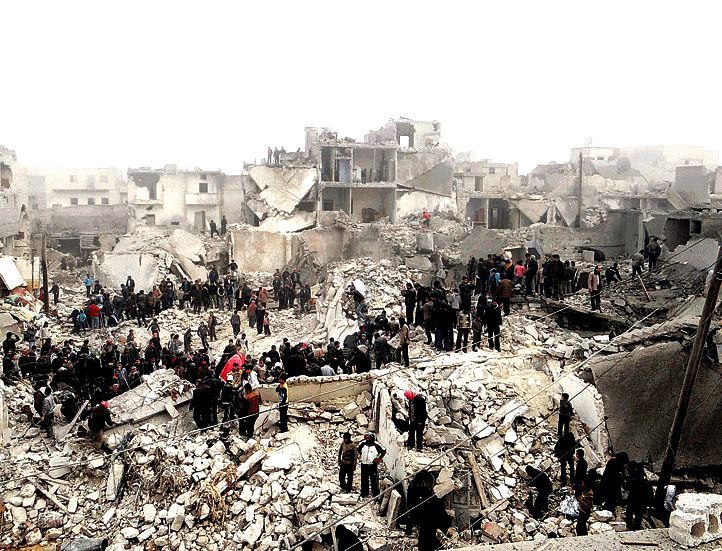
The Syrian regime is using Scud missiles to hit the Syrian cities and villages which out of control and the world is watching …
The below picture can clearly show the devastation that Scud does.
Place: Aleppo City – Northern Syria
P.S
Scud missile is a strategic missile, Medium-range about 400 km and it only can be used in Regional wars.
It also can hold chemical or nuclear warheads.
=====================================
Please share this page and let the world see what’s happening
in #SYRIA

Mouaz Al Khateeb Addressing Syria’s Future and the Status of the Alawite Sect

[youtube http://youtu.be/JD9TvQaQXXY?]

Syria : Yakzan Shishakly


Yakzan Shishakly – Credit Amal Hanano

It was early March 2013, and over 200 Syrian-Americans had gathered in a ballroom at the Four Seasons Hotel in Houston. The gala was a benefit for the Maram Foundation, a nonprofit organization operating out of Reyhanli, Turkey, providing humanitarian aid for Syrians – namely, the thousands of internally displaced people near the Syrian village of Atma.

Maram was founded in October 2012. Its physical presence on the ground has made it prominent among the dozens of nonprofits started in the last two years, as Syrian expats scramble to alleviate their homeland’s humanitarian crisis.

But being on the ground in war-ravaged Syria comes with a price. Maram’s founder, 34-year-old Syrian-American Yakzan Shishakly, knows this all too well. Now living full-time on the Turkish-Syrian border, he runs his foundation’s humanitarian and medical relief programs, which includes managing the Olive Tree Camp, near the town of Atma. Just over the Syrian border, it’s the country’s largest camp for internally displaced persons (IDPs), housing more than 20,000 men, women and children.

Although he is a firsthand witness to the plight of thousands of Syrians and has become an expert on relief work in the region, Shishakly did not get onstage at his foundation’s Houston benefit. He watched the event like an outsider, shy and keeping his distance from the spotlight. Clean-shaven and wearing a suit – a departure from his camp uniform, pants and boots – he seemed to be a transplant in that ballroom, a world away from where I had seen him at work two months before in the hills of Idlib province.

The day after the benefit, Shishakly speeds along wide, smooth, Texas highways just a bit slower than he had on the bumpy Turkish roads leading to Olive Tree camp. “Did you feel out of place last night?” he asks. I know exactly what he means. Though it has been two years since the revolution began, we still find it difficult to maneuver between the roles we have assumed. We fundraise, deliver aid, practice activism and media awareness and, of course, lead our “normal” American lives.

Our stories are similar to those of so many other Syrians, whether inside the country or living abroad. From the tailor picking up a gun to the beautician training as a sniper, to expats across the ocean taking crash courses in aid relief and political lobbying, we are taking on responsibilities for which we were not prepared. All the while, men and women like Shishakly know that our people’s lives are at stake.

*
Shishakly grew up in Damascus in a family with deep political roots. His grandfather Adib was a military leader and president of Syria in 1953. His older brother, the grandfather’s namesake, Adib, is a prominent figure in the current Syrian political opposition. Yakzan, who owns an air-conditioning company in Houston, situated himself far from the world of political conferences and settled instead in the trenches, as close as
possible to the people who had lost everything.

Many people close to Shishakly express surprise at the role he has adopted. His involvement in the revolution began by organizing protests and planning fundraisers in the US, but during a trip to southern Turkey last year, he visited the few thousand stranded people across the border who had fled their homes and were denied entry to Turkey as refugees. They were living among the olive trees, without tents, water or food. Shishakly and his friends delivered the aid that they could and came back to the U.S. But he knew that he had to return. “We can do much better as Syrians for our people,” he said then.

In Houston, he raised money for tents and registered Maram as a nonprofit organization. He named it after a 4-year-old girl who was paralyzed after being injured by shelling in her village. Shishakly began to move back andforth between Reyhanli and Houston. Slowly the trips back to the U.S. became shorter and less frequent until, as he says, “I realized that I live here now,” on the outskirts of his homeland.

*

Shishakly’s day-to-day life is a continuous loop of fulfilling the camp’s never-ending demands and needs. In addition to the basic necessities, including food, water, shelter, medical care and educational programs,
Shishakly also provides security for the IDPs.

It is a struggle to balance the inside-outside factor even from the ground. Aid profiteering has become a booming business in towns that border camps. Shishakly is often in a situation of negotiation and confrontation with the villagers surrounding the camp, who eye the aid coming through the
border as rightfully theirs.

His role is difficult and can be dangerous. But in the months since he arrived, he has slowly changed from the Syrian-American outsider to a trusted advocate for the people in the camp. In helping them, he became “one of them.”

Olive Tree Camp -First Aid Graduation – Credit Maram Foundation

Long-term planning is almost impossible when nothing is static in the camp. The number of displaced arrivals grows by about 100 people every day. Aerial bombardment is constant, even in the liberated northern territories. And the flow of aid is erratic. Each day brings a wave of new people seeking shelter, new tents to erect and new mouths to feed. As time lags on and new arrivals rest among the olive trees, the camp’s earlier settlers grow weary and demanding.

Shishakly and his growing team of volunteers have begun to implement programs to alleviate people’s sense of helplessness and restore their dignity and pride. Recently, a group of 40 women and 20 men completed a first aid course and were awarded certificates. For some of the graduates, this was the first “diploma” they had ever received. “They felt like they existed again,” Shishakly said.

This group will continue their first aid education while working as paid volunteers inside the camp. Shishakly maintains a “help the people help themselves” philosophy. When the violence ends, he hopes to transition people back to their homes as equipped citizens ready to rebuild the country.

***

One of the devastating symptoms of the displaced is that they themselves have become outsiders to the world. They are hardened by the violence they have suffered and witnessed. They are frustrated with the journalists who visit, take pictures and conduct interviews to write yet another report on the dire humanitarian situation in Syria, while their desperate situation remains unchanged. Many of them, now jaded, simply turn away from the cameras and notebooks.

Shishakly is similarly disappointed  – in the political opposition, the endless power plays, empty talk and false promises. As the camp grows, so does his frustration as a result of watching glacial political developments and the trickle of aid. But walking Atma’s dirt lanes, Shishakly seems to be immune to the misery. Among the tents, he is usually surrounded by people, blending in with his beard and rugged clothes.

During my visit in late December, I would come back from the camp and tell him the stories I had heard inside the tents. He only partially listened. He has heard too much and seen too much. When I told him about meeting Manar, a woman who lost her two children in a tent fire last year, he told me that he had taken the children to the hospital, later claimed their burned corpses, and then arranged their burial. He had done the things that their mother couldn’t, and performed the duties of their absent father.

I asked him how he dealt with these responsibilities. He responded with a sentence that has since become his trademark: “Even when your heart is breaking with pain and sadness, you have to keep a smile on your face because your smile may be someone else’s hope.”

*

A few weeks ago, we are on the phone. It’s early morning at Olive Tree. Mid-chat, Shishakly receives a call from the camp. There has been another fire, this time in a village nearby. Because the official Bab al-Hawa crossing is closed, the injured family is rushed through his camp to receive emergency care across the border in a Turkish hospital. Men are yelling for an ambulance. “Come fast!” someone screams. “They are my family. They are dying in front of me.”

Shishakly tells me that he has to go. He’s frustrated. “I don’t even know what I’m supposed to be anymore,” he says, before he hangs up. “Am I a camp director, crisis manager, emergency operator, counselor? I don’t know.”

I sit holding my now silent phone, facing the glowing laptop in my living room. As usual, it’s past midnight here in the West. Upstairs, my own family is sleeping. In a few hours it will be time to assume my “normal”role in the U.S. and live another day pretending that I don’t feel out of place.

I know there are hundreds of Syrians across the world sitting just like me, with Skype messages pouring in and the emails that don’t stop. Screens glow with stories to be written, videos to be watched, news to be shared, funds to be raised, skills to be learned. Another child needs a prosthetic limb, another activist needs political asylum, another contact has been martyred.

The list of duties piles up; they are responsibilities that were not supposed to be ours, but now they are. Each day we convince ourselves that if we just hang in there for a little bit longer, these duties will be crossed off and we can finally close this brutal chapter of our lives. But with each day, the opposite seems to be true. This is our new reality.

Although Shishakly can’t hear me, I answer his question: Neither do I.

In the darkness, I think about my friend across the world, beginning every morning with 20,000 hungry mouths on his mind. Today he started with another fire, and he may end it by collecting scorched bodies of dead children. I know that, despite it all, he will find some way to place a smile on his face.

We have been reduced to frantically placing Band-Aids over our country’s hemorrhaging wounds. Somewhere along the way, we were pulled in and morphed from spectators to actors. We now bear this destiny of personal and collective scars as we navigate between roles and identities. A rare few rose up to the challenge, bluntly sacrificing one part of themselves for another. In the process, they found their unquestionable place.

A few days after the Houston benefit, I messaged Yakzan, asking if he was home yet. His answer came moments later, from Syria: “Yes. :)

*For more information on the Maram Foundation and the Olive Tree Camp, please visit www.maramfoundation.org. *

source

Artists in Syria : Farah, Haji & Omran

http://bcove.me/urfpp5ua

 Farah, Haji & Omran Voices from Syria

« Artists in Syria, they have a weapon – their creativity! » Meet three Syrian artists – Rami Farah, Golan Haji and Mohamad Omran – for a conversation about the role of culture in the uprising against the Syrian regime.

Even though large parts of the western audience and governments seem to be reluctant towards the uprising in Syria, for the Syrian people and intellectuals it is a revolution, says the writer and poet Golan Haji (b.1977). « And actually a question of life and death. »

Video-artist and dancer Rami Farah (b.1980) points out the exposed position of the Syrian cultural elite. « At the beginning of the revolution, the people waited for the artists to engage themselves. » While everybody in Syria is conscious of the fact, that artists are peaceful activists, the Syrian regime – because of the artists’ popularity among the Syrian people – tried to expose them as terrorists.

Award winning Syrian artist Mohamad Omran (b.1979) focuses on the future of the country. « We want an open culture, where you can do and express, whatever you want. » All three intellectuals had to flee the country and speak about the feeling of guilt, living in a safe haven, while their relatives are passing « through the gate of nightmare ». But as Golan Haji expresses it: « When Odysseus turned back, he asked the gods, why did you create misfortune? And they answered him: ‘So the future generations – what are they going to sing about? »

Rami Farah, Golan Haji and Mohamad Omran were interviewed by Marc-Christoph Wagner.

Camera: Jonas Hjort

Edited: Jonas Hjort

Produced by: Marc-Christoph Wagner, 2013

Music: Anouar Brahem – Astrakan Café

Israel’s favorite Arab dictator of all is Assad


Both Assad senior and Assad junior advocated resistance against Israel. This slogan was hollow, serving the regime merely as an insurance policy against any demand for freedom and democracy.

By Salman Masalha Mar.29, 2011 | 2:30 AM | 26

assad - AP - November 10 2010

Syrian President Bashar Assad, November 10, 2010. Photo by AP

As strange as it sounds, everyone in Israel loves Arab dictators. When I say everyone I mean both Jews and Arabs. The favorite dictator of all is president Assad. As Assad junior inherited the oppressive regime in Syria, so did both Jews and Arabs transfer their affection for the dictator from Damascus from Assad senior to his son.

Following the intifada in the Arab states, Bashar al-Assad maintained in an interview to the Wall Street Journal that the situation in Syria is different, adding that Syria is not like Egypt. He also emphasized that Syria was not susceptible to sliding into a similar situation, because it was in the “resistance” front and belongs to the anti-American, anti-Israeli axis.

Well, Assad is right. The situation in Syria is indeed different. The Syrian regime is more like Saddam’s defunct regime. The Ba’ath Party that ruled Iraq and the one still ruling Syria both held aloft flags of pan-Arab national ideology. But slogans are one thing and reality is another. All the ideological sweet talk was only talk. For the Ba’ath Party, both in Iraq and in Syria, constituted a political platform to perpetuate tribal, ethnic oppression.

Indeed, the situation in Egypt is completely different. If we put aside the Coptic minority, then Egyptian society is homogenous religiously and not tribal at all. The demoted Egyptian president, Mubarak, never had a tribal-ethnic crutch to lean on. The Egyptian army is also different and not at all like the Syrian or Iraqi armies.

For example, when the United States invaded Iraq, the Iraqi army splintered into its tribal and ethnic fragments. The soldiers took off their uniforms and each joined his tribe and ethnic community. Saddam too adhered to those tribal codes. He did not flee Iraq but went to hide in the well-protected areas of his tribesmen. This is what happens in these societies. In the land of the cedars, as soon as the civil war broke out, the Lebanese army dissolved into its ethnic components and disappeared.

True, Syria is not Egypt. Syria is also different in terms of the price in blood inflicted by the tyrannical Syrian regime. The Syrian tribal government is based on the force exercised by the security branches ruled by the tribesmen and their interested allies.

Inherently, a tribal regime of this kind will always be seen as a foreign reign. This kind of reign can be called tribal imperialism, which rules by operating brutal terror and oppression. This is underscored when a minority tribe rules, like in Syria. Thus every undermining of the government is seen as a challenge to the tribal hegemony and a danger to the ruling tribe’s survival. Such a regime by its very nature is totally immersed in a bloodbath.

Both Assad senior and Assad junior advocated resistance against Israel. This slogan was hollow, serving the regime merely as an insurance policy against any demand for freedom and democracy. The Syrian “resistance” government has not uttered a peep on the Golan front since 1973. Instead, the “resistance” regime was and still is ready to fight Israel to the last Lebanese, and if that doesn’t do the trick – then to the last Palestinian.

As voices in Israel have recently spoken out in favor of Hamas’ continued rule in Gaza, so many Israelis are worried these days over the Syrian regime’s welfare. Astonishingly, not only Jews are praying secretly for the Damascus regime’s survival, but many in the Arab parties as well. These parties’ leaders have been dumbstruck, their voices have been muted and no outcry has been raised against the Syrian regime’s massacre of civilians.

All the hypocrites, Jews and Arabs alike, have united. It seems Assad has wall-to-wall support here, as though he were king of Israel.

Blog at WordPress.com.

Up ↑