Search

band annie's Weblog

I have a parallel blog in French at http://anniebannie.net

Month

April 2013

Another Gruesome Massacre Near Damascus

21 Apr 2013

At least 450 people were summarily executed in Jdaidet Al Fadhl, near Damascus. Some of the victims, including women and children and a mosque imam, were reportedly slaughtered by knives. Local Coordination Committees (LCCs) activists say 100 of those had been arrested by the regime’s forces some days earlier. The numbers are expectedly on the increase, with the regime’s forces are still roaming the area and carrying out summary execution.
massacre
The regime’s forces reportedly entered the area after anti-regime fighters withdrew from the town. It is probably the first such gruesome massacre on this scale since the Daraya massacre on August 27 last year — often referred to as bloodiest single day of carnage in the Syrian uprising, in which about 1,000 people were killed.
It is not a coincidence that the two massacres, in Daraya and Jdaidet Al Fadhl, occurred in towns close to the capital. Also, another massacre, if only on a lot smaller scale, took place on August 1, when the army went into Jdaidet Artouz and from house by house, dragged more than 20 people to the streets and killed them in a similar manner. An eyewitness, a Christian friend whose family had to leave the town the following day, said the army entered their house and then left after they found out they were Christians. The eyewitness said the tanks demolished a long line of cars while the regime’s forces were handpicking town residents from Sunni neighbourhoods and summarily executing them.

There is a lot of speculation about how the butchery took place exactly. Considering that the town is close to the capital, it is likely the regime is trying to make a point. The same happened last year when rebels tried to enter Damascus in the beginning of the summer.

torture

torture fire

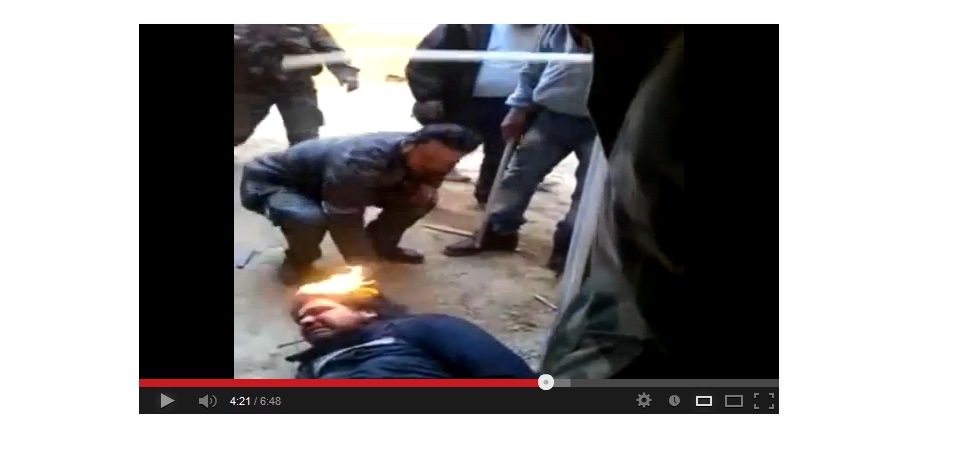
In a separate gruesome episode today, a video emerged showing a number of regime’s Shabbiha (pro-regime armed militias, mostly Alawites) torturing to death two young men in Al-Tal town. The video also shows the Shabbiha putting the young men to fire. In the video, the regime forces put the hair of a man who appears to be in his late thirties to fire, then put it out by kicking his head with their boots, then hit his head with a car tyre. The two young men finally apparently die from torture. Absolutely gruesome.

How will a permanent or even temporary partition of the country impact on the conflict?

A Syria divided

Last Modified: 21 Apr 2013 11:10
[youtube http://youtu.be/W7e756co2ZQ?]
Listen to this page using ReadSpeaker
On Wednesday, Syria’s president said his forces have no option but to win the war , or to lose the country

Given that I don’t see any dramatic shift in US policy or any kind of direct intervention … I think that this kind of conflict will grind on and therefore we will have a Syria that is in the de facto sense a divided Syria but in the du jour sense might still exist.– Andrew Tabler, the Washington Institute for Near East Policy

Speaking in an interview on local TV last week, Bashar al-Assad maintained that thousands of foreign fighters had crossed over from Jordan, and warned that the conflict was increasingly becoming a regional one.

He repeated the allegation that Western powers are directly and indirectly supporting elements of al-Qaeda in their desire to unseat him.

“I think that Syria, in these circumstances, is exposed to an attempted colonisation by all means. There’s an attempt to invade Syria by foreign forces. These forces are using new techniques, it is an attempt to invade Syria culturally,” he told interviewers on pro-regime Syrian television channel Al-Ikhbariya.

This week we focus on the possibility of a permanent or even temporary partition of Syria and whether this would lead to a drop in the level of the conflict.

There’s an objective to create de facto Balkanisation in Syria, there’s an external objective to divide this country. Their neighbours, the Israelis would benefit off this and it would be disastrous  for the entire region.-Mahdi Darius Nazemroaya, the Centre for Research on Globalisation

Last week al-Assad extended yet another amnesty to all those who laid down their arms but within hours of the offer, several reports indicated a massive mobilisation of government forces and a series of offensives in strategic areas of the country.

The possible consequence, whether intended or not, is the creation of defined enclaves in which opposition forces are contained.

To discuss this on Inside Syria, with presenter Mike Hanna, are guests: Andrew Tabler; a senior fellow in the Program on Arab Politics at The Washington Institute for Near East Policy; Ziad Majed, an assistant professor of Middle East Studies at the American University of Paris and co-ordinator of the Arab Network for the Study of Democracy; and Mahdi Darius Nazemroaya; a Canadian-based sociologist who is also a research associate at the Centre for Research on Globalisation in Montreal, specialising in geopolitical and strategic issues.

“It is not a viable situation, all will depend on how things will develop later – now we have areas where chaos is reigning, in others the opposition controls the ground but cannot always protect itself from air raids and scud missiles. So the situation is still unclear now, time will determine to which direction we will be heading. But I think the regime has a Plan B that is to try to defend Homs and the coast, if Damascus is to fall in the hands of the opposition, but we are not yet there.”Ziad Majed, American University of Paris

Maher Almounnes + Amal Hanano: Hallucinations of War

Amal Hanano (@amalhanano)  –  April 13, 2013
This post, called “Hallucinations of War,” was originally published in Arabic on the blog “Overdose”, which is written from Damascus by journalist Maher Almounnes. It is translated here by Syria Deeply associate culture editor Amal Hanano.Before this war, I used to be described as the smiling optimist. Maybe it was a blessing to be known to my friends as a good listener, because I would simplify situations and solve problems and so forth. However, I still, despite all the pain, continue to smile. And I still, despite all the weariness, find meaning within every tragedy.My first sorrows were losing loved ones, one after the other, as they left the country. But I would console myself with the belief that we would meet again and that our reunion will be sweeter after our separation.

Then we started losing loved ones who would never return. Their martyrdom was both a source of mourning and solace, as “the afterlife is better and everlasting.”

And when we left our home, I told myself that we were leaving one home for another, while there were thousands who had left their homes to live without shelter.

Then my father lost his job. I soothed my mother and told her there were others who had lost their eye or their leg or maybe even their life; thank God my father had not been harmed.

Then one of my best friends was abducted. The silver lining was that he returned with his head still attached to his body and that all that they had given him were a few bruises and slightly swollen soles.

Between these events are countless details, from having to postpone my sister’s wedding dozens of times to losing so many friends because of politics.

However, these details and others, like watching scenes of death in repetition, are details that every Syrian knows well. Death has come so close to each one of us that we no longer even see it.

All we see now is that we are political commodities or material for the media, or at best we are a number that scrolls on the red ticker on a television screen proceeded by the word: Breaking!

*

Two years. They seem like 20 years of wisdom and 50 years of sorrow. They made me change how I think about a lot of things. (By the way, I write now because I feel like it, not for any other reason.) But they did not stop me from taking advantage of this miserable reality and conspire with the girl I love.

The irony is, I forced this war to bend to my demands and serve my personal interests.

I claim to be the greatest lover in the dirtiest war. I claim to love her as much as the sorrow in Damascus, the number of the bullets in Aleppo, the destruction of the neighborhoods in the old city of Homs.

Every explosion is another reason to listen to her voice with the excuse to make sure she is alright. Would you believe that I now love the sound of explosions? Just so I can rush to call my love even though I know with certainty that she is safe at home.

Our new home that we fled to is located on the outskirts of Damascus, in a conflict zone. It’s wonderful for your home to be in a “hot” zone, because you have a daily appointment with death. And that’s another opportunity for her to worry about me and to call me every morning to make sure I woke up in my bed, still alive.

I work in a neighborhood where people are often detained. Amazing! A little bit of fear in exchange for more chances to be indulged and receive a few sweet words from here or a warm message from there.

And so what else is there in this war? Snipers? Suicide bombers? Mortars?

How beautiful they all are.

Because of them, I made a pact to never upset her no matter the reason. Because my fear is that death will come quickly, leaving a melancholy gaze between our eyes forever.

I owe our neighborhood sniper a rose. Because of him, I call my love every day, a few meters from my home, and each time it feels like our final phone call. I don’t know how I invent the words of endearment. I’m surprised by the beautiful words flowing out of my mouth that melt her and in turn melt me. Until I arrive safely to my doorstep.

I owe this war: 2,000 text messages; tens of handwritten letters; more than 4,000 “I love yous”; hundreds of kisses, embraces and tears of joy when we meet; and hours of pining and waiting.

Who said this war is all bad? I made the most beautiful love story out of this war.

Forgive me darling, our love story is written in steel and fire.

I swear by the blood of martyrs that spilled over my land that I love you until the last bullet, the last bomb and the last drop of martyr’s blood.

Not only because you are my angel, but because I believe: love is mightier than war.

You are mightier than war.

Kepler discovers two habitable planets

[youtube http://youtu.be/nkOZCK0txEo?]

New poll: 36% of Jewish Israelis back apartheid

Un­sur­pris­ing but im­por­tant new poll that re­veals the deep racism within Is­rael (so often ig­nored in West­ern media cov­er­age of the coun­try).

Mairav Zon­szein re­ports for 972:

Ac­cord­ing to a poll* re­leased Sun­day, a ma­jor­ity of Jew­ish Is­raelis (57 per­cent) be­lieve Is­rael should de­ter­mine its bor­ders uni­lat­er­ally ac­cord­ing to the cur­rent route of the sep­a­ra­tion wall, which cuts deep into the West Bank, wind­ing through Pales­tin­ian land well east of the 1949 Armistice Lines (Green Line).

This con­firms that 1) Is­raelis are ad­mit­ting the coun­try does not have de­fined and rec­og­nized bor­ders 2) Is­raelis are per­fectly happy (in­clud­ing 87 per­cent of Meretz vot­ers) push­ing for­ward uni­lat­er­ally de­spite re­peated claims by both the Is­raeli and U.S. gov­ern­ments that no uni­lat­eral steps should be taken by ei­ther side in the con­flict, and  3) Is­raelis don’t care that the ban­tus­tans cre­ated by the sep­a­ra­tion wall and the set­tle­ments are un­ac­cept­able to Pales­tini­ans or the in­ter­na­tional com­mu­nity, thus ig­nor­ing the im­prac­ti­cal­ity of this op­tion as a long-term so­lu­tion – not to men­tion an un­just one.

But what is even more telling and in­ter­est­ing about the poll is that while 61 per­cent sup­port a two-state so­lu­tion (39 per­cent op­pose), a sub­stan­tial 23 per­cent said they sup­port a bi-na­tional state “with­out giv­ing Pales­tini­ans full civil rights” (up sub­stan­tially from last year’s 13 per­cent). In other words, this can be un­der­stood to mean that 23 per­cent of Jew­ish Is­raelis want to live under an Is­raeli apartheid regime where Pales­tini­ans are in­sti­tu­tion­ally dis­en­fran­chised – though the poll does not men­tion the word apartheid any­where.

The poll also men­tions that 13 per­cent think the sit­u­a­tion should re­main as it is (“de facto Is­raeli con­trol of Pales­tini­ans with­out an­nex­a­tion of Judea and Samaria”), which means main­tain­ing the sta­tus quo. The sit­u­a­tion we live in right now is de facto a bi-na­tional state (or ‘one state’), in which every per­son be­tween the Jor­dan River and the Mediter­ranean lives under vary­ing de­grees of Is­raeli rule, so I think it is fair to add this 13 per­cent to the 23 per­cent  –which es­sen­tially means that a whop­ping 36 per­cent of Jew­ish Is­raelis sup­port Is­raeli con­trol of the West Bank with­out Pales­tin­ian civil rights – what I think can safely be called apartheid.

This may not come as such a sur­prise to some – as back in Oc­to­ber, we re­ported about a Haaretz poll that showed if Is­rael an­nexed the West Bank, a ma­jor­ity of Is­raelis would not want Pales­tini­ans to get the right to vote for Knes­set.

It should also be noted that the seven per­cent of the polled Jew­ish Is­raelis said they sup­port giv­ing Pales­tini­ans full civil rights within a bi-na­tional state – not so tiny con­sid­er­ing how mar­gin­al­ized the left-wing one-state vi­sion is in Is­rael.

The ques­tions in the poll about the bi-na­tional state are worded thusly (trans­lated from He­brew): “Which of the fol­low­ing sce­nar­ios would you pre­fer in order to main­tain Is­rael’s char­ac­ter as a Jew­ish and de­mo­c­ra­tic state 20 years from now?” I think this word­ing is quite telling since the very no­tion that we need to try very hard to “keep” Is­rael Jew­ish and de­mo­c­ra­tic in­her­ently re­flects that being both Jew­ish and de­mo­c­ra­tic isn’t re­ally work­ing out.

The poll was com­mis­sioned by an or­ga­ni­za­tion called Blue White Fu­ture, who pub­lished it in He­brew. The poll ques­tioned 500 Jew­ish Is­raelis, rep­re­sent­ing the adult Jew­ish pop­u­la­tion of Is­rael.

*The poll can­not be found on­line but here is a copy of it in He­brew.

source

Democracy Now Exclusive: Allan Nairn Exposes Role of U.S., New Guatemalan President in Indigenous Massacres

[youtube http://youtu.be/V9YieHwaP4M?]

………..

[youtube http://youtu.be/cXXOgbgVXmQ?]

……..

[youtube http://youtu.be/kKI2C0RzT0c?]

CNN Quits Breaking News, Becomes “CNN Classic”

April 20, 2013

Posted by
cnn-desert-storm.jpgNEW YORK (The Borowitz Report)—In a sweeping format change that marks the end of an era for the nation’s first cable news outlet, CNN announced today that it would no longer air breaking news and would instead re-run news stories of the past “that we know we got right.”The rebranded network, to début nationwide on Monday, will be called “CNN Classic.”

“Breaking news is hard,” said the newly installed CNN chief, Jeff Zucker. “You have to talk to sources, make sure their stories check out O.K., and then get on the air and not say anything stupid. I, for one, am thrilled to be getting out of that horrible business.”

CNN Classic will begin its broadcast day on Monday, Mr. Zucker said, “with round-the-clock coverage of Operation Desert Storm.”

Mr. Zucker did not indicate what impact the new format would have on such CNN stars as Wolf Blitzer, saying only, “I can’t promise that Wolf will be a part of CNN’s future, but he will continue to be a big part of our past.”

The CNN chief scoffed at reports that other cable news outlets had eclipsed his network once and for all, throwing down this gauntlet: “We are going to win May sweeps with Hurricane Katrina.”

Get the Borowitz Report delivered to your inbox.

Anonymous: CISPA Internet Blackout April 22nd | #CISPABlackout

[youtube http://youtu.be/i_nFyavcld4?]

Analysing Assad’s Al-Ikhbareya TV interview

atwan-e1351254980644

No one can deny that Syrian President Bashar al-Assad is stuck in a quagmire, militarily speaking. But when it comes to the media he is free to manoeuvre.

Earlier on in the civil conflict which is devastating Syria, he voiced the theory, ‘We dominate the ground while they control the sky’ with reference to pro-opposition Arab satellite channels. Now he has changed his tactics.

When Assad speaks to a foreign newspaper, it makes headlines across the world. Newspapers and broadcasts splash his words while intelligence experts analyse them.

Syria’s president chose Al-Ikhbareya news channel to make a statement marking Independence Day.

The interview was clearly well prepared. We can’t rule out the possibility that Assad’s presidential office prepared the questions themselves, while the interviewer’s role was limited to reading them off to avoid potential repercussions or violations.

The president wanted to address as many authorities as possible in his answers. I will clarify exactly what here.  READ ON HERE

Blog at WordPress.com.

Up ↑