https://soundcloud.com/onpointradio/syria-chemical-weapons-and-the
see article here on Syria Comment
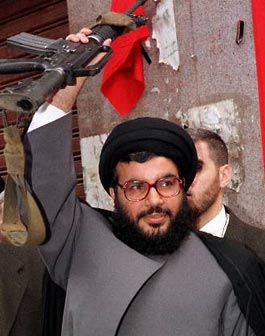
Nasrallah’s speech earlier today was, rhetoric not withstanding, a declaration of war on Syria. Syria, as some people would like us all to forget, is not the Assad regime, it is the Syrian people. And it is the Syrian people that are revolting against Assad, a fact that Nasrallah conveniently ignores in his discourse. His talk today was couched in the same kind of vague language that the Syrian regime uses to refer to the “crisis”, with veiled references to “outside actors” without mentioning names, and with promises that details may perhaps be revealed “in future”. That is all fluff, and observers will notice that the rhetoric Nasrallah uses to explain Hezbullah’s sometimes controversial (to his followers) behaviour is intended to filter down the cult of resistance pyramid – to politicians, journalists, and social media – and shape the discourse. In this way he creates the epistemic grounds for legitimizing what his party does. But that is another blog post for another day.
Most interesting to me was Nasrallah’s statement regarding Damascus. He promised that Damascus would never fall militarily and I believe he means what he says. It is one thing when all of us feel that a sustained push against the regime in Damascus is long overdue, but another thing when Nasrallah confirms this view because that means that somebody is in a position to try and take the city soon.
The statement that the city will “never fall” can mean two things, and neither bode well for the Damascenes and other Syrians who have fled there. The first is that Hezbullah (and Iran) may be heavily invested in the capital and will emerge in full force to support Assad when the campaign begins, and secondly that there will be such a rain of destruction on the city that Aleppo will look like a walk in the park in comparison. Assad’s artillery and bases on Mount Qasiyoon, overlooking Damascus, have been raining destruction on the city suburbs for almost a year, and can easily level the old city if it looks like the regime will lose it. But this is not yet the case, and here it looks like Nasrallah’s warning is intended to point to an alternative that he desires, negotiations. But these are not the negotiations that most people would understand.
I’ve said previously that when Assad’s allies speak of “negotiations”, they use a different meaning. Assad will use “negotiations” to refer to discussions with a loyal opposition, whilst his allies really mean negotiations between the United States and Russia on one level, and perhaps an uneasy understanding between the Gulf states and Iran on the other. The elephant in the room is the Syrian opposition in all its flavours, from the Muslim Brotherhood to the Muaz al Khatib current. This is because they are the only party that Assad and his allies cannot allow to operate freely within Syria. To allow any of these currents will mean genuine political plurality and a real challenge to the regime, therefore its downfall.
The recent, and controversial, statement addressed to him by Muaz al Khatib appears to have not even registered with Nasrallah. Instead he chose to focus, as an ally of Assad, purely on the narrative that there is an international conspiracy against the Syrian regime and that negotiations should really be with the “foreign backers” of these armed gangs. This is unfortunate and he may come to regret this olive branch later, especially when the fighting reaches Lebanon – and it will at some point.
Between Assad negotiating with his loyal opposition, and his foreign allies pushing for the world to abandon Syria’s revolution, the real Syrian opposition in all its spectrums, is to be starved to death, and the Syrian people will be returned back to their fifty year induced coma. In summary, Nasrallah has dug in his heels over Assad’s regime and declared war on Syria. His party will fight on under the pretence of protecting Lebanese in the country, and on the pretence of protecting the shrine of a woman who is revered by Sunnis as well as Shiites.
Hezbullah is now fully embroiled in the Syrian quagmire, and has committed itself to supporting the Assad regime. This is a grave error of judgement for while Hezbullah might be strong in Lebanon, it is not strong in Syria. One need only recall the dreadful blow it received through the assassination of Imad Mughniyeh in Damascus a few years ago, right in the heart of Assad’s security district. Furthermore, Hezbullah’s soldiers are not familiar with the territory they are fighting in, and they are far from their supply lines and support base.
It is clear they have been having an extremely difficult time in the Qusayr, which may be part of the reason why he chose to address his followers about it and also to justify the involvement. Finally, whilst the situation in Lebanon is still not serious enough to concern him, politics in Lebanon can escalate very quickly. By underestimating his domestic opponents and involving himself with a costly fight in Syria, Nasrallah will compound his errors and find himself biting off more than he can chew.
Nasrallah told us tonight that it is not important how “you” understand the situation (regarding Shiite interests in Syria), but how other people (his people) see it. But with his fighters trickling back to Lebanon in boxes, Mr Nasrallah seems to be misreading the situation. The only people who’s understanding he needs to consider carefully is that of the Syrians, and they have already made their views of his involvement very clear. It was not long ago that Israel slipped away during the night after its failed and costly involvement in Lebanon. Today Hezbullah appear to be making the same mistake.
Posted by OFF THE WALL
Dear Friends
I know I have not been writing for a while. This is very important and it is from Yasin Haj Saleh, please spread it. It is important to note that Yassin Haj Saleh is an MD. After his lengthy incarceration by the Assad regime, he went on to finish his medical studies, interrupted by the Assad goons in the eighties. He graduated from the faculty of medicine at the University of Aleppo.
Yassin Haj Saleh*
Tuesday, April 30, 2013.
From الجمهورية لدراسات الثورة السورية (The Republic for Syrian Revolution Studies)

Obama’s red-lines
The thirty-year-old man was brought to “spot 200″ in Duma as being injured by chemical weapons. He seemed debile and his voice was barely audible. The fighter on the front of Jawbar, East of Damascus, had spent 9 hours in “spot 1″, which is a hospital where casualties receive first aid.
Out of the nine hours, he was unconscious for six hours, between 8 in the morning and 2.
Besides fatigue, the man looked physically fine and conscious when I met him at 6 in the evening of Sunday, April 14. He could stand up on his feet, but not firmly.
“What happened?” I asked him. He said that something that looks like a large stone was thrown nearby, but he didn’t pay much attention. But his companion asked a few moments later, “man, what’s this smell?”. The man did not smell or see smoke, but he had difficulty breathing, and his eyes were frozen wide. He thought himself dying, so he started to pray to God loudly.
He also said that after waking up in the hospital, he was spitting blood- he was still spitting blood at six in the evening, but in much smaller quantities.
He had no skin (dermatological?) symptoms. And when he woke up in the hospital, he knew that his friend had died, and possibly others had fallen martyrs. He did not know whether more bombs of the same kind were shelled on Jawbar front.
In his report, the doctor mentioned that the symptoms that the man, who comes from Qanawat neighborhood in Damascus, were pinpoint pupils and mental confusion, which seems to indicate a injury in the central nervous system. The report also says that the man was given 9 injections of atropine, 5 of hydrocortisone, and other 5 of a drug called Dexone (Dexamethasone).
The doctor recommended a normal diet and serums. There were two spots in the man’s left leg and left arm where two viens were opened to insert the serums, of which one was connected to a serum bag above the bed.
The man remained four days in “spot 200″ for follow-up.
Dr. Sakhr from the medical center in Eastern Ghuta said that he examined 20 cases of injury that day, and he personally suffered from the gas that was stuck to the clothes and hair of patients.
According to Dr. Sakhr, symptoms of injury include shortness of breath, red eyes, runny nose and eyes, hemoptysis, fainting and pinpoint pupils.
Two days later, symptoms of emotional instability manifested in form of agitation and anger or in form exhilaration and mania. These symptoms disappeared after two or three days, according to Dr. Sakhr.
Dr. Sakhr thought that the poison gas used was Sarin. He based his evaluation in the report on clinical assessment (symptoms and pathological development of cases). He had no decisive proofs, but he said that he took samples from infected hair, urine, blood and clothes and sent them to agencies that would supposedly be able to determine the type of toxic substance, and the most appropriate antidote for it.
Some of the people I have seen here think that tactical chemical weapons are the ones used by the regime until now. They target fighters and residents in limited areas.
* Translated by Jalal Imran
Powerful column in the UK Independent by Yasmin Alibhai-Brown:
First, read this unconditional acceptance of facts that cannot be denied nor excused. Islamicist terrorism has inflicted atrocities and diffused panic and amorphous, long-term anxiety from east to west, south to north. Citizens of Nairobi and Baghdad, Madrid and London, Bamako and Dar es Salaam, New York and Bali, Mumbai and Damascus, Moscow and Karachi and now Boston, other places too, have had their lives and sense of safety blown apart. Those unaffected personally are haunted by the images and stories. Trepidation has entered their bones, our bones. Almost as chilling as real attacks are those thwarted by intelligence and security services. How many plots are still being planned? What if? Why? What do they want?
Millions of irreproachable Muslims are bewildered and enraged by this global vendetta which seems determined to annihilate modernism, occidental values, and also to destabilise some of the poorest and most hapless of nation states for reasons not made clear at all. Why are they trying to destroy Mali’s old culture for example? Some of us feel ashamed that Islam has become a byword for sinister, guerrilla warfare and is now regarded as a monstrous, rogue faith, easily turned into a killing call, most effectively for young men for whom life lacks meaning and direction. Women are now joining in too. The “spiritual leaders” behind the mayhem are wicked and psychologically manipulative men interested only in high body-counts and lurid publicity.
OK, now let’s turn to the most dominant countries in the world – and their finessed, widespread, extreme tactics used against people, some evidently fanatic and dangerous, others totally innocent. This is state-sponsored, state-activated, state-engineered terrorism which we are just meant to accept as a proportionate response to the evil above. More people are victimised by the unaccountable, secretive actions of the western nations – the US and UK most notably – than all those victimised by Islamicists. Most brainwashed and genuinely frightened westerners just accept what their governments do in fighting a nebulous “war on terror”. Hundreds of thousands are killed, physically and psychologically maimed and shocked and awed by western weaponry. It is fair enough and sensible to use intelligence and prevent plots home and abroad, but what is happening and has been since 9/11 is not defensible, moral, right, just or sane.
April 29, 2013 § 1 Comment
Published at the Global Campaign of Solidarity with the Syrian Revolution, this petition in support of the Syrian people’s struggle against dictatorship and genocide has been signed by leftist luminaries such as Norman Finkelstein, Gilbert Achcar and Tariq Ali (how good it is to welcome the latter back), academics of the stature of Frederic Jameson, Syrian intellectuals such as Yassin al-Haj Saleh, novelists such as Khaled Khalifa, and on the ground activists such as Razan Ghazzawi.
As intellectuals, academics, activists, artists, concerned citizens, and social movements we stand in solidarity with the Syrian people to emphasize the revolutionary dimension of their struggle and to prevent the geopolitical battles and proxy wars taking place in their country. We ask you to lend your support to all Syrians from all backgrounds asking for a peaceful transition of power, one where all Syrians can have a voice and decide their own fate.
We also reject all attempts of any group to monopolize power, and to impose its own agenda, or to impose unitary or homogenous identities on the Syrian people. We ask you to support those people and organizations on the ground that still uphold the ideals for a free and democratic Syria.
Sign our petition here
Our Facebook page
 band annie's Weblog